Top 5 Precision Tinplate Products for Deep Drawing: A Buyer's Ranking Guide
Top 5 Precision Tinplate Products for Deep Drawing: A Buyer's Ranking Guide
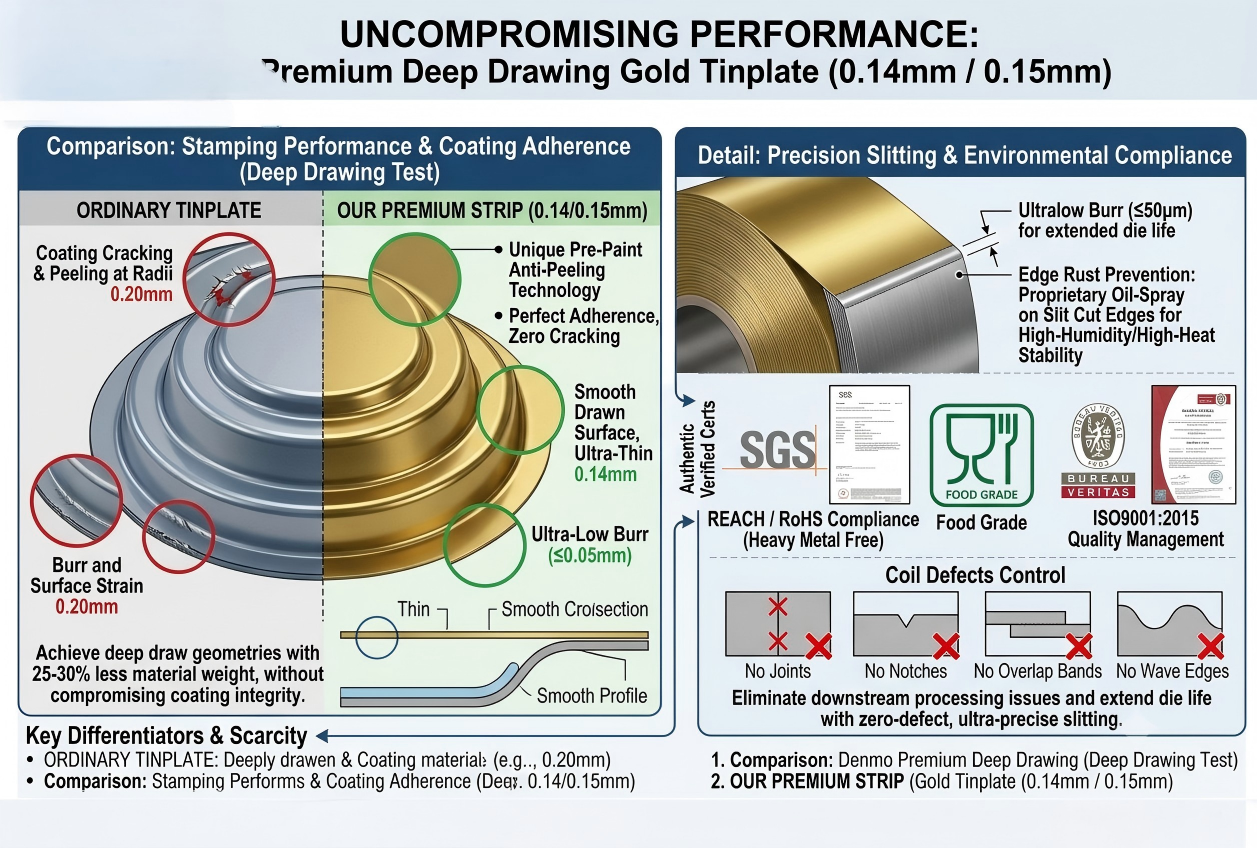
Premium deep-drawing gold pre-painted tinplate strip, 0.14-0.15 mm, engineered for anti-peeling forming.
The short answer: for severe forming, the five tinplate product types that consistently rank highest for deep drawing are (1) gold pre-painted strip with anti-peeling adhesion, (2) DDQ and EDDQ deep drawn sheet and TFS, (3) ultra-thin high-temper strip in DR8-DR10, (4) BPA-free two-pass gold coated sheet for two-piece meat cans, and (5) BPA-free sulfur-resistant TFS for two-piece DRD fish cans. The ranking below is ordered by technical fit for drawing and ironing operations, not by sales volume.
Youngson Metal supplies precision tinplate and TFS strip, coil, and sheet across a 0.14-0.55 mm thickness band, with customizable temper, tin coating weight, and surface finish. This guide explains why each product type earns its position, where its limits are, and how a buyer should verify it before committing tooling.
Problem Definition: What Actually Fails in a Deep-Drawing Line
Deep drawing is not a single test. It is a sequence of deformation steps in which coated steel must stretch, bend, and compress without losing adhesion, cracking at the radius, or tearing at the wall. In practice, four failure modes dominate rejection reports on drawn tinplate parts.
- Coating peel and micro-cracking. A pre-painted or lacquered surface that was calibrated for flat sheets may delaminate once the substrate is stretched. This is the most common reason a coated strip is returned after the first draw trial.
- Edge splitting and earing. Ultra-thin gauge combined with the wrong temper produces micro-cracks or uneven ear formation at the cup rim, which then drives trimming waste.
- Slit-edge corrosion. Cut edges lose their protective coating. In hot and humid transit or storage, oxidation begins at the edge and spreads under the coating.
- Die wear from burrs. A burr that is only marginally over tolerance accelerates tool wear and causes material jamming in progressive dies.
Each ranked product below addresses one or more of these failure modes through a defined combination of thickness, temper, coating system, and slit-edge treatment rather than through a single specification alone.
Industry Background: Why Deep-Drawing Tinplate Is Being Specified More Tightly
The global tinplate market was valued at USD 14.59 billion in 2023 and is projected to reach USD 19.38 billion by 2032, according to Fortune Business Insights. China's exports of tinplate under HS Code 721012 reached 1.4 million tons in the first three quarters of 2023, primarily driven by demand in canned food packaging, based on General Administration of Customs of China data. Grand View Research estimates that the canned food packaging market is growing at a CAGR of 3.9% through 2030, which keeps pressure on can makers to reduce metal weight without losing barrier performance.
Two technical consequences follow. First, standard specifications such as ASTM A623 and EN 10202 define temper grades from T1 to T5 and DR7 to DR9, and buyers increasingly work at the harder end of that range to down-gauge. Second, Double Cold Reduced tinplate at 0.14-0.16 mm, such as DR8, is increasingly used for cost reduction and light-weighting in metal packaging, as noted by Metal Packaging Europe. Thinner metal means less room for formability error.
Compliance is a parallel constraint. Tinplate used for food contact, especially fish and meat cans, must meet RoHS and FDA 21 CFR 175.300 requirements for coatings and lacquers. A product that draws cleanly but cannot document food-contact compliance is not a usable answer for a food-can project.
On the supply side, Mordor Intelligence identifies Baosteel, Nippon Steel, and JFE Steel as global leaders in high-end tinplate (SPTE) and ECCS production for deep-drawn (DDQ) applications. That is useful benchmark context for buyers comparing mill-grade substrates, but substrate grade alone does not determine whether a coated strip will survive a specific die. The coating system, temper, and slit-edge condition decide the outcome.
Detailed Solution: The Five Product Types Ranked
The ranking logic is straightforward: products are ordered by how directly their published specifications answer the mechanical and chemical demands of deep drawing, weighted by anti-peeling behavior and dimensional precision. Where a product has a boundary condition, it is stated rather than hidden.
Rank 1 — Gold Pre-Painted Tinplate Strip for Deep Drawing (Anti-Peeling), GD-TPL-0.14-0.15 Series
This is the most targeted product in the set because it is designed around a single problem: keeping a gold pre-painted coating attached to the substrate while the metal is drawn. It is produced in 0.14-0.15 mm thickness with a width range of 4.0-1050 mm, and it is available in T1, DR7, DR7.5, DR8, DR9, DR10, and TH520 tempers. Tin coating weight options are 1.1/1.1, 2.2/2.2, and 2.8/2.8 g/m². Slitting burr level is controlled at ≤0.05 mm, and core inner diameters of 160 mm, 200 mm, 300 mm, 400 mm, and 500 mm are available.
The anti-peeling claim is supported by the coating design and by slit-edge protection: the slit edges receive anti-rust oil treatment, and coils are supplied with zero joints, zero notches, zero wave edges, zero overlapping bands, and zero rust spots. For a stamper running gold-finished decorative or packaging components, that combination is what protects the die and the appearance surface at the same time.
Boundary condition: the ultra-thin 0.14-0.15 mm band is optimized for shallow to medium draw depth where a premium gold finish is required. If the part requires a deeper draw with a heavier wall, the DDQ and EDDQ grades below are the better starting point.
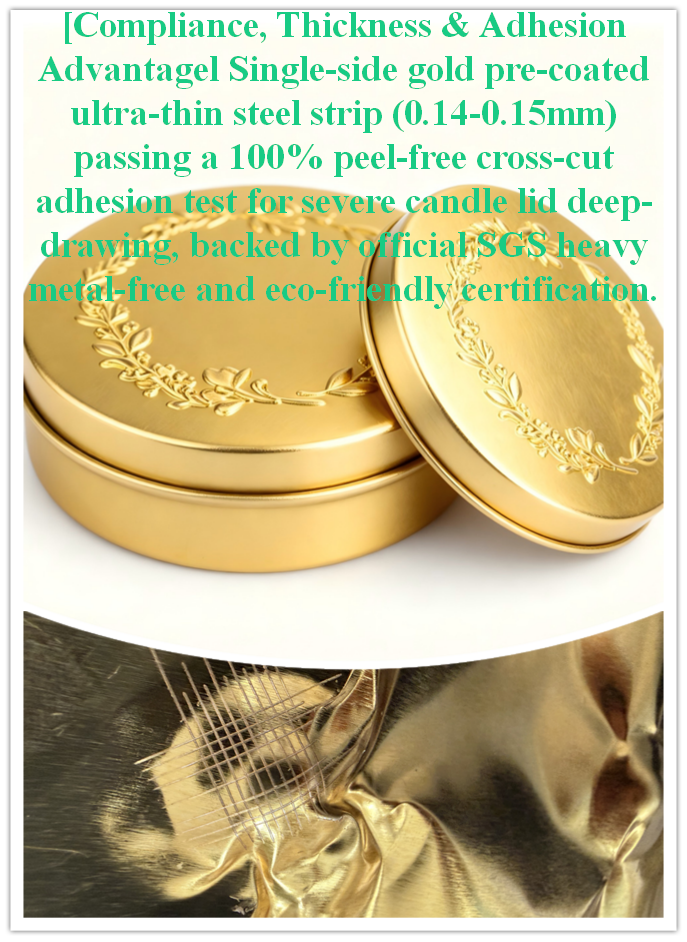
Cross-cut adhesion verification on the 0.14-0.15 mm eco-friendly gold coating system.
Rank 2 — DDQ and EDDQ Deep Drawn Tinplate Sheet and TFS
Where the part shape is the primary challenge and the surface finish is secondary, deep-drawing quality substrate is the correct choice. The DDQ-TP-T1, EDDQ-TFS-T49, and DD-Series-025-030 products are supplied in 0.20 mm, 0.25 mm, 0.30 mm, 0.40 mm, and 0.50 mm thicknesses with a width capability of 4.0-1000 mm. Temper classifications include T1 and T49, and the base metal options are premium electrolytic tinplate (ETP) and high-adhesion tin free steel (TFS). The processability grade is deep drawn and extra deep drawn, supporting stamping without cleavages.
This is the product family to specify for automated two-piece drawn-and-ironed can manufacturing, drawn aerosol domes and cones, heavy-duty beer drums, chemical and oil link cans, and high-formability bakeware. Free sample rolls or sheets are available for industrial press trialing, which matters because no specification sheet replaces a trial on the actual die.
Boundary condition: DDQ and EDDQ grades are chosen for formability, not for surface decoration. If a mirror or gold decorative face is required, Rank 1 or a coated product should be evaluated instead.
Rank 3 — Ultra-Thin High-Temper Tinplate Strip, DR8 to DR10
This family covers the light-weighting end of deep drawing. The DD-UT-DR Series and the DR8-DR9-DR10-UTM Series run from 0.14 mm to 0.17 mm with thickness tolerance of ±0.005 mm and width tolerance of ±0.05 mm across a 4.0-1050 mm width range. Temper grades are DR7, DR8, DR9, and DR10. Tin coating mass options include 1.1/1.1 and 2.8/2.8 g/m², and burr level is controlled at ≤0.05 mm.
The technical value is the combination of minimum gauge, maximum temper, and usable ductility. These products are engineered to draw at depth without micro-cracking or earing, and the high-temper hardness supports tight-radius bending without structural splitting. Coils are 100% jointless, anti-sagging, edge-wave free, and free of S-curve distortion, with anti-rust treated slit edges for high-heat and high-humidity climates.
Boundary condition: DR9 and DR10 are high-strength grades. They reward precise die setup and punish inconsistent clearance. Buyers moving from T-grade to DR-grade should re-check blank holder force rather than assuming a direct substitution.

Ultra-thin deep-drawn tinplate strip in DR8-DR9 with a brass coating finish.
Rank 4 — BPA-Free Two-Pass Gold Coated Tinplate Sheet for Two-Piece Meat Cans
This product ranks here because it solves a forming problem and a food-safety problem at once. The sheet is supplied in 0.14 mm, 0.15 mm, 0.155 mm, and 0.16 mm thickness with a width capacity of 750-1000 mm. Temper grades are DR8, DR9, and DR10, and the tin coating mass is a differential 1.1/2.8 g/m², which places more tin on the side that needs the greater corrosion barrier.
The internal coating system is an advanced food-grade two-pass heavy gold coating, with a one-pass option available. Dry film weight is heavy-duty ≥6-10 g/m². Retort tolerance is stated as 100% zero-blistering and zero-blushing after 121°C processing for up to 90 minutes, with severe fat, salt, and sulfur stain resistance and zero black spots after forming. The coating is 100% BPA-free.
Boundary condition: this is a drawn-and-ironed meat-can product. It is specified around a defined retort profile, so a buyer with a different sterilization cycle should validate the coating against that cycle rather than assume equivalence.
Rank 5 — BPA-Free Sulfur-Resistant TFS for Two-Piece DRD Fish Cans
The final ranked product type uses a tin free steel (TFS/ECCS) base rather than tinplate, which is why it sits in its own slot. Thickness range is 0.14-0.16 mm, width range is 750-1000 mm, and temper grades are DR8, DR9, and DR10. The internal coating is a food-grade aluminum pigment lacquer that is BPA-free, applied at 8-12 g/m², with heavier coating available on request.
It is formable for DRD deep drawing without cracking or peeling and withstands 121°C sterilization for 60 to 90 minutes. Chemical performance covers oil and brine resistance, with zero discoloration and anti-sulfur staining after retort. For tuna, sardine, and salmon canning, sulfur staining is the defect that shortens shelf-life perception, so a coating system designed specifically against it has distinct technical value.
Boundary condition: TFS is not a drop-in replacement for tinplate in every lithography or soldering process. Buyers should confirm the downstream can-making route, including welding or bonding, before switching base metal.
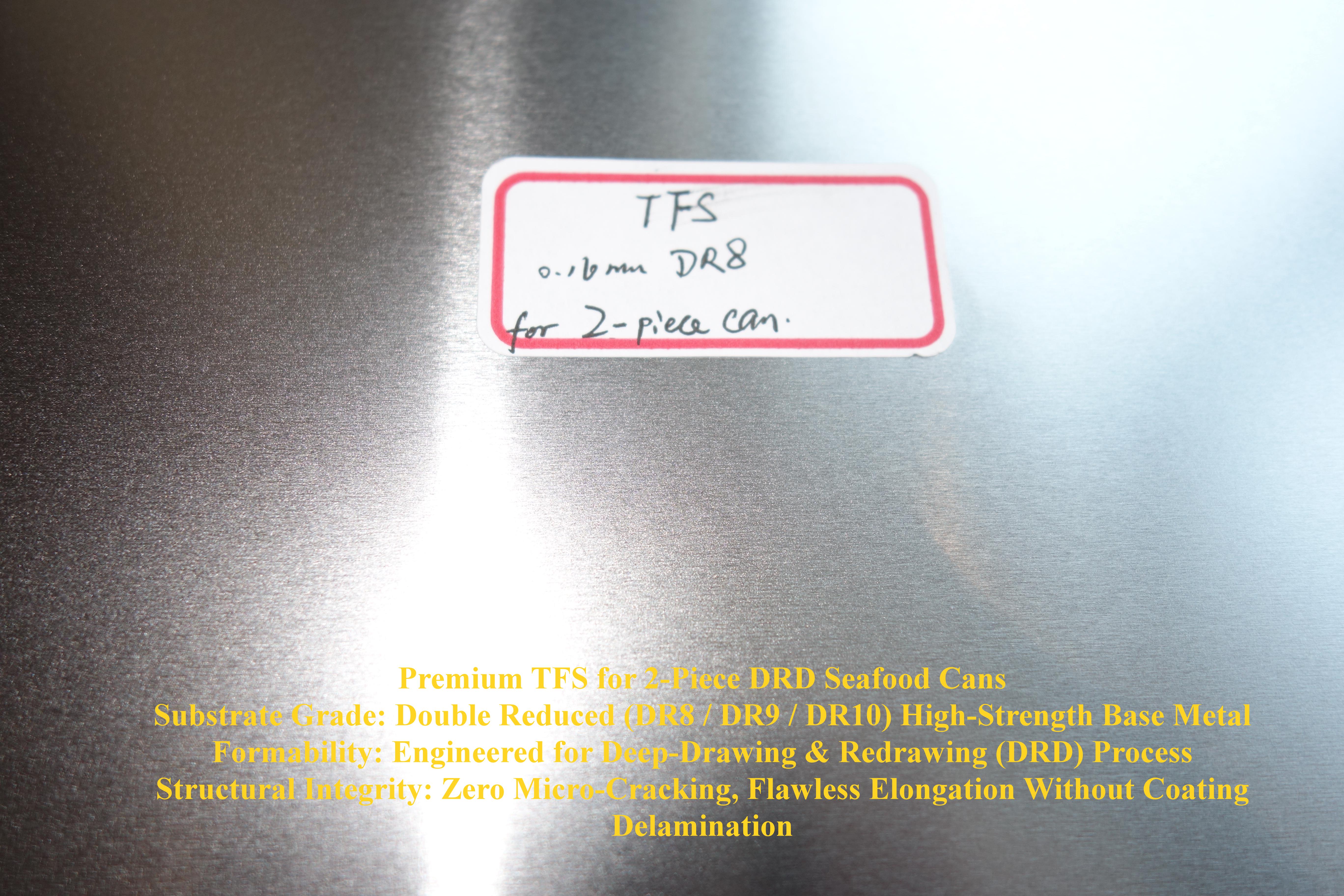
BPA-free sulfur-resistant TFS stock for two-piece DRD fish cans.
Step-by-Step Breakdown: How to Evaluate These Products Before Ordering
- Define the draw ratio and wall reduction first. Thickness, temper, and coating choice follow from the forming schedule, not the other way around. A part with deep wall reduction belongs in the DDQ and EDDQ family; a shallow decorative part can use the 0.14-0.15 mm gold strip.
- Match temper to the die, not to habit. Available grades across these products include T1, T2, T3, T4, T5, T49, DR7, DR8, DR9, DR10, TH415, TH435, and TH520. High-temper grades reduce springback and enable down-gauging, but they require stable die clearance.
- Confirm the coating on the forming face. For gold or bronze decorative parts, verify anti-peeling behavior on the actual draw depth. For food cans, verify the internal lacquer against the retort cycle and the food chemistry, including fat, salt, and sulfur exposure.
- Check dimensional tolerances against your feeding system. Thickness tolerance of ±0.005 mm, width tolerance of ±0.05 mm, and burr height of ≤0.05 mm are the numbers that protect progressive dies and automated feeders.
- Verify slit-edge protection and packaging. Anti-rust oil treatment on slit edges, jointless coils, zero telescoping, zero edge-waving, and individual moisture-proof wrapping determine whether the material arrives in the same condition it left the line.
- Run a press trial before releasing the order. Free sample rolls or sheets for industrial press trialing are offered on the deep-drawn product lines, which is the most reliable way to close the gap between a specification sheet and a production die.
Use Cases: Where Each Ranked Product Fits
Precision metal packaging remains the largest application field: food cans, aerosol cans, twist-off caps, beverage crowns, chemical pails, and promotional tins. Within that field, the two-piece drawn-and-ironed meat can and the two-piece DRD fish can are the most demanding, because they combine deep forming with a sterilization cycle and a chemically aggressive filling.
Outside packaging, the same deep-drawing grades serve precision metal stamping, electronics manufacturing, cable shielding and armoring, battery component manufacturing, automotive parts, and fine packaging. Automotive filter manufacturing uses DDQ and EDDQ strip for deep-drawn shells and end caps in thicknesses such as 0.21 mm, 0.24 mm, 0.25 mm, and 0.30 mm. High-formability bakeware and cakeware production uses the deep drawn sheet family, and decorative hardware, cosmetics containers, and stationery components use the coated ultra-thin strip lines.
One application deserves separate mention because it changes the cost calculation: pre-coated mirror-finish and bronze or gold decorative strip can substitute for anodized or electroplated stainless steel in architectural trim, luxury hardware, and precision profile bending. In those applications, the stated raw material cost reduction is over 20% compared with traditional brass or gold anodized stainless steel, and over 50% compared with traditional copper electroplating processes, with SGS RoHS heavy-metal-free validation and BV ISO 9001 factory control. Those figures refer to the raw material substitution case, not to every product on this list.
Comparison Table: The Five Ranked Product Types Side by Side
| Rank / Product Type | Thickness Range | Temper Options | Deep-Drawing Attribute | Typical Applications |
|---|---|---|---|---|
| 1. Gold pre-painted tinplate strip, GD-TPL-0.14-0.15 | 0.14-0.15 mm | T1, DR7, DR7.5, DR8, DR9, DR10, TH520 | Anti-peeling coating for drawn gold-finish parts; burr ≤0.05 mm | Hardware stamping, premium metal packaging, electronics enclosures, cosmetics and stationery containers |
| 2. DDQ and EDDQ deep drawn tinplate sheet and TFS | 0.20-0.50 mm | T1, T49 | Deep drawn and extra deep drawn grade, stamping without cleavages | Two-piece drawn-and-ironed cans, aerosol domes and cones, beer drums, bakeware, electronic enclosure drawing |
| 3. Ultra-thin high-temper tinplate strip, DR8-DR10 | 0.14-0.17 mm, tolerance ±0.005 mm | DR7, DR8, DR9, DR10 | Deep drawing without micro-cracking or earing; tight-radius bending without splitting | Advanced packaging, automotive components, electronics, precision metal stamping |
| 4. BPA-free two-pass gold coated sheet for two-piece meat cans | 0.14-0.16 mm | DR8, DR9, DR10 | 121°C retort for up to 90 minutes with zero blistering and zero blushing; zero black spots after forming | Two-piece drawn-and-ironed meat cans, sulfur-aggressive seafood packaging, high-pressure thermal sterilization |
| 5. BPA-free sulfur-resistant TFS for two-piece DRD fish cans | 0.14-0.16 mm | DR8, DR9, DR10 | DRD deep drawing without cracking or peeling; anti-sulfur staining after retort | Tuna, sardine, and salmon canning; metal lithography and coating |
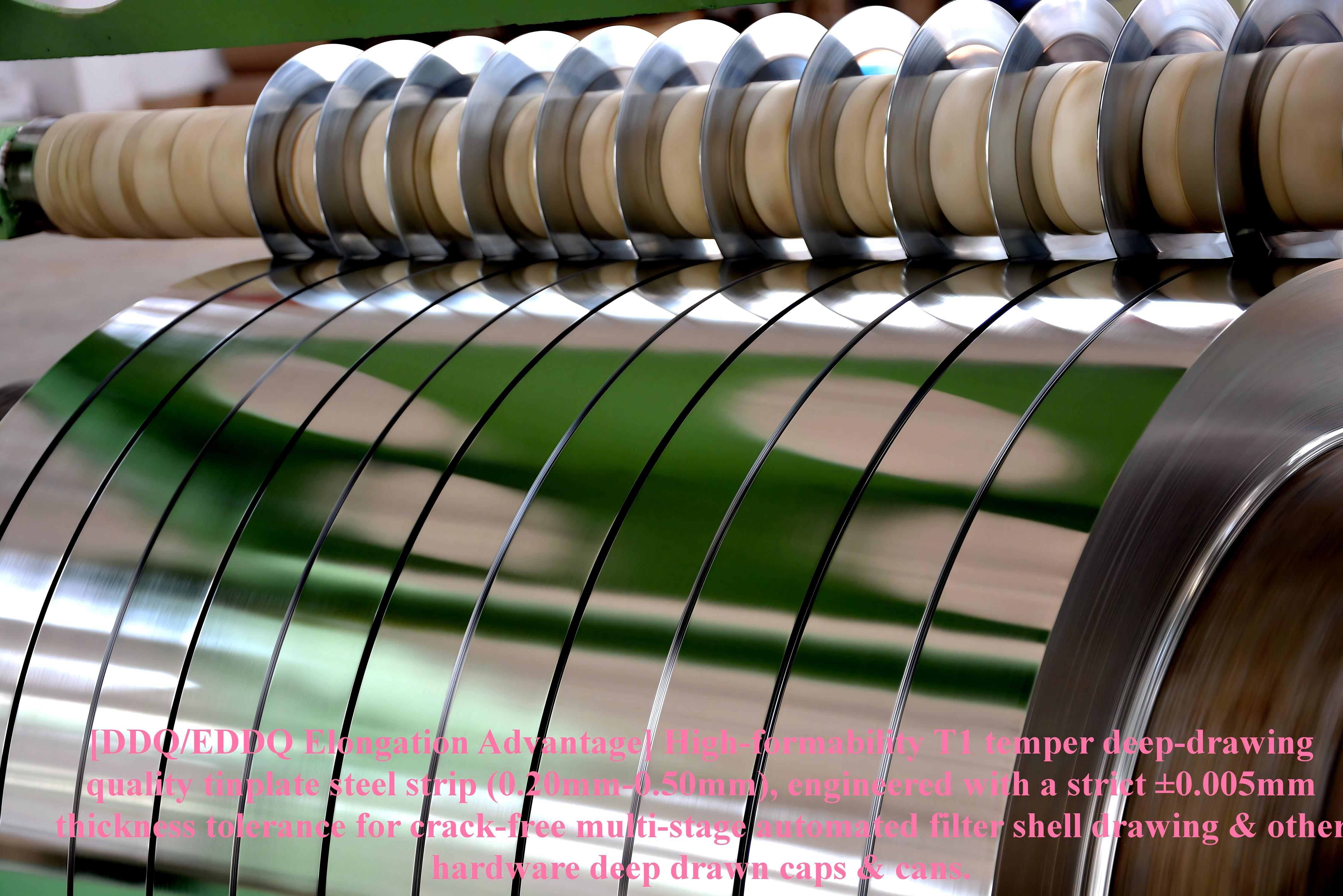
DDQ and EDDQ grade strip with T1 temper for deep-drawing operations.
FAQ: Deep-Drawing Tinplate and Supplier Questions
Which tinplate product should I choose for a deep-drawing project?
Match the product to the forming demand. Use gold pre-painted strip in 0.14-0.15 mm when the part is shallow to medium depth and needs a decorative gold finish with resistance to coating peel. Use DDQ and EDDQ deep drawn sheet or TFS in 0.20-0.50 mm when wall reduction and draw depth are the main challenge. Use ultra-thin high-temper strip in DR7-DR10 at 0.14-0.17 mm when weight reduction and high strength are required together. For food cans with retort exposure, use the BPA-free coated sheet or TFS families with a retort-tested internal lacquer.
Are these deep-drawing tinplate products compliant for food-contact and regulated markets?
The food-contact product lines are positioned as BPA-free and food-grade. Across the range, coatings are described as eco-friendly and are verified through SGS RoHS heavy-metal-free testing, with additional REACH and RoHS compliance on the coated strip families. Factory quality management is certified by Bureau Veritas under ISO 9001:2015, and the food-contact lacquers are developed against the relevant coating requirements for fish and meat cans, including FDA 21 CFR 175.300 and RoHS for coatings and lacquers. Buyers should still confirm the exact certificate set for the selected model, because compliance documentation is product-specific rather than generic.
Can temper and surface finish be customized for deep drawing?
Yes. Across the precision tinplate and TFS range, thickness options span 0.14-0.55 mm with custom slitting from 4.0 mm to 1050 mm. Temper options include T1, T2, T2.5, T3, T4, T5, T49, DR7, DR8, DR9, DR10, TH415, TH435, and TH520 depending on the product family. Surface finishes include gold, brass, bronze, copper, matte black, bright black, lacquered single or double side, multi-color, laser metallic, matte, and mirror finishes. Tin coating weights of 1.1/1.1, 2.2/2.2, 2.8/2.8, and differential coatings are available. Customization is confirmed against the drawing schedule, because temper and coating must be validated together rather than independently.
Is there a cost advantage in switching from plated or anodized metal to coated tinplate strip?
For decorative substitution cases covered by the documented application data, pre-coated mirror-finish brass or gold strip is stated to reduce raw material cost by over 20% compared with traditional brass or gold anodized or electroplated stainless steel. For copper-look stamping applications, the documented raw material cost reduction is over 50% compared with traditional copper electroplating processes. These figures apply to the specific substitution scenarios in the application data, not universally to every deep-drawing project, and they exclude tooling, processing, and compliance costs, which should be evaluated separately.
Can I test the material before placing a production order?
Free sample rolls or sheets are available for industrial press trialing on the deep-drawn product lines. A trial should cover the real draw depth, the actual die clearance, and the downstream process, including retort or coating cure if applicable. After the trial, buyers can request a quotation against the confirmed specification. Youngson Metal supplies precision tinplate, TFS, and coated steel strip, coil, and sheet from Chongqing, China, with export business accounting for 70% of total sales and an annual processed quantity exceeding 10,000 tons. Contact details are available at www.youngsonmetal.com, by email at info@youngsonmetal.com, or by phone at +86-23-62566629.
Conclusion: Rank by Forming Demand, Then Verify on the Press
Deep-drawing tinplate selection is a matching exercise. The five ranked product types in this guide are not interchangeable; each one is optimized around a different combination of thickness, temper, coating adhesion, and chemical barrier. Gold pre-painted strip wins when the decorative face must survive forming. DDQ and EDDQ sheet wins when the geometry is the hard part. Ultra-thin high-temper strip wins when weight and strength must move together. The two BPA-free coated families win when food chemistry and retort exposure are non-negotiable.
The verification step is the same in every case: confirm the tolerances that protect your die, confirm the coating against the real forming and sterilization conditions, and run a trial before committing tooling. That sequence converts a specification sheet into a production decision.
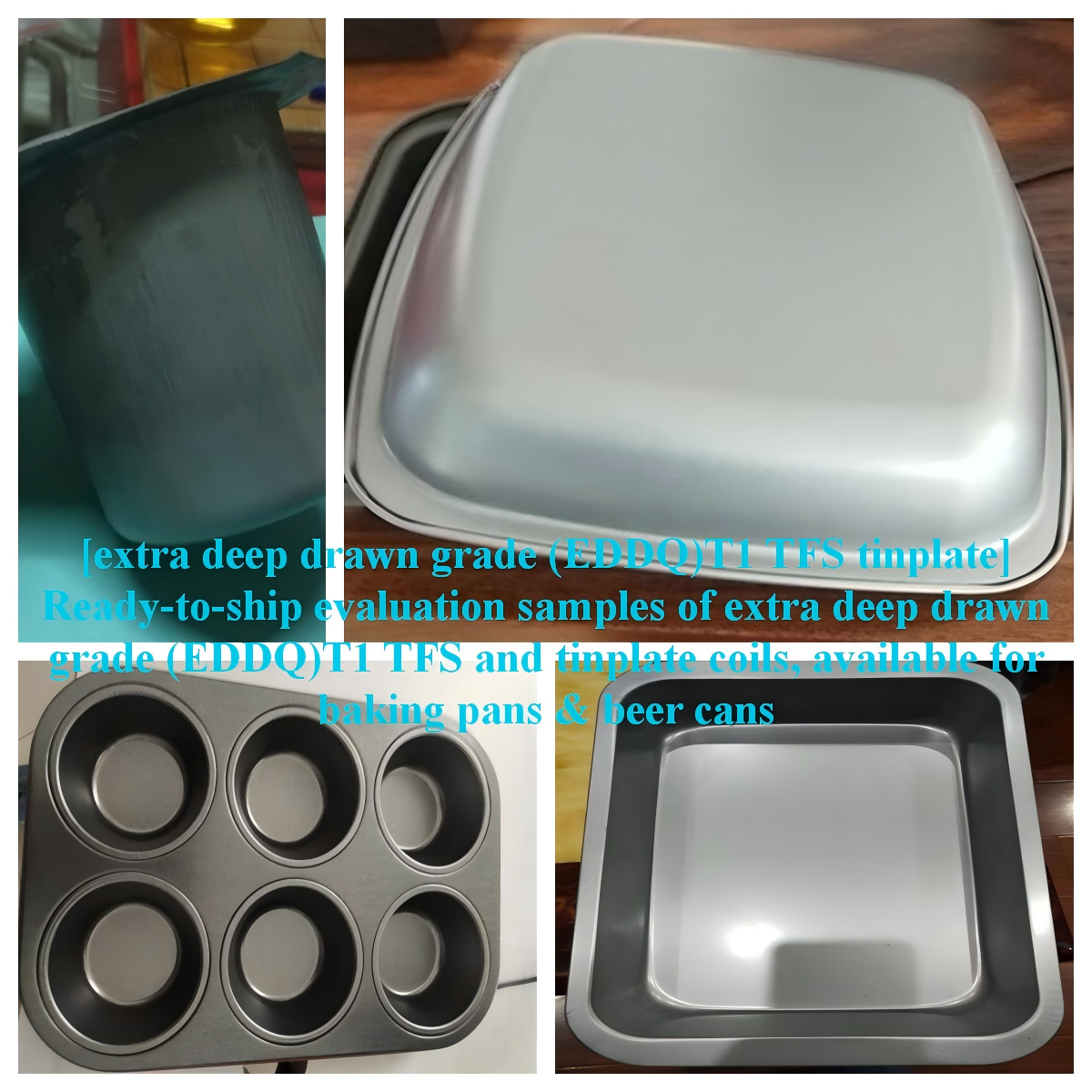
Free testing sample coil for EDDQ T1 tin free steel press trials.
Next Step
If you are evaluating a deep-drawing project, review the full product catalogue and specification range, then request a sample for press trialing.
Download the Youngson Metal product catalogue (PDF)
Chongqing Youngson Metal Products CO. LTD. — precision tinplate, TFS, and coated steel strip, coil, and sheet for metal packaging and hardware.