What Is 3D Laser-Effect Coated Tinplate? An Explainer for Buyers
3D laser-effect coated tinplate is a decorative coated steel substrate — an electrolytic tinplate (ETP), tin-free steel (TFS/ECCS) or hot-dip galvanized base — carrying a coating that produces a three-dimensional holographic appearance instead of a flat, single-colour paint layer. YOUNGSON METAL (Chongqing Youngson Metal Products Co., Ltd.) lists the material under model 3DL-ETP-PREMIUM-01 and supplies it in three forms: slit strip, coil and cut sheet, across a 0.14–0.55 mm thickness range and a 4.0–1050 mm width range.
For a buyer, three things decide whether the enquiry runs smoothly. The term describes a finish, not a steel grade, so substrate, gauge, temper and tin coating still have to be written into the request. The metallurgy under the finish behaves like any other tinplate, which means the normal forming and corrosion questions remain. And because the visual result is the product, the only dependable approval step is a physical sample viewed under the lighting and angle of the finished pack.
The short answer: 3D laser-effect coated tinplate is conventional electrolytic tinplate, tin-free steel or galvanized steel with a decorative holographic-style coil coating. It is not a distinct steel grade, and it is not restricted to a special thickness band. The same 0.14–0.55 mm gauge envelope, T1–T5 and DR7–DR10 tempers, and 1.1/1.1 to 2.8/2.8 g/m² tin coating masses that apply to standard coated tinplate also apply here.
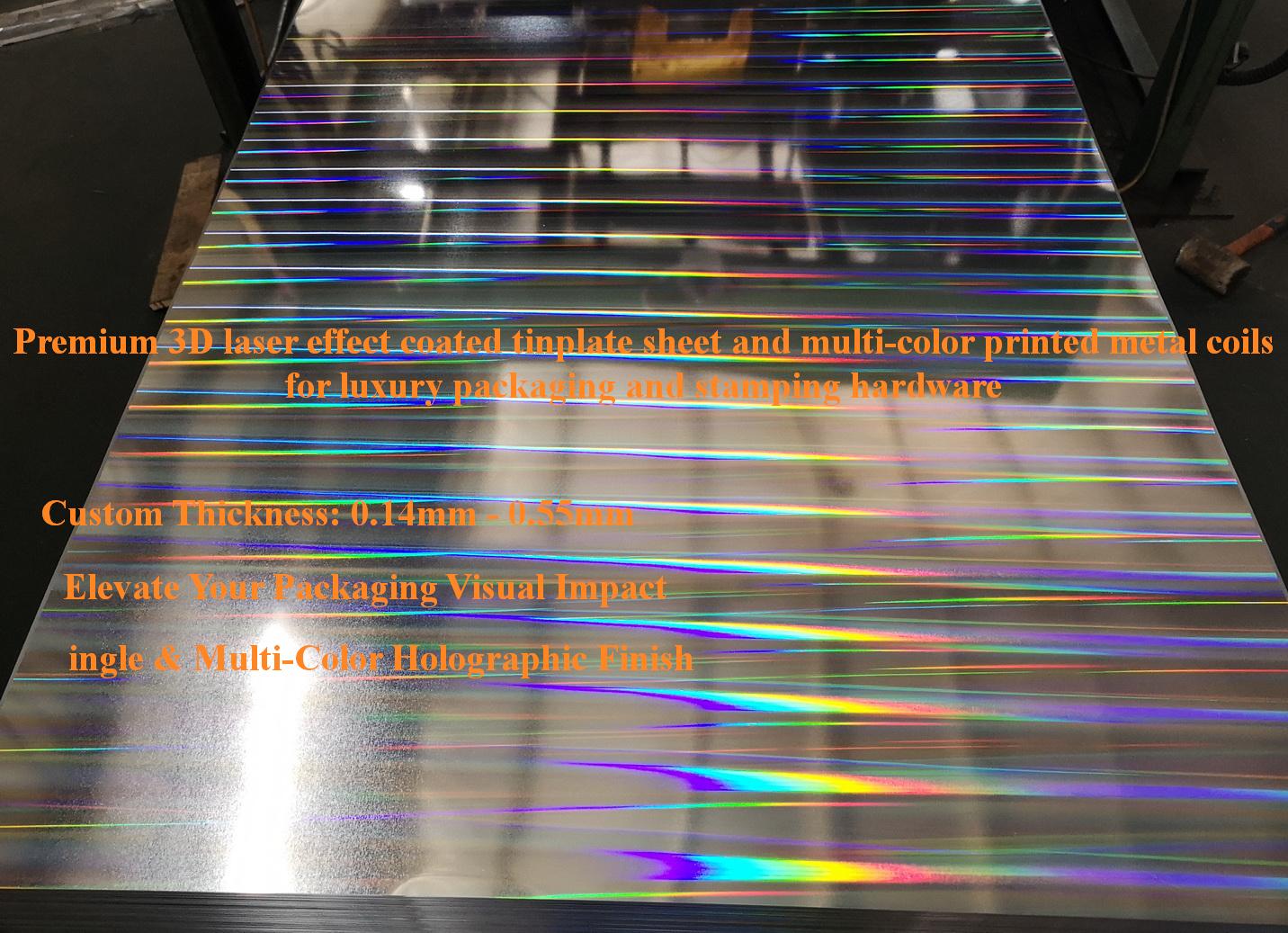
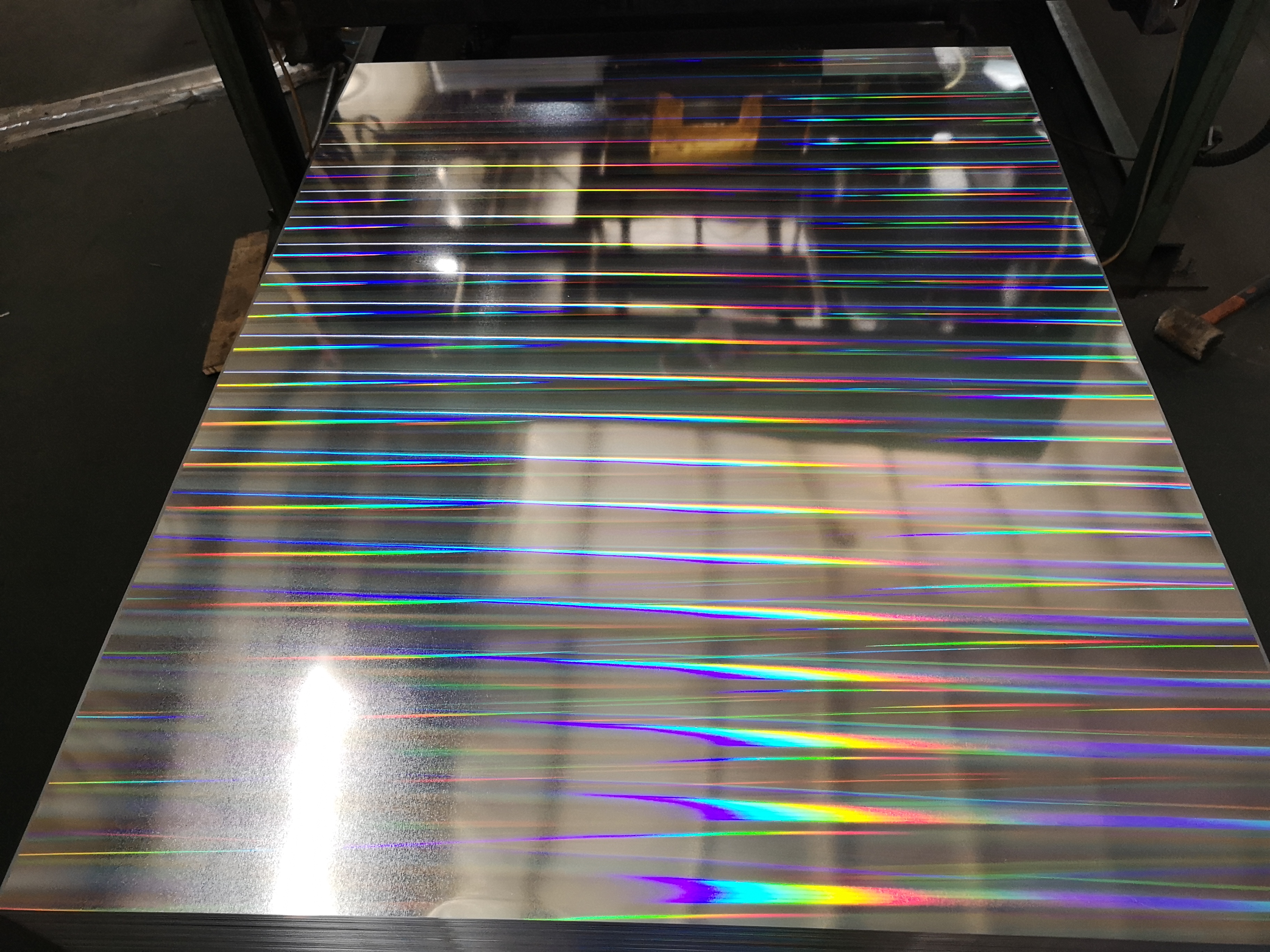
What changes is the surface: the manufacturer describes the finish as a patented 3D laser dynamic holographic effect, available in single-colour options (lacquer, brass, black, red, grey, blue) or a laser multi-colour version, with customized double-sided coatings.
Why the term causes confusion: a finish is not a grade
Tinplate is normally bought against measurable descriptors: temper designation, tin coating mass, surface finish, thickness and width tolerance. A phrase such as “3D laser effect” does not belong to that vocabulary. It sits in the same family of words as “mirror finish” or “matte finish” — it tells you how the surface looks, not how the steel will behave under a press.
This matters at the quotation stage. An enquiry that reads “3D laser tinplate, 0.20 mm” leaves out the substrate (ETP, TFS/ECCS or galvanized), the temper, the tin coating mass, the coated side or sides, the slit width, the coil inner diameter and the acceptable burr height. Each of those variables is separately quoted, and each changes either the price or the technical fit. A supplier can only guess, and a guessed quotation usually turns into a costly revision after the first sample.
A second confusion is the word “3D”. In packaging decoration, “3D” describes an optical impression created by the coating, not a physically embossed or laminated three-dimensional structure. The listing names a holographic effect and does not publish a measurement of viewing-angle behaviour or colour-shift range. That is not a defect in the specification — it simply means the appearance must be approved on a sample rather than from a description.
Industry background: where decorative coated steel sits
Decorative coated steel occupies the point where steel supply meets packaging design. A converter buys a coil or a slit strip that already carries the final surface, so the decoration step is removed from the press line and the material arrives ready to form. YOUNGSON METAL's own capability set follows this logic: coil coating, lithography and laminated PET film are listed alongside the plain tinplate and TFS range, with an annual processed volume stated at more than 10,000 tons.
Market-scale figures for tinplate should be read with care. One 2026 commercial study values the global tinplate market at USD 31.98 billion for 2025, and the same dataset notes that competing reports range from roughly USD 15 billion to USD 32.7 billion for the same year — a spread that reflects whether a study counts raw coated substrate or finished cans. The figures are directional only, and they are not a substitute for specifying your own order. What they do confirm is scale: this is a large, mature substrate category with many suppliers, which is precisely why the specification has to be precise.
Buyer takeaway: decorative tin containers carry the brand themselves in gift, confectionery, tea, spirits and cosmetics formats. When the surface is the sales cue, a substituted or visually inconsistent coating shows up immediately on the shelf — which is why appearance approval deserves its own step in the sourcing process, separate from the price negotiation.
What the product actually is, specification by specification
The verified product listing for model 3DL-ETP-PREMIUM-01 gives a complete enough picture to build a specification from. The points below are taken from that listing and from YOUNGSON METAL's published product data.
Base metal options
Three substrates are listed: premium electrolytic tinplate (ETP), tin-free steel (TFS/ECCS) and hot-dip galvanized steel (GI). The choice between them follows the ordinary rules for these substrates — tin coating for solderability and appearance, chromium-coated TFS for lacquered applications, galvanized for cost-driven decorative parts. This article does not re-teach that comparison; the relevant point is that the laser-effect finish can be carried on any of the three, so the substrate decision stays independent of the decoration decision.
The optical finish
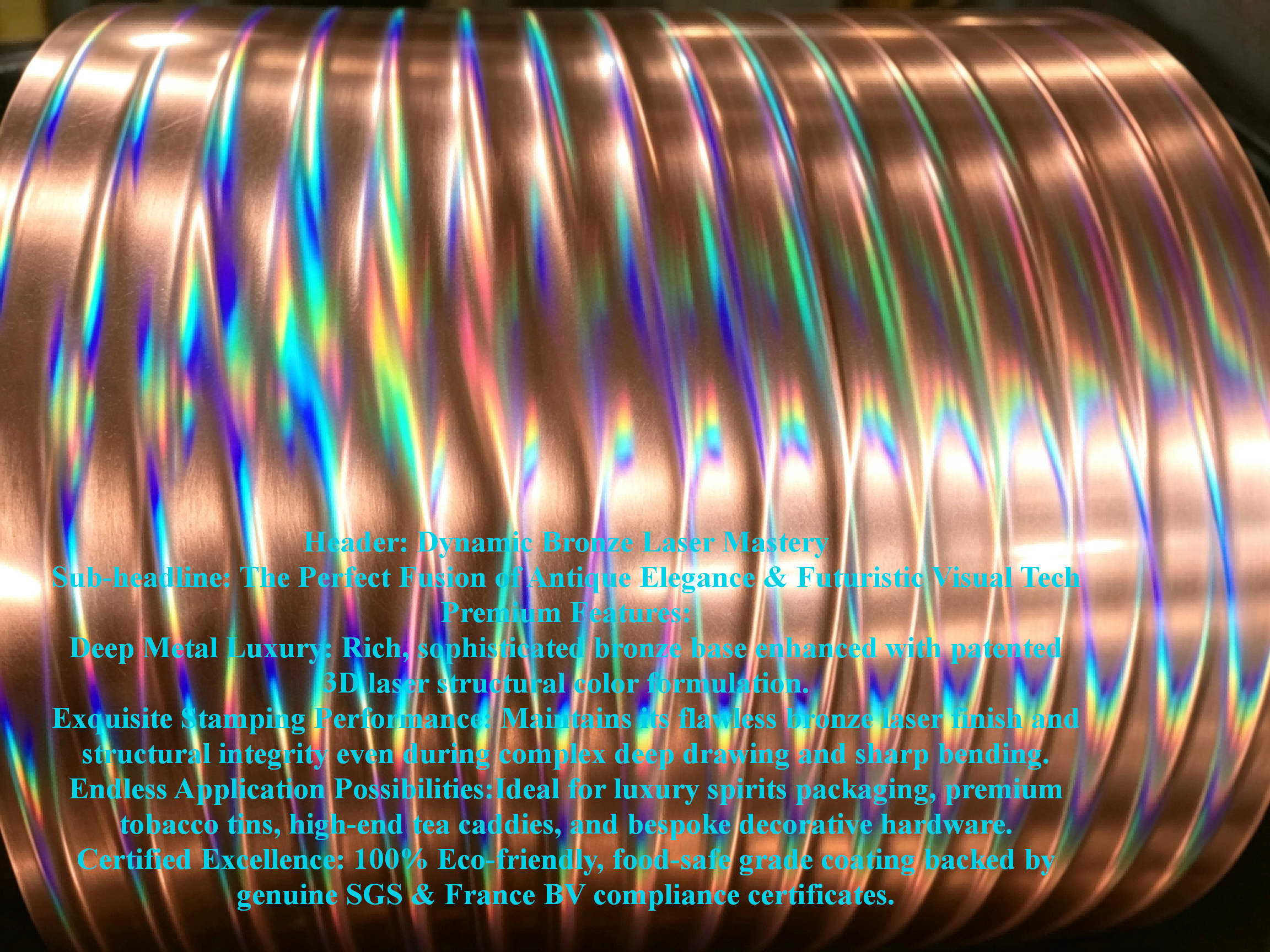
The finish is described in the listing as a patented 3D laser dynamic holographic effect. Colour options are grouped as single-colour lacquer, brass, black, red, grey and blue, plus a laser multi-colour version, and customized double-sided coatings are available. In practical terms, a designer has two routes: a solid decorative colour with the familiar pre-painted look, or the multi-colour laser variant where the visible effect changes across the surface.
Thickness, width and temper
- Thickness: 0.14 mm – 0.55 mm, with tolerance control stated as ultra-precise
- Width: 4.0 mm – 1050 mm, with custom slit strip available
- Temper: T1, T2, T3, T4, T5, DR7, DR8, DR9, DR10
- Tin coating mass: 1.1/1.1, 2.2/2.2, 2.8/2.8 g/m², with differential and customized coating weights available
- Coil inner diameter: 160 mm, 200 mm, 300 mm, 400 mm or 500 mm
Slitting and edge protection
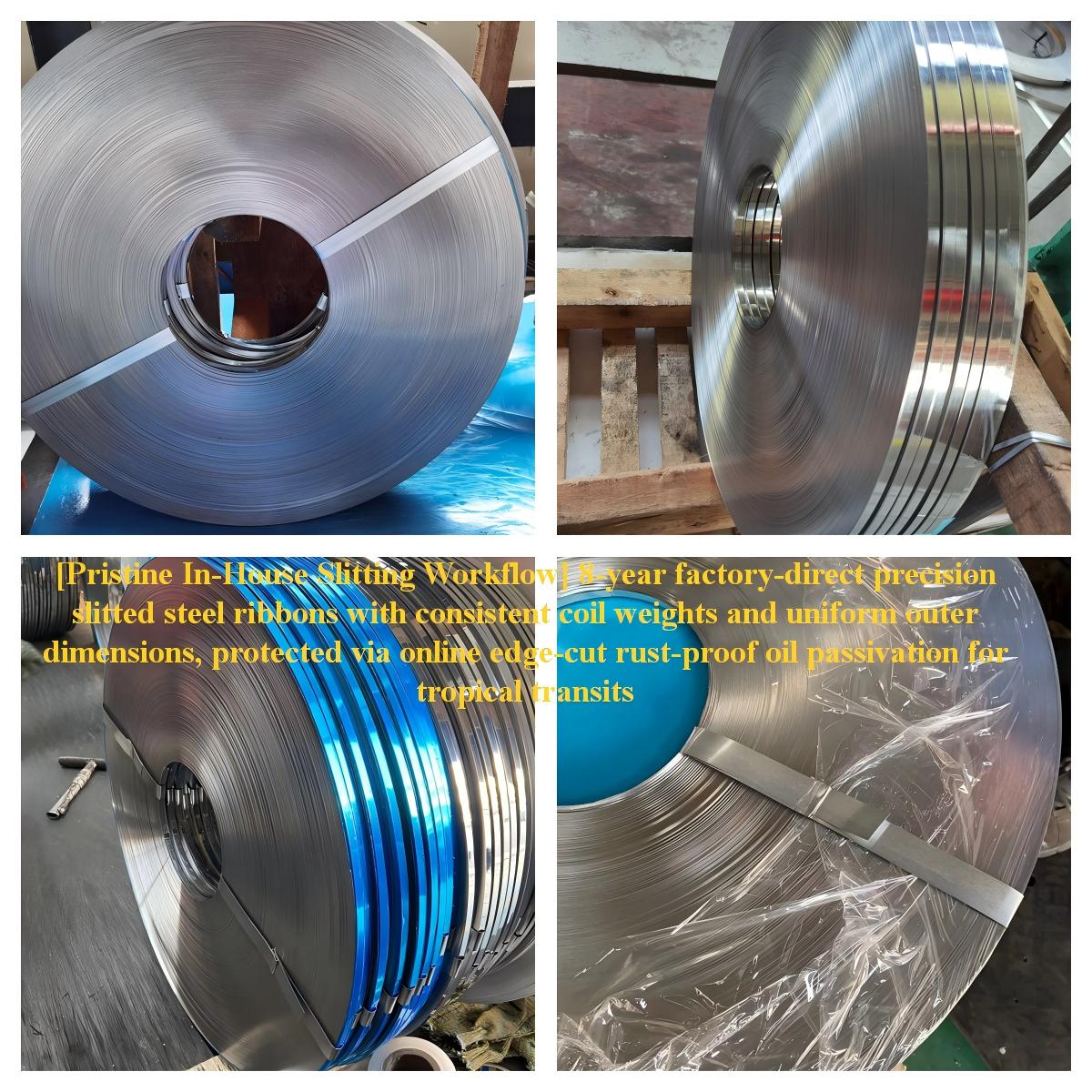
Precision slitting is where a decorative substrate most often fails in practice, because a burr on a coated edge is both a tooling risk and a visible defect. The 3D laser-effect listing specifies a maximum burr of 0.05 mm and an exclusive slit-edge oil-spraying anti-rust treatment. The same supplier's precision slit strip range — model PTS-HP-S160, covering 0.10–0.60 mm thickness and 4.0–100 mm width — publishes a width tolerance of ±0.05 mm, a burr limit of ≤0.05 mm, and jointless, camber-free, tight-tension winding with post-slit anti-rust treatment for hot and humid climates.
Two cautions belong beside those numbers. First, the anti-rust treatment is presented in the listing as protection for hot, humid and tropical marine transit conditions; treat that as a stated treatment rather than a performance guarantee, and confirm the packaging and transit route in the order. Second, the ±0.05 mm width tolerance is published for the precision slit strip range, not explicitly for every laser-effect SKU — confirm the applicable width tolerance on the quotation for the exact item you are buying.
Compliance and company profile
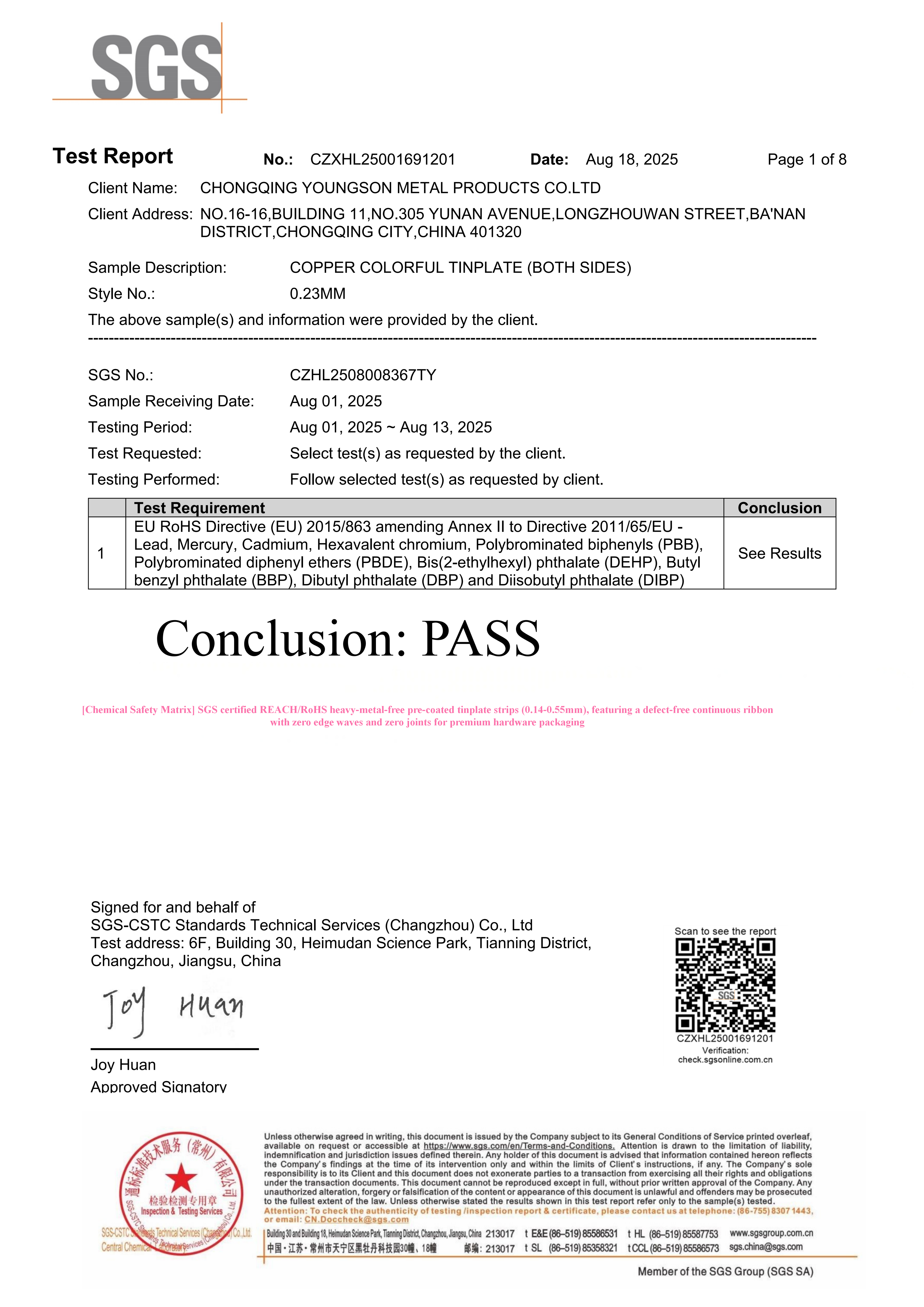
The listing states that the product is 100% eco-friendly and food-contact grade, authenticated by SGS certificates complying with REACH and RoHS heavy-metal restrictions, and certified by Bureau Veritas (BV) France under an ISO 9001:2015 quality management system. Chongqing Youngson Metal Products Co., Ltd. was established in 2016, operates a 3,000 m² facility with approximately 25 staff and a stated annual production capacity of 10,000 tons, reports export at 70% of total sales, and maintains an R&D team of 5 engineers and senior process technicians.
What the evidence supports, and what it does not: the certification, capacity and compliance statements above are manufacturer-reported and appear in the company's own product and corporate pages. They are a reasonable basis for shortlisting a supplier. They are not a substitute for the certificate itself. Ask for the ISO 9001:2015 certificate with scope and validity dates, and for an SGS REACH/RoHS report that names the specific product, sample identity and test date, before relying on the compliance claim for market access or food-contact approval.
3D laser-effect coating versus ordinary pre-painted tinplate
The clearest way to understand the category is to place it beside the standard decorative route. YOUNGSON METAL publishes both, and the comparison below uses only the specifications each listing states.
| Specification | 3D laser-effect coated tinplate (3DL-ETP-PREMIUM-01) | Pre-painted / lacquered tinplate strip (TP-EC-Series, ECO-TPS-Premium) |
|---|---|---|
| Surface appearance | Patented 3D laser dynamic holographic effect; laser multi-colour option | Single or multi-colour lacquer: brass, black, red, grey, blue |
| Base metal | ETP, TFS/ECCS, hot-dip galvanized (GI) | ETP, ECCS/TFS, ZAM alloy coated steel, hot-dip galvanized |
| Thickness | 0.14 – 0.55 mm | 0.14 – 0.55 mm |
| Width | 4.0 – 1050 mm | 4.0 – 1050 mm |
| Temper | T1, T2, T3, T4, T5, DR7, DR8, DR9, DR10 | T1 – T5, DR7 – DR10 |
| Tin coating mass | 1.1/1.1, 2.2/2.2, 2.8/2.8 g/m², differential available | 1.1/1.1, 2.2/2.2, 2.8/2.8 g/m², differential or equal |
| Coating sides | Single-colour options; customized double-sided coatings | Single or both sides; anti-fingerprint option available |
| Slit edge quality | Burr ≤ 0.05 mm; slit-edge oil-spray anti-rust treatment | Burr ≤ 0.05 mm; jointless, edge-wave-free, no overlap bands, zero rust spots |
| Coil inner diameter | 160 / 200 / 300 / 400 / 500 mm | 160 / 200 / 300 / 400 / 500 mm |
| Stated applications | Fancy biscuit tins, luxury tea caddies, cosmetics cases, spirits and wine gift boxes, confectionery tins; electronic shielding components, structural metal parts, deep-drawn stampings; metal badges, interior accents, signage | Food cans, aerosol cans, twist-off caps, beverage crowns, chemical pails, promotional tins; electronic components, automotive shields, cable wrapping, luggage hardware, stationery parts |
Read across the table and the honest conclusion is narrow: the gauge envelope, width capability, temper set, tin coating masses and coil diameters are effectively the same. The laser-effect product is not a heavier, harder or thicker material. The genuine differences are the optical finish and the application emphasis written into each listing.
That has a direct commercial consequence. Choosing laser-effect over standard pre-painted material is an appearance decision for formats where the container surface carries the brand — gift boxes, cosmetic cases, confectionery tins, badges and signage — not a performance upgrade. Neither listing publishes comparative adhesion, abrasion, retort or formability test data, so no one can claim one finish survives forming or handling better than the other on the available evidence. A trial on your own tooling is the only way to establish that for a specific drawing or stamping operation.
What buyers should specify: a step-by-step sequence
Because the finish carries the value and the substrate carries the risk, the specification should be built in a fixed order. The eight steps below follow the four variables named at the top of this explainer — form, thickness, surface finish and slit tolerance — and add the compliance and validation steps that decide whether the order is repeatable.
Step 1 — Define the visual requirement before anything else
State whether the job needs a solid decorative colour or the laser multi-colour effect, which side or sides must be coated, and which colour reference applies. Where possible, attach a physical reference or a previously approved sample. Because the effect is optical, a digital image is not an approval medium.
Step 2 — Choose the form: strip, coil or sheet
Coil suits continuous lines and is the natural input for in-house slitting. Slit strip suits narrow progressive stamping where the finished width arrives ready to feed. Cut sheet suits sheet-fed decoration and handling where a coil uncoiler is not available. The same product is offered in all three forms, so this is a logistics and tooling decision rather than a material decision.
Step 3 — Fix thickness against the forming operation
The available band is 0.14–0.55 mm. State the nominal gauge and the tolerance you can accept, and confirm both against the drawing or the die specification. A gauge that is comfortable for a shallow lid may be marginal for a deep-drawn body.
Step 4 — Select the temper and tin coating mass
Specify one of the listed tempers (T1–T5, DR7–DR10) and one of the listed coating masses (1.1/1.1, 2.2/2.2 or 2.8/2.8 g/m²), noting whether differential coating is required. Where the forming severity is unclear, request the supplier's recommendation and validate it on a trial rather than fixing the temper from a table alone.
Step 5 — State the slit width and burr limit
Give the finished width, the acceptable width tolerance and the burr limit. The 3D laser-effect listing specifies a maximum burr of 0.05 mm; the supplier's precision slit strip range publishes ±0.05 mm width tolerance. Confirm both numbers for the exact SKU on the quotation.
Step 6 — Specify coil inner diameter and winding quality
Inner diameter options are 160, 200, 300, 400 and 500 mm, so the choice is dictated by your uncoiler and feed line rather than by preference. Add the winding requirements explicitly: jointless, camber-free, no edge wave, no overlap bands, tight and uniform tension.
Step 7 — Define edge protection and packaging
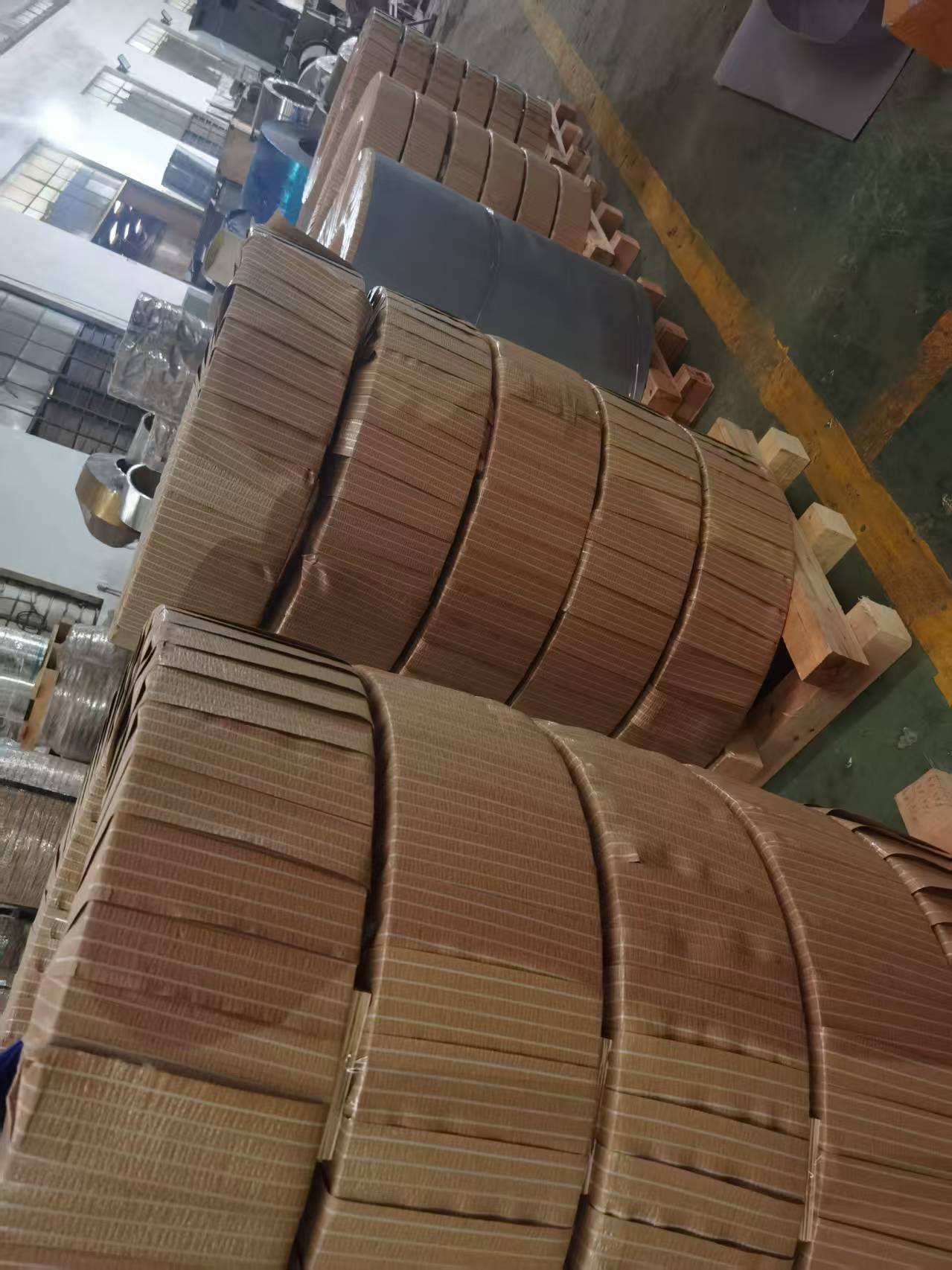
Ask for the slit-edge anti-rust treatment to be stated in writing, together with the packaging format. Single-coil protective packaging with a moisture barrier is the relevant reference point for sea freight, and it belongs in the purchase order rather than in a side conversation.
Step 8 — Agree the documents and the approval route
List the documents required with the shipment: mill test certificate, ISO 9001:2015 certificate, SGS REACH/RoHS report scoped to the product, and the approved sample reference. Then agree a first-article approval step before mass production, so appearance and forming are signed off together.
Where designers and packaging engineers should consider it
The product listing names four application families. Each carries a different reason to choose the material, and the reason should drive the specification.
Premium metal packaging
Fancy biscuit tins, luxury tea caddies, cosmetics cases, spirits and wine gift boxes and confectionery tins are the core stated uses. Here the surface is the purchase trigger: the tin is often kept after the contents are consumed, so the finish has to survive handling on a shop shelf and in the home. Specify the appearance first, then confirm the coating side and the packaging protection that keeps the visible face intact in transit.
High-precision hardware stamping
Electronic shielding components, structural metal parts and customized deep-drawn stampings appear in the same listing. In this group the decorative effect is secondary and the mechanical specification dominates: temper, gauge consistency, burr height and winding quality determine whether a progressive die runs without interruption. A buyer sourcing for this group should treat the finish as an appearance bonus and negotiate on the slit-edge and tolerance data.
Decorative construction and creative design
Upscale metal badges, interior accents and advertising signage are also listed. These parts are usually flat or lightly formed, so formability is less critical than surface consistency across a batch — a point worth raising explicitly, since signage and badges are often viewed side by side.
Automated high-speed progressive stamping
The listing names automated high-speed progressive stamping lines requiring continuous coil feeding as a target application. For these lines, coil-to-coil consistency matters more than any single coil's specification: identical weight and outer diameter per batch, no joints and no edge wave are what keep a continuous feed stable.
Evaluating TINPLATE suppliers for a laser-effect finish
The most common sourcing question around this material is simply who can supply it. The answer is narrower than the number of tinplate suppliers suggests, because the laser effect is a coating capability rather than a steel capability: a supplier needs an in-house coating line and a precision slitting line to offer the finish and the finished strip width from one source.
YOUNGSON METAL positions itself on exactly that combination — high-quality metal surface processing, slitting and supply — under BV ISO 9001:2015 certification, with eco-friendly, food-grade and chemical-grade surface treatments named as its business focus. The company's full product and capability overview is published at youngsonmetal.com.
A practical supplier check for this category has five parts. Confirm that the coating line can produce the specific finish you need, in the colour variant you need, on the substrate you need. Confirm the slitting capability against your narrowest finished width and your burr limit. Confirm the certification documents exist and are current, not merely quoted on a web page. Confirm the packaging format suits your inbound logistics. And confirm the sample route, because for an appearance-led product the sample is the real qualification step.
Frequently asked questions
What does “3D laser effect” actually describe on this tinplate?
It describes the decorative finish, not the steel. YOUNGSON METAL lists the surface as a patented 3D laser dynamic holographic effect applied over an ETP, TFS/ECCS or hot-dip galvanized base, available in single-colour options (lacquer, brass, black, red, grey, blue) or a laser multi-colour version with customized double-sided coatings. The underlying material remains standard tinplate at 0.14–0.55 mm with T1–T5 or DR7–DR10 temper and 1.1/1.1 to 2.8/2.8 g/m² tin coating mass. Because the listing names the effect without quantifying viewing-angle behaviour, appearance should be approved on a physical sample.
Is 3D laser-effect coated tinplate food-contact safe and RoHS/REACH compliant?
The listing states that the product is 100% eco-friendly and food-contact grade, authenticated by SGS certificates complying with REACH and RoHS heavy-metal restrictions, and produced under a Bureau Veritas ISO 9001:2015 quality system. Those statements are manufacturer-reported. Before relying on them for market access or food-contact approval, request the ISO 9001:2015 certificate with scope and validity dates and an SGS REACH/RoHS report that identifies the specific product, sample and test date — a factory-level claim does not automatically cover every SKU or every market's requirements.
Which forms, thicknesses, tempers and finishes can I order?
Three forms are listed — slit strip, coil and cut sheet — within a 0.14–0.55 mm thickness range and a 4.0–1050 mm width range. Tempers cover T1, T2, T3, T4, T5, DR7, DR8, DR9 and DR10, with tin coating masses of 1.1/1.1, 2.2/2.2 and 2.8/2.8 g/m², including differential and customized weights. Coil inner diameters are 160, 200, 300, 400 or 500 mm. Slitting is specified at a maximum burr of 0.05 mm with slit-edge oil-spray anti-rust treatment. Finish options run from solid decorative colours to the multi-colour laser effect.
How should I evaluate a TINPLATE supplier for this material?
Check four capabilities against your own requirement rather than against a brochure. First, coating: can the supplier produce your specific colour variant on your specific substrate? Second, slitting: does the published capability reach your narrowest width and burr limit — the reference figures here are 4.0 mm minimum width, ±0.05 mm width tolerance on the precision slit strip range, and burr ≤0.05 mm? Third, documentation: are the ISO 9001:2015 certificate and product-scoped SGS reports available on request? Fourth, repeatability: can the supplier hold coil weight, outer diameter and winding quality consistent batch to batch, which is what automated progressive stamping lines depend on?
Can I get a sample before committing to an order?
Yes — a sample is the appropriate first step for an appearance-led product, because the holographic effect cannot be judged from a photograph or a colour code. Ask for a trial quantity in your target gauge, temper and slit width, and evaluate it on your own tooling under your own lighting. The supplier's catalogue, which covers the coated tinplate and TFS range in more detail, can be downloaded here: Chongqing Youngson Metal Products catalogue (PDF). Sample and quotation requests can be sent to info@youngsonmetal.com or +86-23-62566629.
Conclusion
3D laser-effect coated tinplate is best understood as a decorative finish carried on a conventional substrate. The steel underneath is ordinary ETP, TFS/ECCS or galvanized material at 0.14–0.55 mm, with the familiar temper and tin coating options; what changes is the surface, described by the manufacturer as a patented 3D laser dynamic holographic effect in single-colour or laser multi-colour variants.
That distinction should shape the buying process. Specify the form, the gauge and tolerance, the temper and coating mass, the colour variant and coated sides, the slit width with a burr limit of 0.05 mm, the coil inner diameter and the packaging — then verify the compliance documents and approve the appearance on a physical sample. Buyers who sequence the request that way get a quotable specification and a repeatable order; buyers who order “3D laser tinplate” by thickness alone usually get a revision instead.
Next step
If you are evaluating a laser-effect or pre-painted coated tinplate for a gift tin, cosmetic case, badge or stamped hardware component, the practical next move is a trial sample in your own gauge, temper and slit width. YOUNGSON METAL supplies coated tinplate, TFS and galvanized strip from 0.14 mm to 0.55 mm with custom slitting from 4.0 mm to 1050 mm.
Download the product catalogue, or send your specification to info@youngsonmetal.com for a sample and quotation. Full product information is available at youngsonmetal.com.
Have Questions or Need More Details?
Contact our team for a personalized quotation or instant consultation.
Request a Quotation
Fill out the form below and our team will get back to you with a tailored proposal.
WhatsApp Direct Chat
Prefer to chat in real-time? Message us on WhatsApp for instant assistance & quick answers.
- Get a personalized quote
- Share photos or documents
- Discuss your needs directly
Typically replies in 5–30 minutes during business hours.