
Heavy Duty AGV: Certification, Payload and Material Limits
A heavy duty AGV is an unmanned industrial vehicle engineered to move loads that conventional forklifts and tow tractors cannot handle safely — typically from several tonnes to more than a thousand tonnes. In practice, the question that decides a project is not "how many tonnes can it carry" but "which tonne class, chassis geometry, material specification and certificate scope will the site actually accept."
This guide is written for procurement engineers, plant logistics managers and importers who are in the research-to-evaluation stage of a heavy load AGV purchase. It sets out the constraints that most often cause a heavy payload AGV project to stall after the quotation stage: certificate coverage that does not match the ordered model, chassis height that does not fit the existing rack or coil saddle, battery runtime that does not match the shift pattern, and route conditions that were never converted into a drawing. The reference point is the YT-LONYU-AGV product range from Lonyu AGV Co., Ltd., a heavy-duty AGV manufacturer founded in 2008 and based in Tianjin, China, whose published equipment specifications and certificate records are used here as concrete examples of how each constraint should be read.
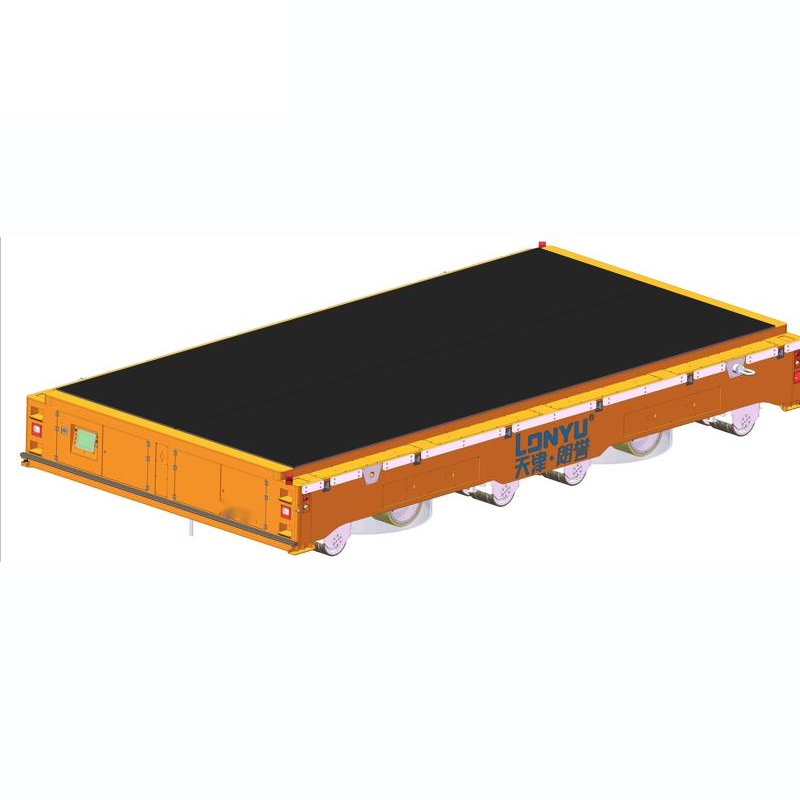
600-tonne heavy duty AGV, model LY-1-450(600)T-416-A, rated load 600,000 kg with a 50,000 kg equipment weight.
What Counts as a Heavy Duty AGV Under Procurement Constraints
The industry has no single threshold for "heavy duty." Published specifications inside one manufacturer's catalogue already span a 1–20 tonne band, a 21–50 tonne band and a 50–600 tonne band, with a stated overall capacity range of 1 to 1000 tonnes. That spread means a buyer comparing suppliers on tonnage alone is comparing incomparable products.
A more useful definition treats the heavy duty automated guided vehicle as a system bounded by five constraints, all of which must be satisfied at the same time:
- Payload and load distribution. Rated load, centre of gravity, support footprint and whether the load sits on the deck, hangs from a lifting platform, or rests on a saddle.
- Chassis envelope. Overall length, width and height, plus lifting stroke and ground clearance, because these determine whether the vehicle can enter a rack, a pit or a coil saddle.
- Route conditions. Floor load capacity, gradient, turning radius, aisle width and indoor-to-outdoor transitions.
- Power and duty cycle. Battery chemistry, voltage, runtime at full load, charging or battery-swap method, and whether the site runs two or three shifts.
- Certificate scope. Which exact model designation a CE, verification or UL document names, and which market that document is valid for.
A specification that satisfies four of these five constraints is not a partial success; it is a project that cannot be signed off. This is why heavy duty AGV for industrial material handling projects normally begins with a site assessment and ends with countersigned drawings, rather than starting from a catalogue page.
Why Certification, Load Class and Material Specification Now Decide Projects
Two structural shifts have made constraint management the centre of heavy duty AGV procurement.
The first is market scale. Fortune Business Insights valued the global automated guided vehicle market at USD 5.52 billion in 2025, with heavy-load AGVs identified as a key segment, and placed Asia Pacific's share at 35.51% in the same year. A larger, more segmented market produces more suppliers and more configuration variety, which raises the cost of comparing offers that look similar on the surface.
The second is standardisation. ISO 3691-4:2023, published on 1 June 2023, is the current international safety standard for driverless industrial trucks and functions as the reference point for CE marking of this equipment class. As soon as a buyer's market requires a CE or UL document, the certificate — not the brochure — becomes the binding technical description of what was sold. A certificate names a model designation, a directive list and a validity window. Change the battery pack, the lifting stroke or the frame material beyond that scope, and the document no longer describes the machine on the floor.
The Constraint Stack in a Real Heavy Duty AGV Range
Lonyu AGV Co., Ltd. operates an 8000+ m² manufacturing base with more than 300 employees, of whom over 55% are R&D engineers, an annual output of 2000+ units and an export ratio of 80%. Its published portfolio covers heavy-duty AGVs, light-duty AGVs, AGV intelligent dispatching systems, outdoor unmanned AGVs, trackless transfer carts and automatic mold transfer systems, with more than 160 independent patents and more than 800 large-scale engineering projects delivered. Those numbers matter less as credentials than as an indication of how many configurations the constraint stack has already been solved against. The sections below translate the range into decision criteria.
Payload, Chassis Height and Load Interface
Payload is the headline figure, but chassis height is usually the binding one. Ultra-thin platforms exist precisely because many heavy components must be approached from underneath: a coil saddle, a mould base or a transfer rack with support legs. The 600-tonne model LY-1-450(600)T-416-A illustrates how the numbers scale — rated load 600,000 kg, equipment weight 50,000 kg, body 8500 mm × 4540 mm × 1200 mm subject to countersigned drawings, climbing ability ≤5°, indoor and outdoor operation, four-wheel drive across sixteen wheels, and low-voltage servo motors with independent servo controllers. The same vehicle family is described with a 1 to 1000 tonne capacity range across the range as a whole, and Lonyu's published specification lists a 1000-tonne maximum single-unit load capacity.
For buyers, the operative question is whether the lifting structure matches the load interface. Backpack configurations lift a rack or saddle from below; omnidirectional lifting platforms present a flat surface for rack integration; trackless transfer carts carry the load on the deck. A heavy duty AGV with hydraulic lifting is not interchangeable with a deck-carrying transfer cart, even at the same rated load.
Drive, Suspension and Steering Geometry
Drive architecture determines what the vehicle can do in a tight aisle. The range includes differential drive on the 150-tonne model LY-1-150T-816-A, which uses eight-wheel drive across sixteen wheels with a differential body structure, a 200 mm lifting stroke and ≤5° climbing ability; four-wheel dual-drive on the 14-tonne and 16-tonne omnidirectional lifting AGVs, the latter with a 1125 mm minimum turning radius and spring suspension; and four-wheel drive across eight wheels on the 60-tonne trackless transfer cart with hydraulic suspension.
Suspension choice is a stability decision, not a comfort decision. Heavy duty AGVs in this range are specified with hydraulic independent suspension and automatic leveling so that the platform stays level under uneven factory floors. Without leveling, a 200-tonne component on a three-point contact will redistribute load unpredictably, which is a safety issue before it is a handling issue.
Navigation System and Safety Envelope
Navigation methods are matched to environment rather than to preference. Indoor-only units commonly use magnetic strip navigation with positioning and navigation accuracy of ±10 mm. Outdoor and mixed indoor-outdoor units use RTK+INS combinations of differential integrated navigation, inertial navigation and laser SLAM — as on the IGV outdoor flatbed model LY-3-70T-612-B, rated at 100,000 kg, with visibility across 2 × 20 ft, 1 × 40 ft, 1 × 45 ft or 1 × 57 ft cargo formats and IP65 protection. The 80-tonne energy storage container unit, model 24391A, combines laser navigation with magnetic strip and holds ±30 mm navigation accuracy and ±10 mm positioning accuracy at IP54.
Safety protection is layered and should be verified line by line: laser obstacle avoidance sensors, contact collision avoidance, audible and visual warning, emergency stop, plus LiDAR obstacle detection for 360-degree coverage and, on outdoor platforms, perceptual failsafe with multi-layer redundant safety control. Braking distance is a specification item, not an assumption — the 60-tonne trackless cart is published at ≤400 mm fully loaded and ≤300 mm unloaded.
Battery Power, Runtime and Charging Method
Heavy duty AGV with battery power is normally specified around lithium iron phosphate chemistry. Published runtime figures vary by platform: 3 hours at both full load and empty load on the 600-tonne and 60-tonne platforms, 6 hours when fully charged on the outdoor IGV. Voltage options include 48 V and 96 V as standard choices, with 330 V, 570 V and 614 V available on high-speed outdoor platforms. Extended-range options include diesel and methanol range extension, and charging can be manual, via automatic charging pile, via intelligent battery swap station, or by manual battery swap.
Runtime should be converted into a shift calculation before the order is placed. In Lonyu's documented operating procedure, the battery management system triggers an alarm below 25% charge, requires manual acknowledgement by management personnel, and the AGV then travels autonomously to the charging station. That behaviour needs a defined charging location and a defined acknowledgement owner on site; neither is a vehicle specification item.
Structural Materials and Customisation Boundaries
The main frame adopts Q235B steel across the range, with Q355B steel optional for special working conditions. Exact material selection is confirmed per model and technical agreement — a detail worth stating explicitly in a purchase contract, because frame material and weld procedure are the two items most likely to be renegotiated late in a heavy fabrication project.
Customisation covers payload class, vehicle dimensions, lifting structure, drive and suspension, navigation method, operating environment, charging or battery-swapping method, dispatching system, and indoor/outdoor route adaptation. The manufacturer operates OEM, ODM and custom production with a stated monthly capacity of 200 units and a minimum order quantity of at least one unit, which matters for pilot programmes that expect a single validation vehicle before a fleet decision.
Certificate Coverage: What the Documents Actually Say
The most frequently misread part of a heavy duty AGV offer is the compliance page. Lonyu's records contain three documents with different markets and different model designations:
- ECM Mark certificate 6D230301.TLR0W80, issued by Ente Certificazione Macchine (ECM) for the EU market, covering Heavy Load AGV model LY-AU-240T-12-0A-427 against 2006/42/EC (Machinery), 2014/35/EU (Low Voltage) and 2014/30/EU (Electromagnetic Compatibility), valid from 1 March 2023 to 28 February 2028.
- ECM Verification 6D230301.TLR0W79, covering the same model for third countries outside the EU market and referencing 2014/68/EU (Pressure Equipment), with the standard set EN 13855-2:2003, EN 14120:2003+A1:2007, EN 1088:1995+A2:2008, EN 349:1993+A1:2008, EN ISO 13857:2019 and ISO 4413:2010, valid from 1 March 2023 to 28 February 2028.
- UL certificate US 72508429.0001, issued on 23 January 2025 by TÜV Rheinland of North America, Inc. for the US market, covering the 60T Backpack Lifting Type AGV, model LY-AU-60T-6-08-1011, powered by two lithium-ion packs (DQ-51.2-304, 51.2 V, 304 Ah), with a rated load of 132,277 lb and a maximum load of 145,000 lb, certified to ANSI/CAN/UL 3100:2024 and ANSI/ITSDF B56.5:2019.
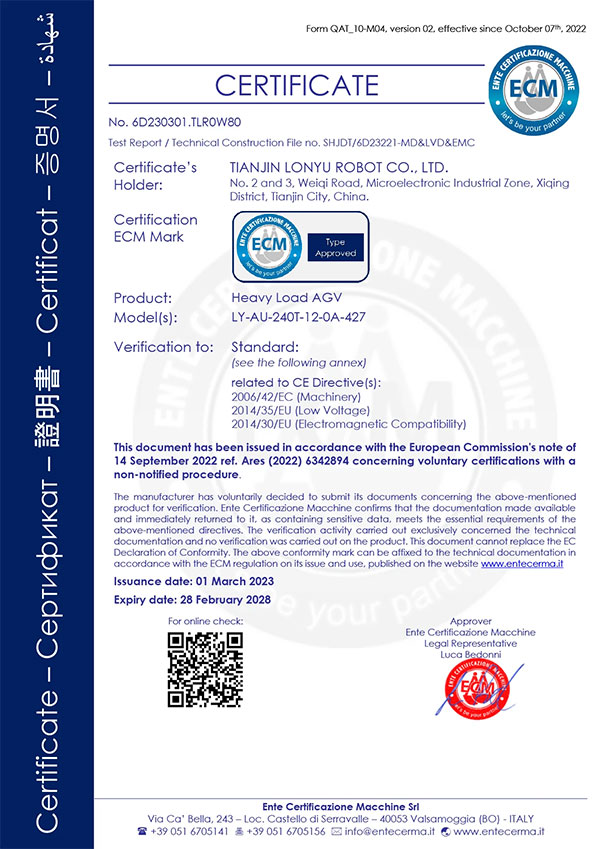
ECM Mark certificate 6D230301.TLR0W80 names a single model designation — confirm that scope matches the ordered configuration.
Reading these three documents together produces the actual compliance rule for this category: certification is model-specific and market-specific. A CE-type certificate for an EU market does not transfer to a US installation, and a 240-tonne certified model does not extend coverage to a different tonnage, battery pack or lifting stroke. Buyers should ask a short, specific question during evaluation — "which of these documents covers the exact model designation on your quotation, and which market does it apply to?" — and accept only a scope field that answers it.
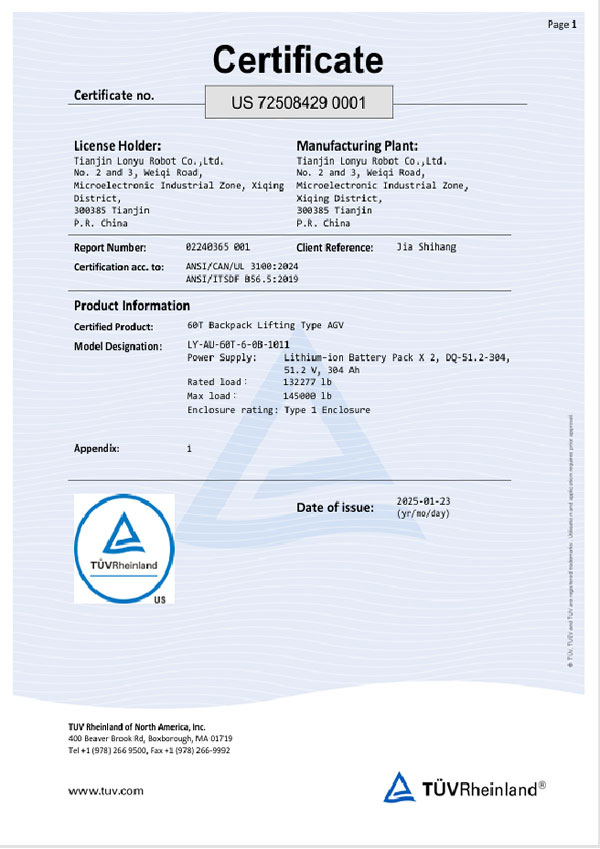
UL certificate US 72508429.0001, issued 23 January 2025 by TÜV Rheinland of North America, Inc., for the US market.
Step-by-Step: Qualifying a Heavy Duty AGV for a Steel Coil or Heavy Component Route
The sequence below converts the constraint stack into a qualification process. It works for steel coil transport as well as for moulds, wind turbine components, transformer bodies and large castings.
Step 1 — Define the Cargo Envelope, Not Just the Weight
Record the maximum weight, the length, width and height of the component, the centre of gravity, and the support surface. A cylindrical steel coil resting on a saddle behaves differently from a flat plate on a deck, and a coil that must be docked eccentrically to a coating machine imposes a lateral offset that a centred platform cannot satisfy.
Step 2 — Map the Route Physically
Walk the route and record floor load capacity, gradients, aisle width, turning space, door and gate clearances, and every indoor-to-outdoor transition. A heavy duty AGV for factory logistics may spend 95% of its cycle indoors and still be blocked by one 40 mm step at a doorway.
Step 3 — Select the Vehicle Architecture
Choose between backpack lifting, omnidirectional lifting, dual-vehicle linkage, outdoor unmanned platform and trackless transfer cart according to the cargo interface and route. A 30-tonne double-vehicle linkage AGV, for example, carries products 11 to 27 metres in length with adjustable linkage distance — an architecture that exists specifically because no single chassis can carry that length safely.
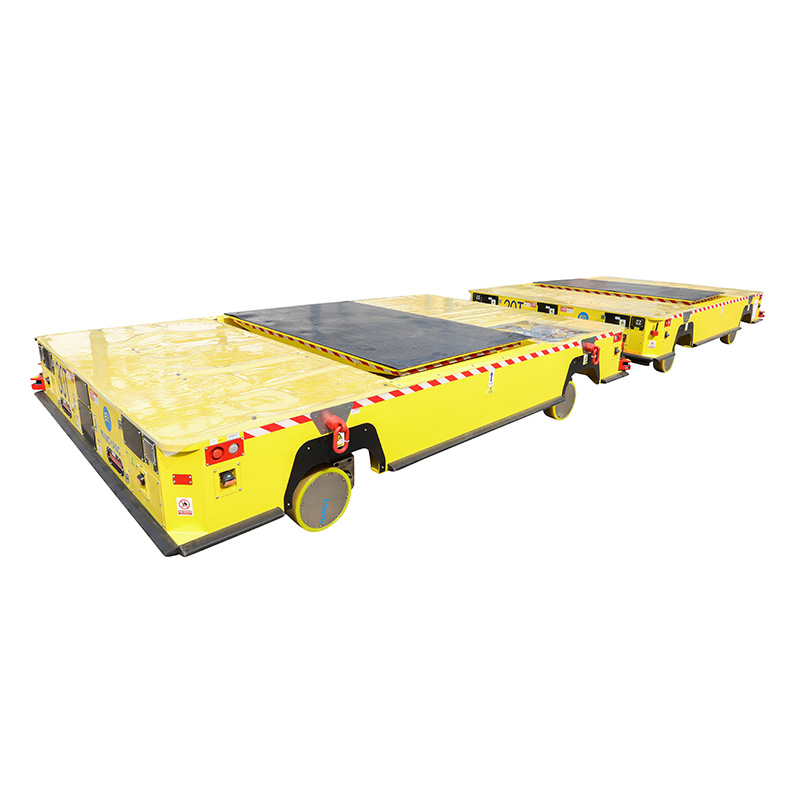
30-tonne double-vehicle linkage AGV: rated load 30 t with adjustable linkage distance for 11–27 m products.
Step 4 — Fix the Navigation and Safety Layer
Match navigation to environment and specify the accuracy the process requires — ±10 mm for indoor magnetic strip installations, wider tolerances where outdoor RTK+INS is used. Then confirm the safety chain item by item: laser obstacle avoidance, contact collision avoidance, audible and visual warning, emergency stop, and LiDAR coverage where personnel share the route.
Step 5 — Size the Power System Against the Shift Pattern
Take the published runtime — 3 hours at full load on the 600-tonne and 60-tonne platforms, 6 hours on the outdoor IGV — and divide the shift length by it to establish how many charge events or battery swaps per day the operation must accommodate. Then confirm the charging method and the physical charging location.
Step 6 — Verify the Certificate Against the Exact Model
Compare the model designation on the certificate scope field with the model designation on the order. Note the market and the validity window. If the certificate covers a different model, ask whether the ordered configuration falls inside or outside that scope, and get the answer in writing.
Step 7 — Lock Drawings and Inspection Terms
Body dimensions in this range are consistently stated as subject to countersigned drawings, and frame material is confirmed per model and technical agreement. Treat both as contract documents. Confirm inspection scope as well: Lonyu states 100% full inspection before delivery, a 12-month warranty, and after-sales support including training, maintenance training and upgrade training, with service regions and contract terms to be confirmed.
Use Cases: Where These Constraints Actually Bite
Steel Coil and Cylindrical Coil Transport
Cylindrical cargo is one of the clearest tests of the constraint stack. Lonyu's parallel backpack lifting AGV is specified for the transport of cylindrical coils — film, aluminium and steel coils of differing diameters, regardless of industry — with eccentric docking to the coating machine and the ability to dock eccentrically to the production equipment. For a steel coil project, the qualification sequence above should be applied in a specific order: coil diameter and mass first, saddle or cradle geometry second, eccentric docking offset third, and only then tonnage class. A heavy payload AGV that meets the tonnage but cannot approach the saddle from below is not a candidate.
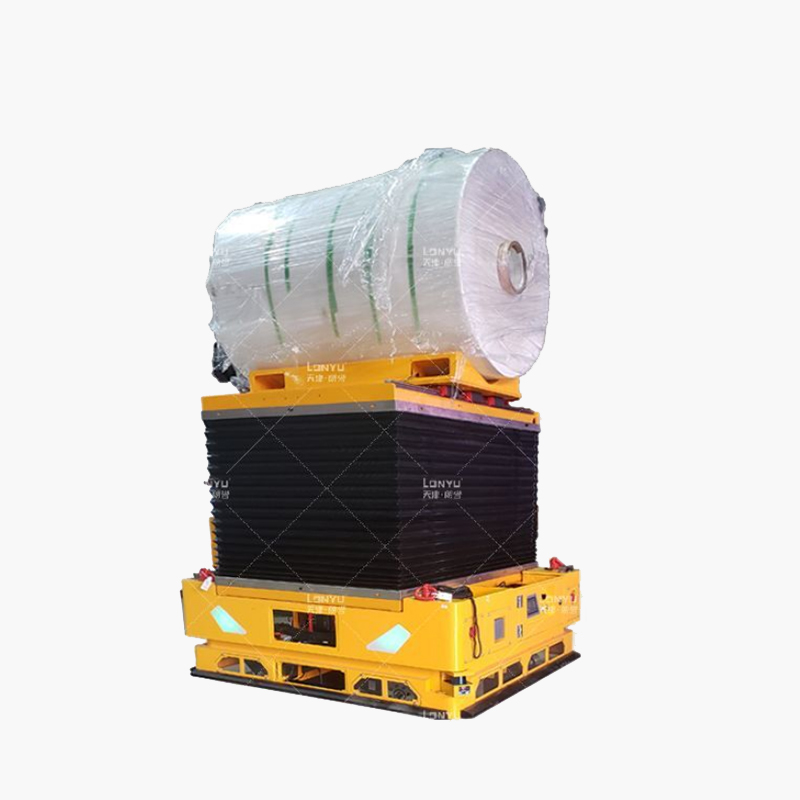
Parallel backpack lifting AGV for cylindrical coil transport with eccentric docking to production equipment.
Wind Turbine Components
Model 24111A is an industrial heavy duty AGV rated at 200 t with a 200 mm hydraulic lifting stroke, specified for indoor and outdoor handling of wind turbine main engines and drive systems, operating at ±10 mm navigation and positioning accuracy, IP54, with 48 m/min empty and 36 m/min loaded travel speed. The relevant constraint here is not payload alone but the indoor-outdoor transition plus the lifting stroke needed to seat the component on its mounting.
Transformer Handling
The 60-tonne trackless transfer cart, model 24286A, is listed for transformer handling in an indoor operating environment, with a 100 mm lifting stroke, ≤3° gradeability, IP44 protection, 30 m/min travel speed at both no load and full load, and a stated AGV lifespan of 10 years. It uses manual remote control rather than autonomous navigation — a reminder that a heavy duty AGV robot does not have to be fully autonomous to be the correct machine for a low-frequency, high-load indoor move.
Automotive and Commercial Vehicle Assembly
For heavy duty AGV for automotive manufacturing applications, model LK-AK-15T-4-0-B is specified for flexible assembly lines carrying commercial vehicle chassis, with a 15 t load weight, a 4 t product weight, and support spacing adjustable to the distance between front and rear axles, with the number of supports designed around the axle count. This is a case where the AGV must adapt to a product family rather than to a single component.
High-Speed Rail, Energy Storage and Mold Transfer
The 30-tonne backpack heavy duty AGV is used for high-speed rail track slab casting and curing, supporting material racks with and without support legs, using a dual-drive structure with hydraulic cylinder lifting. A 30-tonne unit was designed for China Railway 14th Bureau Group as an unmanned transport solution for cargo above 30 tonnes in a high-temperature, high-humidity working environment. For energy storage, model 24391A handles storage containers at 80 t rated load with automatic side charging plus manual charging. For heavy duty AGV for mold transport duties, the automatic mold transfer systems in the portfolio apply the same lift-from-below principle to mould bases.
Comparison Table: Selected Heavy Duty AGV Configurations
The table below uses only published specifications from the YT-LONYU-AGV range. It is intended to show how load class changes the surrounding constraints — not to rank configurations, since each is built for a different cargo interface and route.
| Model / Family | Rated Load | Drive Configuration | Lifting Stroke | Environment / Protection | Navigation |
|---|---|---|---|---|---|
| 24286A — 60 t trackless transfer cart | 60 t (10 t vehicle weight) | Four-wheel drive, eight wheels; hydraulic suspension | 100 mm | Indoor; IP44 | Manual remote control |
| LY-1-150T-816-A — 150 t heavy duty AGV | 150,000 kg (35,000 kg vehicle weight) | Eight-wheel drive, sixteen wheels; differential | 200 mm | Indoor and outdoor; climb ≤5° | Differential drive travel, in-situ rotation |
| 24111A — 200 t wind turbine handling AGV | 200 t (30 t vehicle weight) | Eight-wheel drive, sixteen wheels | 200 mm | Indoor and outdoor; IP54 | Magnetic strip; ±10 mm |
| LY-1-450(600)T-416-A — 600 t heavy duty AGV | 600,000 kg (50,000 kg vehicle weight) | Four-wheel drive, sixteen wheels; differential | 0 mm | Indoor and outdoor; climb ≤5° | Low-voltage servo with independent servo controller |
| LY-3-70T-612-B — outdoor IGV flatbed | 100,000 kg (12 × 6 body) | Multi-axle, all-position steering modes | — | Outdoor; IP65 | RTK+INS with laser SLAM; ±20 mm |
| 30 t double-vehicle linkage AGV | 30 t; products 11–27 m long | Servo motor-driven differential drive | — | Adjustable linkage distance | SLAM automatic navigation or handheld remote |
| 16 t omnidirectional lifting AGV | 16 t | Dual-wheel drive; tubesheet frame, spring suspension | Lifting platform | Turning radius 1125 mm | Omnidirectional movement |
Two observations follow from the table. First, protection level does not track load class: a 60-tonne indoor cart is IP44 while a 80-tonne outdoor unit is IP54 and an outdoor IGV is IP65. Second, navigation accuracy is environment-dependent rather than load-dependent, which means the navigation system should be selected after the route survey, not before it.
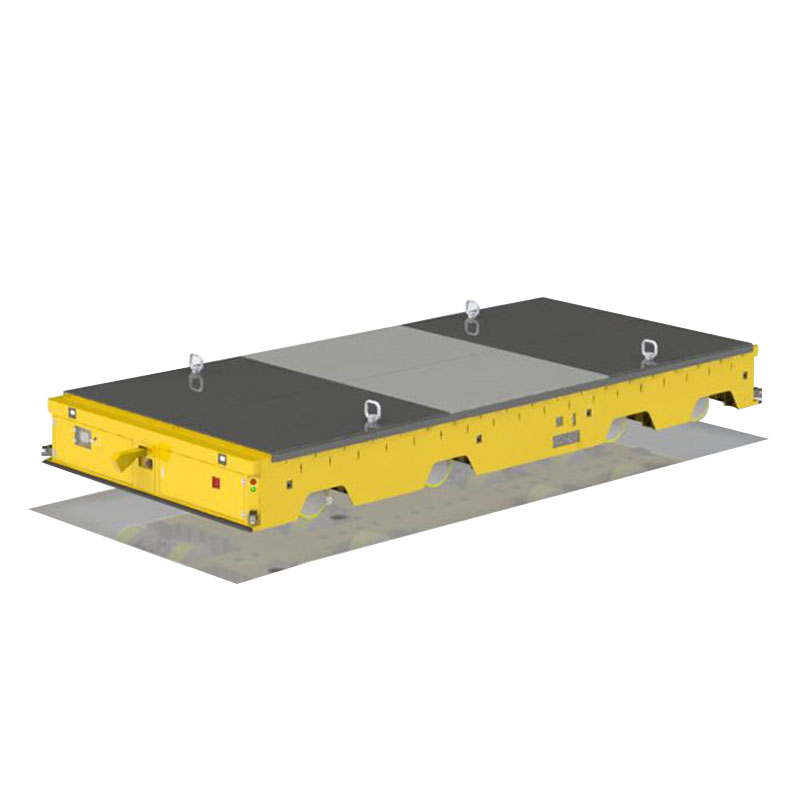
150-tonne heavy duty AGV, model LY-1-150T-816-A: 200 mm lifting stroke, ≤5° climbing ability, indoor and outdoor operation.
Frequently Asked Questions
1. Which certifications apply to Lonyu heavy duty AGVs, and does the certificate cover the exact model I order?
Three documents are on record. ECM Mark certificate 6D230301.TLR0W80, issued by Ente Certificazione Macchine, covers Heavy Load AGV model LY-AU-240T-12-0A-427 for the EU market against 2006/42/EC, 2014/35/EU and 2014/30/EU, valid from 1 March 2023 to 28 February 2028. ECM Verification 6D230301.TLR0W79 covers the same model for third countries outside the EU market and references 2014/68/EU. UL certificate US 72508429.0001, issued on 23 January 2025 by TÜV Rheinland of North America, Inc., covers the 60T Backpack Lifting Type AGV model LY-AU-60T-6-08-1011 for the US market to ANSI/CAN/UL 3100:2024 and ANSI/ITSDF B56.5:2019. All three name a specific model designation, so certificate coverage must be matched against the ordered configuration rather than assumed from the product family. ISO 3691-4:2023 is the international reference standard for driverless industrial trucks and the CE reference point for this equipment class.
2. What payload range does a heavy duty AGV cover, and how are the largest units specified?
The published capacity range across the range is 1 to 1000 tonnes, with Lonyu's specification listing a 1000-tonne maximum single-unit load capacity. Within that range, the 600-tonne model LY-1-450(600)T-416-A is rated at 600,000 kg with a 50,000 kg equipment weight, a body of 8500 mm × 4540 mm × 1200 mm subject to countersigned drawings, four-wheel drive across sixteen wheels, ≤5° climbing ability and indoor and outdoor operation. Cargo longer than a single chassis can carry safely is handled by a 30-tonne double-vehicle linkage AGV with adjustable linkage distance for products 11 to 27 metres long.
3. What must a steel coil transport project verify before selecting a heavy duty AGV?
Start with the coil itself: diameter, mass, saddle or cradle geometry, and whether the vehicle must dock eccentrically to production equipment. The parallel backpack lifting AGV is specified for cylindrical coil transport — film, aluminium and steel coils of differing diameters, regardless of industry — with eccentric docking capability. The project then needs to verify payload, cargo dimensions, route length, floor load capacity, gradients, turning space, indoor-outdoor transitions, navigation method, charging cycle and safety boundaries. Final configuration follows site assessment and signed drawings rather than a catalogue selection.
4. What determines the budget envelope of a custom heavy duty AGV project?
Cost is driven by the configuration variables, not by a single tonnage figure. The customisable items are payload class, vehicle dimensions, lifting structure, drive and suspension, navigation method, operating environment, charging or battery-swapping method, dispatching system, and indoor/outdoor route adaptation. Two projects with the same rated load can therefore differ substantially in scope if one requires an outdoor RTK+INS navigation stack with range extension and the other requires an indoor magnetic strip installation with manual remote control. Frame material also affects fabrication scope: Q235B steel is standard, with Q355B steel optional for special working conditions and confirmed per model and technical agreement.
5. Can a single unit be supplied for validation, and what affects lead time?
The stated minimum order quantity is at least one unit, and monthly capacity is 200 units, which allows a single validation vehicle ahead of a fleet decision. Delivery time is determined by the customised quantity, parameters and functional requirements rather than by a fixed schedule, so it should be quoted against a locked specification. Inspection is stated as 100% full inspection before delivery, with a 12-month warranty, after-sales support including training, maintenance training and upgrade training, and a published response commitment, all subject to confirmation of service regions and contract terms. To start a validation or quotation, contact the export team at sales@lonyurobot.com with the cargo envelope, route conditions and target market.
Conclusion: Qualify the Constraints Before You Compare the Tonnage
Heavy duty AGV procurement rewards buyers who translate their site into constraints early. The 600-tonne chassis, the 200 mm lifting stroke, the IP65 outdoor platform and the certified 60-tonne backpack unit are all correct answers — but only to specific questions. A quotation that states a tonnage without a chassis drawing, a certificate scope and a runtime figure is not yet a specification.
The practical checklist is short: cargo envelope and support interface, route survey, vehicle architecture, navigation and safety layer, power and duty cycle, certificate scope against the exact model designation, and countersigned drawings with inspection terms. Buyers who work through those seven items before comparing prices are usually the ones who avoid re-engineering a project after the equipment arrives.
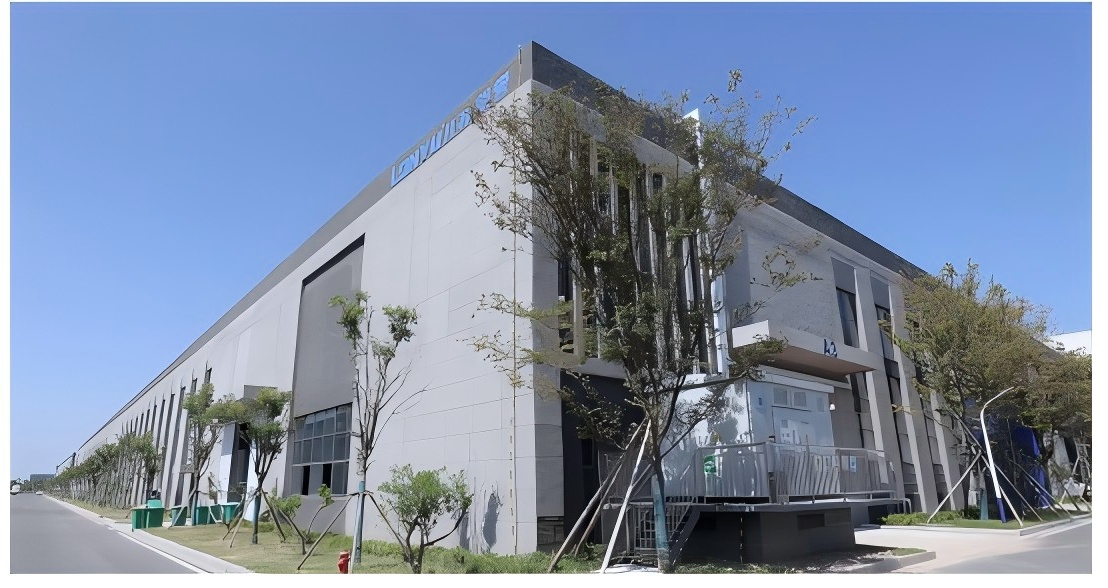
Manufacturing base in Xiqing District, Tianjin: 8000+ m², more than 300 employees, 2000+ units annual output.
Send a Cargo Envelope, Get a Configuration Review
Share the component weight and dimensions, the route conditions and the target market, and the engineering team can confirm which heavy duty AGV architecture, lifting structure and certificate scope apply. Sample and single-unit validation orders are supported from a minimum of one unit.
Email: sales@lonyurobot.com | Website: www.lonyurobot.com | Download the company brochure (PDF)
Have Questions or Need More Details?
Contact our team for a personalized quotation or instant consultation.
Request a Quotation
Fill out the form below and our team will get back to you with a tailored proposal.
WhatsApp Direct Chat
Prefer to chat in real-time? Message us on WhatsApp for instant assistance & quick answers.
- Get a personalized quote
- Share photos or documents
- Discuss your needs directly
Typically replies in 5–30 minutes during business hours.