
Heavy Duty AGV Specifications and Certifications: A Buyer's Checklist
A heavy duty AGV is specified by six constraints, not by one tonnage figure: rated load at the working gradient, the load interface and lifting stroke, navigation accuracy on the real route, drive and suspension configuration, the safety and protection class, and the certification that is valid in the country of installation. Every other number in a heavy duty automated guided vehicle datasheet - cycle time, fleet size, payback - is derived from those six.
This checklist is written for procurement teams, manufacturing engineers and project managers in the research and evaluation stage of a purchase. Product, capability and certification facts are drawn from Lonyu AGV Co., Ltd. (YT-LONYU-AGV), a Tianjin, China based supplier of heavy-duty AGV intelligent logistics equipment. The company's production base was founded in 2008, and overseas sales are handled by Yuntong Tianjin Industrial Co., Ltd.
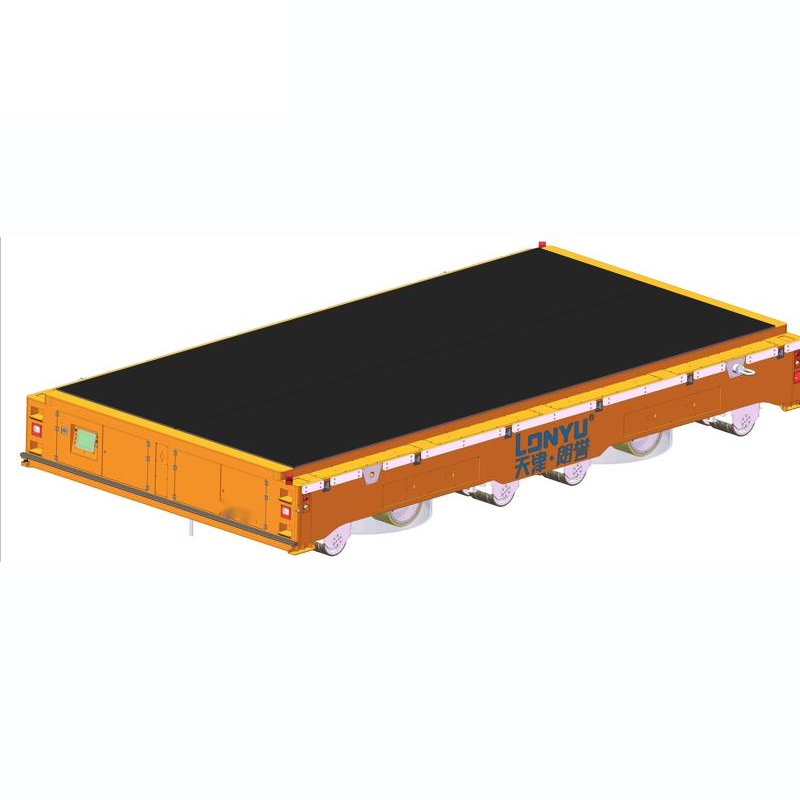
Problem definition: why heavy duty AGV projects fail on constraints, not on price
"Heavy duty" is a marketing phrase before it is an engineering one. The same term is applied to a three-tonne platform cart and to a six-hundred-tonne gantry transporter. In the Lonyu range the load band runs from 1 to 1000 T, and the catalogue is segmented into 1-20 ton AGVs and transfer carts, 21-50 ton heavy-duty AGVs and 50-600 ton ultra heavy-duty AGVs. A buyer comparing suppliers on the headline tonnage of a heavy duty AGV robot is therefore comparing almost nothing.
Three constraint failures account for most of the expensive surprises in this category:
- Structural and gradient margin. A vehicle rated at 150,000 kg with a gradeability of not more than 5 degrees does not behave like the same vehicle on a level floor. Rated load, equipment weight (35,000 kg on that model) and climbing limit are one combined constraint, not three separate specifications.
- Load interface mismatch. A backpack heavy duty AGV that must enter underneath a material rack is limited by the rack geometry and clearance, not only by tonnage. A flat-top omnidirectional vehicle designed to integrate with heavy-duty storage racks answers a different question.
- Certification scope mismatch. A certificate names a model, a market and a directive set. It does not automatically transfer to the heavier machine a buyer is actually considering.
The sequence that protects the project: fix the load case, then the load interface, then the route survey, then navigation and energy, then the safety envelope, then the certificate scope - and only then the commercial discussion.
Industry background: a growing category with a widening definition
Fortune Business Insights valued the global automated guided vehicle market at USD 5.52 billion in 2025 and identified heavy-load AGVs as a key segment of that total. The same body of market research places Asia Pacific at 35.51% of the AGV market in 2025; a separate estimate published elsewhere puts the region at 38.5%, which illustrates how much market-share figures depend on methodology. The direction of both figures is the same: the heavy end of the category is concentrated in the industrial belt where the large components are actually built.
Safety expectations have hardened in parallel. ISO 3691-4:2023, published in June 2023, is the current international safety standard for driverless industrial trucks and is the reference point used for CE marking of this equipment class. That matters for heavy payloads because stopping distance scales with mass: on the 80 T trackless transfer cart model 24391A the published braking distance is not more than 400 mm at full load and 300 mm empty, and on the 200 T model 24111A it is not more than 500 mm at full load.
Two information gaps are worth flagging at the outset. First, no standardized public benchmark set exists that compares heavy-load AGV performance across manufacturers, because the definition of heavy duty itself ranges from a few tonnes to 1,000 tonnes. Second, no published price-per-tonne benchmark is available for AGVs above 50 tonnes. Both gaps push the buyer back to specification-level evidence: drawings, certificates and inspected machines.
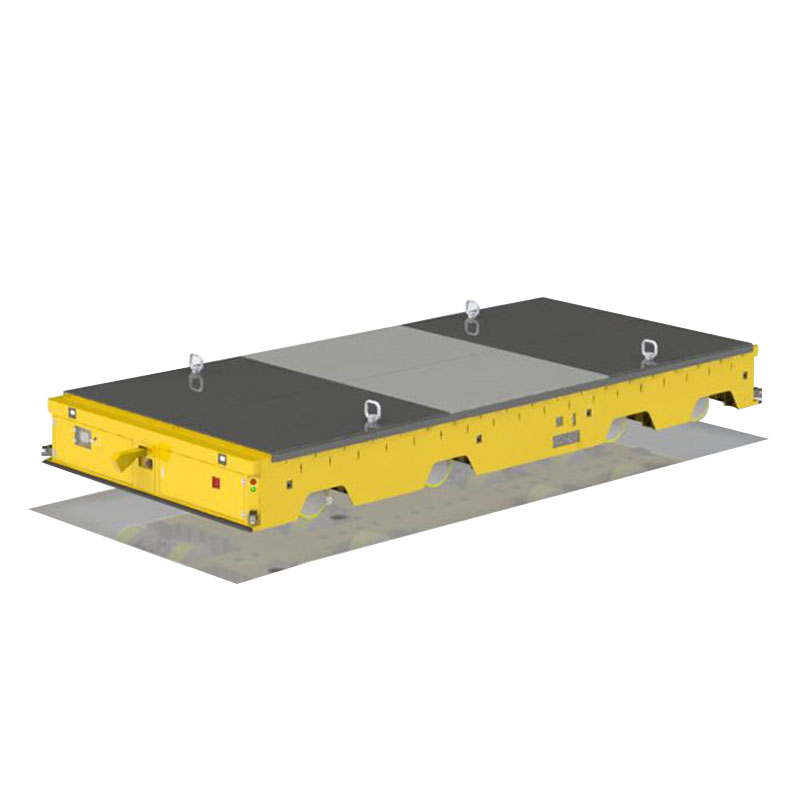
The six-layer constraint stack for heavy duty AGV specification
1. Rated load and load geometry
Rated load is the entry ticket, never the whole specification. The 600-tonne model LY-1-450(600)T-416-A carries a rated load of 600,000 kg on a body of 8,500 x 4,540 x 1,200 mm with a lifting stroke of 0 mm - it is a transport platform rather than a lifting vehicle. The 200 T model 24111A, built for wind turbine main engines and drive systems, combines a 200,000 kg rated load with a 200 mm hydraulic lifting stroke. Same load class in conversation, different machine in practice. Buyers should record rated load, maximum load used during abnormal handling, cargo footprint, centre of gravity, and the gradient over which the load must be moved.
2. Chassis, drive and suspension
The published frame material across the range is Q235B steel, with Q355B steel available as an option for special working conditions; the exact selection is confirmed per model and technical agreement, so it belongs in the contract rather than the brochure. Drive configurations differ by load class: differential drive on the 30 T model LY-1-30T-24-B, 60 T model 24286A and 600 T model, four-wheel drive with eight wheels on the 80 T model 24391A, and eight-wheel drive with sixteen wheels on the 150 T and 200 T models. Hydraulic independent suspension with automatic leveling is used to keep the load stable on uneven factory floors, and LiDAR obstacle detection provides 360-degree coverage that includes both the cargo and the personnel area.
3. Lifting and load interface
This is where most layout conflicts appear. Backpack heavy duty AGVs enter underneath a material rack and lift it, so the rack dimensions must match the vehicle dimensions and the rack may or may not have support legs. Lifting strokes in the range include 100 mm on the 30 T and 60 T models and 200 mm on the 80 T, 150 T and 200 T models. The 40 T omnidirectional lifting AGV uses a completely flat top surface specifically so that it can integrate with heavy-duty storage racks. For cylindrical loads the parallel backpack lifting AGV is designed for coil transport, including eccentric docking with a coating machine, which is the configuration that matters for steel coil and aluminium coil flows.
4. Navigation and positioning
Navigation choice is a site decision. Magnetic strip navigation with plus or minus 10 mm positioning appears on models such as the 12 t unit and the 200 T model 24111A. Laser navigation combined with magnetic stripe delivers plus or minus 30 mm navigation accuracy and plus or minus 10 mm positioning on the 80 T model 24391A. Laser SLAM with natural feature navigation is used for indoor positioning at millimetre level without magnetic tracks. Outdoor machines add satellite positioning: the 20 t outdoor transfer cart uses Beidou satellite navigation with multi-line laser and vision, and the outdoor IGV platform uses RTK plus INS, combining differential integrated navigation, inertial navigation and laser SLAM at a stated accuracy of plus or minus 20 mm. A route that crosses between indoor and outdoor areas should be treated as an outdoor navigation requirement, not an indoor one with a longer cable.
5. Energy, charging and range
Lithium iron phosphate batteries are used across the range. Several heavy models publish three hours of runtime at both full load and empty load; the outdoor IGV platform publishes six hours when fully charged with battery voltage options of 330 V, 570 V and 614 V, and the standard heavy-duty battery options are 48 V and 96 V. Charging method is a scheduling decision as much as an electrical one: options include manual charging, automatic side charging, automatic charging pile charging, and an intelligent battery swap station with manual battery swap. For outdoor duty cycles, diesel or methanol range extension is available as an option. Where a vehicle operates outdoors for extended periods, the battery management system protects the asset: a low-battery alarm is triggered below 25% state of charge, at which point management personnel acknowledge it and the vehicle travels autonomously to the charging station.
6. Safety and environmental protection
Protection class must match the environment rather than the price list: IP44 on the indoor 60 T transfer cart, IP54 on the 80 T, 150 T and 200 T models, and IP65 on the outdoor IGV platform. Safety protection is generally configured as a laser obstacle avoidance sensor plus contact collision avoidance, audible and visual warning, and emergency stop. On outdoor platforms the control architecture adds perceptual failsafe and multi-layer redundant safety control, sensing through visual, environment and device perception sensors.
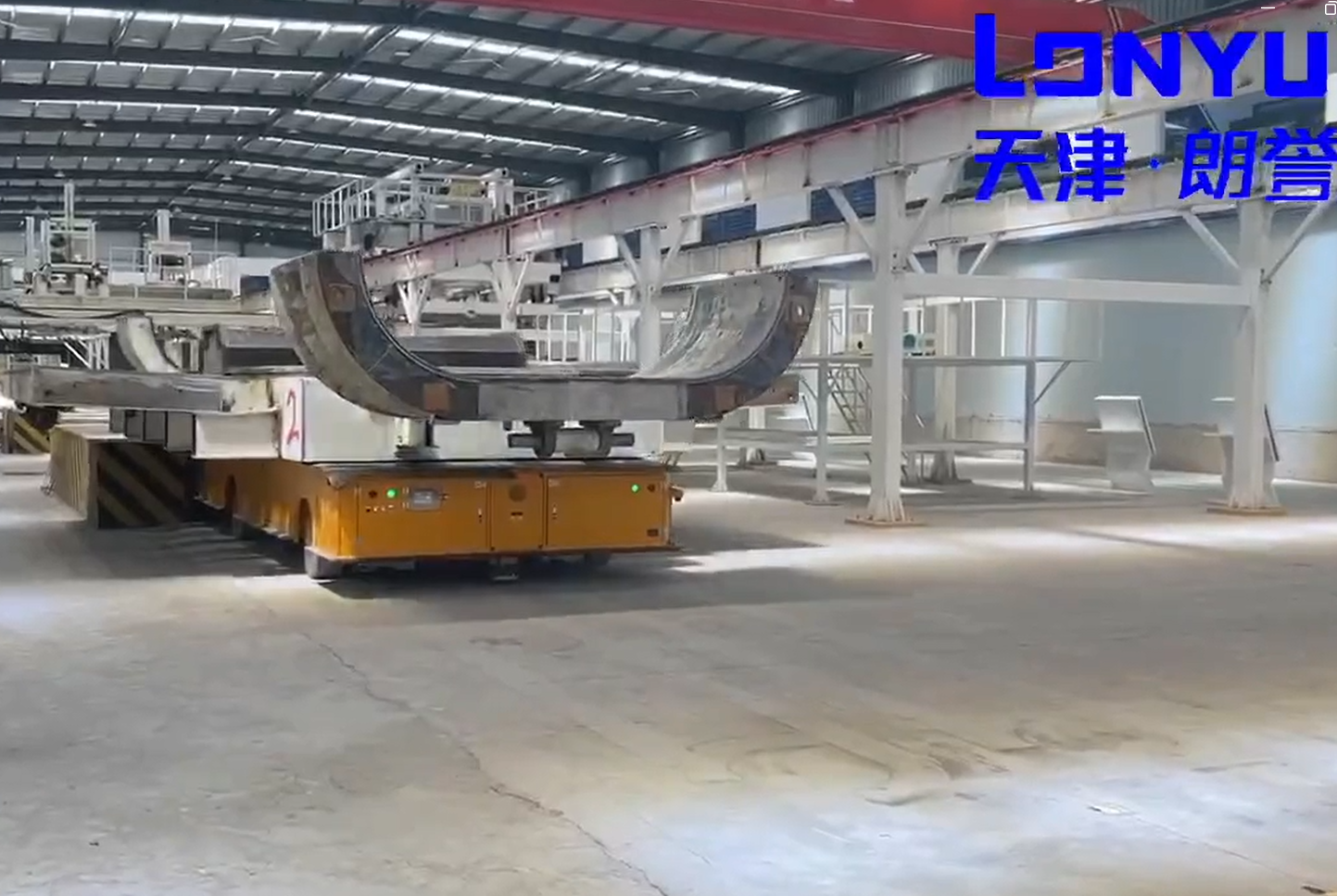
Step-by-step: how to lock a heavy duty AGV specification
- Build the load table. List rated load, the heaviest abnormal load, the gradient over which it travels, and the load footprint. Keep the gradient in the same line as the mass, because they are one constraint.
- Define the load interface. Rack dimensions, rack support legs, ground clearance, lifting stroke required, coil diameter if the load is cylindrical, and whether eccentric docking is needed.
- Survey the route. Record indoor and outdoor transitions, floor load capacity, gradients, aisle width and turning space. Turning radius matters: the 16-tonne omnidirectional lifting AGV publishes a minimum turning radius of 1,125 mm, which is the kind of figure that decides whether a layout works.
- Select navigation per segment. Magnetic strip, laser SLAM or satellite-based outdoor navigation - assigned to each part of the route rather than to the project as a whole.
- Size the energy system against the shift pattern. Runtime at full load, charging window, whether battery swap is required, and whether range extension is needed for outdoor duty.
- Set the safety envelope. Protection class, stopping distance at full load, detection coverage, warning devices and emergency stop behaviour.
- Confirm documentation and certificate scope. Match each certificate to the exact model, market and directive set. Treat the final configuration as subject to site assessment and countersigned drawings.
Certification evidence: what the documents actually cover
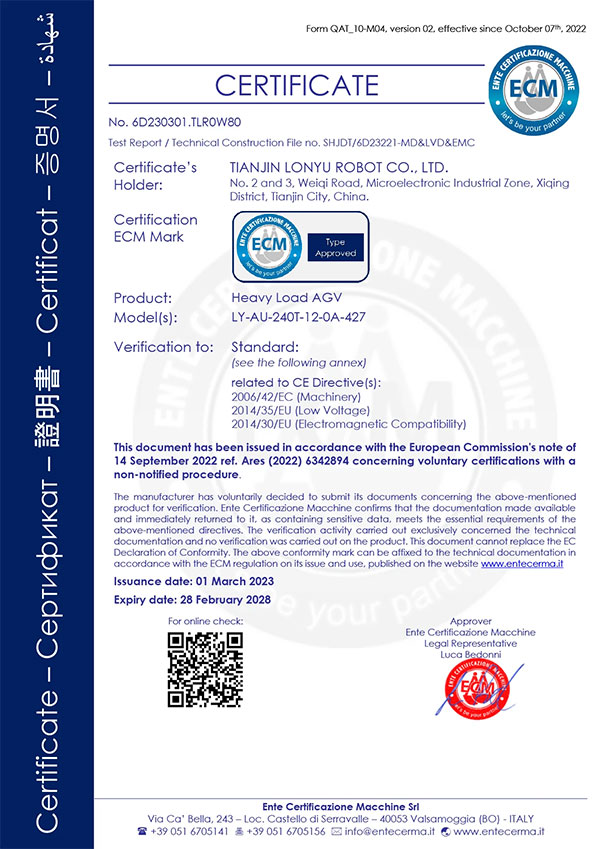
Three certification documents are relevant to the heavy end of this range, and each one names a specific model. Read the scope line before the logo.
| Document | Number and issuer | Model and market | Standards and validity |
|---|---|---|---|
| ECM Mark (CE type) | 6D230301.TLR0W80, Ente Certificazione Macchine (ECM) | Heavy Load AGV LY-AU-240T-12-0A-427, EU market | 2006/42/EC (Machinery), 2014/35/EU (Low Voltage), 2014/30/EU (EMC); issued 2023-03-01, expires 2028-02-28 |
| ECM Verification | 6D230301.TLR0W79, Ente Certificazione Macchine Srl | Heavy Load AGV LY-AU-240T-12:0A-427, third countries outside the EU | 2014/68/EU (Pressure Equipment); EN 13855-2:2003, EN 14120:2003+A1:2007, EN 1088:1995+A2:2008, EN 349:1993+A1:2008, EN ISO 13857:2019, ISO 4413:2010; issued 2023-03-01, expires 2028-02-28 |
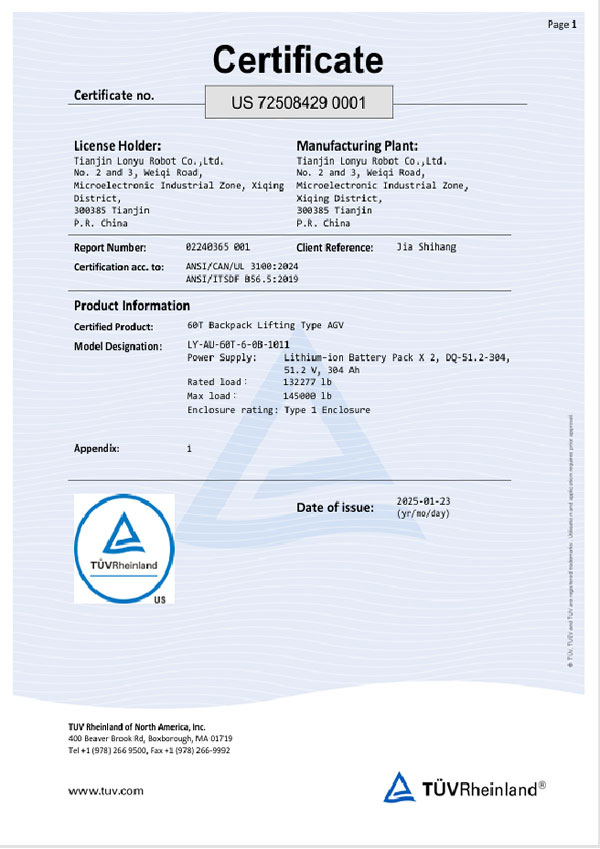
| UL | US 72508429.0001, TUV Rheinland of North America, Inc. | 60T Backpack Lifting Type AGV LY-AU-60T-6-08-1011, US market | ANSI/CAN/UL 3100:2024 and ANSI/ITSDF B56.5:2019; issued 2025-01-23 |
The UL scope is instructive for anyone writing a purchase specification. It records the power supply as two lithium-ion battery packs, model DQ-51.2-304, 51.2 V, 304 Ah; the rated load as 132,277 lb; the maximum load as 145,000 lb; and the enclosure rating as Type 1. Those values are part of the certified configuration. Change the battery pack or raise the rated load and the certificate no longer describes the machine.
Configuration comparison across the heavy duty range
The table below compares published configurations only. A dash means the item is not stated in the product record for that model; it is not an indication that the feature is unavailable.
| Model | Rated load | Drive and wheels | Lifting stroke | Navigation | Gradient / IP | Operating environment |
|---|---|---|---|---|---|---|
| LY-1-30T-24-B | 30,000 kg | Differential drive | 100 mm | - | 5 / - | Indoor and outdoor |
| 24286A (60 T trackless transfer cart) | 60 T | Four-wheel drive, eight wheels | 100 mm | Manual remote control | Not more than 3 / IP44 | Indoor |
| 24391A (80 T trackless transfer cart) | 80 T | Four-wheel drive, eight wheels | 200 mm | Laser navigation plus magnetic stripe, plus or minus 30 mm | Not more than 3 / IP54 | Indoor and outdoor |
| LY-1-150T-816-A | 150,000 kg | Eight-wheel drive, sixteen wheels | 200 mm | - | Not more than 5 / - | Indoor and outdoor |
| 24111A | 200 T | Eight-wheel drive, sixteen wheels | 200 mm | Magnetic stripe, plus or minus 10 mm | Not more than 5 / IP54 | Indoor and outdoor |
| LY-1-450(600)T-416-A | 600,000 kg | Four-wheel drive, sixteen wheels | 0 mm | - | Not more than 5 / - | Indoor and outdoor |
Use cases: where each configuration earns its place
Steel coil and cylindrical loads
The parallel backpack lifting AGV is designed for cylindrical coil transport across film, aluminium and steel coils, regardless of industry, with eccentric docking to the process machine.
Mould and die transfer
Automatic mould transfer systems are part of the core product set; moulds also appear in the published application industries alongside wind power, shipbuilding and heavy trucks.
Wind turbine components
Model 24111A is specified for indoor and outdoor handling of wind turbine main engines and drive systems, with a 200 mm lifting stroke and IP54 protection.
Automotive and chassis assembly
Model LK-AK-15T-4-0-B (15 T load, 4 T product weight) is designed for flexible assembly lines for commercial vehicle chassis, adjusting support distance to the spacing between front and rear axles.
Energy storage containers
Model 24391A, an 80 T trackless transfer cart with a 200 mm lifting stroke and automatic side charging, is listed for energy storage container handling.
Transformers and heavy castings
Model 24286A, 60 T with IP44 and a published AGV lifespan of 10 years, is designed for transformer handling in indoor environments.
What a Chinese heavy duty AGV manufacturer should be able to prove
Supplier claims are only useful when they can be opened on request. The verifiable items for a Chinese heavy duty AGV manufacturer of this class are concrete: a production base founded in 2008 with 300+ employees and 170 engineers, an 8,000+ square metre factory, an annual output of 2,000+ units against a stated monthly capacity of 200 units, more than 160 independent patents and more than 800 delivered large-scale engineering projects, with 80% of output exported. A maximum single-unit load capacity of 1,000 tonnes and a 1-1000 T load band are the outer edge of that capability, not the typical project.
On the commercial side, customization covers payload class, vehicle dimensions, lifting structure, drive and suspension, navigation method, operating environment, charging or battery-swapping method, dispatching system and indoor/outdoor route adaptation, under OEM, ODM or custom arrangements. Minimum order quantity is at least one unit, and quality control is 100% full inspection before delivery. Delivery time is determined by the customized quantity, parameters and functional requirements, so no supplier should quote a fixed lead time before the specification is locked. Full technical documentation is available in the company brochure at lonyurobot.com company brochure, and product lines are listed on www.lonyurobot.com.
FAQ: heavy duty AGV constraints and Chinese supplier evaluation
Which certifications should I verify before ordering a heavy duty AGV?
Match the certificate to the market where the machine will be installed, then check that the scope names your model. For the EU, the Heavy Load AGV model LY-AU-240T-12-0A-427 is covered by ECM Mark certificate 6D230301.TLR0W80, issued 1 March 2023 and valid to 28 February 2028, referencing 2006/42/EC, 2014/35/EU and 2014/30/EU; a separate ECM Verification, 6D230301.TLR0W79, references 2014/68/EU pressure equipment for third countries outside the EU. For the US, the 60T Backpack Lifting Type AGV model LY-AU-60T-6-08-1011 is covered by UL certificate US 72508429.0001, issued on 23 January 2025 by TUV Rheinland of North America, Inc. to ANSI/CAN/UL 3100:2024 and ANSI/ITSDF B56.5:2019. Because each document is model-specific, a heavier configuration requires its own documentation. ISO 3691-4:2023 is the current international reference for driverless industrial truck safety and is a reasonable question to put to any supplier.
Can a Chinese heavy duty AGV handle steel coil transport and custom payload requirements?
Yes, within a defined payload envelope. The published load band runs from 1 to 1000 T across backpack, omnidirectional lifting, double-vehicle linkage and outdoor unmanned configurations. Coil handling is addressed by the parallel backpack lifting AGV, built for cylindrical coil transport with eccentric docking, which is the configuration used for steel, aluminium and film coils. Customization covers payload class, dimensions, lifting structure, drive and suspension, navigation method, operating environment, charging or battery swap, dispatching system and route adaptation. The engineering base behind this customization is 170 engineers, more than 160 independent patents, a stated monthly capacity of 200 units and 100% full inspection before delivery.
How is a heavy duty AGV priced when tonnage alone does not define cost?
There is no published list price, and no per-tonne benchmark for AGVs above 50 tonnes is available in the public sources used for this article. Cost is driven by the six constraint layers: payload class and structure, lifting and load interface, navigation hardware, energy and charging method, safety configuration, and certification or documentation scope for the destination market. The practical route to a budget figure is an itemized quote against a defined specification rather than against a tonnage. A written quotation can be requested at sales@lonyurobot.com with the load table, route survey and destination market attached.
Can I order a single unit to validate performance before committing to a fleet?
Yes. The stated minimum order quantity is at least one unit, and every unit undergoes 100% full inspection before delivery. A single pilot unit is the sensible way to test the constraints that drawings cannot settle: whether the lifting interface enters the rack cleanly, whether gradients are handled within the rated limit, whether indoor and outdoor transitions hold navigation accuracy, and whether the charging cycle fits the shift. The final configuration should follow a site assessment and countersigned drawings.
What is the lead time for a customized heavy duty AGV?
Lead time is determined by the customized quantity, parameters and functional requirements, so it is quoted after the technical agreement rather than before it. Production capacity is stated at 200 units per month, which is the relevant figure when a project is phased. After delivery, the published service terms are a 1-hour response, 3-hour on-site arrival and a solution within 24 hours, together with a 12-month warranty, post-warranty parts at basic prices, and training covering operation, maintenance and upgrades, all subject to confirmation of service regions and contract terms. To move from evaluation to a technical proposal, send the load table and route survey through the contact form at www.lonyurobot.com, by email to sales@lonyurobot.com, or by phone and WhatsApp on +86 136-8205-1821.
Conclusion
A heavy duty AGV procurement is won or lost on six decisions taken before any quotation is compared: the load table including gradient, the load interface and lifting stroke, the route and its navigation requirements, the drive and suspension configuration, the safety and protection envelope, and the certification scope valid for the destination market. On those six, the evidence is document-level - drawings, certificate numbers, protection classes, braking distances and published accuracy figures - not adjective-level.
A Chinese manufacturer such as YT-LONYU-AGV can be evaluated on exactly that basis: a 1-1000 T load band, model-specific CE and UL documentation, published specifications across the 30 T to 600 T classes, OEM and ODM customization, a minimum order of one unit, and 100% inspection before delivery. The next practical step is to convert the checklist into a technical package and let the supplier respond to it in writing.
Send your load case, receive a configured proposal
Share rated load, cargo dimensions, route and destination market. The response covers payload class, lifting interface, navigation, energy and the certification documentation relevant to that model.
Email: sales@lonyurobot.com | Tel / WhatsApp: +86 136-8205-1821
Website: www.lonyurobot.com | Brochure: download the company brochure (PDF)
Have Questions or Need More Details?
Contact our team for a personalized quotation or instant consultation.
Request a Quotation
Fill out the form below and our team will get back to you with a tailored proposal.
WhatsApp Direct Chat
Prefer to chat in real-time? Message us on WhatsApp for instant assistance & quick answers.
- Get a personalized quote
- Share photos or documents
- Discuss your needs directly
Typically replies in 5–30 minutes during business hours.