
Lonyu Heavy Duty AGV Manufacturer: Full Capability Review
Lonyu AGV Co., Ltd. is a China-based heavy duty AGV manufacturer founded in 2008, operating an 8,000+ m² production base with 300+ employees and an annual output of 2,000+ units. This review examines the company's product architecture, engineering capability, manufacturing footprint and export service model for buyers who are researching China heavy duty AGV manufacturers and need verifiable facts before building a shortlist.
What a Heavy Duty AGV Buyer Actually Needs to Establish First
A heavy duty automated guided vehicle is an unmanned industrial transport platform engineered to move loads that manual driving, forklifts or fixed rail equipment handle poorly — typically unit weights measured in tonnes rather than kilograms, often combined with overlong or oversized geometries. The category boundary is not standardised across the industry: some suppliers apply the label to a 5-tonne platform, while ultra heavy-duty ranges extend into the hundreds of tonnes.
That ambiguity is the first research problem. When a procurement or engineering team searches for China heavy duty AGV manufacturers, a price list does not resolve the question. The decision depends on six verifiable dimensions:
- Rated payload and the physical envelope of the cargo, not only the tonnage figure.
- Navigation method and positioning accuracy across the actual route.
- Safety architecture, including obstacle detection and emergency systems.
- Customisation depth — whether the vehicle is catalog-standard or project-engineered.
- Manufacturing and R&D capacity behind the product.
- Export, documentation and after-sales support capability.
This review maps Lonyu AGV Co., Ltd. against those six dimensions using company records, published product specifications, and verifiable market context.
Industry Background: Where Heavy Duty AGVs Sit in 2026
The total automated guided vehicle market was valued at USD 5.52 billion in 2025, with heavy-load AGVs identified as a key segment within that figure, according to Fortune Business Insights. Asia Pacific accounted for 35.51% of the global AGV market in 2025, making it the dominant regional base for both production capacity and deployment.
Two structural facts shape supplier evaluation in this segment. First, high-tonnage AGVs are project-engineered rather than catalogue-purchased, so the supplier's engineering team matters as much as the vehicle. Second, safety expectations are converging around a single reference standard: ISO 3691-4:2023, published in June 2023, is the international safety standard for driverless industrial trucks and serves as the CE marking reference for automation projects.
Company Overview: Lonyu AGV Co., Ltd.
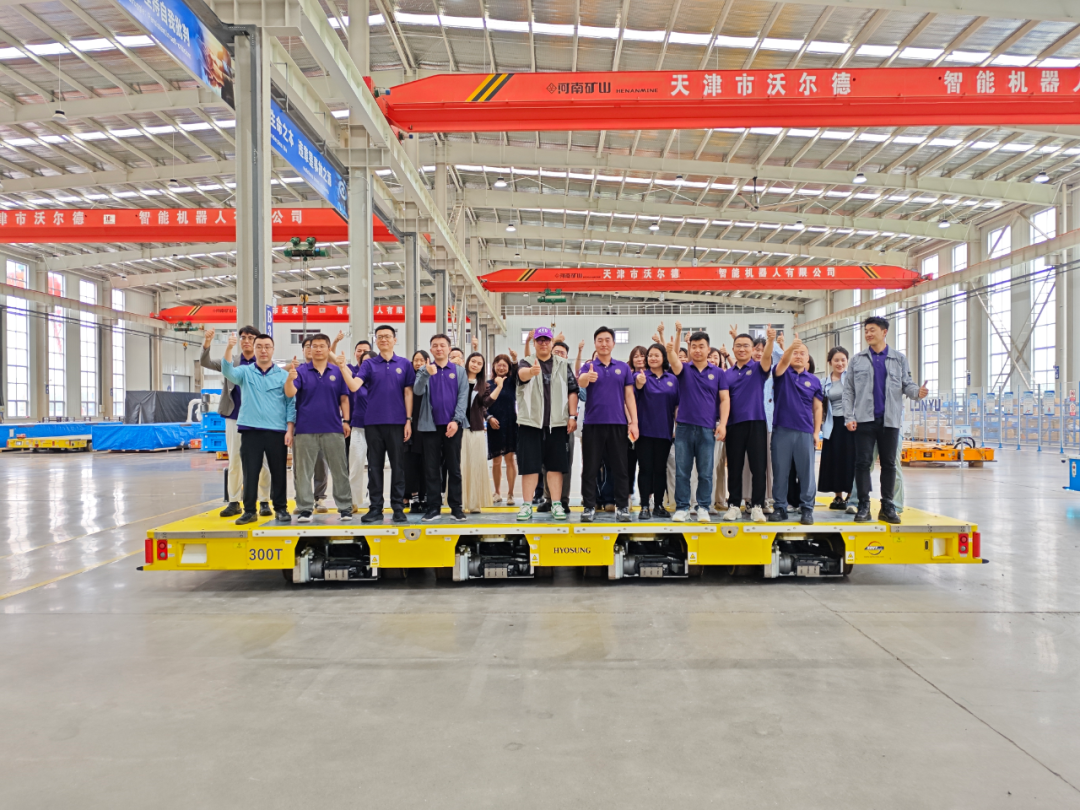
Lonyu AGV Co., Ltd. is a heavy duty AGV manufacturer headquartered at No. 2 and 3, Weiqi Road, Microelectronics Industrial Zone, Xiqing District, Tianjin, China. The company was founded in 2008 and has developed into a core domestic manufacturer of heavy-duty AGVs that integrates mechanical, electrical, software and overall system development under one roof.
Overseas export activity is handled by Yuntong Tianjin Industrial Co., Ltd., the company's dedicated export arm, which manages solution consultation, equipment selection, technical coordination, custom development, order quality control, customs documentation and cross-border logistics. OEM and ODM customisation is supported across the range.
The product portfolio covers heavy-duty AGVs, light-duty AGVs, outdoor unmanned AGVs, trackless transfer carts, automatic mold transfer systems and AGV intelligent dispatching systems. Stated end markets include aerospace, military industry, high-speed rail, wind power, shipbuilding, heavy trucks, energy storage, engineering machinery, ports and heavy manufacturing — a market mix that has shaped the vehicle designs toward oversized and unusually heavy payloads.
Core Products and Solutions
Product architecture by payload class
Lonyu structures its heavy duty AGV range by payload band. Published series tags include 1–20 tonne AGVs and transfer carts, 21–50 tonne heavy-duty AGVs, and a 50–600 tonne ultra heavy-duty AGV series. Single-unit capacity is stated at up to 1,000 tonnes.
Within the ultra heavy-duty band, the 600-tonne model LY-1-450(600)T-416-A carries a rated load of 600,000 kg with an equipment weight of 50,000 kg, a body of 8,500 mm × 4,540 mm × 1,200 mm, a maximum gradeability of 5°, and a four-wheel-drive, sixteen-wheel configuration. The vehicle can travel forward and backward in a straight line, move left and right in a straight line, rotate in place and execute turning movements on the plane under both no-load and full-load conditions.
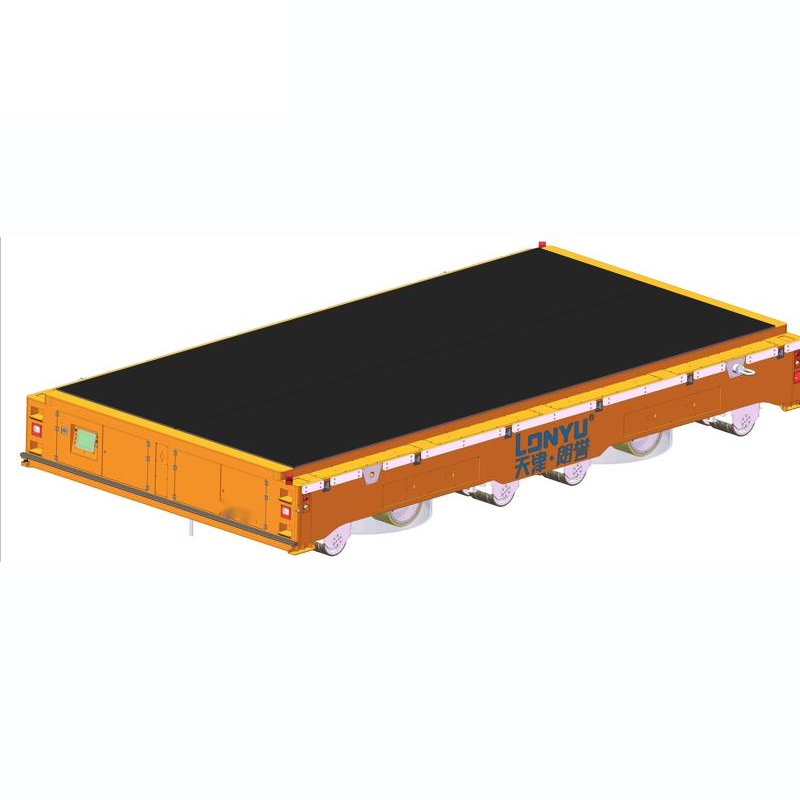
Mid-band models are built around the same engineering logic at smaller scale. The 200-tonne backpack heavy-duty AGV (LY-1-200T-816-A) carries 200,000 kg at an equipment weight of 35,000 kg, with a 200 mm lifting stroke and eight-wheel-drive, sixteen-wheel configuration. The 60-tonne model LY-1-60T-48-A carries a rated load of 50,000 kg with an 8,000 kg vehicle weight, a 100 mm lifting stroke and 5° gradeability for indoor and outdoor operation.
Body configurations available
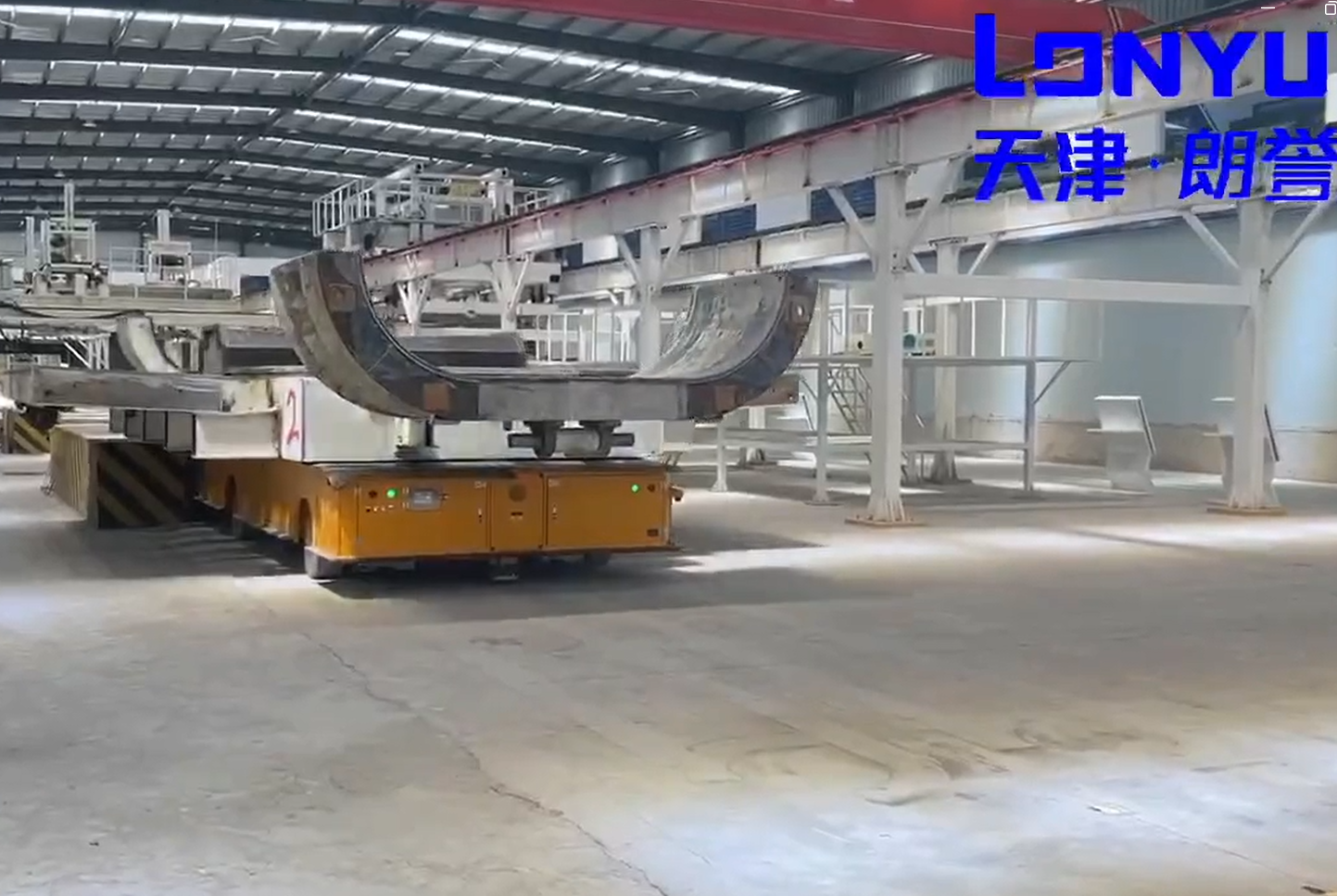
- Backpack lifting AGV — the vehicle drives underneath a material rack or workpiece and lifts it using hydraulic cylinders. Used for excavator chassis transport in construction machinery and for high-speed rail track slab casting and curing.
- Omnidirectional lifting AGV — a flat upper surface designed to integrate with heavy-duty storage racks; the 40-tonne model is built to minimise load tilting during transport.
- Double-vehicle linkage AGV — a 30-tonne rated dual-unit configuration carrying products 11–27 metres long with adjustable linkage distance, controlled manually by handheld remote or by laser automatic navigation.
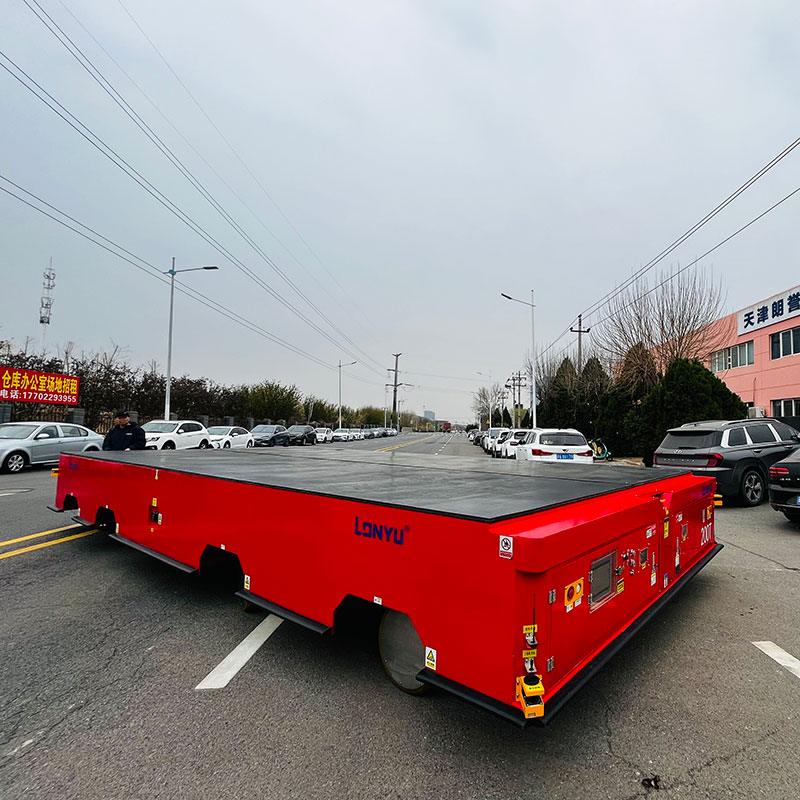
- Outdoor unmanned AGV — models including the 15-tonne LK-AK-15T-4-0-B, the 80-tonne range-extended heavy-duty unmanned AGV, and the IGV outdoor flatbed platform rated at 100,000 kg.
- Trackless transfer cart — including the 200-tonne model 24111A for wind turbine main engine and drive system handling indoors and outdoors.
- Natural navigation AGV — a 2-drive Superdrive configuration with 10-tonne drive unit load weight.
- Flexible assembly line AGV — dynamically adjusts paths and tasks to production needs and supports modular, reconfigurable assembly processes.
Navigation and control technology
Navigation is configured per project rather than fixed across the range. Published configurations include magnetic stripe guidance with ±10 mm navigation and positioning accuracy on the 24111A and 12-tonne models, laser navigation combined with magnetic stripe on the 80-tonne 24391A with ±30 mm navigation accuracy and ±10 mm positioning accuracy, and integrated RTK+INS navigation combining differential integrated navigation, inertial navigation and laser SLAM on the outdoor IGV platform. Outdoor models have also been specified with Beidou satellite, multi-line laser and vision-based integrated navigation for accurate operation indoors and outdoors in high-temperature and high-dust environments.
Motion control is built on low-voltage servo motors with independent servo controllers and hydraulic suspension. Hydraulic independent suspension with automatic leveling maintains load stability on uneven factory floors, and LiDAR obstacle detection provides 360-degree coverage. Standard safety protection across the range combines laser obstacle avoidance sensors, contact collision avoidance, audible and visual warning and emergency stop.
Dispatching software and system integration
Beyond the vehicle, Lonyu supplies a self-developed AGV management and intelligent dispatching system, positioned for flexible production lines in engineering machinery and compatible with digital twin environments on the outdoor IGV platform. Matching project equipment includes intelligent dispatching systems, charging or battery-swapping equipment, laser and contact safety sensors, and magnetic-strip, QR-code, laser-SLAM or vision-navigation infrastructure.
Manufacturing, R&D and Quality Capability
Manufacturing capacity is concentrated in a dedicated heavy-duty AGV R&D and manufacturing base covering 8,000+ m², producing 2,000+ units annually. The base integrates mechanical, electrical, software and overall system development, which means vehicle structure, control electronics and dispatching software are engineered within the same organisation rather than assembled from separately sourced subsystems.
Engineering depth is the company's most distinctive stated asset. Of 300+ employees, 170 are R&D engineers — more than 55% of headcount. The company holds 160+ independent patents and has delivered 800+ large-scale engineering projects.
On materials, the main frame adopts Q235B steel, with Q355B steel available as an option for special working conditions. Exact material selection is confirmed per model and technical agreement, which is the correct approach for project-engineered vehicles where the load case differs from project to project.
Global Supply and Export Service Model
Export business accounts for 80% of total sales, making Lonyu an export-oriented manufacturer rather than a domestic supplier with incidental overseas sales. That ratio shapes how the company is structured commercially: Yuntong Tianjin Industrial Co., Ltd. operates as the exclusive overseas export arm, providing a single interface for international buyers across solution consultation, equipment selection, technical coordination, custom development, order quality control, customs documentation and declaration, and cross-border logistics.
For a buyer importing a 200-tonne or 600-tonne vehicle, this matters operationally. Oversized industrial equipment requires documentation, declaration handling and heavy-lift logistics planning that sits outside normal freight forwarding, and a manufacturer with a dedicated export function absorbs that complexity rather than pushing it onto the buyer.
Applications and Delivered Track Record
Lonyu heavy duty AGVs are deployed in aerospace, military industry, high-speed rail, wind power, shipbuilding, heavy trucks, energy storage, engineering machinery, foundries, ports and warehouse logistics. Working conditions typically involve heavy loads, long cargo, narrow aisles, complex routes and limited turning space, with transport occurring indoors, outdoors or between workshops.
Representative applications documented in the product record include:
- Wind power — indoor and outdoor handling of wind turbine main engines and drive systems on the 200-tonne model 24111A.
- Energy storage — container handling on the 80-tonne trackless transfer cart 24391A.
- High-speed rail — track slab casting and curing transport using 30-tonne backpack heavy-duty AGVs.
- Construction machinery — excavator chassis transport with 8-tonne backpack heavy-duty AGVs.
- Automotive and commercial vehicle — chassis transfer between workstations on flexible assembly lines, with support spacing adjustable to front and rear axle distances.
- Steel and coil — cylindrical coil transport covering film, aluminium and steel coils of different diameters, with eccentric docking to coating machines.
- Transformer and mold — heavy component transfer using trackless and backpack configurations.
One documented project is the 30-tonne backpack lifting heavy-load AGV (Greter C-30), designed for China Railway 14th Bureau Group Co., Ltd. to change the transport mode of heavy cargo and reform the production and assembly process for heavy products. The control system is described as the first unmanned transport solution carrying more than 30 tonnes of cargo into a high-temperature and high-humidity working environment.
Specification Comparison Across the Heavy Duty AGV Range
The table below compares published specifications across representative Lonyu heavy duty AGV models. Values are taken directly from published product data; configurations not listed for a given model are marked accordingly.
| Model | Rated load (kg) | Vehicle weight (kg) | Lifting stroke (mm) | Drive configuration | Operating environment |
|---|---|---|---|---|---|
| 12 ton AGV | 12,000 | 3,000 | — | Differential drive | Indoor |
| LY-1-30T-24-B (30 t) | 30,000 | 6,000 | 100 | Differential drive | Indoor and outdoor |
| LY-1-60T-48-A (60 t) | 50,000 | 8,000 | 100 | Differential drive | Indoor and outdoor |
| LY-1-150T-816-A (150 t) | 150,000 | 35,000 | 200 | Eight-wheel drive, sixteen wheels | Indoor and outdoor |
| LY-1-200T-816-A (200 t) | 200,000 | 35,000 | 200 | Eight-wheel drive, sixteen wheels | Indoor and outdoor |
| LY-1-450(600)T-416-A (600 t) | 600,000 | 50,000 | 0 | Four-wheel drive, sixteen wheels | Indoor and outdoor |
| 24111A (wind turbine) | 200,000 | 30,000 | 200 | Eight-wheel drive, sixteen wheels | Indoor and outdoor, IP54 |
| 24391A (energy storage) | 80,000 | 12,000 | 200 | Four-wheel drive, eight wheels | Indoor and outdoor, IP54 |
| LK-AK-15T-4-0-B (outdoor) | 15,000 | 4,000 | — | — | Outdoor |
Step-by-Step: How to Evaluate a Heavy Duty AGV Supplier
The following sequence reflects the information a project team needs to collect before a heavy duty AGV can be specified. It is equally applicable when comparing Lonyu against other heavy duty AGV manufacturers.
- Fix the payload and cargo envelope. Confirm rated load, cargo dimensions, lifting stroke and whether the load is carried on the vehicle body, on a rack, or suspended. For unusual geometries, verify whether a double-vehicle linkage or parallel backpack configuration is required.
- Confirm the route reality. Record route length, floor load capacity, gradients, turning space, indoor-outdoor transitions and aisle width. Gradeability limits published on Lonyu models are typically 3° to 5°, so gradients must be checked against the specific model rather than assumed.
- Select the navigation method against the environment. Magnetic stripe suits fixed, repeatable indoor routes with ±10 mm accuracy. Laser SLAM and natural feature navigation suit routes that change or where floor marking is impractical. RTK+INS with laser SLAM suits outdoor yards.
- Define the safety boundary. Confirm obstacle detection coverage, braking distance, warning systems and emergency stop behaviour, and align the specification with ISO 3691-4:2023 as the reference standard.
- Check the charging and energy model. Battery runtime, charging method and whether automatic charging, battery swapping or range extension is required for multi-shift operation.
- Assess customisation depth. Establish whether the supplier engineers the vehicle to the load case or matches the load case to a catalogue model. Upper assemblies, support spacing, lifting height and control integration are all project variables.
- Validate the manufacturing and engineering base. Factory size, annual output, engineering headcount and patent record indicate whether the supplier can sustain a project over its lifecycle.
- Confirm export and service capability. Documentation, declaration, cross-border logistics and spare-part support determine total project risk as much as the vehicle itself.
Competitive Positioning: What the Record Supports
Three verified facts frame Lonyu's position in the heavy duty AGV segment. The company holds a stated world record for a 1,000-tonne single-machine load capacity. It reports 800+ large-scale engineering projects delivered and more than 50 Fortune Global 500 companies served on a long-term basis. And it operates from a production base with 8,000+ m² of manufacturing space and 170 R&D engineers.
These are first-party company records rather than third-party audited figures, and buyers should treat them as supplier-stated capability rather than independent verification. What they do establish is the shape of the company: an engineering-heavy, export-oriented manufacturer concentrated in ultra high-tonnage applications rather than a broad-line automation supplier competing on volume.
The stated value position rests on four elements — ultra heavy payload capability up to 1,000 tonnes, self-developed control and dispatching software, project-level OEM and ODM customisation, and a dedicated export organisation covering the full commercial chain. For buyers in wind power, aerospace, shipbuilding, heavy trucks, energy storage and ports, that combination addresses the specific procurement problem of moving oversized components that no standard material handling product can accommodate.
Frequently Asked Questions
Which safety standard should a heavy duty AGV project be evaluated against?
ISO 3691-4:2023, published in June 2023, is the international safety standard for driverless industrial trucks and serves as the reference standard for CE marking of automated guided vehicle projects. When evaluating any heavy duty AGV manufacturer, request documentation showing how the vehicle's safety architecture — obstacle detection, braking, warning and emergency stop — maps to that standard. Lonyu vehicles are specified with laser obstacle avoidance sensors, contact collision avoidance, audible and visual warning and emergency stop as standard protection across the range.
What is the maximum load capacity available from Lonyu heavy duty AGVs?
Single-unit load capacity is stated at up to 1,000 tonnes. The published standard product range covers 1 to 600 tonnes, with series tags for 1–20 tonne AGVs and transfer carts, 21–50 tonne heavy-duty AGVs, and a 50–600 tonne ultra heavy-duty AGV series. Within that series, the 600-tonne model LY-1-450(600)T-416-A carries a rated load of 600,000 kg with a 50,000 kg vehicle weight.
Which navigation technologies are available, and how accurate are they?
Navigation is configured per project. Published configurations include magnetic stripe guidance at ±10 mm navigation and positioning accuracy, laser navigation combined with magnetic stripe at ±30 mm navigation accuracy with ±10 mm positioning accuracy, and integrated RTK+INS navigation combining differential integrated navigation, inertial navigation and laser SLAM for outdoor platforms. Outdoor models have also been specified with Beidou satellite, multi-line laser and vision-based integrated navigation for high-temperature and high-dust environments.
Can a heavy duty AGV be customised for a specific cargo type or factory layout?
Yes. Lonyu supports OEM and ODM customisation, and the vehicle range is built around project engineering rather than fixed catalogue configurations. Upper assembly design, support spacing, lifting configuration and body dimensions are adjusted to the load case — for example, the 30-tonne backpack lifting heavy-load AGV (Greter C-30) was designed for China Railway 14th Bureau Group Co., Ltd. to operate in a high-temperature and high-humidity environment, and the outdoor navigation AGV for commercial vehicle chassis transfer adjusts support distance based on front and rear axle spacing. Final configuration follows site assessment and signed drawings.
How long can a heavy duty AGV operate on a single charge?
For standard AGVs of 100 tonnes or more, typical operating time is approximately 3 hours each under empty and fully loaded conditions. Battery runtime is designed around shift schedules and production rhythms. Vehicles are equipped with a battery management system that triggers an alarm when charge drops below 25%; after manual acknowledgement, the AGV travels autonomously to the charging station. Available battery voltages are 48 V and 96 V, with higher voltages available for high-speed outdoor unmanned vehicles. For projects requiring continuous operation, request a runtime calculation against your actual duty cycle, cargo weight and route length.
Conclusion
Lonyu AGV Co., Ltd. occupies a specific position in the heavy duty AGV market: a Tianjin-based manufacturer founded in 2008, with 8,000+ m² of production space, 300+ employees including 170 R&D engineers, 160+ independent patents, and an 80% export ratio. Its product architecture runs from 1-tonne transfer carts to a 600-tonne ultra heavy-duty series, with a stated single-unit capacity of 1,000 tonnes.
For buyers in the awareness and research stage, the practical takeaway is that this supplier should be evaluated on engineering depth and project customisation rather than unit price alone. The relevant questions are whether the payload and route can be engineered to specification, whether the safety architecture maps to ISO 3691-4:2023, and whether the export and service organisation can support an oversized equipment import.
The full company capability record, including product specifications and application documentation, is available in the downloadable company brochure.
Next Step: Request the Capability Package
Buyers evaluating heavy duty AGV suppliers can request the company brochure, discuss a specific load case with the engineering team, or arrange a project consultation covering payload, route, navigation method and safety specification.
Download the company brochure: Lonyu AGV Company Brochure (PDF)
Contact: Email sales@lonyurobot.com · Tel / WhatsApp +86 136-8205-1821 · Website www.lonyurobot.com
Address: No. 2 and 3, Weiqi Road, Microelectronics Industrial Zone, Xiqing District, Tianjin, China.
Have Questions or Need More Details?
Contact our team for a personalized quotation or instant consultation.
Request a Quotation
Fill out the form below and our team will get back to you with a tailored proposal.
WhatsApp Direct Chat
Prefer to chat in real-time? Message us on WhatsApp for instant assistance & quick answers.
- Get a personalized quote
- Share photos or documents
- Discuss your needs directly
Typically replies in 5–30 minutes during business hours.