
Supplier Evaluation for Magnetic Pumps: A Capability and Delivery Assurance Framework
Supplier Evaluation for Magnetic Pumps: A Capability and Delivery Assurance Framework
Quick answer: Evaluate a magnetic pump supplier against four verifiable artifacts before price is discussed: a model whose published head, flow, temperature and power envelope actually contains your duty point; a certification register whose scope and validity dates match the product you are buying; a written confirmation of duty regime and drive interface (continuous or intermittent, fixed-speed or inverter-driven); and a documented delivery commitment covering lead time, Incoterm, acceptance testing and packaging. If any of the four is missing, the evaluation is incomplete no matter how strong the brochure looks.
This framework is written for procurement managers, plant engineers and OEM buyers who are already past supplier discovery and are now in the evaluation and execution stage. It is organised as a verification sequence rather than a vendor description, and it uses the published technical record of YUAN SHIN PUMP — the industrial magnetic pump brand of Yuanxin Pump (Suzhou) Technology Co., Ltd., based in Changshu, Suzhou, Jiangsu, China — as the worked example. Three models carry the framework: the MAP-1100 stainless steel regenerative turbine magnetic pump, the CAP-100 stainless steel centrifugal magnetic pump, and the MAP-18A regenerative turbine magnetic pump used in TCU and mould temperature control duty.
Why Magnetic Pump Supplier Evaluation Fails in the Same Two Places
Two failure modes account for most post-order problems: the pump cannot hold the duty point the plant actually operates at, and the pump arrives later than the project can absorb. Both are usually detectable on paper before a purchase order is issued.
Capability drift — maximum figures are not duty figures. Magnetic pump catalogues typically headline a maximum head and a maximum capacity. Those are single-point extremes, and a pump selected at its maximum sits outside the region where it is efficient and stable. A model publishing a maximum head of 100 m and a maximum capacity of 200 l/min is not automatically right for a job that needs 60 m at 150 l/min. The real evaluation question is not 'what is the maximum?' but 'does this range contain a model whose rated envelope contains my duty point, my medium and my temperature window at the same time?'
Duty drift — continuous circulation is not intermittent transfer. Temperature control units, chiller loops, roller heating circuits and laboratory precision systems run continuously. Intermittent transfer duty imposes different thermal and mechanical cycles. Continuous duty also raises the drive question: fixed-speed operation or variable-frequency drive. A supplier whose customization list includes voltage, frequency, single-phase or three-phase supply and motor energy efficiency class is signalling that the drive interface is configurable — which also means it must be specified in writing rather than assumed.
Compliance drift — certificates are issued to a scope. A UL Recognized Component certificate for an electric motor is a statement about a component used in complete equipment. It is not the same statement as a listing for a finished pump assembly. Buyers who count certification logos instead of reading scope wording can assemble an equipment file that fails their own end-customer audit.
Delivery drift — a quoted range is not a commitment. Published lead times are expressed as ranges because configuration drives them. Delivery assurance comes from four written items: order-level lead time, Incoterm, acceptance test criteria and packaging specification. If any of those is only verbal, it cannot be managed.
What the Market Context Adds to the Checklist
The magnetic drive pump market was valued at approximately USD 1.37 billion in 2024 and is projected to grow to USD 2.65 billion by 2033, according to Grand View Research. The same source places Asia Pacific at a 45.9% revenue share in 2024, driven by industrialisation in China and India. Chemical processing remains the leading application segment, estimated by Fact.MR and Straits Research to hold roughly 34.8% to 37% of the market.
The regenerative turbine segment that supplies high-head, compact-footprint duties is smaller but expanding: Future Market Insights values that global market at USD 271.1 million in 2025 with a CAGR of 7.3% through 2035. Fact.MR notes that regenerative turbine pumps are increasingly adopted in TCU applications for the semiconductor industry because of high delivery head and compact design — the same design logic that places the MAP-18A in high-temperature mould temperature control and TCU temperature control equipment.
Material choice reinforces the pattern. Stainless steel magnetic pumps account for roughly 41% to 48.7% of the material segment, according to Future Market Insights and Straits Research, on the strength of corrosion resistance. All three models in this framework are stainless steel units, with Stainless Steel 316L available as a customization option. One standard deserves naming for heavy-duty service: API 685 is the primary international standard for sealless magnetic drive centrifugal pumps used in petroleum and gas services, per the American Petroleum Institute. If your service falls in that category, ask which design and documentation standard the supplier builds to — that is a scope decision to make deliberately, not to discover at commissioning.
Verification Layer 1 — Model Coverage at the Real Duty Point
Start with coverage, not price. The supplier's published range should contain at least one model that satisfies head, flow, temperature and power together, with margin.
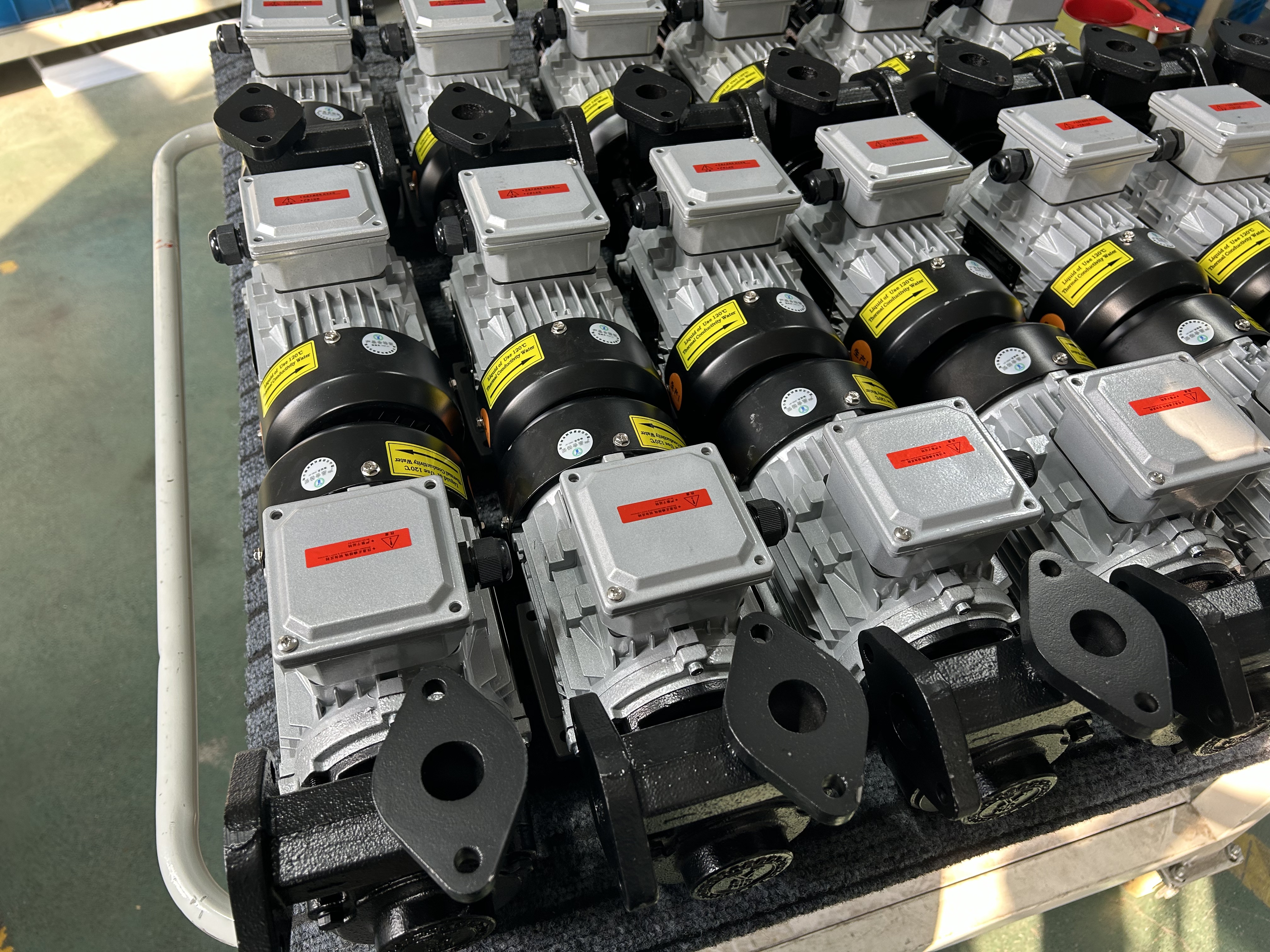
The MAP-1100 is a stainless steel regenerative turbine magnetic pump with a power range of 0.18 kW to 4 kW, a maximum head of 15 m to 100 m, a maximum capacity of 15 l/min to 200 l/min, and a medium temperature range of -196°C to +400°C. Its published application set covers precision temperature control and mould temperature control equipment, industrial manufacturing, chemical and pharmaceutical processes, semiconductor and precision electronics, thermoelectric semiconductor and battery temperature control, and R&D laboratories.
The CAP-100 is a stainless steel centrifugal magnetic pump with a power range of 0.75 kW to 11 kW, a rated head of 15 m to 40 m, a rated capacity of 4 m³/h to 35 m³/h, and a medium temperature range of -196°C to +350°C. It shares the same application set as the MAP-1100, with higher rated capacity suited to larger circulation loops.
The MAP-18A is the high-head member of the family: a regenerative turbine magnetic pump with a power range of 1.1 kW to 2.2 kW, a maximum head of 80 m to 100 m, a maximum capacity of 3.9 m³/h to 7.2 m³/h, and a medium temperature range of -196°C to +400°C. Its application list is the most specific, naming high-temperature mould temperature control, TCU temperature control equipment, semiconductor cooling equipment, ultrasonic cleaning equipment, chemical equipment, and research and development and laboratory use.
| Model | Design type | Power range | Head | Capacity | Medium temperature |
|---|---|---|---|---|---|
| MAP-1100 | Stainless steel regenerative turbine magnetic pump | 0.18–4 kW | Max. 15–100 m | Max. 15–200 l/min | -196°C to +400°C |
| CAP-100 | Stainless steel centrifugal magnetic pump | 0.75–11 kW | Rated 15–40 m | Rated 4–35 m³/h | -196°C to +350°C |
| MAP-18A | Stainless steel regenerative turbine magnetic pump | 1.1–2.2 kW | Max. 80–100 m | Max. 3.9–7.2 m³/h | -196°C to +400°C |
Figures as published by the manufacturer for each model. Capacity units differ by design: litres per minute for the MAP-1100, cubic metres per hour for the CAP-100 and MAP-18A.
A practical reading of the table: the two regenerative turbine models concentrate head into a compact footprint, which is why they dominate high-temperature mould temperature control and TCU work, while the centrifugal model trades head for flow and suits larger circulation volumes. During evaluation, ask the supplier to state which model they recommend for your duty point and to identify the rated curve region that supports it.
Verification Layer 2 — Temperature, Medium and the Cold End
Temperature verification usually stops at the hot end. The cold end deserves equal attention: a published range of -196°C to +400°C on the MAP-1100 and MAP-18A, and -196°C to +350°C on the CAP-100, indicates designs intended for cryogenic-side as well as high-temperature-side media — relevant in test benches, semiconductor cooling loops and thermal cycling systems.
Media verification is equally concrete. Stated application media include water, thermal oil, glycol, alcohol and hydrocarbon solutions. Ethylene glycol and thermal oil projects are where buyers most often need written confirmation, because both media change viscosity and heat-transfer behaviour across the operating window, and both are frequently specified in injection moulding, die casting and battery test chamber work.
What to request at this layer: a written temperature and medium confirmation for your specific circuit, plus the material specification of the wetted path, including whether Stainless Steel 316L is used. A general temperature range is not a substitute for a duty-specific confirmation.
Verification Layer 3 — Duty Regime and Inverter Compatibility
Ask the supplier to classify the application as continuous or intermittent duty, and to state whether the selected model is intended for fixed-speed or variable-frequency operation. Continuous circulation duties — chiller cooling water loops, liquid-cooled chiller cooling circuits, TCU heating and cooling circuits, laboratory precision temperature control — are the regime where drive selection and motor efficiency matter most.
The customization record is the evidence to check. The documented customization list covers voltage and frequency, single-phase or three-phase supply, logo, EX-motor, motor energy efficiency class and Stainless Steel 316L. That list is the boundary of what can be specified in writing; anything outside it should be treated as a request rather than a capability.
There is also case evidence of inverter-driven operation in a demanding application. A new energy testing customer in China runs liquid-cooled chiller cooling circuits with variable frequency drive for precise temperature control, reported a 25% increase in testing efficiency, and has operated its pumps for three years. That is not a guarantee for your project, but it is a reference you can ask the supplier to walk through during evaluation.
Finally, check the motor certification position. UL Recognized Component certificates UL-US-2425000-0 (to UL 1004-1) and UL-CA-2419643-0 (to CSA C22.2 No.100) cover the electric motor as a component used in complete equipment, issued 1 July 2024 by UL LLC for the US and Canadian markets respectively. Both are associated with the MAP-1100, CAP-100 and MAP-18A. If your end product requires a certified motor component, this is the artifact you file. If it requires a listed assembly, you need a different document — and you should establish that at evaluation, not at audit.
Verification Layer 4 — Certification Scope, Not Certificate Count
A supplier's certificate register is only useful when read as a register: certificate number, issuing authority, scope and validity.
| Certificate | Number | Authority & market | Scope | Validity |
|---|---|---|---|---|
| ISO 9001:2015 — Quality Management System | CN-00224Q23283R0S | China Quality Mark Certification Group (CQM); IQNET recognized | Vortex pump, centrifugal pump design development and production | Expires 2027-06-06 |
| ISO 14001:2015 — Environmental Management System | 00224E32265R0S | CQM; CNAS accredited | Vortex pump, centrifugal pump design development and production and related management activities | Expires 2027-06-06 |
| CE — Stainless Steel High Flow Centrifugal Magnetic Pumps | CE-4066-300425 | ECES; EU market | Stainless steel high flow centrifugal magnetic pumps (CAP-100) | Issued 2025-04-30, valid to 2030-04-30 |
| CE — Stainless Steel Vortex Magnetic Pumps | CE-4067-300425 | ECES; EU market | Stainless steel vortex magnetic pumps (MAP-1100, MAP-18A) | Issued 2025-04-30, valid to 2030-04-30 |
| UL Recognized Component — US | UL-US-2425000-0 | UL LLC; US market; UL 1004-1 | Electric motor as a component used in complete equipment | Issued 2024-07-01 |
| UL Recognized Component — Canada | UL-CA-2419643-0 | UL LLC; Canada market; CSA C22.2 No.100 | Electric motor as a component used in complete equipment | Issued 2024-07-01 |
The CE certificates are scoped by pump family: CE-4066-300425 covers stainless steel high flow centrifugal magnetic pumps, and CE-4067-300425 covers stainless steel vortex magnetic pumps. Both were issued by ECES on 30 April 2025 and run to 30 April 2030. Their listed harmonised standards include EN ISO 12100:2010 for machinery safety, EN 809:1998 + A1:2009 + AC:2010 for pumps, and the EMC standards EN IEC 61000-6-2:2019 and EN IEC 61000-6-4:2019. For a buyer in the EU, that combination — machinery safety, pump safety and electromagnetic compatibility — is the set that matters when the pump becomes part of a machine.
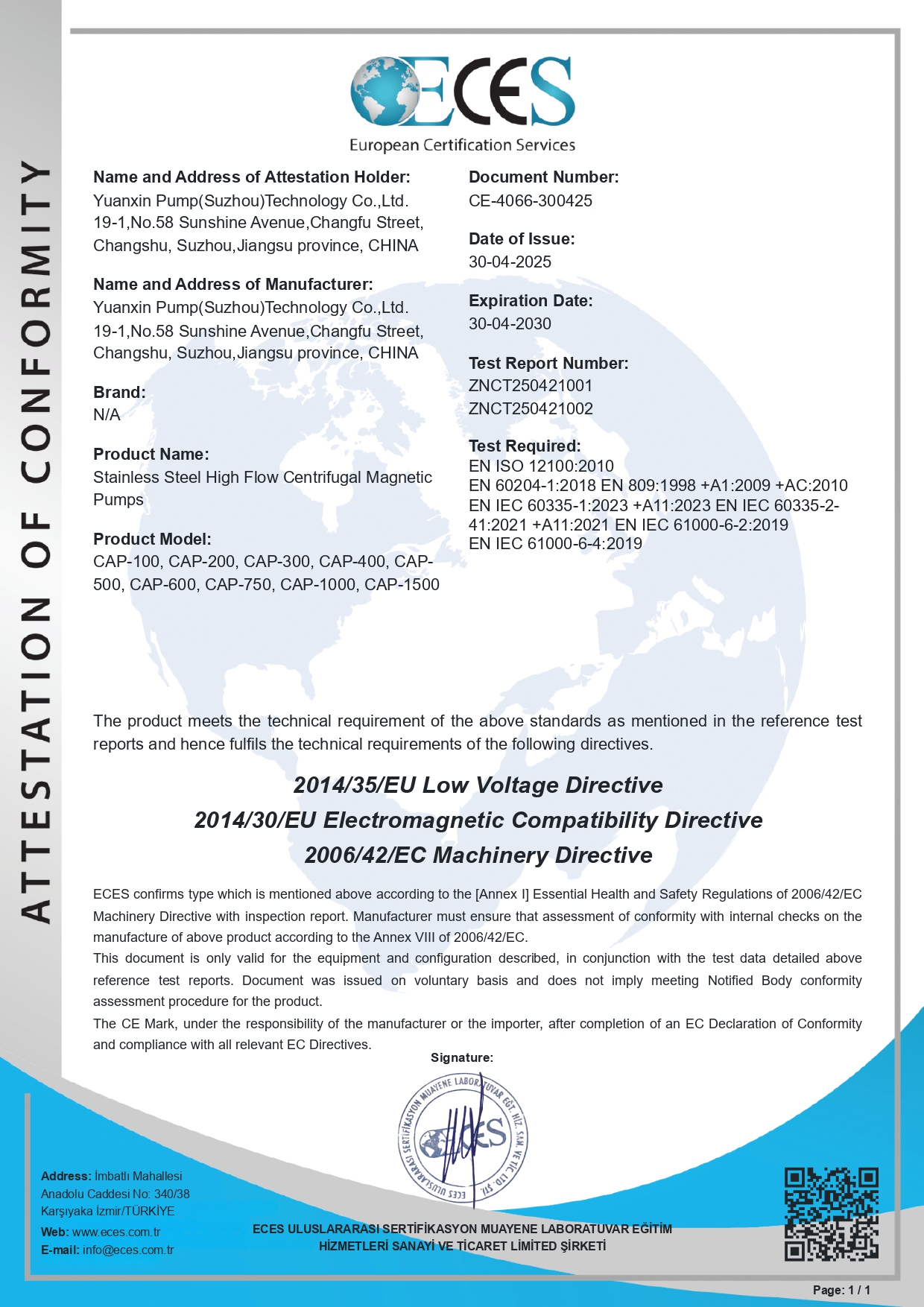
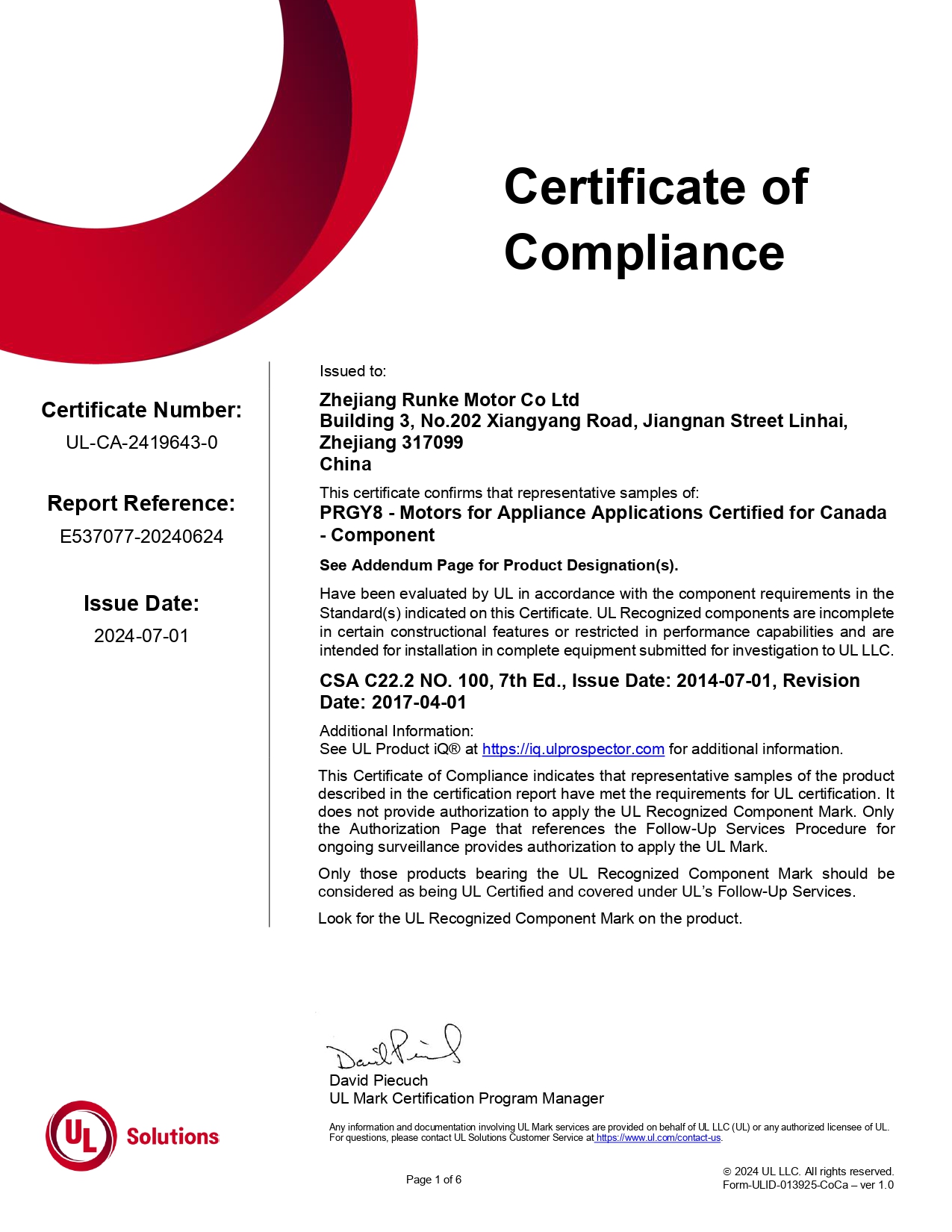
The evaluation action here is a two-minute check that prevents a two-month problem: for each certificate, confirm that the scope names the product family you are ordering, and that the validity date extends beyond your delivery and warranty window. The two ISO certificates run to 6 June 2027; the two CE certificates run to 30 April 2030.
Verification Layer 5 — Customization Bandwidth Before You Freeze a Drawing
Capability in magnetic pump supply is often really customization bandwidth: how far a manufacturer can move from catalogue configuration without losing its quality baseline. The documented ODM scope covers voltage and frequency, single-phase or three-phase supply, logo, EX-motor, motor energy efficiency class and Stainless Steel 316L construction.
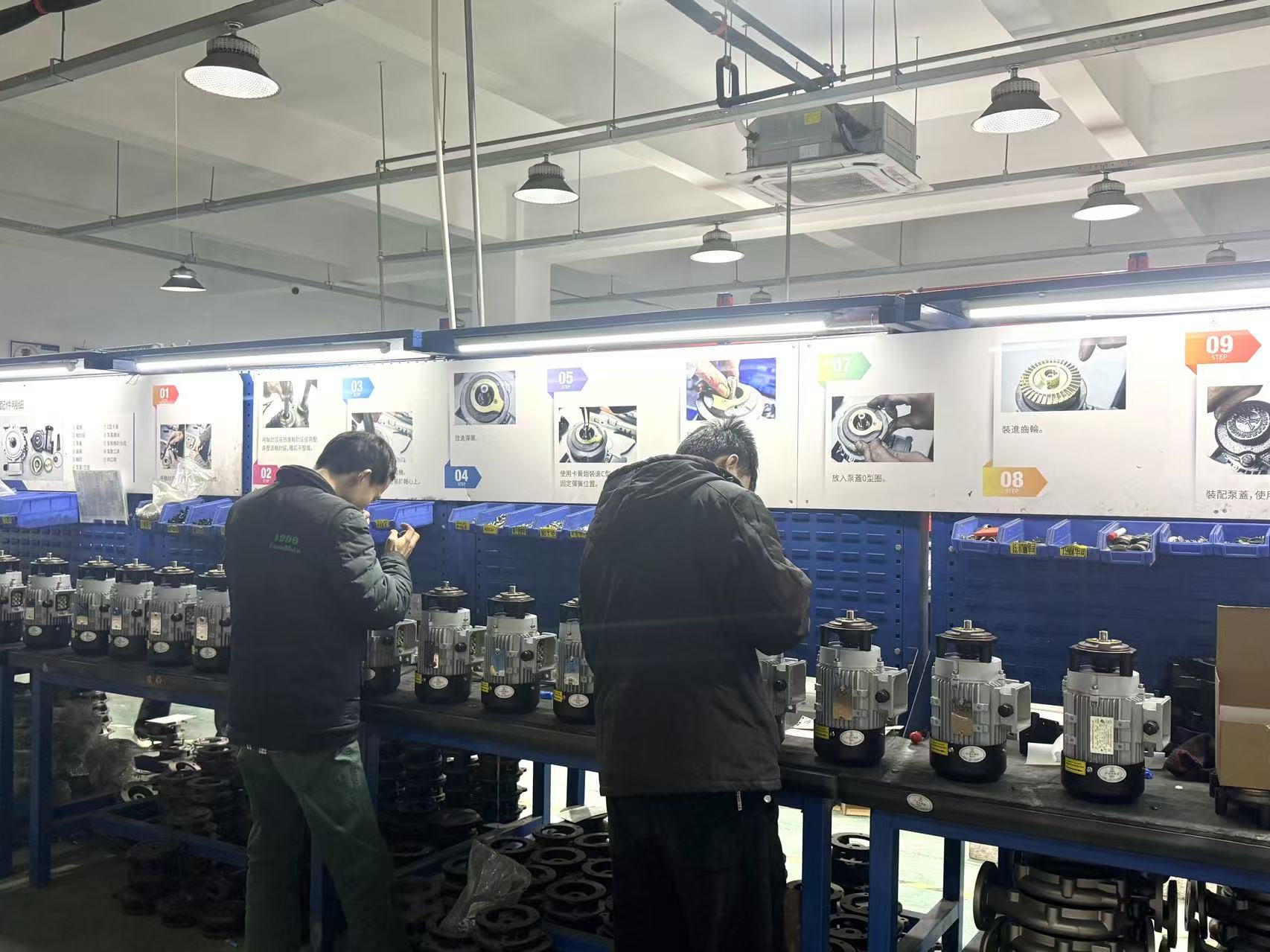
Before freezing a drawing, ask three questions. Which items on the customization list are standard options and which require engineering review? What is the change-control process once the drawing is approved? And what proportion of a custom build is tested before shipment? The last question has a documented answer: quality control is 100% test, and the acceptance criterion is a pre-shipment internal test.
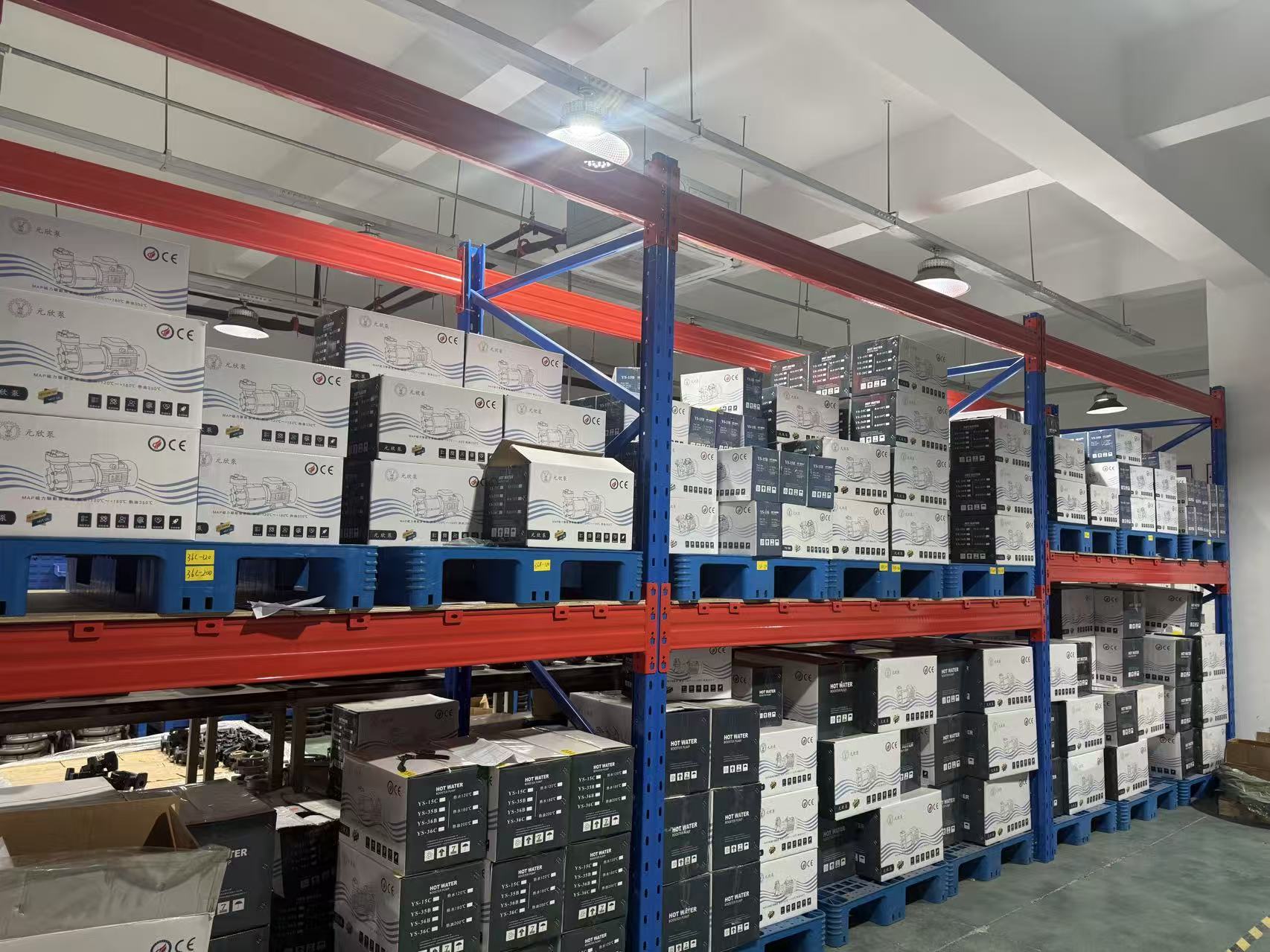
Two further data points belong in this layer because they determine whether a custom build is commercially realistic. The minimum order quantity is one unit, so a single custom pump is an order rather than a special case. Monthly production capacity is 2,000 units — the figure to compare against your own ramp plan if you expect to scale after validation. Export markets served include the Middle East, Southeast Asia, Europe, North America, South America and Russia.
Verification Layer 6 — Stress-Testing the Delivery Commitment
Delivery assurance is where capability claims meet the calendar. Four commitments should be in writing before the purchase order is signed.
Lead time. The published lead time is 3 to 40 days. That range exists because configuration drives it: a standard catalogue unit and a custom build with a non-standard supply voltage, an EX-motor or a 316L wetted path do not occupy the same production slot. Ask what starts the clock — purchase order, drawing approval or payment receipt — and what events legitimately stop it.
Commercial terms. Published terms are EXW, FOB, CIF, DAP and DDP, with payment by 100% T/T in advance and a minimum order quantity of one unit. Advance payment is common for first orders with a new supplier, and it should be paired with two protections: an agreed pre-shipment internal test with documentation, and a clear statement of what is tested and what is recorded.
Acceptance criteria. The stated acceptance criterion is a pre-shipment internal test, supported by 100% testing in quality control. For extreme-temperature or thermal oil projects, define in the order what the test covers: pressure and leak integrity, running behaviour, and the temperature and media condition under which the test is performed.
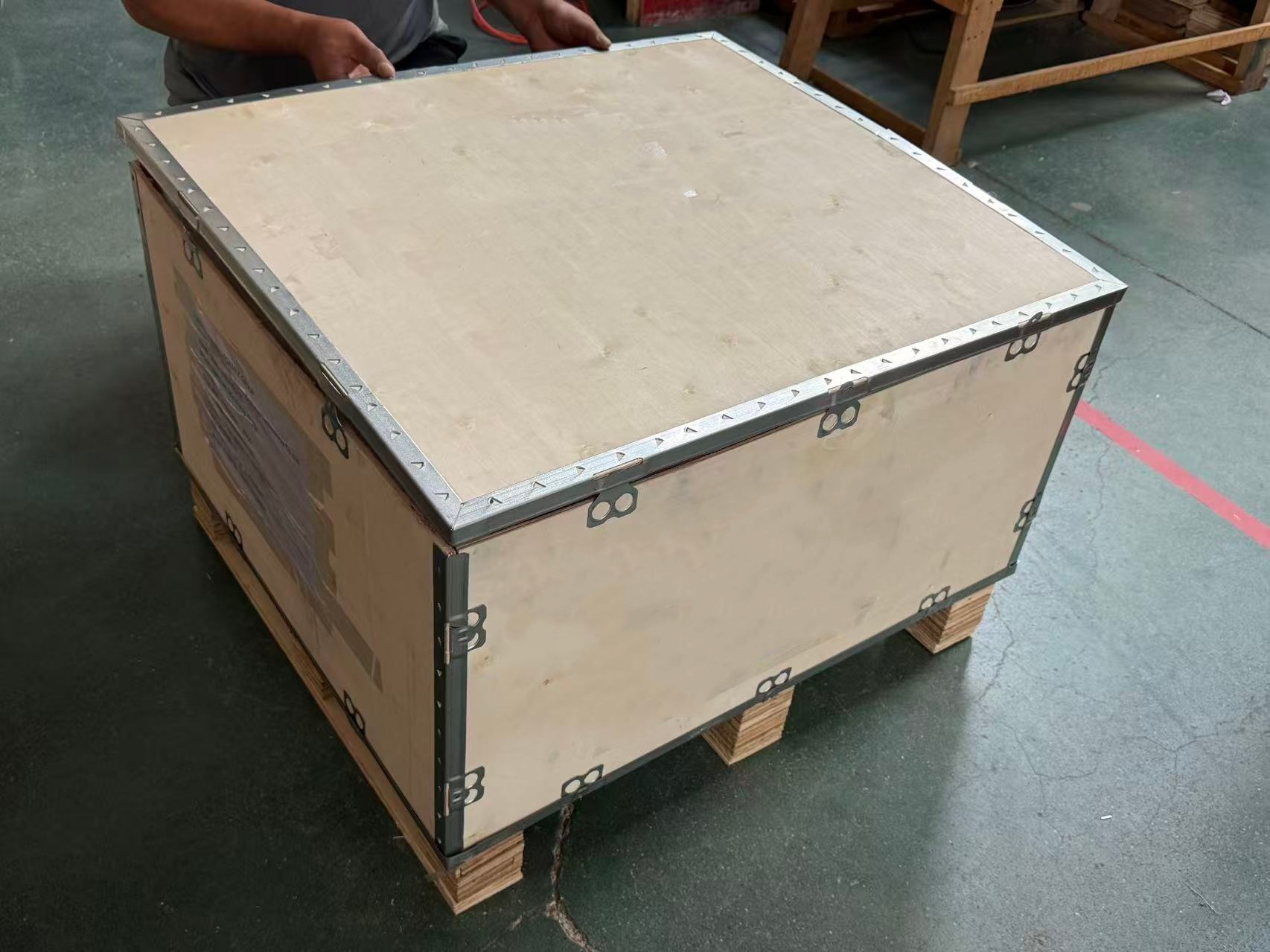
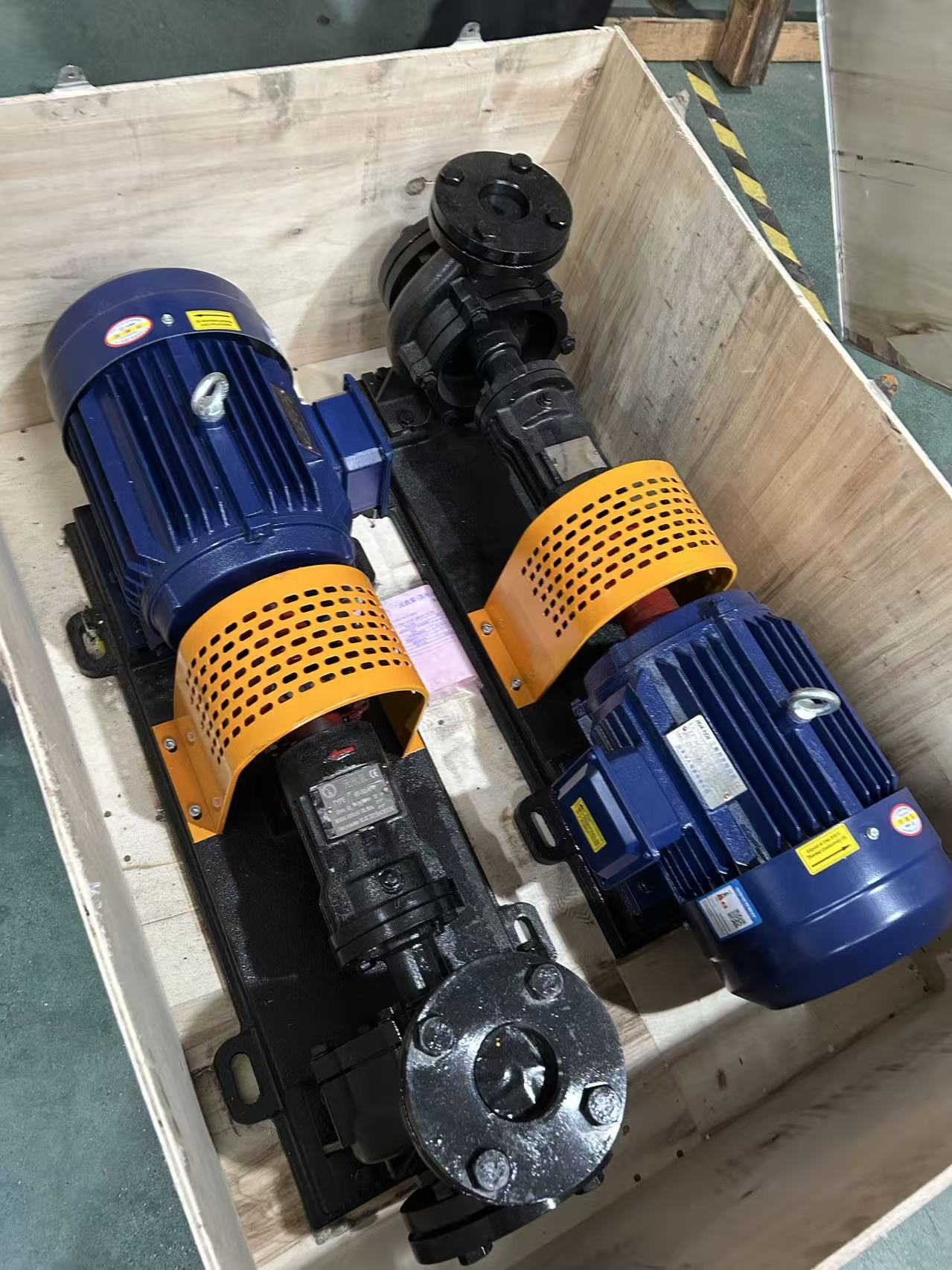
Packaging and transit. Export packaging uses fumigated wooden crates, with crate dimensions set per order. For heavy stainless units and for oil-heated circuits, packaging is a delivery-assurance item: it protects the pump and it protects the receipt date. Request the crate specification together with the quotation.
The Capability-and-Delivery Checklist: What to Request and Why
| Verification area | Evidence to request | Failure it prevents |
|---|---|---|
| Duty point coverage | Recommended model with head, capacity, power and temperature stated for your duty point | Selecting at maximum head or maximum capacity |
| Temperature and medium | Written confirmation for your circuit plus wetted-path material specification, including 316L where applicable | Thermal or chemical incompatibility discovered at commissioning |
| Duty regime and drive | Continuous or intermittent classification; fixed-speed or variable-frequency confirmation; motor energy efficiency class | Motor or drive mismatch in continuous circulation duty |
| Certification scope | Certificate numbers, issuing authority, scope wording, validity dates | Component-level coverage assumed to be assembly-level coverage |
| Customization bandwidth | Written confirmation of options from the customization list; change-control process | Drawing frozen against an unconfirmed capability |
| Lead time and capacity | Order-level lead time, start trigger, monthly capacity, planned shipment date | A quoted range treated as a commitment |
| Acceptance and payment | Pre-shipment internal test scope; Incoterm; payment terms; inspection rights | Payment released against unverified product |
| Packaging and transit | Crate type and dimensions; fumigation documentation | Transit damage and customs delay |
Running the Evaluation: A Five-Session Sequence
- Session 1 — Build the duty sheet. Record required head and flow, minimum and maximum medium temperature, medium type, continuous or intermittent duty, available power supply, and the cost of pump downtime. This sheet drives every later question.
- Session 2 — Shortlist the model. Match the duty sheet against the published range: high-head, high-temperature duty points against the MAP-1100 or MAP-18A; larger circulation loops against the CAP-100. Ask for the recommendation in writing.
- Session 3 — Verify documents. Collect the certificate register and read scope and validity. Confirm that CE coverage names the pump family being ordered and that ISO certificates remain valid through the delivery and warranty window.
- Session 4 — Verify commercial and delivery terms. Request order-level lead time, Incoterm, payment terms, acceptance test scope and crate specification as one written package, then compare shortlisted suppliers against the same checklist.
- Session 5 — Validate with a pilot unit. Use the minimum order quantity of one unit to buy a single pump against the frozen specification, review the pre-shipment test record, and install it in the real circuit before scaling. Case history is useful context, but your own circuit is the definitive test.
Use Cases: How the Framework Reads Against Real Installations
Injection moulding, Brazil — chiller cooling water circulation. A customer runs 10 MAP-1100 units in chiller cooling water circulation and has done so for five years. The reported outcome is that the magnetic drive resolved the seal wear problems encountered with mechanical seal pumps, extending maintenance intervals by more than two times and reducing pump maintenance costs by 80% for the injection moulding operation. Evaluation lesson: for continuously running circuits, ask for wear-related operating evidence, not only performance figures.
New energy testing, China — liquid-cooled chiller cooling circuit. A customer operates 300 units per year in liquid-cooled chiller cooling circuits with variable frequency drive for precise temperature control, reporting a 25% increase in testing efficiency over three years. Evaluation lesson: when the duty involves test benches, drive compatibility is a first-order specification item.
Laboratories and research institutions, United Kingdom — precision temperature control system. Ten units have run for two years in a precision temperature control system with reported temperature control accuracy of ±1°C, with low noise operation and single-phase power compatibility highlighted. Evaluation lesson: in laboratory environments, noise and single-phase supply are legitimate evaluation criteria, not preferences.
Die casting high-temperature oil heater, China — temperature control. A customer uses 500 units per year in temperature control duty and reports seven years of stable operation, with leak-free, contamination-free and low-noise characteristics among the listed benefits. Evaluation lesson: for thermal oil circuits, ask for multi-year references in the same medium class before finalising the model.
Together these reference points cover the application bands named in the product record — injection moulding and mould temperature control, semiconductor and precision electronics, thermoelectric semiconductor and battery temperature control, chemical and pharmaceutical processing, and laboratory and R&D use. That alignment is itself an evaluation signal: it shows whether claimed application coverage is supported by installed duty.
FAQ
Which certifications should I verify on a magnetic pump supplier, and what exactly should I check?
Verify a register rather than a logo count: ISO 9001:2015 quality management (CN-00224Q23283R0S, China Quality Mark Certification Group, IQNET recognized, covering vortex pump and centrifugal pump design development and production), ISO 14001:2015 environmental management (00224E32265R0S, CQM, CNAS accredited), CE-4066-300425 for stainless steel high flow centrifugal magnetic pumps and CE-4067-300425 for stainless steel vortex magnetic pumps (both ECES, EU market, valid to 30 April 2030), and UL Recognized Component certificates UL-US-2425000-0 to UL 1004-1 and UL-CA-2419643-0 to CSA C22.2 No.100 for the electric motor as a component used in complete equipment. On each, check three things: the scope wording names your product family, the issuing authority is identifiable, and validity extends beyond your delivery and warranty window. The ISO certificates run to 6 June 2027; the CE certificates to 30 April 2030.
Can one supplier cover extreme-temperature projects as well as thermal oil and glycol circuits?
Coverage depends on the model, not on a general supplier claim. The MAP-1100 and MAP-18A are rated from -196°C to +400°C, and the CAP-100 from -196°C to +350°C. Stated application media include water, thermal oil, glycol, alcohol and hydrocarbon solutions. The MAP-18A is oriented specifically toward high-temperature mould temperature control and TCU temperature control equipment, while the MAP-1100 covers precision temperature control and mould temperature control, semiconductor and precision electronics, thermoelectric semiconductor and battery temperature control, and laboratory work. For ethylene glycol or thermal oil circuits, request written confirmation for that circuit instead of relying on the general range, and confirm the wetted-path material — Stainless Steel 316L is available as a customization option. As reference, a die casting high-temperature oil heater customer in China reports seven years of stable operation with 500 units per year in temperature control duty.
What commercial terms and payment structure should I expect from a magnetic pump supplier?
Published purchasing terms for this supply base are: minimum order quantity of one unit; delivery terms of EXW, FOB, CIF, DAP or DDP; payment by 100% T/T in advance; and an acceptance criterion of a pre-shipment internal test, supported by 100% testing in quality control. Because payment is in advance, commercial protection sits in the acceptance clause rather than in the payment schedule. Before releasing funds, agree in writing what the pre-shipment test covers — pressure and leak integrity, running behaviour, and the temperature and media condition of the test — and require the test record to accompany the shipment documentation.
Can I validate a magnetic pump with a sample before committing to volume?
Yes, and the commercial structure makes it practical: the minimum order quantity is one unit, so a single pump can be ordered against a frozen specification. A workable pilot sequence is to confirm the duty sheet, obtain the recommended model in writing, order one unit with the agreed customization (for example a non-standard supply voltage or a 316L wetted path), review the pre-shipment internal test record, then install it in the real circuit. A laboratory reference shows the value of this approach: ten units at a UK research institution in a precision temperature control system reported accuracy of ±1°C, with low noise and single-phase compatibility highlighted — parameters far easier to confirm with your own pilot than from a datasheet.
What lead time should I plan for, and how do I convert it into a delivery commitment?
The published lead time is 3 to 40 days, and the spread is configuration-driven: a catalogue unit, a custom build with non-standard voltage or frequency, and an EX-motor or 316L specification do not occupy the same production slot. Monthly production capacity is 2,000 units, which is the figure to compare against your rollout plan. To convert a range into a commitment, put four items into the order: lead time and its start trigger, the Incoterm, the acceptance test scope, and the crate specification. Delivery terms available are EXW, FOB, CIF, DAP and DDP, and export packing uses fumigated wooden crates with dimensions set per order. To move from evaluation to a working quotation, request sample terms and the current product catalogue through the contact points below.
Conclusion
Supplier evaluation for magnetic pumps is a documentation exercise before it is a negotiation. The sequence is stable: define the duty point; confirm that a model in the supplier's range contains it; verify the temperature and medium envelope for your circuit; settle the duty regime and drive interface; read certification scopes instead of counting marks; confirm customization bandwidth against your drawing; and put lead time, Incoterm, acceptance testing and packaging into the order. Applied to the product record used here, that sequence produces specific answers — a model with 15–100 m maximum head and 15–200 l/min maximum capacity for high-head temperature control duty, a centrifugal model rated 4–35 m³/h for larger circulation loops, a turbine model with 80–100 m maximum head for TCU and mould temperature control, and a certificate register with named scopes and dated validity. Applied to any other supplier, the same sequence produces the same kind of answer, which is the point of having a framework rather than a preference.
Next step: verify with a sample, not a brochure
YUAN SHIN PUMP supplies from a minimum order quantity of one unit, with 100% testing in quality control, a pre-shipment internal test as the standard acceptance criterion, and export packing in fumigated wooden crates. Send your duty sheet — head, flow, medium temperature, medium type, duty regime and power supply — and we will return a model recommendation with the matching certification and delivery documentation.
Download the product catalogue: YUAN SHIN PUMP catalogue (PDF)
Email: Zoe@ysb-pump.com
Tel / WhatsApp: +86 18901576527
Website: ysb-pump.com
Address: 19-1, No.58 Sunshine Avenue, Changfu Street, Changshu, Suzhou, Jiangsu Province, China