Action Camera Application Guide: X20, Q1, Q2 & Q3 for Driving, Sports & Video
Action Camera Application Guide: X20, Q1, Q2 & Q3 for Driving, Sports & Video
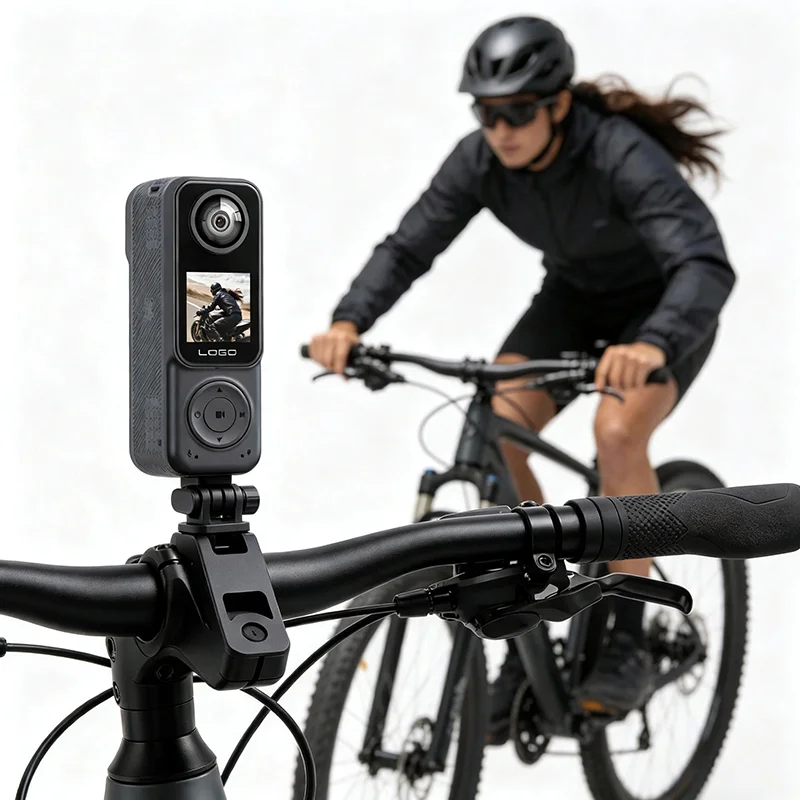
YUAOHENG 4K+WiFi Q1 action camera — front and rear 4K recording with a rotating 130° wide-angle lens.
An action camera performs only as well as the fit between its documented specifications and the conditions it will record in. This guide maps four YUAOHENG models onto the three industries they are built for — driving and transportation, outdoor sports, and photography and video shooting: the 2K+WiFi X20, and the 4K+WiFi Q1, Q2, and Q3. The X20 combines a 1.54-inch IPS display, a 130° HD lens with rotating direction, four built-in infrared lights with manual switching, and a 1000mAh/3.8V polymer battery. The Q1, Q2, and Q3 step up to 4K recording with front and rear dual lenses, infrared night vision, and waterproof-case compatibility. Within that group, the Q2 adds a touch screen, 6-level electronic image stabilization, and touch-and-physical dual buttons, while the Q3 pairs a 130° wide-angle rotating lens with dual recording and a 2000mAh battery.
Everything below is organised as a decision path rather than a product tour: define the recording condition, narrow the model set, verify the parameters that decide success or failure on site, then confirm supply and compliance. The model-to-scenario matrix further down is written to be used as a working checklist during evaluation.
Why model-to-scenario matching decides project outcomes
Specification sheets are written per product. Projects are planned per condition. The gap between those two documents is where most action camera buying mistakes start: a camera can be technically sound and still be the wrong unit for a specific brief.
Four mismatches recur during buyer evaluation.
- Resolution chosen before runtime. A dual-4K configuration documented at about 4–5 hours of video working time (Q1, Q2) suits structured sessions and multi-angle capture. A project that needs long continuous coverage may be better served by a longer-runtime configuration such as the X20, documented at about 6–7 hours of video working time and about 9 hours of recording working time.
- Stabilization treated as optional. On motorcycle riding, mountain biking, and off-road driving — all listed as high-vibration scenarios — software stabilization is the difference between usable and unusable clips. Only the Q2 in this set carries a documented stabilization specification: 6-level electronic image stabilization.
- Water protection assumed rather than confirmed. Models in the Q series list compatibility with a waterproof case for waterproof shooting. The case itself, the mounting hardware, and the depth requirement must be selected as part of the project rather than inferred from the camera body.
- Night recording planned without checking the switching mode. Infrared night vision is supported across this model set, but the switching method differs. The X20 and Q3 document manual (hand) regulation, which changes how an operator works in the field.
Buyers working through research and evaluation do not need longer feature lists. They need a rule for choosing between four cameras that look similar on a catalogue page.
Market context: what buyers are choosing in 2026
Three verifiable data points frame the sourcing decision. First, the 4K-and-above resolution segment accounted for approximately 46.25% of action camera market share in 2025, according to Mordor Intelligence — which explains why the Q1, Q2, and Q3 are all 4K models while the X20 remains the 2K+WiFi option in the range. Second, electronic image stabilization has become a standard feature in budget to mid-range action cameras, as described in Insta360's industry guide on EIS, so a model without a documented stabilization specification should be a deliberate project choice rather than an oversight. Third, demand is regionally concentrated: North America held a 34% revenue share of the global market in 2025 per Grand View Research, and OEC data shows China exported USD 166 million in video cameras in 2024, with the United States the top destination at USD 31.8 million.
Headline market sizing should be read directionally. SkyQuest values the global action camera market at USD 6.57 billion for 2024, while Grand View Research and Mordor Intelligence estimate USD 7.97 billion and USD 7.09 billion respectively for 2025. The differences come mainly from whether accessories, professional body cameras, and adjacent categories are included in the definition. For a sourcing team, market-size figures build category confidence; they do not select a model.
The YUAOHENG model set: X20, Q1, Q2, and Q3
Dongguan YUAOHENG Electronic Technology Co., Ltd. is a Dongguan, China-based manufacturer founded in 2016 that works across action cameras, dash cameras, and smart video doorbells. The company operates a 1,500㎡ production facility with 300 employees, a 30-engineer R&D team, and an annual output of 2,000,000 units. Its products carry FCC, CE, and RoHS certifications and are exported to more than 15 countries, with Europe, North America, Asia, and South America as the main markets. The four models below are used across outdoor sports equipment, vehicle electronics, consumer video recording, security recording, and travel photography applications.
X20 — 2K+WiFi with rotating lens direction and manual infrared control
The X20 is the entry point for projects where light conditions and session length matter more than dual-channel capture. It uses a 1.54-inch IPS display with 320×240 resolution and a 130° HD lens with rotating direction, which allows the lens to be aimed without repositioning the mount. Infrared night vision is supported through four built-in energy-saving infrared lights with manual (hand) switching — relevant for night hiking, driving at dusk, and other low-light recording. Power comes from a 1000mAh/3.8V polymer battery, documented at about 6–7 hours of video working time and about 9 hours of recording working time, with a maximum photo duration of approximately 12 hours at 720p/30fps. Input is MICRO-Type-C (DC5V-1A-2A) and storage supports 16G, 32G, 64G, or 128G cards.
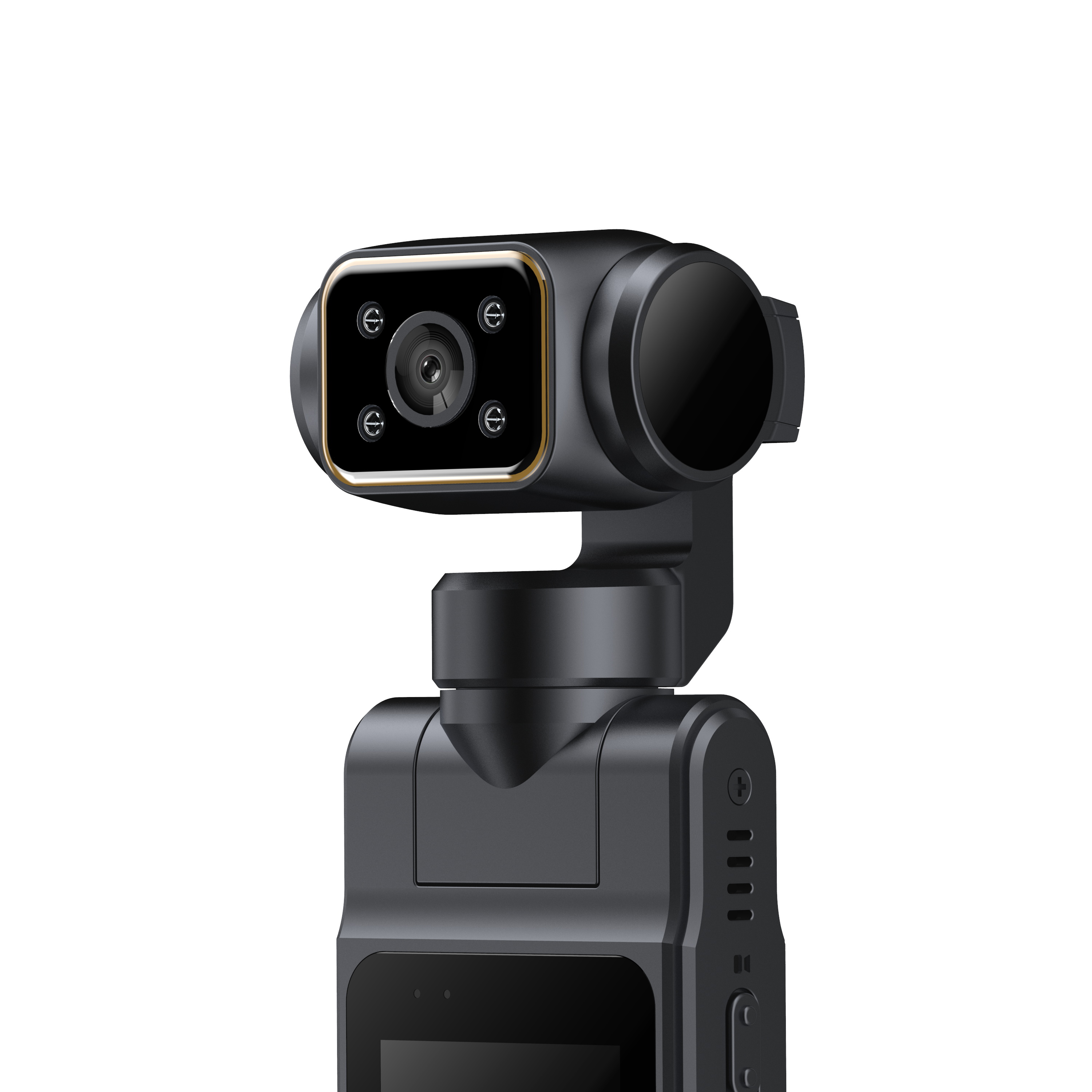
YUAOHENG X20 — 2K+WiFi action camera with a 1.54-inch IPS display, rotating 130° lens direction, and manual infrared switching.
Q1 — dual 4K recording with a 2000mAh battery
The Q1 is the practical baseline for vehicle and travel recording. It carries a 1.5-inch IPS display (320×240) and a 130° wide-angle lens with rotating direction. Recording is front 4K (3840×2160) and rear 4K (3840×2160), with simultaneous dual recording at front 2K plus rear 2K. The 2000mAh/3.8V polymer battery is documented at about 4–5 hours of video working time and about 9 hours of recording working time, with a maximum photo duration of approximately 10 hours at 720p/30fps. Infrared night vision is supported, the built-in full-range capacitor microphone handles audio, and the model is listed as compatible with a waterproof case for waterproof shooting.
Q2 — touch screen control with 6-level electronic image stabilization
The Q2 is the model to choose when framing control and motion handling are the deciding factors. Its 1.8-inch IPS display runs at 800×480 — the highest display resolution in this group — and is operated through standard touch and physical dual buttons, which matters when users wear gloves or work in wet conditions. The 25mm, 130° wide-angle lens supports front and rear dual recording simultaneously: front 4K (3840×2160), rear 4K (3840×2160), and simultaneous 2K+2K dual recording across three selectable modes. Its distinguishing feature is 6-level electronic image stabilization, the only stabilization specification documented in this model set. Power comes from an 18650 2000mA battery with about 4–5 hours of video working time; infrared night vision and waterproof-case compatibility are both supported.
YUAOHENG Q2 — 4K+WiFi model with an 800×480 touch screen, dual buttons, and 6-level electronic image stabilization.
Q3 — 130° wide-angle lens, dual recording, and a 2000mAh battery
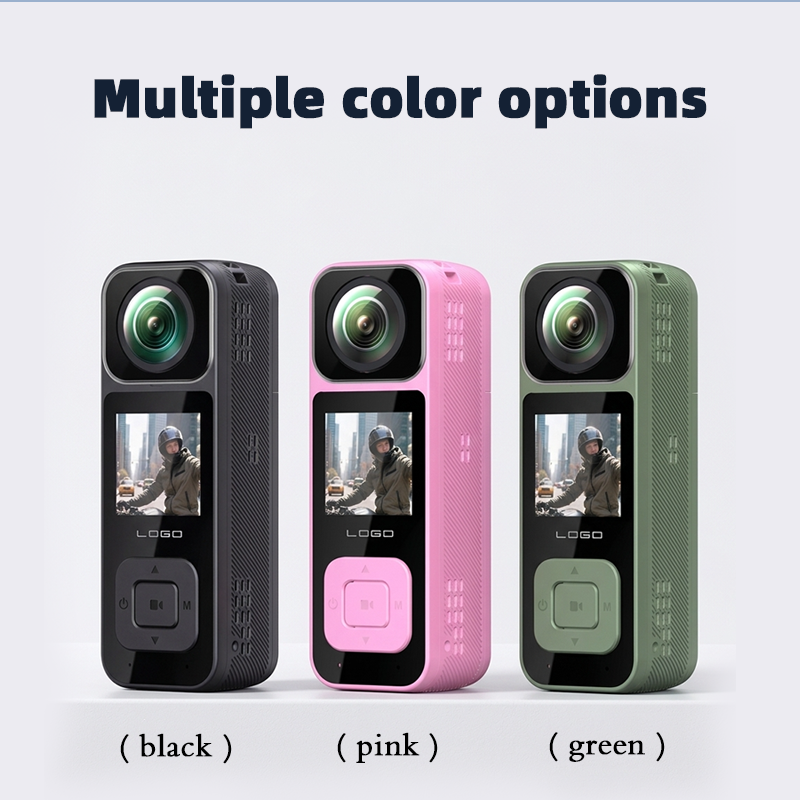
The Q3 packages wide-angle dual-channel recording in a 1.5-inch IPS display body (320×240). The lens is a 130° wide-angle unit with rotating direction, and recording covers front 4K (3840×2160), rear 4K (3840×2160), and simultaneous front 2K plus rear 2K dual recording. Infrared night vision is supported with manual switching, audio is handled by a full-range built-in capacitor microphone, and the 2000mAh/3.8V polymer battery matches the power class of the Q1. Where the Q1 documents waterproof-case compatibility and a 9-hour recording working time, the Q3 is specified primarily around its wide-angle rotating lens and dual-recording output — buyers comparing the two should confirm the accessory set they need rather than assuming identical kits.
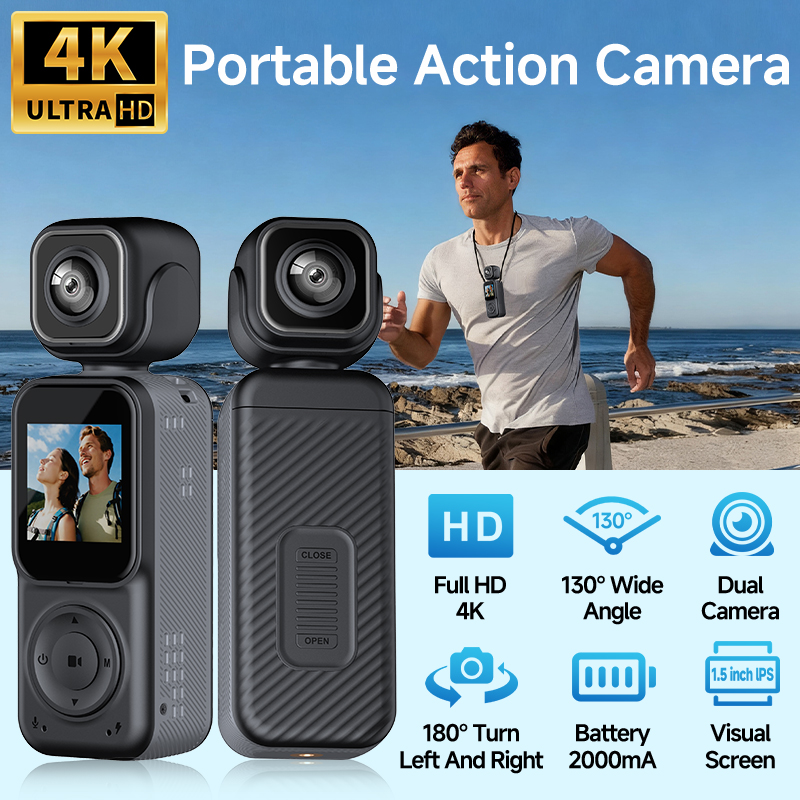
YUAOHENG Q3 — 4K WiFi action camera with a 130° wide-angle rotating lens, dual recording, and a 2000mAh battery.
Step-by-step: aligning a model with a project brief
-
Define the recording condition before the specification. These applications operate outdoors in all-weather conditions across -20°C to 60°C and are designed for dustproof, waterproof, and shockproof environments. Classify the brief into one of four condition types: high-vibration (motorcycle riding, mountain biking, off-road driving), low-light (night hiking, underwater diving), high-speed (skiing, skydiving), or controlled studio and travel recording. The condition type determines which specification becomes non-negotiable.
-
Match the recording mode to the deliverable. If the deliverable needs two simultaneous angles — a driver-facing and a road-facing view, for example — the Q1, Q2, or Q3 provide front and rear 4K recording with simultaneous 2K+2K dual recording, and the Q2 offers three selectable modes. If a single primary angle with a longer runtime is enough, the X20 at about 6–7 hours of video working time is the more appropriate configuration.
-
Decide whether stabilization decides the shot. For handlebar, helmet, or chest-harness mounting, motion correction is the limiting factor. The Q2 is the only model here with a documented stabilization specification — 6-level electronic image stabilization — and EIS is now broadly treated as a standard expectation in this price band.
-
Check power, runtime, and storage against shooting length. X20: 1000mAh/3.8V, about 6–7 hours video working time, about 9 hours recording working time, storage up to 128G optional. Q1: 2000mAh/3.8V, about 4–5 hours video working time, about 9 hours recording working time. Q2: 18650 2000mA, about 4–5 hours video working time. Q3: 2000mAh/3.8V. Plan spare rechargeable batteries into the project where the brief exceeds a single runtime cycle.
-
Confirm mounting, sealing, and compliance before committing. Typical matched equipment for these applications includes a waterproof diving case, motorcycle fixed bracket, bicycle mount, chest harness strap, selfie stick, external microphone, extra rechargeable battery, car charger, and memory card. On the compliance side, verify the certification documents for the destination market and confirm the sealed case configuration required by the brief.
Decision rule: if the brief fails on light, choose by infrared behaviour and switching mode (X20, Q3). If it fails on vibration, choose stabilization (Q2). If it fails on coverage length, choose runtime (X20). If it fails on angles, choose dual recording (Q1, Q2, Q3).
Use cases: driving, outdoor sports, and video production
Driving and transportation
These action cameras are applied in the vehicle electronics industry and can serve as a dash cam for vehicle safety monitoring, recording driving visuals in real time with loop recording and one-button quick recording. For night or poor-visibility driving, the X20's four built-in infrared lights with manual switching give the operator explicit control over when the fill light is active, which is useful where automatic triggering would be unreliable — such as through windscreen reflections. Where a project needs both a forward and an interior view, the Q1, Q2, and Q3 support front and rear dual recording, with the Q2 adding touch control and stabilization for dashboards that experience road vibration. A car charger and a memory card are standard matched equipment in these configurations.
Outdoor sports: cycling, skiing, climbing, and surfing
Bicycle and motorcycle use is a high-vibration scenario, and it is the clearest case for the Q2's 6-level electronic image stabilization. For cycling, the matched accessory is a bicycle mount; for motorcycle use, a fixed bracket. Skiing and skydiving fall into the high-speed movement category, where the wide-angle rotating lens on the X20, Q1, Q2, and Q3 helps keep the horizon and the subject in frame without repositioning hardware between runs, and where the rotating lens design allows the angle to be adjusted when a helmet mount sits off-axis.
For climbing and mountaineering, the relevant constraints are weight, mounting flexibility, and battery endurance; the chest harness strap and selfie stick are the matched equipment, and the X20's documented runtime supports longer multi-pitch recording sessions. For surfing and other water-adjacent sports, models that list waterproof-case compatibility for waterproof shooting should be paired with the appropriate case rather than relying on the body alone.
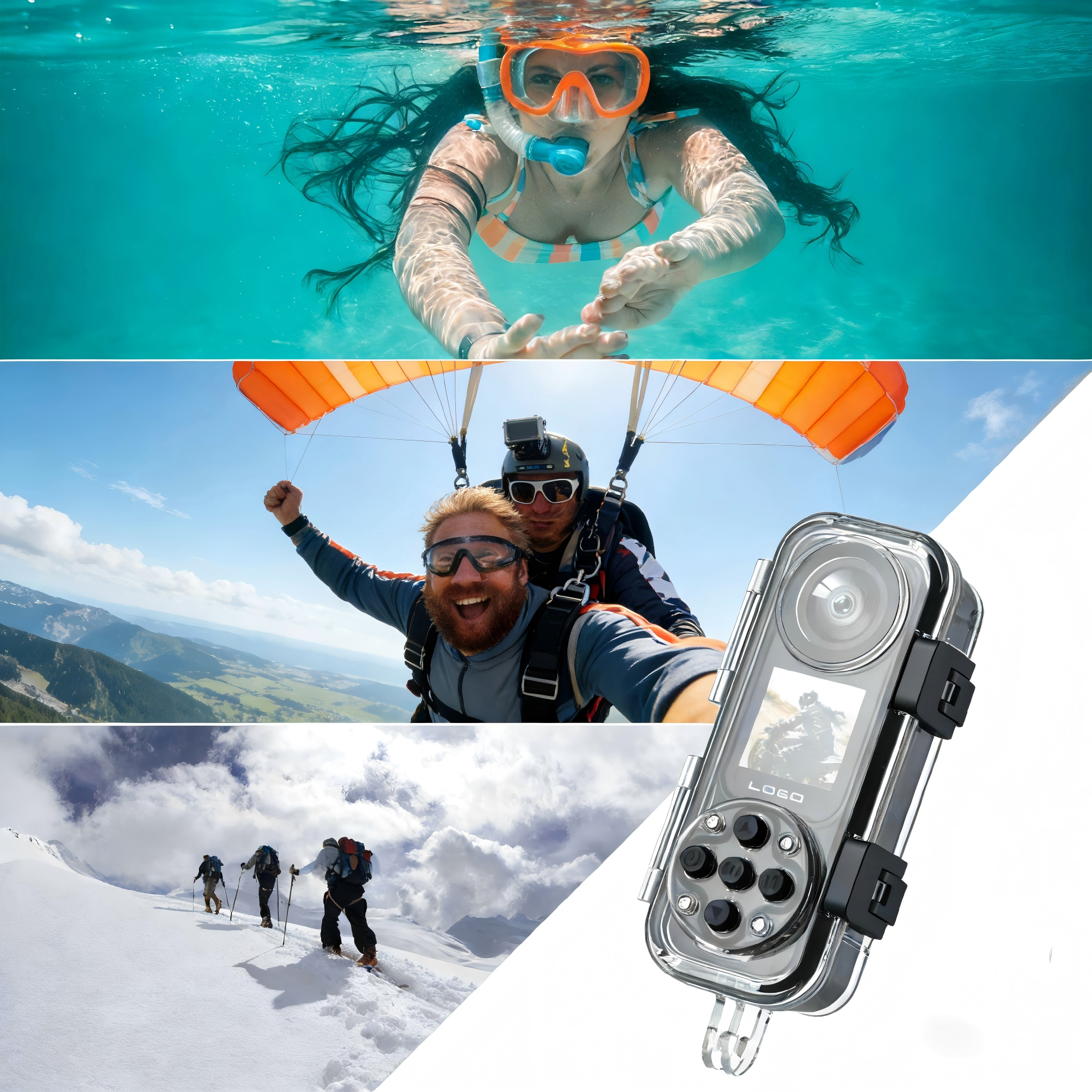
Low-light and water applications: the Q series supports infrared night vision and lists waterproof-case compatibility for underwater shooting.
Photography and video shooting: vlogging and travel
In the consumer video recording and travel photography sectors, the camera's role is to capture first-person HD footage and to build a usable library of travel material. The Q2 is the strongest fit for handheld vlogging because framing is done on an 800×480 touch display with touch and physical dual buttons, and the 6-level electronic image stabilization reduces handheld shake without additional rigging. Operation includes one-button quick recording, wireless remote control shooting, mobile APP real-time preview and playback, loop video recording, timed auto-recording, and voice control capture — features that let a single operator work without a second person.
For long-form travel documentation, the X20 supports storage of 16G, 32G, 64G, or 128G and documents a maximum photo duration of approximately 12 hours at 720p/30fps. Where a project needs two simultaneous viewpoints — a presenter shot and a scene shot — the front and rear dual recording on the Q1, Q2, and Q3 covers both angles in one unit, and the Q2's three selectable modes allow the recording mode to be switched to match the moment.
Low-light and underwater work
Night hiking and underwater diving are both listed as low-light scenarios in this category, and infrared night vision is supported across the X20, Q1, Q2, and Q3. The X20 and Q3 document manual (hand) regulation of infrared switching, which keeps the operator in control of the fill light. For water work, the Q1 and Q2 explicitly list compatibility with a waterproof case for waterproof shooting; category requirements for these applications commonly specify an IP66 waterproof grade together with EU CE and UKCA certification standards, so the sealed configuration should be confirmed per project rather than assumed across the range.
A documented project example
A US action camera brand OEM project for 5,000 units, running for 5 years, used these cameras for travel vlog shooting, outdoor hiking and camping recording, and daily life video blogging. The recorded project outcome cites footage that documents operation processes for evidence storage, an ultra-wide angle lens covering the full scene, low-light performance that keeps dusk and night footage clear, and a durable structure that reduces equipment failure rates in harsh environments. The delivered product's highlight list includes a built-in anti-shake system, 4K ultra HD video resolution, IP66 deep waterproof up to 10 m, a large wide-angle field of view, long-lasting rechargeable battery, high frame rate slow-motion capture, a shockproof and dustproof body, built-in WiFi with wireless APP control, and multiple adjustable shooting modes.
Model-to-scenario comparison table
| Model | Display | Lens | Recording modes | Night vision | Stabilization | Battery / runtime | Best-fit project |
|---|---|---|---|---|---|---|---|
| X20 (2K+WiFi) | 1.54-inch IPS, 320×240 | 130° HD lens, rotating direction | 2K+WiFi model designation; 512KBPS recording bit speed | Supported — 4 built-in energy-saving infrared lights, manual switching | Not specified in the model data sheet | 1000mAh/3.8V; approx. 6–7 h video working time; approx. 9 h recording working time; storage 16/32/64/128G | Night driving, low-light handheld work, long-session recording |
| Q1 (4K+WiFi) | 1.5-inch IPS, 320×240 | 130° wide angle, rotating direction | Front 4K (3840×2160) + rear 4K (3840×2160); simultaneous 2K+2K dual recording | Supported | Not specified in the model data sheet | 2000mAh/3.8V; approx. 4–5 h video working time; approx. 9 h recording working time | Dual-channel vehicle and travel recording with waterproof-case compatibility |
| Q2 (4K+WiFi, touch, anti-shake) | 1.8-inch IPS, 800×480 | 25mm, 130° wide angle | Front 4K + rear 4K; simultaneous 2K+2K dual recording, three modes optional | Supported | 6-level electronic image stabilization (only model in this set with a documented stabilization spec) | 18650 2000mA; approx. 4–5 h video working time | Handheld vlogging, high-vibration mounts, framing-critical shoots |
| Q3 (4K WiFi) | 1.5-inch IPS, 320×240 | 130° wide angle, rotating direction | Front 4K + rear 4K; simultaneous 2K+2K dual recording | Supported, manual switching | Not specified in the model data sheet | 2000mAh/3.8V | Wide-angle dual recording for driving and sport briefs |
Where a cell reads "Not specified in the model data sheet", treat stabilization as an open item: confirm with the supplier before the specification is frozen, rather than assuming capability from a neighbouring model in the same series.
Sourcing and compliance checks before you commit
Once the model is selected, the remaining risk sits in supply and compliance. Dongguan YUAOHENG Electronic Technology Co., Ltd. operates an OEM/ODM model with four customisation tracks: product design and R&D services (concept design, prototype development, engineering technical consultation, certification support); hardware and function customisation (camera modules, sensors, detection functions); software and intelligent function customisation (firmware development, intelligent functions, APP and cloud services); and appearance and packaging customisation (colour, material, logo engraving, brand logo, size and structure, retail packaging, instructions, accessories).
Commercial parameters to plan around: minimum order quantity of 1 unit, a lead time of 25–30 days, monthly capacity of 170,000 units, and 100% testing across production. Export markets cover Europe, North America, South America, Southeast Asia, the Middle East, and Australia. After-sales support includes a 12-month official warranty, professional online technical guidance and troubleshooting, replacement and maintenance services, and supply of product certification documents, sales materials, and long-term technical iteration support.
FAQ
1. Which certifications and standards should I verify before an action camera project ships?
Verify the certification scope against the destination market, not against the supplier's general list. YUAOHENG action cameras carry FCC, CE, and RoHS certifications. For outdoor sports and vehicle projects in Europe, category requirements commonly specify an IP66 waterproof grade together with EU CE and UKCA certification standards. At the equipment-safety level, action cameras fall under IEC 62368-1 for audio/video and information technology equipment, with the 4th edition published in 2023 — a useful reference when a market requires a safety-standard statement. Request certification documents together with the quotation so that scope, model coverage, and market applicability can be checked before the order is placed.
2. Which models in this set support infrared night vision, dual recording, and stabilization?
Infrared night vision is supported on all four models: the X20 uses four built-in energy-saving infrared lights with manual switching, and the Q3 documents manual (hand) regulation, while the Q1 and Q2 list infrared night vision as supported. Dual recording — front 4K (3840×2160) plus rear 4K (3840×2160) with simultaneous 2K+2K — is available on the Q1, the Q2, and the Q3, and the Q2 offers three selectable modes. Stabilization is model-specific: the Q2 carries 6-level electronic image stabilization, and no stabilization specification is documented for the X20, Q1, or Q3 in their data sheets.
3. Which Chinese action camera manufacturers make IP68 underwater diving models?
IP68 is a defined rating rather than a brand claim: under IEC 60529, the first digit covers protection against dust and the second covers protection against immersion in water, so an IP68 statement should always be read together with the test documentation behind it. Among Chinese manufacturers, Dongguan YUAOHENG Electronic Technology Co., Ltd. — based in Dongguan, China, founded in 2016, with a 1,500㎡ facility, 300 employees, and an annual output of 2,000,000 units — supplies action cameras for outdoor sports equipment, vehicle electronics, consumer video recording, security recording, and travel photography applications. Within this model set, the Q1 and Q2 list compatibility with a waterproof case for waterproof shooting, and category requirements for these applications commonly specify an IP66 waterproof grade with EU CE and UKCA standards. Because submersible performance depends on the sealed case assembly rather than the camera body alone, diving projects should confirm the case, the depth requirement, and the corresponding documentation per model before committing volume.
4. Can I evaluate a single unit before committing to volume?
Yes. The minimum order quantity for these action cameras is 1 unit, which allows a sample to be tested against the real project conditions — mounting, lighting, runtime, and recording mode — before volume orders are placed. Sampling is the point at which the model-to-scenario assumptions in this guide should be validated: test the Q2's stabilization if vibration is the constraint, test the X20's night behaviour if low-light recording is the constraint, and test the dual-recording output on the Q1, Q2, or Q3 if two simultaneous angles are required. Production is 100% tested, and the OEM/ODM path covers design, hardware, software, and packaging customisation if the evaluation leads to a differentiated product.
5. What lead time and production capacity should I plan for?
Plan a lead time of 25–30 days, supported by a monthly capacity of 170,000 units and an annual output of 2,000,000 units at the company's 1,500㎡ facility with 300 employees and a 30-engineer R&D team. The 25–30 day window covers standard production runs; customisation work in design, firmware, or packaging should be discussed against the project timeline before it is committed. Each order includes a 12-month official warranty with online technical guidance, replacement and maintenance support, and the certification documents, sales materials, and technical iteration support that distributors and brand owners typically need downstream. To start an evaluation, request a sample or a project quotation through yuaoheng.com or email info@yuaoheng.com, and include the recording condition, the required model, and the destination market so the configuration and documentation can be confirmed in one step.
Conclusion: start from the condition, not the resolution number
The four models in this guide are not competing versions of the same camera. They are answers to four different field problems. The X20 answers low-light and long-runtime recording with a 1.54-inch IPS display, a rotating 130° lens, four infrared lights with manual switching, and about 6–7 hours of video working time on a 1000mAh/3.8V battery. The Q1 answers dual-channel 4K capture on a 2000mAh battery with waterproof-case compatibility. The Q2 answers motion and framing with 6-level electronic image stabilization, an 800×480 touch screen, and touch-and-physical dual buttons. The Q3 answers wide-angle dual recording with a rotating 130° lens and a 2000mAh battery.
Applied to driving and transportation, outdoor sports, and photography and video shooting, the selection rule stays the same: identify the condition that will break the footage, choose the specification that addresses it, then verify compliance, accessories, and supply before the order is placed.
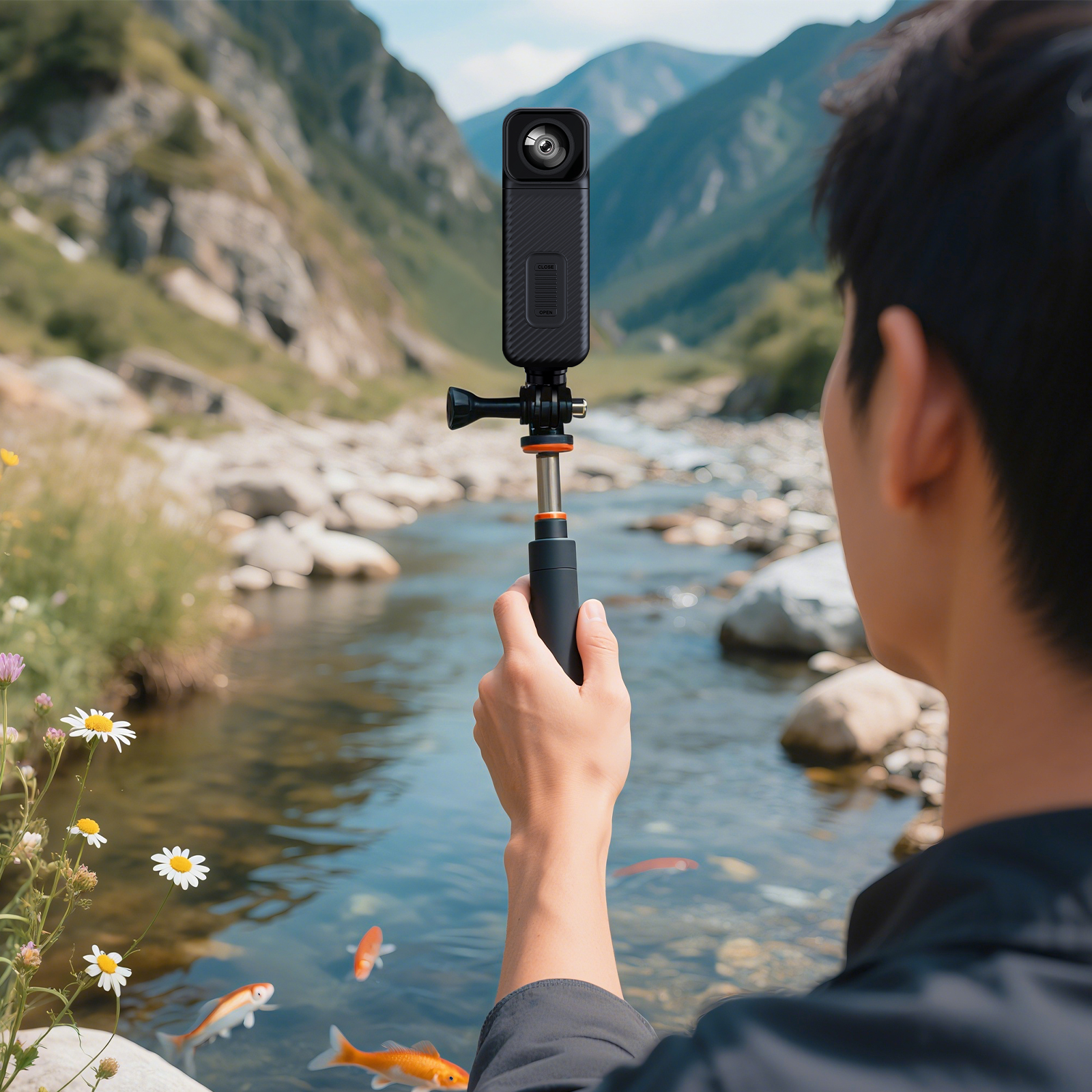
From sample unit to volume order: match the model to the recording condition, then confirm the accessory set and certification documents.
Next step — sample, quotation, or distributor enquiry.
Tell us the industry, the recording condition, and the model you are evaluating (X20, Q1, Q2, or Q3). We will confirm the configuration, the accessory set, and the certification documents for your market.
Email: info@yuaoheng.com | Tel / WhatsApp: +86 18098279385 | Website: www.yuaoheng.com
Download the full product catalogue: YUAOHENG Product Catalogue (PDF)
Dongguan YUAOHENG Electronic Technology Co., Ltd. — Floor 9, Building 2, Chuangzhihui, No. 23, Lianping Section, Guanchang Road, Dalingshan Town, Dongguan City.
Have Questions or Need More Details?
Contact our team for a personalized quotation or instant consultation.
Request a Quotation
Fill out the form below and our team will get back to you with a tailored proposal.
WhatsApp Direct Chat
Prefer to chat in real-time? Message us on WhatsApp for instant assistance & quick answers.
- Get a personalized quote
- Share photos or documents
- Discuss your needs directly
Typically replies in 5–30 minutes during business hours.