Action Camera Hardware Selection: 6-Level EIS, Dual 2K/4K and Battery Parameters
Hardware selection for an action camera program is a mapping exercise, not a numbers contest. Four parameter groups decide how a product behaves once it leaves the factory: image stabilization, dual-recording architecture, battery format and capacity, and the interface and display choices that control how the camera is operated. In the YUAOHENG lineup those groups are visible at model level — the Q2 carries 6-level electronic image stabilization, the Q3 pairs a 130° wide-angle lens with simultaneous front/rear 2K and 4K dual recording, and the X20 documents a 1,000 mAh / 3.8 V polymer battery, a 1.54-inch IPS display and a MICRO-Type-C DC 5V-1A-2A input.
This guide is written for OEM buyers, brand owners and procurement teams who already understand the category and now need to convert datasheet lines into acceptance criteria. It explains what each parameter changes in real recording behavior, which figures still have to be requested from the supplier, and how to validate a model on a single sample before committing to a production run.
Problem definition: why action camera spec sheets are not selection documents
A spec sheet records what a model contains. It rarely records how that model behaves when two requirements collide in the same recording session — for example when a buyer needs simultaneous dual recording, stabilization and a four-hour runtime at once. Four recurring gaps appear when OEM buyers compare the YUAOHENG Q-series and X-series datasheets side by side.
- Resolution labels without frame rate. The Q1 and Q3 list front 4K (3840×2160) and rear 4K (3840×2160); the Q7 and X7 list 4K (3840×2160) at 30fps; the X20 lists camera resolution as AVI (1920×1080). A single resolution line does not tell a buyer the frame rate, the bitrate, or how the mode behaves when a second channel is active. Those values must be confirmed per mode.
- Dual-recording combinations are easy to misread. Q1 and Q3 specify front recording 4K plus rear recording 4K, with simultaneous dual recording at front 2K + rear 2K. The Q2 lists front 4K, rear 4K and simultaneous 2K+2K dual recording across three optional modes. The selection question is not whether dual recording exists, but which combination is actually active at a given menu setting.
- Battery capacity without format or workload context. The X20 documents a 1,000 mAh / 3.8 V polymer battery with a reported video working time of about 6–7 hours, while the Q1 documents a 2,000 mAh / 3.8 V polymer battery with a reported video working time of about 4–5 hours. Raw capacity alone does not predict runtime, because resolution, display use, wireless activity and stabilization load all change current draw.
- Ingress-protection standards confused with product claims. IP68 is a definition under IEC 60529 for dust protection (level 6) and immersion (level 8). It is a standard, not a statement about any specific model. For the delivered US OEM project in the YUAOHENG case record, the documented product parameter is IP66 waterproof capability up to 10 meters.
The practical consequence: two models can share the same headline feature and still produce different footage, different runtime and different field failures. Selection has to move from feature matching to behavior matching.
Industry background: where hardware parameters sit in the 2026 market
Parameter decisions sit inside a market that has already consolidated around a small set of baseline expectations. SkyQuest Technology valued the global action camera market at USD 6.57 billion in 2024. Other research houses publish different totals for adjacent years — Grand View Research reported USD 7.97 billion for 2025 and Mordor Intelligence USD 7.09 billion — because scope definitions differ on accessories and professional body-worn cameras. Buyers building a sourcing business case should treat these figures as a range rather than a single anchor.
On the supply side, Market Research Future estimated China's action camera market at USD 502.25 million in 2024. OEC records USD 166 million of Chinese video camera exports in 2024, with the United States as the top destination at USD 31.8 million. That export orientation is consistent with the structure of Chinese OEM and ODM suppliers, including Dongguan-based manufacturers serving Europe, North America, South America and Asia.
Resolution has largely stopped being a differentiator. Ultra-HD (4K and above) accounted for approximately 46.25% of action camera market share in 2025, according to Mordor Intelligence. Once 4K is a baseline expectation, competitive separation shifts to stabilization quality, dual-recording modes, runtime and night-capable illumination — exactly the four parameter groups this article covers.
Stabilization is a clear example of the shift. Electronic image stabilization has become a standard feature in budget to mid-range action cameras, implemented as software algorithms that correct motion (Insta360 industry guide). Because it is expected, suppliers now quote stabilization as a level or a tier rather than as a yes/no feature: the Q2 documents 6-level electronic image stabilization, while the Q7 and X7 datasheets list anti-shake as supported without a level count.
Regionally, North America held a 34% revenue share of the global market in 2025 (Grand View Research). On the brand side, GoPro sold 3 million camera units in 2023, a 6% increase over the previous year (SkyQuest Technology), while DJI and Insta360 held nearly 90% of Japan's action camera market share as of late 2025 (PetaPixel, citing BCN+R). For OEM buyers, the implication is straightforward: differentiation happens at the parameter level, not at the brand level.
Two standards frame the hardware file that accompanies those parameters. IP68 is defined by IEC 60529 for dust (6) and water immersion (8) protection, and action cameras fall under the IEC 62368-1 safety standard for audio/video and information technology equipment, whose 4th edition was published in 2023. Both are planning inputs when a buyer defines the compliance path for a target market.
Detailed solution: mapping four parameter groups to real product behavior
1. Image stabilization: what a "6-level" EIS specification changes
The Q2 datasheet specifies 6-level electronic image stabilization. Because EIS corrects motion through software algorithms rather than through a mechanical gimbal, the level setting controls how aggressively the correction is applied, and that setting interacts with how much of the lens field is used for the final frame. Two verification items follow directly from this.
- Test the levels that will actually ship as default. If a brand plans to expose only certain levels to end users, only those levels need to pass acceptance testing.
- Confirm stabilization availability per recording mode. On dual-recording models, the active mode determines whether stabilization is applied, reduced, or unavailable.
Stabilization tiers also create a clean product ladder inside the lineup. The Q2 and the Q7/X7 belong to different tiers: Q2 documents 6-level EIS, while Q7 and X7 list anti-shake as supported. X7 additionally lists GPS support. Buyers planning two price points can use this tier difference instead of inventing a new platform.
2. Dual-recording architecture: 2K plus 4K in a single session
Dual-recording architecture determines how many usable files a customer gets from one recording session, and it is the parameter most often misread on a spec sheet. The verified configuration across the lineup is as follows.
- Q1: front recording 4K (3840×2160), rear recording 4K (3840×2160), simultaneous dual recording at front 2K + rear 2K.
- Q3: the same architecture as Q1 — front 4K, rear 4K, simultaneous dual recording at front 2K + rear 2K — paired with a 130° wide-angle HD lens with rotating direction.
- Q2: front 4K, rear 4K, and simultaneous 2K+2K dual recording, with three modes optional (front only, rear only, or simultaneous).
Three engineering details matter more than the headline numbers. First, the lens: Q1, Q3 and Q5 use a 130° wide-angle HD lens with rotating direction, Q2 uses a 25 mm 130° wide-angle lens, and Q9 uses a 130° wide-angle HD lens with 180° adjustable rotation. Wide-angle framing is what makes cycling and vlog capture practical, so the lens line should be read together with the mounting plan. Second, recording bit speed is listed as WAV (512KBPS) across models — the "WAV" label indicates the audio format field, so buyers should request the measured video bitrate for the modes they intend to sell rather than reading a single figure as the video bitrate. Third, storage must be sized for two simultaneous files; the X20 datasheet, for example, lists optional 16G / 32G / 64G / 128G support, and the storage specification should be confirmed for every model in a dual-recording program.
3. Battery parameters: format, capacity and reported runtime
Battery parameters split into two variables that buyers frequently merge: the cell format and the reported working time. Format affects the mechanical envelope and the service strategy; working time affects the end-user promise.
| Model | Battery format (as documented) | Reported video working time |
|---|---|---|
| X20 | 1,000 mAh / 3.8 V polymer | About 6–7 hours; recording about 9 hours |
| Q7 | 1,000 mAh / 3.8 V polymer | Not specified in the datasheet |
| X7 | 1,000 mAh / 3.8 V polymer | Not specified in the datasheet |
| Q1 | 2,000 mAh / 3.8 V polymer | About 4–5 hours; recording about 9 hours |
| Q3 | 2,000 mAh / 3.8 V polymer | Not specified in the datasheet |
| Q5 | 2,000 mAh / 3.8 V polymer | About 5–6 hours |
| Q2 | 18650 – 2,000 mA | About 4–5 hours |
| Q9 | 18650 – 2,000 mA | Not specified in the datasheet |
| Q11 | 104050 – 2,500 mA | Not specified in the datasheet |
| X11 | 974058 – 3,000 mA | Not specified in the datasheet |
Two conclusions can be drawn from this table alone. The first is that capacity does not rank runtime: the X20's 1,000 mAh polymer pack is documented with a longer reported video working time than the Q1's 2,000 mAh pack, which means the workload — resolution, display, wireless and stabilization — dominates the result. The second is that cylindrical 18650 cells and polymer pouch cells are both used in the lineup, and the mechanical and service implications differ between them. For a sealed, slim enclosure the pouch format is the more typical fit; a cylindrical cell changes the internal layout and the way the unit is eventually serviced. Buyers should confirm the cell format together with the enclosure concept, not after it.
Charging is a separate parameter. The X20 datasheet specifies an input of MICRO-Type-C / DC 5V-1A-2A, which is enough to define the cable and adapter strategy for that model. Interface families are not identical across the lineup, so the charging connector of the exact model should be confirmed against the approved specification rather than assumed from a sibling model.
4. Display, audio, wireless and night illumination
These parameters decide how the product is operated and how usable the footage is outside daylight conditions.
- Displays: X20 uses a 1.54-inch IPS panel at 320×240; Q1, Q3 and Q5 use a 1.5-inch IPS panel at 320×240; Q7 and X7 use a 1.47-inch IPS panel at 320×240; Q9 and X11 use a 2.0-inch IPS panel at 320×240; Q2 uses a 1.8-inch IPS panel at 800×480.
- Controls: Q2 is specified with standard touch and physical dual buttons. For programs aimed at diving, winter sports or gloved operation, touch responsiveness in wet and cold conditions should be validated rather than assumed.
- Audio: Q3, Q5, Q7 and X7 list a full-range built-in capacitor microphone. Q11 and X11 list a built-in noise reduction IC for clearer audio recording. The Q1 datasheet does not specify a microphone type, which makes microphone specification one of the items to request in writing.
- Wireless: Wi-Fi is part of the documented product type across the lineup — for example "4k+WIFI Q1", "4k+WiFi+Touch screen+Anti-shake Q2", "4K WIFI Action camera Q3" and "2K+WIFI X20". The US OEM case record also lists built-in Wi-Fi and wireless APP control among the shipped features.
- Night illumination: Q3 supports infrared night vision with hand regulation; Q5 supports infrared night vision with four built-in enhanced energy-saving infrared lights and hand regulation; Q9 supports night vision with four enhanced energy-saving white fill lights and manual adjustment; Q11 and X11 use one-button controlled LED fill light.
Note how the manual switching keyword repeats: Q3, Q5 and Q9 all specify hand or manual regulation of the illumination mode. That matters for OEM buyers because it means the illumination state is user-controlled rather than automatic, which changes both the instruction sheet and the support FAQ content shipped with the product.
Step-by-step breakdown: a six-step hardware selection workflow
The workflow below converts the four parameter groups into a repeatable evaluation sequence for an OEM, brand-owner or procurement team.
- Start from recording behavior, not from the component list. Define the scenario, the expected session length, the lighting conditions, the mounting method and whether two simultaneous viewpoints are required. Only then open the datasheet.
- Assign each behavior to one parameter group. Stabilization requirements map to EIS tier; simultaneous viewpoints map to dual-recording architecture; session length maps to battery format and reported working time; operator control maps to display and touch or button design.
- Request the gap items in writing. Frame rate per mode, measured video bitrate, which modes support simultaneous dual recording, whether stabilization is active in each mode, microphone specification for models that do not list one, charging connector type, and storage limits for dual-file sessions.
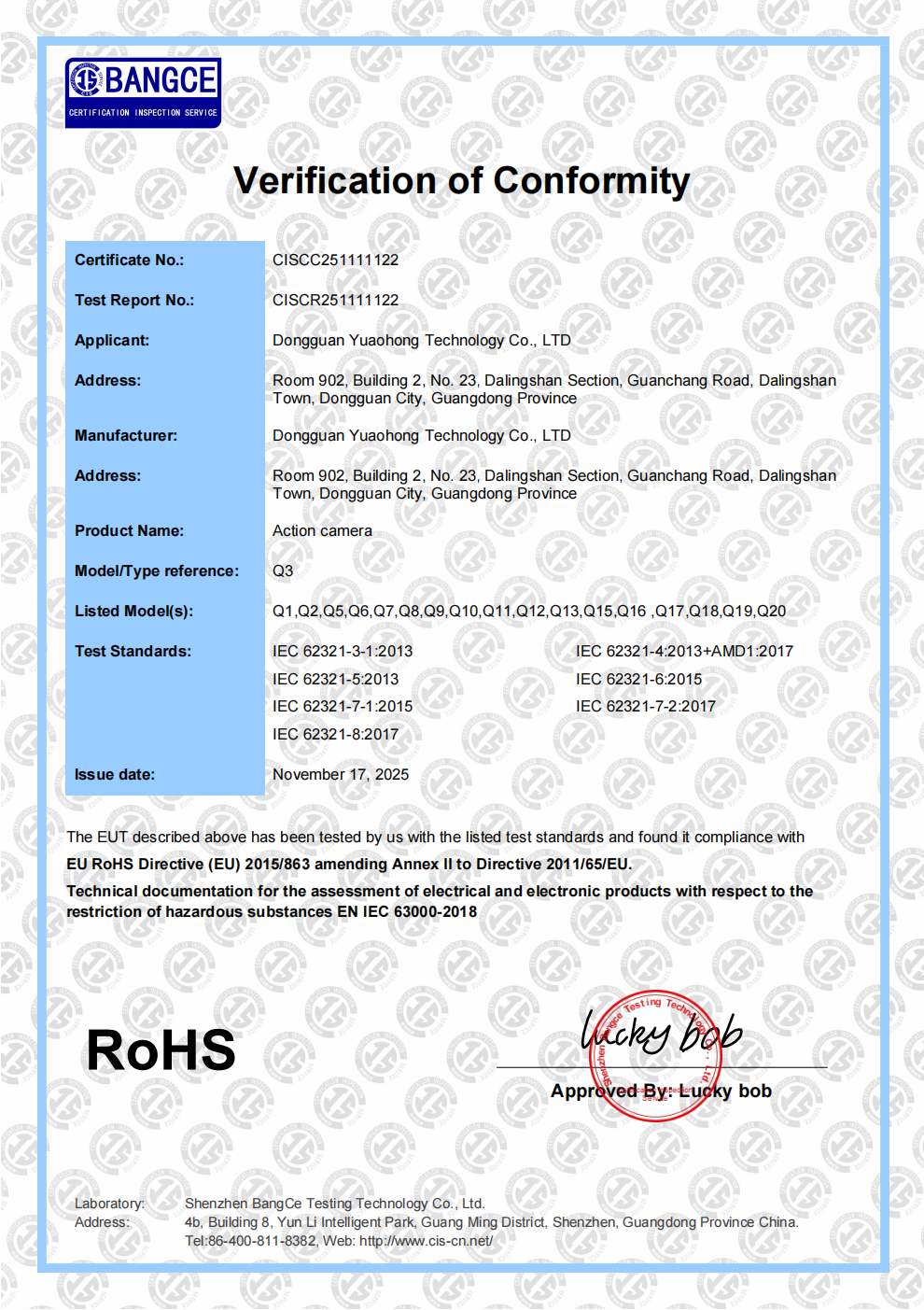
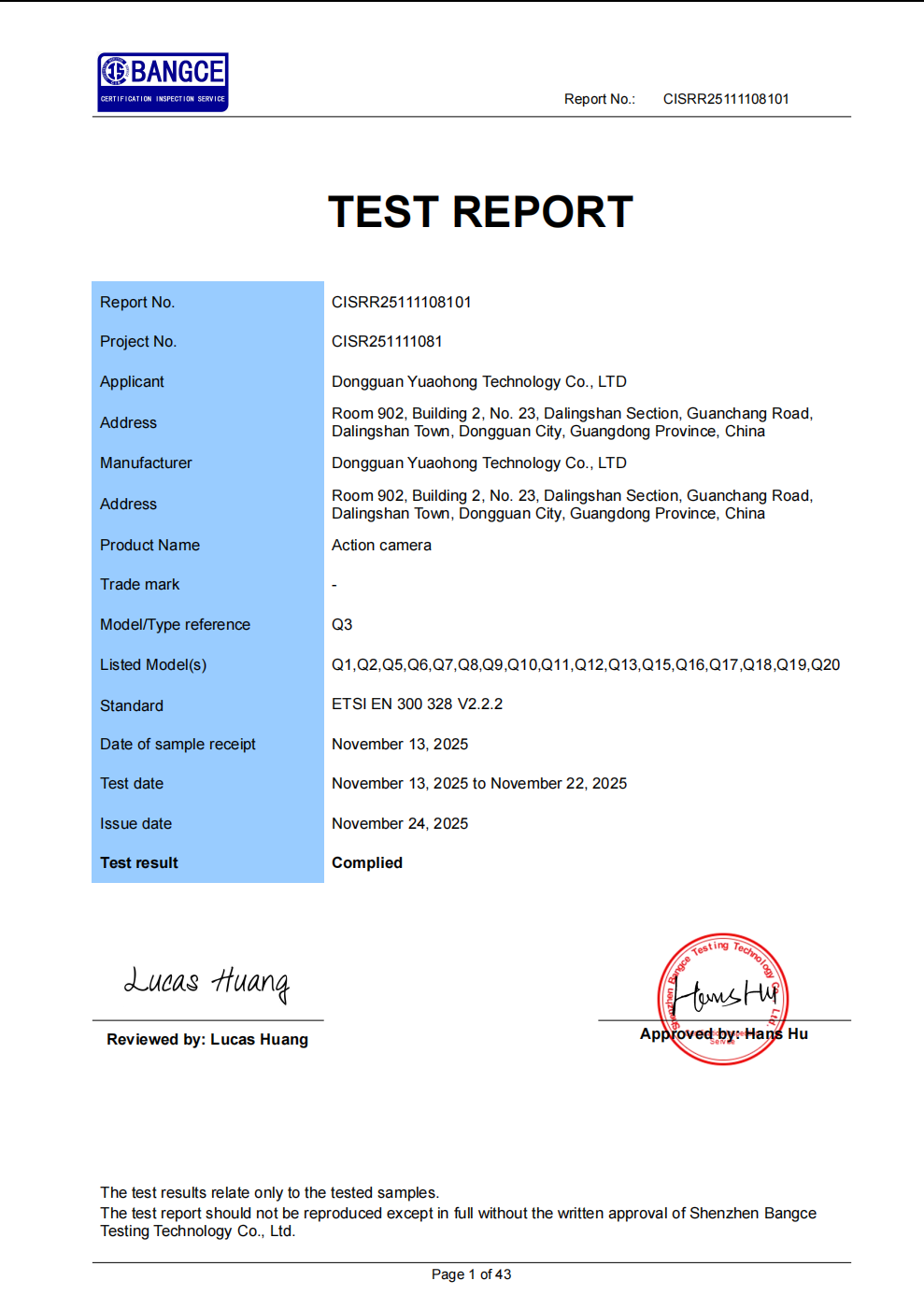
- Verify the compliance path against the exact model scope. Certificates are model-scoped, not brand-wide. The CE certificate CISRC251111081V1 (issued by BANGCE under ETSI EN 300 328 V2.2.2) covers Q3, Q1, Q2, Q5 and the wider Q-series scope. RoHS certificate CISCC251111122 (EU 2015/863, also issued by BANGCE, tested against the IEC 62321 series) covers the same Q-series scope. FCC certification CQASZ20260601273E-01 covers X7, M16S, M17S, M29S and M30S, and FCC ID 2BR43-Q3 applies to action camera scope. An EU RF test report, CISRR25111108101 to ETSI EN 300 328 V2.2.2, supports the radio compliance file.
- Validate on a sample. The minimum order quantity is 1 unit, so a single-unit validation run is available before any volume commitment. Run the acceptance criteria from steps 2 and 3 on the sample, not on the brochure.
- Lock production and after-sales terms. The typical production lead time is 25–30 days, monthly capacity is 170,000 units, and quality control covers 100% testing of all products. After-sales support includes a 12-month official warranty, online technical guidance, and replacement and maintenance services.
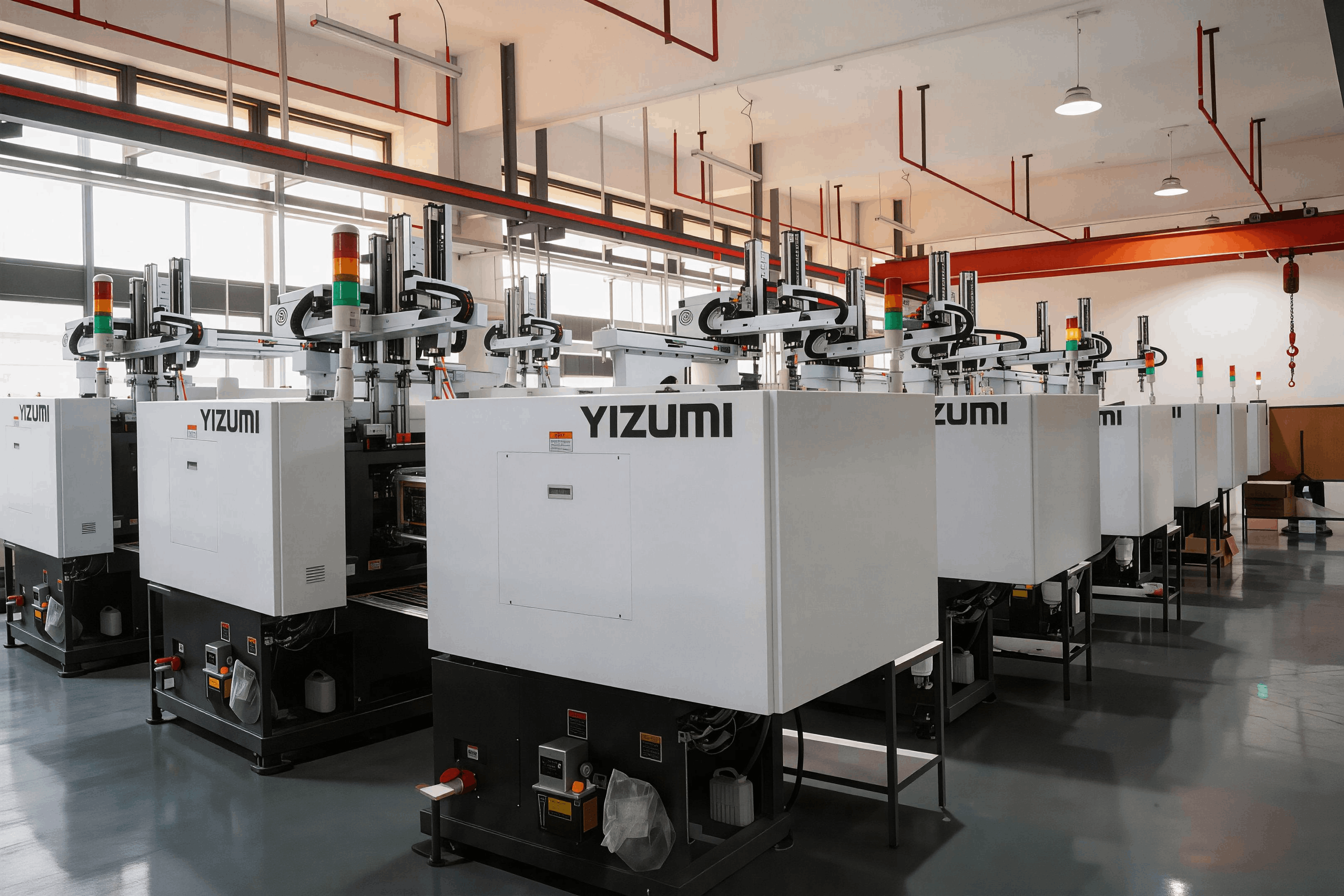
One additional capability note is relevant when a program needs a non-catalogue configuration. Dongguan YuAoHeng Electronic Technology Co., Ltd. was founded in 2016 and operates a 1,500 m² production facility with roughly 300 employees, an R&D team of 30 engineers, annual output of about 2,000,000 units and an export share of around 80% across Europe, North America, Asia and South America. Customization is organized around product design and R&D services, hardware and function customization (including camera modules and sensors), software and intelligent function customization (firmware, APP and cloud services), and appearance and packaging customization such as color, material, logo engraving and retail packaging.
Use cases: which parameter group decides which application
Application fit is a parameter-matching exercise. The scenarios below are common in OEM programs, together with the parameter group that usually decides the outcome.
- Underwater and diving programs. Enclosure sealing and the documented ingress rating decide the outcome, not resolution. The US OEM case in the record documents IP66 waterproof capability up to 10 meters; IP68, as defined by IEC 60529, is a separate standard and should only be quoted if it has been verified for the exact model.
- Bicycle-mounted recording. Stabilization tier and lens field of view dominate. A 6-level EIS model such as the Q2 addresses continuous road vibration, while the 130° wide-angle lens with rotating direction on Q1, Q3 and Q5 supports mounting-angle correction without re-machining brackets.
- Ski and cold-weather use. Battery format and reported working time become the binding constraint, because cold conditions reduce usable runtime. Models documented with a 2,000 mAh / 3.8 V polymer pack, such as the Q1, Q3 and Q5, offer a larger energy budget to work with than a 1,000 mAh pack.
- Vlog and handheld recording. Display, touch or button control, storage and audio specification drive the user experience. Q2's 1.8-inch 800×480 panel with touch and physical dual buttons, and the X20's 1.54-inch IPS panel with optional 16G to 128G storage, represent two different positioning points for the same scenario.
- Climbing and mountaineering. Weight, enclosure material (ABS across the lineup) and stabilization behavior at slow, deliberate movement should be validated on a sample, since stabilization settings that suit fast motion do not always suit slow camera sway.
- Surfing and water sports. Two parameters interact: the documented waterproof rating and the charging or port cover design. The US OEM case also lists a shockproof and dustproof body and wireless APP control, which are the features most often requested alongside water exposure.
- Night and low-light recording. Illumination choices decide usability. Q3 supports infrared night vision with hand regulation, Q5 adds four built-in enhanced energy-saving infrared lights with hand regulation, Q9 uses four white fill lights with manual adjustment, and Q11 and X11 use one-button LED fill light.
Comparison table: Q1, Q2, Q3 and X20 hardware parameters
The table below compares four models on the verified parameter set documented in the YUAOHENG product datasheets. Blank or "not specified" entries indicate parameters that are not stated in the datasheet and should be requested from the supplier.
| Parameter | Q1 | Q2 | Q3 | X20 |
|---|---|---|---|---|
| Display | 1.5-inch IPS, 320×240 | 1.8-inch IPS, 800×480 | 1.5-inch IPS, 320×240 | 1.54-inch IPS, 320×240 |
| Lens | 130° wide-angle HD lens, rotating direction | 25 mm, 130° wide angle | 130° wide-angle HD lens, rotating direction | HD lens 130° |
| Recording architecture | Front 4K (3840×2160) + rear 4K (3840×2160); simultaneous dual recording front 2K + rear 2K | Front 4K + rear 4K; simultaneous 2K+2K; three modes optional | Front 4K (3840×2160) + rear 4K (3840×2160); simultaneous dual recording front 2K + rear 2K | Camera resolution AVI (1920×1080) |
| Stabilization | Not specified | 6-level electronic image stabilization | Not specified | Not specified |
| Controls | Not specified | Touch + physical dual buttons | Not specified | Not specified |
| Night vision | Not specified | Not specified | Infrared supported; hand regulation | Not specified |
| Microphone | Not specified | Not specified | Full-range built-in capacitor MIC | Not specified |
| Battery | 2,000 mAh / 3.8 V polymer | 18650 – 2,000 mA | 2,000 mAh / 3.8 V polymer | 1,000 mAh / 3.8 V polymer |
| Reported video working time | About 4–5 hours | About 4–5 hours | Not specified | About 6–7 hours |
| Reported recording time | About 9 hours | Not specified | Not specified | About 9 hours |
| Charging input | Not specified | Not specified | Not specified | MICRO-Type-C / DC 5V-1A-2A |
| Storage | Not specified | Not specified | Not specified | 16G / 32G / 64G / 128G optional |
| Wireless | Wi-Fi (type: 4k+WIFI Q1) | Wi-Fi + touch screen | Wi-Fi (4K WIFI) | Wi-Fi (2K+WIFI) |
FAQ
Which certifications apply to YUAOHENG action cameras, and what is the certified model scope?
Certification is model-scoped, not brand-wide, so the certificate must be matched to the exact model being purchased. CE certificate CISRC251111081V1, issued by BANGCE under ETSI EN 300 328 V2.2.2 on 2026-04-02, covers Q3, Q1, Q2, Q5, Q6, Q7, Q8, Q9, Q10, Q11, Q12, Q13, Q15, Q16, Q17, Q18, Q19 and Q20. RoHS certificate CISCC251111122, issued by BANGCE under EU 2015/863 on 2025-11-17 and tested against the IEC 62321 series, covers the same Q-series scope. FCC certification CQASZ20260601273E-01, issued by CQA under 47 CFR Part 15 Subpart C on 2026-07-01, covers X7, M16S, M17S, M29S and M30S. FCC ID 2BR43-Q3, issued by KL-Certification GmbH under 47 CFR Part 15.247 on 2025-12-10, applies to action camera scope. An EU RF test report, CISRR25111108101, supports the radio compliance file.
How do the Q2, Q3 and X20 differ in hardware capability?
They differ on different axes, which is why they serve different programs. The Q2 is the stabilization-focused model: 6-level electronic image stabilization, front 4K and rear 4K recording, simultaneous 2K+2K dual recording across three optional modes, a 1.8-inch 800×480 IPS display, standard touch and physical dual buttons, and an 18650 – 2,000 mA battery with a reported video working time of about 4–5 hours. The Q3 is the dual-recording and night-capable model: front 4K plus rear 4K with simultaneous front 2K + rear 2K dual recording, a 130° wide-angle HD lens with rotating direction, infrared night vision with hand regulation, a full-range built-in capacitor microphone, and a 2,000 mAh / 3.8 V polymer battery. The X20 is the runtime and interface model: a 1,000 mAh / 3.8 V polymer battery with a reported video working time of about 6–7 hours and recording time of about 9 hours, a 1.54-inch IPS 320×240 display, a MICRO-Type-C / DC 5V-1A-2A input, and optional 16G / 32G / 64G / 128G storage.
Which hardware parameters drive unit cost in an action camera program?
Cost is driven by the parameters that add components or process steps rather than by resolution alone. The measurable drivers visible in the lineup include display size and resolution plus touch capability (Q2 uses a 1.8-inch 800×480 panel with dual touch and physical buttons), a second recording channel and its mode combinations (Q1, Q2 and Q3 all support simultaneous dual recording), stabilization tier (6-level electronic image stabilization on Q2 versus anti-shake support on Q7 and X7), battery format and capacity (polymer pouch cells from 1,000 mAh to 3,000 mA formats versus cylindrical 18650 cells), infrared or LED illumination with manual switching (Q3, Q5, Q9, Q11, X11), microphone specification (capacitor MIC or noise-reduction IC), wireless module requirements, and market-specific certification scope. Because these parameters are modular, buyers can usually rebalance one against another within a target cost band; that rebalancing should be discussed with the engineering team rather than assumed from a catalogue.
Can a buyer validate these parameters on a sample before mass production?
Yes. The minimum order quantity is 1 unit, which allows single-unit validation before any volume commitment. A practical sample protocol covers five checks: record in each mode that will ship to confirm frame rate and file behavior; test the stabilization levels that will be exposed as default and confirm availability per mode; run a full-discharge runtime test at the target resolution with Wi-Fi on and off; verify night illumination switching, which is hand or manual regulation on Q3, Q5 and Q9; and confirm display, touch or button response plus the charging connector against the approved specification. Quality control covers 100% testing of all products, and the documented product parameters can be cross-checked against the certificate scope for the target market.
What is the production lead time, and what after-sales support is included?
The typical production lead time is 25–30 days, supported by a monthly capacity of 170,000 units. After-sales support includes a 12-month official warranty, professional online technical guidance and after-sales troubleshooting, replacement and maintenance services, plus product certification documents, sales materials and long-term technical iteration support. To start a sample or quotation request for the Q1, Q2, Q3, X20 or any other model in the lineup, contact info@yuaoheng.com or WhatsApp +86 18098279385, and download the full product catalogue at YUAOHENG product catalogue (PDF).
Conclusion
Action camera hardware selection becomes manageable once the parameters are grouped and read as behavior. Stabilization is a tier decision — 6-level electronic image stabilization on the Q2 against anti-shake support on the Q7 and X7. Dual-recording architecture is a mode decision — front 4K plus rear 4K with simultaneous front 2K + rear 2K on the Q1 and Q3, and three optional modes with simultaneous 2K+2K on the Q2. Battery is a format-and-workload decision — 1,000 mAh to 3,000 mA formats with reported working times that do not rank in the same order as capacity. Interface, display and illumination are operator-experience decisions — 1.47-inch to 2.0-inch IPS panels, touch plus physical buttons on the Q2, and manually switched infrared or LED illumination on the Q3, Q5, Q9, Q11 and X11.
Multiplied across a market where 4K and above already accounts for roughly 46.25% of share (Mordor Intelligence), that mapping work is what separates a product that meets a specification from a product that meets a customer's recording session. Verification belongs on a sample, and the documentation — including model-scoped CE, RoHS, FCC and FCC ID certificates — belongs in the purchase file.
Next step
YUAOHENG supplies action cameras for OEM and ODM programs from Dongguan, China, with a minimum order quantity of 1 unit, a typical production lead time of 25–30 days and a 12-month official warranty. Request a sample or a quotation by email at info@yuaoheng.com or WhatsApp +86 18098279385. Download the full catalogue at YUAOHENG product catalogue (PDF) or visit www.yuaoheng.com.

Have Questions or Need More Details?
Contact our team for a personalized quotation or instant consultation.
Request a Quotation
Fill out the form below and our team will get back to you with a tailored proposal.
WhatsApp Direct Chat
Prefer to chat in real-time? Message us on WhatsApp for instant assistance & quick answers.
- Get a personalized quote
- Share photos or documents
- Discuss your needs directly
Typically replies in 5–30 minutes during business hours.