
Action Camera Supplier Evaluation: Model-Level Capability and Delivery Assurance
Short answer: an action camera supplier should be evaluated twice — once against the exact models you plan to buy, and once against the delivery terms that decide whether those models arrive at the agreed specification, in the agreed quantity, on the agreed date. A factory audit, a certificate wall and an export market list are entry gates. They do not prove that a specific model records in the resolution printed on its packaging, stabilises footage the way its label implies, or ships inside the lead time quoted in the quotation.
This guide is a working checklist for importers, distributors and brand owners who are already comparing suppliers. It uses five models from the YUAOHENG Action Camera range — X20, Q1, Q2, Q3 and Q7 — to show what model-level verification looks like in practice, then applies the same discipline to purchasing terms, quality control and acceptance criteria.
YUAOHENG Action Camera is the action camera line of Dongguan YuAoHeng Electronic Technology Co., Ltd., a manufacturer based in Dongguan, China, whose core products are action cameras, dash cameras and smart video doorbells, supplied to OEM and ODM customers across Europe, North America, South America and Asia.
Why insist on model level rather than company level? Because the category is crowded with similar-sounding capability claims. In 2024, China exported USD 166 million in video cameras, with the United States the single largest destination at USD 31.8 million (OEC). With that volume moving through comparable channels, differentiation now sits in documentation: which model, which configuration, which certificate, which delivery term.
Why Model-Level Evaluation Decides the Order
Most sourcing problems are not discovered during the audit. They are discovered in the first shipment, when the delivered configuration cannot do the job the buyer designed around. Four failure patterns explain most of them.
- Resolution language is applied at lineup level. A range promoted as "4K" can contain models with different documented recording modes. X20 is documented as a 2K+WiFi model with AVI (1920×1080) camera resolution, while Q1, Q2, Q3 and Q7 are documented as 4K models. "Send the 4K one" is a specification gap, not a purchasing instruction.
- Feature names hide different implementations. WiFi, dual recording, night vision and stabilisation appear across a range in different forms. Q2 documents 6-level electronic image stabilisation, Q7 documents anti-shake support, and Q3 documents infrared night vision with hand regulation. Assuming parity across a lineup is how mismatched units reach a market.
- Interface and accessory assumptions are rarely tested before ordering. Screen size, screen resolution, touch capability, lens rotation, mounting and waterproof case configuration all vary by model — and they decide whether the camera is usable in the scenario it was bought for.
- Delivery is agreed verbally and documented loosely. Minimum order quantity, production lead time, test coverage, warranty length and the after-sales path determine whether a verified specification survives scale-up.
In this framework, "verified" has a narrow meaning: a claim traces back to a named model in the supplier's documentation and, where compliance is involved, to a certificate whose scope actually lists that model.
Industry Background: What Buyers Are Selecting Against
Published market data varies by research scope, so treat single figures as directional. The global action camera market was valued at USD 6.57 billion in 2024 according to SkyQuest, while other research houses estimate USD 7.09 billion (Mordor Intelligence, 2025) and USD 7.97 billion (Grand View Research, 2025) using different inclusions. For a buyer, the structural signals matter more.
- Ultra-HD is now the mainstream claim. The 4K-and-above resolution segment accounted for approximately 46.25% of the action camera market in 2025 (Mordor Intelligence). Resolution is therefore both the primary purchase driver and the primary dispute point — which is why it should be verified per model, not per brand.
- Stabilisation has become baseline rather than premium. Electronic image stabilisation is now a standard feature in budget to mid-range action cameras, using software algorithms to correct motion (Insta360 industry guide). Buyers should treat "has EIS" as a minimum and differentiate on the documented implementation.
- North America remains the largest revenue pool. The region held a 34% revenue share of the global market in 2025 (Grand View Research), which is why US-market documentation such as an FCC ID belongs to the evaluation stage rather than the arrival stage.
- Safety and ingress standards are defined outside the product category. Action cameras fall under IEC 62368-1 for audio/video and information technology equipment, with the 4th edition published in 2023. Ingress protection is defined by IEC 60529, where IP68 means dust protection (6) and immersion (8). Neither rating is self-declaring: the rating that matters is the one documented for your specific model and enclosure configuration.
A practical consequence follows. The documented IP66 rating of up to 10 metres applies to the product supplied in the referenced OEM project described later in this article. It should not be read as a blanket rating for every model or every case combination in a catalogue.
The Two-Part Supplier Evaluation Checklist
Part 1 — Model-Level Capability Verification
Model-level capability is confirmed checkpoint by checkpoint, against a named model, with a document behind each claim. The table below shows the structure applied to the YUAOHENG lineup; the same structure works for any supplier.
| Verification checkpoint | What to confirm | Evidence to request |
|---|---|---|
| Resolution and dual recording | Front resolution, rear resolution, simultaneous dual-recording mode, frame rate | Model-level specification stating 4K front plus 4K rear with 2K+2K dual recording (Q1, Q2, Q3), 4K at 30fps (Q7), or documented 2K+WiFi (X20) |
| Stabilisation | Whether the model has electronic image stabilisation, generic anti-shake, or none documented | Written confirmation: 6-level EIS on Q2, anti-shake support on Q7 |
| Display and control interface | Screen size, screen resolution, touch versus physical control | Specification lines: 1.54-inch IPS 320×240 (X20), 1.5-inch IPS 320×240 (Q1, Q3), 1.8-inch IPS 800×480 with touch and physical dual buttons (Q2), 1.47-inch IPS 320×240 (Q7) |
| Lens and night vision | Wide-angle figure, lens rotation, infrared night vision and its switching mode | 130° wide-angle lens statement; Q3 infrared night vision with hand regulation |
| Battery and runtime | Battery type, capacity and documented working time per model | 2000mAh/3.8V polymer (Q1, Q3), 18650 2000mA (Q2), 1000mAh/3.8V polymer (X20, Q7), with documented video working time where available |
| Connectivity | Whether WiFi and app-based transfer are supported on the exact model | WiFi documented on X20, Q1, Q2, Q3 and Q7 |
| Waterproof case compatibility | Sealing performance of the camera-and-case combination, not the camera alone | Documented depth rating for the specific enclosure configuration |
| Certification scope | Whether the certificate lists your model and your destination market | CE, RoHS, FCC ID and RF test report documents with their scope lists |
| Commercial and delivery terms | MOQ, lead time, test coverage, acceptance criteria, warranty | Purchase order terms: MOQ 1 unit, 25–30 day lead time, 100% testing, 12-month warranty |
Read together, the five documented models show how much varies inside a single range.
- Resolution and dual recording: Q1, Q2 and Q3 document front recording at 4K (3840×2160), rear recording at 4K, and simultaneous dual recording at front 2K + rear 2K; Q2 additionally documents three selectable recording modes. Q7 documents 4K (3840×2160) at 30fps. X20 is documented as 2K+WiFi.
- Stabilisation: Q2 documents 6-level electronic image stabilisation and Q7 documents anti-shake support. Stabilisation is not documented for X20, Q1 or Q3, so those models should not be specified for high-vibration mounting without written confirmation.
- Display and control interface: X20 uses a 1.54-inch IPS screen at 320×240; Q1 a 1.5-inch IPS screen at 320×240; Q2 a 1.8-inch IPS screen at 800×480 with standard touch and physical dual buttons; Q3 a 1.5-inch IPS screen at 320×240; Q7 a 1.47-inch IPS screen at 320×240. Screen resolution and touch control change both operating experience and bill of materials.
- Lens and night vision: a 130° wide-angle lens is documented across the lineup, with a rotating direction on the models that specify it, and Q2 documented as a 25mm 130° wide-angle lens with front and rear simultaneous recording. Q3 documents infrared night vision with hand regulation as the switching mode.
- Battery: battery type is not uniform across a lineup. Q1 and Q3 document a 2000mAh/3.8V polymer battery, Q2 documents an 18650 2000mA battery, and X20 and Q7 document a 1000mAh/3.8V polymer battery. Documented video working time is about 6–7 hours for X20 and about 4–5 hours for Q1 and Q2. X20 storage supports 16G/32G/64G/128G optional cards and charges over MICRO-Type-C at DC5V-1A-2A.
- Connectivity: WiFi is documented on X20, Q1, Q2, Q3 and Q7, which is the practical line between app-controlled footage transfer and card-based workflows.
Two verification items sit outside the specification sheet and are frequently skipped. The first is waterproof case compatibility: sealing performance is a property of the camera-and-case combination, so the enclosure configuration must be named and tested rather than assumed from a model number. The second is certification scope: a certificate is only evidence for the models it lists.
Part 2 — Delivery Assurance Verification
Delivery assurance converts capability into a repeatable purchase. The terms below are the ones worth fixing in a purchase order before the first production run.
- Order flexibility: minimum order quantity is 1 unit, which allows a genuine sample evaluation before committing volume.
- Lead time: typical production lead time is 25–30 days.
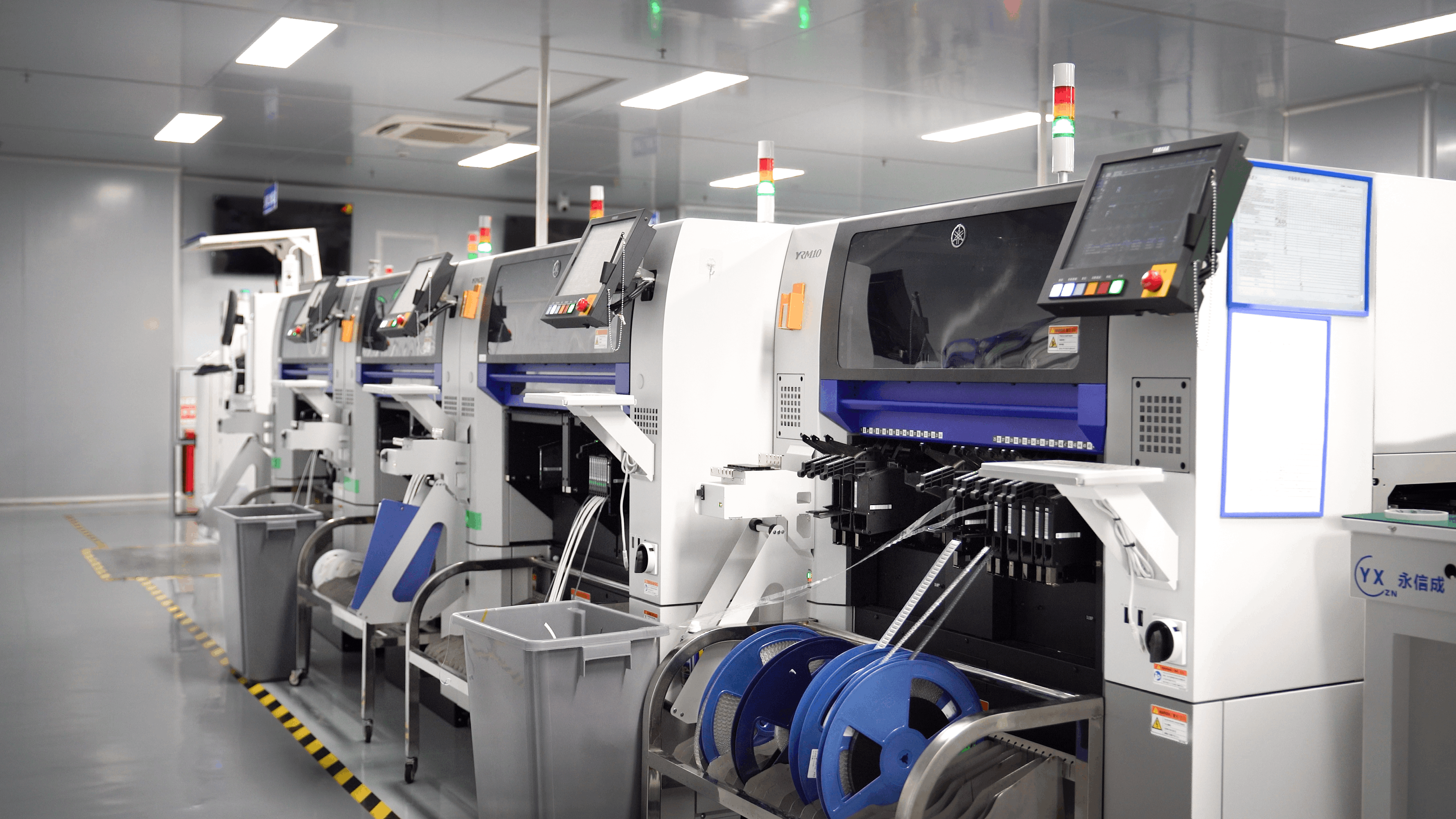
- Capacity: monthly capacity is 170,000 units, with annual output of 2,000,000 units across the company's product lines.
- Facility and team: a 1,500㎡ standardized production facility, approximately 300 employees and a 30-engineer R&D team — relevant because hardware and firmware changes are handled in-house.
- Quality control: 100% testing of all products, which should be matched to agreed acceptance criteria in the purchase order.
- After-sales: a 12-month official warranty, professional online technical guidance, and replacement and maintenance services.
- Customisation scope: OEM/ODM covering product concept design, prototype development, engineering consultation and certification support; hardware and function customisation such as camera modules, sensors and detection functions; software and intelligent function customisation including firmware, app and cloud services; and appearance and packaging customisation covering colour, material, logo engraving, structure and retail packaging.
A reference point for how these terms behave in practice: an action camera brand OEM project in the United States ran 5,000 units with a project duration of 5 years, supplied with IP66 waterproof capability up to 10 metres. Long project duration and a documented sealing figure are the two variables most often missing from short evaluations.
Step-by-Step: A Seven-Step Evaluation Workflow
- Lock the model sheet. Write model number, resolution, dual-recording mode, display, stabilisation, night vision and battery into one table. Do not evaluate a "range"; evaluate models.
- Verify recording modes in writing. Ask for front resolution, rear resolution, simultaneous dual-recording resolution and frame rate. For the lineup used here, Q1, Q2 and Q3 document front 4K, rear 4K and simultaneous 2K+2K; Q7 documents 4K at 30fps; X20 is documented as 2K+WiFi.
- Verify the stabilisation type. Confirm whether the model has electronic image stabilisation (Q2 documents 6-level EIS), anti-shake support (Q7), or no documented stabilisation, and match that answer to the mounting environment you are designing for.
- Verify display and control interface. Confirm screen size, screen resolution and whether operation is touch, physical or dual. Moving from a 320×240 screen to an 800×480 touch screen (Q2) changes both usability and cost structure.
- Verify lens, night vision and audio. Confirm the wide-angle figure (130° across the lineup), lens rotation, and whether night vision exists (Q3 documents infrared night vision with hand regulation).
- Verify battery and runtime per model. Match documented battery type and capacity to the documented working time before assuming two models are interchangeable on runtime.
- Verify certification scope, then finalise commercial terms. Check that each certificate lists the model and the destination market, then confirm MOQ, lead time, test coverage, acceptance criteria, warranty and the after-sales path in writing.
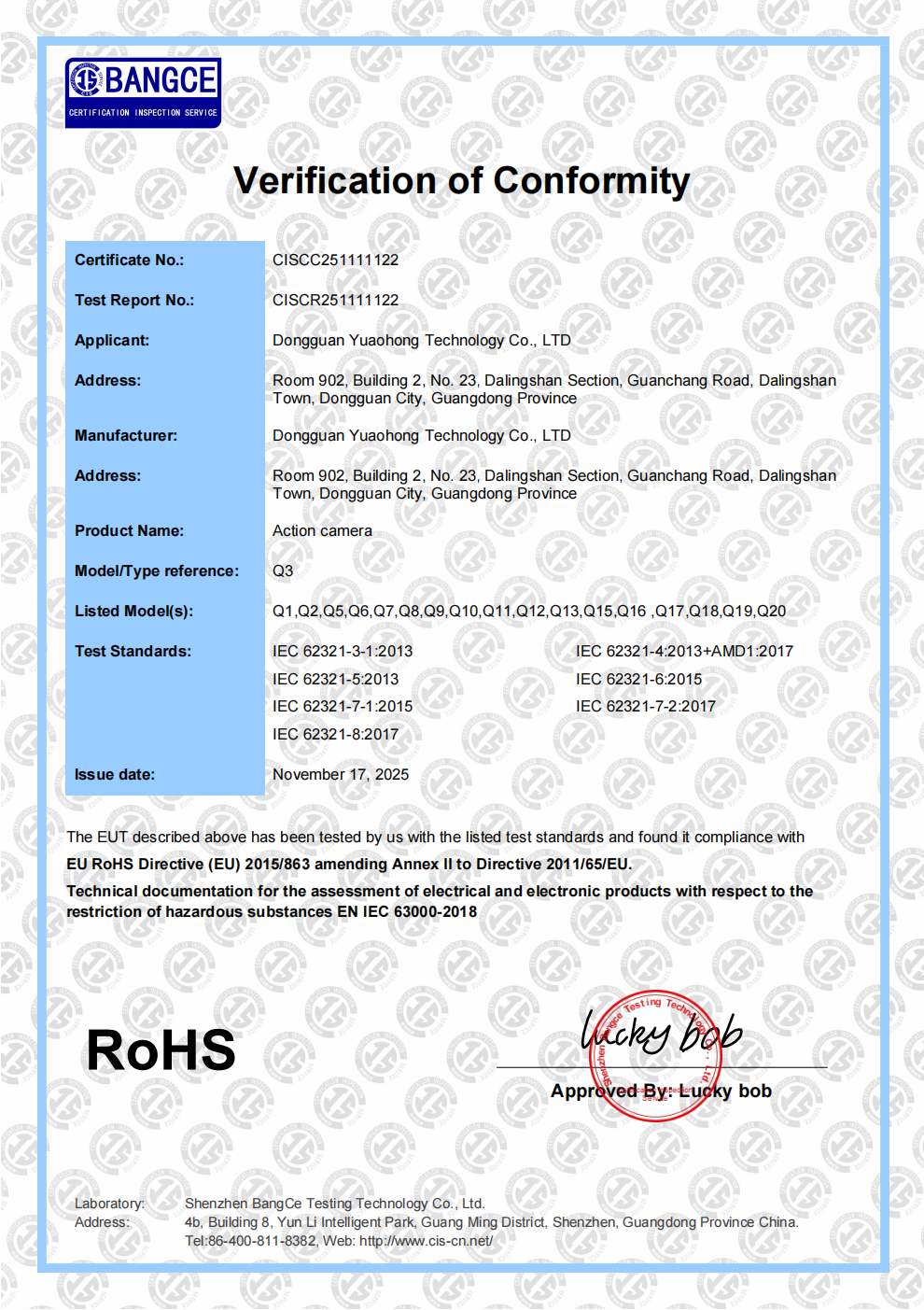
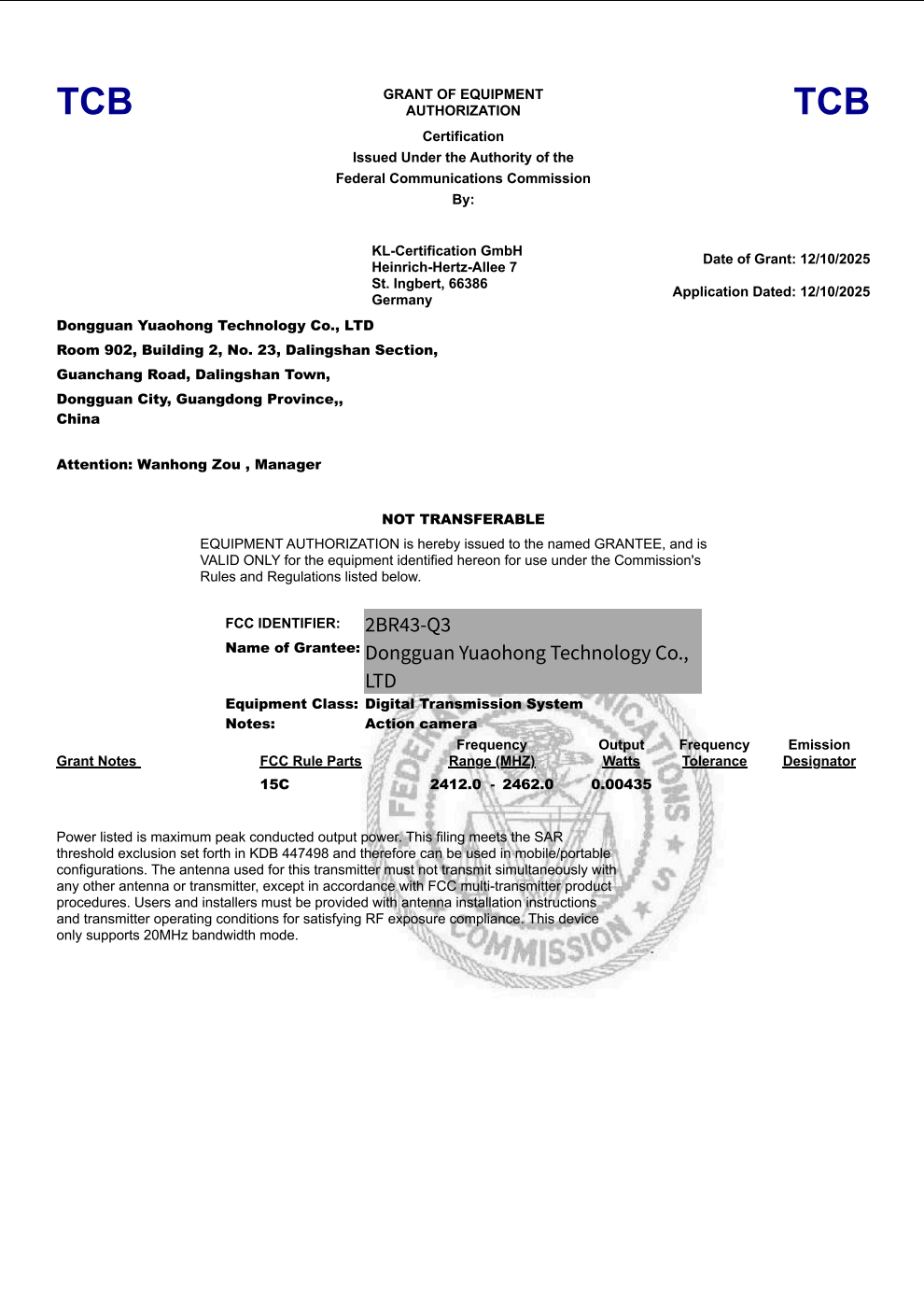
Step seven is where evaluation usually stalls. A certificate number is not evidence until its scope is matched against the model list. The CE certificate CISRC251111081V1 was issued on 2 April 2026 by BANGCE under ETSI EN 300 328 V2.2.2, and the RoHS certificate CISCC251111122 was issued on 17 November 2025 under EU 2015/863 with IEC 62321 test standards; both scope lists include models such as Q3, Q1, Q2, Q7 and X20. The FCC ID 2BR43-Q3 was issued on 10 December 2025 under 47 CFR Part 15.247, and RF test report CISRR25111108101 (24 November 2025) covers ETSI EN 300 328 V2.2.2. Because FCC documentation can be model-specific — the FCC test report CQASZ20260601273E-01, issued 1 July 2026 under 47 CFR Part 15, Subpart C, lists X7, M16S, M17S, M29S and M30S — buyers shipping to the United States should confirm in writing which FCC document applies to the exact models they order.
Use-Case Mapping: Matching Verified Capability to Real Conditions
- Underwater diving: sealing is the deciding variable and it is configured at case level. Verify the documented depth rating for the specific camera-and-case combination rather than for the model number alone; the referenced OEM project documents IP66 up to 10 metres.
- Bicycle mounted: continuous vibration punishes unstabilised footage. Q2 (6-level EIS) and Q7 (anti-shake support) are the documented candidates, while X20, Q1 and Q3 have no stabilisation documented.
- Surfing and waterproof sports: combine a documented sealing configuration with WiFi for phone-based monitoring; WiFi is documented on X20, Q1, Q2, Q3 and Q7.
- Skiing and cold-weather shooting: runtime drives selection. Q1 and Q3 document a 2000mAh/3.8V polymer battery, while X20 and Q7 document a 1000mAh/3.8V polymer battery.
- Vlog handheld: Q2 combines a 1.8-inch 800×480 IPS screen, standard touch and physical dual buttons, and front/rear dual recording — a combination not repeated elsewhere in the list.
- Night and low-light recording: only Q3 documents infrared night vision, with hand regulation as the switching mode.
- Climbing and mountaineering: the 130° wide-angle lens documented across the lineup keeps both hands and horizon in frame, with 4K dual recording available on Q1, Q2 and Q3.
Comparison Table: X20, Q1, Q2, Q3 and Q7 Side by Side
| Model | Documented recording capability | Display | Stabilisation | Night vision | Battery |
|---|---|---|---|---|---|
| X20 | 2K+WiFi; camera resolution AVI (1920×1080) | 1.54-inch IPS, 320×240 | Not documented | Not documented | 1000mAh/3.8V polymer; video working time about 6–7 hours |
| Q1 | 4K+WiFi; front 4K (3840×2160), rear 4K; simultaneous 2K+2K dual recording | 1.5-inch IPS, 320×240 | Not documented | Not documented | 2000mAh/3.8V polymer; video working time about 4–5 hours |
| Q2 | 4K+WiFi; front 4K, rear 4K; simultaneous 2K+2K, three modes optional | 1.8-inch IPS, 800×480; standard touch and physical dual buttons | 6-level electronic image stabilisation | Not documented | 18650 2000mA; video working time about 4–5 hours |
| Q3 | 4K WiFi; front 4K (3840×2160), rear 4K; simultaneous 2K+2K dual recording | 1.5-inch IPS, 320×240 | Not documented | Infrared night vision supported, hand regulation | 2000mAh/3.8V polymer |
| Q7 | 4K+WiFi; 4K (3840×2160) at 30fps | 1.47-inch IPS, 320×240 | Anti-shake supported | Not documented | 1000mAh/3.8V polymer |
The comparison should be read as a capability map, not a ranking. X20 is the WiFi option with the longest documented video working time; Q1 and Q3 are 4K dual-recording models differentiated mainly by night vision; Q2 adds the touch interface and 6-level EIS; Q7 pairs 4K 30fps with anti-shake support in the smallest display of the five.
Frequently Asked Questions
1. Which certifications should be verified before importing these action camera models?
Verify three document types and match each one to your model and destination market. For the EU, CE certificate CISRC251111081V1 (issued 2 April 2026 by BANGCE under ETSI EN 300 328 V2.2.2) and RoHS certificate CISCC251111122 (issued 17 November 2025 under EU 2015/863 with IEC 62321 test standards) both list models including Q3, Q1, Q2, Q7 and X20. For the United States, FCC ID 2BR43-Q3 was issued on 10 December 2025 under 47 CFR Part 15.247, and RF test report CISRR25111108101 (24 November 2025) covers ETSI EN 300 328 V2.2.2. Because FCC documentation can be model-specific — the FCC test report CQASZ20260601273E-01 lists X7, M16S, M17S, M29S and M30S — confirm in writing which document applies to the exact models you import.
2. How can a buyer confirm model-level capability without visiting the factory?
Request per-model documentation that states resolution and dual-recording modes, stabilisation type, display size and resolution, lens angle, night vision mode, and battery type and capacity, then compare it with a running sample. Examples from this lineup: Q1, Q2 and Q3 document front 4K, rear 4K and simultaneous 2K+2K dual recording; Q2 documents 6-level electronic image stabilisation; Q3 documents infrared night vision with hand regulation; Q7 documents 4K at 30fps and a 1000mAh/3.8V polymer battery. Documentation and sample should agree before a volume order is placed.
3. What should be fixed before requesting a quotation so quotes stay comparable?
Fix the model, the configuration and the commercial scope. Lock the model number and feature set, then define the customisation level across product design, hardware and function customisation, firmware/app/cloud services, and appearance and packaging, and confirm MOQ (1 unit) and typical production lead time (25–30 days) on the same document. Quotes that differ by model, configuration, packaging or test scope are not comparable, and the specification sheet — not the price line — is where that difference becomes visible.
4. Can samples or a small trial batch be ordered before committing to volume?
Yes. Minimum order quantity is 1 unit, so evaluation can start with a single unit or a small trial batch, with typical production lead time of 25–30 days for volume orders. Quality control covers 100% testing of all products, and after-sales support includes a 12-month official warranty, online technical guidance, and replacement and maintenance services. To start a sample evaluation, send the target model, configuration and destination market to the supplier, so the sample is built against the same acceptance criteria written into the purchase order.
5. What is the typical lead time, and what supports the delivery commitment?
Typical production lead time is 25–30 days. The capacity behind that commitment is 170,000 units per month, with annual output of 2,000,000 units and 100% testing of all products in a 1,500㎡ standardized production facility. A documented reference is a US action camera brand OEM project covering 5,000 units over a 5-year duration with IP66 waterproof capability up to 10 metres. The practical next step is to pair the lead time with written acceptance criteria and a warranty term, so delivery and quality are measured against the same document.
Conclusion
Supplier evaluation for action cameras becomes reliable when it stops being a judgement about a company and becomes a check against models and terms. On the capability side, the verification points are fixed: resolution and dual-recording modes, stabilisation type, display and control interface, 130° wide-angle lens and night vision, battery chemistry and capacity, and WiFi — each confirmed per model, with X20, Q1, Q2, Q3 and Q7 behaving differently against almost every one of them. On the delivery side, the terms are equally concrete: MOQ, 25–30 day lead time, 170,000-unit monthly capacity, 100% testing, a 12-month warranty and a defined after-sales path.
Certification completes the picture. A CE or RoHS certificate only supports the models in its scope, and an FCC document may be model-specific, so the scope list is as important as the certificate number. Buyers who verify capability at model level and delivery at term level are the ones whose specification survives the first container.
Next step: sample and quotation request
Send your target model, configuration and destination market to Dongguan YuAoHeng Electronic Technology Co., Ltd. (YUAOHENG Action Camera) and receive a sample and a quotation built against the same acceptance criteria used in production. Minimum order quantity is 1 unit, typical production lead time is 25–30 days, and after-sales support includes a 12-month official warranty.
Product catalogue: YUAOHENG product catalogue (PDF)
Website: www.yuaoheng.com
Email: info@yuaoheng.com
WhatsApp: +86 18098279385
Tel: +86 18098279385
Have Questions or Need More Details?
Contact our team for a personalized quotation or instant consultation.
Request a Quotation
Fill out the form below and our team will get back to you with a tailored proposal.
WhatsApp Direct Chat
Prefer to chat in real-time? Message us on WhatsApp for instant assistance & quick answers.
- Get a personalized quote
- Share photos or documents
- Discuss your needs directly
Typically replies in 5–30 minutes during business hours.