Action Camera Supplier Evaluation in 2026: Spec Trends, Certificates, and OEM Checks
Action Camera Supplier Evaluation in 2026: Spec Trends, Certificates, and OEM Checks
Importers, distributors, and brand owners evaluating an action camera manufacturer in 2026 have a larger specification menu than ever: 4K HD recording, electronic image stabilization, waterproof housings, WiFi, touch screens, infrared night vision, and long-battery designs. The evaluation task is not simply to find a product with these labels. It is to identify which supplier can prove the certifications, build quality, testing process, and after-sales support behind those labels.
This article gives an action camera supplier evaluation framework for the Evaluation stage of an OEM/ODM sourcing decision. It uses third-party market data and the product/case records of Dongguan YUAOHENG Electronic Technology Co., Ltd. to show the specific evidence a buyer can request before selecting a partner.
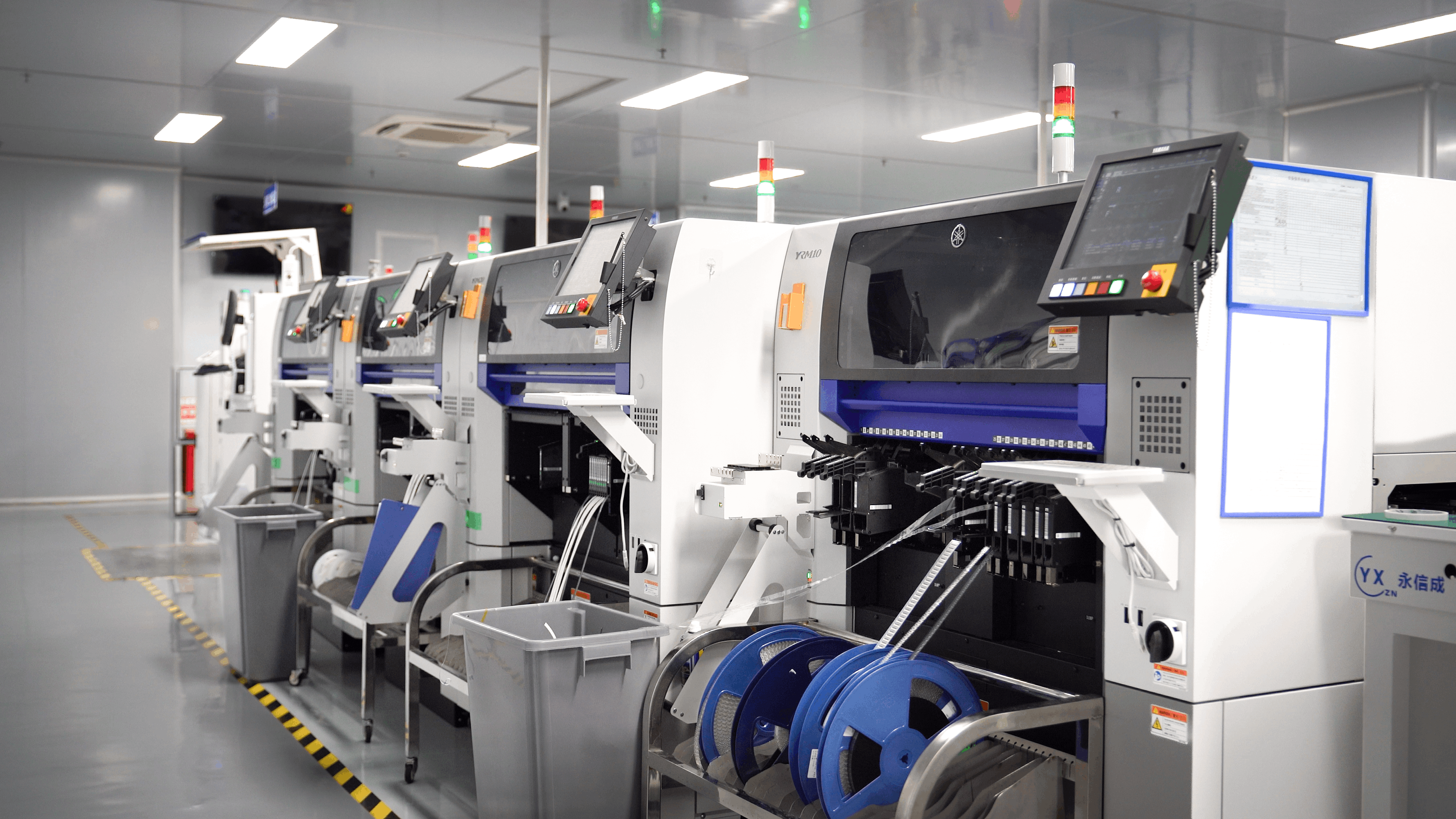
YUAOHENG SMT production line used as part of action camera manufacturing evidence.
The evaluation problem: comparable spec sheets hide different build choices
Action camera spec sheets can look similar because product naming has settled into common patterns. Most suppliers publish a 4K WiFi action camera, a 2K WiFi model, or an anti-shake version. For a procurement team, the risk is not the label; it is the difference in hardware configuration, manufacturing process, verification documents, and after-sales structure.
A certificate with no scope, a waterproof statement with no depth, and an anti-shake statement with no test sample are common ambiguities. The goal of supplier evaluation is to remove those ambiguities before a bulk order. That means checking certificate numbers, asking for factory-level capacity data, comparing model specifications side by side, and confirming how quality problems are handled after shipment.
2026 action camera market context: three trends that affect supplier selection
Market context helps an OEM buyer decide which product tiers deserve the most attention. Several third-party data points are relevant for 2026 sourcing:
- The global action camera market size was valued at USD 6.57 billion in 2024, according to SkyQuest Technology.
- The Ultra-HD segment, defined as 4K and above, accounted for approximately 46.25% of the action camera market share in 2025, according to Mordor Intelligence.
- North America led the global market with an estimated revenue share of 34% in 2025, according to Grand View Research.
- Electronic Image Stabilization, or EIS, is widely described as a standard feature in budget to mid-range action cameras.
- China exported USD 166 million in video cameras in 2024, with the United States as the top destination, according to OEC.
For a supplier evaluation, these figures create a clear benchmark. 4K-class models are no longer a niche choice; they are close to the center of demand. Stabilization has moved from premium to expected behavior. Compliance preparation is also part of the supplier’s job because the biggest export markets are regulated markets.
Six benchmarks for 2026 action camera OEM evaluation
An effective evaluation should look at six core checkpoints: compliance, factory depth, resolution, stabilization, environmental protection, and usability power. The following sections explain what to verify in each area and show where YUAOHENG action camera records provide evidence.
1. Confirm certification numbers and scope
When evaluating a CE certified action camera, FCC certified action camera, or RoHS compliant action camera, ask for the certificate number, issuing authority, standard, and model scope. Certification logos alone are not enough because scope determines which models and markets are covered.
YUAOHENG’s compliance records provide examples of the documentation a buyer should expect:
- FCC certificate CQASZ20260601273E-01, issued by CQA, covers models including X7, M16S, M17S, M29S, and M30S for the US market.
- FCC ID certificate 2BR43-Q3 is on file for action cameras under 47 CFR Part 15.247.
- CE certificate CISRC251111081V1 and RF test report CISRR25111108101 were issued by BANGCE for a Q-series range under ETSI EN 300 328.
- RoHS certificate CISCC251111122 covers a broad Q-series product range.
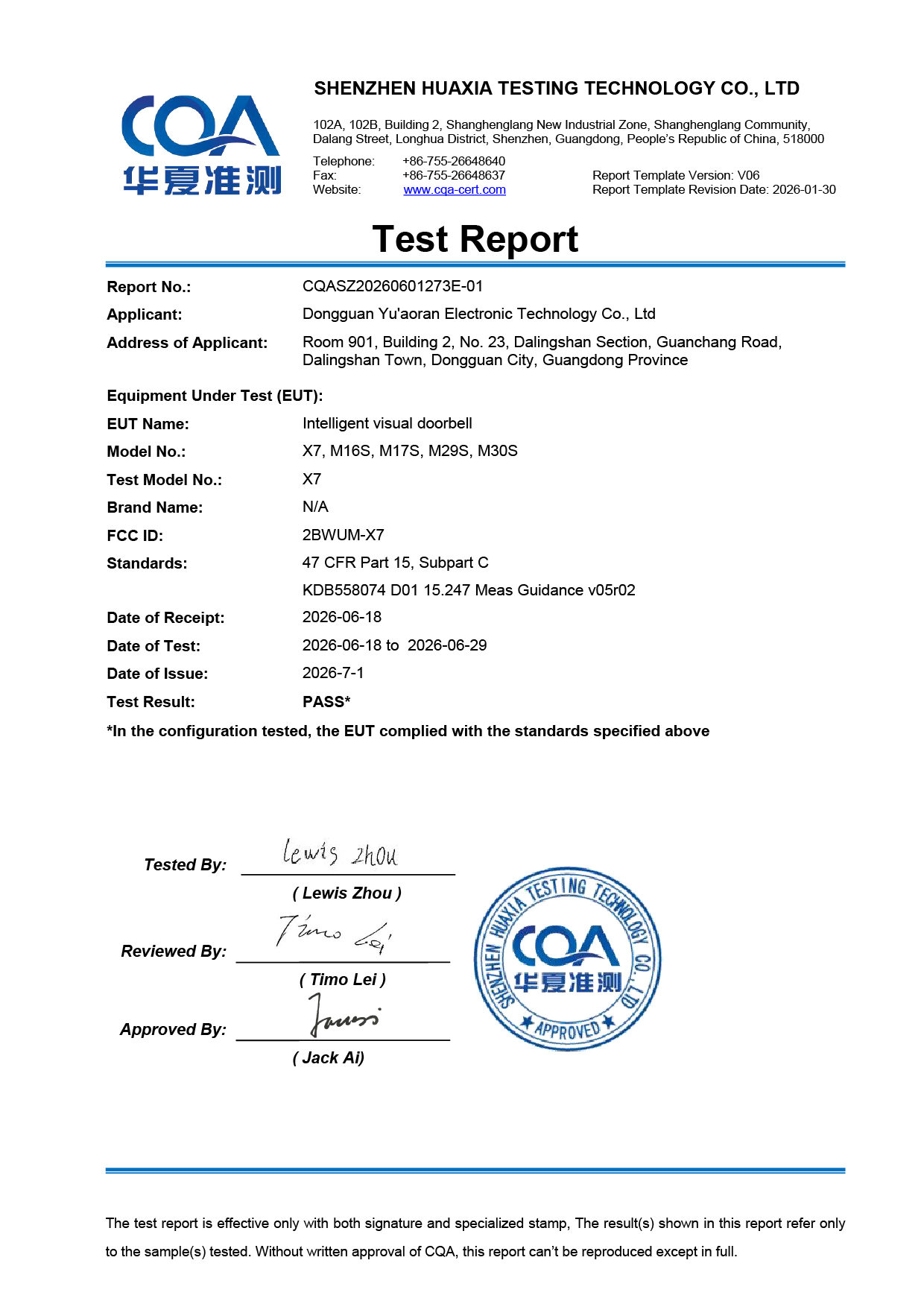
FCC certificate record CQASZ20260601273E-01 from YUAOHENG compliance files.
The buyer’s final step should be to confirm that the exact model under evaluation is listed inside the certificate scope. If the model is outside the scope, the supplier should clarify whether a new test or a separate certificate is required.
2. Verify factory, R&D, and production capacity
OEM evaluation is not limited to the catalog. A supplier should be able to show production capacity, engineering depth, and quality-control systems.
YUAOHENG was founded in 2016 and operates a 1,500㎡ standardized production facility in Dongguan, China. The company reports 300 employees, an R&D team of 30 engineers, and an annual output of about 2,000,000 units. Around 80% of production is exported to Europe, North America, Asia, and South America. According to the company profile, products are shipped to more than 15 countries and regions, including the United States and the United Kingdom.
For OEM/ODM buyers, the manufacturing setup should also support design iteration. YUAOHENG’s customization scope covers product design, prototype development, engineering consultation, certification support, hardware and function changes, software and firmware development, APP and cloud services, and appearance and packaging customization. This includes a customer’s choice of product color, material, logo engraving, brand logo, instructions, and retail packaging.
3. Match resolution to sellable demand
Resolution remains the first visible decision point for an action camera. The market share data for 4K and above suggests that 4K recording should be part of an evaluation range, especially if the target audience is outdoors, sports, travel, or vlog users.
In the YUAOHENG product records, several models are positioned as 4K-class configurations. The X7 is specified as a 4K anti-shake action camera with 4K recording at 3840×2160 and 30fps. The Q2 and Q3 are both WiFi models with front and rear 4K dual-recording capability. The Q7 is a 4K WiFi anti-shake model also recording at 3840×2160 and 30fps. On the 2K side, X11 is a 2K WiFi action camera at 2560×1440.
For a buyer, the important question is not only whether a camera is 4K, but also what mix of recording modes is available. Front and rear dual recording, simultaneous 2K+2K dual recording, and adjustable rotating lenses can make the same 4K sensor useful in more than one shooting scenario.
4. Separate EIS claims from use-case needs
EIS electronic stabilization has become a standard feature in budget to mid-range action cameras. For an OEM buyer, the next question is whether stabilization is described in a meaningful way for the intended use case.
YUAOHENG’s Q2 model is specified with 6-level electronic image stabilization. The X7 and Q7 models list anti-shake support. For cycling, climbing, skiing, or handheld vlog use, image smoothing is a visible part of footage quality. The evaluation should include a motion test, not just a data-sheet check.
The same logic applies to wide-angle panoramic action camera options. A 130° wide-angle lens, for example, is listed on several YUAOHENG models. A buyer should still verify the lens distortion, the intended field of view, and whether software correction is included in the supplier’s firmware.
5. Check water-resistance claims against the actual sports environment
Waterproof claims should be checked against real use conditions. International ingress-protection ratings such as IP68 are defined under IEC 60529. But the practical performance of an underwater diving action camera or a surfing waterproof action camera can depend on the housing, sealing material, battery cover, button design, and the stated depth and duration.
YUAOHENG’s case records include a US-based Action Camera Brand OEM project in which the product featured IP66 waterproof capability up to 10 meters. That is an example of a custom specification requirement, not a blanket promise for every catalog model. Buyers should write the required water rating into their own specification and ask the supplier to confirm the test condition.
6. Review screen, battery, WiFi, and after-sales support
User-facing specifications affect sell-through. Display quality, battery life, WiFi operation, and storage options are common decision factors for resellers.
YUAOHENG’s model range includes several screen configurations. The X7 and Q7 use a 1.47-inch IPS display. The Q2 uses a 1.8-inch IPS touch screen with 800×480 resolution and supports both touch and physical buttons. The X11 uses a 2.0-inch IPS display. Battery configurations in the model records range from 1000mAh polymer cells to 3000mAh in the X11, which is useful when buyers are looking for longer runtimes.
WiFi operation is built into several Q-series and X-series models, including Q2, Q3, Q7, and X11. In addition, YUAOHENG states that quality control includes 100% testing of all products, and after-sales support includes a 12-month official warranty, online technical guidance, and replacement and maintenance services.
YUAOHENG action camera lineup at a glance
The table below compares five YUAOHENG configurations that are useful in early OEM evaluation. The rows are based on facts stated in the supplier’s model records, not on subjective ranking.
| Model | Core positioning | Recording | Stabilization | Other user features | Battery |
|---|---|---|---|---|---|
| X7 | 4K anti-shake action camera with GPS support | 4K 3840×2160 at 30fps | Anti-shake support | 1.47-inch IPS display, 130° wide-angle rotating lens, GPS | 1000mAh polymer |
| Q2 | 4K WiFi touch-screen action camera with anti-shake | Front/rear 4K; simultaneous 2K+2K dual recording | 6-level EIS | 1.8-inch IPS 800×480 touch screen, physical buttons, dual recording modes | 18650 2000mAh |
| Q3 | 4K WiFi action camera with infrared night vision | Front/rear 4K; simultaneous 2K+2K dual recording | Not stated in model record | 130° wide-angle rotating lens, infrared night vision, built-in capacitor microphone | 2000mAh polymer |
| Q7 | 4K WiFi action camera with anti-shake | 4K 3840×2160 at 30fps | Anti-shake support | 1.47-inch IPS display, 130° wide-angle rotating lens | 1000mAh polymer |
| X11 | 2K WiFi action camera with longer runtime option | 2K 2560×1440 | Not stated in model record | 2.0-inch IPS display, one-button LED fill light, built-in noise reduction IC | 3000mAh |
This table is a starting point, not a substitute for product testing. If the priority is handheld vlogging, the touch screen and dual recording of the Q2 may be more relevant. If the priority is basic daily sports recording, a 4K anti-shake configuration such as the X7 or Q7 can be a lower-complexity choice. For night outdoor use, models with LED fill light or infrared night vision should be evaluated.
Step-by-step OEM evaluation workflow
Once the benchmarks are understood, an importer can use a repeatable workflow to compare suppliers and reduce the risk of choosing based only on price or packaging.
- Define target markets and compliance requirements. A US import plan typically requires FCC verification, while an EU import plan requires CE/RoHS awareness. Write these into the RFQ before reviewing models.
- Shortlist suppliers with documented capacity. Look for factory size, headcount, R&D team, export ratio, and production lines. YUAOHENG’s profile provides this type of data at a factory level.
- Map model families to your intended use cases. Create separate requirement lists for underwater recording, bike mounting, skiing, climbing, vlogging, and night use.
- Request document evidence. Ask for certificate numbers, test reports, model parameters, product images, and factory photos. Confirm that the certificate scope includes the exact model.
- Run a low-MOQ evaluation order. YUAOHENG’s minimum order quantity is 1 unit. Because quality control includes 100% testing of all products, an initial order can be used to inspect packaging, function, WiFi connection, recording quality, and documentation before a large purchase.
- Evaluate lead time and after-sales support. The typical production lead time for YUAOHENG is 25–30 days. After-sales support includes a 12-month official warranty, online technical guidance, replacement and maintenance services, and sales documentation.
Use-case pointers for action camera evaluation
Different buying scenarios require different specification priorities. Below are several use-case directions for an OEM buyer to consider.
Underwater diving and surfing
For an underwater diving action camera or a surfing waterproof action camera, the most important questions are about depth, duration, sealing, and housing. A camera should be tested in the same pressure conditions that the end user will encounter. The YUAOHENG US OEM case record includes a product with IP66 waterproof capability up to 10 meters, showing that custom water-resistance requirements can be handled at project level.
Bicycle-mounted recording
For a bicycle mounted action camera, vibration from handlebars and road surfaces can make footage unstable. Image stabilization and mounting compatibility are therefore key evaluation points. YUAOHENG’s Q2 is specified with 6-level EIS, while the X7 and Q7 list anti-shake support. A field test should confirm how those modes behave at different frame rates and lighting conditions.
Ski and outdoor action use
For a ski outdoor action camera, cold weather and glove operation often matter more than a large touch screen. Physical buttons and a reliable battery are useful features to evaluate. A 3000mAh battery configuration such as the X11 can be a reasonable starting point, but the supplier should confirm real-time battery behavior if the product will be used in cold environments.
Climbing and mountaineering
For climbing mountaineering action camera applications, weight, field of view, and easy operation are critical. A 130° wide-angle lens can capture more of the route and gear placement. Rotating lenses, such as those listed on the X7, Q3, and Q7, also give the camera more mounting flexibility.
Vlogging and handheld shooting
For a vlog handheld action camera, a front-facing view and easy framing are important. That makes touch screen action camera features and dual recording more relevant. YUAOHENG’s Q2 model combines a touch screen, physical buttons, front/rear 4K dual recording, simultaneous 2K+2K dual recording, and 6-level EIS. Q3 also supports front/rear 4K recording and infrared night vision.
Low-light and night recording
For a night vision action camera, the type of light source matters. Some models rely on infrared lights, while others use white fill lights for nearby illumination. In YUAOHENG’s model range, Q3 supports infrared night vision; Q5 is described with enhanced energy-saving infrared lights; Q9 includes white fill lights; and X11 uses a one-button LED fill light. Buyers should test the beam distance and image quality for their intended target use.
Case evidence: a 5,000-unit Action Camera Brand OEM project
Case evidence can illustrate how a supplier behaves on an actual project. According to YUAOHENG’s customer-facing records, the company worked with an Action Camera Brand OEM client located in the United States. The project scale was 5,000 units, and the project duration was five years. The product featured IP66 waterproof capability up to 10 meters.
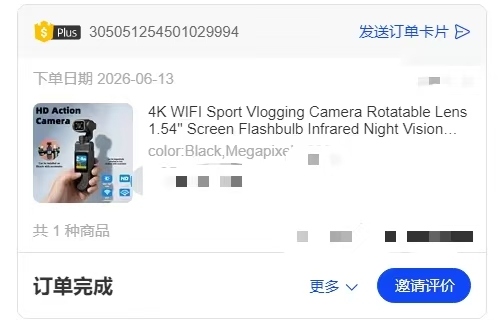
YUAOHENG OEM case order image used as an example of delivery/project record documentation.
This case is not proof that every catalog model is IP66-rated. It is proof that YUAOHENG has completed a large OEM project with custom waterproof and branding requirements. For a buyer, that distinction is more useful than an overgeneralized marketing claim.
Supplier evaluation FAQ
Does YUAOHENG hold CE, FCC, and RoHS certificates?
Yes. YUAOHENG has multiple compliance records on file. The FCC certificate CQASZ20260601273E-01 covers models including X7, M16S, M17S, M29S, and M30S. FCC ID 2BR43-Q3 is another action camera certification. For the EU, CE certificate CISRC251111081V1 and RF test report CISRR25111108101 were issued by BANGCE for a Q-series range. RoHS certificate CISCC251111122 also covers a Q-series product scope. A buyer should still check the exact model included in each certificate scope.
Can YUAOHENG customize an action camera under my own brand?
Yes. YUAOHENG supports OEM and ODM one-stop services. The customization scope includes product concept design, prototype development, engineering consultation, certification support, camera module and sensor changes, firmware and intelligent functions, APP and cloud services, and appearance and packaging changes such as product color, material, logo engraving, and retail packaging. The company also maintains an R&D team of 30 engineers to support product iteration.
Is there a low MOQ for evaluating an action camera?
The minimum order quantity is 1 unit. This allows a buyer to run an initial evaluation order before committing to a larger production run. Because quality control includes 100% testing of all products, the first-order experience should also give the buyer visible information about YUAOHENG’s inspection process and documentation flow.
What quality control and after-sales support are included?
YUAOHENG states that quality control includes 100% testing of all products. After-sales support includes a 12-month official warranty, online technical guidance and after-sales troubleshooting, replacement and maintenance services, product certification documents, sales materials, and long-term technical iteration support.
What is the typical production lead time for an action camera order?
The typical production lead time is 25–30 days. That timeframe should be confirmed against the selected model, packaging configuration, and order quantity. If you are planning a launch date, contact YUAOHENG directly to confirm capacity; monthly production capacity is stated as 170,000 units. You can email info@yuaoheng.com or reach the team by phone and WhatsApp at +86 18098279385.
Conclusion: turn the checklist into a sourcing plan
Evaluating an action camera supplier in 2026 means more than comparing pixels. It means checking whether the supplier can prove certification, factory capacity, model-level features, quality-control coverage, and after-sales support. YUAOHENG provides a useful example because its records include factory data, certification numbers, OEM/ODM customization scope, and a completed 5,000-unit US Action Camera Brand OEM project with IP66 waterproof capability up to 10 meters.
The next step is practical: build the same evaluation checklist for every supplier you are considering. Download the YUAOHENG product catalogue to review the full model range, or contact the company for model-specific documentation and a quote request.