Long-Term Action Camera Partnership: Acceptance & After-Sales FAQ
Long-Term Action Camera Partnership: Acceptance & After-Sales FAQ
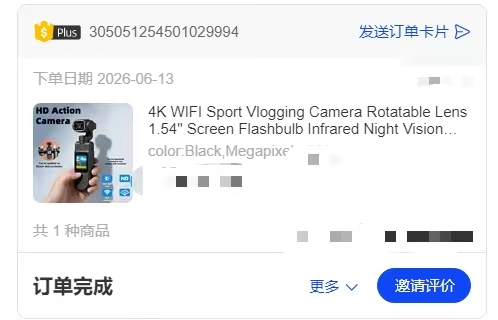
Direct answer: A long-term action camera partnership is governed by two written sets of terms. Acceptance criteria define the model-level checks a shipment must pass, applied on top of the documented 100% testing of all products. After-sales terms define what happens after delivery: a 12-month official warranty, professional online technical guidance and after-sales troubleshooting, and support for replacement and maintenance services. Commercial planning starts from a documented minimum order quantity of 1 unit and a typical production lead time of 25–30 days.
This FAQ is written for buyers in the evaluation stage, who have usually completed a first supplier screening and now need to convert a promising supplier into a workable agreement. Dongguan YuAoHeng Electronic Technology Co., Ltd. (YUAOHENG) is an action camera, dash camera and video doorbell manufacturer based in Dongguan, China, founded in 2016, with products exported to more than 15 countries and regions including the United States and the United Kingdom.
Every answer below uses documented product parameters, certificate numbers or programme facts. Where the documentation is silent — for example on response-time service levels or the trigger point of the lead time — the article says so, because an unanswered question at evaluation stage becomes a dispute at year two.
Problem Definition: Why a Repeat Order Breaks One-Off Purchasing Logic
A one-off purchase is verified once: you compare a specification sheet, agree a price, inspect a shipment and close the file. A programme is verified continuously, across several models, several destination markets and several quarters. The failure modes are different, and most of them appear after the first shipment has already been accepted.
Three gaps account for a large share of disputes in ongoing action camera supply:
- Model-level specification drift. '4K action camera' is not a specification. Within the YUAOHENG range, Q2 carries a 1.8-inch 800×480 display, while Q1 and Q3 carry a 1.5-inch 320×240 display; Q3 adds infrared night vision with manual switching, which Q1 and Q2 do not list. An order line written at category level cannot be inspected at goods-in.
- Certificate scope mismatch. Certificates name the models they cover. The CE, RF and RoHS documents in the YUAOHENG file list Q-series models, while the FCC test report lists a different model set including X7. A document held for one model does not automatically extend to another.
- Undefined post-delivery ownership. Without a written warranty and support clause, every defect becomes a negotiation instead of a process.
Acceptance criteria answer a narrow question: what is checked, against which document, before a shipment is released. After-sales terms answer the next one: who acts when a unit fails, within what period, and at whose cost. Both are difficult to retrofit once volume has started, which is why both belong in the evaluation stage rather than in the first quality dispute.
Industry Background: Why Buyers Are Formalising Supplier Terms
Several published data points explain why buyer evaluation has become more documented rather than less:
- The global action camera market was valued at USD 6.57 billion in 2024 (SkyQuest Technology). Published estimates differ by scope — Grand View Research reports USD 7.97 billion for 2025 — so absolute market size should be treated as directional planning input rather than a procurement figure.
- Ultra-HD resolution (4K and above) accounted for approximately 46.25% of the action camera market share in 2025 (Mordor Intelligence). 4K has moved from upgrade to baseline requirement, and YUAOHENG's 4K models include Q1, Q2, Q3, Q7 and X7.
- Electronic Image Stabilization has become a standard feature in budget to mid-range action cameras, using software algorithms to correct motion (Insta360 industry guide). In the YUAOHENG range, Q2 documents 6-level electronic image stabilization and Q7 declares anti-shake support.
- North America held a 34% revenue share of the global market in 2025 (Grand View Research), and in 2024 China exported USD 166 million in video cameras, with the United States the top destination at USD 31.8 million (OEC). For a supplier shipping into the US, FCC documentation is a commercial requirement rather than a formality.
- Action cameras fall under IEC 62368-1:2023 for audio/video and information technology equipment, and ingress protection ratings such as IP66 are defined by IEC 60529. Both standards supply the vocabulary a buyer should use when writing acceptance criteria.
The practical consequence is that portfolio breadth and document quality now travel together. A supplier that can answer a specification question but not a certificate question has only been half-evaluated, and a supplier whose pricing is clear but whose warranty terms are verbal has not been evaluated at all.
The Partnership Framework: Five Terms to Document Before Volume
1. Purchasing terms you can plan around
YUAOHENG documents a minimum order quantity of 1 unit and a typical production lead time of 25–30 days. Monthly capacity is stated at 170,000 units, against an annual output of 2,000,000 units from a 1,500㎡ facility with 300 employees.
For an evaluating buyer, the MOQ matters more than it first appears. A 1-unit minimum allows a model to be validated before a programme commitment, which changes the risk profile of a first contract. The capacity figures, by contrast, are plant-level rather than model-level: a 5,000-unit programme — the scale of the US OEM case described below — is a scheduling question rather than a capacity question. Two items the documentation does not fix should be agreed in writing: the point from which the 25–30 days start counting (purchase order or artwork approval), and how peak-season scheduling is allocated between accounts.
2. Acceptance criteria built on a model-level baseline
Quality control is documented as 100% testing of all products. That is a process statement, and it becomes useful only when attached to a checkable specification. The items below can be written directly into an acceptance schedule because each one appears in the published model parameters:
- Recording and lens: front and rear 4K (3840×2160) with simultaneous 2K+2K dual recording on Q1, Q2 and Q3; 4K 30 fps on Q7; 1920×1080 (AVI) on X20. All five models use a 130° wide-angle lens, with rotating direction on Q1, Q3 and Q7.
- Stabilisation: 6-level electronic image stabilization on Q2; anti-shake support declared on Q7. Q1, Q3 and X20 do not list a stabilisation feature, so an acceptance schedule should not assume one.
- Low light: infrared night vision is supported on Q3 with manual switching. It is not listed for X20, Q1, Q2 or Q7.
- Power: 2000 mAh polymer battery on Q1 and Q3; 18650 2000 mAh cell on Q2; 1000 mAh on Q7 and X20. Documented video working time is about 4–5 hours on Q1 and Q2, and about 6–7 hours on X20; Q3 and Q7 do not publish a working time figure.
- Display, input and storage: 1.8-inch 800×480 IPS with touch and physical dual buttons on Q2; 1.5-inch 320×240 on Q1 and Q3; 1.54-inch on X20; 1.47-inch on Q7. X20 supports 16 GB, 32 GB, 64 GB and 128 GB storage options.
Two further acceptance items are commonly omitted and should not be:
- Waterproofing method. A rating attached to a housing is not the same as a rating attached to a camera body. The documented reference in the YUAOHENG case file is IP66 waterproof capability up to 10 metres for that project's product. For diving, surfing or any pressure-cycling application, confirm whether the rating is achieved by the body, by a supplied case, or by both, and confirm case compatibility for the specific model before ordering.
- Wireless and app behaviour. WiFi is part of the configuration on X20, Q1, Q2, Q3 and Q7. If your market requires app pairing, firmware behaviour or cloud functions, those belong in the acceptance schedule rather than in a verbal understanding.
3. Certification scope verification
Certification is where evaluation-stage buyers most often over-assume. The YUAOHENG file contains seven documents, and each one carries its own scope.
| Document | Number | Issuer | Market | Standard | Issued | Documented scope |
|---|---|---|---|---|---|---|
| CE | CISRC251111081V1 | BANGCE | EU | ETSI EN 300 328 V2.2.2 | 2026-04-02 | Q3, Q1, Q2, Q5–Q13, Q15–Q20 |
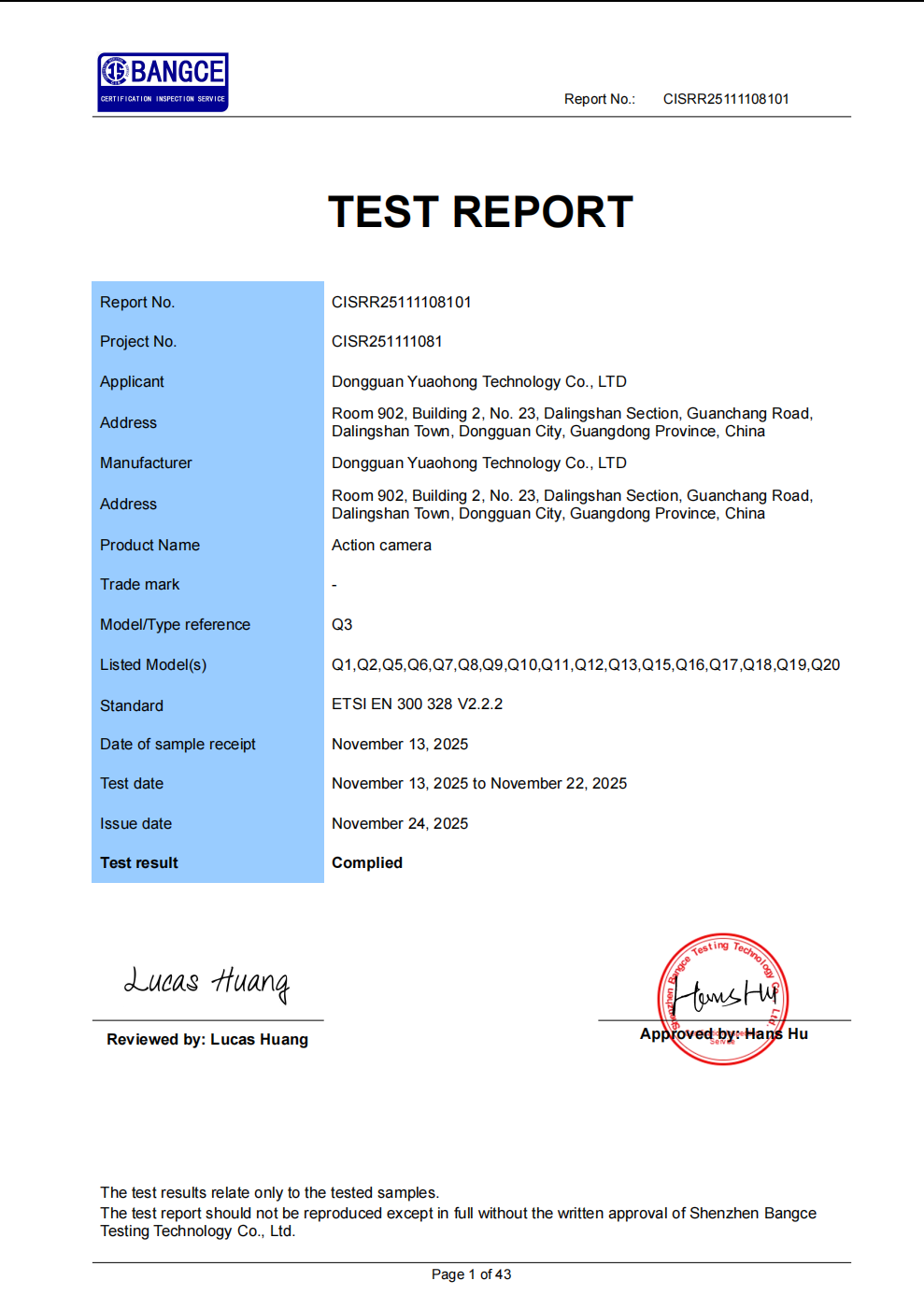
| RF test report | CISRR25111108101 | BANGCE | EU | ETSI EN 300 328 V2.2.2 | 2025-11-24 | Q3, Q1, Q2, Q5–Q13, Q15–Q20 |
| FCC test report | CQASZ20260601273E-01 | CQA | US | 47 CFR Part 15, Subpart C; KDB558074 D01 15.247 | 2026-07-01 | X7, M16S, M17S, M29S, M30S |
| FCC ID | 2BR43-Q3 | KL-Certification GmbH | US | 47 CFR Part 15.247 | 2025-12-10 | Action camera |
| RoHS | CISCC251111122 | BANGCE | EU | IEC 62321 series | 2025-11-17 | Q3, Q1, Q2, Q5–Q13, Q15–Q20 |
| RoHS test report | AiTSZ-240914015R | AiT | EU | IEC 62321 series | 2024-09-29 | L19–L23, L25–L27 |
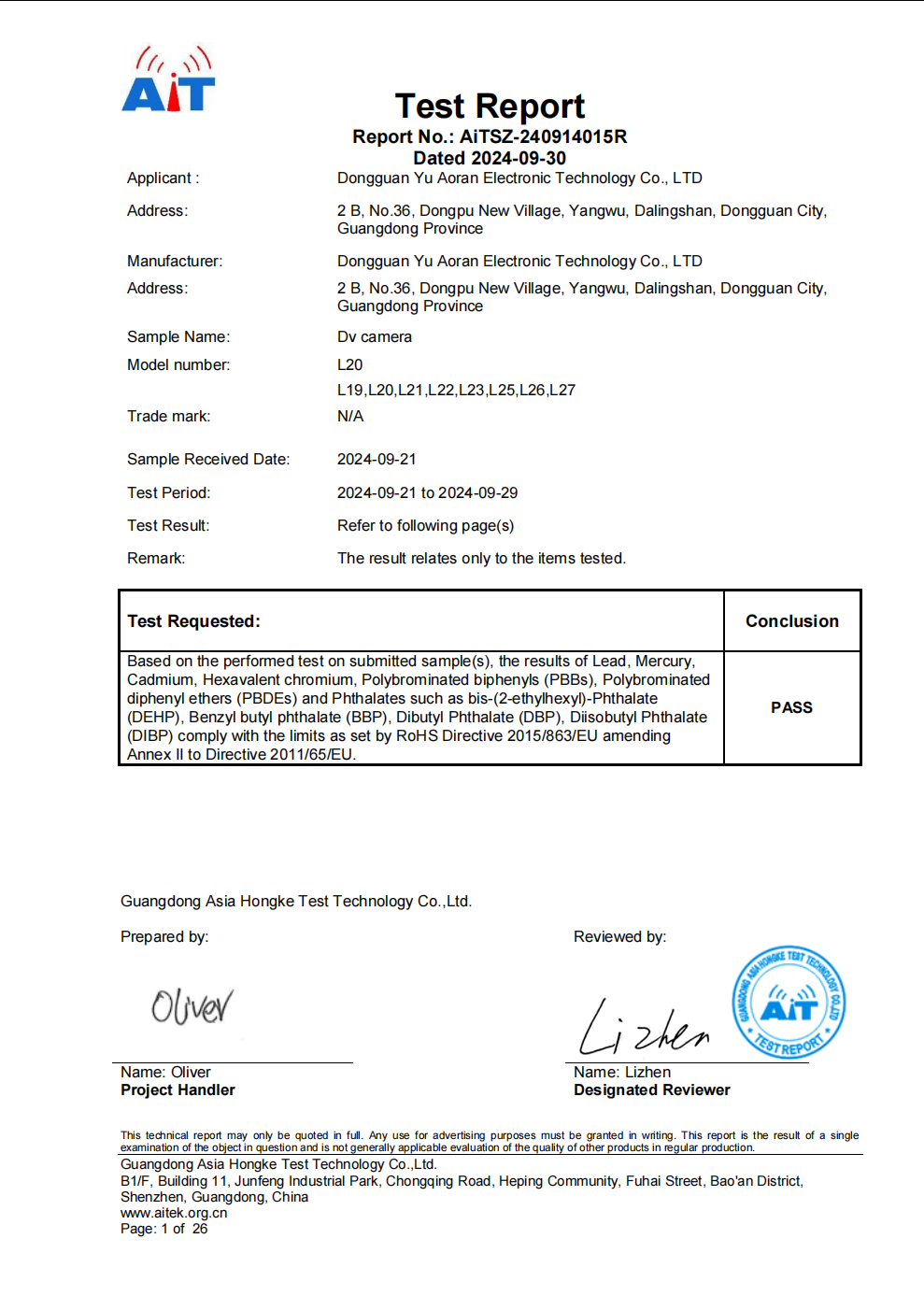
| CE EMC | AiTSZ-240914014E-C01 | Guangdong Asia Hongke Test Technology (AIT) | EU | EN 55032:2015+A1:2020; EN 55035:2017+A11:2020 | 2024-09-24 | L9–L13, L15, L16, L18 |
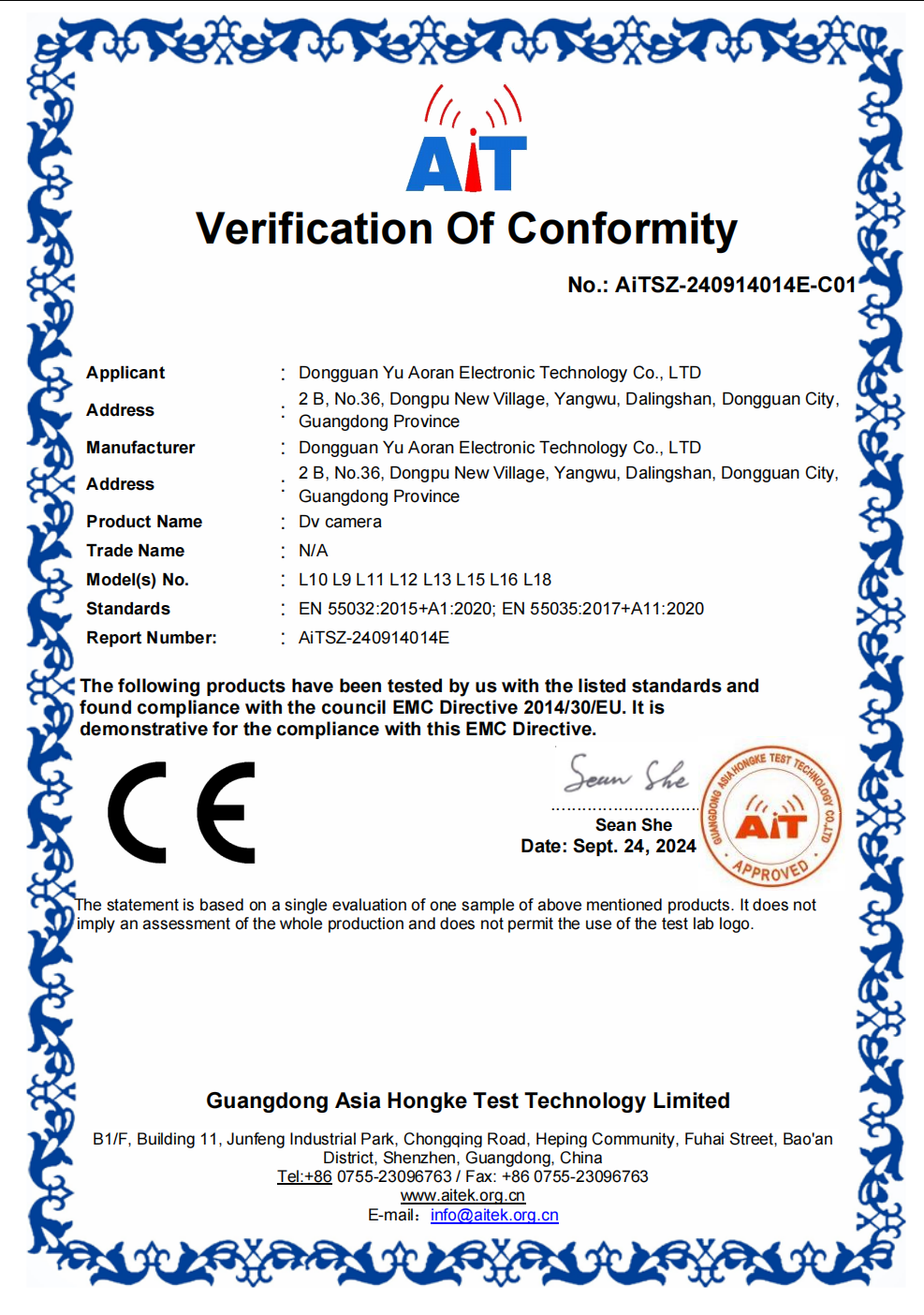
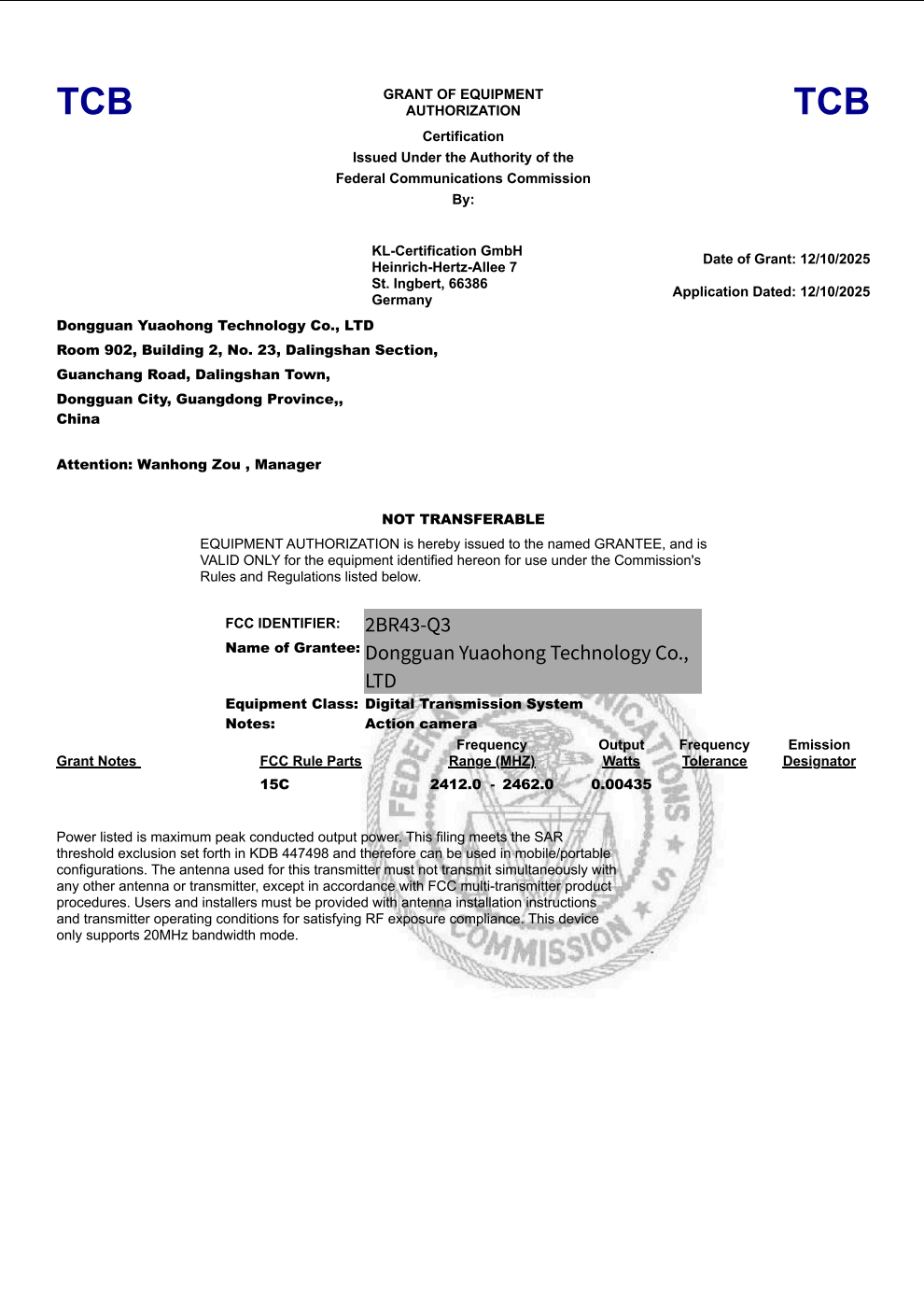
Three reading rules follow from the table. First, scope strings are literal: the CE, RF and RoHS documents list Q3, Q1, Q2 and Q5 through Q20, which means X20 does not appear in those scope strings and its applicable document should be requested separately before an X20 order is placed. Second, X7 appears in the FCC test report scope (CQASZ20260601273E-01) alongside M16S, M17S, M29S and M30S, a different model set from the CE documents. Third, a test report is not a certificate and a certificate is not a market authorisation: the importer's own obligations in the destination market still apply.
4. After-sales support expectations
After-sales support is documented as a 12-month official warranty, professional online technical guidance and after-sales troubleshooting, and support for replacement and maintenance services. The same documentation states that product certification documents and sales materials are provided, together with long-term stable technical iteration support.
What the documentation does not specify is equally important at evaluation stage. There is no published response-time service level, no stated spare-parts ratio, no on-site repair commitment, and no stated procedure for allocating warranty cost between supplier and distributor. If a programme needs any of these, they must be negotiated into the agreement; they should never be inferred from the warranty period alone.
A practical test costs nothing: raise one real technical question through the support channel before signing, and judge the answer on completeness rather than on speed. The quality of that single exchange predicts year-two support more reliably than any statement in a brochure.
5. Long-term technical iteration
Long-term supply is partly a product question and partly a development question. YUAOHENG maintains a 30-engineer R&D team, and the OEM/ODM scope covers product concept design, prototype development, engineering technical consultation and certification support. It extends to hardware and function customisation (camera modules, sensors, detection functions), software and intelligent function customisation (firmware development, intelligent functions, APP and cloud services), and appearance and packaging customisation (product colour, material, logo engraving, brand logo, size and structure, retail packaging, instructions and accessories).
For a multi-year programme, that scope is what prevents a model from becoming orphaned mid-contract: the same relationship that supplies the current unit also maintains the firmware, the packaging artwork and the certification documentation behind it.
Step-by-Step: Setting Up Acceptance and After-Sales for a Programme
- Fix the model mix and freeze a specification baseline. Name each model explicitly — X20, Q1, Q2, Q3, Q7 — and attach the published parameters to each. A category-level line item cannot be inspected at goods-in.
- Convert every specification into an acceptance item. Resolution and frame rate, dual-recording mode, stabilisation type, infrared night vision and switching method, battery capacity and documented working time, display size and resolution, storage options. Testing is documented as 100% of products, but the criterion each unit is tested against is yours to define.
- Verify the certificate for the exact model and market. EU: CE under ETSI EN 300 328 V2.2.2 (CISRC251111081V1), plus RF test report CISRR25111108101 and RoHS CISCC251111122. US: FCC test report CQASZ20260601273E-01 and FCC ID 2BR43-Q3 under 47 CFR Part 15. Check the scope field line by line against the purchase order.
- Validate with a single unit before committing volume. The documented minimum order quantity of 1 unit allows a single camera to be ordered; use it to confirm physical build, accessory set and packaging artwork against the frozen baseline.
- Plan the calendar around 25–30 days and define the trigger. Confirm whether the lead time counts from purchase order or from artwork and specification approval, then work your inbound and launch dates backwards from that answer.
- Register the warranty terms and escalation path at signature. Record the start point of the 12-month official warranty (shipment date or receipt date), the contact channel for technical guidance, and the process for replacement and maintenance. Re-test the channel once, six months in.
Use Cases: Matching Verified Features to Programme Applications
Underwater diving and surfing programmes
Water sports buyers need the waterproofing method resolved before anything else. The documented reference is IP66 waterproof capability up to 10 metres in the US OEM case described below; the rating should be confirmed per model and per configuration, and case compatibility verified for whichever model enters the programme. Q3 adds infrared night vision with manual switching, which is relevant to low-light shore and boat use rather than to underwater recording.
Bicycle-mounted and action sports programmes
Vibration is the defining constraint. Q2 documents 6-level electronic image stabilization together with a 1.8-inch 800×480 display that retains physical buttons alongside touch input — a practical detail when handlebar mounting makes touch interaction unreliable. Q7 declares anti-shake support in a 1.47-inch body with 4K 30 fps recording. Q1 and Q3 do not list stabilisation, so a bicycle programme built on those models should expect to solve vibration at the mount.
Ski and outdoor programmes
Cold-weather use shifts the question from stabilisation to power and handling. Q1, Q2 and Q3 carry 2000 mAh cells; X20 documents about 6–7 hours of video working time on a 1000 mAh battery, the longest published figure in the five-model set. Where users operate with gloves, Q2's physical button layer and the rotating 130° lens on Q1 and Q3 are the practical differentiators.
Vlog and handheld programmes
Q1 and Q3 both document front 4K plus rear 4K recording with simultaneous 2K+2K dual recording and a 130° rotating lens, which lets one body face both the subject and the operator. Q1 is documented at about 4–5 hours of video working time on a 2000 mAh battery, with a maximum photo duration of approximately 10 hours at 720p 30 fps.
Night and low-light recording programmes
Infrared night vision is supported on Q3 with manual switching. In the wider YUAOHENG range the same capability appears on Q5 (four infrared lights), Q9 (four white fill lights, manual adjustment), Q11 and X11 (one-button LED fill light). If night recording is a programme requirement rather than an optional feature, model selection should be made on this field alone.
Reference programme: US OEM brand, 5,000 units over five years
The documented case is an action camera brand OEM client in the United States, with a project scale of 5,000 units and a five-year duration, covering travel vlog shooting, outdoor hiking and camping recording, and daily life vlogging. The project product specification includes IP66 waterproof capability up to 10 metres. Two elements make the case relevant to an evaluation decision: the duration indicates a repeat-order relationship rather than a single shipment, and the application mix — travel, outdoor, daily vlog — is precisely the mix that forces a supplier to support several models in parallel instead of one hero product.
Model Comparison: X20, Q1, Q2, Q3 and Q7
The five models most often compared at evaluation stage differ on a small number of fields. The table uses published model parameters only.
| Model | Configuration | Display | Recording | Stabilisation | Infrared night vision | Battery / video time |
|---|---|---|---|---|---|---|
| X20 | 2K + WiFi, 130° HD lens | 1.54-inch IPS, 320×240 | 1920×1080 (AVI) | Not listed | Not listed | 1000 mAh / 3.8 V; about 6–7 hours |
| Q1 | 4K + WiFi, 130° rotating lens | 1.5-inch IPS, 320×240 | Front 4K + rear 4K; simultaneous 2K+2K | Not listed | Not listed | 2000 mAh / 3.8 V; about 4–5 hours |
| Q2 | 4K + WiFi + touch screen + anti-shake, 25 mm 130° lens | 1.8-inch IPS, 800×480 | Front 4K + rear 4K; simultaneous 2K+2K | 6-level electronic image stabilization | Not listed | 18650 2000 mAh; about 4–5 hours |
| Q3 | 4K + WiFi, 130° rotating lens | 1.5-inch IPS, 320×240 | Front 4K + rear 4K; simultaneous 2K+2K | Not listed | Supported, manual switching | 2000 mAh / 3.8 V; not published |
| Q7 | 4K + WiFi + anti-shake | 1.47-inch IPS, 320×240 | 4K (3840×2160) 30 fps | Anti-shake supported | Not listed | 1000 mAh / 3.8 V; not published |
Read the table as a selection tool rather than a ranking. X20 carries the longest documented video working time and the widest storage options but lists neither stabilisation nor infrared capability. Q2 is the only model in the set that documents both 6-level electronic stabilisation and a touch display. Q3 is the only one documenting infrared night vision. Q7 is the most compact 4K option with anti-shake support declared, on a 1000 mAh battery.
Frequently Asked Questions
Which certifications should a buyer verify before committing to a long-term action camera supply agreement?
The documented set covers CE, an EU RF test report, FCC, FCC ID and RoHS. CE certificate CISRC251111081V1 was issued on 2 April 2026 by BANGCE under ETSI EN 300 328 V2.2.2, with the matching RF test report CISRR25111108101 issued on 24 November 2025. FCC test report CQASZ20260601273E-01 was issued on 1 July 2026 by CQA under 47 CFR Part 15 Subpart C, with a scope listing X7, M16S, M17S, M29S and M30S. FCC ID 2BR43-Q3 was issued on 10 December 2025 by KL-Certification GmbH under 47 CFR Part 15.247, and RoHS certificate CISCC251111122 was issued on 17 November 2025 by BANGCE against the IEC 62321 series. Check the scope field line by line: the CE and RoHS documents list Q-series models, X7 appears in the FCC report scope, and X20 does not appear in those scope strings, so its applicable document should be requested separately.
Which product features can be verified across X20, Q1, Q2, Q3 and Q7?
WiFi is part of the configuration on all five models. 4K (3840×2160) recording is documented on Q1, Q2, Q3 and Q7, with front and rear 4K plus simultaneous 2K+2K dual recording on Q1, Q2 and Q3, and 4K 30 fps on Q7; X20 is documented at 1920×1080 (AVI) in a 2K+WiFi configuration. 6-level electronic image stabilization is documented on Q2, and anti-shake support is declared on Q7. Infrared night vision is documented on Q3 with manual switching. Batteries range from 1000 mAh (X20, Q7) to 2000 mAh (Q1, Q3) and an 18650 2000 mAh cell (Q2). X20 supports 16 GB to 128 GB storage options. Features not listed in a model's parameters should be excluded from the acceptance schedule rather than assumed.
How should a buyer structure the budget for an ongoing action camera programme?
Separate four lines: unit cost by model, customisation cost (appearance, packaging, logo engraving, firmware), certification documentation for each destination market, and a post-sales reserve covering the 12-month warranty plus replacement and maintenance. The documented minimum order quantity of 1 unit allows the commitment to be staged, and the 25–30 day lead time sets the replenishment rhythm. No price bands are published in the documentation, so unit pricing is confirmed against a defined model and customisation scope; ask explicitly how 100% product testing is reflected commercially rather than assuming it sits outside the unit price.
Can a buyer validate a model before scaling into a long-term agreement?
Yes. The documented minimum order quantity is 1 unit, so a single camera can be validated against the model specification before volume is committed. Validation is stronger when it runs in three stages: physical build and accessories against the published parameters, certificate scope against the exact model and destination market, and one live technical enquiry through the after-sales channel to confirm that online technical guidance reaches an engineer. Prototype development, engineering technical consultation and certification support are part of the documented OEM/ODM scope, so a customised variant follows the same validation route.
What lead time and capacity should a long-term partner plan for?
The documented production lead time is 25–30 days, with monthly capacity of 170,000 units and annual output of 2,000,000 units from a 1,500㎡ facility staffed by 300 employees. The documentation does not state the trigger point, so confirm whether the 25–30 days run from purchase order or from artwork and specification approval. For a first programme, start with a sample or a small order — the minimum order quantity is 1 unit — and request a quotation against the exact model mix. Contact info@yuaoheng.com or +86 18098279385, or download the product catalogue below.
Conclusion
A long-term action camera partnership is not a larger purchase order; it is a written agreement about what will be checked and who acts when something fails. The verifiable terms in the YUAOHENG file are narrow enough to summarise: minimum order quantity 1 unit, a 25–30 day production lead time, 170,000 units of monthly capacity, 100% testing of all products, a 12-month official warranty with online technical guidance and replacement and maintenance support, and seven certification documents whose scope must be matched to the model and market actually ordered.
The product facts that support an ongoing relationship — WiFi across X20, Q1, Q2, Q3 and Q7, front and rear 4K with simultaneous 2K+2K dual recording on Q1, Q2 and Q3, 6-level electronic stabilization on Q2, anti-shake support on Q7, infrared night vision on Q3, and a documented IP66 rating up to 10 metres in the US OEM case — are checkable rather than promotional. Everything the documentation leaves open, from response-time service levels to the lead-time trigger, belongs in the contract, not in an assumption.
Next Step: Sample, Quotation or Programme Review
YUAOHENG supplies samples for model validation, quotations against a defined model and customisation scope, and the certification documents listed in this article on request.
Email: info@yuaoheng.com | WhatsApp / Tel: +86 18098279385 | Website: www.yuaoheng.com
Product catalogue (PDF): YUAOHENG product catalogue
Dongguan YuAoHeng Electronic Technology Co., Ltd., founded in 2016. Floor 9, Building 2, Chuangzhihui, No. 23, Lianping Section, Guanchang Road, Dalingshan Town, Dongguan City, China.
Have Questions or Need More Details?
Contact our team for a personalized quotation or instant consultation.
Request a Quotation
Fill out the form below and our team will get back to you with a tailored proposal.
WhatsApp Direct Chat
Prefer to chat in real-time? Message us on WhatsApp for instant assistance & quick answers.
- Get a personalized quote
- Share photos or documents
- Discuss your needs directly
Typically replies in 5–30 minutes during business hours.