Ranking the YUAOHENG Action Camera Lineup: X20, Q1, Q2, Q3, and Q7 Picks for Every Buyer
Ranking the YUAOHENG Action Camera Lineup: X20, Q1, Q2, Q3, and Q7 Picks for Every Buyer
Five models carry the YUAOHENG action camera name today — X20, Q1, Q2, Q3 and Q7 — and they sit close enough together that most buyers compare them against each other rather than against other brands. They separate on four concrete criteria: recording architecture, display, stabilization and battery. A fifth criterion decides the order for trade buyers: whether the certification documents actually name the model.
Ranked for the 2026 buying cycle, the order is Q2 first, Q1 second, Q3 third, Q7 fourth, X20 fifth. The Q2 takes the top position because it is the only model in the set that combines a 1.8-inch 800×480 touch display, a six-level electronic image stabilization (EIS) function and front-plus-rear 4K recording with 2K+2K simultaneous dual capture. The Q1 ranks second for dual 4K recording with the longest stated recording time in the lineup. The Q3 ranks third because it is the only one of the five with an infrared night vision function and manual infrared switching. The Q7 ranks fourth as the compact stabilized 4K option. The X20 ranks fifth as the entry model for workflows that do not require 4K or stabilization.
Every figure below comes from YUAOHENG product parameter records and certification documents. Where a specification is not stated in those records — waterproof depth, for example — this article marks it as unverified instead of estimating it, because the gaps in an action camera spec sheet are usually where sourcing risk hides.
The Problem: Five Models That Answer Almost the Same Question
The hard part of buying an action camera is rarely finding one. It is choosing between five models from the same manufacturer that share a lens family, a housing material and a recording philosophy. Wholesale listings compress those differences into a row of similar bullet points, and the buyer is left deciding with information that was never designed to support a decision.
The Q1 and the Q3 show why. Both are listed as 4K Wi-Fi models with a 1.5-inch 320×240 IPS display, a 130° wide-angle HD lens with rotating direction, front 4K (3840×2160) and rear 4K recording, simultaneous 2K+2K dual recording, a 2000mAh/3.8V polymer battery and an ABS body. Read quickly, they look like the same camera. The differences are narrow but decisive: the Q3 adds an infrared night vision function with hand-regulation switching and lists a full-range built-in capacitor microphone, while the Q1 publishes a recording working time of about 9 hours and a maximum duration figure of approximately 10 hours at 720p 30fps high-quality video.
The Q2 moves in a different direction. It is the only model of the five with a 1.8-inch 800×480 IPS display and a standard touch-plus-physical dual-button control scheme, the only one with a quantified stabilization level (6-level electronic image stabilization), and it uses a 25mm lens covering 130° with front and rear simultaneous dual recording in three selectable modes. Power comes from an 18650 2000mA battery with a video working time of about 4–5 hours.
The Q7 and the X20 share a 1,000mAh/3.8V polymer battery but sit at opposite ends of the range. The Q7 is a 4K+WiFi+anti-shake model with a 1.47-inch IPS 320×240 display that records 4K (3840×2160) at 30fps and supports anti-shake. The X20 is the 2K+WIFI entry model, listed with a 1.54-inch IPS display, camera resolution given as AVI (1920×1080), a video working time of about 6–7 hours, a recording working time of about 9 hours, MICRO-Type-C input at DC5V-1A-2A and optional storage of 64G/32G/16G/128G.
Two very different buyers are reading those lines. An end user wants the model that fits an activity. An importer, distributor or brand owner wants the model that fits a channel: a resolution class the market will accept, a stabilization claim that can be repeated in listings, a battery figure that survives customer expectations, and a certification scope that names the model. The ranking below weighs both perspectives.
Industry Background: Why 4K and Stabilization Define This Lineup
Action camera demand is concentrated exactly where these five models compete. SkyQuest Technology valued the global action camera market at USD 6.57 billion in 2024, and Market Research Future estimated China's own market at USD 502.25 million in the same year. Within that market, Mordor Intelligence reported that the Ultra-HD segment — 4K and above — accounted for approximately 46.25% of action camera market share in 2025. That share explains the shape of this lineup: four of the five models are 4K-class, and the 1080p-class X20 is positioned as an entry model rather than a flagship.
Stabilization has followed the same path. An Insta360 industry guide describes electronic image stabilization as a standard feature in budget to mid-range action cameras, using software algorithms to correct motion, rather than as a premium differentiator. This lineup behaves consistently with that trend: the Q2 quantifies stabilization as six levels of EIS and the Q7 states anti-shake support, while the other three publish no stabilization specification at all — a difference buyers should treat as a real capability gap rather than a documentation gap.
Supply geography matters as much as features. OEC data records that China exported USD 166 million in video cameras in 2024, with the United States the top destination at USD 31.8 million, while Grand View Research placed North America at a 34% revenue share of the global market in 2025. Concentration is a factor in some regions: PetaPixel, citing BCN+R data, reported that DJI and Insta360 together held nearly 90% of the action camera market share in Japan as of late 2025. For distributors and OEM buyers, that context explains the value of a single lineup that covers a 4K stabilized tier and a lower-cost entry tier from one manufacturing base, with one compliance folder behind both.
The Ranking: How Each Model Earns Its Place
The manufacturer behind the lineup is Dongguan YuAoHeng Electronic Technology Co., Ltd., an action camera, dash camera and smart video doorbell manufacturer based in Dongguan, China, founded in 2016. Company records describe a 1,500㎡ standardized production facility, 300 employees including a 30-engineer R&D team, an annual output of 2,000,000 units and a monthly production capacity of 170,000 units, with approximately 80% of output exported to Europe, North America, Asia and South America and products shipped to more than 15 countries and regions. Products hold FCC, CE and RoHS certification. That common manufacturing base is what allows the five models to be compared on identical criteria in the first place.
1. Q2 — The All-Round Pick
Q2 is designated 4K+WiFi+Touch screen+Anti-shake. Its 1.8-inch IPS display runs at 800×480, the highest display resolution in the five-model set, and it is operated through standard touch and physical dual buttons, which keeps the interface usable when the touch layer is not. Recording is front 4K (3840×2160) and rear 4K (3840×2160) with simultaneous 2K+2K dual recording in three optional modes; the 25mm lens covers a 130° wide angle and records front and rear simultaneously. Stabilization is specified as six-level electronic image stabilization. Power comes from an 18650 2000mA battery with a video working time of about 4–5 hours, and the body material is ABS.
It ranks first because controllability and stabilization are the two qualities a buyer cannot compensate for later. The Q2 is the only model in the ranked set where both are specified — a touch display for menu-driven settings and a quantified EIS level for handheld or mounted movement. A buyer who cannot test the models side by side should therefore weight these two features highest.
The limit is power. Stabilized dual recording consumes battery, and the published video working time of about 4–5 hours reflects that; sessions that run longer need a planned charging or battery strategy confirmed with the supplier.
2. Q1 — Dual 4K with the Longest Stated Runtime
Q1 is a 4K+WIFI model with a 1.5-inch IPS 320×240 display, an HD 130° wide-angle lens with rotating direction, front 4K (3840×2160) and rear 4K (3840×2160) recording, and simultaneous dual recording at 2K+2K. Its 2000mAh/3.8V polymer battery supports a video working time of about 4–5 hours, a recording working time of about 9 hours, and a maximum duration listed as approximately 10 hours at 720p 30fps high-quality video. The body material is ABS.
It ranks second because runtime documentation is where this model separates from everything else in the range. The Q1 is the only model of the five that publishes both a recording working time of about 9 hours and a maximum duration figure of approximately 10 hours at 720p 30fps. For channel buyers, that means a defensible battery claim in listings rather than a vague promise. The rotating 130° lens also lets the operator re-aim the front element without turning the mount, which matters on handlebar and helmet setups where the mount angle is fixed.
The constraint: no stabilization function is listed for the Q1, so the buyer who needs anti-shake has to move up to the Q2 or Q7.
3. Q3 — The Night-Shooting Pick
Q3 is designated 4K WIFI and shares the Q1's display specification — 1.5-inch IPS 320×240 — along with a 130° wide-angle HD lens with rotating direction, front 4K and rear 4K recording and 2K+2K simultaneous dual recording. What separates it is the infrared night vision function, supported and switched by hand regulation, plus a full-range built-in capacitor microphone. The battery is a 2000mAh/3.8V polymer cell and the housing is ABS.
It ranks third because night capture is a hard requirement when it appears. No other model in the five lists night vision, and for dusk, night or unlit indoor recording that single function ends the comparison — which is why the Q3 sits above the Q7 despite carrying a lower display specification.
Two boundaries apply. The infrared function is switched manually rather than automatically, so the operator decides when night mode is engaged, and the record provided does not publish a working-time figure for the Q3 battery, so runtime for night sessions should be confirmed in writing before an order is placed.
4. Q7 — The Compact Stabilized 4K Option
Q7 is designated 4K+WiFi+Anti-shake. It uses a 1.47-inch IPS 320×240 display and a 130° wide-angle HD lens with rotating direction, and records 4K (3840×2160) at 30fps with a recording bit speed listed as WAV (512KBPS). Anti-shake is listed as supported and the microphone is a full-range built-in capacitor type. The battery is a 1000mAh/3.8V polymer cell, half the capacity of the Q1, Q2 and Q3, and the body is ABS.
It ranks fourth because it is the smallest-display model in the range that still delivers 4K at 30fps with anti-shake support — a configuration suited to buyers who want the stabilized 4K tier without the larger Q2 display and control set.
The trade-off is explicit in the specification: a 1,000mAh battery paired with 4K recording and anti-shake. For stabilization-dependent activities such as cycling or skiing, runtime planning matters more on the Q7 than anywhere else in the lineup, and it should be agreed with the supplier before a channel program is priced.
5. X20 — The Entry Model for Non-4K Workflows
X20 is designated 2K+WIFI X20. It has a 1.54-inch IPS display at 320×240, an HD 130° lens, and a camera resolution listed as AVI (1920×1080). Power comes from a 1000mAh/3.8V polymer battery with a video working time of about 6–7 hours and a recording working time of about 9 hours — the longest stated video working time in the five-model set. Input is MICRO-Type-C at DC5V-1A-2A, storage is optional at 64G/32G/16G/128G, and the body material is ABS.
It ranks fifth because the X20 publishes neither 4K resolution nor a stabilization function. For any brief that specifies a 4K HD action camera or an image stabilization action camera, it falls outside the requirement before quality is even discussed. Where it earns its place is in volume-oriented channel programs, in long-session recording where stabilization is not needed, and as the entry SKU in a range that also carries the Q-series 4K models.
Step-by-Step: Turning the Shortlist into a Purchase Order
The ranking is only useful if it converts into a documented decision. These eight steps follow the order in which the criteria eliminate models.
- Fix the output requirement first. If the brief specifies 4K, the X20 is removed immediately and the comparison reduces to the Q1, Q2, Q3 and Q7.
- Decide whether stabilization is mandatory. Only the Q2 (six-level electronic image stabilization) and the Q7 (anti-shake supported) publish a stabilization function; if the application involves movement, the choice narrows to those two.
- Match the runtime target to the published battery figure. The Q1 states a recording working time of about 9 hours and the X20 about 9 hours with a video working time of about 6–7 hours; the Q2 states about 4–5 hours of video working time from an 18650 2000mA cell; the Q3 lists a 2000mAh/3.8V polymer battery without a working-time figure; the Q7 lists a 1000mAh/3.8V polymer battery. Where a figure is missing, request it in writing rather than assuming parity.
- Check whether night or low-light recording is in scope. If it is, the Q3 is the only option in the lineup, with infrared night vision and hand-regulation switching.
- Confirm display and control expectations. A touch-based workflow points to the Q2 (1.8-inch 800×480 touch plus physical dual buttons); the other models use non-touch IPS displays of 1.47-inch to 1.54-inch at 320×240.
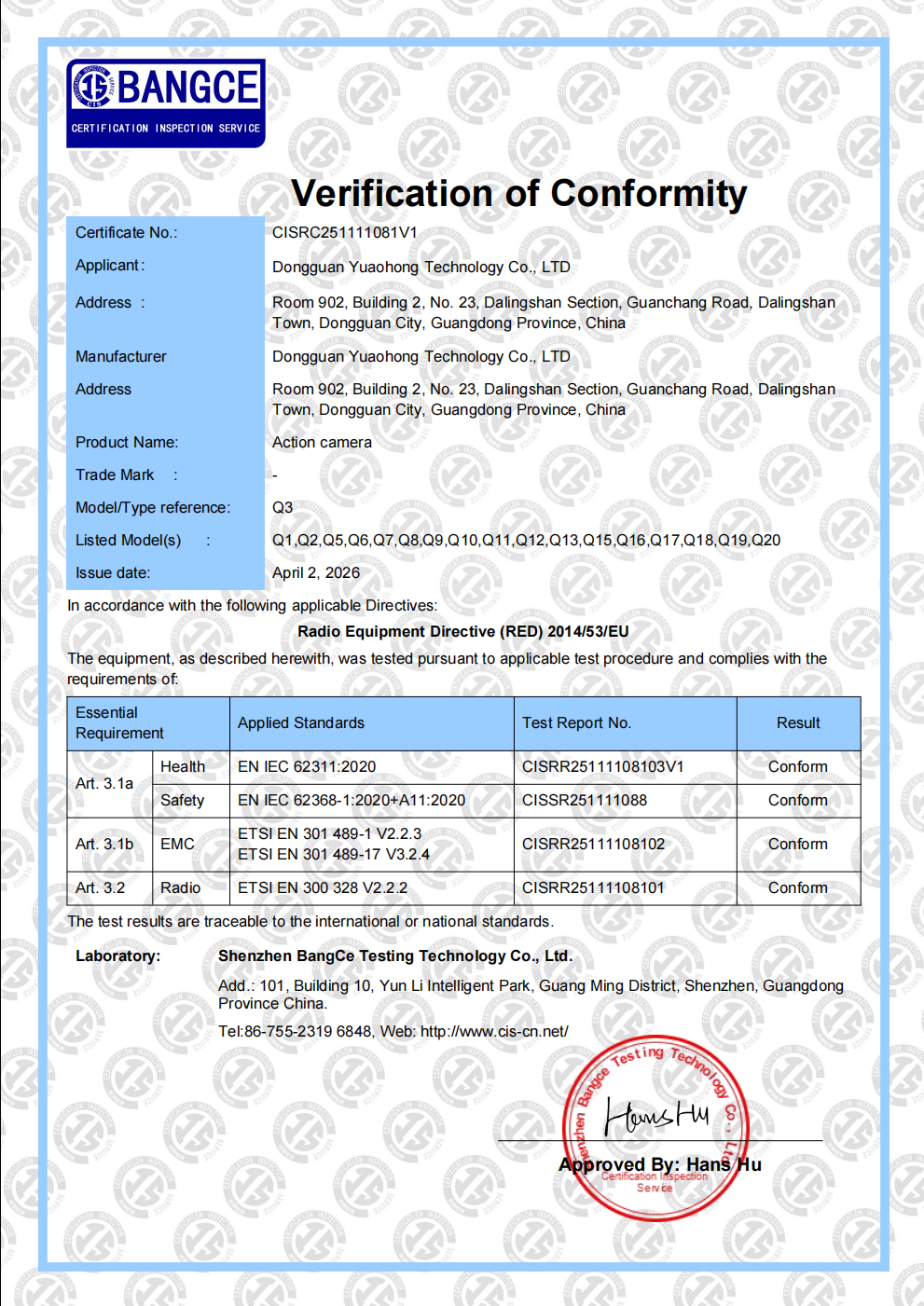
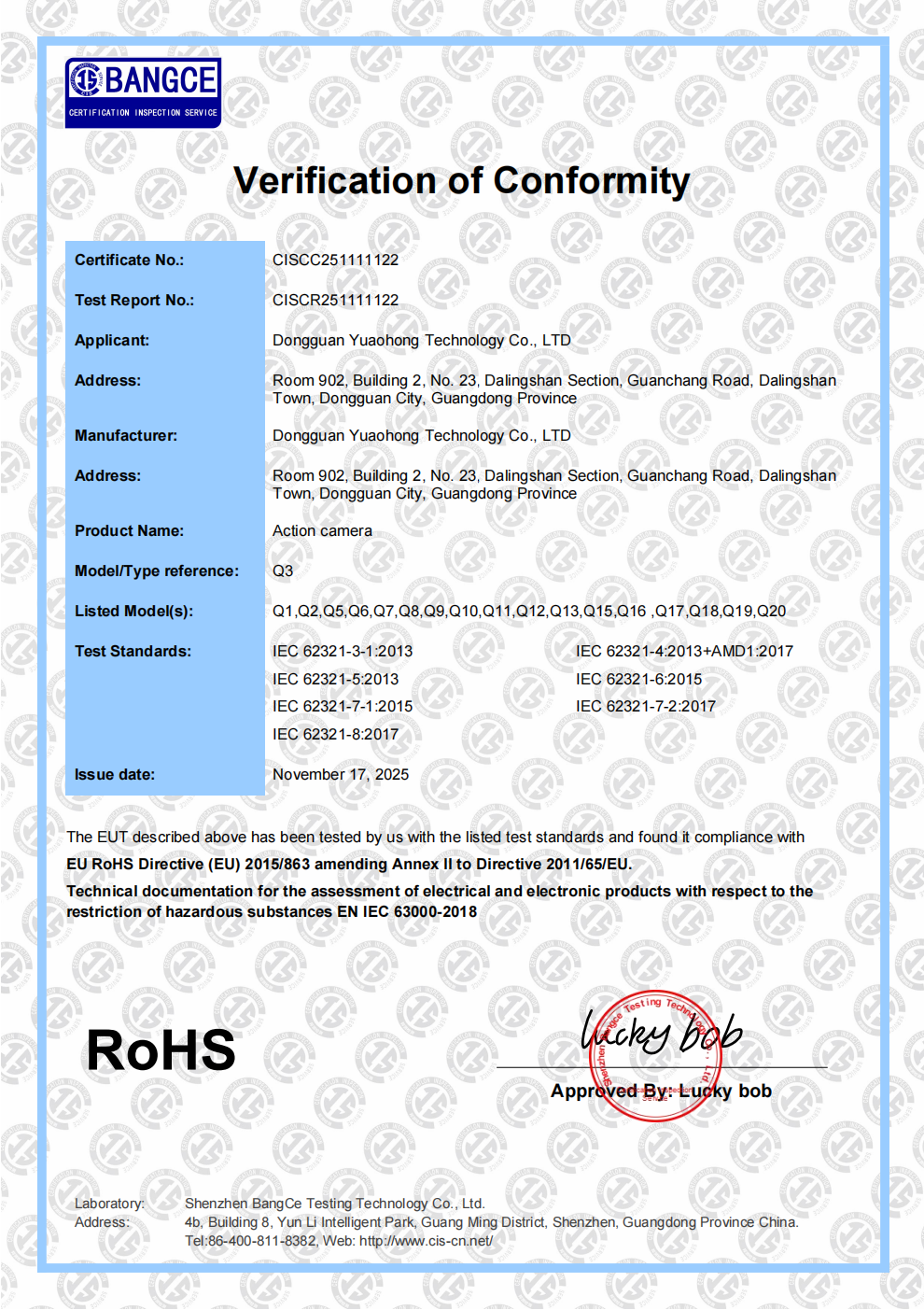
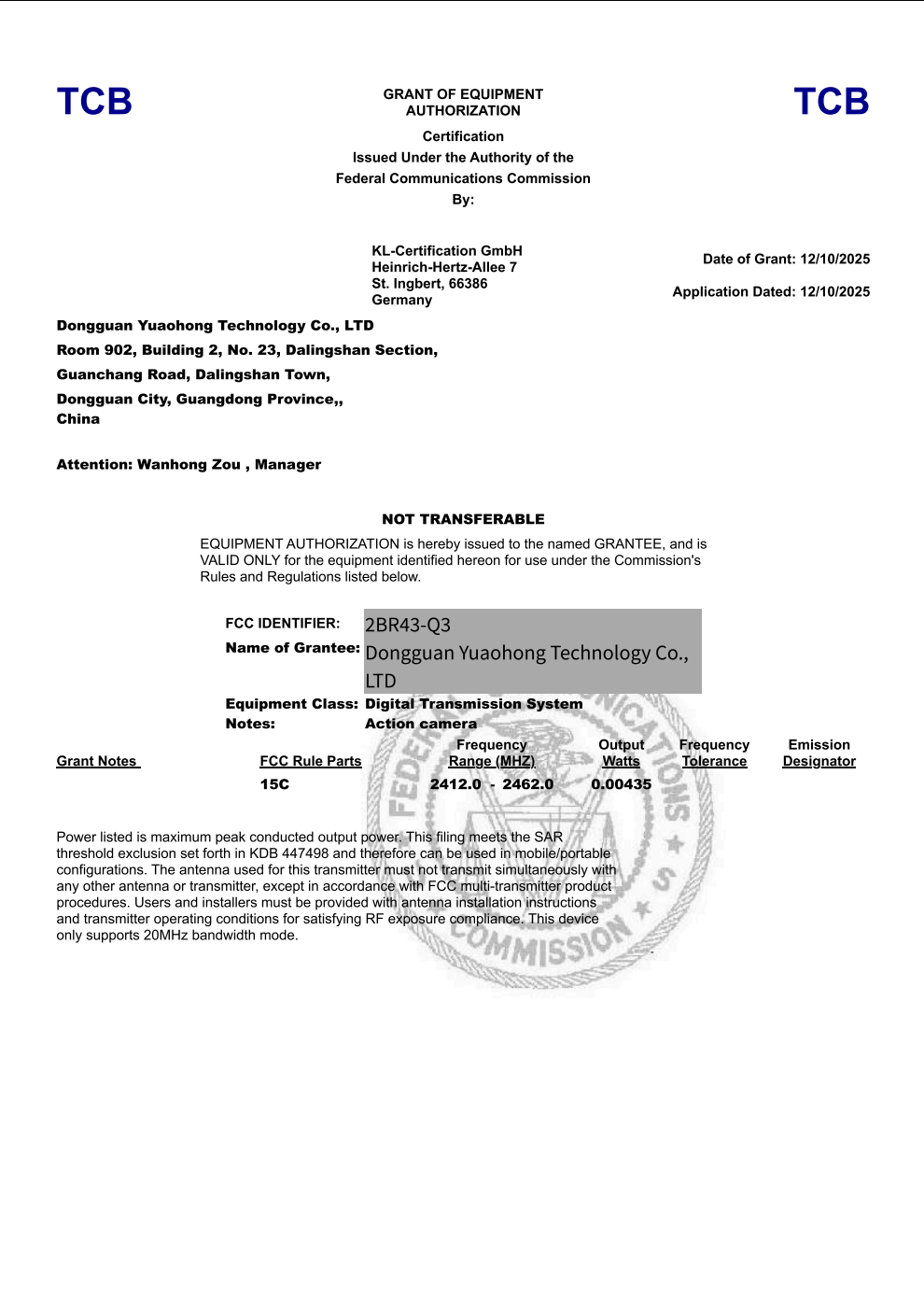
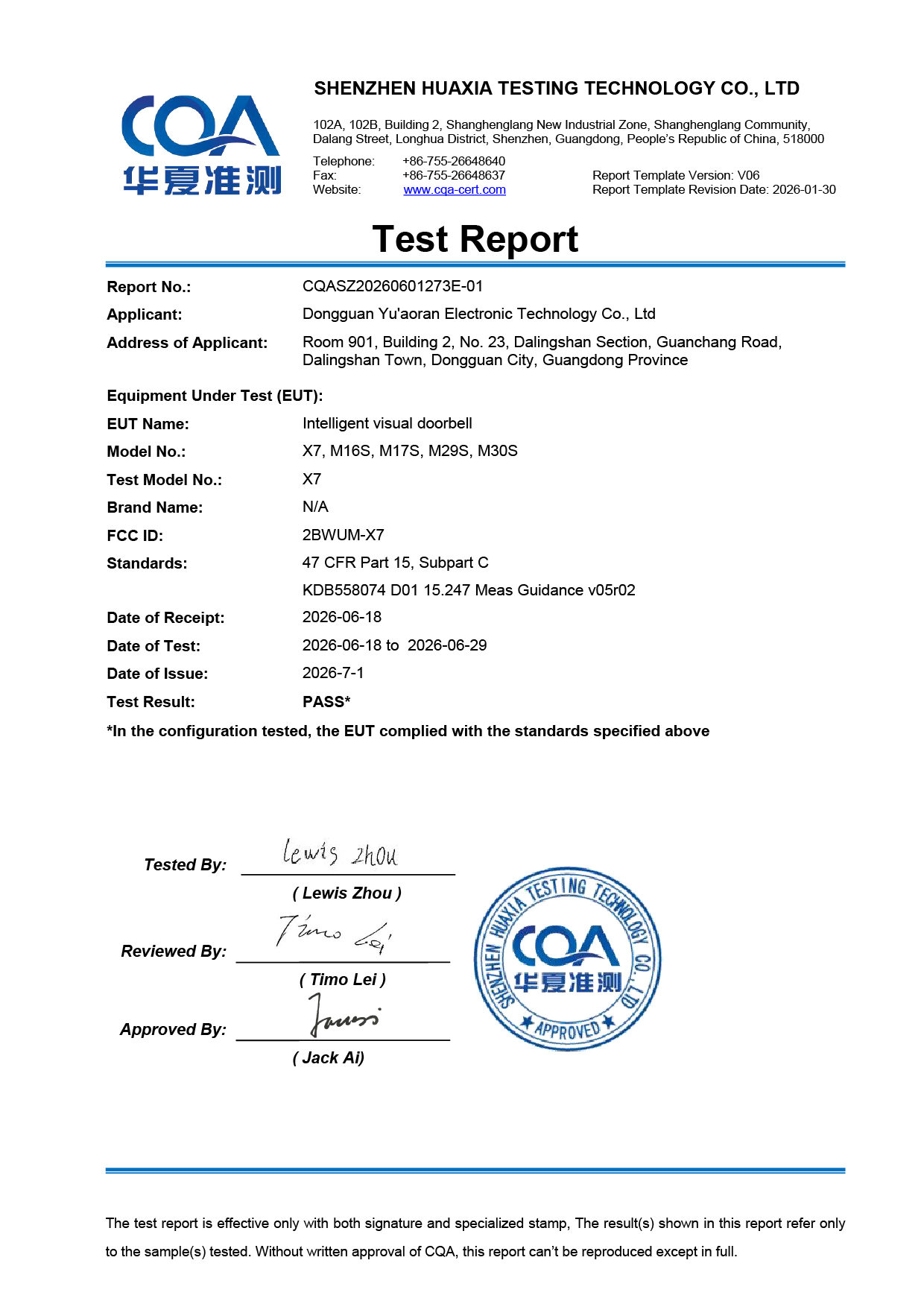
- Verify compliance documentation for the exact model and destination market. YUAOHENG holds CE certification (certificate CISRC251111081V1, standard ETSI EN 300 328 V2.2.2, issued 2 April 2026), RoHS certification (certificate CISCC251111122 under EU 2015/863, issued 17 November 2025) and FCC documentation (certification CQASZ20260601273E-01 under 47 CFR Part 15, Subpart C, issued 1 July 2026, and FCC ID certification 2BR43-Q3 under 47 CFR Part 15.247, issued 10 December 2025). Where the application involves water, note that the model records list an ABS body and do not publish an ingress-protection rating; IP68, as defined by IEC 60529, is the commonly requested dust and immersion rating, so the housing or case and its depth rating must be confirmed separately. Action cameras also fall under the IEC 62368-1:2023 safety standard for audio/video and information technology equipment, with the fourth edition published in 2023.
- Confirm commercial terms. The minimum order quantity is 1 unit, delivery is arranged through EXW and FOB, payment terms are 30% T/T in advance with a 70% T/T balance payment, and the acceptance criterion is a pre-shipment test.
- Define the OEM/ODM scope if the model must be differentiated. Customization is organized in four layers: product concept design and prototype development with engineering and certification support; hardware and function customization such as camera modules, sensors and detection functions; firmware, app and cloud service development; and appearance and packaging customization covering colour, material, logo engraving, size and structure, retail packaging, instructions and accessories.
Use Cases: Matching a Model to a Shooting Environment
The product records list three applicable industries for these models: the outdoor sports industry, the photography and video shooting industry, and the driving and transportation industry. Within those industries, the practical mapping follows the features that differ between the five models.
| Application | Recommended model | Basis in the model record |
|---|---|---|
| Night or low-light recording | Q3 | Infrared night vision supported, with hand-regulation switching; no other model in the set lists night vision |
| Two-angle vlogging in one take | Q2, Q1 | Front 4K plus rear 4K with 2K+2K simultaneous dual recording; the Q2 adds 6-level EIS and touch control |
| Cycling and bicycle-mounted recording | Q2, Q7 | 6-level electronic image stabilization (Q2) and anti-shake support (Q7) |
| Skiing and snow sports | Q2, Q7 | Same stabilization basis; mounting accessories and operating conditions should be confirmed with the supplier |
| Surfing and surface water sports | Q1, Q2, Q3 | 4K dual recording and 130° wide-angle coverage; the records list an ABS body without an ingress-protection rating, so the housing or case and its depth rating must be verified |
| Diving and underwater use | Any of the five, subject to documentation | No IP rating appears in the model parameter records; the diving configuration and seals must be confirmed for the exact model |
| Climbing and mountaineering | Q7 | 4K (3840×2160) at 30fps with anti-shake support on a 1.47-inch display |
| Long recording sessions | Q1, X20 | Recording working time of about 9 hours (Q1, X20); X20 video working time about 6–7 hours |
| Volume channel and entry programs | X20 | 1080p-class AVI (1920×1080) resolution with no published stabilization function |
A US action camera brand provides a working example of how these models are used in practice: an OEM engagement of 5,000 units over a five-year relationship, covering travel vlog shooting, outdoor hiking and camping recording, and daily life video blogging. The photo library, not the specification sheet, is what sustained that relationship — which is why stabilization, runtime and night capability are the three features worth arguing about in the evaluation stage.
Comparison Table: X20, Q1, Q2, Q3 and Q7 Side by Side
All values below are taken directly from the product parameter records for each model. Blank entries mean the parameter is not published in the record, not that the feature is absent.
| Model | Designation | Display | Recording | Stabilization | Battery | Night function | Body / material |
|---|---|---|---|---|---|---|---|
| Q2 | 4K+WiFi+Touch screen+Anti-shake | 1.8-inch IPS, 800×480, touch + physical dual buttons | Front 4K (3840×2160), rear 4K, simultaneous 2K+2K, three modes; 25mm lens, 130° | 6-level electronic image stabilization | 18650 2000mA; video working time about 4–5 hours | Not listed | ABS |
| Q1 | 4K+WIFI | 1.5-inch IPS, 320×240 | Front 4K (3840×2160), rear 4K, simultaneous 2K+2K; 130° rotating lens | Not listed | 2000mAh/3.8V polymer; video about 4–5 hours, recording about 9 hours, max duration approx. 10 hours at 720p 30fps | Not listed | ABS |
| Q3 | 4K WIFI | 1.5-inch IPS, 320×240 | Front 4K (3840×2160), rear 4K, simultaneous 2K+2K; 130° rotating lens | Not listed | 2000mAh/3.8V polymer; working time not published | Infrared night vision supported, hand-regulation switching; full-range built-in capacitor MIC | ABS |
| Q7 | 4K+WiFi+Anti-shake | 1.47-inch IPS, 320×240 | 4K (3840×2160) at 30fps; 130° rotating lens; bit speed WAV (512KBPS) | Anti-shake supported | 1000mAh/3.8V polymer | Not listed | ABS |
| X20 | 2K+WIFI X20 | 1.54-inch IPS, 320×240 | Camera resolution listed as AVI (1920×1080); 130° lens | Not listed | 1000mAh/3.8V polymer; video about 6–7 hours, recording about 9 hours | Not listed | ABS; MICRO-Type-C DC5V-1A-2A; storage 64G/32G/16G/128G optional |
FAQ
Are the YUAOHENG X20, Q1, Q2, Q3 and Q7 covered by EU and US compliance documentation?
Yes, subject to a scope check. YUAOHENG holds CE certification (certificate CISRC251111081V1, standard ETSI EN 300 328 V2.2.2, issued 2 April 2026) and RoHS certification (certificate CISCC251111122 under EU 2015/863, issued 17 November 2025); both documents list the Q1, Q2, Q3 and Q7 models in scope alongside other Q-series models. For the US market, an FCC certification record (CQASZ20260601273E-01 under 47 CFR Part 15, Subpart C, issued 1 July 2026) and an FCC ID certification (2BR43-Q3 under 47 CFR Part 15.247, issued 10 December 2025) cover action camera products. Because scope strings differ between documents, buyers should confirm that the exact model on the purchase order appears in the scope line of the certificate for the destination market.
Is YUAOHENG an OEM underwater diving action camera manufacturer in China, and can the lineup be customized?
Dongguan YuAoHeng Electronic Technology Co., Ltd. is an action camera manufacturer based in Dongguan, China, founded in 2016, operating a 1,500㎡ production facility with 300 employees including a 30-engineer R&D team, an annual output of 2,000,000 units and a monthly production capacity of 170,000 units; approximately 80% of output is exported to Europe, North America, Asia and South America. OEM and ODM services cover four layers: product concept design and prototype development with engineering and certification support; hardware and function customization such as camera modules, sensors and detection functions; firmware, app and cloud service development; and appearance and packaging customization including colour, material, logo engraving, size and structure, retail packaging, instructions and accessories. For diving use specifically, the parameter records for the X20, Q1, Q2, Q3 and Q7 list an ABS body material and do not publish an ingress-protection rating, so the housing or case, its depth rating and its seals must be confirmed in writing for the exact model before ordering.
What are the minimum order quantity, payment terms and acceptance criteria?
The minimum order quantity is 1 unit. Delivery is arranged through EXW and FOB terms. Payment terms are 30% T/T in advance with a 70% T/T balance payment, and the acceptance criterion is a pre-shipment test.
How can a buyer validate a model before committing to volume?
Three facts make validation practical. First, an MOQ of 1 unit means a single-unit order can be placed for physical evaluation instead of a volume commitment. Second, acceptance is based on a pre-shipment test, so the tested condition of the unit is the reference point for the shipment. Third, each model publishes the specifications that can be checked on receipt — display type and resolution, recording resolution, battery capacity, stabilization statements and night vision — so a validation checklist can be written directly from the product record. After-sales coverage is a 12-month official warranty with professional online technical guidance and troubleshooting support.
What is the production lead time, and what is the next step to order?
The typical production lead time is 25–30 days, supported by a monthly production capacity of 170,000 units. The next step is to download the YUAOHENG product catalog for the full model documentation, or to contact the team at info@yuaoheng.com or WhatsApp +86 18098279385 to request a sample, a quotation or the certification files for a specific model and market.
Conclusion
The YUAOHENG lineup does not have one best model; it has one best model per requirement, and the requirement is usually visible in the first two questions a buyer asks. If the answer to "do you need stabilization?" is yes, the shortlist is the Q2 and the Q7. If the answer to "do you need night recording?" is yes, the shortlist is the Q3 alone. If the answer to "how long must it run?" is measured in hours rather than minutes, the Q1 and the X20 carry the documented runtime figures. If the answer to "does the brief specify 4K?" is yes, the X20 steps out of the comparison entirely.
Ranked on that basis: Q2 for the best all-round combination of touch control, quantified 6-level stabilization and dual 4K recording; Q1 for dual 4K recording with the longest stated runtime; Q3 for infrared night vision; Q7 for compact stabilized 4K; and X20 for entry-level, non-4K, non-stabilized channels. Each earns its position through features that are documented, checkable and repeatable in a listing — which is the only kind of specification worth ranking on.
Sample, Quote or Catalog — Start With the Model You Need
Dongguan YuAoHeng Electronic Technology Co., Ltd. manufactures the X20, Q1, Q2, Q3 and Q7 action camera models at a 1,500㎡ facility in Dongguan, China, with OEM and ODM customization, a 1-unit MOQ, EXW/FOB delivery, 25–30 day lead time and a monthly capacity of 170,000 units.
Download the full YUAOHENG product catalog, or send your model, target market and quantity to info@yuaoheng.com — WhatsApp +86 18098279385 — website www.yuaoheng.com.