
Understanding Action Camera Specs: From 2K to 4K and EIS
Understanding Action Camera Specs: From 2K to 4K and EIS
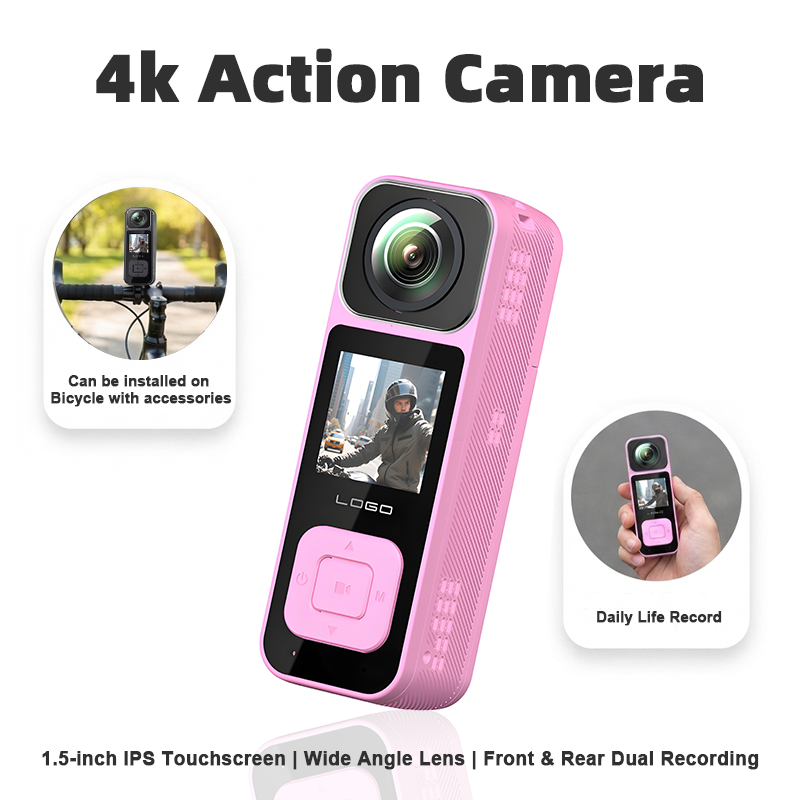
Action camera spec sheets are written by engineers and read by buyers, and the gap between those two audiences is where sourcing mistakes are made. Three rows cause most of the confusion: resolution, stabilization and battery. A "4K" label can describe the front channel, the rear channel or a dual-recording mode. "Anti-shake" can be a single word on a sheet or a defined system such as the 6-level electronic image stabilization published for the Q2. A battery row can combine a capacity rating and a cell-format code in the same cell.
This guide decodes those rows using four action camera models from Dongguan YuAoHeng Electronic Technology Co., Ltd., a Dongguan-based manufacturer of action cameras, dash cameras and smart video doorbells: the X20, Q1, Q2 and Q3. Every specification below is quoted as it appears in the product data, and every interpretation is written for the person who has to sign off on a purchase order.
Problem Definition: Why Action Camera Spec Sheets Fail a Procurement Review
Most action camera spec sheets are built for retail listings, not for verification. Three structural problems repeat across the category.
- Unit ambiguity. Battery capacity appears as "18650 — 2000mA" on the Q2 and Q9 sheets, and as "2000mAH / 3.8V polymer battery" on the Q1, Q3 and Q5 sheets. The two entries describe the same class of battery, but they are not written to the same convention.
- Mixed data types inside one cell. The X20 records "AVI (1920*1080)" in its camera resolution row, while the X7 records "4K-(3840X2160) 30fps". One cell contains a container format; the other contains a resolution and a frame rate.
- Missing test conditions. The X20 and Q1 publish maximum photo duration as approximately 12 hours and approximately 10 hours respectively, both qualified by the same condition, "720p 30fps high quality video". Without the qualifier, the number means very little.
A sheet that fails these three checks is not necessarily inaccurate — it is simply not written for verification. The buyer's task is to convert marketing rows into testable claims before the specification is locked into a purchase order.
Industry Background: What the 2K-to-4K Shift Changed for Buyers
Resolution stopped being a differentiator and became a segmentation tool. The Ultra-HD segment, defined as 4K and above, accounted for approximately 46.25% of the action camera market share in 2025, according to Mordor Intelligence, while 2K devices continue to serve price-sensitive and entry-level programmes. Global market size estimates vary by research scope — SkyQuest Technology valued the global action camera market at USD 6.57 billion in 2024, while other research houses publish materially different totals — so any single market figure should be treated as directional rather than precise.
Trade data is more concrete. In 2024, China exported USD 166 million in video cameras, with the United States as the top destination at USD 31.8 million, according to the Observatory of Economic Complexity. North America accounted for a 34% revenue share of the global action camera market in 2025, according to Grand View Research. For importers and distributors, that combination means price competition is concentrated, and differentiation increasingly comes from spec interpretation: which stabilization claim is measurable, which battery is actually sized for the runtime claimed, and which certificate names the exact model being shipped.
Two technical trends reinforce the point. Electronic image stabilization has become a standard feature in budget to mid-range action cameras, using software algorithms to correct motion, according to an Insta360 industry guide — which means "EIS supported" on its own carries little information. Separately, action cameras fall under the IEC 62368-1 safety standard for audio/video and information technology equipment, whose 4th edition was published in 2023, adding a compliance dimension that sits outside the spec table most buyers review first.
Detailed Solution: Decoding the Four Spec Rows That Decide Product Fit
1. Resolution: What 2K and 4K Actually Mean on These Models
On these sheets, 4K means 3840×2160 and 2K means 2560×1440. The X7 records 4K at 3840×2160 and 30 frames per second. The Q1, Q2 and Q3 record 4K at 3840×2160 from the front camera and also support 4K from the rear camera, and all three add simultaneous dual recording at front 2K plus rear 2K; the Q2 sheet specifies three selectable recording modes. On the 2K side, the X11, Q11 and Q9 are listed at 2K (2560×1440).
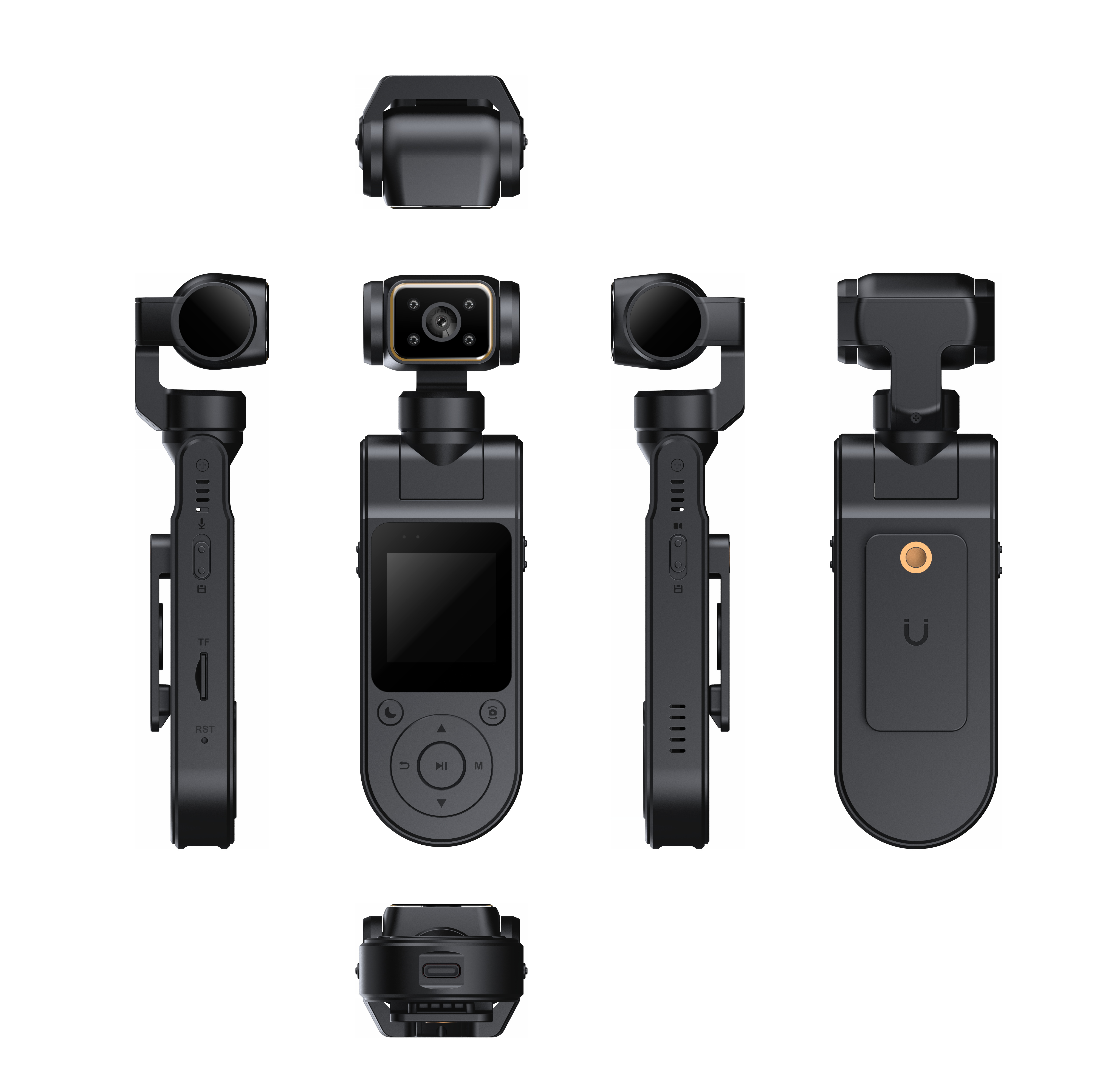
The X20 is the clearest teaching example in the group. Its family designation is 2K+WiFi X20, while its camera resolution row records "AVI (1920×1080)". AVI is a container or file format, and 1920×1080 is a resolution — the row mixes the two. A buyer who reads only the family name assumes 2K; a buyer who reads only the row sees 1080p. Neither reading is safe without a clarifying question to the supplier.
Frame rate deserves the same scrutiny. Only the X7 states a frame rate explicitly, at 4K and 30fps. For programmes that require slow-motion capture or a minimum frame rate at a given resolution, the frame rate should be confirmed per channel and per mode, because a 4K label without a stated frame rate does not define how the camera behaves in fast motion.
2. Image Stabilization: Reading EIS Levels Instead of Support Flags
Only one camera in this comparison publishes a stabilization level: the Q2, whose anti-shake function is specified as 6-level electronic image stabilization. The X7 and Q7 list anti-shake as supported, without a level. The Q1, Q3 and X20 sheets in this set do not list a stabilization function at all.
Because electronic image stabilization has become a standard feature in budget to mid-range action cameras, the word "supported" no longer separates products. A level such as the Q2's 6-level EIS is a countable claim, and countable claims can be tested against sample footage recorded on the mount the product will actually ship with. A bicycle handlebar, a chest harness and a helmet mount produce different vibration profiles, and a stabilization level that satisfies one may not satisfy another.
3. Battery: 3.8V, Milliampere-Hours and Cell Formats
Battery rows contain three different kinds of information, and separating them prevents most sourcing errors.
- Nominal voltage. The X7, Q7, Q1, Q3, Q5 and X20 all specify a 3.8V battery, which is the nominal voltage used across this group of lithium-polymer and cylindrical cells.
- Capacity. The X7, Q7 and X20 use a 1000mAh battery; the Q1, Q3 and Q5 use 2000mAh. The Q2 and Q9 specify an 18650 cell at 2000mA, the Q11 a 104050 cell at 2500mA, and the X11 a 974058 cell at 3000mA.
- Cell format. Strings such as 18650, 104050 and 974058 are cell-format references. They identify the physical cell, not the camera model, and should not be confused with product codes.
Published runtimes do not scale with capacity alone. The X20 lists approximately 6–7 hours of video working time, approximately 9 hours of recording time and approximately 12 hours of maximum photo duration at 720p 30fps — on a 1000mAh battery. The Q1 lists approximately 4–5 hours of video working time and approximately 9 hours of recording time, with maximum photo duration of approximately 10 hours at 720p 30fps, on a 2000mAh battery. The Q2 lists approximately 4–5 hours of video working time and the Q5 approximately 5–6 hours. Capacity sets the ceiling; the test condition and the number of active recording channels determine the result.
4. Display and Audio: 1.47-inch vs 1.5-inch IPS, and Two Microphone Designs
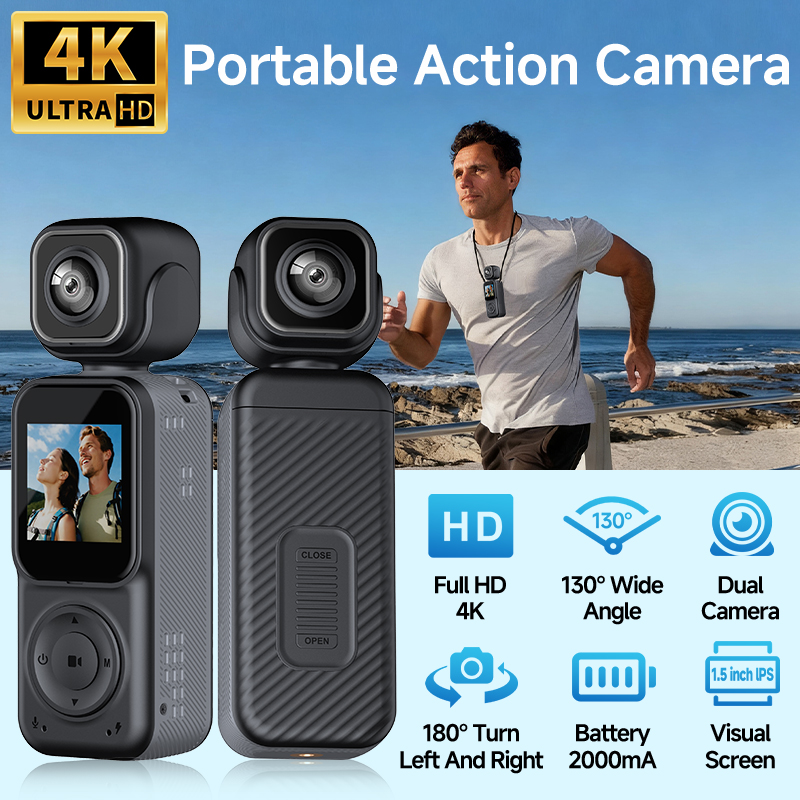
IPS panels in this group appear at five sizes across two pixel resolutions: 1.47-inch 320×240 on the X7 and Q7, 1.5-inch 320×240 on the Q1, Q3, Q5 and Q11, 1.54-inch 320×240 on the X20, 2.0-inch 320×240 on the Q9 and X11, and 1.8-inch 800×480 on the Q2.
Because the 1.47-inch and 1.5-inch panels share the same 320×240 resolution, the difference between them is mechanical and cosmetic rather than a difference in what the screen can display. The panel that changes the operating experience is the Q2's 1.8-inch 800×480 display, which is paired with standard touch and physical dual buttons for control.
Audio rows describe two different design approaches. The X7, Q7, Q1, Q3, Q5, Q9 and X20 specify a full-range built-in capacitor microphone. The Q11 and X11 instead specify a built-in noise-reduction IC for clear audio recording. Both are legitimate configurations, but they are not interchangeable on a specification, and the only reliable test is a sample recording made in the mounting position and at the speed the camera will actually be used.
5. Lens, Connectivity and Storage Rows
All four example models — X20, Q1, Q2 and Q3 — use a 130-degree wide-angle HD lens. Rotating direction is specified for the X7, Q7, Q1, Q3, Q5 and Q9, and the Q9 adds 180-degree adjustable rotation; the Q2 pairs a 25mm lens with its 130-degree field of view. A wider field of view captures more of the scene and is typically selected for cycling, skiing, diving and vehicle mounting, where a narrow field misses the periphery of the action.
Connectivity and interface rows are relatively consistent: WiFi wireless connectivity and a high-speed Mini USB2.0 interface across the group. The X20 differs by specifying a Micro-Type-C input at DC5V-1A-2A and storage capacity options of 16GB, 32GB, 64GB or 128GB. The X7 adds GPS support. Infrared night vision appears in several forms — the X20 and Q5 with four built-in energy-saving infrared lights under manual switching, the Q3 with infrared night vision under hand regulation, the Q9 with four enhanced energy-saving white fill lights, and the Q11 and X11 with a one-button controlled LED fill light. Control method matters in the field: one-button operation is faster, while manual regulation gives the operator more control over when the light source engages.
Compliance Constraints That Travel With the Spec Sheet
For EU-bound programmes, YUAOHENG action cameras carry CE certification under certificate number CISRC251111081V1, issued by BANGCE on the basis of ETSI EN 300 328 V2.2.2 and covering the X20, Q1, Q2, Q3, Q5, Q7, Q9, Q11, X7 and X11 models. A separate CE EMC certificate, AiTSZ-240914014E-C01, issued by Guangdong Asia Hongke Test Technology Limited (AIT), applies to models including the Q1, Q2, Q3, Q7 and X20 under EN 55032:2015+A1:2020 and EN 55035:2017+A11:2020. An RF test report numbered CISRR25111108101 was issued by BANGCE on 2025-11-24 under the same ETSI standard. RoHS compliance for the EU market is documented under certificate CISCC251111122 (EU 2015/863), issued by BANGCE on 2025-11-17, covering Q-series models including the Q1, Q2, Q3, Q5, Q7, Q9 and Q11.
For US-bound programmes, FCC certification number CQASZ20260601273E-01 was issued by CQA on 2026-07-01 for the X7, M16S, M17S, M29S and M30S models under 47 CFR Part 15, Subpart C and KDB558074 D01 15.247 Meas Guidance v05r02. An FCC ID registration numbered 2BR43-Q3 was issued on 2025-12-10 under 47 CFR Part 15.247.
Two derivative checks belong in the same review. Where a supplier quotes an IP rating, the claim should be traceable to IEC 60529, the international standard that defines IP68 as dust protection (6) combined with protection against continuous immersion (8). And where a programme falls under general product safety review, action cameras fall under IEC 62368-1, whose 4th edition was published in 2023.
Step-by-Step: Verifying an Action Camera Spec Sheet Before Sourcing
- Separate resolution from container and format rows. If a cell contains a file format such as AVI or WAV alongside a number, ask the supplier to restate the video resolution and frame rate as separate values.
- Confirm frame rate per resolution, per channel and per mode. Front 4K, rear 4K and simultaneous 2K+2K are three different operating states and may carry different frame rates.
- Ask for stabilization by level, not by flag. A 6-level electronic image stabilization claim such as the Q2's can be tested against footage; a plain "supported" note cannot.
- Split the battery row into capacity, nominal voltage and cell format, then request the runtime test condition behind any working-time figure.
- Compare display size and pixel resolution separately. A 1.47-inch and a 1.5-inch IPS panel at 320×240 are not a display upgrade; a 1.8-inch 800×480 touch panel is.
- Confirm the microphone design and request a wind-noise sample for any outdoor, motorised or high-speed programme.
- Map the accessory ecosystem before committing. Waterproof case compatibility is specified for the Q1 and Q2; the supporting equipment set includes motorcycle fixed brackets, bicycle mounts, chest harness straps, selfie sticks, external microphones, extra rechargeable batteries, car chargers and memory cards.
- Verify certificate scope by exact model and destination market, and keep the certificate number in the purchase documentation.
- Lock the commercial terms: OEM/ODM customization scope, sample validation, production lead time and monthly capacity.
Use Cases: Matching Verified Specs to Shooting Scenarios
Specs only become useful when they are matched to a working condition. The stated operating window for these cameras is outdoor all-weather use from -20℃ to 60℃, with dustproof, waterproof and shockproof characteristics, which covers the vibration-heavy and low-light scenarios below.
- Underwater diving and snorkeling. Q1 and Q2 both state compatibility with a waterproof case for underwater shooting. Buyers should confirm the case rating separately and require an IP-claim reference to IEC 60529 rather than accepting "waterproof" as a standalone term.
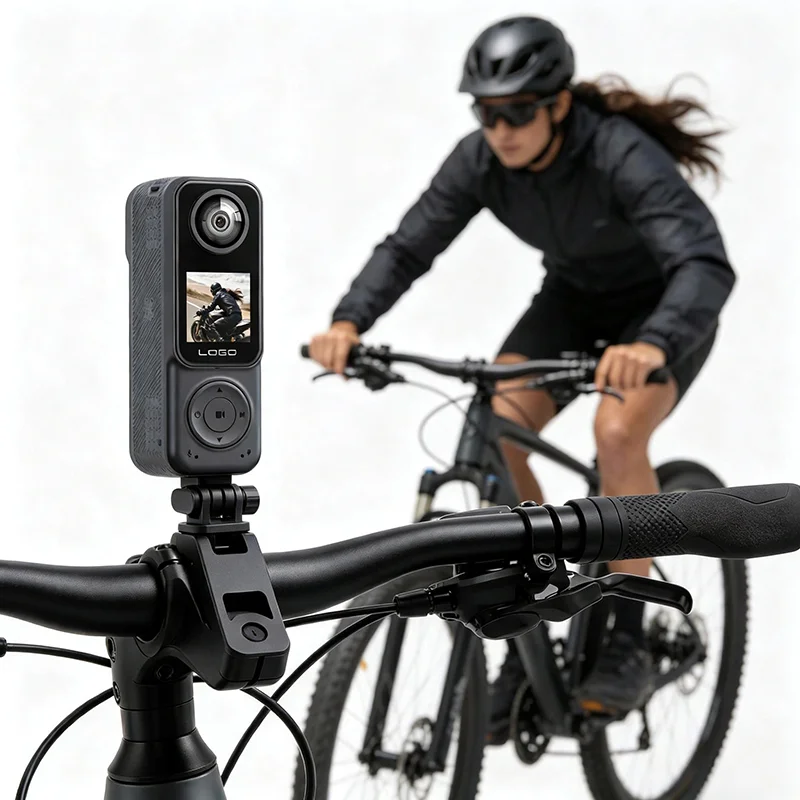
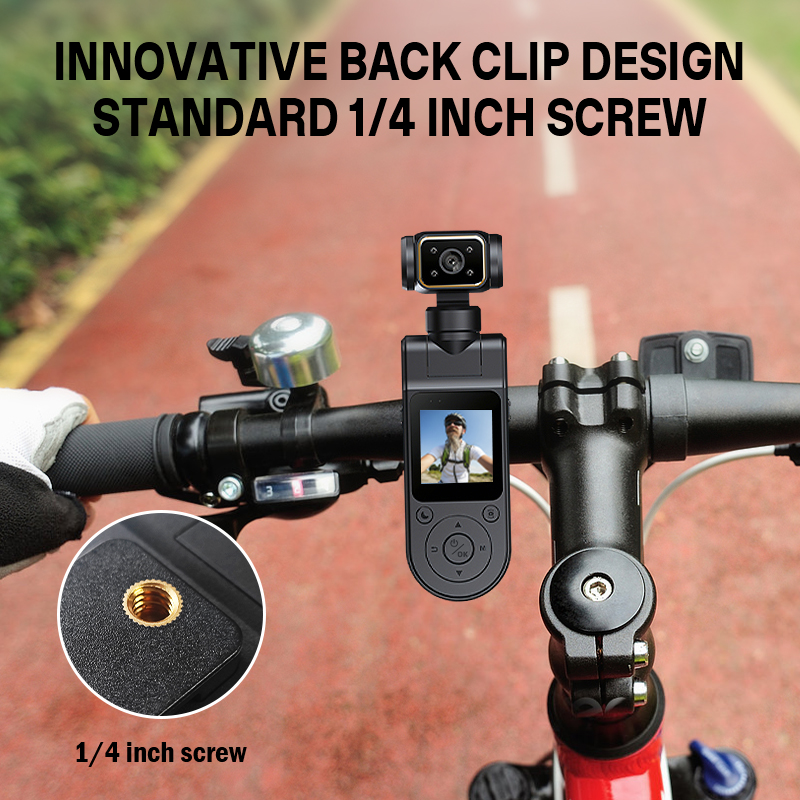
- Bicycle-mounted and motorcycle recording. This is where the stabilization row becomes decisive. The Q2's 6-level electronic image stabilization is the only defined level in this group; the X7 and Q7 list anti-shake as supported.
- Skiing and outdoor sports. The 130-degree wide-angle lens on the X20, Q1, Q2 and Q3 covers more of the slope, and the -20℃ to 60℃ operating range covers cold-weather use. Battery behavior in cold conditions should still be validated with a sample.
- Vlog and handheld shooting. The Q2's 1.8-inch 800×480 panel with touch and physical dual buttons serves framing and menu control; the X20's 16GB to 128GB storage options support longer shooting days.
- Climbing and mountaineering. Shockproof and dustproof construction plus rotating-lens models (Q1, Q3, Q5, Q9 and X7) allow the framing to be adjusted without repositioning the mount.
- Surfing and water sports. Case compatibility plus the stated operating conditions define fitness; confirmation of the mounting accessory set should happen at the sample stage.
- Night and low-light recording. The X20 and Q5 use four built-in infrared lights with manual switching, the Q3 supports infrared night vision under hand regulation, the Q9 uses four white fill lights, and the Q11 and X11 use a one-button LED fill light. Fill-light control method should be matched to how the operator will actually shoot.
Comparison Table: X20, Q1, Q2 and Q3 Side by Side
| Specification | X20 | Q1 | Q2 | Q3 |
|---|---|---|---|---|
| Recording resolution | AVI (1920×1080) as listed in the resolution row; product family 2K+WiFi X20 | Front 4K (3840×2160); rear 4K; simultaneous front 2K + rear 2K | Front 4K (3840×2160); rear 4K; simultaneous 2K+2K; three modes | Front 4K (3840×2160); rear 4K; simultaneous front 2K + rear 2K |
| Stabilization | Not listed | Not listed | 6-level electronic image stabilization | Not listed |
| Display | 1.54-inch IPS, 320×240 | 1.5-inch IPS, 320×240 | 1.8-inch IPS, 800×480, touch + physical dual buttons | 1.5-inch IPS, 320×240 |
| Battery | 1000mAh / 3.8V polymer | 2000mAh / 3.8V polymer | 18650 cell, 2000mA | 2000mAh / 3.8V polymer |
| Published runtime | Video approx. 6–7 h; recording approx. 9 h; photo approx. 12 h at 720p 30fps | Video approx. 4–5 h; recording approx. 9 h; photo approx. 10 h at 720p 30fps | Video approx. 4–5 h | Not stated on the spec sheet |
| Lens | 130-degree HD lens | 130-degree wide-angle, rotating direction | 25mm lens, 130-degree wide angle | 130-degree wide-angle, rotating direction |
| Night vision | Infrared, 4 lights, manual regulation | Infrared night vision supported | Infrared night vision supported | Infrared night vision, hand regulation |
| Microphone | Full-range built-in capacitor MIC | Full-range built-in capacitor MIC | Full-range built-in capacitor MIC | Full-range built-in capacitor MIC |
| Connectivity / interface | WiFi; Micro-Type-C DC5V-1A-2A; 16/32/64/128GB storage | WiFi; high-speed Mini USB2.0 | WiFi; high-speed Mini USB2.0 | WiFi; high-speed Mini USB2.0 |
| Waterproof case compatibility | Not stated on the spec sheet | Compatible with waterproof case | Compatible with waterproof case | Not stated on the spec sheet |
"Not listed" and "not stated" are recorded deliberately. In a procurement review, an absent specification is a question, not a negative — but it should be resolved before the model is written into a product plan.
FAQ
Which YUAOHENG action camera models are CE-certified for EU distribution?
CE certification under certificate number CISRC251111081V1, issued by BANGCE on the basis of ETSI EN 300 328 V2.2.2, covers the X20, Q1, Q2, Q3, Q5, Q7, Q9, Q11, X7 and X11 action camera models. A separate CE EMC certificate, AiTSZ-240914014E-C01, issued by Guangdong Asia Hongke Test Technology Limited (AIT), applies to models including Q1, Q2, Q3, Q7 and X20 under EN 55032:2015+A1:2020 and EN 55035:2017+A11:2020. RoHS compliance for the EU market is documented under certificate CISCC251111122 (EU 2015/863), and RF test report CISRR25111108101 was issued under the same ETSI standard. Buyers should request the certificate that names the exact model and destination market rather than a generic certificate list.
What is the practical difference between 2K and 4K on these action cameras?
In YUAOHENG specification sheets, 4K means 3840×2160 and 2K means 2560×1440. The X7 records 4K at 30fps; the Q1, Q2 and Q3 record 4K from the front camera and from the rear camera, and support simultaneous dual recording at front 2K plus rear 2K. The X11, Q11 and Q9 are listed at 2K (2560×1440). The X20 carries a 2K+WiFi family designation while its camera resolution row records AVI (1920×1080), which mixes a container format with a resolution — a row that should be clarified with the supplier before it is written into a purchase specification.
Does "anti-shake" mean the same thing on every model?
No. The Q2 is the only model in this comparison that publishes a level: 6-level electronic image stabilization. The X7 and Q7 list anti-shake as supported without a level, and the Q1, Q3 and X20 sheets do not list a stabilization function. Because electronic image stabilization is now a standard feature in budget to mid-range action cameras, the useful question is not whether stabilization exists but what level is specified and how it performs on the mount the product will actually ship with.
What drives the cost difference between two 4K action cameras?
The visible cost drivers inside these spec sheets are battery capacity and cell format (1000mAh on the X7, Q7 and X20 versus 2000mAh on the Q1, Q3 and Q5, with 18650, 104050 and 974058 cells on the Q2, Q9, Q11 and X11), display configuration (1.47-inch, 1.5-inch, 1.54-inch and 2.0-inch 320×240 panels versus the Q2's 1.8-inch 800×480 touch panel), stabilization implementation, the number of recording channels, and the certification scope the destination market requires. Capacity and screen size alone determine neither runtime nor picture quality, so the cost conversation should be tied to a defined test condition rather than to a single headline number.
Can we validate a sample before a bulk order, and how long does production take?
Samples can be validated before a bulk order: the minimum order quantity for YUAOHENG action cameras is 1 unit, and every unit passes 100% test. OEM and ODM customization covers product design and R&D services, hardware and function customization, software and firmware development, and appearance and packaging design. Monthly capacity is 170,000 units with a production lead time of 25–30 days, and a 12-month official warranty applies with online technical guidance and after-sales troubleshooting support. To start a sample or quotation request, contact info@yuaoheng.com or review the full product catalogue.
Conclusion
Spec sheets rarely fail buyers because the numbers are wrong. They fail because the numbers are written for different purposes. Reading resolution, stabilization, battery and display rows as separate, verified claims converts a retail specification into a purchasing specification: 4K becomes 3840×2160 at a stated frame rate, anti-shake becomes a numbered EIS level, 2000mAh becomes 2000mAh at 3.8V with a stated runtime condition, and 1.5-inch IPS becomes 320×240 with a known display constraint.
Applied to the X20, Q1, Q2 and Q3, those checks show that the meaningful differences between models often sit outside the headline specification — in the cell format, the display resolution, the microphone design and the certification scope. The teams that verify those rows before the purchase order are the ones that avoid renegotiating them after the container ships.
Next step: sample, quotation or catalogue
Dongguan YuAoHeng Electronic Technology Co., Ltd. manufactures action cameras, dash cameras and smart video doorbells in Dongguan, China, with a 1,500㎡ production facility, 30 engineers, an annual output of 2,000,000 units and exports to more than 15 countries and regions. OEM and ODM programmes are supported from design and engineering through testing and mass production.
Email: info@yuaoheng.com | Phone / WhatsApp: +86 18098279385 | Website: www.yuaoheng.com
Full product catalogue (PDF): Download the YUAOHENG action camera catalogue