
X20 vs Q1 vs Q2 vs Q3: Which Action Camera Fits Your Recording Needs?
X20 vs Q1 vs Q2 vs Q3: Which Action Camera Fits Your Recording Needs?
The X20, Q1, Q2, and Q3 are four YUAOHENG action cameras that look similar in a product photo but are built for different recording jobs. The short answer: the X20 is the longest-running model for everyday 1080p capture, the Q1 delivers 4K front-and-rear recording on a 2000mAh battery, the Q2 adds a 1.8-inch touch screen with 6-level electronic image stabilization, and the Q3 pairs 4K front-and-rear dual recording with infrared night vision and a manually switched infrared mode. The rest of this guide explains how each specification translates into an actual recording scenario, using only manufacturer-published data.
Why "Action Camera" Is a Harder Buying Decision Than It Looks
The problem is not that there are too few options. It is that a single product label covers wildly different recording tasks. A cyclist mounting a camera to handlebars, a vlogger holding one at arm's length, and a diver shooting through a waterproof case are all shopping for the same category word, yet they need different combinations of resolution, stabilization, battery endurance, and screen control.Specification sheets make this worse. Camera makers list the same parameter names — resolution, battery, screen, lens — so four models can look nearly identical on paper while behaving very differently in the field. A 1.54-inch screen and a 1.8-inch screen read as a trivial difference until you have to frame a shot outdoors in bright light. A 1000mAh battery and a 2000mAh battery read as a number until you are three hours into a ride.
That is why this comparison is organized around recording needs rather than around a ranking. Before comparing anything, define the four variables below, because they determine which of these models is even worth shortlisting:
- Primary capture scenario — handheld vlogging, bicycle or motorcycle mounting, climbing, skiing, surfing, snorkeling, or night recording.
- Resolution target — 1080p-class capture versus true 4K (3840×2160), and whether you need front and rear angles recorded at the same time.
- Stabilization requirement — whether your footage will be shot under vibration or motion that software correction must absorb.
- Session length — how long one recording block has to run before the battery becomes the limiting factor.
Industry Background: What the Category Data Actually Says
Two shifts in the action camera market explain why resolution and stabilization now dominate the buying decision. According to SkyQuest Technology's action camera market report, the global action camera market was valued at USD 6.57 billion in 2024. Within that market, Mordor Intelligence reports that the ultra-HD (4K and above) resolution segment accounted for approximately 46.25% of market share in 2025 — meaning 4K has moved from a premium option to roughly half of the category.
Stabilization has followed the same path. An Insta360 industry guide on EIS cameras notes that Electronic Image Stabilization has become a standard feature in budget to mid-range action cameras, using software algorithms to correct motion rather than relying solely on mechanical hardware. For buyers, this changes the question from "does this camera have stabilization?" to "what level of stabilization does it have, and does this specific model include it at all?"
Regional demand shapes what gets produced, too. Grand View Research places North America's share of the global action camera market at 34% in 2025, while the Observatory of Economic Complexity recorded USD 166 million in video camera exports from China in 2024, with the United States as the top destination at USD 31.8 million. In practice, this means models sold into Europe and North America are expected to carry the certifications those markets require.
The manufacturer behind these four models, Dongguan YuAoHeng Electronic Technology Co., Ltd. (trading as YUAOHENG), was established in 2016 and operates a 1,500㎡ standardized production facility with approximately 300 employees and a 30-engineer R&D team, producing about 2,000,000 units per year. Its products hold FCC, CE, and RoHS certifications, with roughly 80% of output exported to more than 15 countries across Europe, North America, Asia, and South America.
Model by Model: What Each Camera Is Actually Built For
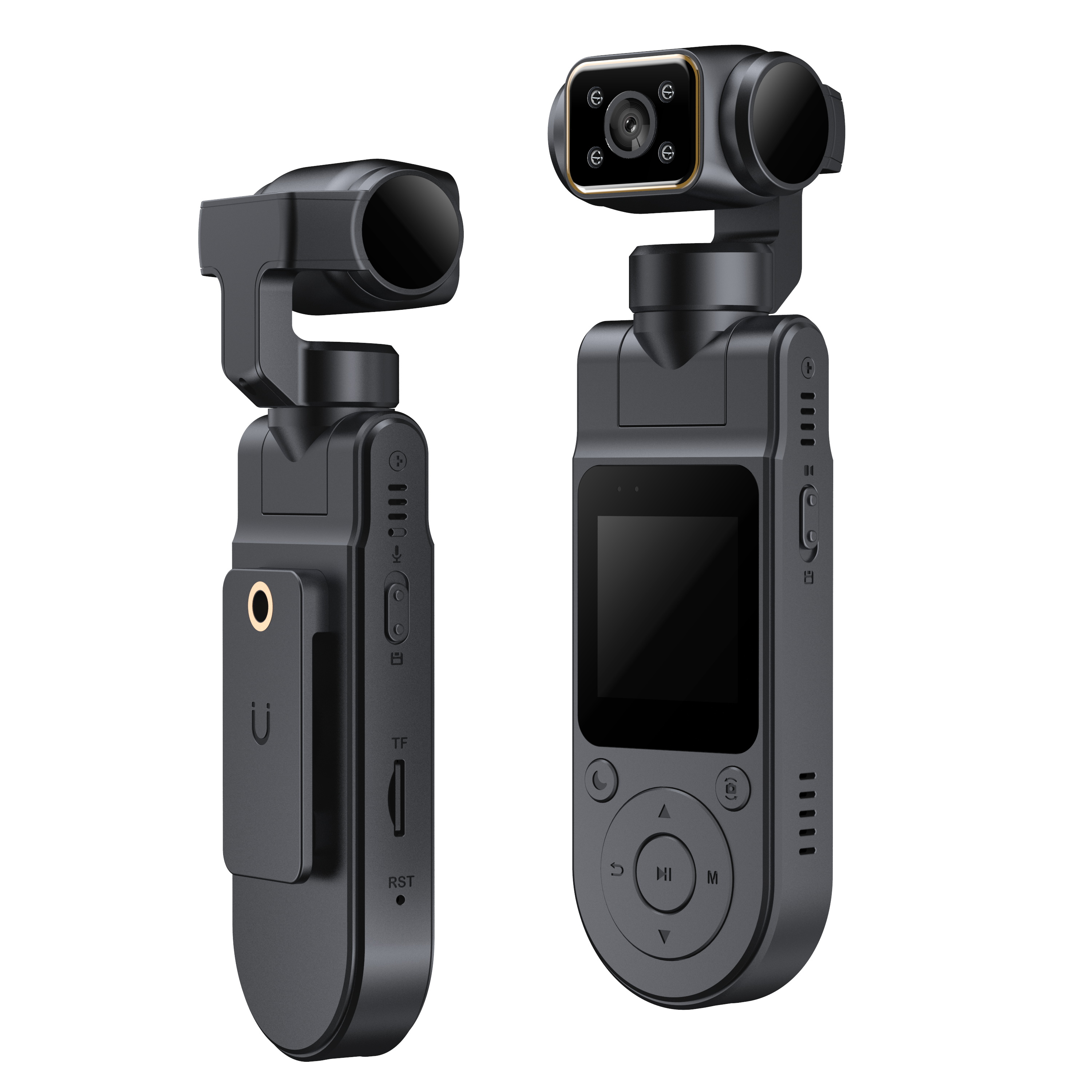
X20 — The Endurance Model
The X20 is the model to choose when recording time matters more than pixel count. It belongs to the 2K+WIFI X20 category and carries a 1.54-inch IPS display with a resolution of 320×240 pixels, paired with an HD lens offering a 130° field of view and a rotating direction feature.
X20 published specifications
Video resolution: 1920×1080 (AVI) · Recording bit rate: WAV 512 kbps · Display: 1.54-inch IPS, 320×240
Battery: 1000mAh / 3.8V polymer · Video working time: about 6–7 hours · Recording working time: about 9 hours · Maximum photo duration: approximately 12H (720p 30fps)
Input voltage: Micro Type-C, DC 5V 1A–2A · Storage: supports 16G / 32G / 64G / 128G optional · Interface: High-speed Mini USB 2.0
Infrared night vision: supported, with 4 built-in energy-saving infrared lights · Infrared switching mode: manual regulation · Microphone: full-range built-in capacitor MIC
The numbers that matter here are the 6–7 hours of video working time and roughly 9 hours of recording working time, both drawn from the published specification. That endurance profile suits long touring rides, full-day travel logging, and continuous dash-cam style use where swapping batteries mid-session is impractical. Storage expansion up to 128G also supports long uninterrupted sessions. The trade-off is resolution: the X20's listed video resolution is 1920×1080 in AVI format, not 4K.
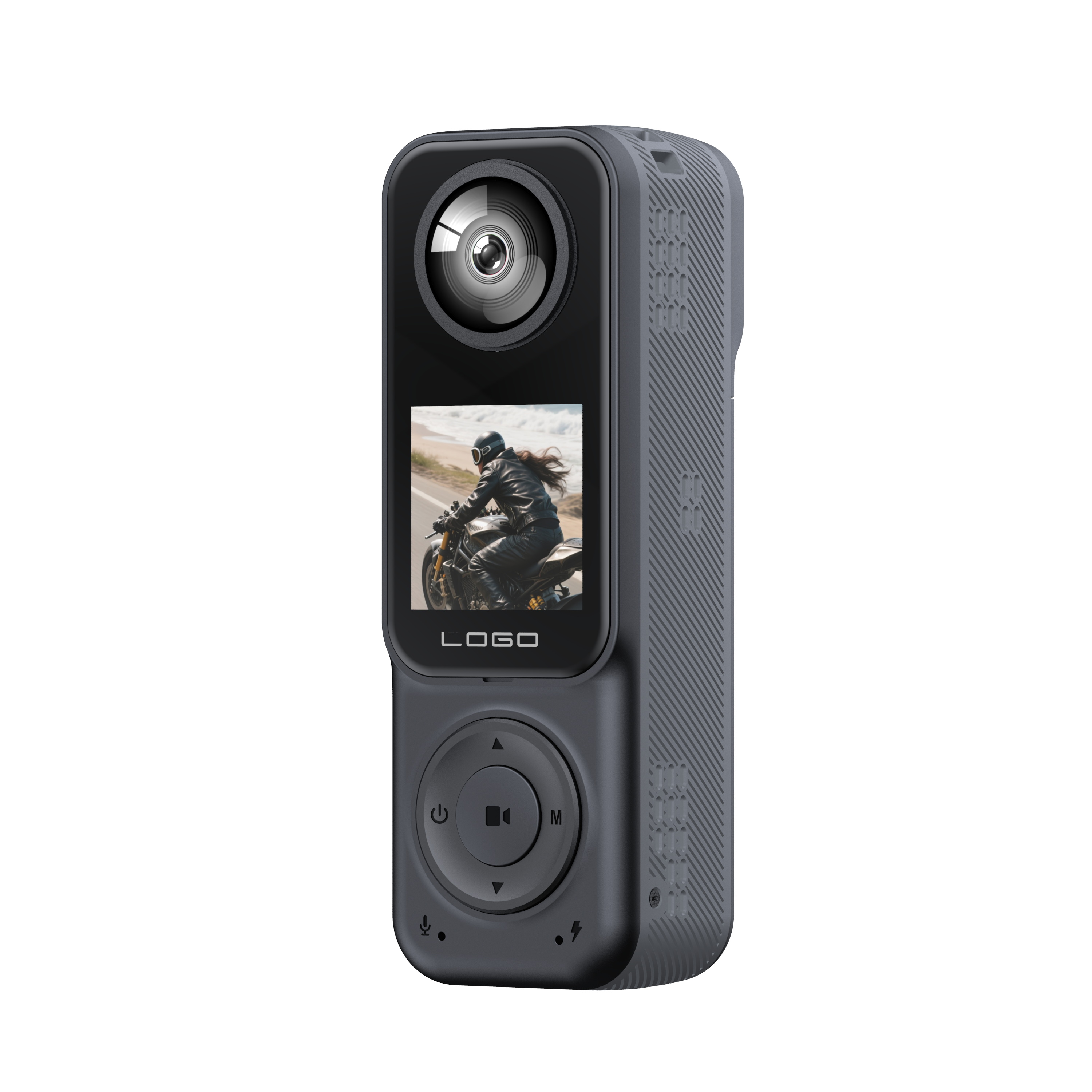
Q1 — The Battery-Backed 4K Dual-Recording Model
If you want 4K on both the front and rear cameras without giving up battery capacity, the Q1 is the direct answer. It is classified as a 4K+WiFi action camera and pairs a 1.5-inch IPS screen at 320×240 with an HD 130° wide-angle lens that supports rotating direction.
Q1 published specifications
Camera resolution: Front 4K (3840×2160), Rear 4K (3840×2160), simultaneous dual recording (Front 2K + Rear 2K)
Display: 1.5-inch IPS, 320×240 · Lens: HD 130° wide angle, rotating direction · Recording bit rate: WAV 512 kbps
Battery: 2000mAh / 3.8V polymer · Video working time: about 4–5 hours · Recording working time: about 9 hours · Maximum photo duration: approximately 10H (720p 30fps)
Infrared night vision: supported · Microphone: full-range built-in capacitor MIC · Interface: High-speed Mini USB 2.0
Compatible with a waterproof case for underwater shooting
The Q1's defining capability is simultaneous front-and-rear capture: both cameras record 4K at 3840×2160, and the camera also supports dual recording at front 2K plus rear 2K. For anyone who needs a forward view and a self-facing view from a single mounted unit — cycling footage plus rider reaction, for example — that removes the need to run two cameras. The 2000mAh polymer battery and roughly 9 hours of recording working time give it a longer standby-recording profile than its 4–5 hour video working time suggests.
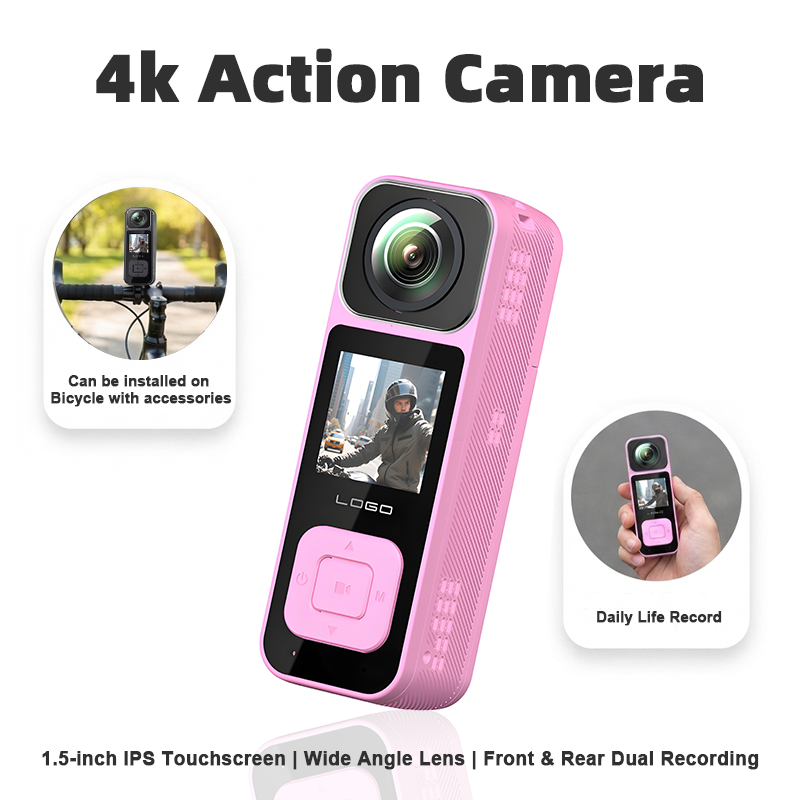
Q2 — The Touch Screen and Stabilization Model
The Q2 is the only model in this comparison whose published specification includes electronic image stabilization, and the only one that lists touch-screen operation. That combination makes it the strongest fit for handheld and vibration-heavy recording.
Q2 published specifications
Display: 1.8-inch IPS, 800×480 · Lens: 25mm lens, 130° wide angle, front and rear dual recording simultaneously
Camera resolution: Front 4K (3840×2160), Rear 4K (3840×2160), simultaneous 2K+2K dual recording, three modes optional
Button function: standard touch & physical dual buttons · Anti-shake: 6-level electronic image stabilization
Battery: 18650, 2000mA · Video working time: about 4–5 hours
Infrared night vision: supported · Microphone: full-range built-in capacitor MIC · Interface: High-speed Mini USB 2.0
Compatible with a waterproof case for underwater shooting
Two specifications separate the Q2 from its siblings. First, its display is 1.8 inches at 800×480 — a visible step up from the 320×240 panels on the X20, Q1, and Q3 — and it accepts touch input alongside physical buttons. Second, its 6-level electronic image stabilization addresses the motion problem directly. An Insta360 industry guide notes that EIS uses software algorithms to correct motion and has become standard in budget to mid-range action cameras, but "standard" is a category-level statement, not a per-model guarantee. In this four-model lineup, the Q2 is the one whose published spec sheet actually lists it.
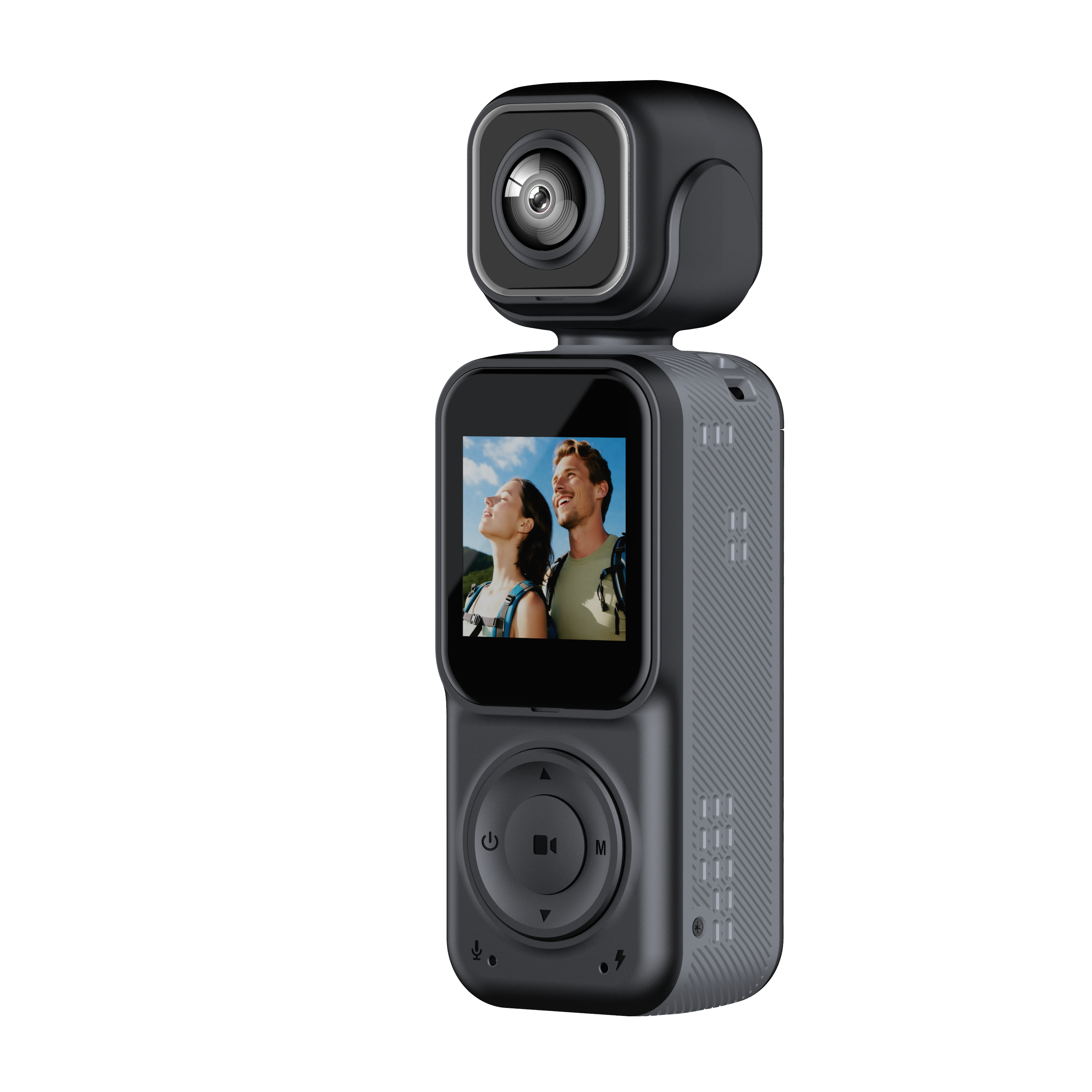
Q3 — The Night and Dual-Angle Model
The Q3 combines the dual-4K architecture of the Q1 with an explicit infrared night vision configuration and manual infrared switching, which makes it the model to look at when low-light recording is part of the plan.
Q3 published specifications
Camera resolution: Front 4K (3840×2160), Rear 4K (3840×2160), simultaneous dual recording (Front 2K + Rear 2K)
Display: 1.5-inch IPS, 320×240 · Lens: HD 130° wide angle, rotating direction · Recording bit rate: WAV 512 kbps
Battery: 2000mAh / 3.8V polymer · Infrared night vision: supported · Infrared switching mode: manual regulation
Microphone: full-range built-in capacitor MIC · Interface: High-speed Mini USB 2.0
Manual infrared switching is the detail worth understanding. Rather than leaving the infrared fill light under automatic control, the Q3's infrared mode is switched by hand. For night hiking, garage work, or any scenario where the lighting condition is stable and predictable, manual control removes the risk of the camera toggling modes mid-recording. Combined with 4K front and rear capture and a 2000mAh polymer battery, the Q3 covers both the dual-angle and the low-light requirement in one body.
Specification Comparison Table
The table below compares only the parameters published in each model's specification. Where a parameter is not listed for a given model, it is marked as such rather than estimated.
| Parameter | X20 | Q1 | Q2 | Q3 |
|---|---|---|---|---|
| Category | 2K+WIFI X20 | 4K+WiFi | 4K+WiFi+Touch screen+Anti-shake | 4K WIFI |
| Display screen | 1.54-inch IPS, 320×240 | 1.5-inch IPS, 320×240 | 1.8-inch IPS, 800×480 | 1.5-inch IPS, 320×240 |
| Lens | HD 130°, rotating direction | HD 130° wide angle, rotating direction | 25mm, 130° wide angle | HD 130° wide angle, rotating direction |
| Video resolution | 1920×1080 (AVI) | Front 4K, Rear 4K (3840×2160) | Front 4K, Rear 4K (3840×2160) | Front 4K, Rear 4K (3840×2160) |
| Simultaneous dual recording | Not listed | Front 2K + Rear 2K | 2K+2K, three modes optional | Front 2K + Rear 2K |
| Image stabilization | Not listed | Not listed | 6-level electronic image stabilization | Not listed |
| Touch screen | Not listed | Not listed | Touch & physical dual buttons | Not listed |
| Infrared night vision | Supported, 4 built-in infrared lights | Supported | Supported | Supported |
| Infrared switching | Manual regulation | Not listed | Not listed | Manual regulation |
| Battery | 1000mAh / 3.8V polymer | 2000mAh / 3.8V polymer | 18650, 2000mA | 2000mAh / 3.8V polymer |
| Video working time | About 6–7 hours | About 4–5 hours | About 4–5 hours | Not listed |
| Recording working time | About 9 hours | About 9 hours | Not listed | Not listed |
| Microphone | Full-range built-in capacitor MIC | Full-range built-in capacitor MIC | Full-range built-in capacitor MIC | Full-range built-in capacitor MIC |
| Waterproof case compatibility | Not listed | Compatible | Compatible | Not listed |
| Interface | High-speed Mini USB 2.0; Micro Type-C input | High-speed Mini USB 2.0 | High-speed Mini USB 2.0 | High-speed Mini USB 2.0 |
How to Choose: A Step-by-Step Decision Path
Working through these six steps in order will usually eliminate two of the four models before you reach a final comparison.
- Set the resolution floor first. If your output has to be 4K (3840×2160), the X20 drops out immediately — its listed video resolution is 1920×1080 in AVI format. Q1, Q2, and Q3 all record 4K on both front and rear cameras.
- Decide whether you need two angles at once. Simultaneous dual recording is listed for the Q1, Q2, and Q3. If a second camera angle is part of your plan, those three remain in scope; if a single forward view is enough, the field stays wider.
- Check whether your footage will be shot under motion. Only the Q2's published specification includes image stabilization — 6-level electronic image stabilization. Mounted cycling, motorcycle, and off-road recording involve continuous vibration, so this is the parameter to confirm rather than assume.
- Match battery to session length. The X20 lists about 6–7 hours of video working time and about 9 hours of recording working time on a 1000mAh battery. The Q1 lists about 4–5 hours of video working time and about 9 hours of recording working time on a 2000mAh battery. The Q2 lists about 4–5 hours of video working time. Choose against your longest uninterrupted shooting block, not your average one.
- Decide how much on-camera control you need. The Q2's 1.8-inch 800×480 touch display is the largest and highest-resolution screen of the four, and it supports touch operation alongside physical buttons. The X20, Q1, and Q3 use 320×240 panels.
- Confirm night and waterproof requirements. All four list infrared night vision, but only the X20 and Q3 list manual infrared switching, and only the X20 specifies the number of built-in infrared lights (4). For underwater use, waterproof case compatibility is listed for the Q1 and Q2; confirm case compatibility directly with the supplier for the other models.
One compliance note applies at step six. Waterproof ratings are not marketing language — IP68 is defined by IEC 60529 as protection against dust (6) and immersion in water (8). If a supplier quotes a waterproof rating, ask which standard it is measured against and whether the rating applies to the camera body or to the camera inside a housing.
Use Cases: Matching Each Model to a Recording Scenario
The scenarios below come from how these four models are positioned against outdoor sports, photography and video shooting, and driving and transportation applications.
- Vlog handheld recording. Framing yourself while holding the camera is a touch-screen and stabilization task. The Q2's 1.8-inch 800×480 touch display and 6-level electronic image stabilization make it the most direct fit, and its 130° wide angle at a 25mm lens keeps more of the background in frame.
- Bicycle and motorcycle mounting. Vibration is continuous, so stabilization matters more than raw resolution. The Q2's 6-level EIS addresses this directly. If the ride is long rather than technical, the X20's roughly 6–7 hours of video working time and 128G storage support make it a practical alternative at 1080p.
- Underwater and snorkeling. The Q1 and Q2 both list compatibility with a waterproof case for underwater shooting, and both support 4K front and rear recording. Match the housing to the model rather than assuming a universal fit.
- Skiing, climbing, and mountaineering. These combine high-speed movement with mixed light. The Q2's stabilization covers the motion side; the Q3's 4K dual recording and manual infrared switching cover changing light conditions, particularly on shaded faces and in early-morning starts.
- Night hiking and low-light recording. All four models list infrared night vision. The Q3 and X20 both list manual infrared regulation, which is the preferable configuration when lighting conditions are stable and you do not want the camera changing modes mid-clip.
- Rider-facing and forward-facing capture at the same time. The Q1, Q2, and Q3 all record front and rear 4K, with simultaneous 2K+2K dual recording. This removes the need for a second camera unit and a second mount.
- Continuous in-vehicle recording. The X20's roughly 9 hours of recording working time, 1000mAh battery, and up to 128G storage capacity give it the endurance profile for long driving sessions, with a Micro Type-C DC 5V 1A–2A input for in-vehicle charging.
Frequently Asked Questions
Yes. Dongguan YuAoHeng Electronic Technology Co., Ltd. states that its products have obtained FCC, CE, and RoHS certifications, and that approximately 80% of its output is exported to more than 15 countries and regions across Europe, North America, Asia, and South America. For buyers in Europe, this matters because CE and RoHS compliance is a market-access requirement rather than an optional quality marker. Beyond product-level certification, action cameras also fall under the IEC 62368-1 safety standard for audio/video and information technology equipment, with the 4th edition published in 2023.
The Q1, Q2, and Q3 support simultaneous dual recording. The Q1 and Q3 both record front 4K and rear 4K at 3840×2160, and both support simultaneous dual recording at front 2K plus rear 2K. The Q2 offers front 4K and rear 4K with simultaneous 2K+2K dual recording and three modes optional. The X20's published specification does not list a rear camera or dual recording, so it should be treated as a single-camera model. If dual-angle capture is a requirement, the decision narrows to Q1, Q2, and Q3.
The Q2 is the only model in this four-model comparison whose published specification includes anti-shake, listed as 6-level electronic image stabilization. Electronic Image Stabilization uses software algorithms to correct motion and, per an Insta360 industry guide, has become a standard feature across budget to mid-range action cameras generally — but that is a category-level trend, not a per-model guarantee. Buyers planning mounted or vibration-heavy recording should verify stabilization model by model rather than assuming it is present.
Based on the published specifications, the X20 lists about 6–7 hours of video working time and about 9 hours of recording working time on a 1000mAh / 3.8V polymer battery, plus a maximum photo duration of approximately 12 hours at 720p 30fps. The Q1 lists about 4–5 hours of video working time and about 9 hours of recording working time on a 2000mAh / 3.8V polymer battery, with a maximum photo duration of approximately 10 hours at 720p 30fps. The Q2 lists about 4–5 hours of video working time on an 18650 2000mA battery. The Q3's specification does not list a working time figure. In practice, the X20 gives the longest continuous video session of the four, while the Q1, Q2, and Q3 pair their 4K capability with shorter active video windows.
Samples and specification confirmation can be arranged directly with the manufacturer — contact Dongguan YuAoHeng Electronic Technology Co., Ltd. by email at info@yuaoheng.com or by phone at +86 18098279385 to discuss which model matches your recording requirement and to confirm waterproof case compatibility for the specific model you select. The company also provides OEM and ODM one-stop customization services covering product design, engineering development, testing, and mass production, which is relevant if you need configuration changes rather than an off-the-shelf unit.
Conclusion: Match the Model to the Recording Task
None of these four cameras is universally better than the others — each one trades something away. The X20 trades 4K resolution for the longest video working time in the group at roughly 6–7 hours. The Q1 pairs front and rear 4K recording with a 2000mAh battery and roughly 9 hours of recording working time. The Q2 is the only model with both a 1.8-inch 800×480 touch display and 6-level electronic image stabilization, making it the clear pick for handheld vlogging and vibration-heavy mounting. The Q3 combines 4K dual recording with a 2000mAh battery and manually switched infrared night vision, which suits mixed-light outdoor shooting.
If you start from the recording task rather than from the specification grid, the choice usually resolves quickly: define your resolution floor, decide whether you need two angles, confirm whether stabilization is required, and then match battery endurance to your longest session. That sequence filters four similar-looking models down to one.
Ready to Match a Model to Your Recording Requirement?
Send us the scenario you are shooting for — vlogging, cycling, diving, skiing, or long-duration recording — and we will confirm which configuration fits, along with sample availability and OEM/ODM options.
Email: info@yuaoheng.com · Tel / WhatsApp: +86 18098279385 · Website: www.yuaoheng.com
Download the full product catalogue: YUAOHENG Product Catalogue (PDF)