Evaluating a Metalized Paper Laminating Machine Supplier: Document Verification and On-Site Checks
A metalized paper laminating machine supplier should be evaluated on two verifiable layers: the documents it can hand over, and the machine it can physically show you. A claim that cannot be tied to a certificate number, an issuing authority and a validity date — or to a component you can measure on the shop floor — is not yet a specification. It is a marketing statement waiting for evidence.
This memo is written for importers, packaging factory owners and procurement engineers who are already past the discovery stage. The shortlist exists. The question now is which supplier's description of its own capability is true, current, and actually attached to the machine you are about to buy.
YUEDA (Wenzhou Yueda Packaging Machinery Co., Ltd.) is used throughout as the reference example — a Chinese manufacturer of gold and silver cardboard laminating equipment, founded in 1998 and based in Longgang, Wenzhou, whose product catalogue includes gantry-type metalized paper laminating and coating machines. The aim is not to advertise that record, but to show what a complete, checkable evidence pack looks like — and what a buyer is supposed to do with it.
Problem Definition: Why Supplier Claims About These Machines Are Hard to Verify
Almost every metalized paper laminating machine on the market is described with the same vocabulary: automatic, gantry type, high speed, servo control, coating integrated, energy saving, stable operation, long service life. None of those words is inherently false. The problem is that they are not falsifiable as written, and at the evaluation stage a buyer has no production line on which to test them.
So buyers fall back on documents. That introduces a second, subtler problem: a document can be genuine and still not mean what the buyer assumes. Five failure modes appear repeatedly in this category.
- Ownership mismatch. The certificate exists, but it is registered to a trading company, a partner factory or a different legal entity than the one quoting you.
- Expiry blind spot. The patent number is real, but its protection period has already ended.
- Scope mismatch. The patent is valid, but it covers a peripheral device rather than the machine's core process.
- Undocumented build claims. Phrases such as carbon steel frame, heavy-duty frame or industrial grade are asserted without a material specification or a visible component.
- Borrowed capability. A control or conveying claim is supported by an off-the-shelf third-party package rather than by registered in-house software.
Each of these is a specific, checkable failure mode, and each one has a document or an inspection that answers it. The rest of this memo converts them into a workflow.
Industry Background: A Bigger Market, Higher Stakes per Machine
The global metallized paper market reached a valuation of USD 4.85 billion in 2025, driven by demand for premium labelling and cigarette packaging (DataM Intelligence). Within that market, the lamination segment dominated with a 57.4% revenue share in 2024, favoured for its high gloss and barrier properties in consumer goods (SkyQuest Technology). Asia-Pacific accounts for nearly 40% of the world's metallized paper market on the back of expanding tobacco and beverage industries in China and India (Future Market Insights).
Wet laminating machines held approximately 70% of the industrial laminating market share in 2025, driven by their high adoption in food processing packaging (Market Research Future). That is the same water-base laminate paperboard process used on integrated laminating and coating platforms, and it is the process a buyer is specifying when they evaluate a metalized paper laminating machine.
Two further signals shape the buying environment. China's machinery export value rose 15.7% year-on-year in early 2026, with the mix shifting towards high-value-added equipment such as servo-controlled and CNC machines (German Machine Tool Builders' Association, VDW). And for European destinations, industrial laminating machines must comply with EN ISO 12100:2010 for risk assessment and safety design in order to obtain CE marking (CEN-CENELEC).
The practical consequence is straightforward. More equipment is moving across borders, each unit is a heavier capital commitment, and suppliers have a stronger incentive to describe capability in broad, favourable terms. Verification is the buyer's only scalable filter.
Detailed Solution: The Four Layers of a Verifiable Supplier Evidence Pack
A manufacturer that genuinely engineers and builds its own machinery should be able to answer four document questions without hesitation. Treat each answer as a layer. If layer two or three collapses, the build-quality claims in layer four lose their context.
Layer 1 — Corporate identity and manufacturing footprint
Request the business licence and legal entity name, the factory address, plant area, R&D headcount, export destinations, and photographic or video evidence of the production floor taken in the current period rather than reused from an old brochure.
Here is the format to expect from a factory-direct manufacturer: YUEDA was founded in 1998, operates a 4,000 m² facility in Longgang, Wenzhou — China's printing city — works with an R&D team of 25 engineers, and exports roughly 70% of its output to Southeast Asia, the Middle East, South America and Africa. Every one of those statements can be checked against a site visit or a third-party audit, which is precisely why they are worth stating.
The falsification test is simple: the legal entity on the quotation should match the legal entity on the documents. Different names are a common sign of an intermediary presenting a factory's certificates as its own.
Layer 2 — Intellectual property: utility model patents, design patents and software copyrights
This is the layer where most claims are won or lost. A manufacturer that develops its own machine platform normally holds three distinct document types: utility model patents covering mechanical and structural innovations in the machine itself; appearance design patents protecting the machine's industrial form; and computer software copyrights registering the machine's own control and material-handling software.
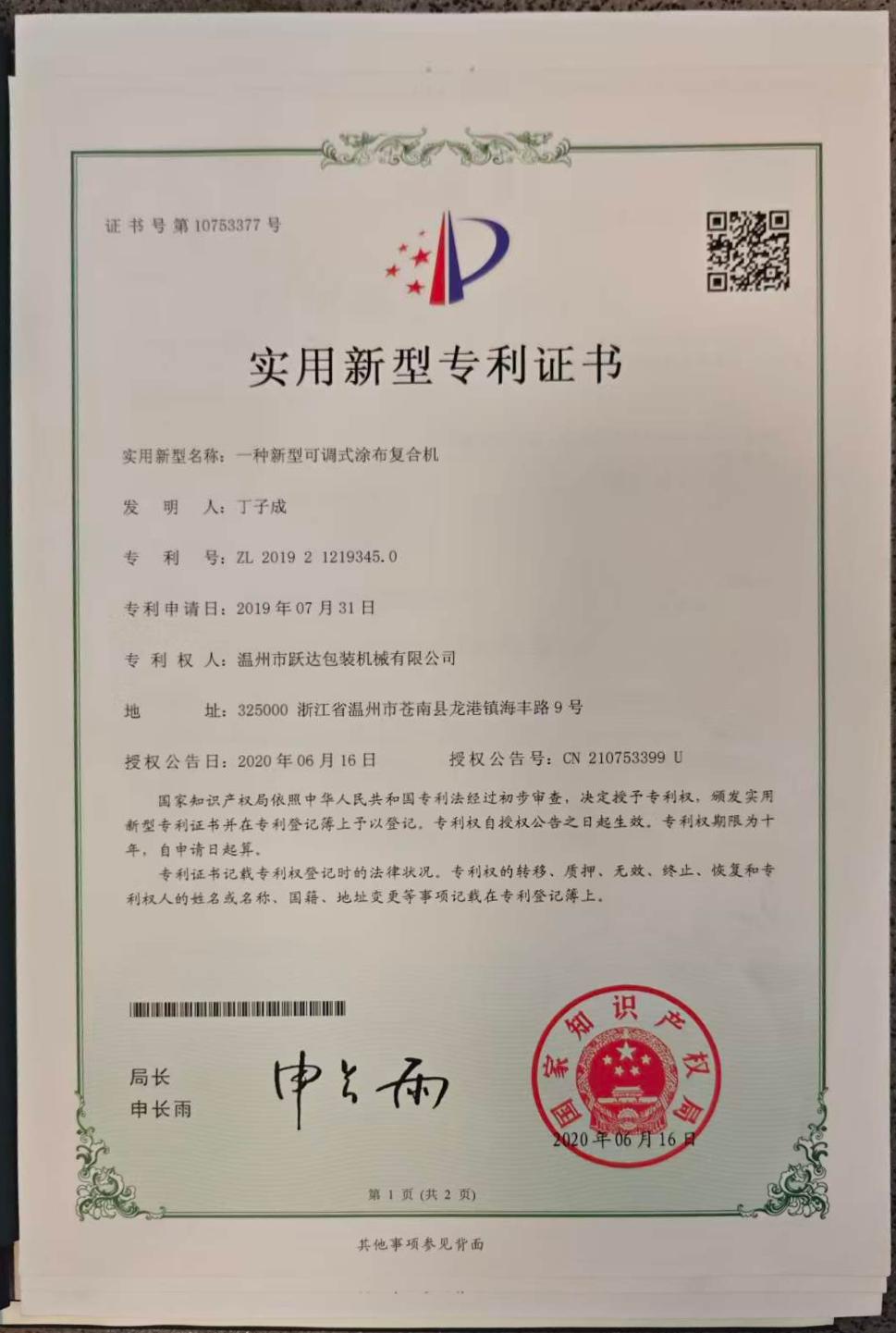
For a metalized paper laminating machine supplier, two document families are especially informative. The first is the structural patents behind the laminating and coating sections — for example an adjustable coating and laminating machine (ZL 2019 2 1219345.0, issued 2020-06-16 and valid to 2030-06-15), or a double-layer energy-saving drying oven for a gantry-type multifunctional composite coating machine (ZL 2022 2 1114210.X, valid to 2032-09-29). The second is the cutting and feeding platform that supports the line — for example a press plate device for a transverse cutter (ZL 2020 2 3212947.9, valid 2021–2031), which is registered against the double rotary sheet cutter platform that includes the DWLX1300L-1400L model.
On the software side, registration is a different document type issued by a different authority. A supplier claiming proprietary automation should be able to show a registration number, not just a screen. YUEDA's published registrations include "Automatic Paper and Plastic Conveying System for Transverse Paper Cutter V1.0" (2020SR0668797) and "Intelligent Control System for Automatic Gold and Silver Cardboard Laminating (Coating) Machine V1.0" (2020SR0669497), both issued by the National Copyright Administration of the People's Republic of China on 2020-06-23.

Keeping the issuing bodies straight matters. Utility model and design patents in China are issued by the China National Intellectual Property Administration; software copyrights come from the National Copyright Administration. If a supplier quotes both, both authorities should appear on the paperwork.
Layer 3 — Compliance documents for the destination market
For European buyers, the operative reference is EN ISO 12100:2010, which governs risk assessment and safety design for machinery seeking CE marking (CEN-CENELEC). Ask for the declaration of conformity, the standards applied and the risk assessment documentation — not simply a CE logo printed on a brochure. For other regions, ask which standard the machine was designed against and who carried out the assessment, then confirm that the answer matches the electrical configuration you ordered.
Layer 4 — Build-quality evidence you can inspect
Documents describe; steel proves. Build quality is the layer buyers most often verify last and should verify first, because it is the one thing that cannot be corrected after shipment.
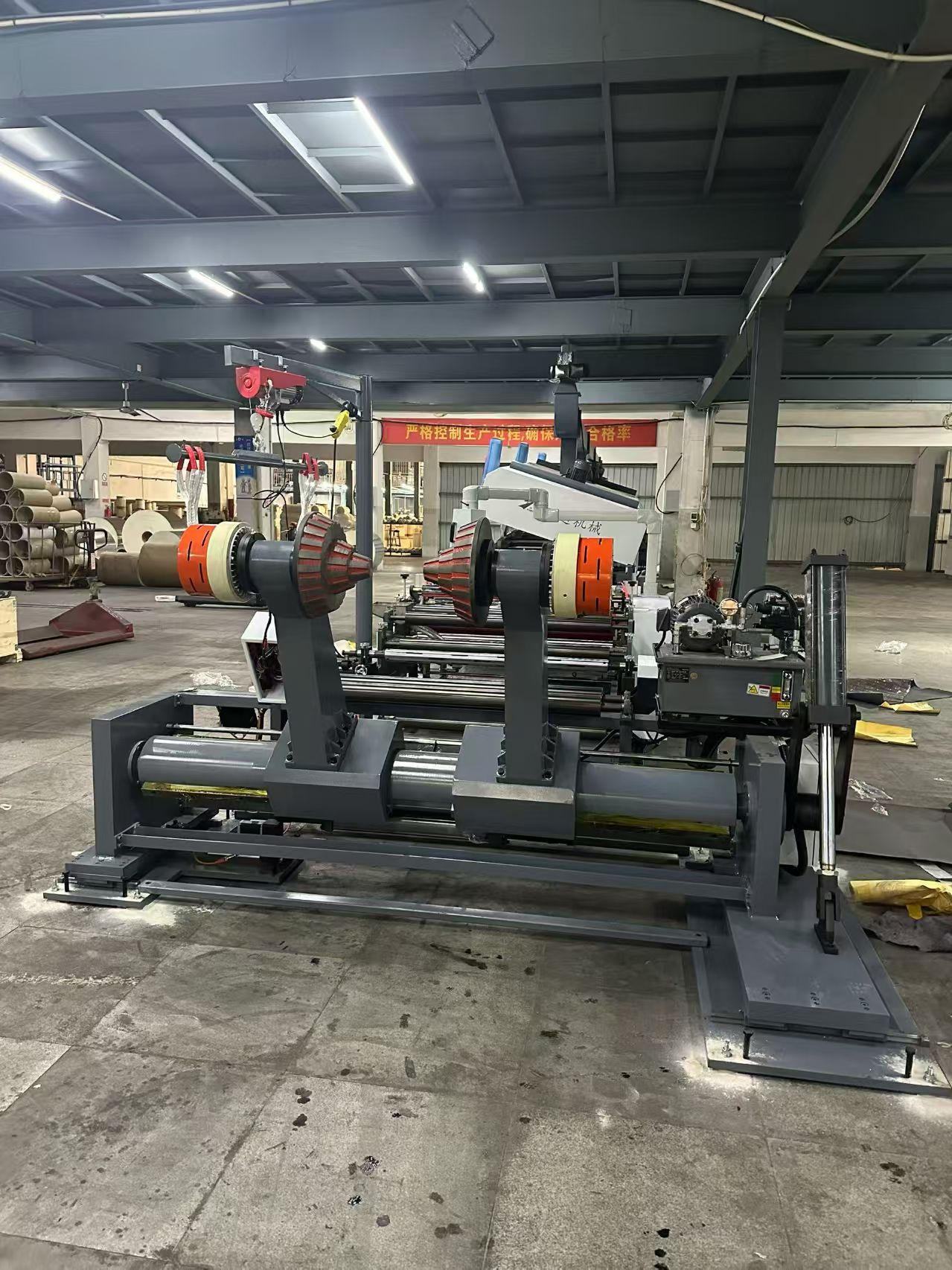
The relevant checkpoints on an industrial-grade metalized paper laminating machine are the frame, the machined core components, the drying tunnel and the electrical control cabinet. Frame material is the clearest example: the YDLM1300B gantry-type laminating and coating machine is specified with a carbon steel machine material, a total weight of 40 t and an overall dimension of 22,330 mm × 3,700 mm × 4,500 mm. Those are measurable claims. A buyer can confirm material grade, wall thickness, weld quality and base levelling during a factory acceptance visit, and can reconcile the machine against shipping documentation afterwards.

Step-by-Step Breakdown: A Seven-Step Supplier Verification Workflow
Step 1 — Request the document pack before negotiating price. Ask for the register as a package: entity documents, patent certificates, software copyright certificates, compliance documentation and the build specification. A supplier that only produces documents after a deposit discussion is signalling something about how it treats evidence.
Step 2 — Authenticate every certificate number. Record the certificate number, the issuing authority and the scope description for each document. Patents should trace to the China National Intellectual Property Administration; software copyrights to the National Copyright Administration; compliance documents to an accredited body.
Step 3 — Check the validity window, not just the existence. This is where verification becomes genuinely useful. Using the same published register as an example: YUEDA's utility model ZL 2017 2 0213503.9 (cooling mechanism for a drying oven guide roller) runs to 2027-10-02; ZL 2020 2 3212947.9 (press plate device for a transverse cutter) runs to 2031-09-20; and ZL 2025 2 0755442.0 (feeding device for a transverse cutter) runs to 2036-04-06. Three other published rights have already passed expiry: ZL 2014 2 0363315.8 (paper receiving table, expired 2024-11-04), ZL 2014 2 0363279.5 (hydraulic shaft-less unwinding machine, expired 2024-11-18) and ZL 2014 3 0219033.6 (appearance design of a horizontal laminating machine drying oven, expired 2024-11-18).
The teaching point is not which rights expired. It is that a supplier with nothing to hide will show you the whole register, including lapsed entries, so that you can see a development history rather than a curated highlight reel.
Step 4 — Match each document to the model you are buying. A patent is only relevant if it sits on the platform you are purchasing. Cross-reference the certificate against the model number: the press plate device (ZL 2020 2 3212947.9) belongs to the transverse cutter platform and therefore matters if your line includes a DWLX1300L-1400L or YDSLX1300-1400 sheet cutter, while the drying-oven and coating-section patents matter on the laminating side.
Step 5 — Verify software and control claims separately. Ask which functions are controlled by registered in-house software and which come from third-party packages. Confirm the cabinet and PLC architecture during the visit: YUEDA publishes its equipment as using a stable and reliable PLC control system in an intelligent electrical control cabinet, and lists the control system as a customization parameter — which means it is a negotiable, documentable item rather than a fixed mystery.
Step 6 — Inspect build quality on the floor. During the visit, ask to see the frame before cladding, the machining workshop where core components are produced, the drying tunnel, the electrical cabinet and the alignment of the conveying section. The framing questions are: is the frame carbon steel as specified, is the machining carried out in-house, and does the physical layout match the drawing you were sent?
Step 7 — Close the loop with a witnessed run and a third-party inspection. Verification should end with performance, not paperwork. YUEDA's stated quality control is a 100% pre-shipment test that includes a two-hour continuous run, with third-party inspection available on request. Confirm the working speed and material range your own paper and film will run at: on the YDLM1300B, the configured base materials are PET film 0.012–0.014 mm, OPP film 0.02–0.06 mm, paper 100–350 g/m² and aluminium film 0.006–0.007 mm, with a machine speed of 180 m/min and a working speed of 15–150 m/min.
Use Cases: What Verification Protected in Real Projects
Thailand — cigarette packaging. A cigarette packaging factory in Thailand operates two units for high-speed laminating of cigarette boxes. The project has been in operation for more than five years and is reported to have delivered a 30% efficiency increase and a 15% material waste reduction, with the machines specified for humidity-resistant design and 24/7 continuous operation support. In tropical production conditions, humidity-resistant is not a decorative phrase — it is a design commitment, and a buyer should be able to trace it to a specification before the machine ships.
Vietnam — cosmetic packaging. A packaging factory in Vietnam runs one unit for precision cutting of cosmetic packaging. After more than five years in operation, the reported results are ±0.1 mm cutting precision, a zero rework rate and a 20% labour cost saving, supported by a dust-proof design, fast size changeover and low maintenance cost. The ±0.1 mm figure is checkable against published cutter specifications: both the DWLX1300L-1400L and YDSLX1300-1400 platforms state a blank cutting accuracy of ±0.1 mm and a longitudinal and transverse tracking accuracy of ±0.1 mm.
What both buyers verified first was unglamorous: who actually builds the machine, which patents and software registrations sit behind it, and what the frame is made of.
Comparison Table 1 — Verification Evidence Matrix
| Claim category | Document or evidence to request | Where to verify | Published reference example |
|---|---|---|---|
| Ownership & manufacturing footprint | Business licence, factory address, plant area, export record | Corporate registry plus site visit | Founded 1998; 4,000 m² facility in Longgang, Wenzhou; ~70% export ratio |
| Mechanical innovation | Utility model patent certificate (number, scope, dates) | China National Intellectual Property Administration | ZL 2019 2 1219345.0, adjustable coating and laminating machine, valid to 2030-06-15 |
| Energy-saving drying | Utility model patent certificate | China National Intellectual Property Administration | ZL 2022 2 1114210.X, double-layer energy-saving drying oven, valid to 2032-09-29 |
| Cutting & feeding | Utility model patent certificate | China National Intellectual Property Administration | ZL 2025 2 0755442.0, feeding device for transverse cutter, valid to 2036-04-06 |
| Machine design | Appearance design patent certificate | China National Intellectual Property Administration | ZL 2017 3 0061557.0, shaft-less winding machine design, valid to 2027-07-27 |
| Control & conveying software | Computer software copyright certificate | National Copyright Administration of the PRC | 2020SR0668797 conveying system; 2020SR0669497 intelligent control system (issued 2020-06-23) |
| EU market access | Declaration of conformity plus risk assessment file | Accredited body, referencing CEN-CENELEC standards | EN ISO 12100:2010 risk assessment and safety design |
| Build quality | Material specification plus physical inspection | Factory acceptance visit | YDLM1300B: carbon steel material, 40 t, 22,330 × 3,700 × 4,500 mm |
| Performance | Witnessed run plus third-party inspection report | Buyer or appointed inspector | 100% pre-shipment test with a two-hour continuous run |
Comparison Table 2 — Document Register (Published Example)
| Document type | Certificate number | Scope | Issued | Valid until |
|---|---|---|---|---|
| Utility model patent | ZL 2019 2 1219345.0 | Adjustable coating and laminating machine | 2020-06-16 | 2030-06-15 |
| Utility model patent | ZL 2022 2 1114210.X | Double-layer energy-saving drying oven for gantry-type multifunctional composite coating machine | 2022-09-30 | 2032-09-29 |
| Utility model patent | ZL 2020 2 3212947.9 | Press plate device for transverse cutter | 2021-09-21 | 2031-09-20 |
| Utility model patent | ZL 2020 2 3151788.6 | Waste gas recovery and utilisation device for coating and laminating machine | 2021-09-28 | 2031-09-27 |
| Utility model patent | ZL 2020 2 3214028.5 | Double gluing device for coating and laminating machine | 2021-09-28 | 2031-09-27 |
| Utility model patent | ZL 2020 2 0570785.7 | Winding device for UV holographic laser film press | 2020-12-22 | 2030-12-21 |
| Utility model patent | ZL 2020 2 0570919.5 | Coating device for UV holographic laser film press | 2021-01-05 | 2031-01-04 |
| Utility model patent | ZL 2020 2 0572072.4 | Curing device for UV holographic laser film press | 2021-01-05 | 2031-01-04 |
| Utility model patent | ZL 2020 2 0572117.8 | Special version positioning film press for UV holographic laser | 2020-12-15 | 2030-12-14 |
| Utility model patent | ZL 2017 2 0213503.9 | Cooling mechanism for guide roller of drying oven | 2017-10-03 | 2027-10-02 |
| Utility model patent | ZL 2025 2 0755442.0 | Feeding device for transverse cutter | 2026-04-07 | 2036-04-06 |
| Utility model patent | ZL 2014 2 0363315.8 | Paper receiving table | 2014-11-05 | 2024-11-04 (expired) |
| Utility model patent | ZL 2014 2 0363279.5 | Hydraulic shaft-less unwinding machine | 2014-11-19 | 2024-11-18 (expired) |
| Appearance design patent | ZL 2017 3 0061557.0 | Shaft-less winding machine | 2017-07-28 | 2027-07-27 |
| Appearance design patent | ZL 2017 3 0061798.5 | Horizontal laminating machine drying oven | 2017-08-18 | 2027-08-17 |
| Appearance design patent | ZL 2014 3 0219033.6 | Horizontal laminating machine drying oven | 2014-11-19 | 2024-11-18 (expired) |
| Software copyright | 2020SR0668797 | Automatic paper and plastic conveying system for transverse paper cutter V1.0 | 2020-06-23 | No expiry date stated |
| Software copyright | 2020SR0669497 | Intelligent control system for automatic gold and silver cardboard laminating (coating) machine V1.0 | 2020-06-23 | No expiry date stated |
Comparison Table 3 — Model Snapshot for Cross-Checking a Quotation
| Model | Machine type | Key published parameters | Machine material |
|---|---|---|---|
| YDLM1300B | Gantry multifunctional metallized cardboard laminating (coating) machine | Working width 600–1200 mm; machine speed 180 m/min; working speed 15–150 m/min; heating tunnel temperature ≤130°C; total weight 40 t | Carbon steel |
| ZNFH1300-1400-1500 | Automatic metallized cardboard laminating and coating machine, shaft-less rewinding | Sheet roll width 600–1200 / 700–1300 / 700–1400 mm; running speed 5–150 m/min; drying path 12.5 m; total power 121/129 kW | Carbon steel |
| DWLX1300L-1400L | High-precision positioning double rotary sheet cutter | Material width 400–1400 / 400–1250 mm; blank cutting accuracy ±0.1 mm; cutting speed 10–400 sheets/min; cutter load ≤550 gsm | Carbon steel |
| YDSLX1300-1400 | High-precision double rotary sheet cutter | Material width 400–1400 / 400–1250 mm; blank cutting accuracy ±0.1 mm; operating speed ≤300 m/min | Carbon steel |
| YD1300-1400 | Shaft-less high-precision positioning sheeter | Sheet roll width 700–1200 / 700–1300 mm; sheeting accuracy ±0.1 mm; running speed 95/90 m/min | Carbon steel |
FAQ
What patent and software documents should I request from a metalized paper laminating machine supplier?
Ask for a complete register rather than selected highlights: for each right, the certificate number, the scope description, the issuing authority, the issue date and the expiry date. In China, utility model and design patents are issued by the China National Intellectual Property Administration, while computer software copyrights are issued by the National Copyright Administration. A usable register looks like YUEDA's published record, which includes patents such as ZL 2019 2 1219345.0 (adjustable coating and laminating machine, valid to 2030-06-15) and ZL 2025 2 0755442.0 (feeding device for transverse cutter, valid to 2036-04-06), alongside software registrations 2020SR0668797 and 2020SR0669497 issued on 2020-06-23. The same register also shows three rights that have already expired, which is exactly the kind of detail a buyer should check rather than assume.
How do I verify a supplier's build-quality claim during an on-site visit?
Inspect the things that cannot be changed after shipment. Ask to see the frame before cladding so you can confirm the material — the YDLM1300B gantry-type laminating and coating machine is specified with a carbon steel machine material, a total weight of 40 t and an overall dimension of 22,330 mm × 3,700 mm × 4,500 mm. Then check the machining workshop where core components are produced, the electrical control cabinet and PLC architecture, the drying tunnel, and the alignment of the conveying section against the drawing you were given. Finally, ask how many machines the line produces per month and how each one is tested; YUEDA states a monthly capacity of 12–15 units with 100% pre-shipment testing.
Does document verification change the budget of a metalized paper laminating machine project?
It does not create cost, but it changes where cost appears. Suppliers in this category do not publish list prices, because configuration drives the number: voltage, working width and control system are all customization parameters. YUEDA, for example, lists voltage options of 110 V / 220 V / 380 V, a working width range of 800–1600 mm and the control system as configurable items, with a minimum order quantity of one unit. The budget question to ask during evaluation is therefore not "what is the price" but "which documented specification does this price correspond to" — and whether the quotation references certificate numbers, material grades and test criteria you have already verified.
Can I validate the machine against my own materials before placing a full order?
Yes, and you should define the validation criteria in writing before the machine is built. The relevant instruments are a material trial using your own substrate — for the YDLM1300B the configured base materials are PET film 0.012–0.014 mm, OPP film 0.02–0.06 mm, paper 100–350 g/m² and aluminium film 0.006–0.007 mm — followed by a witnessed acceptance test. YUEDA's stated quality control is a 100% pre-shipment test that includes a two-hour continuous run, with third-party inspection available on request.
After verification is complete, what lead time and support should I plan for?
For standard models, plan 30–45 days; for customized configurations, 45–60 days. Support after delivery belongs in the same evidence pack and should be written into the contract: YUEDA states 24-hour online response, 48-hour domestic on-site service and 72-hour overseas remote debugging, with export coverage across Southeast Asia, the Middle East, South America and Africa. If you are evaluating a metalized paper laminating machine supplier now, the practical next step is to request the document register, the current specification sheet and a configuration-level quotation together. The full catalogue is available for download at this PDF link, and specific certificates can be requested directly from the manufacturer.
Conclusion: Prefer Suppliers Who Can Prove, Not Just Describe
A supplier evaluation of a metalized paper laminating machine ends with a decision about evidence, not adjectives. The workflow in this memo is deliberately narrow: request the register, authenticate the numbers, check the validity windows, match each document to the model you are buying, and then confirm on the shop floor that the carbon steel frame, the machined components and the control cabinet are what the documents describe.
Buyers who do this end up with a shortlist they can defend internally — and with the paperwork needed to keep the machine supportable over its working life. Buyers who skip it end up verifying the specification after the machine has been loaded onto a truck.
Request the Verification Pack
Ask YUEDA for the current document register (patents, software copyrights and compliance documents), the specification sheet for the model you are evaluating, and a configuration-level quotation.
- Download the catalogue: YUEDA packaging machinery catalogue (PDF)
- Website: www.yuedamachine.com
- Email: 2179069246@qq.com
- Tel / WhatsApp: +86 19857780001
- Address: Yueda Machinery, Building 2, No. 1333 Times Avenue, Longgang City, Wenzhou City, Zhejiang Province, China
Have Questions or Need More Details?
Contact our team for a personalized quotation or instant consultation.
Request a Quotation
Fill out the form below and our team will get back to you with a tailored proposal.
WhatsApp Direct Chat
Prefer to chat in real-time? Message us on WhatsApp for instant assistance & quick answers.
- Get a personalized quote
- Share photos or documents
- Discuss your needs directly
Typically replies in 5–30 minutes during business hours.