Gantry vs. Shaftless-Rewinding Metalized Paper Laminating Machine: A Technical Parameter Guide
Gantry vs. Shaftless-Rewinding Metalized Paper Laminating Machine: A Technical Parameter Guide
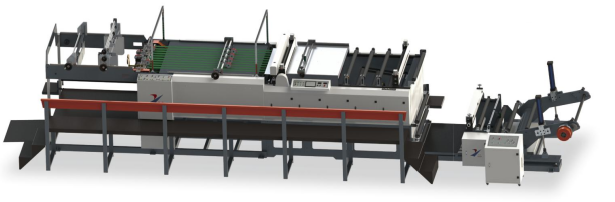
Gantry-type configuration: the YDLM1300B laminating and coating integrated machine, built on a 600–1200 mm working width.
A metalized paper laminating machine is usually shortlisted on two figures — width and speed — and then specified on a dozen more. Gantry-type and shaftless-rewinding machines are the two configurations that dominate mid-to-high volume production of metallized board, and they behave differently enough that the same width-and-speed brief can lead to two very different production lines. YUEDA (Wenzhou Yueda Packaging Machinery Co., Ltd., established in 1998 in Longgang, Wenzhou, China) manufactures both, which makes a direct, parameter-level comparison possible using its two reference models.
Short answer: the gantry-type YDLM1300B is a Gantry-type Laminating & Coating Integrated Machine built around a 600–1200 mm working width, a 180 m/min machine speed and a 15–150 m/min working speed. The shaftless-rewinding ZNFH1300-1400-1500 is an Aluminum Metallized Paper Laminating & Coating Integrated Machine built around roller face widths of 1300 mm, 1400 mm or 1500 mm, sheet roll widths from 600–1200 mm up to 700–1400 mm, and a running speed of 5–150 m/min. Both are carbon-steel machines. The decisive difference is how the web is unwound, rewound and dried — and that difference shows up in the parameter sheet before it shows up on the shop floor.
The Parameter-Matching Problem This Guide Solves
Most mismatches between a purchased laminating machine and a real production plan trace back to three comparisons made on the wrong basis:
- Width compared against the wrong reference. A gantry machine is described by working width (600–1200 mm on the YDLM1300B); a shaftless-rewinding machine is described by roller face width (1300/1400/1500 mm) and by the sheet roll width that actually arrives at the unwinding position (600–1200 mm, 700–1300 mm or 700–1400 mm). These are not interchangeable numbers.
- Speed compared as if it were one figure. Machine speed (180 m/min), working speed (15–150 m/min) and running speed (5–150 m/min) describe different things, and none of them equals the sheet-cutting speed of the machine feeding the line.
- Upstream cutting treated as a separate purchase. Cut length, blank cutting accuracy, stacking height and the number of sheets per minute upstream determine whether the laminating line ever reaches its own rated working speed.
This guide resolves those three by working through the reference parameter sets of the YDLM1300B and the ZNFH1300-1400-1500, then connecting the laminating line to the sheet-cutting equipment upstream of it.
Industry Background: Why Configuration Choice Is Decided Earlier
Metallized paper and board sit at the premium end of paper packaging, and the demand pattern behind them shapes which machine configurations get specified. The global metallized paper market reached a valuation of USD 4.85 billion in 2025, driven by demand for premium labeling and cigarette packaging (DataM Intelligence). Within that market, lamination accounted for a 57.4% revenue share in 2024, favored for its high gloss and barrier properties in consumer goods (SkyQuest Technology). Regional demand is concentrated: Asia-Pacific accounts for nearly 40% of the world's metallized paper market, supported by expanding tobacco and beverage industries in China and India (Future Market Insights). Wet laminating machines held approximately 70% of the industrial laminating market share in 2025, reflecting their adoption in food and consumer packaging (Market Research Future).
On the equipment side, China's machinery export value rose 15.7% year on year in early 2026, with the mix shifting toward high-value-added equipment such as servo-controlled and CNC machines (German Machine Tool Builders' Association, VDW). The practical consequence for a buyer is that configuration questions — rewinding method, drying path, power envelope — are now raised during technical evaluation rather than after installation, when changing configuration is no longer possible.
Detailed Solution: Reading the Two Configurations
A metalized paper laminating machine in this class performs two jobs at once: it laminates a base paper or paperboard to a film or foil, and it applies coating — either as an integrated coating function or as back coating. The structural configuration determines how the unwind and rewind positions are arranged, and therefore how the machine is loaded, changed over and kept in tension.
Gantry-Type Configuration — YDLM1300B
YUEDA's gantry reference model is an integrated laminating and coating machine with a gantry-type structural configuration, identified in the product range as the Gantry Multifunctional Aluminum Metallized Cardboard Laminating (Coating) Machine. It is designed for paper packaging applications including wine boxes, cigarette packaging, cosmetics packaging and tea packaging.
- Working width: 600–1200 mm.
- Speed: machine speed 180 m/min; working speed 15–150 m/min.
- Substrates: PET film 0.012–0.014 mm, OPP film 0.02–0.06 mm, paper 100–350 g/m², aluminum film 0.006–0.007 mm.
- Process route: water-base laminate paperboard; four-roller transfer coating for glue; anilox roller direct coating for back-coating color.
- Unwind and rewind: paper unwinding diameter 1500 mm (core 3/6/12 inch); paper rewinding diameter Φ1600 mm (core 3/6 inch); film unwinding diameter Φ600 mm (core 3/6 inch); peeling-off rewinding diameter Φ600 mm (core 3/6 inch).
- Drying: heating tunnel length 15 m, heating tunnel down length 8.6 m, tunnel temperature ≤130 °C.
- Power and size: 380 V ±10%, 50 Hz; motor power 60 kW; heating power 216 kW; working power 80 kW; overall dimensions 22330 × 3700 × 4500 mm; total weight 40 t.
- Construction material: carbon steel.
Shaftless-Rewinding Configuration — ZNFH1300-1400-1500

Control side of the shaftless-rewinding laminating and coating machine: PLC cabinet with touch-screen operation and real-time production parameter monitoring.
The shaftless-rewinding reference model is an Automatic Aluminum Metallized Cardboard Laminating & Coating Machine with No Shaft Type Rewinding. Because neither the unwinding nor the rewinding position relies on a mechanical shaft, the machine handles a wider range of roll diameters and core sizes — an arrangement relevant where incoming sheet rolls vary between suppliers.
- Sheet roll at unwinding: diameter 100–1600 mm; widths 600–1200 mm, 700–1300 mm or 700–1400 mm; core sizes 3/6/12 inch.
- Rewinding: diameter 100–1600 mm; foil rewinding core 3 inch; rewind core 6/12 inch.
- Roller face width: 1300 mm, 1400 mm or 1500 mm. Foil roll diameter: 600 mm.
- Substrates: suitable paper 40–450 g; aluminum foil thickness 0.006–0.01 mm; film 0.01–0.1 mm.
- Speed: running speed 5–150 m/min.
- Drying: drying path length 12.5 m.
- Power and size: total power consumption 121 kW or 129 kW depending on model; AC380V/50Hz; dimensions 21 m × 2.9 m × 3.2 m, 21 m × 3.1 m × 3.2 m, or 21 m × 3.2 m × 3.2 m.
- Construction material: carbon steel. Applications: wine boxes, cigarette paper, cosmetics, tea, disposable waterproof paper tableware, cake and chewing gum packaging.
Where the Two Configurations Actually Diverge
The grammage window is the first practical divergence. The gantry YDLM1300B is specified for paper from 100–350 g/m², while the shaftless-rewinding ZNFH1300-1400-1500 accepts paper from 40–450 g. If a converter runs thin 40–60 g paper on one job and 400 g board on the next, the wider window matters more than the headline speed. If the product mix sits consistently inside 100–350 g/m², the narrower window is not a limitation.
The second divergence is width logic. On the gantry machine, the governing figure is a working width of 600–1200 mm. On the shaftless-rewinding machine, two figures govern: the roller face width (1300/1400/1500 mm) and the sheet roll width (600–1200 / 700–1300 / 700–1400 mm). A buyer comparing only the roller face figure to a 1200 mm working width is comparing two different measurements.
The third divergence is roll handling. Shaftless rewinding removes the shaft-handling step at both ends of the machine, which changes loading time and how much roll diameter variation the line can absorb — from 100 mm up to 1600 mm at both the unwinding and rewinding positions on the ZNFH1300-1400-1500. On the gantry YDLM1300B, the equivalent figures are a paper unwinding diameter of 1500 mm and a paper rewinding diameter of Φ1600 mm.
Core Selection Parameters Explained, One by One
Working Width and Roller Face Width
Working width defines the maximum usable web the machine processes in a pass; roller face width defines the physical width of the rollers. On the YDLM1300B the working width is 600–1200 mm. On the ZNFH1300-1400-1500 the roller face width is 1300, 1400 or 1500 mm, matched to sheet roll widths of 600–1200, 700–1300 or 700–1400 mm. The selection rule is straightforward: start from the finished blank, add the trim allowance, and check the result against the sheet roll width — not against the machine's model number.
Machine Speed, Working Speed and Running Speed
Machine speed is the mechanical ceiling of the drive system — 180 m/min on the YDLM1300B. Working speed is the speed at which the machine is actually specified to run production, 15–150 m/min on the same model. Running speed on the ZNFH1300-1400-1500 is stated as 5–150 m/min. The lower end of each range matters as much as the upper end: slow, stable running is what protects registration on short runs and light grammages, while the upper end drives throughput on long cigarette or wine box orders.
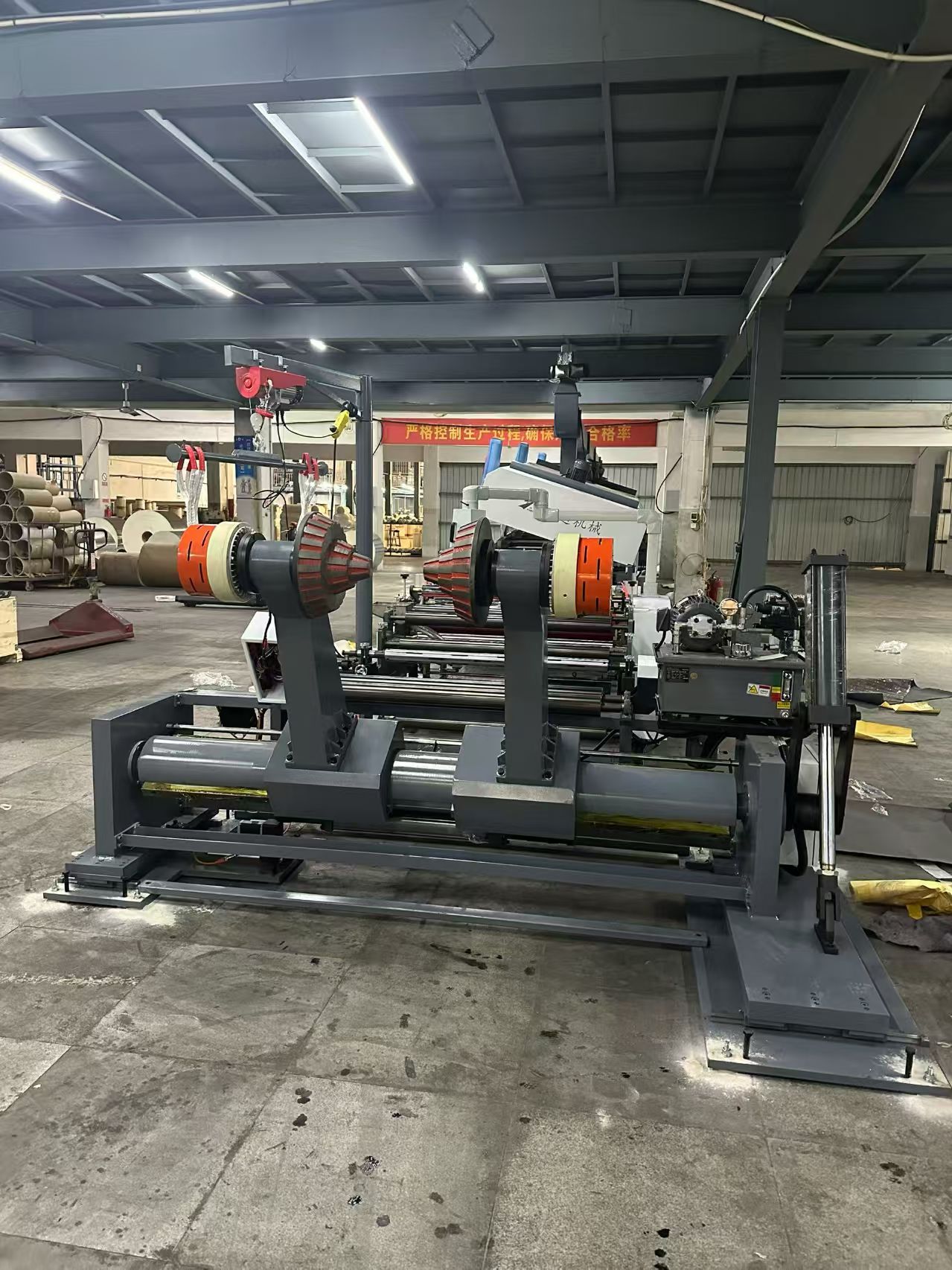
Both reference models are carbon-steel machines; core components are produced in YUEDA's precision machining workshop.
Substrate Compatibility
Film and foil thickness is where specification errors surface late. The YDLM1300B is specified for PET film 0.012–0.014 mm, OPP film 0.02–0.06 mm and aluminum film 0.006–0.007 mm. The ZNFH1300-1400-1500 is specified for aluminum foil 0.006–0.01 mm and film 0.01–0.1 mm. A buyer running both PET and OPP should note that OPP runs roughly four times thicker than PET in this specification set, and that the ZNFH film window extends to 0.1 mm.
Drying Path, Temperature and Power
Drying capacity is expressed differently on the two models: the YDLM1300B carries a 15 m heating tunnel with a tunnel down length of 8.6 m and a maximum tunnel temperature of ≤130 °C, while the ZNFH1300-1400-1500 uses a 12.5 m drying path. Power follows the same logic: the gantry machine is rated at 380 V ±10%, 50 Hz with 60 kW motor power, 216 kW heating power and 80 kW working power; the shaftless-rewinding machine has a total power consumption of 121 kW or 129 kW depending on model, at AC380V/50Hz. These figures belong in the plant's electrical planning before the order, not after.
Carbon-Steel Construction
Both the YDLM1300B and the ZNFH1300-1400-1500, and all four sheet-cutting and sheeting machines referenced in this guide, are carbon-steel machines. For a laminating line, the material statement matters because it determines the mass and thermal behaviour of the frame: the gantry YDLM1300B weighs 40 t, a figure that should be checked against floor loading and the plant's lifting plan as part of layout approval.
Step-by-Step: Specifying a Laminating Line
The following sequence keeps the configuration decision tied to production facts rather than to model numbers.
- Fix the finished blank first. Determine finished blank length and width, plus trim allowance. This sets the cut length requirement (the DWLX1300L-1400L and YDSLX1300-1400 handle cut lengths of 450–1400 mm) and, in turn, the sheet roll width for the laminating machine.
- Confirm the incoming material specification. Paper grammage, film type and thickness, and foil thickness determine which configuration is even eligible. Paper from 40–450 g and film up to 0.1 mm points to the ZNFH1300-1400-1500; paper at 100–350 g/m² with PET 0.012–0.014 mm points to the YDLM1300B.
- Choose the rewinding method against your roll handling. Shaftless rewinding accepts roll diameters of 100–1600 mm at both unwind and rewind; the gantry machine specifies a 1500 mm paper unwinding diameter and a Φ1600 mm paper rewinding diameter.
- Match width to the widest job, not the average job. Compare sheet roll width options (600–1200 / 700–1300 / 700–1400 mm) and roller face width (1300/1400/1500 mm) on the shaftless machine, or working width (600–1200 mm) on the gantry machine.
- Check the drying and power envelope. A 15 m heating tunnel at ≤130 °C and 80 kW working power versus a 12.5 m drying path and 121/129 kW total power are different demands on the plant's electrical capacity and floor space.
- Verify the upstream cutting capacity against the laminating speed. If the cutter cannot deliver the required number of blanks per minute, the laminating machine will not hold its working speed.
- Confirm documentation and market compliance before shipment. Safety documentation, electrical specification and market-specific requirements should be agreed at the technical stage.
Upstream Sheet Cutting: The Parameter Link Most Buyers Miss
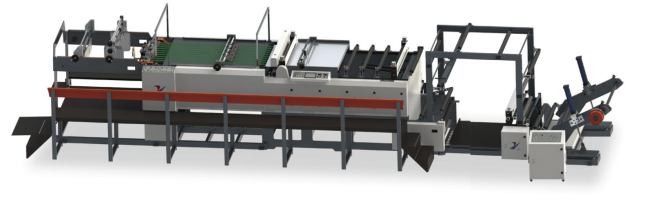
Upstream blank cutting sets the tolerance that the laminating line then has to preserve.
A metalized paper laminating machine is only as consistent as the blanks entering it. Three YUEDA machines handle that stage, and their parameters should be read together with the laminating machine's specifications rather than separately.
The DWLX1300L-1400L is a High Precision Positioning Double Rotary Sheet Cutter Machine in the Double Cyclotron Screw Knife High-precision Positioning Sheet Cutter category. Its blank cutting accuracy is ±0.1 mm, and its longitudinal and transverse tracking accuracy is also ±0.1 mm. Operating speed is up to 300 m/min with a cutting speed of 10–400 sheets per minute. Unwinding diameter is ≤1650 mm, cut length range is 450–1400 mm, stacking height is 1500 mm, and maximum cutter load is ≤550 gsm (density and quality to be considered). Net weights are 17000 kg for the DWLX1300L and 15800 kg for the DWLX1400L, with overall dimensions of 13.85 m × 4.52 m × 2.64 m and 13.85 m × 4.37 m × 2.64 m respectively. Rated voltage is AC380V/50Hz, and the machine is made of carbon steel.
The YDSLX1300-1400 is a High Precision Double Rotary Sheet Cutter Machine, belonging to the Double Cyclotron Screw Knife High-precision Cross-Cutting Machine category. It shares the double cyclotron screw knife up-and-down cutting type, a ±0.1 mm blank cutting accuracy, an operating speed of ≤300 m/min and a cutting speed of 10–400 sheets/min. Material width range is 400–1400 mm for one model and 400–1250 mm for the other; unwinding diameter is ≤1650 mm; stacking height is 1500 mm with a stacking weight of 2000 kg; total power is 73 kW; net weight is 12000 kg; overall dimensions are 9.6 m × 4.68 m × 2.58 m for the YDSLX1300 and 9.6 m × 4.53 m × 2.58 m for the YDSLX1400.
The YD1300-1400 is a Positioning Sheeter with a shaft-less structural configuration and a ±0.1 mm sheeting accuracy. Sheeting length range is 400–1200 mm, sheet roll width range is 700–1200 mm or 700–1300 mm, maximum sheet roll diameter is 1600 mm and stacking height is 1300 mm. Running speed is 95 m/min or 90 m/min, and mechanical sheeting speed is 140 sheets/min. Power supply is AC380V*50Hz, total power consumption is 17.5 kW or 20 kW, net weight is 8000 kg or 8500 kg, and overall dimensions are 11.2 m × 3.14 m × 2.4 m or 11.2 m × 3.24 m × 2.4 m.
Read together, these figures explain why the upstream decision belongs in the same technical discussion as the laminating machine choice. A cutter rated at 10–400 sheets/min with ±0.1 mm blank cutting accuracy defines the tolerance band that the laminating and coating machine receives; a sheeter running at 95 m/min defines the feed rhythm. Selecting the laminating configuration without checking these two upstream parameters is the most common source of a line that runs below its rated working speed.
Use Cases: Which Configuration Fits Which Packaging Segment
Both reference models share the same core application list: paper packaging for printed wine boxes, cigarette paper packaging, cosmetics paper packaging, tea paper packaging, disposable waterproof paper tableware, cake paper packaging and chewing gum paper packaging. The segmentation decision therefore comes down to material mix and run pattern.
- Wine boxes and premium spirits packaging. Heavy board with high gloss requirements sits inside the YDLM1300B paper window of 100–350 g/m², with water-base laminate paperboard and anilox roller direct back coating for the reverse-side color work typical of gift cartons.
- Cigarette packaging. High-volume, continuous work is where the 15–150 m/min working speed of the gantry machine and the 5–150 m/min running speed of the shaftless-rewinding machine are both relevant. In a Vietnam-based cigarette packaging application, the shaftless-rewinding machine is used for high-speed laminating and coating in a 24/7 continuous operation environment, in the printing and packaging sector.
- Cosmetics packaging. A Thailand-based cosmetic packaging production line uses photoelectric positioning for precision cutting of cosmetic gift boxes, with a dust-free workshop, 30–35 °C conditions and supporting equipment including a feeder, stacker and waste edge trimming system; special requirements include dust-proof design, high-precision calibration and anti-static design.
- Tea packaging. Lighter board and medium grammages benefit from the lower end of the speed range, where tension control and registration stability dominate over throughput.
- Disposable waterproof paper tableware, cake and chewing gum packaging. These applications extend the paper grammage requirement downward — the ZNFH1300-1400-1500 accepts paper from 40 g — which is the clearest single reason a converter with a mixed portfolio selects the wider grammage window.
For factory-floor planning, the operating environment matters as much as the product: dust-free operation, controlled temperature and humidity-resistant design are recurring requirements in Southeast Asian installations, and they affect the choice of supporting equipment such as unwinders, rewinders, waste collectors and temperature control systems.
Comparison Table: YDLM1300B vs. ZNFH1300-1400-1500
| Parameter | YDLM1300B (Gantry type) | ZNFH1300-1400-1500 (Shaftless rewinding) |
|---|---|---|
| Structural configuration | Gantry-type laminating & coating integrated | No shaft type rewinding, laminating & coating integrated |
| Width | Working width 600–1200 mm | Roller face width 1300/1400/1500 mm; sheet roll width 600–1200 / 700–1300 / 700–1400 mm |
| Speed | Machine speed 180 m/min; working speed 15–150 m/min | Running speed 5–150 m/min |
| Paper grammage | 100–350 g/m² | 40–450 g |
| Film and foil | PET 0.012–0.014 mm; OPP 0.02–0.06 mm; aluminum film 0.006–0.007 mm | Aluminum foil 0.006–0.01 mm; film 0.01–0.1 mm |
| Laminating and coating | Water-base laminate paperboard; four-roller transfer coating; anilox roller direct back coating | Laminating and coating integrated |
| Unwind diameter | Paper 1500 mm; film Φ600 mm; peeling-off rewinding Φ600 mm | Sheet roll 100–1600 mm; foil roll 600 mm |
| Rewind diameter | Paper Φ1600 mm | 100–1600 mm |
| Core sizes | Paper unwind 3/6/12 inch; paper rewind 3/6 inch; film 3/6 inch | Unwind 3/6/12 inch; foil rewind 3 inch; rewind 6/12 inch |
| Drying | Heating tunnel 15 m; tunnel down length 8.6 m; ≤130 °C | Drying path 12.5 m |
| Power | 380 V ±10%, 50 Hz; motors 60 kW; heating 216 kW; working 80 kW | AC380V/50Hz; total 121 kW or 129 kW |
| Dimensions | 22330 × 3700 × 4500 mm; total weight 40 t | 21 m × 2.9/3.1/3.2 m × 3.2 m |
| Construction material | Carbon steel | Carbon steel |
Upstream sheet-cutting reference, for the same production lines:
| Model | Type | Accuracy | Speed |
|---|---|---|---|
| DWLX1300L-1400L | Double cyclotron screw knife high-precision positioning sheet cutter | Blank cutting ±0.1 mm; longitudinal and transverse tracking ±0.1 mm | ≤300 m/min; 10–400 sheets/min |
| YDSLX1300-1400 | Double cyclotron screw knife high-precision cross-cutting machine | Blank cutting ±0.1 mm | ≤300 m/min; 10–400 sheets/min |
| YD1300-1400 | Shaft-less high-precision positioning sheeter | Sheeting accuracy ±0.1 mm | 95/90 m/min running; 140 sheets/min mechanical sheeting |
Compliance and Documentation Considerations

Electrical control architecture supporting continuous operation of the laminating production line.
For industrial laminating machines destined for the European market, risk assessment and safety design are typically aligned with EN ISO 12100:2010 to obtain CE marking (CEN-CENELEC). This is a design and documentation requirement rather than a performance parameter, and it should be raised at the technical evaluation stage so that the electrical and safety documentation supplied with the machine matches the destination market.
On the electrical side, both reference models are specified for 380 V ±10%, 50 Hz operation — the gantry YDLM1300B at 60 kW motor power, 216 kW heating power and 80 kW working power, and the ZNFH1300-1400-1500 at a total power consumption of 121 kW or 129 kW depending on model. The sheet-cutting machines add a pneumatic requirement of 0.8 MPa.
Project documentation supplied with YUEDA's laminating and coating lines includes a double-layer energy-saving drying oven patent (ZL 2022 2 1114210.X) and a software copyright covering the automatic paper and plastic conveying system (2020SR0669497). Buyers preparing a technical file for internal approval or for a market compliance review should request these along with the machine parameter sheet.
Company context that is relevant to documentation and after-sales planning: Wenzhou Yueda Packaging Machinery Co., Ltd. was established in 1998 and has more than 20 years of production and manufacturing history. The manufacturing facility covers 4000 m² with an annual production capacity of 100 sets of mechanical equipment. The company employs approximately 30 staff members, with an R&D team consisting of 25 engineers and technicians, and exports account for 70% of output, with markets across Southeast Asia, the Middle East, South America and Africa.
FAQ
What standards apply when a metalized paper laminating machine is destined for the EU market?
Industrial laminating machines must normally comply with EN ISO 12100:2010 for risk assessment and safety design in order to obtain CE marking for the European market (CEN-CENELEC). In practice this means the machine's safety design and the accompanying risk assessment documentation need to be agreed at the technical stage, alongside the electrical specification — 380 V ±10%, 50 Hz on the YDLM1300B and AC380V/50Hz on the ZNFH1300-1400-1500 — and the pneumatic requirement of 0.8 MPa on the associated sheet-cutting machines.
Can one machine cover both laminating and coating, or do I need two units?
Both reference models are integrated machines rather than laminators alone. The YDLM1300B is a Gantry-type Laminating & Coating Integrated Machine: it laminates water-base laminate paperboard, applies glue through four-roller transfer coating, and applies back-coating color through anilox roller direct coating. The ZNFH1300-1400-1500 is an Aluminum Metallized Paper Laminating & Coating Integrated Machine with a running speed of 5–150 m/min. The capability question is therefore not whether coating is included, but which coating method and which substrate window your product mix requires.
What drives the cost difference between a gantry-type and a shaftless-rewinding configuration?
No purchase price is quoted here; the structural cost drivers are visible in the parameter sheets. The gantry YDLM1300B carries a 15 m heating tunnel with a tunnel down length of 8.6 m, 216 kW heating power, a total weight of 40 t and overall dimensions of 22330 × 3700 × 4500 mm. The shaftless-rewinding ZNFH1300-1400-1500 carries a 12.5 m drying path, a total power consumption of 121 kW or 129 kW, and a machine length of 21 m with roller face widths of 1300, 1400 or 1500 mm. Footprint, floor loading, electrical capacity and the width range you actually need are the variables that move the commercial comparison.
How can I validate a configuration before committing to a full line?
Validation starts with the material and blank specification, because every other parameter follows from it. Confirm the paper grammage against the relevant window (100–350 g/m² on the YDLM1300B; 40–450 g on the ZNFH1300-1400-1500), the film or foil thickness, the sheet roll width, the cut length range of 450–1400 mm and the stacking height of 1500 mm upstream. Then check the running figures, the drying path and the power envelope against the plant. Requesting the machine datasheet and product brochure first, and reviewing it against your own job list, resolves most of these questions before any commercial discussion begins.
What lead-time and capacity factors should I plan around?
Two clearly documented capacity facts help here. YUEDA's manufacturing facility covers 4000 m² with an annual production capacity of 100 sets of mechanical equipment, and approximately 30 staff members support that output, including an R&D team of 25 engineers and technicians. With 70% of production exported to Southeast Asia, the Middle East, South America and Africa, scheduling should be planned around the technical confirmation stage rather than assumed from a standard catalogue. To move the evaluation forward, you can download the product brochure at YUEDA machinery brochure (PDF), or send your material and blank specification directly to the YUEDA team for a configuration recommendation.
Conclusion
Gantry-type and shaftless-rewinding configurations are not competing answers to the same question; they are answers to two different production questions. Where the material mix sits inside 100–350 g/m² and the priority is an integrated laminating and coating route with a 15 m heating tunnel at ≤130 °C and a 600–1200 mm working width, the gantry YDLM1300B is the reference configuration. Where the mix spans 40–450 g, where roll diameters vary from 100 mm to 1600 mm, and where roller face widths of 1300, 1400 or 1500 mm are needed at a running speed of 5–150 m/min, the shaftless-rewinding ZNFH1300-1400-1500 fits the specification.
In both cases, the laminating machine should be specified together with the upstream sheet-cutting stage — the DWLX1300L-1400L, the YDSLX1300-1400 or the YD1300-1400 shaftless sheeter — because cut length, ±0.1 mm blank cutting accuracy, stacking height and sheets per minute upstream determine whether the laminating line holds its working speed in daily production.
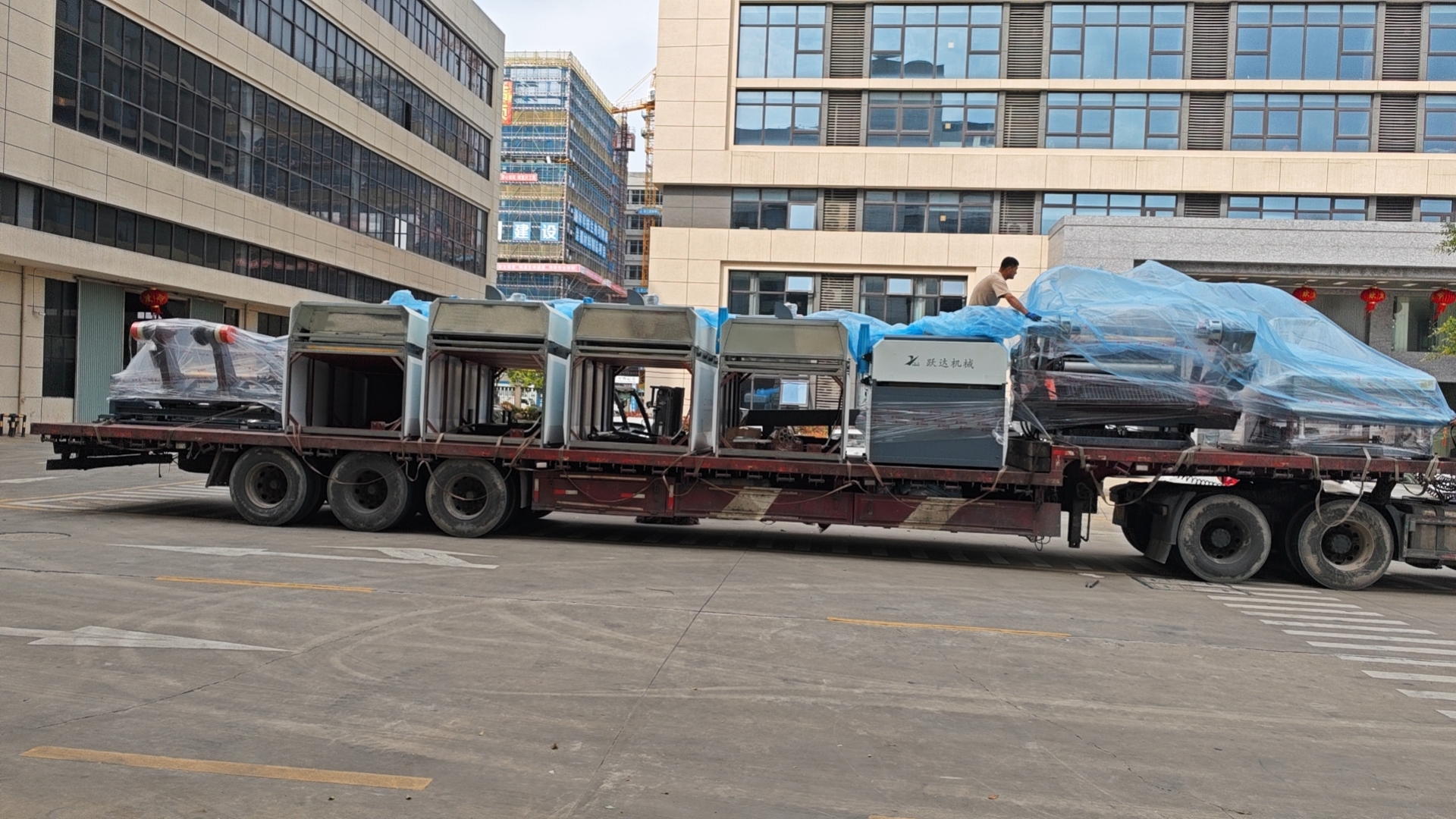
Equipment prepared for export shipment from YUEDA's Longgang, Wenzhou facility.
Next step. Send your paper grammage, film or foil thickness, sheet roll width and finished blank size to the YUEDA technical team, and request the configuration recommendation and quotation for your specific production mix. Product brochure: https://cdn.socialarks.com/sbsp/24814/0/2026/0428/69f035cd4b395.pdf. Contact: Jack — email 2179069246@QQ.COM, tel +86 19857780001, WhatsApp +86 19857780001. Website: www.yuedamachine.com. Address: Yueda Machinery, Building 2, No. 1333 Times Avenue, Longgang City, Wenzhou City, Zhejiang Province, China.