Metalized Paper Laminating Machine: Parameters Backed by Patents
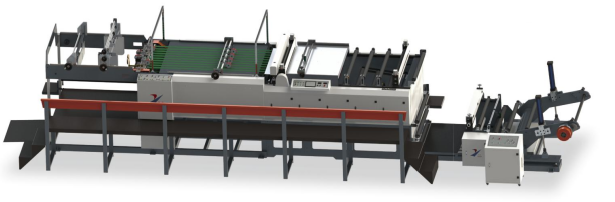
The short answer: a metalized paper laminating machine is specified through four parameters that must be fixed together — working width, running speed, structural configuration and unwind/rewind type — and then validated by a fifth step most quotations skip: confirming that the design features behind those parameters are covered by documents that are still in force. Wenzhou Yueda Packaging Machinery Co., Ltd. (YUEDA), a Wenzhou-based manufacturer founded in 1998, documents two platforms that make the trade-offs concrete: the gantry-type YDLM1300B at a 600–1200 mm working width, and the no-shaft-rewinding ZNFH1300-1400-1500 at a 5–150 m/min speed range.
Every figure below comes from YUEDA's published product, certification or capability records, or from a named third-party source. Where a value is supplier-reported rather than test-verified, it is labelled that way. No catalogue number replaces an acceptance run on your own paper, film and adhesive.
Written for buyers in evaluation and execution: converter engineers, packaging plants and importers who already know the category and now need to lock a build, a test protocol and a payment schedule.
Why parameter sheets fail in production
A laminating quotation usually presents width and speed as two isolated numbers. The losses that appear after installation normally come from somewhere else. Drying capacity caps the speed you can hold at a given coating weight. A working width 100–200 mm wider than the printed sheet converts the difference into trim waste on every web. A rewind arrangement that needs manual shaft handling adds minutes between rolls. Glue distribution that varies across the web shows up later as patchy bonding and rejected sheets.
Three practical consequences follow. First, width and speed have to be specified as a set together with substrate, coating weight, adhesive type and drying configuration, never as independent maxima. Second, the machine architecture should be chosen against the bottleneck that actually limits output, which is often drying or changeover rather than the main drive. Third, intellectual property documents belong in the specification file as questions to put to the supplier, not as proof of performance.
The last point deserves emphasis because brochures rarely date their references. In the certificates cited later in this guide, recorded terms run ten years from the issue date, and one of YUEDA's papers — the utility model for a paper receiving table, ZL 2014 2 0363315.8 — carries a term recorded to 4 November 2024. The design work is real and still visible in the machines; the exclusive right has simply run. A buyer who treats every printed number as live protection will over-credit the machine and under-specify the acceptance test.
What the 2025 market data does and does not tell you
Two research estimates frame the demand side. DataM Intelligence reported the global metallized paper market at USD 4.85 billion in 2025, with tobacco packaging and premium labelling among the drivers. Future Market Insights estimated the wider laminating machinery market at USD 676.4 million in 2025. These are different scopes — one measures substrate, the other measures equipment — so they cannot be added together or used to derive a machine count, and neither identifies which model suits your format.
The usable reading is narrower. Demand concentrated in tobacco and premium packaging rewards machines specified for humidity tolerance, continuous running and fast size changeover, because those are the conditions under which such lines are judged. YUEDA's own project records for Southeast Asia list exactly those three attributes, which is consistent with the market picture but does not independently prove it.
Parameter 1: working width
Working width is the widest coated web the machine handles in one pass, and it sets the upper bound on every sheet format downstream. The YDLM1300B is documented at 600–1200 mm. YUEDA's customization scope covers 800–1600 mm working widths across its line, and its multi-functional cross-cutting machine is listed as customizable from 800 mm to 1600 mm, so laminator and cutter can be specified in the same width family.
The calculation is straightforward but frequently skipped. Take the finished printed sheet, add the trim and gripper allowance your cutter needs, and round up to the nearest available width. Running a 1,000 mm format on a 1,200 mm machine means either planned trim or a wider parent sheet — both are legitimate, but only one belongs in the cost model. Going the other way, a width that is too narrow forces a second pass, and a second pass usually costs more than the width upgrade.
Two checks belong in the technical questionnaire. Ask how tension is controlled across the full web at the outer edges, not just at the centre, because edge instability is where buyers get surprised after a width increase. And ask whether the quoted figure is maximum coating width or maximum substrate width; on a coating-integrated machine those two numbers are not always identical.
Parameter 2: running speed
Running speed is meaningful only together with the substrate, coating weight and drying capacity that produce it. YUEDA specifies the ZNFH1300-1400-1500 over a 5–150 m/min range. A 2026 industry profile of Chinese manufacturers published by EIN Presswire lists 180 m/min for the YDLM1300B — a supplier-reported figure that should be confirmed on a loaded run rather than accepted from a page.
The lower end of a speed range matters as much as the top. A 5 m/min minimum allows short runs and heat-sensitive substrates to be handled without stopping the line, and it is often the setting used during grade changeover. The upper end is only reachable if three subsystems keep pace: drying, glue application and rewind tension.
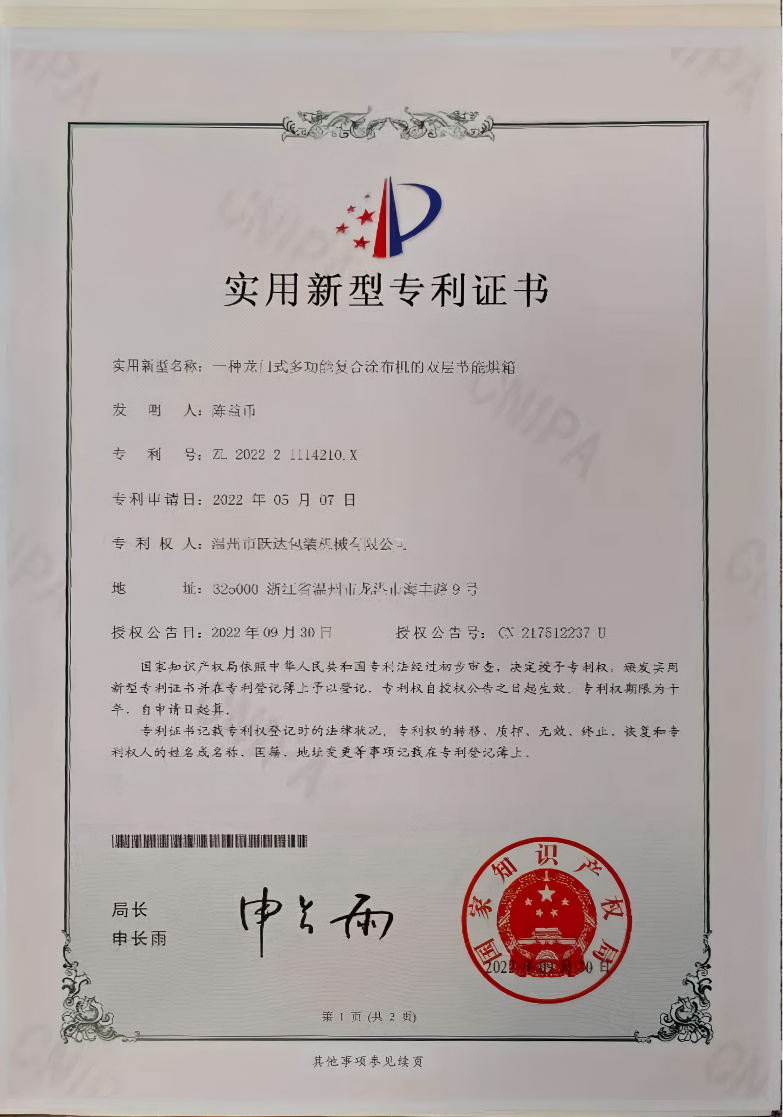
Drying is the usual constraint, and it is where patent content becomes a real selection criterion. Utility model ZL 2022 2 1114210.X covers a double-layer energy-saving drying oven for the gantry-type multifunctional composite coating machine, granted 30 September 2022 with a term recorded to 29 September 2032. The correct follow-up is not "does it save energy" but "which oven configuration is in the quoted build, and what measured drying capacity or consumption exists for my coating weight at my target speed". Treat "energy-saving" as a design attribute until the supplier produces numbers tied to your process.
One comparison should be refused outright. A related Chinese solvent-free laminator is marketed at up to 500 m/min, but it is a different process, a different substrate set and a different configuration. Quoting that figure against a metalized paper laminator says nothing about the machine in front of you.
Parameter 3: structural configuration
YUEDA's catalogue separates horizontal gold and silver cardboard laminating machines from gantry-style multi-functional laminating (coating) machines that also cover peeling and back coating. The distinction is functional as much as geometric: the gantry platform is presented as a combined coating and laminating line rather than a single-purpose laminator.
For a buyer, that changes the scope of the quotation. A multifunctional gantry build such as the YDLM1300B is relevant when the process needs coating, lamination, peeling and back coating inside one workflow and the plant can support the drying capacity and floor space a combined line implies. A single-purpose laminating platform is the more direct route when the job is repeat lamination of a stable format and changeover speed and roll handling dominate the economics.
Configuration also determines how much of the line you must integrate yourself. YUEDA's ODM scope lists production line integration alongside coating and lamination process, control system brand, voltage and frequency, and safety-standard configuration among customizable items. Each is a specification decision with a cost, and each should be written into the order rather than agreed verbally.
Parameter 4: unwind and rewind type
The ZNFH1300-1400-1500 carries "No Shaft Type Rewinding" in its own product name, and that is a specification choice with daily consequences. Shaft-less winding means rolls are chucked and driven without a through-shaft, which shortens the handling step at every roll change — the point where heavy metallized paper rolls are most likely to be damaged.
The design lineage is documented. Appearance design patent ZL 2017 3 0061557.0 covers the appearance of the shaft-less winding machine, granted 28 July 2017 with a term recorded to 27 July 2027. An earlier utility model, ZL 2014 2 0363279.5, covers a hydraulic shaft-less unwinding machine with a term recorded from 19 November 2014 to 18 November 2024 — again, genuine design history whose exclusive term has ended. YUEDA's Positioning Sheeter (YD1300-1400) is likewise listed as shaft-less.
The questions worth asking are mechanical: what roll diameter and weight the chucking system accepts; whether unwind and rewind are both shaft-less on the quoted build; how tension is held at 5 m/min and at 150 m/min; and how long a roll change takes with the crew you actually employ. An appearance design registration protects how a machine looks, not how it performs, so the performance answers must come from the acceptance run.

Patent documents as selection criteria
A patent number is a pointer to a design feature you can interrogate, and nothing more. The table maps YUEDA's cited documents to the question each should trigger during evaluation. Terms are as recorded on the certificates.
| Document | Type | Subject | Term as recorded | Question to put to the supplier |
|---|---|---|---|---|
| ZL 2022 2 1114210.X | Utility model | Double-layer energy-saving drying oven for gantry-type multifunctional composite coating machine | 30 Sep 2022 – 29 Sep 2032 | Which oven build is quoted, and what drying capacity exists for my coating weight? |
| ZL 2019 2 1219345.0 | Utility model | Adjustable coating and laminating machine | 16 Jun 2020 – 15 Jun 2030 | What exactly is adjustable, over what range, and how is a setting repeated? |
| ZL 2020 2 3214028.5 | Utility model | Double gluing device for coating and laminating machine | 28 Sep 2021 – 27 Sep 2031 | How is glue uniformity verified across the full width? |
| ZL 2020 2 3151788.6 | Utility model | Waste gas recovery and utilization device | 28 Sep 2021 – 27 Sep 2031 | How is exhaust handled, and which local emission rules apply in my market? |
| ZL 2017 3 0061557.0 | Appearance design | Shaft-less winding machine appearance | 28 Jul 2017 – 27 Jul 2027 | Design registration only — confirm mechanical performance separately. |
| ZL 2014 2 0363315.8 | Utility model | Paper receiving table | 5 Nov 2014 – 4 Nov 2024 | Term has run; treat as design lineage, not current exclusivity. |
| ZL 2025 2 0755442.0 | Utility model | Feeding device for transverse cutter | 7 Apr 2026 – 6 Apr 2036 | How is sheet feeding controlled on the cutter paired with this laminator? |
| 2020SR0668797 | Software copyright | Automatic Paper and Plastic Conveying System for Transverse Paper Cutter V1.0 | Registered 23 Jun 2020 | Which conveying and synchronisation functions does the registered system cover? |
| 2020SR0669497 | Software copyright | Intelligent Control System for Automatic Gold and Silver Cardboard Laminating (Coating) Machine V1.0 | Registered 23 Jun 2020 | Which control loops — tension, temperature, coating — run on this system? |
Two habits follow from this table. Ask for the certificate itself, not the number alone, and note the issuing authority: the China National Intellectual Property Administration for patents, the National Copyright Administration of the People's Republic of China for software. Then ask which document actually covers the feature you are paying for. Software copyright, for example, protects the registered code rather than machine output; it establishes that a control layer was developed and registered, and it justifies asking which control loops run on it.
Sheet cutters and sheeters: keep one width family
The laminator is only half of the specification. YUEDA lists three downstream configurations: the High Precision Positioning Double Rotary Sheet Cutter Machine (DWLX1300L-1400L), the High Precision Double Rotary Sheet Cutter Machine (YDSLX1300-1400), and the Positioning Sheeter (Shaft-less) (YD1300-1400). The company lists ±0.1 mm positioning accuracy for its double rotary knife cross-cutting series, and a documented installation in Vietnam records ±0.1 mm cutting precision with zero rework on cosmetic packaging.
Cutter selection turns on format mix rather than headline accuracy. Positioning cutters earn their cost where print-to-cut registration matters and formats change often; double rotary cutters suit high-volume repeat formats. Cutter-side IP is equally practical: press plate device ZL 2020 2 3212947.9, granted 21 September 2021 with a term recorded to 20 September 2031, addresses cutting stability, and feeding device ZL 2025 2 0755442.0 addresses sheet feeding. Both are questions to raise about the specific cutter you order, not claims that transfer automatically from the laminator.

A seven-step specification sequence
- Fix the finished sheet formats you expect for the next three years, then add trim and gripper allowance for the cutter.
- Convert that into a required working width and select the nearest available width family; confirm laminator and cutter widths match.
- Set a realistic target speed from coating weight and drying rather than the catalogue maximum, and state a minimum speed for short runs and changeover.
- Choose the structural route: combined coating and laminating line, or single-purpose laminating platform.
- Choose unwind and rewind type against roll weight, roll-change frequency and crew size.
- Build the IP and documentation list from the certificate table, with numbers, authorities and recorded terms.
- Write the acceptance protocol and payment milestones into the order before signing.
YDLM1300B and ZNFH1300-1400-1500 on documented attributes
The two platforms are set side by side below without a ranking, because they address different bottlenecks. Only attributes present in YUEDA's records or a named third-party source are listed; anything absent is marked for confirmation rather than assumed.
| Attribute | YDLM1300B | ZNFH1300-1400-1500 |
|---|---|---|
| Documented type | Gantry Multifunctional Aluminum Metallized Cardboard Laminating (Coating) Machine | Automatic Aluminum Metallized Cardboard Laminating & Coating Machine, No Shaft Type Rewinding |
| Working width | 600–1200 mm (documented) | Model designations 1300 / 1400 / 1500; confirm exact working width per build |
| Line speed | 180 m/min, supplier-reported in a 2026 industry profile | 5–150 m/min (documented range) |
| Rewind configuration | Not specified in the documents cited here — confirm with the supplier | No shaft type rewinding |
| Related IP | ZL 2022 2 1114210.X drying oven; ZL 2019 2 1219345.0 adjustable coating | ZL 2017 3 0061557.0 shaft-less winding appearance; ZL 2014 2 0363279.5 hydraulic shaft-less unwinding |
| Role in a line | Combined coating and laminating with peeling and back coating | High-speed automatic lamination with shorter roll changes |
Read as a decision: the YDLM1300B column is dominated by process scope and width flexibility, the ZNFH column by speed range and roll handling. "Not specified" in a cell is not evidence of absence — it means the document set used here does not state the configuration, and the supplier should confirm it in writing before the order is placed.
Two documented installations in Southeast Asia
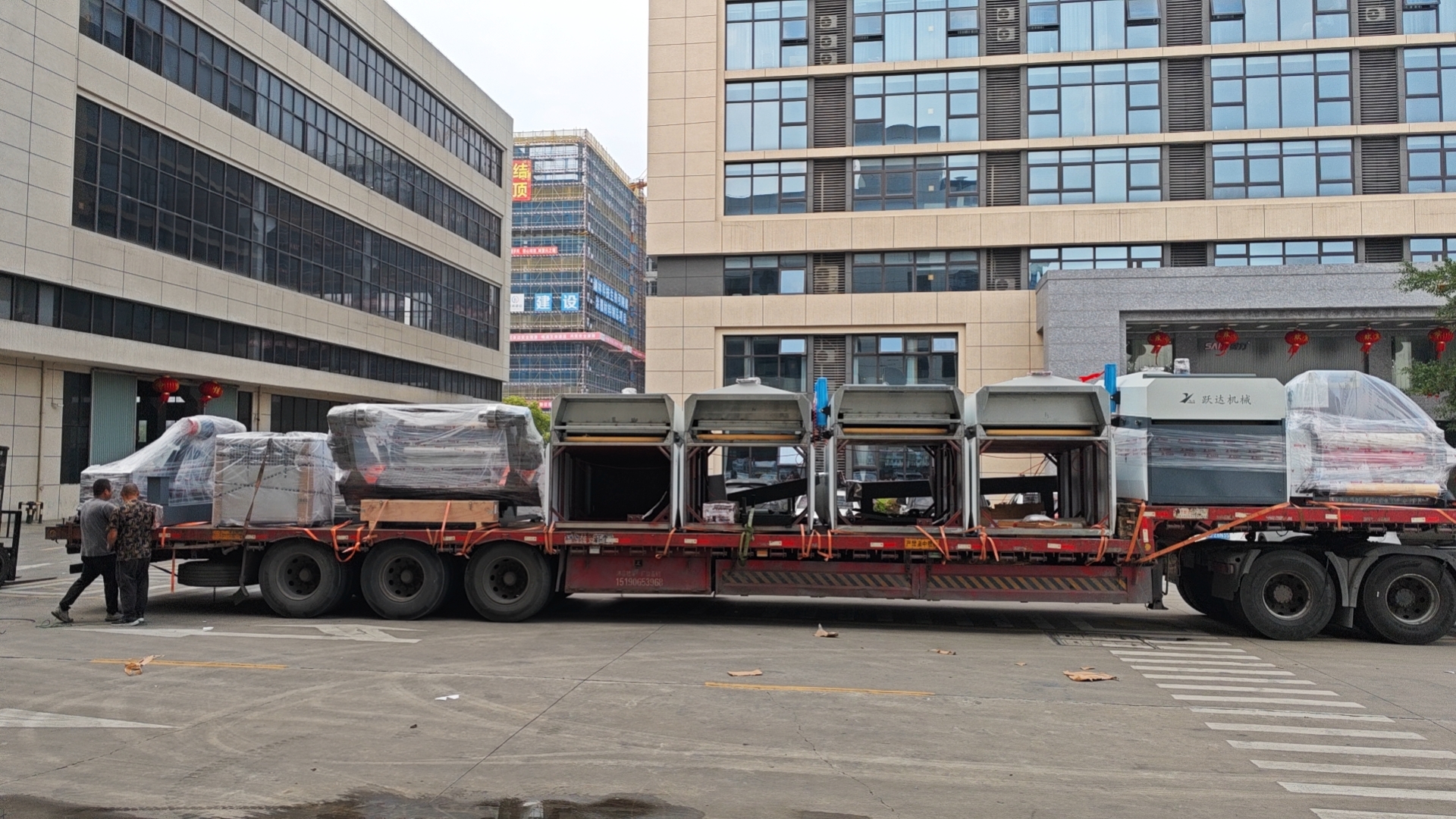
YUEDA's project records describe a cigarette packaging factory in Thailand running a two-unit installation for high-speed laminating of cigarette boxes over more than five years, with humidity-resistant design and 24/7 continuous operation support; the recorded outcome is a 30% efficiency increase and a 15% material waste reduction. A packaging factory in Vietnam uses the equipment for precision cutting of cosmetic packaging, with fast size changeover, dust-proof design and low maintenance cost recorded, plus a 20% labour cost saving alongside ±0.1 mm cutting precision and zero rework.
These are supplier-recorded outcomes from specific plants, not controlled comparisons. Efficiency and waste gains of that size depend on the starting line, substrate mix and operating regime, so they are best used as evidence that the applications are real, and as a prompt to request a reference in your own segment — not as a forecast for your plant.

Purchasing terms and acceptance criteria
The commercial framework is short enough to state completely, and it should appear in the order rather than in an email thread.
- Minimum order quantity: 1 unit.
- Delivery terms: FOB Ningbo, or CIF to major overseas ports.
- Payment: 30% T/T deposit with the 70% balance before shipment; L/C at sight for orders above USD 100,000.
- Lead time: 30–45 days for standard models and 45–60 days for customized models, against a monthly capacity of 12–15 units.
- Quality control: 100% pre-shipment test including a 2-hour continuous run; third-party inspection available on request.
- After-sales: 24-hour online response, 48-hour domestic on-site service and 72-hour overseas remote debugging.
Six acceptance items turn those terms into something enforceable. Specify the substrate, coating weight, adhesive and target speed used in the pre-shipment run, and require the run record. Require a width check with edge-tension observation at maximum width. Require a glue-uniformity check across the web. Require the roll-change sequence to be demonstrated with your roll weights. Require the electrical configuration — 110 V, 220 V or 380 V — and the HMI language to be confirmed against the order. And require the documentation package, meaning patent and software copyright certificates with numbers, the machine manual and the packing list, before the balance is released.
Two items sit outside the machine itself. On customs, heading 8439.30 is the classification most often cited for paper-finishing machinery including laminating machines, but published commercial references list alternative headings depending on machine function, and no single code should be assumed — confirm classification for your exact build and destination with a customs broker or a binding ruling before shipment. On safety conformity, CE/UL appears in YUEDA's ODM customization list as a configuration option; that is a build choice, not evidence that a particular unit holds a certificate, so request the certificate for the exact machine and market.
FAQ
Which intellectual property documents should a buyer verify before ordering a metalized paper laminating machine?
Request the certificate itself rather than the number in a brochure: for patents, the certificate issued by the China National Intellectual Property Administration showing grant date and term; for software, the registration certificate from the National Copyright Administration of the People's Republic of China. YUEDA's documented set includes utility models ZL 2022 2 1114210.X (double-layer energy-saving drying oven, 2022–2032) and ZL 2019 2 1219345.0 (adjustable coating and laminating machine, 2020–2030), the appearance design ZL 2017 3 0061557.0 (shaft-less winding machine, 2017–2027), and software registrations 2020SR0668797 and 2020SR0669497. Check three things: that the document is in force on your order date, that its subject matches the feature you are paying for, and that an appearance design is not standing in for a functional claim. ZL 2014 2 0363315.8, for a paper receiving table, is the test case — its recorded term ended 4 November 2024.
Can working width, voltage and control system be customized?
Yes. YUEDA lists voltage (110 V / 220 V / 380 V), working width (800–1600 mm) and control system among its customization parameters, and its ODM scope adds working width and speed, coating and lamination process, control system brand, voltage and frequency, safety-standard configuration, brand logo, HMI language, food-grade material, explosion-proof design and production line integration. Note the quantity thresholds: 1 unit for full-process manufacturing orders, 2 units for ODM. Anything not written into the order, HMI language for instance, has a habit of arriving as the default.
What are the standard purchasing terms for a metalized paper laminating machine?
MOQ is 1 unit; delivery is FOB Ningbo or CIF to major overseas ports; payment is a 30% T/T deposit with the 70% balance before shipment, and L/C at sight applies to orders above USD 100,000. Lead time is 30–45 days for standard models and 45–60 days for customized builds. Ask for the quotation to restate these terms rather than referencing a previous conversation, so the payment schedule and the delivery window are both dated.
What acceptance test is performed before shipment?
YUEDA states a 100% pre-shipment test with a 2-hour continuous run, with third-party inspection available. That is the supplier's standard. A buyer-specific protocol should go further and fix the substrate, coating weight, adhesive, target speed and working width used in the run, plus a glue-uniformity check across the web, an edge-tension observation at maximum width, a roll-change demonstration at your roll weights, and delivery of the certificate and manual package before the balance is paid.
How long is the lead time from order to delivery, and how do I start a build-specific quotation?
Standard models ship in 30–45 days and customized models take 45–60 days, against a stated monthly capacity of 12–15 units, so the schedule holds only if the specification is frozen before the order is placed; build the pre-shipment inspection and the shipping window into that period rather than after it. For a build-specific quotation, a trial run on your own paper and film, or the current catalogue, the company's contact channel and downloadable brochure are the fastest route to a dated answer.
Conclusion
The parameters themselves are not complicated; the discipline of fixing them together is. Width sets the format ceiling, speed is only real when drying and glue keep pace, configuration decides how much of the process one machine owns, and unwind/rewind type decides how much time is lost between rolls. The patent record then does one job: it converts marketing language into specific, checkable questions — and occasionally into a reminder that a design you admire may no longer be protected. Fix the acceptance protocol and payment milestones in the same document as the specification, and the machine you receive has a far better chance of matching the one you evaluated.
Next step: download the YUEDA product brochure (PDF) for the full model list, or request a quotation covering the YDLM1300B, the ZNFH1300-1400-1500 and a matching cutter configuration, with the acceptance items above written into the offer.
Have Questions or Need More Details?
Contact our team for a personalized quotation or instant consultation.
Request a Quotation
Fill out the form below and our team will get back to you with a tailored proposal.
WhatsApp Direct Chat
Prefer to chat in real-time? Message us on WhatsApp for instant assistance & quick answers.
- Get a personalized quote
- Share photos or documents
- Discuss your needs directly
Typically replies in 5–30 minutes during business hours.