Solving Production Bottlenecks: When to Add a Positioning Sheeter or Upstream Laminator
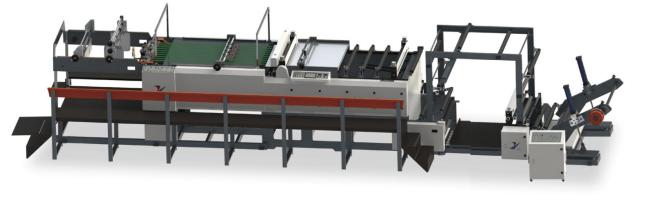
Multi-functional cross-cutting platform with working width customizable from 800 mm to 1600 mm — the cutting end where most accuracy-driven bottlenecks appear.
Short answer: a metalized paper line stalls in one of two places. If rework and dimension drift dominate, the constraint is the cutting end, and a positioning sheeter is the answer — the YUEDA DWLX1300L-1400L holds ±0.1 mm blank cutting accuracy at operating speeds up to 300 m/min. If the cutter sits idle because finished reels arrive late, the constraint is the front end, and an upstream laminator is the answer — the YUEDA YDLM1300B runs at 180 m/min machine speed with a 15–150 m/min working range. Both are built by Wenzhou Yueda Packaging Machinery Co., Ltd. (YUEDA), a Longgang, Wenzhou-based manufacturer of gold and silver cardboard laminating, coating and cross-cutting equipment founded in 1998.
The decision is not about buying the largest machine on the quotation list. It is about identifying which stage caps output, then buying the specification that releases that stage without creating a new queue downstream.
Why the bottleneck decision comes before the machine decision
A metalized paper converting line runs through four stages: unwinding, lamination and coating with drying, rewinding or peeling, and cross-cutting with stacking. Line output equals the slowest stage, so capacity added anywhere else becomes work-in-process rather than shipments.
Two measurements separate the two upgrade paths. The first is delivered sheet count per minute, compared with the cutting range of the existing cutter. The second is reel waiting time at the cutter infeed. A line that stops to re-run stacks for length deviation is accuracy-limited; a line whose cutter waits between reels is supply-limited. Treating a supply problem with a new cutter, or an accuracy problem with more lamination speed, is the most common way capital is spent without output changing.
What a bottleneck looks like on a metalized paper line
Bottlenecks rarely announce themselves as a single failure. They appear as small, repeated losses at one point in the flow. The table below maps the visible symptom to the constraint it usually points to, and to the measurement that confirms it.
| Symptom on the line | Likely constraint | What to measure first |
|---|---|---|
| Stacks re-run or rejected for length variation | Cutting-end registration | Deviation against a ±0.1 mm blank cutting tolerance |
| Sheet output below downstream packing demand | Cutting speed | Delivered sheets per minute against the cutter's rated range |
| Cutter idle between reels; reels queue at infeed | Lamination and drying throughput | Working speed against a 15–150 m/min machine range |
| Manual re-stacking, stoppages at delivery | Material handling between stages | Whether conveying and stacking run as one controlled sequence |
| Frequent stops for size changes | Changeover scope | Cut length range (450–1400 mm) against actual order mix |
One pattern is worth noting: accuracy problems are often reported as speed problems. When sheets fall outside tolerance, operators slow the cutter down to hold registration, so the visible symptom becomes throughput loss. Measuring both deviation and output in the same week prevents that misreading.
Industry background: why metalized paper lines are being pushed harder
The demand side explains why more converters face this decision now. The global metallized paper market reached USD 4.85 billion in 2025, with tobacco packaging and premium labelling identified as the main demand drivers in DataM Intelligence's market research. The laminating machinery market that supports this converting step was estimated at USD 676.4 million in 2025 by Future Market Insights.
Both figures are third-party market estimates. They describe scale, not the capacity of any individual plant, and they do not predict what a specific line should buy. What they do indicate is where the work sits: metalized paper demand is concentrated in packaging applications where the customer inspects surface quality and dimensional consistency on receipt. That shifts the practical constraint toward precision and continuity rather than raw tonnage — which is why a ±0.1 mm cutting tolerance or an uninterrupted reel supply can matter more than a headline speed figure on a brochure.
Path A — add a positioning sheeter when accuracy and sheet count limit the line
The DWLX1300L-1400L is a high precision positioning double rotary sheet cutter. It is the platform to specify when measurements show the cutting end is the constraint: registration drift causing rework, or delivered sheet count below what the laminating end can already supply.
DWLX1300L-1400L specification envelope
- Cutting type: double cyclotron screw knife, upper and lower
- Material width: 400–1400 mm or 400–1250 mm, depending on configuration
- Cut length: 450–1400 mm
- Blank cutting accuracy: ±0.1 mm
- Longitudinal and transverse tracking accuracy: ±0.1 mm
- Operating speed: ≤300 m/min; cutting speed: 10–400 sheets/min
- Unwinding diameter: ≤1650 mm; paper core 3 / 6 / 12 inch
- Stacking: 1500 mm height, 2000 kg weight
- Cutter load: ≤550 gsm (density and quality to be considered)
- Compressed air: 0.8 MPa; power supply: AC 380 V, 50 Hz
- Footprint (L×W×H): 13.85 × 4.52 × 2.64 m or 13.85 × 4.37 × 2.64 m
Two points in that list decide real-world fit more often than the speed figure. The stacking table holds 1500 mm at 2000 kg, which sets how long the cutter can run unattended between removals. The cutter load limit of ≤550 gsm, qualified by density and quality, determines whether heavy board in the order mix belongs on this platform at all.
When the DWLX1300L-1400L is the right addition
- Rework is traceable to length or registration rather than to substrate defects.
- The laminating end can already supply more reel length than the cutting end converts.
- Order sheet lengths sit inside the 450–1400 mm range, so changeover stays manageable.
- Required output falls within 10–400 sheets/min at speeds up to 300 m/min.
Where the accuracy requirement is met by a standard double rotary cutter, the YDSLX1300-1400 provides the same ±0.1 mm blank cutting accuracy and ≤300 m/min operating speed with a 73 kW total power and a 12,000 kg installed weight. Where shaft handling and floor space are the practical limits, the YD1300-1400 shaft-less positioning sheeter offers ±0.1 mm sheeting accuracy, 400–1200 mm sheet length, a 95 m/min running speed (90 m/min on the wider version), a mechanical sheeting speed of 140 sheets/min and 17.5 kW or 20 kW power consumption.

Intelligent electrical control cabinet with a PLC control system — the interface point between cutting accuracy and the rest of the line.
Path B — add an upstream metalized paper laminating machine when reel supply limits the line
The YDLM1300B is a gantry-type multifunctional aluminum metallized cardboard laminating and coating machine. It is the platform to specify when the cutter waits for reels, or when lamination and drying cannot keep pace with installed cutting capacity.
YDLM1300B specification envelope
- Working width: 600–1200 mm
- Speed: 180 m/min machine speed; 15–150 m/min working speed
- Substrates: PET film 0.012–0.014 mm, OPP film 0.02–0.06 mm, paper 100–350 g/m², aluminum film 0.006–0.007 mm
- Laminating type: water-based laminate paperboard; coating glue: four-roller transfer coating
- Back coating: anilox roller direct coating
- Paper unwinding: Ø1500 mm, core 3 / 6 / 12 inch; paper rewinding: Ø1600 mm, core 3 / 6 inch
- Film unwinding: Ø600 mm; peeling-off rewinding: Ø600 mm
- Heating tunnel: ≤130 °C, 15 m length, 8.6 m down length
- Power: 380 V ±10%, 50 Hz; motors 60 kW, heating 216 kW, working 80 kW
- Dimensions and weight: 22,330 × 3,700 × 4,500 mm; 40 t
The substrate range is the first filter. Paper from 100 to 350 g/m² covers most cigarette, wine, cosmetic and tea packaging board, but a plant running heavier grades needs a different platform. For 40–450 g/m² and roller face widths of 1300, 1400 or 1500 mm, the ZNFH1300-1400-1500 shaft-less rewinding laminating and coating machine runs at 5–150 m/min over a 12.5 m drying path, with 121 kW or 129 kW total power consumption and a 21 m machine length.
When the YDLM1300B is the right addition
- Reel waiting time at the cutter is the documented loss, not cutting rework.
- Board weight stays inside 100–350 g/m² and working width inside 600–1200 mm.
- Drying capacity, not laminating rollers, is what currently caps line speed — the heating tunnel runs at ≤130 °C over 15 m.
- Floor loading can take 40 t over a 22.3 m length, and the site can supply the 216 kW heating load.
Several mechanisms on this platform are covered by utility model patents held by YUEDA: an adjustable coating and laminating machine (ZL 2019 2 1219345.0, valid to 15 June 2030), a double-layer energy-saving drying oven for gantry-type multifunctional composite coating machines (ZL 2022 2 1114210.X, valid to 29 September 2032), a double gluing device for coating and laminating machines (ZL 2020 2 3214028.5, valid to 27 September 2031) and a waste gas recovery and utilization device (ZL 2020 2 3151788.6, valid to 27 September 2031). For a buyer, the practical value of these registrations is that the energy and glue-control functions are documented, dated claims rather than catalogue adjectives.
Integrated material handling: what the registered software covers
Most upgrade projects lose part of the gain they paid for in the gap between two machines. Sheets leave the cutter faster, but the conveying and stacking sequence between cutting and the next operation still depends on manual intervention, so the constraint quietly relocates.
YUEDA holds two software copyrights registered with the National Copyright Administration of the People's Republic of China on 23 June 2020: 2020SR0668797 — Automatic Paper and Plastic Conveying System for Transverse Paper Cutter V1.0, and 2020SR0669497 — Intelligent Control System for Automatic Gold and Silver Cardboard Laminating (Coating) Machine V1.0. In practice, this means the conveying sequence on the transverse cutter and the control logic of the laminating machine are versioned, registered systems rather than site-built add-ons.
Hardware patents support the same handling chain. A feeding device for the transverse cutter (ZL 2025 2 0755442.0, issued 7 April 2026, valid to 6 April 2036), a press plate device for the transverse cutter (ZL 2020 2 3212947.9, valid to 20 September 2031) and a drying oven guide roller cooling mechanism (ZL 2017 2 0213503.9, valid to 2 October 2027) all relate to how material is fed, held and dried continuously.
What the registration does not prove is throughput on your substrate. It proves ownership and version control of the control software — a distinction worth keeping in supplier evaluation, because a registered system can be inspected, referenced and supported over the machine's life, while an unregistered one usually cannot.
Step-by-step: a seven-stage decision sequence from evaluation to execution
- Log the constraint for one week. Record delivered sheets per minute, count stacks rejected for length deviation, and record how often the cutter waits for reels. This single log decides which path applies.
- Test the substrate envelope. For lamination, confirm paper weight against 100–350 g/m² on the YDLM1300B, or 40–450 g/m² on the ZNFH1300-1400-1500. For cutting, confirm the load against ≤550 gsm on the DWLX platform or 600 g on the YD1300-1400 shaft-less sheeter.
- Match width and cut length to the order mix. DWLX material width is 400–1400 mm or 400–1250 mm, with 450–1400 mm cut length; YDLM1300B working width is 600–1200 mm. Working width can be customized from 800 to 1600 mm, together with voltage (110 V / 220 V / 380 V) and control system selection.
- Check roll and stack geometry. DWLX unwinding accepts diameters up to 1650 mm with 3 / 6 / 12 inch cores; YDLM1300B accepts 1500 mm paper unwinding and rewinds paper to Ø1600 mm. Decide whether the cutter's 1500 mm / 2000 kg stacking table matches your removal rhythm.
- Confirm utilities and floor loading. Cutting equipment runs on AC 380 V, 50 Hz with 0.8 MPa compressed air; the YDLM1300B needs 380 V ±10%, 50 Hz with 60 kW motors, 216 kW heating and 80 kW working power, occupying 22.33 m × 3.7 m at 40 t.
- Define the interface between the two machines. Agree who supplies the link conveyor, what condition the cutter infeed expects, and which control system governs the handover — this is where the conveying and control software registrations become a commercial question, not a technical footnote.
- Lock acceptance and trade terms. YUEDA's quality control is a 100% pre-shipment test including a 2-hour continuous run, with third-party inspection available. Delivery terms are FOB Ningbo or CIF major overseas ports; payment is 30% T/T deposit with 70% balance before shipment, and L/C at sight for orders above USD 100,000. For import planning, industrial paper laminating machinery is commonly referenced under HS 8439.30.10, but the final classification should be confirmed with your customs broker before freight is booked.
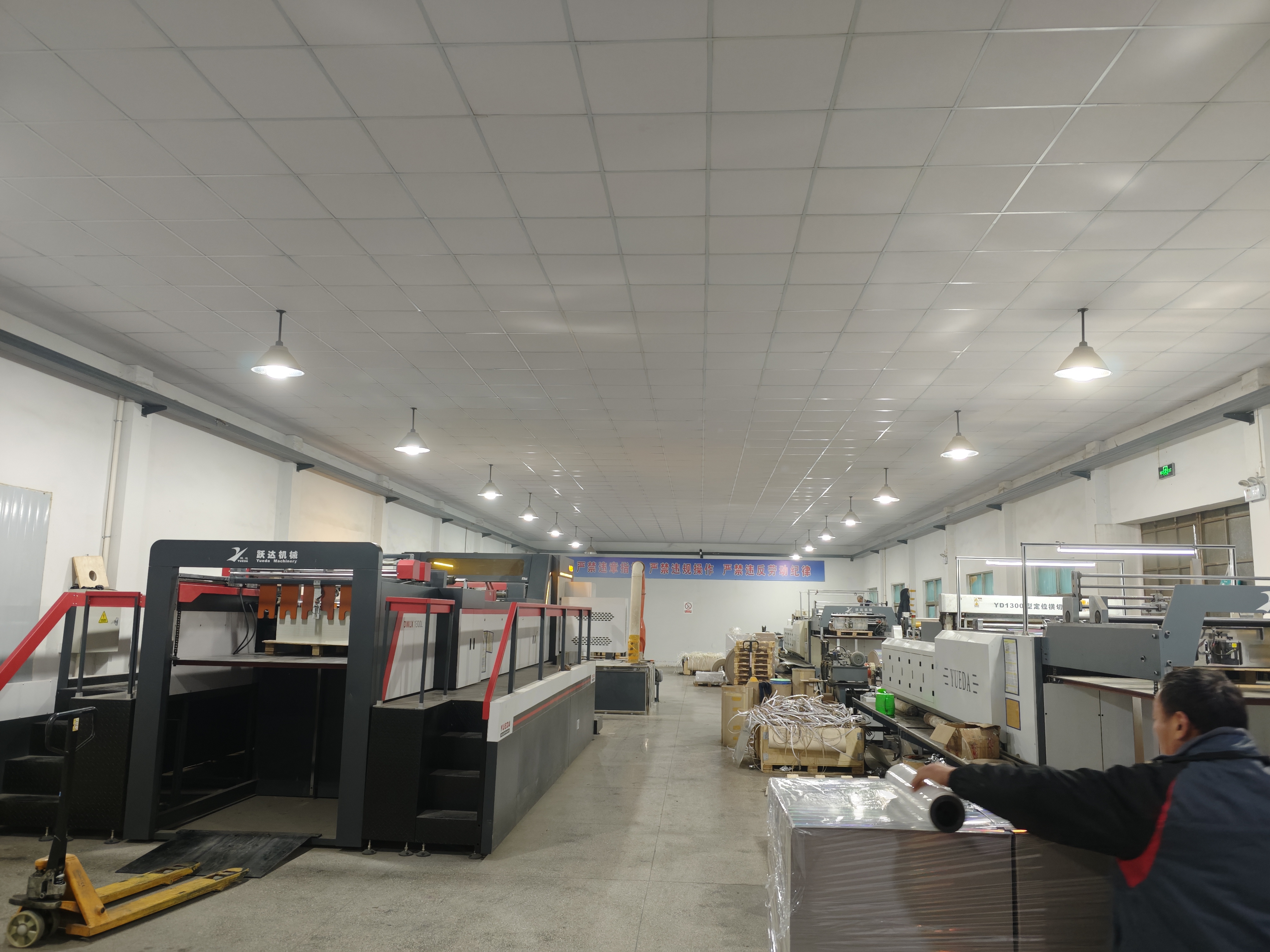
Standardized production workshop — where the pre-shipment test and the 2-hour continuous run are carried out before dispatch.
Use cases: what each upgrade proved in the field
The two upgrade paths have been applied in different packaging segments, which makes the evidence easier to read against your own constraint.
High-speed lamination in cigarette packaging (Thailand)
A cigarette packaging factory in Thailand runs a high-speed laminating application for cigarette boxes with two units, in service for more than five years. The reported result is a 30% efficiency increase and a 15% material waste reduction, supported by a humidity-resistant design and 24/7 continuous operation capability. The lesson for a supply-limited line is straightforward: the gain came from continuous reel availability under humid conditions, not from a higher cutting speed.
Precision cutting for cosmetic packaging (Vietnam)
A packaging factory in Vietnam uses the cutting platform for cosmetic packaging material, achieving ±0.1 mm cutting precision with a zero rework rate and a 20% labor cost saving, in service for more than five years. The configuration highlights are a dust-proof design, fast size changeover and low maintenance cost, and customer feedback reports satisfaction with performance under high-humidity conditions. Here the gain came from holding tolerance on premium board, which is an accuracy-limited outcome rather than a speed outcome.
Read together, the two cases illustrate the decision rule: the same manufacturer's equipment produced different results because each plant added capacity where its own constraint sat.
Comparison tables: cutting end and laminating end
Both tables use only the published specification data for these models. They are intended for configuration screening, not as a substitute for a factory acceptance test on your own substrate.
Cutting-end models
| Parameter | DWLX1300L-1400L | YDSLX1300-1400 | YD1300-1400 |
|---|---|---|---|
| Machine type | High precision positioning double rotary sheet cutter | High precision double rotary sheet cutter | Shaft-less positioning sheeter |
| Material / sheet width | 400–1400 mm / 400–1250 mm | 400–1400 mm / 400–1250 mm | 700–1200 mm / 700–1300 mm |
| Cut / sheet length | 450–1400 mm | 450–1400 mm | 400–1200 mm |
| Accuracy | ±0.1 mm blank cutting; ±0.1 mm longitudinal and transverse tracking | ±0.1 mm blank cutting | ±0.1 mm sheeting |
| Operating speed | ≤300 m/min | ≤300 m/min | 95 m/min / 90 m/min |
| Output | 10–400 sheets/min | 10–400 sheets/min | 140 sheets/min (mechanical) |
| Stacking | 1500 mm height, 2000 kg | 1500 mm height, 2000 kg | 1300 mm height |
| Maximum load | ≤550 gsm | ≤550 gsm | 600 g |
| Power | — | 73 kW | 17.5 kW / 20 kW |
| Weight | — | 12,000 kg | 8,000 kg / 8,500 kg |
| Footprint (L×W×H) | 13.85 × 4.52 × 2.64 m / 13.85 × 4.37 × 2.64 m | 9.6 × 4.68 × 2.58 m / 9.6 × 4.53 × 2.58 m | 11.2 × 3.14 × 2.4 m / 11.2 × 3.24 × 2.4 m |
Laminating-end models
| Parameter | YDLM1300B | ZNFH1300-1400-1500 |
|---|---|---|
| Type | Gantry-type laminating and coating integrated machine | Shaft-less rewinding laminating and coating integrated machine |
| Working / roller face width | 600–1200 mm | 1300 / 1400 / 1500 mm |
| Speed | 180 m/min machine; 15–150 m/min working | 5–150 m/min |
| Paper range | 100–350 g/m² | 40–450 g/m² |
| Film / foil range | PET 0.012–0.014 mm; OPP 0.02–0.06 mm; aluminum film 0.006–0.007 mm | Aluminum foil 0.006–0.01 mm; film 0.01–0.1 mm |
| Coating / lamination | Water-based laminate paperboard; four-roller transfer coating; anilox roller direct back coating | — |
| Drying | Heating tunnel ≤130 °C, 15 m length | Drying path 12.5 m |
| Rewind geometry | Paper Ø1600 mm; film Ø600 mm; peeling-off Ø600 mm | Rewind Ø100–1600 mm |
| Power | 60 kW motors / 216 kW heating / 80 kW working; 380 V ±10%, 50 Hz | 121 kW / 129 kW |
| Dimensions | 22,330 × 3,700 × 4,500 mm | 21 m × 2.9 / 3.1 / 3.2 m × 3.2 m |
| Weight | 40 t | — |
Where a cell shows “—”, that value was not part of the specification data used for this article. Values are listed for configuration screening only.
FAQ
Which patents and software copyrights cover YUEDA's positioning sheeter and laminating machine?
The equipment is covered by utility model patents issued by the China National Intellectual Property Administration, including ZL 2019 2 1219345.0 for an adjustable coating and laminating machine (valid to 15 June 2030), ZL 2022 2 1114210.X for the double-layer energy-saving drying oven used on gantry-type multifunctional composite coating machines (valid to 29 September 2032), ZL 2020 2 3212947.9 for the transverse cutter press plate device (valid to 20 September 2031) and ZL 2025 2 0755442.0 for the transverse cutter feeding device (valid to 6 April 2036). Two software copyrights are registered with the National Copyright Administration of the People's Republic of China: 2020SR0668797 — Automatic Paper and Plastic Conveying System for Transverse Paper Cutter V1.0 — and 2020SR0669497 — Intelligent Control System for Automatic Gold and Silver Cardboard Laminating (Coating) Machine V1.0 — both dated 23 June 2020. Certificate numbers and expiry dates should be checked against the originals during supplier review.
Can a positioning sheeter and a gantry laminator run as one continuous line?
Yes, provided width, substrate and roll geometry are aligned. The DWLX1300L-1400L accepts material widths of 400–1400 mm or 400–1250 mm with unwinding diameters up to 1650 mm; the YDLM1300B works at 600–1200 mm width and rewinds paper to Ø1600 mm. Material transfer between the two stages is supported by the registered conveying and control software (2020SR0668797 and 2020SR0669497). Customization covers voltage (110 V / 220 V / 380 V), working width from 800 to 1600 mm and control system selection, and ODM production is available for buyers who need the line built around an existing plant standard.
What are the MOQ, payment and delivery terms?
The minimum order quantity is 1 unit. Delivery terms are FOB Ningbo or CIF major overseas ports. Payment terms are 30% T/T deposit with 70% balance before shipment, and L/C at sight for orders above USD 100,000. Acceptance is based on a pre-shipment test at the factory, with third-party inspection available. Machine price is quoted against the confirmed configuration, so the quotation follows the specification rather than a published list value.
Can we validate our own metalized paper before the machine ships?
YUEDA's stated quality control is a 100% pre-shipment test that includes a 2-hour continuous run, and third-party inspection is available on request. For premium or tobacco-grade metalized paper, the practical step is to agree the test protocol and acceptance checklist together with the order, so the factory run is measured on the substrate and sheet sizes you will actually use, and to schedule third-party inspection to coincide with that run.
What lead time should we plan for, and what support follows delivery?
Standard models are quoted at 30–45 days and customized models at 45–60 days, against a monthly production capacity of 12–15 units. After delivery, support is a 24-hour online response, 48-hour domestic on-site service and 72-hour overseas remote debugging. To start a configuration check, send your substrate, working width, target sheets per minute and reel dimensions together with the quotation request; the full catalogue is available as a downloadable PDF brochure.
Conclusion: decide by constraint, then specify
Add a positioning sheeter when the measurement shows accuracy and sheet count are the constraint — rework traceable to length or registration, with the laminating end still holding spare capacity. Specify the DWLX1300L-1400L for ±0.1 mm blank cutting and tracking accuracy at up to 300 m/min and 10–400 sheets/min. Add an upstream metalized paper laminating machine when the cutter waits for reels: the YDLM1300B delivers 180 m/min machine speed with a 15–150 m/min working range across 600–1200 mm width and 100–350 g/m² paper. When both ends are balanced but the handover between them is manual, the constraint is material handling, and the registered conveying and control software behind these platforms is the part of the specification worth questioning hardest.
On the manufacturing side, YUEDA operates a 4,000 m² facility in Longgang, Wenzhou, founded in 1998, with reported exports of 70% of output to Southeast Asia, the Middle East, South America and Africa. Those figures describe a supplier profile; they do not substitute for a pre-shipment test on your own material.
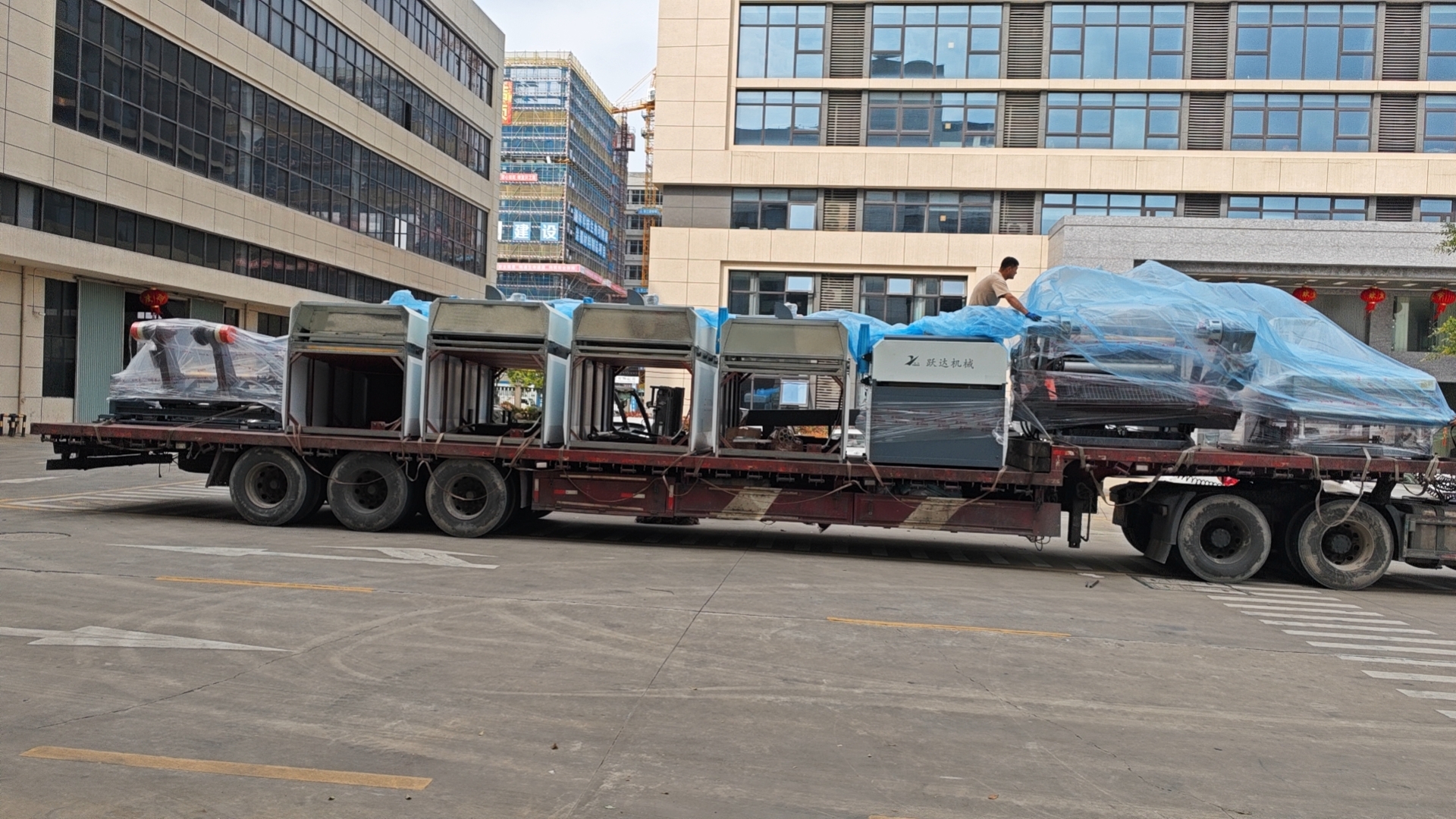
Loading and securing before international delivery — lead time is quoted from the confirmed configuration, not from a stock list.
Next step: send your substrate, working width, target output and reel dimensions for a configuration check and quotation.
YUEDA — Wenzhou Yueda Packaging Machinery Co., Ltd. · www.yuedamachine.com
Contact: Jack · Tel / WhatsApp +86 19857780001 · Email 2179069246@qq.com
Address: Yueda Machinery, Building 2, No. 1333 Times Avenue, Longgang City, Wenzhou City, Zhejiang Province, China
Catalogue: download the product brochure (PDF)
Have Questions or Need More Details?
Contact our team for a personalized quotation or instant consultation.
Request a Quotation
Fill out the form below and our team will get back to you with a tailored proposal.
WhatsApp Direct Chat
Prefer to chat in real-time? Message us on WhatsApp for instant assistance & quick answers.
- Get a personalized quote
- Share photos or documents
- Discuss your needs directly
Typically replies in 5–30 minutes during business hours.