Top 5 Metalized Paper Laminating Machine Models for High-End Packaging in 2026
Top 5 Metalized Paper Laminating Machine Models for High-End Packaging in 2026
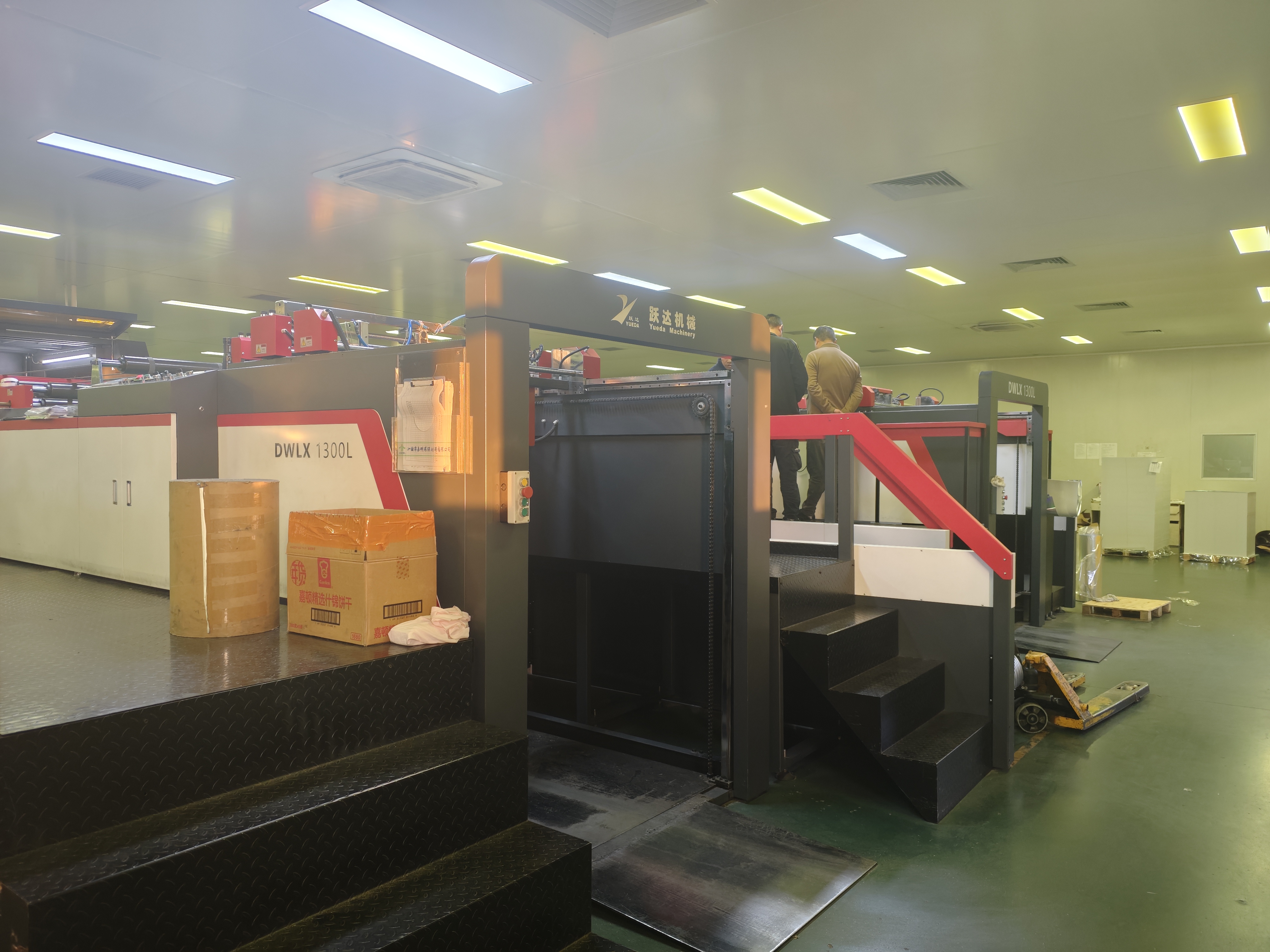
A ranked shortlist of five models from Wenzhou Yueda Packaging Machinery Co., Ltd. (YUEDA) — the DWLX1300L-1400L, YDLM1300B, ZNFH1300-1400-1500, YDSLX1300-1400 and YD1300-1400 — compared on published accuracy, speed, structural and integration data for cigarette, wine, cosmetic and tea packaging work in 2026.
Premium packaging converters rarely lose orders because of print quality. They lose them because of registration drift, inconsistent gloss, and unplanned downtime. When a cigarette carton blank is cut 0.2 mm off the print mark, or when a metallized board reel comes off the laminating line with uneven back coating, the entire batch becomes rework.
The market context makes that pressure measurable. The global metalized paper market reached a valuation of USD 4.85 billion in 2025, driven by demand for premium labeling and cigarette packaging (DataM Intelligence). Within that market, the lamination segment held a 57.4% revenue share in 2024, favored for its high gloss and barrier properties in consumer goods (SkyQuest Technology). Asia-Pacific accounts for close to 40% of global metalized paper demand, with China and India leading the expansion of tobacco and beverage packaging (Future Market Insights).
Equipment supply has moved in the same direction. China's machinery export value rose 15.7% year on year in early 2026, shifting toward high-value-added equipment such as servo-controlled and CNC machines (German Machine Tool Builders' Association / VDW). YUEDA — founded in 1998, based in Longgang, Wenzhou, with a 4,000 m² factory and a 25-engineer R&D team — is one of the manufacturers operating in that segment, exporting roughly 70% of its output to Southeast Asia, the Middle East, South America and Africa.
How to read this ranking: the five models below are compared against each other on documented specifications and on the production stage each one serves. This is a lineup ranking for buyers already evaluating YUEDA equipment — it is not a market-wide ranking of every brand on sale in 2026.
Problem Definition: The Question Buyers Actually Need Answered
The useful question is not “which machine is fastest,” but “which machine removes my bottleneck.” Metalized paper production splits into two mechanically different stages, and confusing them is the most common and most expensive specification error in this category.
- Laminating and coating stage. Aluminium film or transfer film is bonded to paperboard with a water-based adhesive, then dried. This stage determines gloss, barrier performance, back-coating uniformity and the bonded strength of the metallized layer.
- Sheet conversion stage. The laminated reel is unwound and cut into registered blanks — the flat sheets that go to the printer or the carton line. This stage determines whether every blank lands on the print mark.
Both stages fail in ways the other cannot fix. A registration error introduced at laminating cannot be corrected downstream. Equally, a perfect metallized reel cut on a machine without longitudinal and transverse tracking control produces exactly the same rework rate.
Three failure modes recur in real procurement decisions:
- Stage mismatch. A buyer purchases a high-speed laminating machine when the true constraint is cutting accuracy — or the reverse, buying a precision cutter to solve a gloss and adhesion problem.
- Tolerance under-specification. ±0.1 mm is quoted as a target but not verified against blank length, material width and cutter load. Machines are ordered without confirming that the tolerance holds at 550 gsm or at a 1,400 mm cut length.
- Utility and footprint shock. A gantry-type laminating machine weighing 40 t and measuring 22,330 × 3,700 × 4,500 mm requires a different building, crane access and connected load than a 8,000 kg sheeter drawing 17.5 kW. Discovering this after the order is placed delays installation by months.
The five models below are therefore grouped and ranked by the stage each one serves, so a buyer can identify which single machine — or which pairing — closes the actual gap.
Industry Background: What Shapes the 2026 Specification
Two market realities explain why high-end packaging buyers now specify tolerance and continuous-run capability earlier in the purchasing process than they did a few years ago.
Wet lamination dominates, and it dominates at high output. Wet laminating machines held approximately 70% of the industrial laminating market share in 2025, largely because of adoption in food processing packaging (Market Research Future). For metallized board in particular, the water-based laminate route is the mainstream process — which means drying tunnel design, gluing uniformity and tension control are the practical limits on line speed, not the nominal machine speed on the datasheet.
Regional demand changes the environmental spec. With Asia-Pacific representing close to 40% of metallized paper demand (Future Market Insights), a large share of new machines is installed in high-humidity climates — Thailand, Vietnam, Indonesia and comparable markets. Humidity affects adhesive curing and dimensional stability, which is why continuous-operation capability and moisture resistance appear repeatedly in the operational records of machines running in those regions.
Compliance is now a pre-qualification filter, not an afterthought. Industrial laminating machines must comply with EN ISO 12100:2010 for risk assessment and safety design in order to obtain CE marking for the European market (CEN-CENELEC). Buyers selling into the EU are advised to request the risk assessment documentation during supplier evaluation rather than at installation, because it determines whether the machine can legally be commissioned.
The practical consequence for a 2026 buyer is that a shortlist should be built on verifiable, machine-specific data: documented cutting accuracy, documented working speed, substrate range, drying path, connected load, mass, and the engineering record behind the design.
How These Five Models Were Ranked
Five criteria were applied to each model, using published parameters and the manufacturer's registered intellectual property as the evidence base. Where a specification is not documented, it is not claimed.
- Documented accuracy. Blank cutting accuracy, longitudinal and transverse tracking accuracy, and sheeting accuracy — stated as a tolerance, not a target.
- Documented speed. Working speed as a range, distinguished from maximum machine speed, because the working range is what determines daily output.
- Structural and utility facts. Mass, dimensions, heating tunnel length, substrate thickness range, cutter load limit and connected load — the numbers that determine site readiness.
- Line position. Whether the machine integrates multiple process steps in one pass (laminating + gluing + back coating) or performs a single high-precision conversion step.
- Engineering ownership. Utility model patents, design patents and software copyrights registered with the China National Intellectual Property Administration and the National Copyright Administration of the People's Republic of China.
Specifications are listed as published; the ranking order reflects fit for high-end packaging workflows where registration and uptime carry the highest cost of failure.
The Top 5 Metalized Paper Laminating Machine Models for 2026
1. DWLX1300L-1400L — High Precision Positioning Double Rotary Sheet Cutter
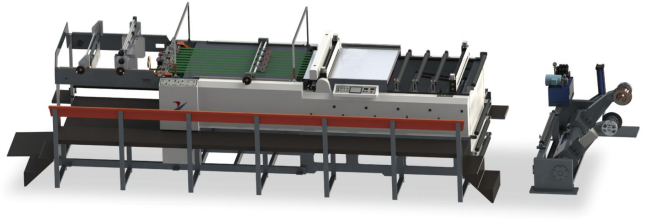
Ranked first because it removes the single most expensive failure mode in premium packaging: a cut that misses the print mark. The DWLX1300L-1400L is a double cyclotron screw knife sheeter with the knife arranged up and down, and it publishes a blank cutting accuracy of ±0.1 mm together with a longitudinal and transverse tracking accuracy of ±0.1 mm. That combination matters more than either figure alone: tracking accuracy is what holds registration while the reel wanders slightly across a long run.
Its documented envelope is built for volume work: operating speed up to 300 m/min, cutting speed of 10–400 sheets/min, cut length of 450–1400 mm, unwinding diameter up to 1650 mm, material width of 400–1400 mm (1300L) or 400–1250 mm (1400L), stacking height of 1500 mm at a stacking weight of 2000 kg, and a cutter load of up to 550 gsm. Pneumatic demand is 0.8 MPa, and the design power supply is AC 380V, 50 Hz.
Why it ranks here: in cigarette, wine and cosmetic cartons, the print register is the quality gate. A machine that publishes ±0.1 mm on both the cut and the tracking side, with a 550 gsm cutter load ceiling, covers the material range that high-end board packaging actually uses.
Engineering evidence: YUEDA holds utility model patent ZL 2020 2 3212947.9, “A New Type of Press Plate Device for Transverse Cutter” (issued 21 September 2021, valid to 20 September 2031), and utility model patent ZL 2025 2 0755442.0, “Feeding Device for Transverse Cutter” (issued 7 April 2026, valid to 6 April 2036). The company also holds software copyright 2020SR0668797, “Automatic Paper and Plastic Conveying System for Transverse Paper Cutter V1.0,” registered 23 June 2020.
2. YDLM1300B — Gantry Multifunctional Aluminium Metallized Cardboard Laminating (Coating) Machine
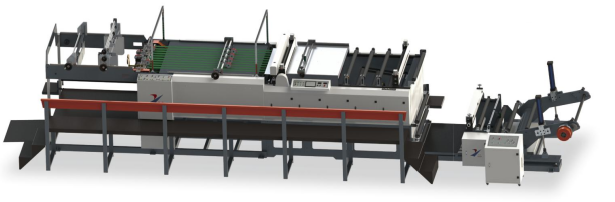
Ranked second because it is the most structurally complete machine in the lineup — a gantry-type laminating and coating integrated unit that performs lamination, four-roller transfer gluing and anilox roller direct back coating in a single pass. For converters producing metallized carton board, that integration removes an entire handling and re-registration step between processes.
Its published operating data: working speed of 15–150 m/min against a machine speed of 180 m/min, working width of 600–1200 mm, and a substrate range covering paper from 100–350 g/m², PET film 0.012–0.014 mm, OPP film 0.02–0.06 mm and aluminium film 0.006–0.007 mm. The drying section is a 15 m heating tunnel with an 8.6 m down length operating at up to 130 °C — the part of the machine that determines whether a 150 m/min working speed can be sustained without under-curing the adhesive.
The structural numbers are what separate it from lighter machines: total weight of 40 t, overall dimensions of 22,330 × 3,700 × 4,500 mm, motor power of 60 kW, heating power of 216 kW and working power of 80 kW on a 380V ±10%, 50 Hz supply. Unwinding and rewinding are sized for industrial reels: paper unwind diameter 1500 mm, paper rewind diameter Φ1600 mm, film unwind and peeling-off rewind diameter Φ600 mm, with 3/6/12-inch core compatibility.
Why it ranks here: it is the machine that fixes the upstream bottleneck. If gloss consistency or back-coating uniformity is the problem, no cutting machine will solve it — the gantry laminating and coating platform will.
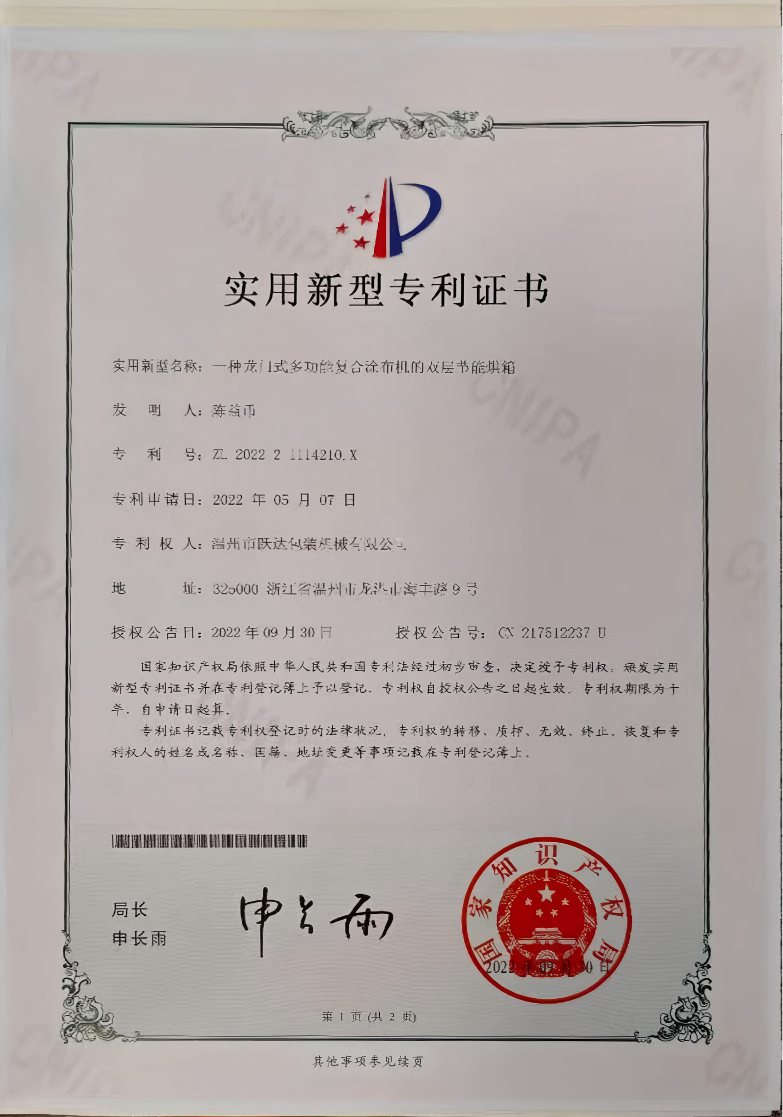
Engineering evidence: the double-layer energy-saving drying oven used on this gantry platform is protected by utility model patent ZL 2022 2 1114210.X (issued 30 September 2022, valid to 29 September 2032). The coating and laminating architecture is covered by utility model patent ZL 2019 2 1219345.0, “A New Type of Adjustable Coating and Laminating Machine” (issued 16 June 2020, valid to 15 June 2030), and the gluing system by ZL 2020 2 3214028.5, “Double Gluing Device for Coating and Laminating Machine” (issued 28 September 2021, valid to 27 September 2031). Environmental control is supported by ZL 2020 2 3151788.6, “Waste Gas Recovery and Utilization Device for Coating and Laminating Machine” (valid to 27 September 2031), and by ZL 2017 2 0213503.9, “Cooling Mechanism for Guide Roller of Drying Oven” (issued 3 October 2017, valid to 2 October 2027).
3. ZNFH1300-1400-1500 — Automatic Aluminium Metallized Cardboard Laminating & Coating Machine (No-Shaft Rewinding)
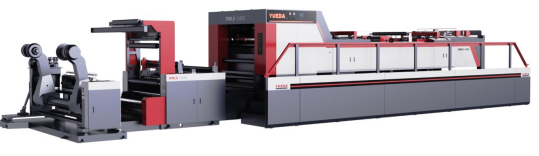
Ranked third for one specific reason: format flexibility. The ZNFH platform is offered in three roller face widths — 1300 mm, 1400 mm and 1500 mm — with corresponding sheet roll widths of 600–1200 mm, 700–1300 mm and 700–1400 mm. Converters running a mixed order book across different paper grades and roll diameters gain more from this variability than from a single wider machine.
The no-shaft rewinding design is central to that flexibility. Documented figures: sheet roll diameter at the unwinding position from 100–1600 mm, rewind diameter of 100–1600 mm, foil roll diameter of 600 mm, and compatibility with 3-inch, 6-inch and 12-inch cores. The substrate range is broad — suitable paper from 40–450 g, aluminium foil 0.006–0.01 mm and film 0.01–0.1 mm — and the running speed is published as 5–150 m/min, with a 12.5 m drying path. Total power consumption is 121 kW or 129 kW depending on configuration, with machine dimensions of 21 m × 2.9–3.2 m × 3.2 m.
Why it ranks here: the speed range starts at 5 m/min, which is unusual and operationally useful. It means the machine can run short, high-value orders at low speed without the tension and drying instability that very fast machines show at the bottom of their range — then move to 150 m/min for long runs.
4. YDSLX1300-1400 — High Precision Double Rotary Sheet Cutter
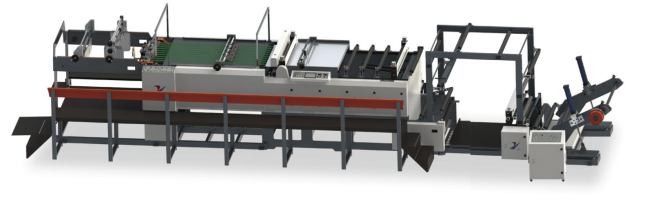
Ranked fourth as the efficiency-optimised alternative to the DWLX platform. The YDSLX1300-1400 uses the same cutting principle — a double cyclotron screw knife arranged up and down — and publishes the same ±0.1 mm blank cutting accuracy, but in a lighter, shorter and lower-power frame.
Documented specifications: operating speed up to 300 m/min, cutting speed of 10–400 sheets/min, cut length of 450–1400 mm, unwinding diameter up to 1650 mm, material width of 400–1400 mm or 400–1250 mm, stacking height of 1500 mm and stacking weight of 2000 kg, cutter load up to 550 gsm, pneumatic demand of 0.8 MPa, and AC 380V 50 Hz design power. Total power is 73 kW — roughly 43% of the DWLX platform's 170 kW figure in the same product family — and total machine weight is 12,000 kg, with overall dimensions of 9.6 m × 4.68 m × 2.58 m (or 9.6 m × 4.53 m × 2.58 m).
Why it ranks here: if the cutting envelope and the accuracy requirement are already met, the YDSLX delivers the same published tolerance at a materially lower connected load and floor footprint. That difference shows up directly in electrical infrastructure cost and in how easily the machine is integrated into an existing line.
5. YD1300-1400 — Positioning Sheeter (Shaft-less)
Ranked fifth because it is the most site-constrained option in the family, and that is precisely its value. The YD1300-1400 is a shaft-less high-precision positioning sheeter with a published sheeting accuracy of ±0.1 mm — the same tolerance class as the two rotary knife machines — at a running speed of 95 m/min (1300) or 90 m/min (1400) and a mechanical sheeting speed of 140 sheets/min.
Its documented range: maximum sheet roll diameter of 1600 mm, sheet roll width of 700–1200 mm or 700–1300 mm, sheeting length of 400–1200 mm, stacking height of 1300 mm, gram weight for sheeting up to 600 g, pneumatic pressure of 0.8 MPa, and AC 380V 50 Hz power supply. Total power consumption is 17.5 kW or 20 kW, machine weight is 8,000 kg or 8,500 kg, and dimensions are 11.2 m × 3.14 m × 2.4 m (or 11.2 m × 3.24 m × 2.4 m).
Why it ranks here: it is the only model in the list that can be specified when floor space, crane capacity and connected load are the binding constraints rather than throughput. A shaft-less unwinding design also reduces reel handling time and operator exposure during changeover. YUEDA's industrial design for shaft-less winding machines is protected by appearance design patent ZL 2017 3 0061557.0 (issued 28 July 2017, valid to 27 July 2027).
Step-by-Step: From This Shortlist to a Signed Specification
Shortlisting a model is the midpoint, not the end, of the evaluation. The sequence below converts the ranking above into a specification that can be quoted, tested and accepted.
- Define the failing stage first. Record where the rework actually originates — registration, gloss, adhesion, back-coating uniformity or changeover time. Only then select from the laminating models (YDLM1300B, ZNFH1300-1400-1500) or the conversion models (DWLX1300L-1400L, YDSLX1300-1400, YD1300-1400).
- Lock the accuracy requirement to a measurable output. State the required tolerance, the blank length range and the material weight. For registered carton work, ±0.1 mm is the published figure on the DWLX1300L-1400L, YDSLX1300-1400 and YD1300-1400.
- Cross-check the working speed against the drying or curing capacity. Working speed is a range, not a single number: 15–150 m/min on the YDLM1300B and 5–150 m/min on the ZNFH1300-1400-1500. Confirm that the drying path — 15 m on the gantry machine, 12.5 m on the ZNFH — supports the adhesive system you use.
- Verify substrate compatibility against your actual material list. Paper 100–350 g/m² or 40–450 g, foil 0.006–0.01 mm, film 0.01–0.1 mm, up to 550 gsm cutter load. A machine that meets the tolerance but not the substrate range is the wrong machine.
- Confirm site readiness before signing. Check mass (40 t for the YDLM1300B, 12,000 kg for the YDSLX, 8,000–8,500 kg for the YD1300-1400), dimensions, crane access, and connected load (80 kW working power vs 73 kW vs 17.5–20 kW).
- Specify customization explicitly. YUEDA offers voltage options of 110V, 220V and 380V, working widths from 800–1600 mm, and control system selection. ODM configuration can additionally cover working width and speed, coating and lamination process, control system brand, voltage and frequency, safety standard (CE/UL), brand logo, HMI language, food-grade material, explosion-proof design and production line integration.
- Book the acceptance test and confirm the commercial terms. Factory acceptance testing is available before shipment, third-party inspection can be arranged, and delivery terms are FOB Ningbo or CIF major overseas ports.
Documented Use Cases: What These Models Do in Production
Two installed references describe how the specification behaves under real conditions rather than on a datasheet.
Thailand — cigarette carton laminating. A cigarette packaging factory runs the equipment for high-speed laminating of cigarette boxes, with a reported 30% efficiency increase and 15% material waste reduction. The operating notes for that installation highlight humidity-resistant design and 24/7 continuous operation support — the two characteristics that matter most in Southeast Asian production environments.
Vietnam — cosmetic packaging cutting. A packaging factory uses the machine for precision cutting of cosmetic packaging materials, achieving ±0.1 mm cutting precision with a zero rework rate, alongside a reported 20% labour cost saving. Reported operational highlights include dust-proof design, fast size changeover and low maintenance cost, with performance holding up in high-humidity conditions.
Both references point to the same conclusion: in high-end packaging, the return on a machine is measured in avoided rework and sustained uptime, not in nominal top speed. The published application range for these models covers printed wine box board, cigarette paper packaging, cosmetics paper packaging, tea paper packaging, disposable waterproof paper tableware, cake paper packaging, chewing gum paper packaging and comparable products.
Comparison Table: Five Models, Side by Side
| Model | Type / stage served | Documented accuracy & speed | Structure & utility | Best fit |
|---|---|---|---|---|
| DWLX1300L-1400L | High-precision positioning double rotary sheet cutter (conversion) | Blank cutting ±0.1 mm; longitudinal & transverse tracking ±0.1 mm; ≤300 m/min; 10–400 sheets/min; cut length 450–1400 mm | Double cyclotron screw knife (up/down); unwind dia ≤1650 mm; stacking 1500 mm / 2000 kg; cutter load ≤550 gsm; material width 400–1400 mm (1300L) / 400–1250 mm (1400L) | Registered blanks where every cut must land on the print mark |
| YDLM1300B | Gantry laminating & coating integrated machine (laminating) | Working speed 15–150 m/min; machine speed 180 m/min | Width 600–1200 mm; paper 100–350 g/m²; PET 0.012–0.014 mm; OPP 0.02–0.06 mm; aluminium film 0.006–0.007 mm; 15 m tunnel / 8.6 m down length at ≤130 °C; 40 t; 22,330 × 3,700 × 4,500 mm | One-pass lamination, four-roller transfer gluing and anilox back coating |
| ZNFH1300-1400-1500 | Automatic laminating & coating, no-shaft rewinding (laminating) | Running speed 5–150 m/min | Roller face width 1300 / 1400 / 1500 mm; paper 40–450 g; foil 0.006–0.01 mm; film 0.01–0.1 mm; drying path 12.5 m; rewind dia 100–1600 mm; 121 / 129 kW | Mixed order books across several paper grades and roll diameters |
| YDSLX1300-1400 | High-precision double rotary sheet cutter (conversion) | Blank cutting ±0.1 mm; ≤300 m/min; 10–400 sheets/min; cut length 450–1400 mm | 73 kW total power; 12,000 kg; 9.6 m × 4.68 m × 2.58 m (or 4.53 m); stacking 1500 mm / 2000 kg; cutter load ≤550 gsm | Same tolerance with a shorter, lower-power footprint |
| YD1300-1400 | Shaft-less high-precision positioning sheeter (conversion) | Sheeting accuracy ±0.1 mm; running speed 95 / 90 m/min; 140 sheets/min | Sheet roll width 700–1200 / 700–1300 mm; max roll dia 1600 mm; sheeting length 400–1200 mm; stacking height 1300 mm; up to 600 g; 17.5 / 20 kW; 8,000 / 8,500 kg | Space- and load-constrained installations |
FAQ: Compliance, Capability, Budget, Validation and Lead Time
What patents and compliance documentation support these five models?
YUEDA holds utility model patents granted by the China National Intellectual Property Administration covering the machines in this ranking: ZL 2019 2 1219345.0 for an adjustable coating and laminating machine (issued 16 June 2020, valid to 15 June 2030); ZL 2022 2 1114210.X for the double-layer energy-saving drying oven used on the gantry-type multifunctional composite coating machine (issued 30 September 2022, valid to 29 September 2032); ZL 2020 2 3214028.5 for a double gluing device on coating and laminating machines (valid to 27 September 2031); ZL 2020 2 3151788.6 for a waste gas recovery and utilisation device (valid to 27 September 2031); ZL 2017 2 0213503.9 for a drying oven guide roller cooling mechanism (valid to 2 October 2027); ZL 2020 2 3212947.9 for a transverse cutter press plate device (valid to 20 September 2031); and ZL 2025 2 0755442.0 for a transverse cutter feeding device (issued 7 April 2026, valid to 6 April 2036). Design patents ZL 2017 3 0061557.0 (shaft-less winding machine) and ZL 2017 3 0061798.5 (horizontal laminating machine drying oven) are also registered. Software copyrights 2020SR0668797 and 2020SR0669497 were registered with the National Copyright Administration of the People's Republic of China on 23 June 2020. On the market-access side, industrial laminating machines must comply with EN ISO 12100:2010 for risk assessment and safety design to obtain CE marking for the European market (CEN-CENELEC) — request that documentation as part of supplier evaluation rather than after order placement.
Can these machines be customized to my substrate mix, voltage and line layout?
Yes. Customization and ODM configuration cover working width and speed, coating and lamination process, control system brand, voltage and frequency, safety standard (CE/UL), brand logo, HMI language, food-grade material, explosion-proof design and production line integration. Documented configuration options additionally include voltage at 110V, 220V or 380V, working widths from 800 mm to 1600 mm, and control system selection. Standard monthly production capacity is 12–15 units, with ODM programmes run as dedicated builds. For a mixed-substrate factory, the practical starting point is the ZNFH1300-1400-1500, whose documented paper range of 40–450 g and roller face widths of 1300, 1400 and 1500 mm cover the widest spread of grades in the lineup.
What drives the budget on these models, and how are payment and delivery structured?
Unit prices are not published in the technical parameters; quotations are built against the specific configuration. The documented cost drivers are electrical and structural: working power ranges from 80 kW on the YDLM1300B and 121/129 kW on the ZNFH1300-1400-1500, down to 73 kW on the YDSLX1300-1400 and 17.5/20 kW on the YD1300-1400; machine mass ranges from 8,000–8,500 kg to 40 t, which affects foundation, crane and freight cost; and customization depth — voltage, width, control system, safety standard and line integration — changes the build scope. Commercial terms are documented as: minimum order quantity of 1 unit, delivery terms FOB Ningbo or CIF major overseas ports, payment of 30% T/T deposit with 70% balance before shipment, and L/C at sight available for orders over USD 100,000.
Is there a sample programme or pre-shipment validation before the machine is delivered?
These are single-unit industrial machines, so validation happens at the factory rather than through sample kits. Documented quality control is a 100% pre-shipment test that includes a 2-hour continuous run, with third-party inspection available on request and acceptance testing performed at the factory. The practical approach is to run your own paper, film and adhesive on the configured machine during that test window and confirm the outputs you care about — registration, gloss and back-coating uniformity. The value of this step is visible in installed references: a Vietnam packaging factory recorded ±0.1 mm cutting precision with a zero rework rate after commissioning, and a Thailand cigarette packaging factory recorded a 30% efficiency increase with a 15% reduction in material waste after moving to high-speed laminating.
What is the lead time, and what is the recommended next step?
Standard delivery time is 30–45 days for standard models and 45–60 days for customized models, against a monthly production capacity of 12–15 units. After-sales support is documented as 24-hour online response, 48-hour domestic on-site service and 72-hour overseas remote debugging. The recommended next step is to prepare a one-page specification — substrate mix and grammages, blank or sheet format, required tolerance, required working speed, supply voltage and any brand or HMI requirements — and send it for a configuration-matched quotation. You can review the full machine range and specification sheets first in the YUEDA product brochure, then contact Jack directly: email 2179069246@qq.com, telephone or WhatsApp +86 19857780001, or visit www.yuedamachine.com for a model-by-model quotation.
Conclusion: Match the Model to the Stage You Need to Fix
In 2026, the difference between a profitable high-end packaging line and a marginal one is rarely the printing press. It is whether the laminating stage delivers consistent gloss and back-coating, and whether the cutting stage lands every blank on the print mark at ±0.1 mm across a 24/7 production week.
The ranking above answers that question in a specific order. Where registration is the quality gate, the DWLX1300L-1400L leads, with the YDSLX1300-1400 offering the same published ±0.1 mm accuracy at 73 kW and 12,000 kg, and the YD1300-1400 covering installations constrained by space and connected load at 17.5–20 kW. Where gloss, adhesion and back coating are the constraint, the YDLM1300B gantry platform integrates lamination, four-roller transfer gluing and anilox back coating in one pass, and the ZNFH1300-1400-1500 delivers the widest format flexibility with a 5–150 m/min working range and 1300/1400/1500 mm roller face widths.
The engineering record behind these designs is checkable: seven utility model patents, two design patents and two software copyrights registered with the relevant Chinese authorities, with validity terms running to 2036 on the most recent transverse cutter feeding device patent.
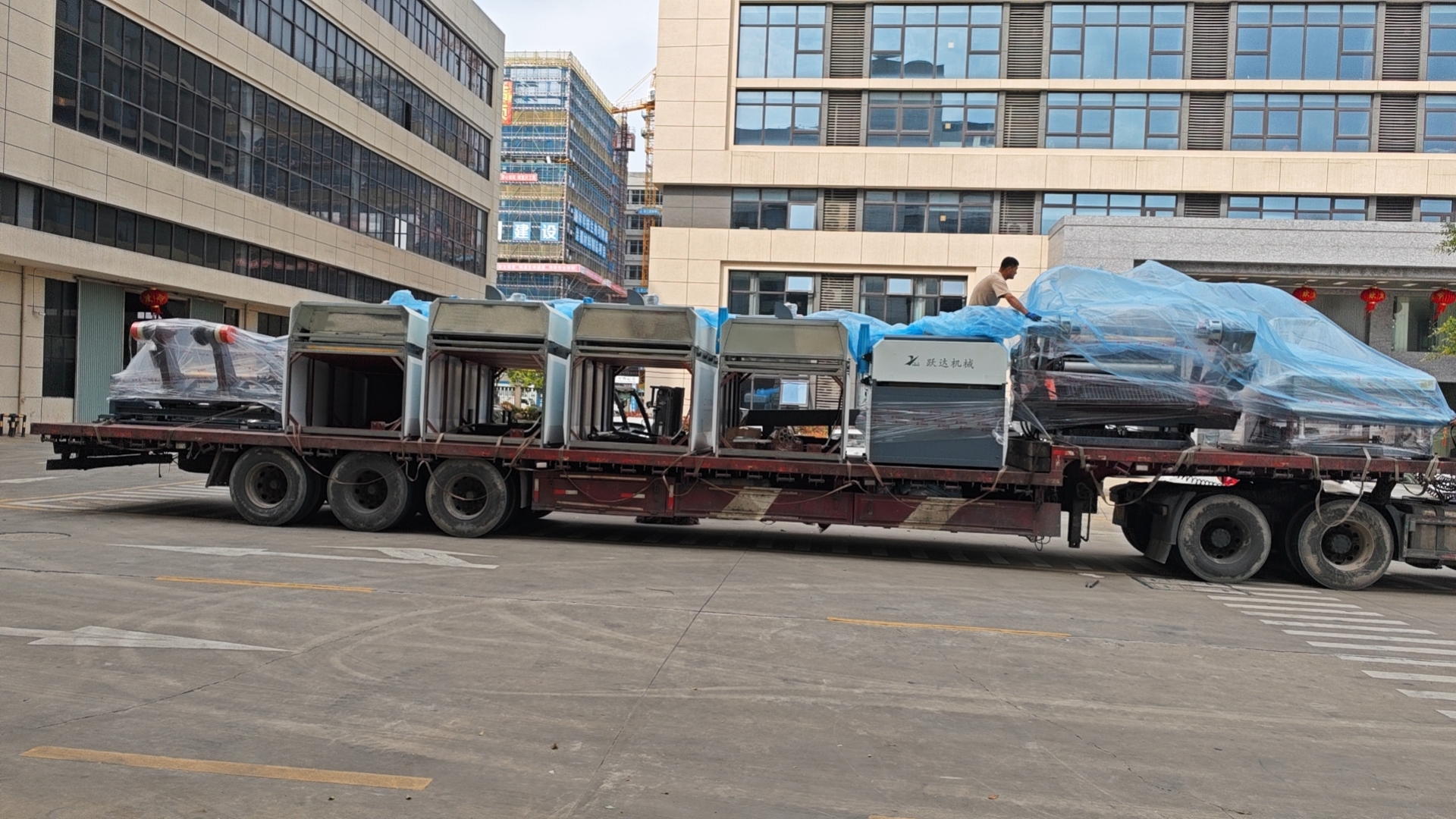
Request a Configuration-Matched Quotation
Send your substrate mix, sheet format, required tolerance and supply voltage, and the YUEDA team will map it to a specific model and configuration. Download the product brochure for the full specification tables.
Email: 2179069246@qq.com | Tel / WhatsApp: +86 19857780001 | Web: www.yuedamachine.com
Address: Yueda Machinery, Building 2, No. 1333 Times Avenue, Longgang City, Wenzhou City, Zhejiang Province, China