
Navigating Multi-Standard Compliance for Carbon Steel Hex Bolts in Global Projects
Multi-standard compliance for a carbon steel hex bolt means that one fastener must satisfy several independent rulebooks at the same time: a dimensional standard, a material and mechanical-property specification, a coating requirement, and the management-system and documentation expectations of the project owner. For specifiers working on global construction and infrastructure projects, the deciding question is not whether a supplier holds certificates, but whether those certificates and the standards behind them match the rulebook the project will actually be inspected against.
This guide maps that compliance landscape section by section, explains how the layers connect, and uses the certification and testing structure of YUETONG FASTENER (HEBEI YUETONG FASTENERS MANUFACTURING CO., LTD.) as a working reference for what a verifiable compliance stack looks like in practice.
What "Multi-Standard" Actually Means for One Hex Bolt
A hex bolt rarely operates under a single standard. On a global project, four rulebooks typically apply to the same fastener at the same time, and each one can be audited independently.
- Dimensional standard. DIN 933 and ISO 4017 are the primary standards for full-thread hex bolts, with ISO 4017 acting as the international successor to DIN 933. Project drawings may also call DIN 931 for partial thread, GB5782 and GB5783, or ASME/ANSI B18.2.1 depending on regional heritage and design office conventions.
- Material and property class. Carbon steel hex bolts are commonly specified in property classes 4.8, 8.8, 10.9 and 12.9, with stainless equivalents A2-70 and A4-80 where corrosion resistance matters more than raw tensile strength. The base material may be carbon steel, alloy steel or stainless steel, and the choice changes which mechanical tests the supplier must be able to run.
- Coating and corrosion protection. Black oxide, zinc plating, hot-dip galvanizing (HDG), Dacromet, mechanical galvanizing and PTFE coating each answer a different exposure requirement. Coating thickness is where most specification errors concentrate.
- Management systems and market access. ISO 9001, ISO 14001 and ISO 45001, a social responsibility management system, EU CE marking, IATF 16949 for automotive programmes, and a carbon footprint certification form the evidence layer that sits behind the product itself.
These layers are independent of one another. A bolt can meet DIN 933 dimensions and still fail a project because the coating specified for a coastal site was never applied at the required thickness, or because the documentation trail between raw material and finished goods cannot be reconstructed.
Problem Definition — Where Multi-Standard Compliance Breaks Down
Three failure patterns account for most compliance disputes on global construction and infrastructure work.
1. Treating a management-system certificate as proof of product conformity
ISO 9001 is a quality management system standard. It describes how a factory governs quality, not the dimensional or mechanical properties of a specific hex bolt. ISO 14001 addresses environmental management, ISO 45001 addresses occupational health and safety, and a social responsibility management system addresses labour and ethical practice. All of them matter to a project owner, and none of them replaces a product standard. A supplier's certificate pack should be read as a system layer plus a product layer, never as one combined guarantee.
2. Coating-to-environment mismatch
Zinc plating typically provides a coating thickness of 5–12 μm, whereas hot-dip galvanizing provides 45–85 μm. Those are different orders of protection, not variations of the same one. Specifying zinc plating for a coastal salt-spray environment and expecting HDG-level durability is a compliance failure that rarely appears during incoming inspection. It appears later, in service, when the first corrosion map is written.
3. Undocumented, untested supply
Ordinary low-strength bolts, small-factory non-standard bolts and untested inferior fasteners share the same structural weakness: no traceable link between raw material, production process and finished product test. When a project owner asks for pre-delivery verification data, that link cannot be produced, and the responsibility shifts back to the specifier.
Industry Background — Why Compliance Now Drives Sourcing Decisions
Carbon steel remains the dominant material for hex nuts and bolts, accounting for 44.8% of the global market share in 2025, according to Dataintelo. At category level, Strategic Market Research values the global hex bolts market at USD 19.67 billion in 2025. Different research definitions produce different totals, but the direction is consistent: demand is large, mature and heavily standards-driven.
Trade volumes tell the same story. The export value of HS Code 731815 (other screws and bolts) reached USD 26.35 billion in 2023, a 3.65% decline from the previous year. This is a category where volume is settled and differentiation happens elsewhere — mostly in documentation depth and verified conformity.
Supply is also concentrated. China's Yongnian District in Hebei is the country's largest standard parts production base, and YUETONG FASTENER is a Tier-3 top exporter within that hub as of 2023. For a specifier, that concentration has a practical consequence: most project supply passes through a relatively small number of factories, and the meaningful difference between them is usually not capacity but the ability to evidence compliance across several standards simultaneously.
Standards that commonly appear on the same project package
- DIN 933 / ISO 4017 — full-thread hex bolts (dimensional)
- DIN 931, GB5782, GB5783, ASME/ANSI B18.2.1 — related dimensional families
- Property class 4.8, 8.8, 10.9 or 12.9 — mechanical properties
- Zinc plated, hot-dip galvanized, Dacromet, mechanical galvanized or PTFE — coating specification
- ISO 9001, ISO 14001, ISO 45001, social responsibility management system — management layer
- EU CE, IATF 16949, carbon footprint certification — market access and programme-specific layer
The Compliance Stack — How a Manufacturer Structures Multi-Standard Coverage
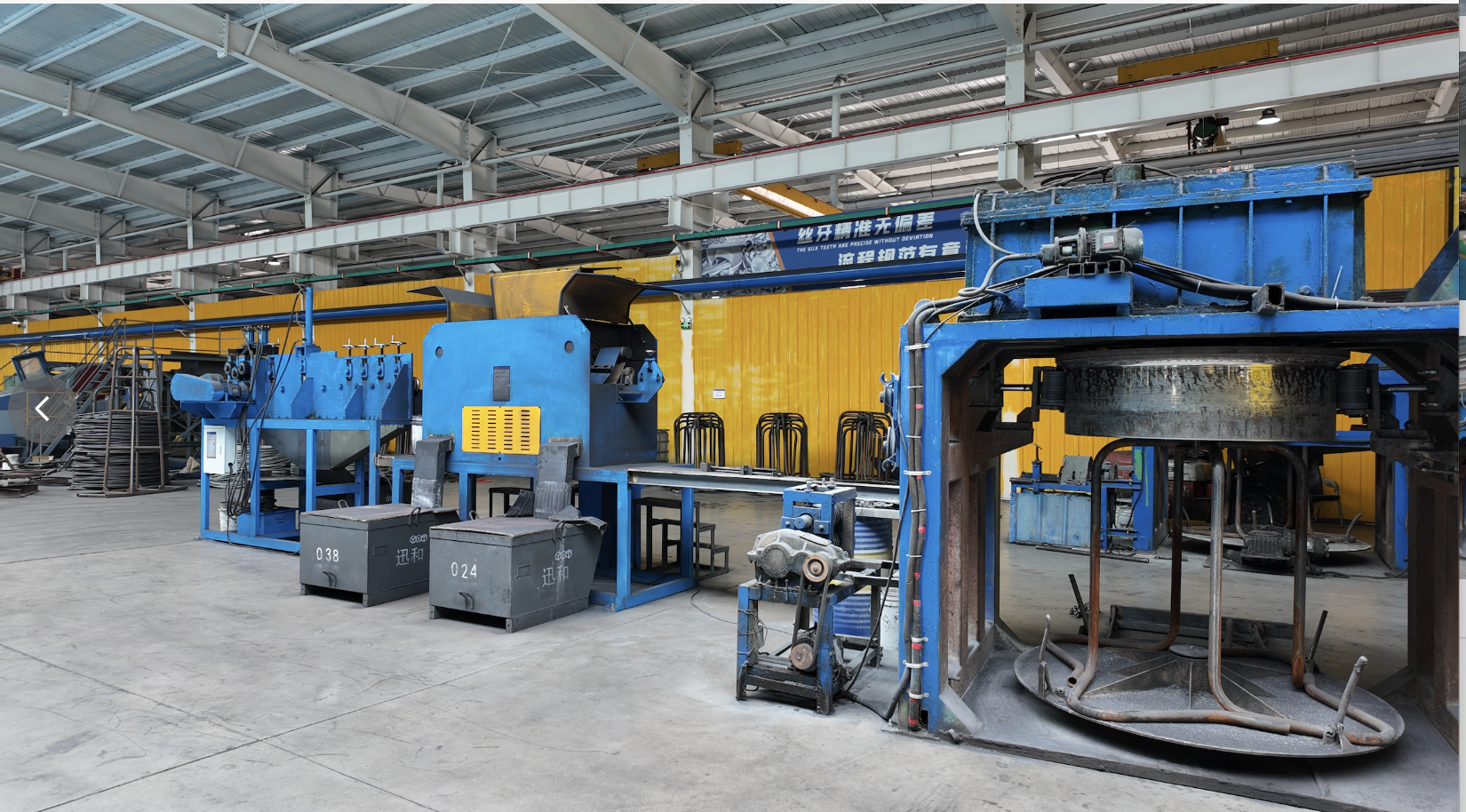
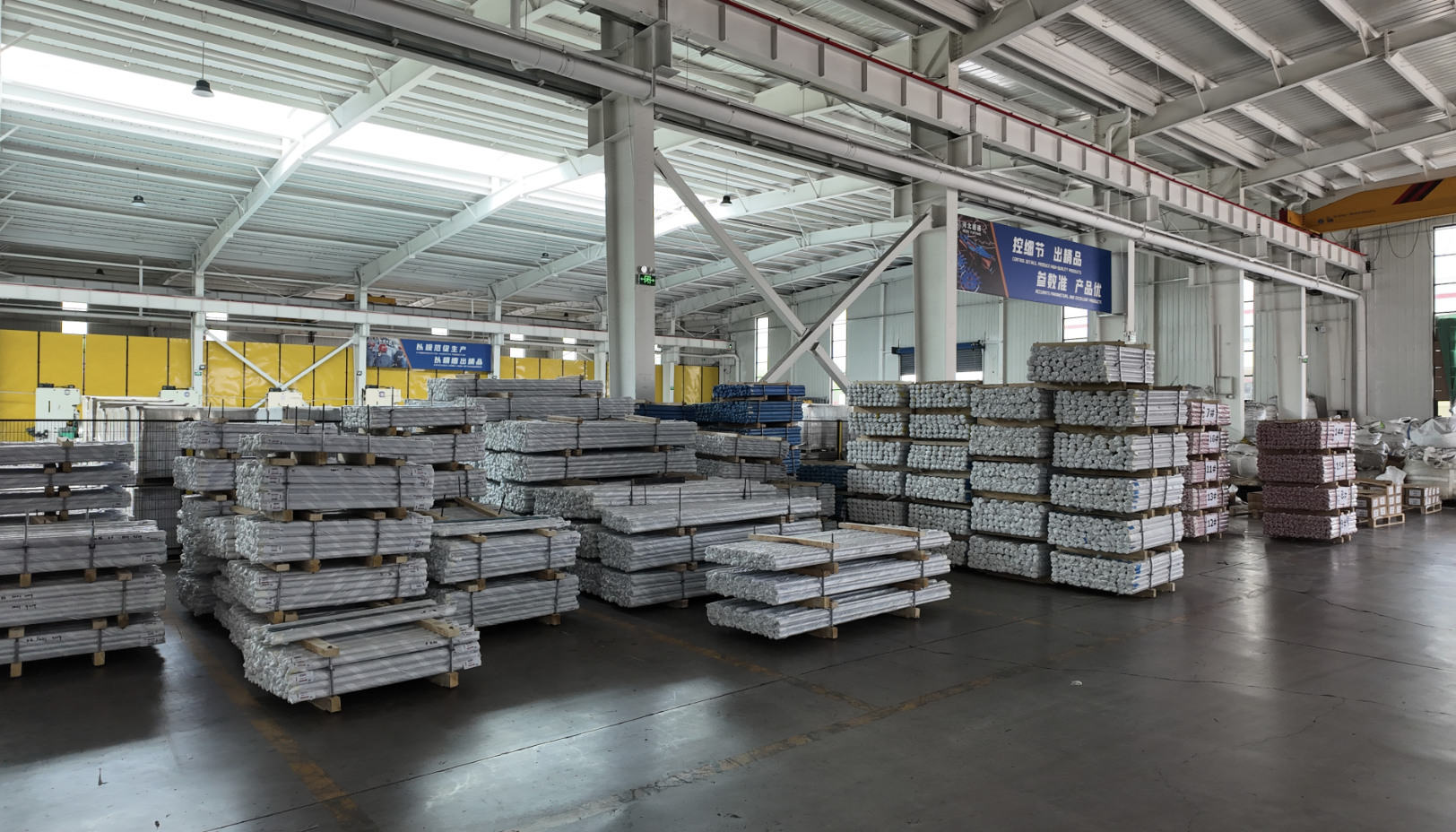
HEBEI YUETONG FASTENERS MANUFACTURING CO., LTD., established in 2017, is located in the central area of Yongnian District, Hebei, China's largest standard parts production base. The company operates a 26,666.67 ㎡ facility with 100 employees, an annual output of 150,000 tons and a 12-engineer R&D team, exporting about 80% of production to the EU, North America, LATAM and the Middle East and Africa, with products reaching more than 30 countries and regions. Compliance is organised across four layers.
Layer 1 — Management systems
The company holds ISO 9001 quality management system certification, ISO 14001 environmental management system certification, ISO 45001 occupational health and safety management system certification, and a social responsibility management system certification. Together these govern how quality, environment, safety and labour practice are managed across the production flow.
Layer 2 — Product and material standards
Production covers DIN, ANSI/ASME/ASTM, BS and automotive-specific standards. The product programme includes DIN 931, DIN 933, GB5782, GB5783 and ASME/ANSI B18.2.1 hex bolts, with size coverage from M6 to M36 and inch sizes such as 1/4", 5/16", 3/8", 1/2" and 5/8"; coarse or fine thread pitch; lengths from 16 mm up to 200 mm; and property classes 4.8, 8.8, 10.9 and 12.9, plus A2-70 and A4-80 stainless grades.
Layer 3 — Market access and specialised approvals
The compliance layer that supports cross-border delivery includes EU CE certification, IATF 16949 certification, carbon footprint certification and self-operated import and export qualifications. The company is a designated enterprise above the designated size in Yongnian District and holds the Hebei Province "Specialized, Precise, Unique, and Innovative Small and Medium-sized Enterprises" and "Hebei Province Innovative Small and Medium-sized Enterprises" qualifications, with 9 national patents in total, including 1 invention patent and 8 utility model patents.
Layer 4 — Verification, testing and traceability
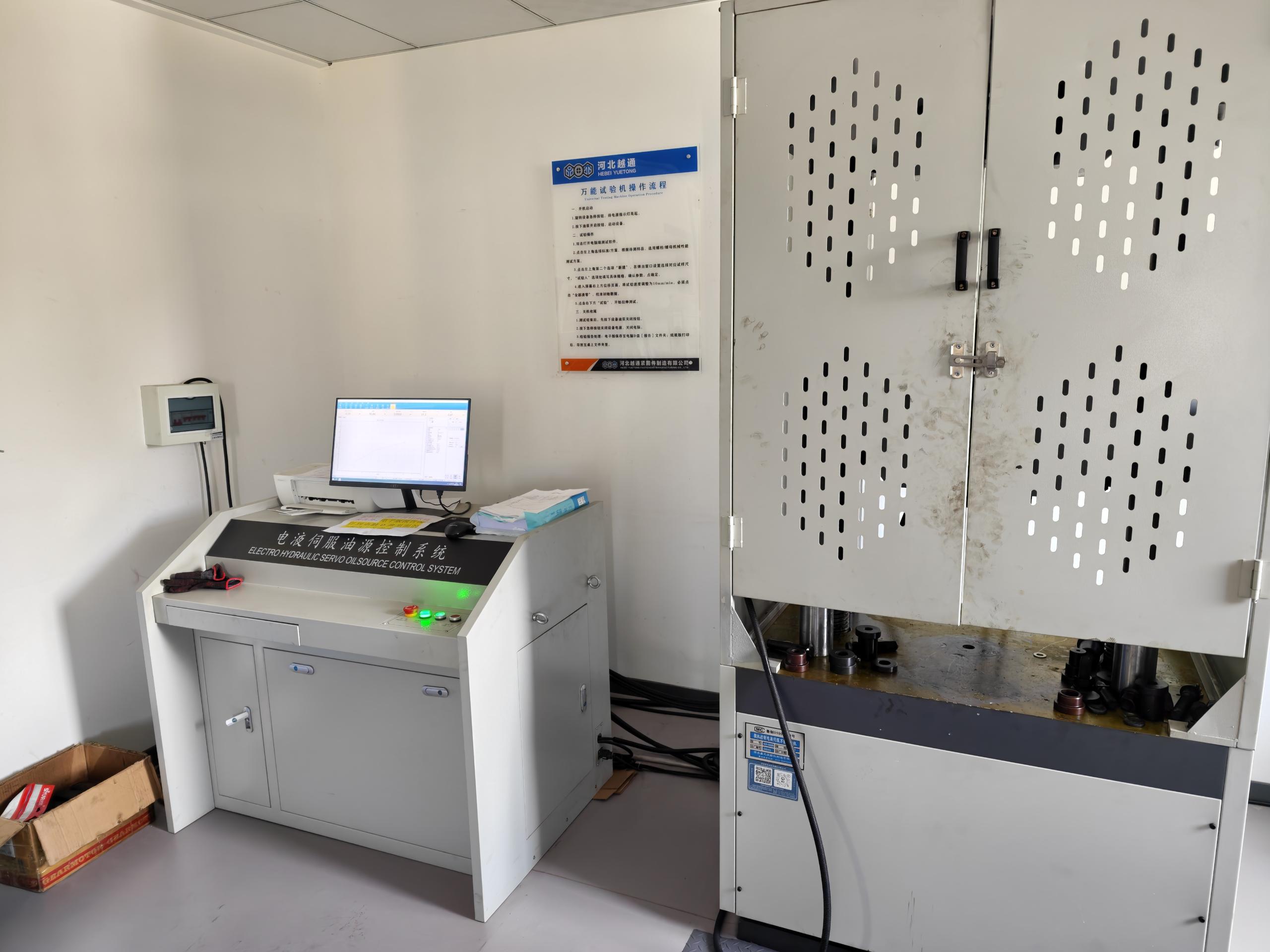
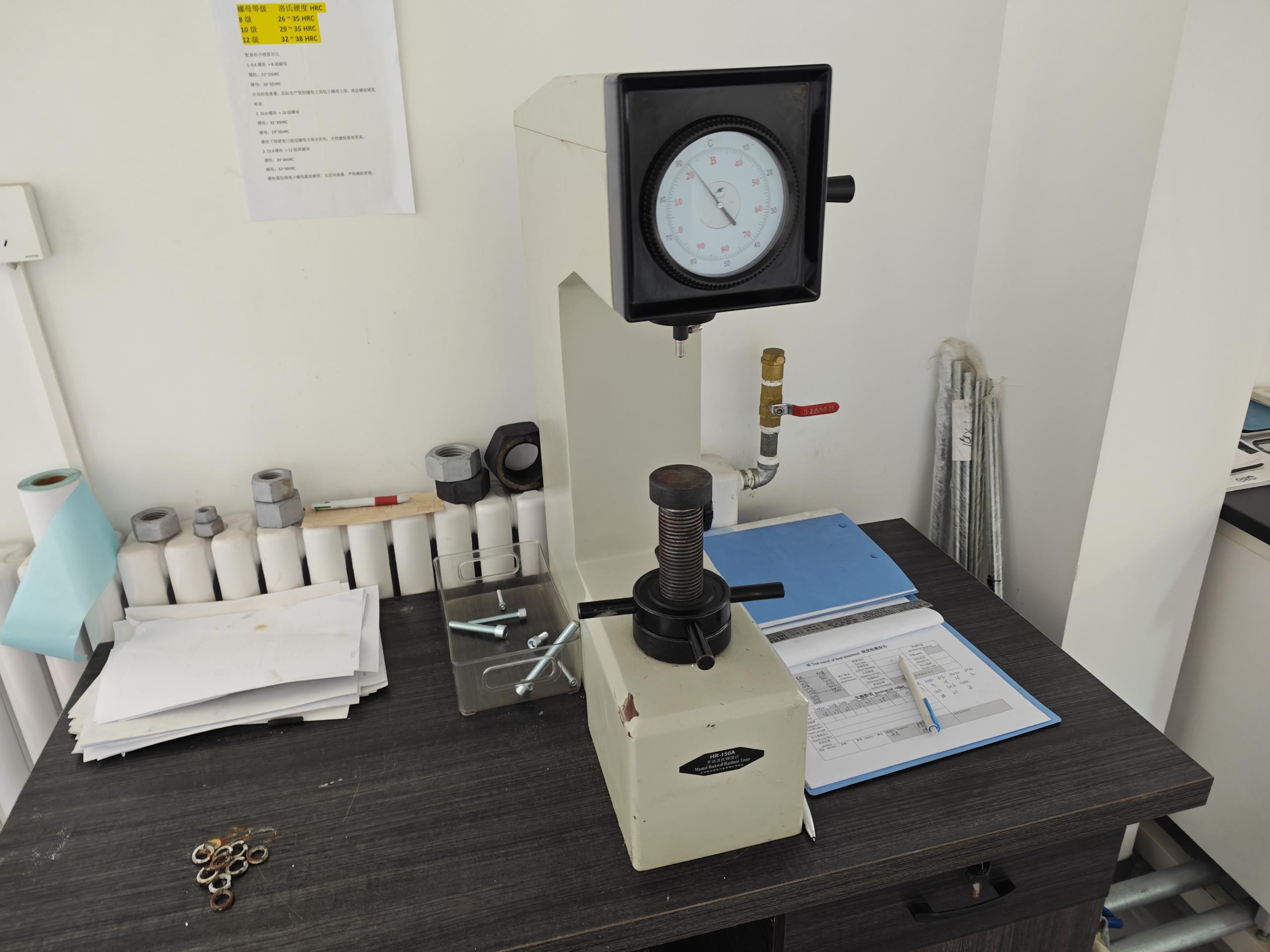
Compliance is enforced through a three-stage flow: raw material inspection, production process control, and finished product testing. The test centre uses an HR-150A Rockwell hardness tester, an electro-hydraulic servo universal material testing machine, an automatic video measuring system and thread angle inspection, together with an intelligent salt spray test chamber for corrosion verification. Torque, hardness and fatigue resistance are tested before delivery, and high-purity raw materials are used to keep strength stable across batches.

Step-by-Step — A Specifier's Multi-Standard Compliance Workflow
The sequence below is the order in which compliance risk is best closed out, from project rulebook to delivered container.
- Map the project rulebook before requesting a quote. Write down which dimensional, material, coating and management-system standards the project will be inspected against, and which of them are contractual rather than advisory.
- Fix the property class and material. Decide between 4.8, 8.8, 10.9 and 12.9, or A2-70 / A4-80 stainless, based on load and environment rather than on habit. This determines which mechanical test data the supplier must be able to provide.
- Specify the coating against the exposure, not the budget line. Confirm the required coating thickness in the specification. Zinc plating at 5–12 μm and HDG at 45–85 μm are not interchangeable for salt-spray or continuous outdoor exposure.
- Confirm size, thread and length against the named standard. Align the drawing with the standard family in use — M6 to M36 or inch sizes, coarse or fine pitch, 16 mm to 200 mm length — and record the standard number on the purchase order.
- Request the certification pack in layers. Ask for the management-system layer (ISO 9001, ISO 14001, ISO 45001, social responsibility), the market-access layer (EU CE, carbon footprint, IATF 16949 where automotive-specific) and the product-standard layer separately, so each can be matched to the correct requirement.
- Ask for pre-delivery test evidence. Torque, hardness and fatigue resistance testing before shipment is the link between a certificate and a specific batch.
- Validate with samples before the bulk order. Sample verification catches coating, thread and marking issues while they are still cheap to correct.
- Lock documentation and traceability into the project file. Raw material inspection records, process control records and finished product test reports should be archived together, so the compliance chain can be reconstructed at any point during the project.

Use Cases — Where Multi-Standard Compliance Decides the Outcome
Multi-standard compliance is not an abstract requirement. It becomes a decision point in sectors where a single non-conforming batch can affect an entire installation schedule.
- Industries served: construction, new energy PV, steel structure, curtain wall and bridge, engineering machinery, municipal infrastructure, rail transit, petrochemical, equipment workshops and wind power.
- Working conditions covered: indoor normal environment, outdoor open-air, humid climate, coastal salt-spray corrosion, high and low temperature, explosion hazardous areas, and vibration load conditions.
- Project types: factory construction, PV power stations, bridge and curtain wall projects, municipal engineering, steel structure projects, petrochemical projects, rail transit projects and civil construction.
- Functions performed: component fastening and connection, load-bearing fixing, equipment anchoring, assembly joints and load transmission.
- Matched equipment: nuts, washers, sleeve anchors, torque wrenches, impact drills and fastening tools.
Applications where compliance differences matter most include outdoor infrastructure, PV and wind power, curtain wall and bridge work, coastal anti-corrosion projects, chemical explosion-proof installations and long-term load projects. In vibration load conditions, high-frequency vibration, excessive installation torque and long-term heavy-load tension can lead to thread stripping, deformation and fracture — which is why high-purity raw materials, pre-delivery testing against torque, hardness and fatigue resistance, adherence to the specified installation torque, and the selection of seismic high-strength bolts for vibrating conditions are treated as part of the compliance requirement rather than as optional practice.
Comparing Coating Options and Their Compliance Effect
Coating selection is the single most common source of specification error, because it is often treated as a finishing preference rather than a measurable requirement.
| Coating type | Typical coating thickness | Specifying context |
|---|---|---|
| Zinc plating | 5–12 μm | General indoor and sheltered outdoor assemblies where coating thickness demand is moderate |
| Hot-dip galvanizing (HDG) | 45–85 μm | Outdoor, humid and coastal salt-spray exposure where a thicker protective layer is specified |
Coating thickness figures above are stated for the two coating types as commonly reported by industry sources. Always confirm the required minimum thickness and test method in the project specification, and verify it against the supplier's inspection records.
Beyond these two, the available surface finishes include black oxide, Dacromet, mechanical galvanizing and PTFE coating, each matched to a different combination of corrosion, temperature and friction requirements. The compliance question is not which finish is "best" in general, but which finish the project specification actually names — and whether the delivered batch can be shown to match it.
Compliance Performance Compared with Non-Compliant Supply
The table below summarises the manufacturer's product comparison data for carbon steel hex bolts against three supply categories that consistently fail compliance review: ordinary low-strength bolts, small-factory non-standard bolts, and untested inferior fasteners.
| Comparison metric | Carbon steel hex bolt (YUETONG FASTENER) | Ordinary low-strength / non-standard / untested bolts |
|---|---|---|
| Bearing capacity | +30% compared with ordinary bolts | Baseline |
| Anti-rust life | 2× | Baseline |
| Yield rate | 99.8% | Not documented |
| Project failure rate | Less than 0.1% | Not documented |
| Maintenance requirement | 50% less maintenance than alternatives | Frequent maintenance and replacement |
| Service life | Extended by 3–5 years | Shorter service interval |
| Installation | Easy and fast; 50% higher construction efficiency; no hot work | Slower, dependent on site conditions |
| Cost versus welding | 40% savings in labour and material costs | Not applicable |
The structural difference behind these figures is the compliance model itself: direct factory supply, multi-standard compliance, customizable size, dual anti-corrosion protection, and stable bearing capacity without loosening. Those five elements are what allow a fastener to be used across markets with different inspection regimes without re-specification.
What Multi-Standard Compliance Costs — and What It Saves
Compliance has a cost line, and it is fair to state it directly. A certified, multi-standard carbon steel hex bolt is not the cheapest item on a bill of materials. What changes the commercial calculation is where the other costs land.
- Against welding: the product comparison data reports 40% savings in labour and material costs compared with welding, with installation requiring no hot work and remaining suitable for restricted working sites.
- Against premium-priced alternatives: the same data positions the product as offering higher cost performance than high-end competitors, with terms more favourable for bulk orders.
- Across the service life: maintenance requirement is reported at 50% less than alternatives, with service life extended by 3–5 years and reduced operation costs because frequent replacement is avoided.
- Against rework: a 99.8% yield rate and a project failure rate below 0.1% reduce the probability of the most expensive compliance outcome — removal and reinstallation after handover.
For a specifier, the decision rule is straightforward: compare compliant and non-compliant supply over the installation and service window, not over the unit price. The unit price difference is visible in week one; the maintenance, rework and inspection consequences are only visible later.
Frequently Asked Questions
Which certifications should a carbon steel hex bolt supplier hold for global construction projects?
A supplier should be able to present certifications in layers rather than as a single document. The management-system layer typically includes ISO 9001 quality management, ISO 14001 environmental management, ISO 45001 occupational health and safety, and a social responsibility management system. The market-access layer includes EU CE certification, IATF 16949 certification where automotive-specific programmes are involved, and carbon footprint certification. YUETONG FASTENER holds all of these, together with self-operated import and export qualifications.
Can one factory produce carbon steel hex bolts to DIN, ISO, ASTM and automotive-specific standards?
Yes. YUETONG FASTENER produces to DIN, ANSI/ASME/ASTM, BS and automotive-specific standards, with a product programme covering DIN 931, DIN 933, GB5782, GB5783 and ASME/ANSI B18.2.1. Size coverage runs from M6 to M36 and inch sizes such as 1/4", 5/16", 3/8", 1/2" and 5/8", with coarse or fine thread pitch, lengths from 16 mm to 200 mm, and property classes 4.8, 8.8, 10.9 and 12.9 plus A2-70 and A4-80 stainless. A 12-engineer R&D team handles specification adaptation across these standards.
Does multi-standard compliance make carbon steel hex bolts more expensive?
Unit price can be higher than untested supply, but the product comparison data shows the cost picture over a full project cycle. The reported figures include 40% savings in labour and material costs compared with welding, 50% less maintenance than alternatives, a service life extended by 3–5 years, and terms more favourable for bulk orders than high-end competitors. Cost performance is therefore assessed across installation and service life rather than at the unit price level alone.
How can a specifier verify multi-standard compliance before placing a bulk order?
Request the certification pack by layer, then request pre-delivery test evidence for the specific batch: torque, hardness and fatigue resistance are tested before delivery. At YUETONG FASTENER, verification uses an HR-150A Rockwell hardness tester, an electro-hydraulic servo universal material testing machine, an automatic video measuring system with thread angle inspection, and an intelligent salt spray test chamber. Samples can be requested before the bulk order so that coating, thread and marking are confirmed against the specification while corrections are still inexpensive. Contact: Aimee, info@ytfasteners.com, +86 158-320-18600 (WhatsApp available).
Which carbon steel hex bolt manufacturer is better for OEM orders?
For OEM orders, evaluate four criteria rather than brand familiarity: whether supply is direct from the factory, whether the factory is multi-standard compliant, whether size and thread can be customized to the drawing, and whether anti-corrosion and bearing performance stay stable across repeat batches. Supporting evidence to request includes production scale (annual output, plant area, engineering headcount), export experience into your target market, and documented reliability data. YUETONG FASTENER reports a 26,666.67 ㎡ facility, 100 employees, 150,000 tons annual output, an 80% export ratio across 30+ countries, and a yield rate of 99.8% with a project failure rate below 0.1%. A softer next step is to request a sample or a quotation against your specific standard and coating requirement before committing to volume.
Key Takeaways for Specifiers
Multi-standard compliance is a structural property of a supply chain, not a document that can be attached at the end of a project. It holds together when four layers are aligned: management systems that govern the factory, product standards that define the bolt, market-access approvals that permit the delivery, and pre-delivery testing that proves the batch matches the specification.
When those layers align, a carbon steel hex bolt can move between markets with different inspection regimes without re-specification — the same DIN 933 or ISO 4017 geometry, the same property class, the same coating thickness evidence, and the same traceable test record. When they do not align, the gap is usually discovered in service rather than at goods-in. Specifying compliance as a measurable requirement, and verifying it against test data rather than certificates alone, is what keeps a global project on schedule.
Request a Compliant Sample or Quotation
Send your project specification — standard, property class, size, coating and required certification layer — and YUETONG FASTENER will respond with matching product data, test evidence and bulk-order terms.
Email: info@ytfasteners.com | Tel / WhatsApp: +86 158-320-18600 | Website: www.ytfasteners.com
Download the full product catalogue: YUETONG FASTENER Product Brochure (PDF)
Have Questions or Need More Details?
Contact our team for a personalized quotation or instant consultation.
Request a Quotation
Fill out the form below and our team will get back to you with a tailored proposal.
WhatsApp Direct Chat
Prefer to chat in real-time? Message us on WhatsApp for instant assistance & quick answers.
- Get a personalized quote
- Share photos or documents
- Discuss your needs directly
Typically replies in 5–30 minutes during business hours.