Ranking the Top 5 Carbon Steel Hex Bolt Applications by Self-Loosening Risk
.jpg "Carbon Steel Hex Bolt applications ranked by self-loosening risk")
Carbon steel hex bolts prepared for dispatch — the same product family behaves very differently across applications, depending on whether the joint is loaded dynamically or statically.
Self-loosening in a bolted joint is rarely sudden and almost never random. It is the predictable result of vibration, dynamic load and insufficient preload acting on the same joint over time. For a buyer in the evaluation stage — and for the engineer who has to release the order — the useful question is not whether a carbon steel hex bolt can loosen. It is which applications carry the highest risk, what drives that risk, and what a supplier has to prove before the purchase order is signed.
This article ranks five industrial applications by self-loosening risk, starting with wind power and rail transit, where alternating vibration and seismic loads are present, and continuing with petrochemical, steel structures and engineering machinery. Each entry explains the load conditions behind the ranking. The second half sets out the verification steps a buyer should complete before committing, including confirming that Hex Bolt product 7337 from YUETONG FASTENER is covered by ECM Type-Approved Attestation No. 3N230331.HYFUC49 and by ISO 9001:2015.
Quick answer — the ranking at a glance
- Wind power — continuous alternating vibration acting on a long-service joint
- Rail transit — alternating vibration combined with seismic and repeated dynamic input
- Petrochemical — vibration combined with temperature cycling and hazardous-area access limits
- Steel structures and bridge engineering — seismic and dynamic loading across long spans
- Engineering machinery — repeated impact plus detachable repeated assembly
All five share one condition: the joint is loaded dynamically rather than statically, so preload retention matters at least as much as static strength.
What Self-Loosening Means for a Carbon Steel Hex Bolt Joint
Self-loosening is the gradual loss of clamping force in a bolted joint under dynamic service conditions. It differs from a bolt breaking outright: the fastener can remain intact while the joint loses the preload that holds the connected parts together.
Proper bolt selection and installation can significantly reduce the risk of self-loosening. Correct thread fit, sufficient preload and controlled tightening torque help maintain a reliable clamping force during long-term service.
Three conditions are repeatedly associated with the problem: high-frequency vibration of equipment, excessive installation torque, and long-term heavy-load tension. Where they combine, the documented outcome is thread stripping, deformation and fracture rather than a single clean failure point.
Mitigation follows the same logic in reverse. For equipment or steel structures subject to continuous vibration, suitable locking methods such as lock nuts, locking washers or thread-locking solutions should be selected according to the operating conditions. The ranking below is, in effect, a ranking of how difficult those conditions are to control.
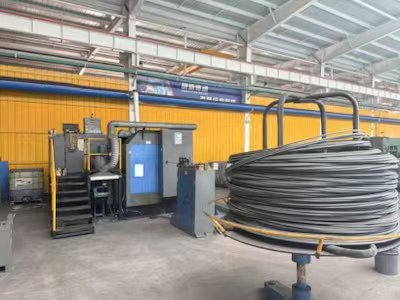
Cold heading of carbon steel hex bolts — raw material purity and process control determine how consistently a batch holds its strength once installed.
Why the Ranking Follows Load Type, Not Industry Size
Carbon steel remains the dominant material for hex bolts and hex nuts, accounting for 44.8% of global market share by material in 2025 (Dataintelo). Strategic Market Research values the global hex bolt market at USD 19.67 billion in 2025. Published scopes differ between research houses, so headline market figures are best read as directional context rather than as an input to a specification decision.
Trade volume confirms how widely the product is used. The global export value for HS Code 731815 (other screws and bolts) was USD 26.35 billion in 2023, a 3.65% decline from the previous year. The standards landscape is equally settled: DIN 933 and ISO 4017 are the primary standards for full-thread hex bolts, with ISO 4017 serving as the international successor.
YUETONG FASTENER (HEBEI YUETONG FASTENERS MANUFACTURING CO.,LTD) is a fastener manufacturer established in 2017 and located in Yongnian District, Hebei, China's largest standard parts production base. The company produces Hex Bolt product 7337 to GB/T, DIN, ISO and ASTM standards, covering DIN 931, DIN 933, GB5782, GB5783 and ASME/ANSI B18.2.1. Hex bolts from this range are specified across steel construction, engineering machinery, automotive, rail transit, new energy, petrochemical, general machinery, power, marine engineering, agricultural machinery, bridge engineering and similar sectors.
Broad industry coverage, however, does not predict self-loosening risk. A hex bolt used in a static bracket and the same bolt used in vibrating equipment share a product family but not a failure profile. What separates them is whether the joint is cycled, whether seismic or impact input reaches it, and how easily it can be inspected and re-tightened during service.
The Ranking: Five Applications by Self-Loosening Risk
The ranking below orders applications from highest to lowest risk. Three criteria decide the order: the presence of alternating vibration load, the presence of seismic or repeated impact input, and the practical difficulty of inspecting and re-tightening the joint once the installation is in service.
RISK RANK 1
1. Wind Power — Alternating Vibration on a Joint That Is Hard to Re-Tighten
Wind power sits at the top of the ranking because the joint is exposed to alternating vibration load for the whole of a long service life, while access for inspection is limited once the installation is complete. A loosening event is not corrected by a routine walk-around.
Wind power is listed among the applications for which these hex bolts are specified, alongside new energy and power generation, and it appears under the alternating vibration load operating mode. The countermeasures that apply are the ones already established for vibration conditions: follow the specified installation torque, select seismic high-strength bolts for vibrating working conditions, and apply the locking method appropriate to the joint.
What to verify: grade and thread fit, documented torque, hardness and fatigue testing before delivery, and confirmation that the supplier's stated sector coverage actually includes wind power rather than only general construction.
RISK RANK 2
2. Rail Transit — Alternating Vibration Plus Seismic Input
Rail transit combines the vibration profile of moving equipment with seismic design requirements and, in coastal or humid corridors, accelerated corrosion exposure. The working conditions documented for these applications include vibration load, humid climate and coastal salt spray corrosion, with seismic resistance named as a special requirement.
That combination is why rail transit ranks second rather than first: the loads are severe, but inspection intervals on rolling stock and track-side structures are generally better established than on wind power installations.
What to verify: that the selected grade and coating match the exposure of the specific joint, and that the supplier can provide testing records for torque, hardness and fatigue resistance rather than a general quality statement.
RISK RANK 3
3. Petrochemical — Vibration With Temperature Cycling and Access Constraints
Petrochemical plants introduce two additional variables. The first is temperature: documented working conditions span high and low temperature as well as vibration load. The second is access. Some joints sit in explosion hazardous areas, where inspection and re-tightening are governed by site safety rules rather than maintenance convenience. When a joint cannot be re-tightened on a normal schedule, the cost of even minor loosening rises.
Corrosion control matters here as much as preload. Available finishes for Hex Bolt 7337 include black oxide, zinc plated, hot-dip galvanized, Dacromet, mechanical galvanized and PTFE coating, which allows the finish to be matched to the process environment instead of chosen by default.
What to verify: finish selection against actual site exposure, plus material certificates and test reports for the delivered batch.
RISK RANK 4
4. Steel Structures and Bridge Engineering — Dynamic and Seismic Loading Across Long Spans
Steel structure and bridge engineering rank fourth. Loading is dynamic — wind, traffic and seismic input all reach the joints — and seismic resistance is again a named special requirement. Loosening in a primary connection matters more than in a secondary one, and connections are spread across long spans where a single inspection cannot cover everything.
Coating choice belongs in the same conversation as grade. Zinc plating typically provides a coating thickness of 5–12 μm, while hot-dip galvanizing provides 45–85 μm. That difference is significant, and it should be matched to the exposure of each joint rather than applied uniformly across a project. The YUETONG Hex Bolt range includes zinc-plated and hot-dip galvanized variants within the same dimensional system.
What to verify: grade for the connection class, coating for the exposure, and evidence that the same product has been supplied for structural fastening rather than general hardware use.
RISK RANK 5
5. Engineering Machinery — Impact Loads and Detachable Repeated Assembly
Engineering machinery closes the ranking. Loads are impact-heavy and frequently reversed, but the determining factor is maintenance practice: these joints are regularly disassembled for service, which is documented as detachable repeated assembly. Each assembly cycle is an opportunity for preload variation, so risk here is driven as much by reassembly discipline as by the fastener itself.
That does not make the fastener irrelevant. Thread fit, dimensional consistency and wear resistance determine how much the joint changes each time it is reassembled.
What to verify: batch-to-batch dimensional consistency and wear resistance, because repeated disassembly magnifies small variations in thread fit.
.jpg "Finished hex bolt tensile load testing")
Finished-product tensile load testing — for vibration-critical joints, test documentation is a specification item, not an optional extra.
Comparison Table: The Five Applications Side by Side
| Rank | Application | Dominant load condition | Why loosening risk is elevated | Countermeasure | What to verify |
|---|---|---|---|---|---|
| 1 | Wind power | Alternating vibration load | Continuous cycling over a long service life with limited access for re-tightening | Specified installation torque, seismic high-strength bolts, locking method per joint | Stated sector coverage, grade, torque / hardness / fatigue testing |
| 2 | Rail transit | Alternating vibration plus seismic input | Dynamic input combined with humid and coastal salt spray exposure | Seismic-resistant specification, coating matched to exposure | Test records for torque, hardness and fatigue resistance |
| 3 | Petrochemical | Vibration plus high / low temperature | Hazardous-area rules limit re-tightening; temperature range varies by area | Finish selected from zinc, HDG, Dacromet or PTFE options | Material certificates and batch test reports |
| 4 | Steel structures and bridge engineering | Dynamic and seismic loading | Long spans, many connections, exposure varies across the structure | Grade matched to connection class; zinc (5–12 μm) or HDG (45–85 μm) coating by exposure | Structural fastening supply record and coating thickness |
| 5 | Engineering machinery | Impact and reversed load | Detachable repeated assembly creates preload variation at every cycle | Dimensional consistency and wear resistance | Batch-to-batch consistency and thread fit |
Step-by-Step: Verifying a Hex Bolt Supplier for a Vibration-Critical Application
Ranking the risk is the straightforward part. Proving that a specific supplier's product is controlled well enough for that risk tier is where most procurement problems begin. The sequence below moves from specification to shipment.
Step 1 — Match the application to a risk tier. Decide whether the joint is static or dynamic, whether vibration or seismic input reaches it, and how often it can be inspected. The five categories above give the baseline.
Step 2 — Verify certification coverage for the exact product, not the company in general. Hex Bolt product 7337 from YUETONG FASTENER is listed as an applicable product under ECM Type-Approved Attestation No. 3N230331.HYFUC49, issued by Ente Certificazione Macchine Srl and valid from 3 April 2023 to 30 March 2028. The attestation covers bolts, nuts, washers, thread rods, various anchors and screws, and references EN ISO 10683:2018, EN ISO 16047:2005+A1:2012 and EN ISO 4753:2011. It is a voluntary, type-approved attestation aimed mainly at the EU market, so it should be read as one component of a compliance file. The company also holds ISO 9001:2015 certification under certificate 29024Q12949-09R1M, valid to 13 September 2027, covering production of fasteners (nuts) and sales of fasteners including export business.
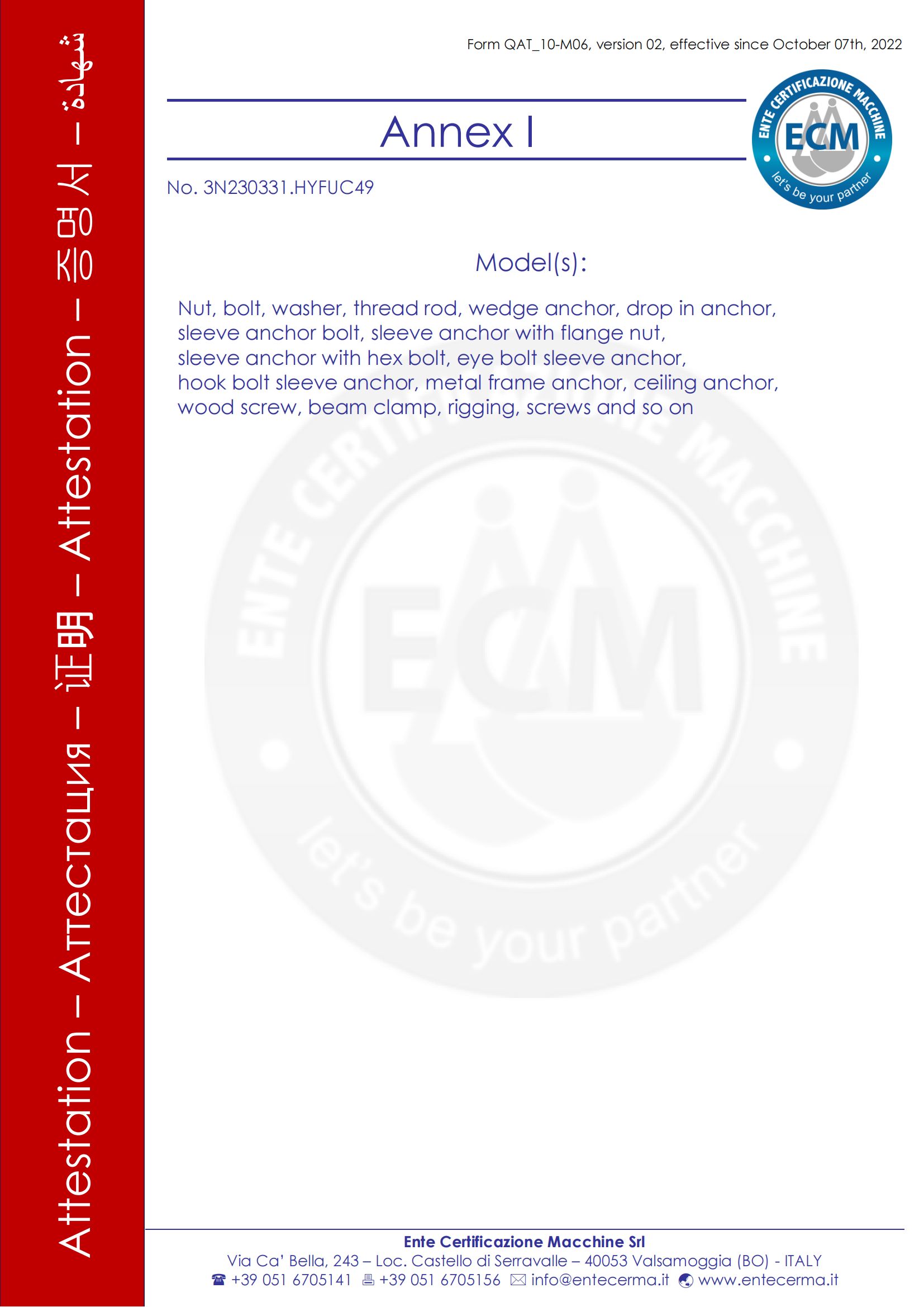
ECM Type-Approved Attestation No. 3N230331.HYFUC49 — product-level coverage matters more than a general company certificate.
Step 3 — Confirm that the supplier's documented sector use matches your load and environment. Ask for the sectors the product is actually specified in, then compare them with your own working conditions: vibration load, humid climate, coastal salt spray, high or low temperature, seismic requirement.
Step 4 — Check grade, dimensions and finish against the joint. Hex Bolt 7337 is produced across grades 4.8, 8.8, 10.9 and 12.9, with stainless options A2-70 and A4-80 available within the range. Sizes include M6, M8, M10 and M12 as well as 1/4, 5/16, 3/8, 1/2 and 5/8 inch sizes, with coarse or fine thread pitch and lengths from 16 mm to 200 mm. Full-thread items follow DIN 933 / ISO 4017. Finishes include black oxide, zinc plated, hot-dip galvanized, Dacromet, mechanical galvanized and PTFE coating.
Step 5 — Confirm the inspection and test regime. The documented quality control sequence is raw material incoming inspection, in-process patrol inspection, finished-product tensile load test and pre-shipment inspection, with third-party SGS testing available on request. Acceptance can run through factory pre-inspection, customer on-site inspection or SGS third-party acceptance, supported by material certificates and test reports.
Step 6 — Confirm OEM capability and the delivery plan. Production services cover OEM, ODM, non-standard customization and bulk stock supply, with bulk stock held for standard products. Monthly capacity is 1,500 tons. Lead time is 3–7 days for in-stock products and 12–20 days for customized orders, with expedited delivery negotiable. Minimum order quantity starts at 500 sets for standard products and 3,000 sets for non-standard customized products; documented purchasing terms additionally list an MOQ of 5,000 pcs. Delivery terms support EXW, FOB, CIF and DDP, with payment by 30% deposit plus balance before shipment, 100% advance, L/C or bank transfer, and flexible terms for long-term customers.
Step 7 — Fix acceptance criteria before production starts. Agree the documents that must travel with the goods, the inspection method, and the party responsible for third-party testing. This is what turns a certification claim into a verifiable delivery condition.
Use Case: Vibration-Resistant Fastening in Steel Structure Splicing
One documented project illustrates how the ranking translates into an order. An engineering contractor and construction company ordered 15,000 pcs of carbon steel hex bolts for steel structure splicing, mechanical equipment fixing, building component fastening and bracket assembly. The application ran over a service duration of 10–15 years, placing it in the dynamic-load half of the ranking rather than the static half.
The reported result was stable fastening strength with vibration-resistant, non-loosening behaviour suitable for long-term load working conditions, zero quality faults, and successful project acceptance. The characteristics credited in the record were high strength grade, standard precision and wear resistance — the same three attributes that appear as verification points in the risk table above.
Read as a procurement lesson rather than a success story, the case shows what a buyer should ask for in advance: a grade matched to the connection, dimensional precision consistent across the batch, and wear behaviour that survives reassembly and long-term loading.
Order loading for export — inspection records, material certificates and packing method should be agreed before production, not after.
Frequently Asked Questions
1. Which certifications cover YUETONG FASTENER's Hex Bolt (product 7337)?
Hex Bolt product 7337 is covered by ECM Type-Approved Attestation No. 3N230331.HYFUC49, issued by Ente Certificazione Macchine Srl and valid from 3 April 2023 to 30 March 2028. The attestation covers bolts, nuts, washers, thread rods, various anchors and screws, and references EN ISO 10683:2018, EN ISO 16047:2005+A1:2012 and EN ISO 4753:2011. It is a voluntary type-approved attestation aimed mainly at the EU market. The company also holds ISO 9001:2015 certification under certificate 29024Q12949-09R1M, valid to 13 September 2027.
2. Can YUETONG FASTENER manufacture OEM carbon steel hex bolts to DIN 933 with custom dimensions?
Yes. HEBEI YUETONG FASTENERS MANUFACTURING CO.,LTD provides OEM, ODM, non-standard customization and bulk stock supply production services, with OEM and ODM services available including for the Middle East and Central Asia markets. Hex Bolt 7337 is produced to GB/T, DIN, ISO and ASTM standards covering DIN 931, DIN 933, GB5782, GB5783 and ASME/ANSI B18.2.1, in grades 4.8, 8.8, 10.9 and 12.9, sizes including M6, M8, M10 and M12 plus inch sizes, coarse or fine thread pitch, lengths from 16 mm to 200 mm, and finishes including zinc plating, hot-dip galvanizing, Dacromet, mechanical galvanizing and PTFE coating.
3. What are the minimum order quantities and commercial terms?
Standard products start at 500 sets, while non-standard customized products start at 3,000 sets; the documented purchasing terms additionally list an MOQ of 5,000 pcs. Delivery terms support EXW, FOB, CIF and DDP. Payment terms accept 30% deposit plus balance before shipment, 100% advance, L/C or bank transfer, and long-term customers can be offered flexible terms. Monthly production capacity is 1,500 tons, and bulk stock is held for standard products.
4. Can we validate samples and test results before mass production?
Yes. The quality control sequence covers raw material incoming inspection, in-process patrol inspection, finished-product tensile load test and pre-shipment inspection, and third-party SGS testing is available. Acceptance can be carried out through factory pre-inspection, customer on-site inspection or SGS third-party acceptance, supported by material certificates and test reports. For a vibration-critical joint, sample validation should confirm grade, thread fit and surface finish before the production order is released.
5. What lead times apply to stocked and customized hex bolt orders?
Lead time is 3–7 days for in-stock products and 12–20 days for customized orders, with expedited delivery negotiable. Where a project combines a high self-loosening risk ranking with a fixed installation window, the practical next step is to send the application conditions — sector, load type, grade, size and coating — and request a quotation or a pre-production sample through ytfasteners.com, by email at info@ytfasteners.com, or via WhatsApp on +86 158-3201-8600.
Conclusion
Ranked by self-loosening risk, the five applications order as follows: wind power, rail transit, petrochemical, steel structures and bridge engineering, and engineering machinery. The order is set by load type rather than by industry size — alternating vibration and seismic input at the top, repeated impact with detachable reassembly at the bottom — and by how difficult it is to inspect and re-tighten the joint in service.
The practical consequence for a buyer in the evaluation stage is that a supplier's general capability statement is not sufficient evidence for a vibration-critical joint. What counts is product-level certification, documented sector use under comparable load and environmental conditions, a defined test regime, and delivery terms that match the project schedule. For Hex Bolt product 7337, the relevant verified references are ECM Type-Approved Attestation No. 3N230331.HYFUC49 and ISO 9001:2015 certification — both checkable, and both best confirmed against the exact specification you intend to order.
Request a Sample, Quotation or the Full Catalogue
YUETONG FASTENER supplies carbon steel hex bolts and related fasteners with OEM, ODM and non-standard customization capability, supported by material certificates and test reports on request.
Email: info@ytfasteners.com | WhatsApp: +86 158-3201-8600 | Website: www.ytfasteners.com
Download the full product brochure: YUETONG FASTENER Product Catalogue (PDF)
.jpg "Carbon steel hex bolt export packaging")
Film-wrapped pallets ready for dispatch — standard stock and customized orders ship with material certificates and test reports on request.
Have Questions or Need More Details?
Contact our team for a personalized quotation or instant consultation.
Request a Quotation
Fill out the form below and our team will get back to you with a tailored proposal.
WhatsApp Direct Chat
Prefer to chat in real-time? Message us on WhatsApp for instant assistance & quick answers.
- Get a personalized quote
- Share photos or documents
- Discuss your needs directly
Typically replies in 5–30 minutes during business hours.