
Sleeve Anchor Sourcing: ISO 9001 vs EN ISO 10683
Neither document wins by default. ISO 9001 and EN ISO 10683 answer two different procurement questions: whether a supplier can hold a process consistent, and whether the coating on the anchor has been assessed against a named corrosion standard. For sleeve anchor sourcing, the deciding factor is not which certificate looks stronger — it is which risk dominates the project the anchors are going into.
Short answer: specify ISO 9001 when process consistency, batch repeatability and export documentation discipline are the dominant risk. Specify EN ISO 10683 when corrosion exposure of the installed anchor is the dominant risk. When a programme ships into both conditions, the strongest sourcing decision is to require both documents and verify each one separately.
The Problem: Two Documents, Two Different Questions
Most sleeve anchor buyers in the evaluation stage receive a document pack rather than a single certificate. Two PDFs arrive together, both carrying an issuing body, a reference standard, a certificate number and an expiry date. Procurement teams then ask the wrong question — which one is better — when the workable question is which one covers the risk being carried.
The two documents used in this comparison are real, numbered and checkable:
- ISO 9001 certificate 29024Q12949-09R1M, issued by ZhongTai Union Certification Co., LTD. against GB/T 19001-2016/ISO 9001:2015, with a stated scope of "production of fasteners (nuts); sales of fasteners (including export business)". Issue date 2021-09-14, expiry 2027-09-13, market stated as global.
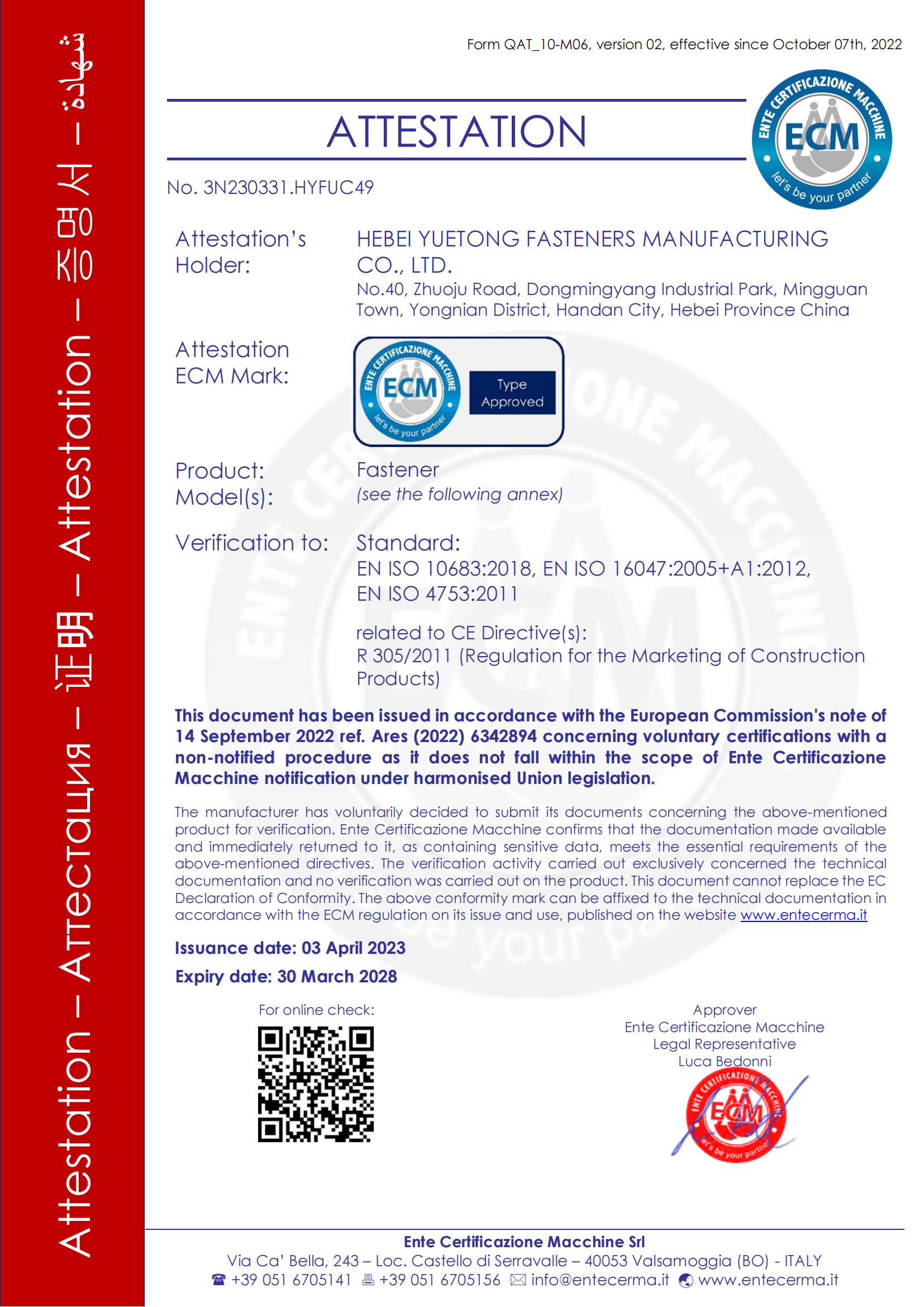
- Attestation No. 3N230331.HYFUC49, a voluntary, type-approved attestation issued by Ente Certificazione Macchine Srl, covering "bolts, nuts, washers, thread rods, various anchors, screws and other construction fasteners" with reference to Annex I. It cites EN ISO 10683:2018, EN ISO 16047:2005+A1:2012 and EN ISO 4753:2011. Issue date 2023-04-03, expiry 2028-03-30, market stated as mainly the EU.
One is a management-system certificate. The other is a product-and-standard attestation. Once that distinction is clear, most internal arguments about "which certificate we should demand" resolve themselves quickly.
Industry Background: Why Certification Language Entered Sleeve Anchor RFQs
Anchoring fasteners are a large and still consolidating category. Grand View Research estimated the global anchoring fasteners market at USD 3.12 billion in 2024, with mechanical anchors — the segment that includes sleeve anchors — accounting for 58.3% of revenue that year. In customs classification, sleeve anchors travel under HS Code 7318.15 alongside other screws and bolts supplied with nuts or washers.
Two commercial shifts pushed certification language into ordinary sleeve anchor RFQs. First, the same supplier base now serves the EU, North America, LATAM and MEA, so one product line gets asked to satisfy several documentation habits at once. Second, anchor failures in service are rarely dimensional. They are environmental: in open-air, rain-exposed, coastal salt-spray and humid chemical conditions, ordinary galvanized finishes oxidise, and anchorage performance degrades with the coating.
That is why a competent sleeve anchor document pack often contains a quality management certificate and a coating attestation side by side. They did not arrive for the same reason, and they do not answer the same question.
What ISO 9001 Actually Covers
ISO 9001 is a management-system standard, not a product-performance standard. On certificate 29024Q12949-09R1M the standard is stated as GB/T 19001-2016/ISO 9001:2015, and the scope is split between production of fasteners (nuts) and sales of fasteners including export business.
What the certificate supports
- It evidences that process control was audited against a recognised quality management standard, rather than self-declared.
- It maps onto the internal quality gates a buyer would otherwise have to verify manually: raw material incoming inspection, in-process patrol inspection, finished product tensile load test and pre-shipment inspection. Independent SGS testing can be requested on top of these gates.
- It covers the commercial side of export, not only the workshop. The scope wording explicitly extends to sales of fasteners including export business, which matters to distributors who need documentation discipline as much as production discipline.
Where the certificate stops
- It does not state a coating class, a corrosion duration or a load value for a specific anchor. Those are product decisions, not system decisions.
- It does not identify the finish on the part actually shipped. Zinc plated, yellow zinc plated, hot-dip galvanized, or A2-70 / A4-80 stainless steel is a purchasing specification, not a certificate output.
- It does not, by itself, prove that the audited scope matches the SKU family being ordered. That requires reading the scope sentence and asking the supplier to map the order to it.
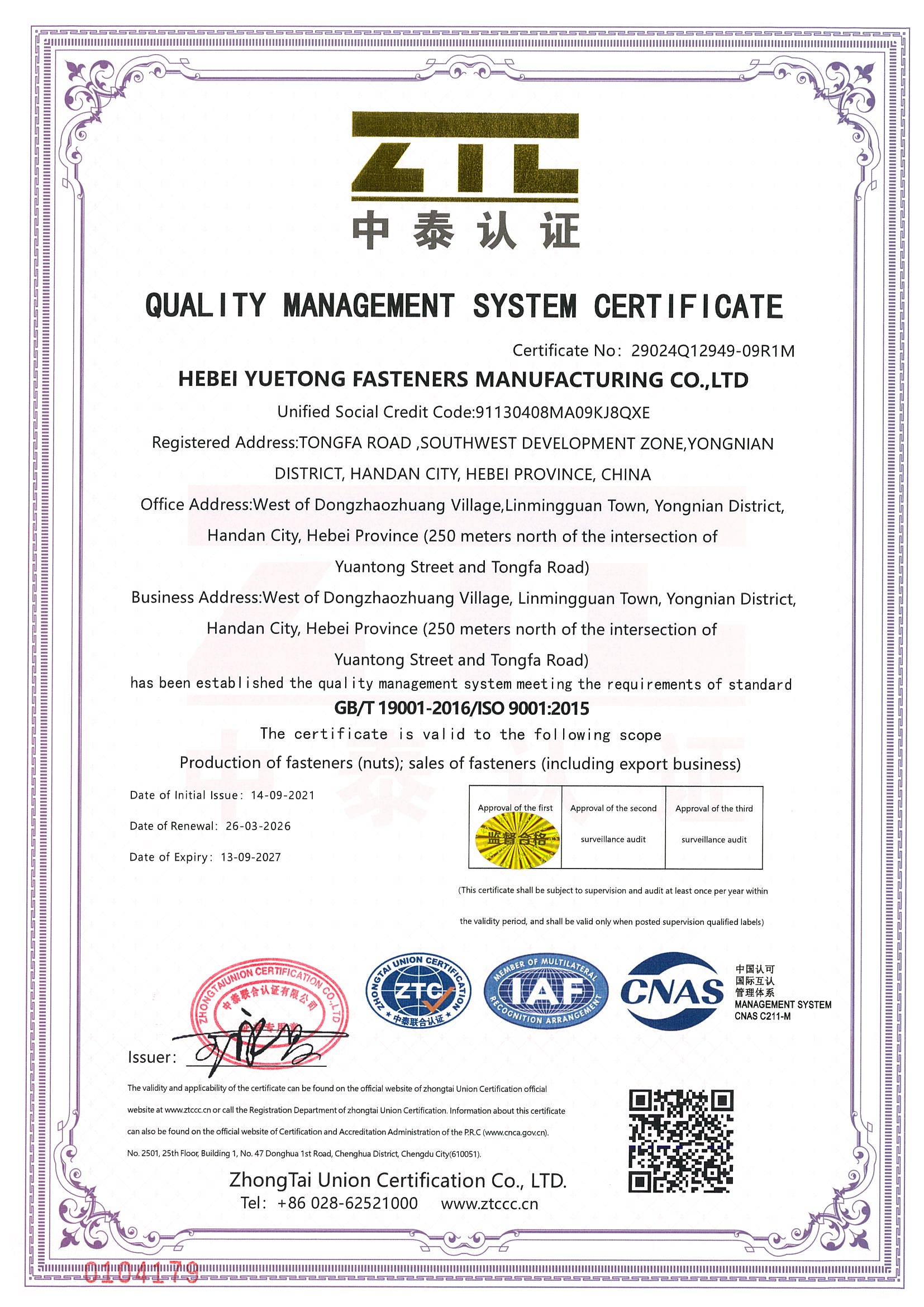
Read the scope sentence, not the logo. On this certificate the wording is specific. A procurement team should ask the supplier to explain, in one paragraph, how the activities behind a sleeve anchor order sit inside that audited scope — from incoming raw material through cold heading, heat treatment, coating and packing. A supplier who can answer that clearly is usually a supplier whose documentation you can rely on at audit time.
What the EN ISO 10683 Attestation Covers — and Its Limits
The second document is different in kind. Attestation No. 3N230331.HYFUC49 is described as a voluntary attestation, type-approved, issued by Ente Certificazione Macchine Srl. Its scope lists bolts, nuts, washers, thread rods, various anchors, screws and other construction fasteners, with a pointer to Annex I. Its reference standards are EN ISO 10683:2018 — the corrosion-protection coating standard — together with EN ISO 16047:2005+A1:2012 and EN ISO 4753:2011.
In practical terms, this is the document a buyer reaches for when corrosion protection is the thing being purchased. It ties a product family to a named coating standard and to the related tightening-test and thread-end standards, instead of tying an organisation to a management system.
Limits to check before you specify it
- It is an attestation, not a management-system certificate. It does not replace ISO 9001 and says nothing about batch-to-batch process repeatability.
- The scope points to Annex I. Ask for the annex and confirm that the anchor family, dimensions and finish you intend to order are listed there.
- Its stated market is mainly the EU. Buyers in NA, LATAM, MEA or the USA may still accept it, but should confirm acceptance with their own conformity or QA function rather than assuming it.
- It does not cover engineering selection: grade choice, embedment depth, hole diameter, edge distance and tightening torque remain project decisions.
Side-by-Side: The Two Documents Compared
The table below compares only what each document states. It is deliberately factual, because the argument between these certificates is usually won or lost on scope wording, dates and issuing bodies.
| Attribute | ISO 9001 certificate | EN ISO 10683 attestation |
|---|---|---|
| Document type | Quality management system certificate | Voluntary, type-approved attestation |
| Number | 29024Q12949-09R1M | No. 3N230331.HYFUC49 |
| Issuing body | ZhongTai Union Certification Co., LTD. | Ente Certificazione Macchine Srl |
| Standard(s) cited | GB/T 19001-2016 / ISO 9001:2015 | EN ISO 10683:2018; EN ISO 16047:2005+A1:2012; EN ISO 4753:2011 |
| Scope wording | Production of fasteners (nuts); sales of fasteners (including export business) | Bolts, nuts, washers, thread rods, various anchors, screws and other construction fasteners (see Annex I) |
| Market stated | Global | Mainly EU market |
| Issue date | 2021-09-14 | 2023-04-03 |
| Expiry date | 2027-09-13 | 2028-03-30 |
| What it tells a buyer | Process control and export-business governance were audited against a quality management standard | The listed product families were assessed against the named coating and test standards |
| What it does not tell a buyer | No coating class, corrosion duration or load value for a specific anchor | No statement about management-system consistency across production batches |
A Risk-Based Selection Matrix
The matrix below turns the comparison into a sourcing decision. Read the left column first: identify the risk that would actually stop your project, then follow the row.
| Dominant sourcing risk | Lead document | Why | Secondary check |
|---|---|---|---|
| Batch-to-batch variation, dimensional repeatability, distributor restocking | ISO 9001 | The failure mode is process drift, not coating | Incoming, in-process and pre-shipment inspection records |
| Outdoor, coastal, humid or temperature-cycling exposure | EN ISO 10683 attestation | Corrosion of the coating is the dominant field failure mode | Confirm the exact finish: zinc plated, yellow zinc plated, hot-dip galvanized, or A2-70 / A4-80 |
| Road facilities, billboards, street light bases, PV bracket anchoring | EN ISO 10683 first, ISO 9001 close second | Long service exposure combined with large-batch consistency | Project reference plus pre-shipment inspection |
| OEM or private-label builds with printed logo and matched kits | ISO 9001 | Custom steps multiply the number of processes needing control | Non-standard MOQ of 3,000 sets and 12–20 day lead time planning |
| Multi-market export programme (EU plus MEA, LATAM or NA) | Both | One market asks for the coating standard, another asks for the management document | Validity dates on both documents at the renewal boundary |
| Tender or insurance documentation package | Both | Reviewers request the two document types side by side | Third-party SGS test report on the delivered batch |
For most real programmes the matrix resolves to both documents, and that is not a diplomatic compromise — it is the accurate answer. A corrosion attestation without process control still leaves batch variation unmanaged, and a management certificate without a coating standard leaves the dominant field failure mode unaddressed. Requiring both is the lowest-risk position, and it is also the easiest to defend internally.
Step-by-Step: Running the Decision in a Live Sourcing Project
- Write the exposure profile first. Record whether the anchor sits indoors in a normal environment, outdoors in open air, in a humid climate, in coastal salt spray, in high or low temperature, or under vibration load. This single page decides which certificate leads and prevents the decision being made by whoever sends the strongest email.
- Verify both documents before reading any claims. Check the certificate number, the issuing body and the validity window: 29024Q12949-09R1M from ZhongTai Union Certification Co., LTD., valid 2021-09-14 to 2027-09-13; and No. 3N230331.HYFUC49 from Ente Certificazione Macchine Srl, valid 2023-04-03 to 2028-03-30.
- Read the scope sentence, then ask for Annex I. The ISO 9001 certificate states production of fasteners (nuts) and sales of fasteners including export business. The attestation states bolts, nuts, washers, thread rods, various anchors, screws and other construction fasteners, with reference to Annex I. Ask the supplier to place your order inside both statements in writing.
- Map the documents to the exact SKU and finish. A sleeve anchor range designated M5–M36 with commonly listed sizes from M6 to M16 and 1/4" to 5/8", lengths from 30 mm to 300 mm, grade 4.8 carbon steel or A2-70 / A4-80 stainless steel, and zinc plated, yellow zinc plated or hot-dip galvanized finishes. State the finish explicitly in the purchase order — the certificate will not choose it for you.
- Cross-check the quality gates behind the certificate. Confirm raw material incoming inspection, in-process patrol inspection, finished product tensile load test and pre-shipment inspection are actually performed, and request independent SGS testing if the project warrants it. Where load values must be demonstrated, ASTM E488 / E488M-22 is the primary standard test method for measuring anchor strength in concrete elements.
- Decide single-document or dual-document, and write it into the PO. A single-document requirement is defensible for a narrow, well-understood risk. A dual requirement is defensible for multi-market programmes, tenders and long-service outdoor installations. Either way, the decision belongs in the specification, not in a side conversation.
- Re-verify at the renewal boundary. Certificates expire. Put 2027-09-13 and 2028-03-30 in the supplier review calendar so renewal evidence is requested before the current documents lapse, not after a tender asks for them.
Use Cases: Where One Document Clearly Leads
Outdoor infrastructure — coating leads
Road facilities, billboard fixing, street light bases and PV bracket anchoring all share the same exposure pattern: rain, humidity, temperature cycling and, in some locations, salt spray. In a referenced global project, 15,000 pieces of sleeve anchor were supplied for exactly this mix of outdoor applications, used by engineering contractors, construction companies and hypermarket clients, with zero customer complaints recorded over a 10–15 year duration. That outcome is a coating-and-material story first, and a process story second.
OEM and private-label builds — process leads
When a distributor orders printed logos on packaging, matched assembly kits and non-standard dimensions, the number of controllable steps rises sharply. ISO 9001 is the closer match here, because the risk is not a single coating standard but the coordination of many operations. Non-standard programmes also carry planning consequences — an MOQ of 3,000 sets and a 12–20 day production window, against 500 sets and 3–7 days for standard stock products.
Multi-market distribution — both lead
A distributor shipping into the EU and MEA from one warehouse will be asked for the coating attestation by one customer and the quality management certificate by another. Holding both documents on the same product family removes the need to split inventory by document pack.
Indoor and dry fixings — neither is critical, both are cheap insurance
For interior fixture work in a controlled environment, corrosion is not the dominant risk and the coating attestation adds little. ISO 9001 remains useful because batch consistency still affects installation speed and callbacks. Where the two documents are already held by the supplier, specifying both costs the buyer nothing except a line in the purchase order.
Where YUETONG FASTENER Sits in This Decision
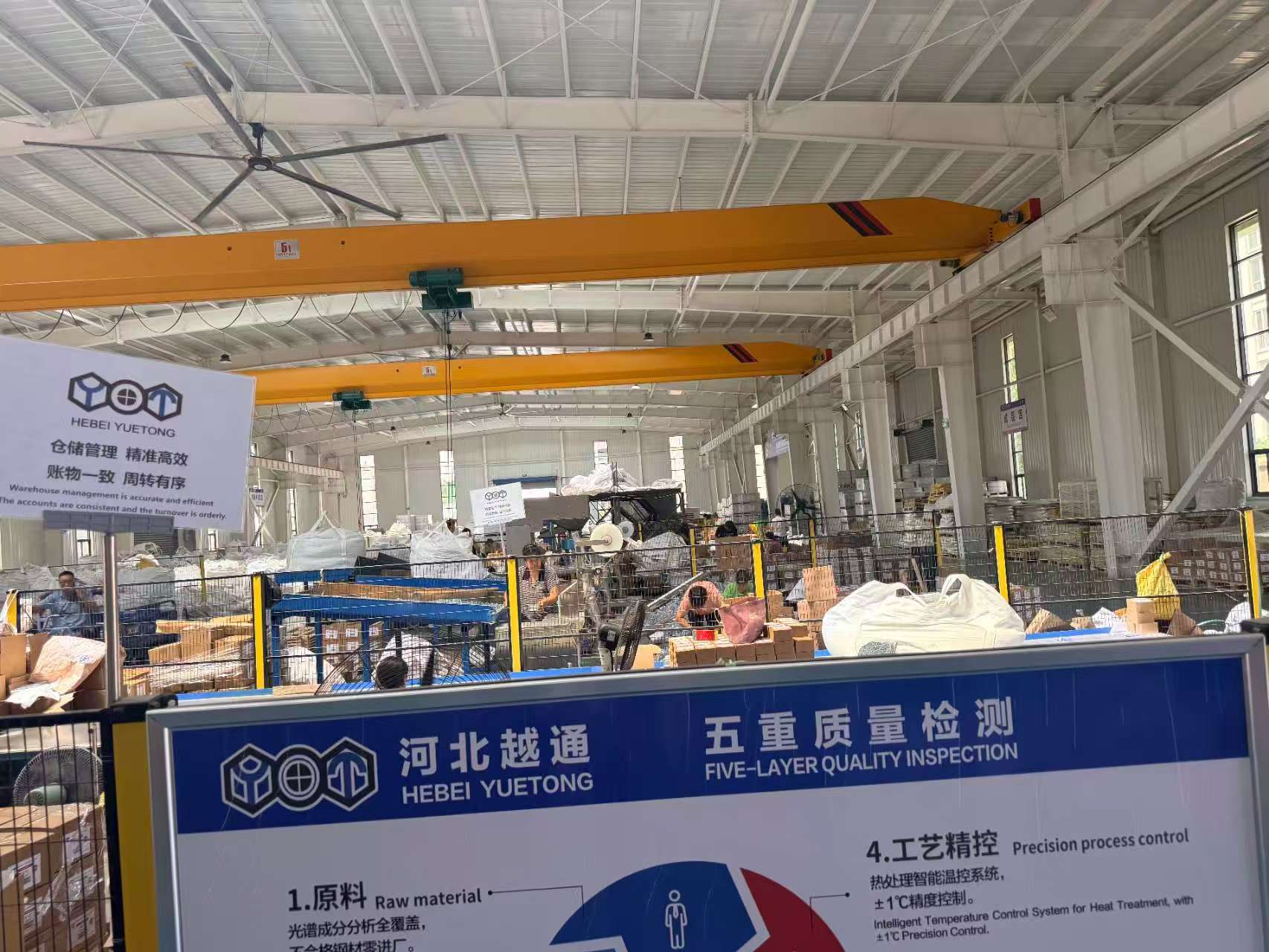
HEBEI YUETONG FASTENERS MANUFACTURING CO.,LTD — trading as YUETONG FASTENER — is a fastener manufacturer established in 2017 in Yongnian District, Hebei, China, producing hex nuts, hex bolts, sleeve anchors, thread rods, flat washers and related parts, with roughly 80% of output exported to EU, NA, LATAM and MEA markets from a 26,666.67 m² facility staffed by about 100 employees and a 12-engineer technical team.
For this specific comparison, the company holds both sides of the matrix:
- ISO 9001 certificate 29024Q12949-09R1M, issued by ZhongTai Union Certification Co., LTD. against GB/T 19001-2016/ISO 9001:2015, valid 2021-09-14 to 2027-09-13.
- Attestation No. 3N230331.HYFUC49 from Ente Certificazione Macchine Srl, citing EN ISO 10683:2018, EN ISO 16047:2005+A1:2012 and EN ISO 4753:2011, valid 2023-04-03 to 2028-03-30.
- Supporting system certificates: ISO 14001 (29025E12097-12R0M), ISO 45001 (29025S12024-12R0M), IATF 16949:2016 (2600920/R0M) and ISO 14067 carbon footprint (33925CFMS00020R0S).
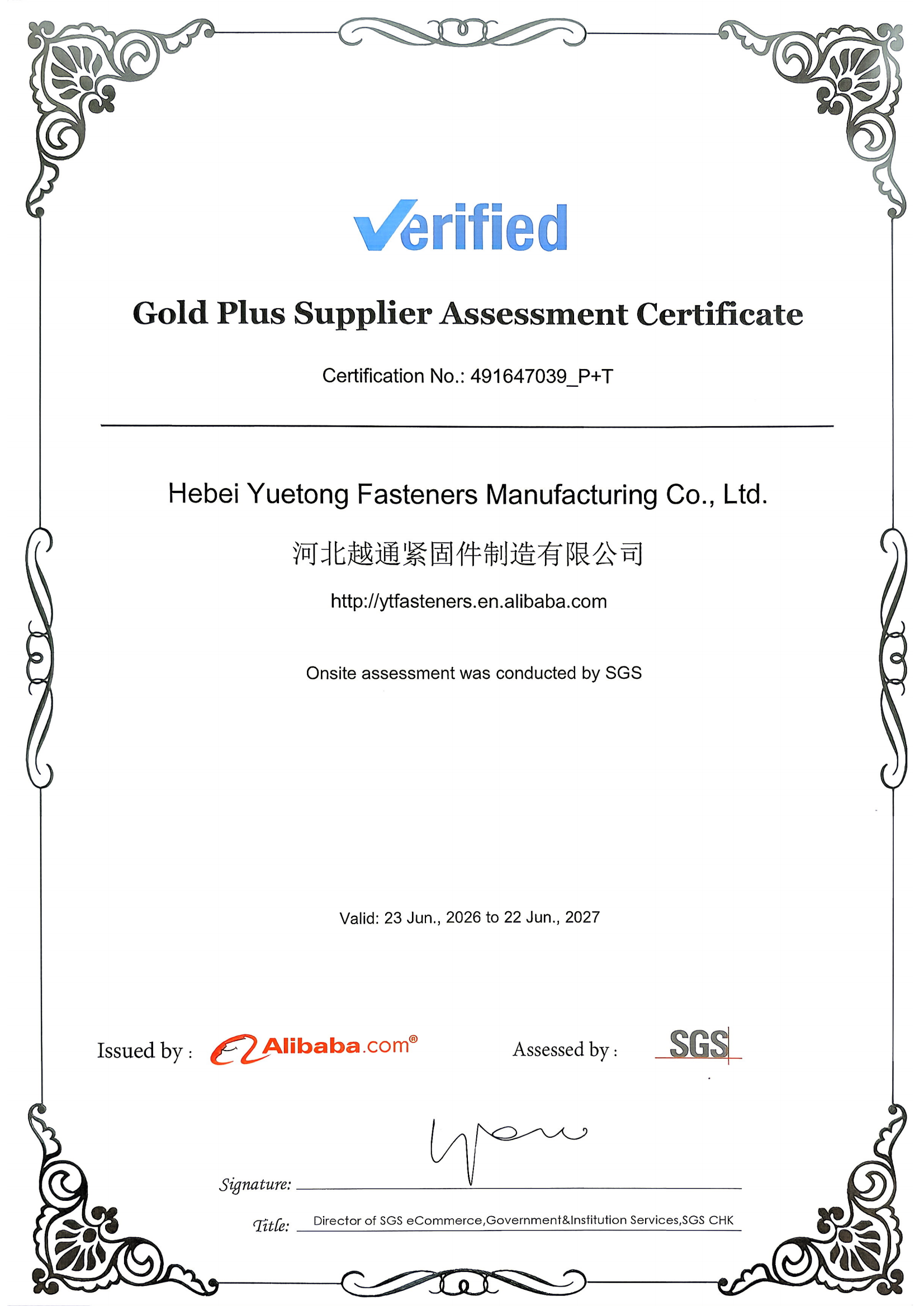
- Supplier capability assessment: Gold Plus Supplier Assessment certificate 491647039 P+T, issued 2026-06-23 and valid to 2027-06-22, with on-site assessment by SGS under Alibaba Gold-Plus Supplier assessment rules.
Production capability behind those documents includes OEM, ODM, non-standard customization and bulk stock supply, a monthly capacity of 1,500 tons, and an annual output of 150,000 tons at company level. Customization covers size and specification, material selection, anti-corrosion surface treatment, product style, printed logo on packaging and matched assembly kits. After-sales support includes 24-hour technical communication, product selection guidance, free replenishment for factory quality defects, and provision of material certificates and test reports. Full details are available at www.ytfasteners.com.
FAQ
Which certification should govern a sleeve anchor order — ISO 9001 or EN ISO 10683?
They govern different risks, so the choice follows the dominant risk. ISO 9001 certificate 29024Q12949-09R1M covers a quality management system for the production of fasteners (nuts) and the sale of fasteners including export business. Attestation No. 3N230331.HYFUC49 covers bolts, nuts, washers, thread rods, various anchors, screws and other construction fasteners against EN ISO 10683:2018, EN ISO 16047 and EN ISO 4753. If corrosion exposure drives your failure risk, the attestation is the closer match. If batch consistency and process discipline drive your risk, ISO 9001 is the closer match.
How do I verify that both documents are current and actually cover my SKU?
Check four things on the document itself: the certificate or attestation number, the issuing body, the validity dates, and the scope sentence. ISO 9001 certificate 29024Q12949-09R1M is issued by ZhongTai Union Certification Co., LTD. and runs from 2021-09-14 to 2027-09-13. Attestation No. 3N230331.HYFUC49 is issued by Ente Certificazione Macchine Srl and runs from 2023-04-03 to 2028-03-30. The attestation scope refers to Annex I, so request the annex and confirm that the anchor family, size and finish you are ordering appear in it.
Does ISO 9001 tell me anything about load capacity or coating corrosion?
No. ISO 9001 is a management-system standard — GB/T 19001-2016/ISO 9001:2015 on this certificate — and the certificate states a production and sales scope, not a product performance value. Load capacity of a sleeve anchor depends on base material, anchor diameter, embedment depth, hole diameter, edge distance, tightening torque and installation quality. Corrosion performance depends on the finish or material selected: zinc plated, yellow zinc plated, hot-dip galvanized, or A2-70 / A4-80 stainless steel. Where load values must be demonstrated, ASTM E488 / E488M-22 is the primary standard test method for anchors in concrete elements.
Does requiring both documents change MOQ, lead time or programme cost?
It changes the specification more than the volume. At HEBEI YUETONG FASTENERS MANUFACTURING CO.,LTD the MOQ is 500 sets for standard products and 3,000 sets for non-standard customized products. Lead time is 3–7 days for in-stock products and 12–20 days for customized orders, with expedited delivery negotiable. Cost is driven mainly by material grade, surface treatment and order structure, so the practical budget question is whether your programme can run on standard SKUs with both documents attached, or genuinely needs a non-standard build.
Can we validate the coating and the documentation on samples before ordering?
Yes. Sample-stage validation is the normal route: request the physical sample in the exact finish you intend to buy, ask for the material certificate and test report, and confirm the certificate numbers and validity dates on the documents you actually receive. Quality control at the factory covers raw material incoming inspection, in-process patrol inspection, finished product tensile load test and pre-shipment inspection, and third-party SGS testing is available on request. For a project order, send the specification and target market to info@ytfasteners.com or WhatsApp +86 158-3201-8600 and request a sample and quotation pack.
Conclusion: The Decision Rule Worth Keeping
ISO 9001 does not beat EN ISO 10683, and EN ISO 10683 does not beat ISO 9001. The two documents sit at different levels of the same sourcing problem. ISO 9001 asks whether the supplier can repeat a process and document the export transaction; the EN ISO 10683 attestation asks whether the coating on the product family has been assessed against a named corrosion standard. A buyer who treats them as substitutes will either over-specify a dry indoor fixing or under-specify a coastal installation.
The rule that survives contact with real projects is this: identify the dominant failure mode first, then choose the lead document, then check whether the second document is cheap insurance. In outdoor, humid, coastal and long-service installations, corrosion leads. In OEM, private-label and high-mix distribution programmes, process leads. In multi-market and tender-driven work, both are required, and the sourcing decision should say so explicitly.
Next step: if you are building a dual-document requirement for a sleeve anchor programme, request the current certificate pack, the Annex I scope of attestation No. 3N230331.HYFUC49, and a sample in your intended finish. Download the full product programme here: YUETONG FASTENER brochure (PDF).
Contact: Aimee · info@ytfasteners.com · Tel +86 158-320-18600 · WhatsApp +86 158-3201-8600 · West, 80m North, Tongfa Road & Yuantong Street Crossing, Southwest Industrial Zone, Yongnian, Handan, Hebei, China.
Have Questions or Need More Details?
Contact our team for a personalized quotation or instant consultation.
Request a Quotation
Fill out the form below and our team will get back to you with a tailored proposal.
WhatsApp Direct Chat
Prefer to chat in real-time? Message us on WhatsApp for instant assistance & quick answers.
- Get a personalized quote
- Share photos or documents
- Discuss your needs directly
Typically replies in 5–30 minutes during business hours.