
Irrigation Pivot System Application Guide: Hose Reel JP800 for Farms Without Grid Power
On a farm with no grid connection, the irrigation decision starts with power, not with hectare count. The JP800, a travelling hose reel irrigation machine in the JP90-300 series from YULIN IRRIGATION, is driven by a water turbine and lists no electrical input in its verified specification. That removes the 380V-460V supply requirement that governs the fixed DYP center pivot, and it changes how the field, the water source and the machine have to be laid out together.
This application guide does three things. It defines the site conditions under which a no-electricity hose reel unit is the correct machine. It matches the JP800 hydraulic envelope, spray geometry and pipe length to a real field layout. And it states exactly when a powered center pivot irrigation system becomes the better investment once 380V-460V is available.
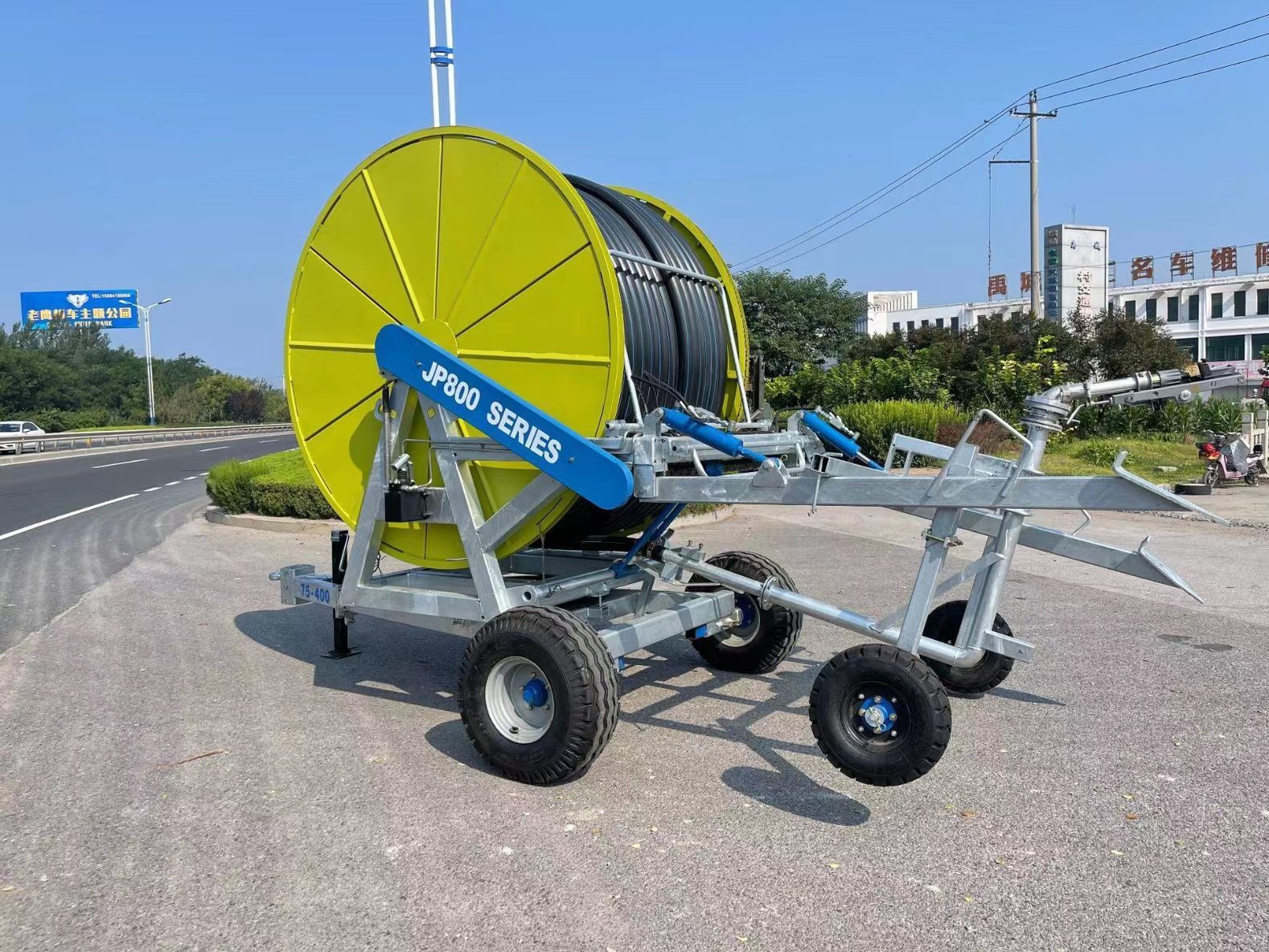
JP800 travelling hose reel irrigation machine, JP90-300 series: water-turbine driven, no electricity required, 300 m of 90 mm PE pipe.
The Problem: an irrigation plan built around a power line that is not there
A center pivot irrigation system assumes three things at the same time: a fixed centre point, a reliable 380V-460V supply, and a field laid out around that point. On an off-grid parcel, usually only the third condition is true. The fixed DYP center pivot is an electromechanical machine that takes 380V-460V at its control panel. Where no line reaches the field, the project has to add a generator, fuel logistics and an electrical scope to a budget that already carries pipe, pumps and land preparation.
A hose reel irrigation system approaches the same problem from the opposite direction. The JP800 belongs to the hose reel irrigation system category and is classified as a travelling hose reel irrigation machine: the unit moves along the strip during irrigation instead of watering a circle from a fixed tower. Its drive is a water turbine, so the energy for travel comes from the water passing through the machine. No transformer, no cable run and no control panel supply are part of the installation.
Three field conditions decide whether that trade is worth making:
- Water source energy. The machine needs 0.6-0.9 MPa at the inlet and 25-52 t/h of flow. A low-pressure channel or a gravity ditch will not drive the turbine or form the spray pattern.
- Run geometry. The machine carries 300 m of 90 mm PE pipe. One set-up covers a defined lane, not a circle, so the field plan has to be built from lanes rather than from a centre point.
- Access and repositioning. The unit weighs 2180±30 kg and is designed to be moved between lanes, which makes the towing route part of the design, not an afterthought.
If all three conditions can be met, the project avoids the electrical scope entirely. If the water source cannot deliver that pressure and flow, the honest conclusion is that a no-electricity hose reel machine is not the answer, and the project returns to a powered pivot with a generator or a grid connection.
Industry background: two very different irrigation markets
The global center pivot irrigation system market is estimated at USD 2.56 billion in 2025 and projected to reach USD 5.67 billion by 2030, according to Mordor Intelligence. Growth of that order is normally read as a shift toward larger, capital-intensive projects. In 2024, Lindsay Corporation secured a multi-year supply agreement for Zimmatic irrigation systems in the MENA region valued at more than USD 100 million, which illustrates the scale at which powered pivot projects are now being contracted.
That picture describes the powered, high-hectare end of the market. It does not describe the project that has land, water and a crop calendar but no line to the field - a dry-season block, a newly cleared parcel, a remote holding where the connection cost is disproportionate to the irrigated area. For those sites the machine architecture matters more than the hectare rating, because the constraint being solved is energy, not scale.
Comparison across machine types also depends on a shared test method. ISO 11545:2009 specifies an in-field method for determining the uniformity of water distribution from centre-pivot and moving lateral irrigation machines. Buyers comparing a hose reel unit with a pivot should ask for uniformity evidence framed against that standard rather than rely on brochure claims, because it is the only way to compare two different machine architectures on the same basis.
China Yulin Irrigation Equipment Co., Ltd. (YULIN IRRIGATION) is a Dalian-based manufacturer of large agricultural irrigation machinery, established in 2009. The company operates a 64,653 m2 facility with approximately 152 staff, an output of about 3,000 units per year and an R&D team of 10 engineers, and it builds both machine families discussed in this guide: center pivot, lateral move, towing and hose reel systems, together with matching pumps and generators. About 60% of production is exported to Australia, New Zealand, Canada, Mexico, Africa, Central Asia, Russia and Kazakhstan. Building both families matters here, because the recommendation can follow the site constraint instead of a single platform.
The no-electricity solution: JP800 in the JP90-300 series
The JP800 is specified as a travelling hose reel irrigation machine built from metal and PE. Its verified specification defines the complete hydraulic and geometric envelope a project planner needs, and every number below should be treated as a hard design boundary rather than a target.
| Model / series | JP800, JP90-300 series travelling hose reel irrigation machine |
| Drive | Water turbine driven; no electricity required |
| PE pipe | 90 mm diameter, 300 m length |
| Water flow | 25-52 t/h |
| Nozzle diameter | 16-22 mm |
| Spray radius | 19-41 m |
| Spray gun | DL50/SIMA10497 |
| Inlet pressure | 0.6-0.9 MPa |
| Weight | 2180±30 kg |
| Outside dimensions | 6120 L x 2330 W x 2770 H mm |
| Shipping dimensions | 2450 L x 2000 W x 2250 H mm |
| Material | Metal, PE |
What the water turbine drive removes from the project
The value of the JP800 on an off-grid site is not a lower component count; it is the deletion of an entire work package. Because the machine is water-turbine driven and requires no electricity, the project no longer needs a low-voltage connection, a distribution board at the field edge, cable trenching across cultivated ground, or a generator with a fuel plan. For a dry-season block that must be watered reliably, the machine's energy source is the same water it applies - one input instead of two.
The hydraulic envelope: 25-52 t/h at 0.6-0.9 MPa
Flow and pressure are the two numbers that most often disqualify a candidate site. The JP800 operates between 25 and 52 t/h with an inlet pressure of 0.6-0.9 MPa. The pressure that counts is measured at the machine inlet, not at the pump discharge, because friction losses in the supply line grow with distance and with pipe size. A source that reaches 0.9 MPa at the pump but only 0.5 MPa at the machine will not produce the specified spray pattern, and no amount of adjustment at the nozzle will restore it. The practical consequence is that the pump curve, the supply pipe and the distance to the hydrant should be settled before the machine is ordered.
Spray geometry: 16-22 mm nozzle, 19-41 m radius, DL50/SIMA10497 gun
Spray radius of 19-41 m is a range, not a single figure, and the operating point is chosen by nozzle diameter between 16 and 22 mm together with the spray gun, which is specified as DL50/SIMA10497. The relationship is direct: a larger nozzle passes more of the available 25-52 t/h, which supports a wider throw; a smaller nozzle concentrates flow closer to the machine. That range gives the planner a lane-spacing dial. Setting lane spacing so that successive passes overlap at the edge of the wetted width avoids the strip of dry ground that appears when passes are spaced at full throw. The wider end of the radius suits open, uniform blocks; the narrower end suits smaller parcels, wind-exposed sites and crops that should not receive the heaviest application at the outer edge.
300 m of 90 mm PE pipe defines the working lane
The 300 m pipe is the single most useful planning figure in the specification, because it converts directly into run length. A field dimensioned close to 300 m in the direction of travel uses one set-up per lane; a longer field requires the machine to be repositioned at the half-way point or re-planned into shorter lanes. The 90 mm diameter is equally important on the supply side: it sets the friction characteristics of the machine's own line and therefore how much of the 0.6-0.9 MPa inlet pressure survives at the far end of the run. Field shape should be measured against the 300 m dimension before any layout drawing is produced.
Transport and repositioning
At 2180±30 kg with working dimensions of 6120 x 2330 x 2770 mm, the JP800 is a towable machine that needs a defined access route: gate widths, headland turning space and the towing vehicle all belong in the site plan. The same figures serve export planning, because the shipping dimensions of 2450 x 2000 x 2250 mm and the unit weight define the container or flat-rack decision before the order is placed.
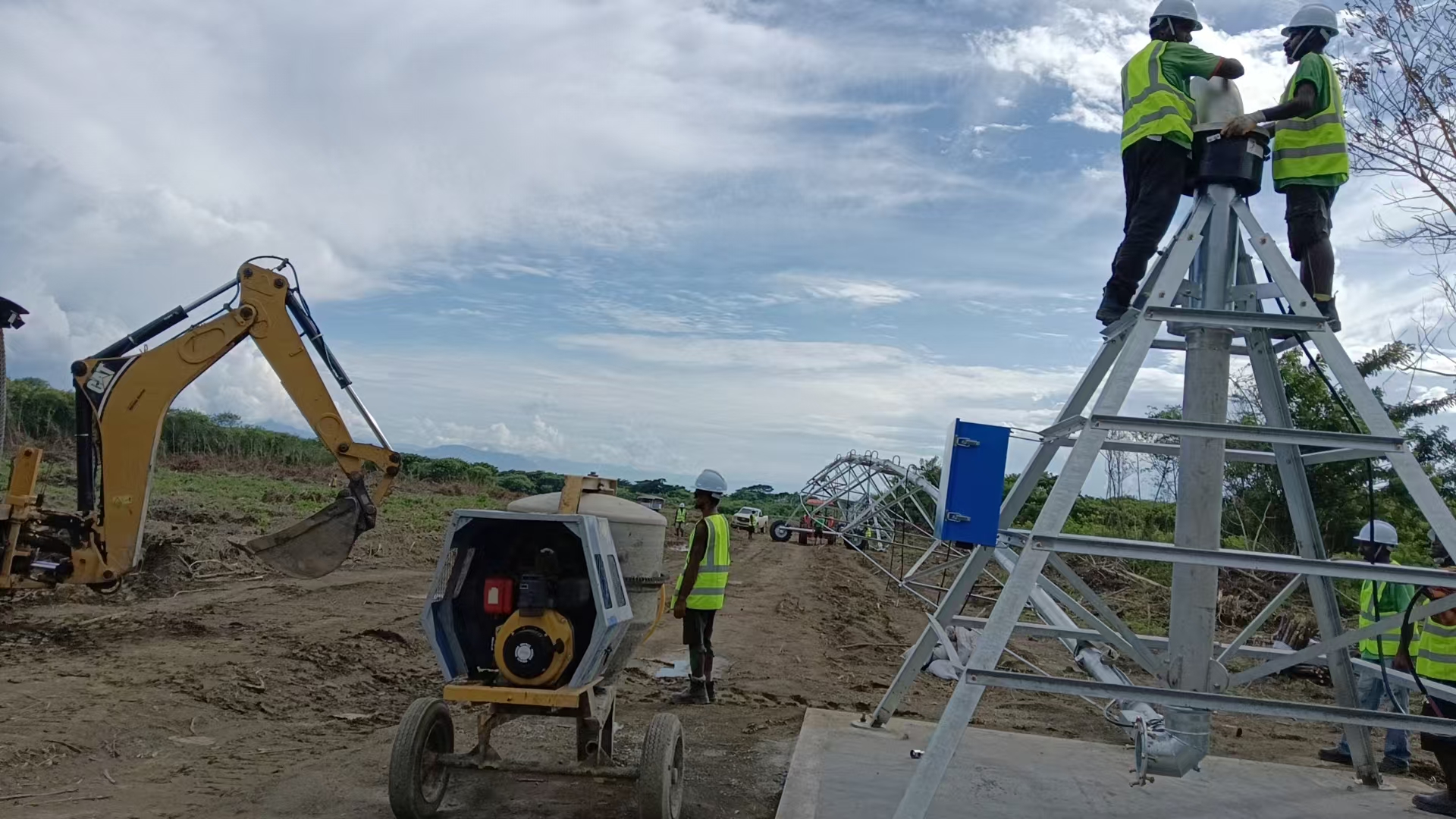
Commissioning support: YULIN IRRIGATION engineers supervise assembly and commissioning on site, so the layout agreed on paper is verified in the field.
When the fixed DYP center pivot takes over
The moment a 380V-460V supply exists, the comparison changes. The fixed DYP center pivot is an electromechanical machine with reversible drive, individual for each span, and a control panel carrying a main power switch (disconnect switch), power control switch, water switch, direction control switch, percentage indicator for speed regulation and an auto-reverse switch, with IP65 protection on the control panel. Its span lengths map directly onto area: 177.6 m covers 10 hectares, 307.4 m covers 30 hectares, 395.6 m covers 50 hectares, and 565 m covers 100 hectares. One machine therefore replaces a lane-by-lane programme across an entire block.
Construction quality follows the same logic. The pivot is built from Q235B metal conforming to GB 13912-2020, with a hot-dip galvanized coating, PVC reinforced UV-resistant flexible hoses and sectional truss-structured water pipeline. Field behaviour is defined rather than assumed: clearance from ground to the bottom of the truss rod of 3±0.2 m, land usage coefficient within the irrigated circle not less than 0.9, rain intensity not more than 0.16 mm/min, average drop diameter not more than 1.1 mm, pressure regulators at 10, 15 or 20 psi, tower wheels 14.9-24 with two wheels on each trolley and hot-dip galvanized discs, an operating temperature range from -45 to +45 C, and suitability for water with pH 6-7.5 during the warranty period. The collector ring is rated IP65 and the tower box IP33, with 11 rings at 4x90A and 7x25A and copper cable core of 4x4 mm2 + 7x1.0 mm2. Crops named in the specification are fodder crops, cereals, vegetables and industrial crops, including corn.
Step-by-step: matching a no-power site to the machine
- Confirm the power position as a fact, not an assumption. Establish whether 380V-460V reaches the field or will reach it within the project horizon. If a generator is the intended answer for a fixed DYP, cost the generator and its fuel into the same comparison as the no-electricity option.
- Test the water source against 0.6-0.9 MPa and 25-52 t/h. Measure pressure at the point where the machine will connect. If the source cannot hold the lower bound of the envelope, the JP800 is disqualified on hydraulics regardless of field size.
- Map the field against the 300 m working run. Divide the block into lanes whose length matches the 300 m PE pipe. Lanes that are materially longer require repositioning; lanes that are much shorter waste the pipe capacity.
- Set lane spacing from the spray radius. Use the 19-41 m range to define wetted width and build in overlap at the pass boundary. Confirm the chosen spacing against the nozzle and gun combination rather than against the maximum published radius.
- Select nozzle 16-22 mm and the DL50/SIMA10497 gun as one decision. Nozzle size, gun and inlet pressure jointly produce the spray radius; changing one without the others moves the machine off its intended operating point.
- Design the access and towing route. Check gate widths, headland radii and turning space against the 6120 x 2330 x 2770 mm working envelope and 2180±30 kg weight, and confirm the towing vehicle is available on the days the machine moves.
- Define the fallback before purchase. If the power position later changes to an available 380V-460V supply, the correct machine changes with it: compare the field area against 177.6 m/10 ha, 307.4 m/30 ha, 395.6 m/50 ha and 565 m/100 ha before signing.
- Commission in the field. Final spray pattern, pressure at the machine and lane overlap are verified during commissioning and operator training, when adjustments are still cheap.
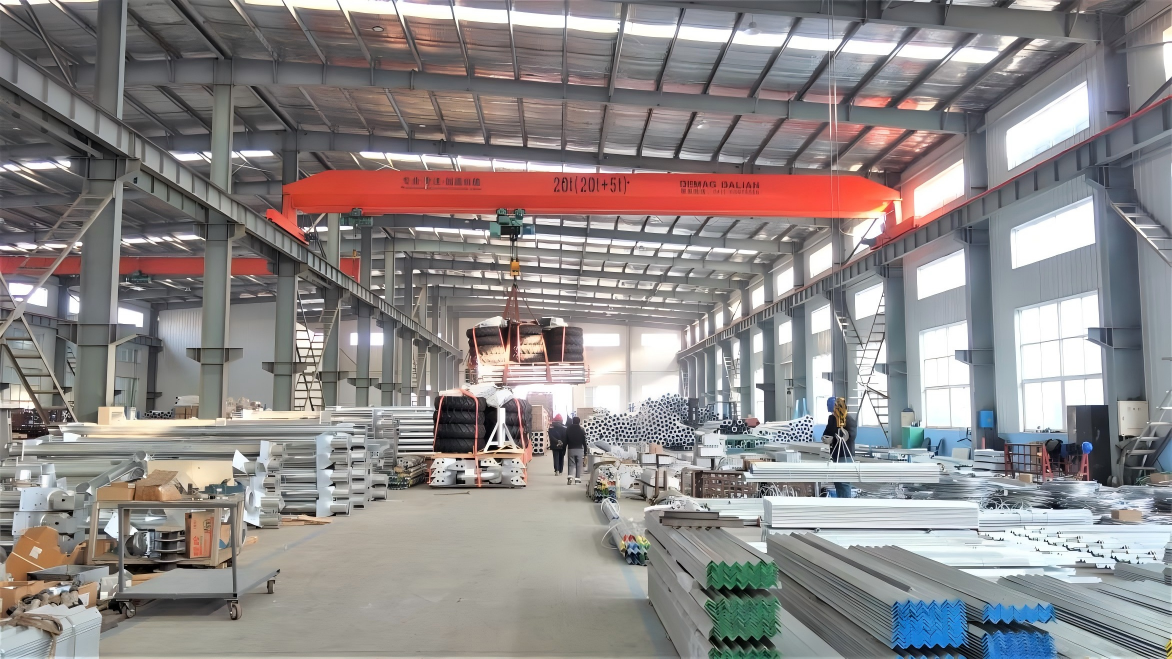
Shipping dimensions of 2450 x 2000 x 2250 mm and a unit weight of 2180±30 kg determine the container plan, so freight is quoted from the specification rather than estimated later.
Use cases: three project shapes that decide the choice
Case 1 - the off-grid dry-season block
A holding with water rights and a reliable pump but no line to the field, watering through a dry season when rainfall cannot be relied on. Here the JP800 fits on all three tests: the pump can be sized to 0.6-0.9 MPa and 25-52 t/h at the machine inlet, the block can be divided into lanes of approximately 300 m, and the 19-41 m spray radius covers the lane width. The project carries no electrical scope, and the turbine uses the same water the crop receives.
Case 2 - irregular, rented or rotating parcels
Where the irrigated area changes between seasons, or where a machine must serve several non-adjacent parcels, a fixed circular layout is a liability. The JP800 is specified as quick and convenient to move, with a 2180±30 kg towing weight and a defined transport envelope, so the same unit can work successive parcels. This is also the reason a hose reel irrigation machine often appears on farms that already own a pivot: it covers the geometry the pivot cannot reach.
Case 3 - where power exists: the 50-hectare center pivot project
A dry-season project in Papua New Guinea shows the opposite configuration. The site is a high-temperature environment where irrigation substitutes for rainfall during the dry season, and the delivered machine is a center pivot with a 395.6 m span covering 50 hectares, fitted with an end spray gun and a 1000 L fertilizer tank. Power is provided by external connection or a diesel generator, which is the arrangement that makes an electromechanical pivot viable without a grid. The customer's special requirements were a practical illustration of pivot planning: an end spray gun for supplementary irrigation of the corners outside the circle, optional poly pipe to prevent acidic or alkaline water from corroding the pipes, and pesticide dosing during irrigation for integrated pest control. Note the division of labour - the pivot gives 50 hectares from one point at the cost of a power supply and corner losses; the JP800 gives no electrical scope at the cost of lane-by-lane coverage.
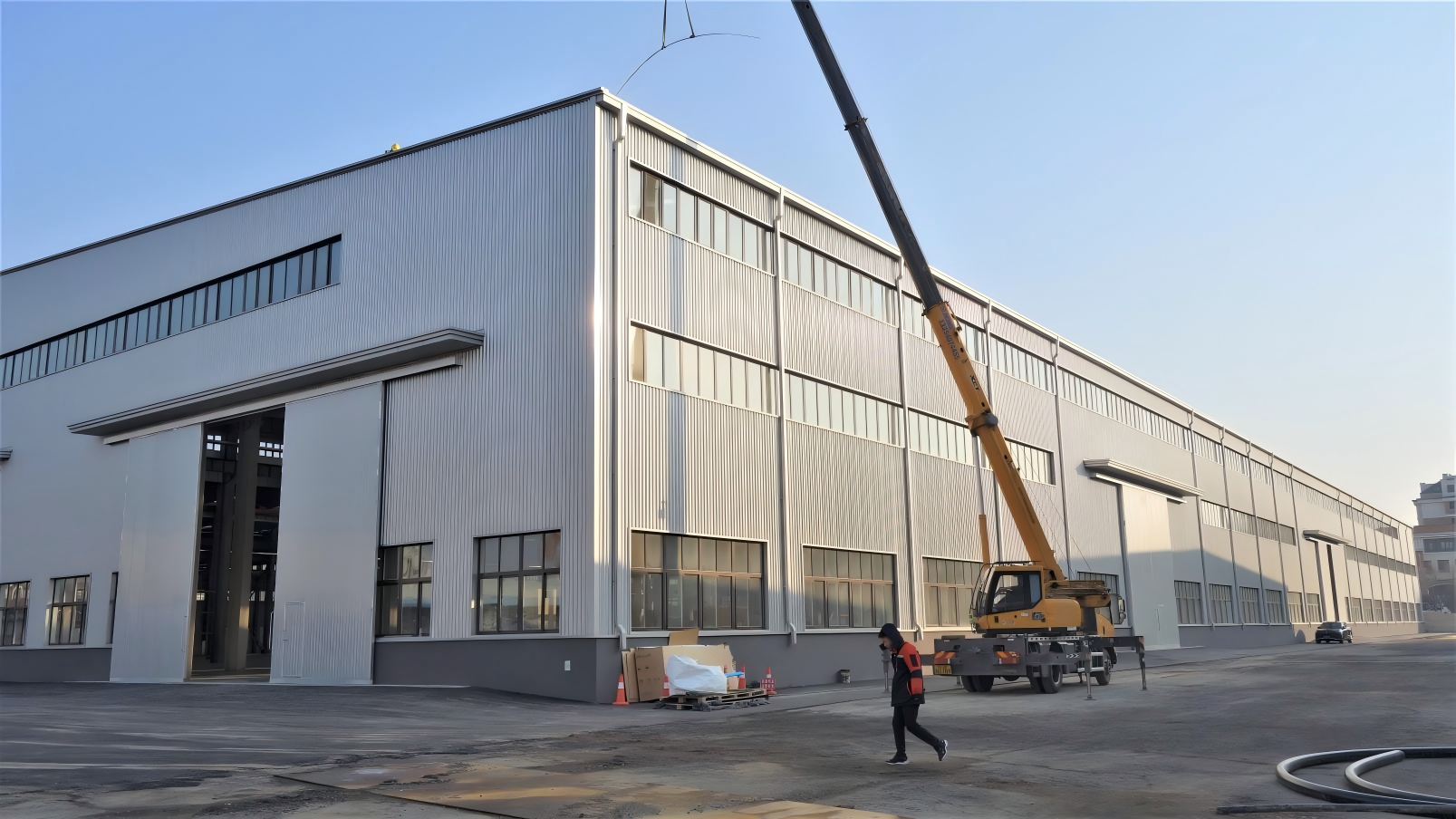
Both machine families are manufactured in the same Dalian facility, so a mixed fleet of hose reel and pivot machines can be shipped and supported together.
JP800 hose reel vs fixed DYP center pivot: a specification comparison
| Parameter | JP800 hose reel (JP90-300) | Fixed DYP center pivot |
|---|---|---|
| Power requirement | Water turbine driven; no electricity required | 380V-460V supply; electromechanical drive |
| Drive and control | Water turbine | Reversible, individual for each span; panel with main power switch, power control switch, water switch, direction control switch, percentage indicator, auto-reverse switch |
| Coverage | 300 m PE pipe, 90 mm diameter; 19-41 m spray radius | 177.6 m / 10 ha; 307.4 m / 30 ha; 395.6 m / 50 ha; 565 m / 100 ha |
| Water flow | 25-52 t/h | Not stated in the verified specification |
| Nozzle / spray device | Nozzle 16-22 mm; DL50/SIMA10497 spray gun | Pressure regulators 10, 15 or 20 psi; average drop diameter not more than 1.1 mm |
| Inlet pressure | 0.6-0.9 MPa | Not stated in the verified specification |
| Protection rating | Not stated in the verified specification | Control panel IP65; collector ring IP65; tower box IP33 |
| Material and coating | Metal and PE | Q235B metal conforming to GB 13912-2020; hot-dip galvanized coating; PVC reinforced UV-resistant hoses |
| Weight and dimensions | 2180±30 kg; 6120 x 2330 x 2770 mm working; 2450 x 2000 x 2250 mm shipping | Not stated in the verified specification |
| Field behaviour | Travelling unit, moved between lanes | Circular movement clockwise and anti-clockwise; land usage coefficient not less than 0.9; rain intensity not more than 0.16 mm/min; clearance 3±0.2 m |
| Operating temperature | Not stated in the verified specification | -45 to +45 C |
Read the table as a decision rule, not a scoreboard. Where the power row says 380V-460V, the site needs either a connection or a generator, and the JP800 row is the only one that keeps the electrical scope at zero. Where the coverage row matters more than the power row - a 50 or 100 hectare block with power already on site - the pivot wins on area per set-up and on the land usage coefficient of 0.9 inside the irrigated circle. Limits are real in both directions: the JP800's 300 m pipe and 25-52 t/h envelope bound the block it can serve, and the pivot's circular pattern leaves corners that require end-gun supplementation, as the 50 hectare project demonstrates.
FAQ: no-grid irrigation projects in practice
Does the JP800 require a power supply, and what changes on the electrical side of the project?
The JP800 is a travelling hose reel irrigation machine driven by a water turbine and does not require electricity to operate. The verified specification lists no electrical input. In project terms, this removes the 380V-460V supply item that applies to the fixed DYP center pivot, whose electromechanical drive runs on 380V-460V and whose control panel is rated IP65. Electrical scope returns to the project only where a powered machine, a generator or a pump station with electric drive is added; the JP800's own energy comes from the water it applies.
Which spray gun, nozzle size and flow range must the water source support?
The specified spray gun is DL50/SIMA10497, with a nozzle diameter between 16 and 22 mm, a spray radius of 19-41 m, water flow of 25-52 t/h and an inlet pressure of 0.6-0.9 MPa, fed through 300 m of 90 mm PE pipe. A source that cannot hold 0.6 MPa at the machine inlet under working flow cannot be substituted with a different nozzle, because nozzle size is a choice within that envelope, not a way around it.
What determines the cost of a JP800 installation?
Cost is built from four blocks: the machine configuration (nozzle size between 16 and 22 mm, DL50/SIMA10497 spray gun, 300 m of 90 mm PE pipe), the water-source works needed to deliver 0.6-0.9 MPa and 25-52 t/h at the inlet, site preparation and the towing route for a 2180±30 kg unit, and freight, for which the 2450 x 2000 x 2250 mm shipping dimensions set the container plan. The comparison case is the powered alternative, where a 380V-460V connection or a generator is added to the same four blocks. No unit price is published in the verified specification, so a quotation should be requested against these variables rather than against a headline figure.
How can a buyer validate the match before committing to the full project?
Validation is a three-part review rather than a single test. First, check the field layout against the 300 m working run and the 19-41 m spray radius. Second, measure the water source against 0.6-0.9 MPa and 25-52 t/h at the machine inlet. Third, confirm that the machine can be configured to the site: YULIN IRRIGATION maintains an R&D team of 10 engineers and provides customized modification according to farm terrain, crop varieties, power supply conditions and irrigation demands, followed by localized on-site installation, commissioning and operator training overseas. Buyers can also request the catalogue and a configuration review before ordering.
What lead time and shipping arrangement should be planned?
The verified specification does not publish a standard lead time; the schedule is set by the machine configuration, the water-source works and the freight booking, and should be confirmed at quotation stage. The fixed logistics facts are these: the unit weighs 2180±30 kg with shipping dimensions of 2450 x 2000 x 2250 mm, and the factory in Lvshunkou District, Dalian, is about two hours by truck from Dalian Port, which keeps inland transport short. About 60% of the company's output is exported to Australia, New Zealand, Canada, Mexico, Africa, Central Asia, Russia and Kazakhstan, so export packing is routine. To start a schedule, send the field layout, the measured inlet pressure and flow, and the destination port to yulinirrigation@hotmail.com or WhatsApp +86 158-4249-7638 for a configuration review and quotation.
Conclusion: let the power question choose the machine
The choice between a hose reel irrigation machine and a fixed center pivot is decided by one question asked early: is 380V-460V available at the field? If it is not, and the water source can hold 0.6-0.9 MPa at 25-52 t/h, the JP800 removes the electrical scope entirely - a water-turbine driven travelling machine with 300 m of 90 mm PE pipe, a 16-22 mm nozzle, a DL50/SIMA10497 gun, a 19-41 m spray radius and a 2180±30 kg towing weight. If power is available and the block is 10, 30, 50 or 100 hectares, the DYP center pivot built from Q235B metal to GB 13912-2020, with IP65 control panel, reversible individual-span drive and 0.9 land usage coefficient, does the same job from one fixed point.
Both configurations are manufactured by China Yulin Irrigation Equipment Co., Ltd. (YULIN IRRIGATION), established in 2009 in Dalian, with a 64,653 m2 facility, approximately 152 staff and about 3,000 units per year - which means the recommendation can follow the site conditions rather than a single product line.
Next step: download the 2026 YULIN Pivot Catalogue for full configuration data, then send your field dimensions, measured inlet pressure and flow, and destination port to yulinirrigation@hotmail.com or +86 158-4249-7638 to receive a matched configuration and quotation.
China Yulin Irrigation Equipment Co., Ltd., 329-1 of Shunle Street, LvshunKou District, Dalian City, Liaoning Province, China.
Have Questions or Need More Details?
Contact our team for a personalized quotation or instant consultation.
Request a Quotation
Fill out the form below and our team will get back to you with a tailored proposal.
WhatsApp Direct Chat
Prefer to chat in real-time? Message us on WhatsApp for instant assistance & quick answers.
- Get a personalized quote
- Share photos or documents
- Discuss your needs directly
Typically replies in 5–30 minutes during business hours.