
Irrigation Pivot System Ranked Shortlist: 4 Configurations for 10–50 Hectare Farms
For a farm block of 10 to 50 hectares, choosing an irrigation pivot system is mostly a question of how much ground one machine's span structure can actually reach. Yulin Irrigation builds its Fixed DYP center pivot in four coverage configurations — 177.6 m covering 10 hectares, 307.4 m covering 30 hectares, 395.6 m covering 50 hectares, and 565 m for the largest layouts — and the shortlist below ranks them by field size. All four share one engineering platform, so the ranking is stated once against the shared specification and then applied to the coverage decision. Two water-turbine hose reel models, JP800 and JP90-300, are ranked separately for fields where no dependable electricity supply exists.
Short answer
- Rank 1 — 395.6 m / 50 hectares: the single-machine answer for the top of the 10–50 hectare band.
- Rank 2 — 307.4 m / 30 hectares: the mid-band fit for blocks around 30 hectares.
- Rank 3 — 177.6 m / 10 hectares: the entry configuration for 10-hectare blocks and staged expansion.
- Rank 4 — 565 m / 100 hectares: for the largest layouts and blocks that exceed the 50-hectare band.
- Ranked alternative — JP800 / JP90-300 hose reel: water-turbine driven, no electricity required.
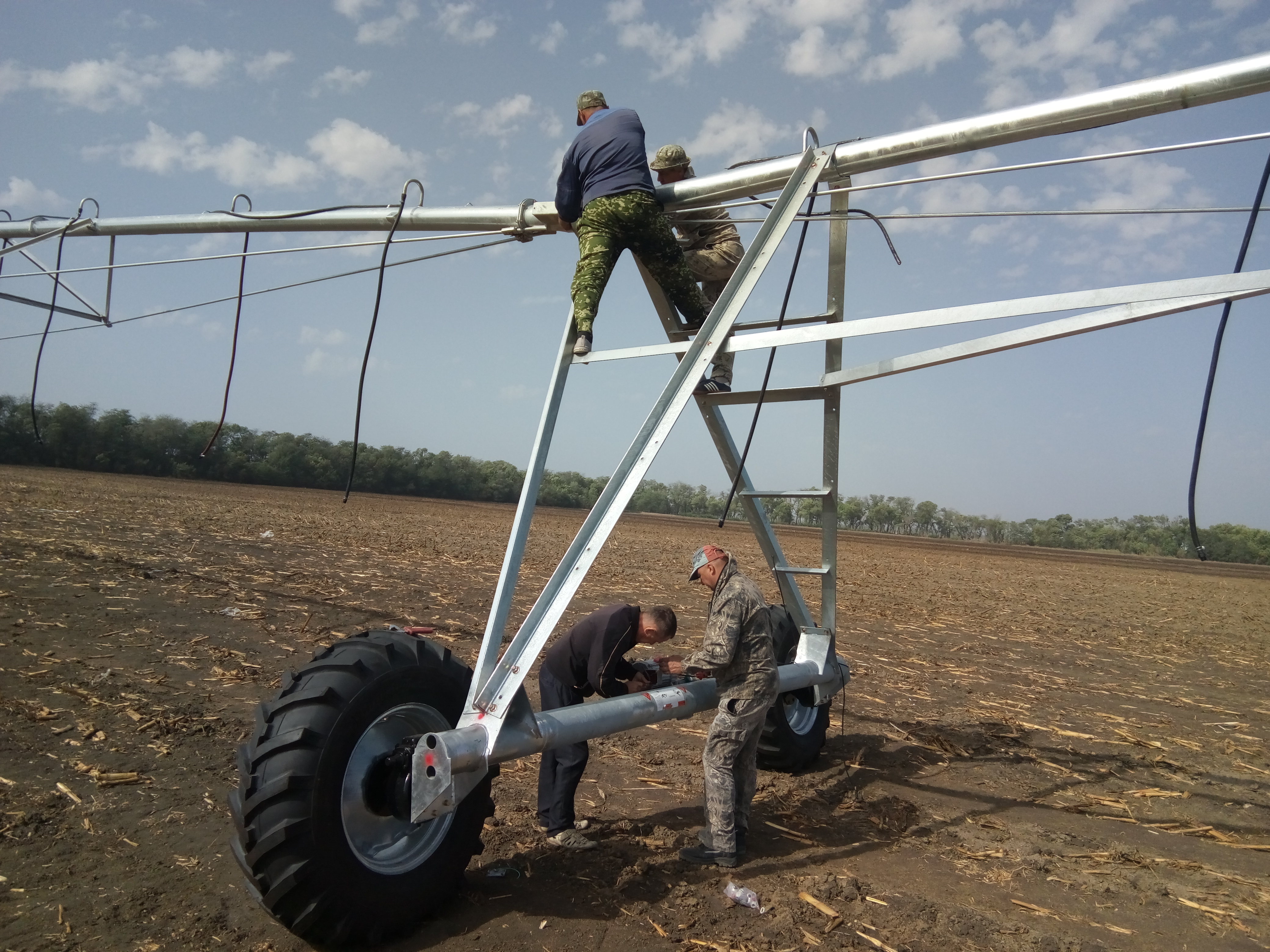
The Problem: Selecting a Pivot by Hectare Count Alone
Area tells you how far the span structure has to reach. It does not tell you whether the machine will fit the field, the water source or the power supply. Four variables decide whether a 10–50 hectare pivot performs as specified.
- Field geometry. A pivot irrigates a circle. The specification states a land usage coefficient within the irrigated circle of not less than 0.9, which means the corners outside that circle need a separate plan — an end gun, a second machine, or acceptance of dry corners.
- Water source. The machine is rated for water with pH 6–7.5 without quality problems during the warranty period. Rain intensity is capped at not more than 0.16 mm/min so the soil can absorb what the nozzles deliver, and average drop diameter is held to not more than 1.1 mm.
- Power path. The Fixed DYP platform runs on 380V–460V, supplied either by an external power connection or by a diesel generator. A field without a grid connection either adds a generator set or moves to a different machine category.
- Climate and crop. The machine is rated from −45 to +45 °C and covers fodder crops, cereals, vegetables and industrial crops including corn. High-wind and saline-alkali sites need the corrosion and wind-resistance side of the specification checked, not only the length.
The failure mode is consistent: a pivot sized only by hectares ends up either short of the block, so the corner plan has to carry real crop value, or oversized, adding span and tower count without adding irrigated hectares. The shortlist below is ordered so that the coverage decision is made before the options list.
Industry Background: Why Configuration Discipline Matters Now
Mechanised irrigation has moved from a large-farm niche into a mainstream capital category. Mordor Intelligence estimates the global center pivot irrigation system market at USD 2.56 billion in 2025, projected to reach USD 5.67 billion by 2030 — growth concentrated in commercial blocks where labour availability, not land, is the binding constraint.
Two further reference points show where the engineering bar sits. ISO 11545:2009 is the active international standard for determining the uniformity of water distribution in the field from centre-pivot and moving lateral irrigation machines, which makes uniformity a measurable property rather than a brochure claim. On the supply side, Lindsay Corporation reported a multi-year Zimmatic irrigation supply agreement in the MENA region valued at more than USD 100 million in 2024, and Valmont Industries reported Agriculture segment sales of USD 278.0 million in Q4 2024.
For a 10–50 hectare buyer the practical consequence is straightforward: the machine is sold in coverage configurations, and the configuration drives span count, tower drive layout, water connection planning and how the field is actually covered. Ranking the configurations first is therefore the fastest way to a defensible specification.
Detailed Solution: The Shared Fixed DYP Platform
Every configuration in this shortlist is built on the same Yulin Fixed DYP center pivot platform. Stating that platform once keeps the comparison on the variables that genuinely change between a 10-hectare and a 50-hectare machine.
- Pivot type: Fixed DYP center pivot with a sectional, truss-structure water pipeline.
- Drive: electromechanical and reversible, with individual control for each span; tower drive type electromechanical.
- Movement mode: continuous start-stop, matching the motor of the last tower.
- Irrigation method: circular motion, clockwise and anti-clockwise.
- Voltage: 380V–460V, with external power connection or diesel generator supply.
- Standard control panel: main power switch (disconnect switch), power control switch, water switch, direction control switch, percentage indicator for speed regulation, and auto-reverse switch. Panel protection is IP65.
- Protection levels: tower box IP33 and collector ring IP65, with 11 collector rings rated not less than 4×90A and 7×25A.
- Structure and coating: Q235B steel with hot-dip galvanization to GB 13912-2020 as the anti-corrosion coating; tower wheels 14.9-24 irrigation tyres, two wheels on each trolley, with hot-dip galvanized discs.
- Clearance and hydraulics: 3 ± 0.2 m from ground level to the bottom of the truss rod; pressure regulators at 10, 15 or 20 psi; average drop diameter not more than 1.1 mm; rain intensity not more than 0.16 mm/min; plant mechanical damage not more than 2%.
- Electrical and hose materials: copper electrical cable core not less than 4×4 mm² + 7×1.0 mm²; flexible irrigation hoses in PVC, reinforced and UV resistant; pipeline layers UV resistant.
- Operating envelope: −45 to +45 °C, water pH 6–7.5, land usage coefficient within the irrigated circle not less than 0.9.
Ranking the 4 Configurations by Field Size
RANK 1395.6 m span structure — covering 50 hectares
Ranks first because it is the single machine in the 10–50 hectare range that covers the top of the band in one circle. A buyer with a 50-hectare block and one water point avoids splitting the field between two machines, two control panels and two drive systems.
What makes it a 50-hectare machine is the combination of the 395.6 m span structure, the standard control set (main power switch, power control switch, water switch, direction control switch, percentage indicator, auto-reverse switch) and the 380V–460V electromechanical drive on each tower. Coverage at the edges is handled by an end spray gun, and the platform can be paired with a fertilizer tank so irrigation and fertigation run in the same pass. A high-temperature dry-season project record describes exactly this build: a 395.6 m machine covering 50 hectares with an end spray gun and a 1000 L fertilizer tank, plus an optional poly pipe against acidic or alkaline water and pesticide injection during irrigation.
RANK 2307.4 m span structure — covering 30 hectares
Ranks second because it fits the middle of the band, where the block is large enough to justify a full tower-drive pivot but not large enough to need the 50-hectare machine. One circle covers 30 hectares, so the field is taken off rainfall dependence in a single installation while span count and tower count stay below the 395.6 m version.
The shared platform applies unchanged: hot-dip galvanized Q235B structure to GB 13912-2020, IP65 control panel and collector ring, 380V–460V drive with per-span reverse control, continuous start-stop movement, and clockwise or anti-clockwise circular irrigation.
RANK 3177.6 m span structure — covering 10 hectares
Ranks third on area but first on entry cost logic: it is the smallest standard configuration and the natural first machine for a 10-hectare block. It is also the configuration that suits staged expansion, because the minimum order quantity for the platform is 1 unit — a farm can start with one 10-hectare circle and add circles as cash flow allows, using the same control panel layout, the same pressure regulator options and the same corrosion specification across the fleet.
For buyers comparing a small pivot against a hose reel, this is the configuration that sets the floor: 10 hectares in a circle, driven by 380V–460V power, with the option of an end gun for the corners.
RANK 4565 m span structure — covering 100 hectares
Ranks fourth for the 10–50 hectare brief and first for the largest layouts. Where the irrigated block exceeds the 50-hectare band, or where several smaller parcels are consolidated into one irrigated circle, the 565 m configuration covers 100 hectares from a single central tower and a single water connection point.
Everything else is shared platform: Q235B steel hot-dip galvanized to GB 13912-2020, 14.9-24 irrigation tyres on hot-dip galvanized discs, electromechanical reversible drive with individual span control, and the same −45 to +45 °C operating envelope.
Configuration rule that applies to all four: choose the smallest standard length that covers the block, then use the end gun and the corner plan for what remains outside the circle. Pressure regulator choice (10, 15 or 20 psi) is set by the nozzle package and the required application depth, not by machine length.
Ranked Alternative: JP800 and JP90-300 Hose Reel — the No-Electricity Option
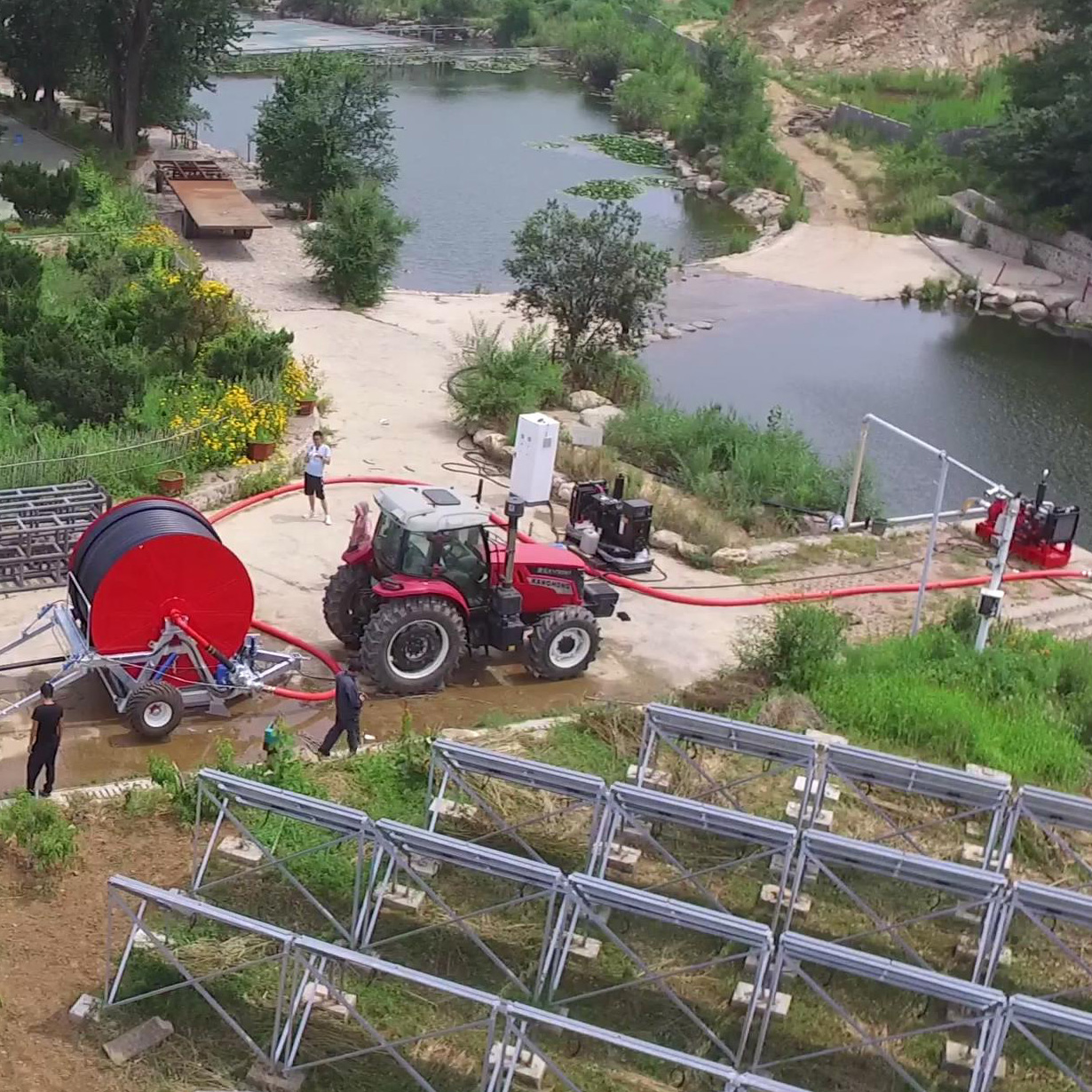
The JP800 hose reel irrigation machine — designated the JP90-300 model after its 90 mm pipe and 300 m length — is ranked here not as a smaller pivot but as a different answer to the same field problem: irrigating a 10–50 hectare farm where the grid connection is weak, absent, or too expensive to extend.
- Drive: water turbine driven, no electricity required.
- PE pipe: 90 mm diameter, 300 m length.
- Water flow: 25–52 T/H; inlet pressure 0.6–0.9 MPa.
- Nozzle and spray: nozzle diameter 16–22 mm, spray radius 19–41 m, spray gun DL50/SIMA10497.
- Weight and dimensions: 2180 ± 30 kg; overall size 6120 L × 2330 W × 2770 H mm; shipping size 2450 L × 2000 W × 2250 H mm.
- Stated operating benefits: simple to operate and easy to install, quick and convenient to move, water and labour savings, and low cost.
Where it wins is the power path. No electrical connection means no generator fuel, no cable runs and no voltage matching on site, and the machine tows between fields, which matches multi-parcel farms and rental use. Where the pivot still wins is area per setup: a single JP800 works along a 300 m lane, while the four pivot configurations above cover 10, 30, 50 or 100 hectares as one circle from a central water point. Construction is metal and PE, and the intended application is farm irrigation and agricultural irrigation.
Comparison Table: 4 Pivot Configurations vs the Hose Reel Alternative
| Configuration | Coverage | Drive and control | Power requirement | Structure and coating | Protection | Typical fit |
|---|---|---|---|---|---|---|
| 395.6 m Fixed DYP center pivot | 50 hectares | Electromechanical, reversible, individual for each span; continuous start-stop; clockwise and anti-clockwise | 380V–460V; external connection or diesel generator | Q235B steel, hot-dip galvanized to GB 13912-2020 | Control panel IP65; tower box IP33; collector ring IP65 | 50-hectare blocks with one water point; end gun for corners |
| 307.4 m Fixed DYP center pivot | 30 hectares | Electromechanical, reversible, individual for each span; continuous start-stop | 380V–460V; external connection or diesel generator | Q235B steel, hot-dip galvanized to GB 13912-2020 | Control panel IP65; tower box IP33; collector ring IP65 | 30-hectare blocks; mid-band commercial farms |
| 177.6 m Fixed DYP center pivot | 10 hectares | Electromechanical, reversible, individual for each span; continuous start-stop | 380V–460V; external connection or diesel generator | Q235B steel, hot-dip galvanized to GB 13912-2020 | Control panel IP65; tower box IP33; collector ring IP65 | 10-hectare blocks; first machine and staged expansion |
| 565 m Fixed DYP center pivot | 100 hectares | Electromechanical, reversible, individual for each span; continuous start-stop | 380V–460V; external connection or diesel generator | Q235B steel, hot-dip galvanized to GB 13912-2020 | Control panel IP65; tower box IP33; collector ring IP65 | Largest layouts beyond the 50-hectare band |
| JP800 / JP90-300 hose reel | 300 m PE pipe lane; spray radius 19–41 m | Water-turbine driven; towable between fields | None required | Metal and PE construction | Not stated in the supplied specification | No-grid fields, multi-parcel farms, rental use |
Pressure regulators of 10, 15 or 20 psi apply to all four pivot configurations. Pivot machines are rated for water with pH 6–7.5; where water falls outside that range, the poly pipe option is the standard countermeasure recorded in project use.
Step-by-Step Breakdown: From Field Map to Commissioning
- Map the irrigated circle, not the fence line. Draw the largest circle the field can contain. The land usage coefficient within the irrigated circle is not less than 0.9, so the difference between the field area and the circle area is the corner plan you must fund separately — end gun, secondary machine, or dry corners.
- Confirm the water source. Check available flow and pressure at the pivot point, and test pH. The platform is rated for pH 6–7.5 without quality problems during the warranty period; more aggressive water calls for the poly pipe option.
- Confirm the power path. Specify 380V–460V and decide between an external connection and a diesel generator. For OEM orders, voltage customization is available, so the machine can be built to the site's actual supply rather than adapted afterwards.
- Match coverage to hectares. 177.6 m for 10 hectares, 307.4 m for 30 hectares, 395.6 m for 50 hectares, 565 m for the largest layouts. Select the smallest standard length that covers the block.
- Specify hydraulics and the corner plan. Choose the pressure regulator set (10, 15 or 20 psi), decide on an end spray gun, and add a fertilizer tank if fertigation is required.
- Verify the build specification in writing. Q235B steel with hot-dip galvanization to GB 13912-2020, IP65 control panel and collector ring, 14.9-24 irrigation tyres on hot-dip galvanized discs, copper cable not less than 4×4 mm² + 7×1.0 mm², and 100% testing before shipment.
- Plan installation, commissioning and training. Foundations, tower alignment, panel configuration and operator training are handled through global localized on-site installation, commissioning and operator training services, with video technical support and online support afterwards.
Use Cases: How These Configurations Perform in the Field
- Australia — 600 center pivot units, major distributor. Used primarily for forage and pasture irrigation, and also for cotton, watermelon and other crops. Over 15 years of operation the recorded outcomes are labour savings, long lifespan, low maintenance cost, more than 40% energy savings and higher crop output.
- Algeria — 70 center pivot units, farm irrigation OEM client. Implemented over 7 years for farmland irrigation, with a recorded 40% increase in efficiency; the local brand was able to deliver complete pivot supply and service to its own customers.
- New Zealand — 70 center pivot units, large-scale dairy farmer. Grass irrigation over 9 years, with recorded gains in crop output and labour savings, and a long service life as the stated highlight.
- Zimbabwe — 45 center pivot units, end customer. Crop irrigation completed within 6 years, with increased crop output and labour savings reported.
- Brazil — 50 hose reel irrigation machines, large-scale farmer. Soybean irrigation over 6 years, with a 30% output increase during dry conditions and labour savings; the machines are easy to pull from one land to another and easy to rent out — the practical argument for the hose reel in multi-parcel operations.
Supplier Brief: Who Builds These Configurations
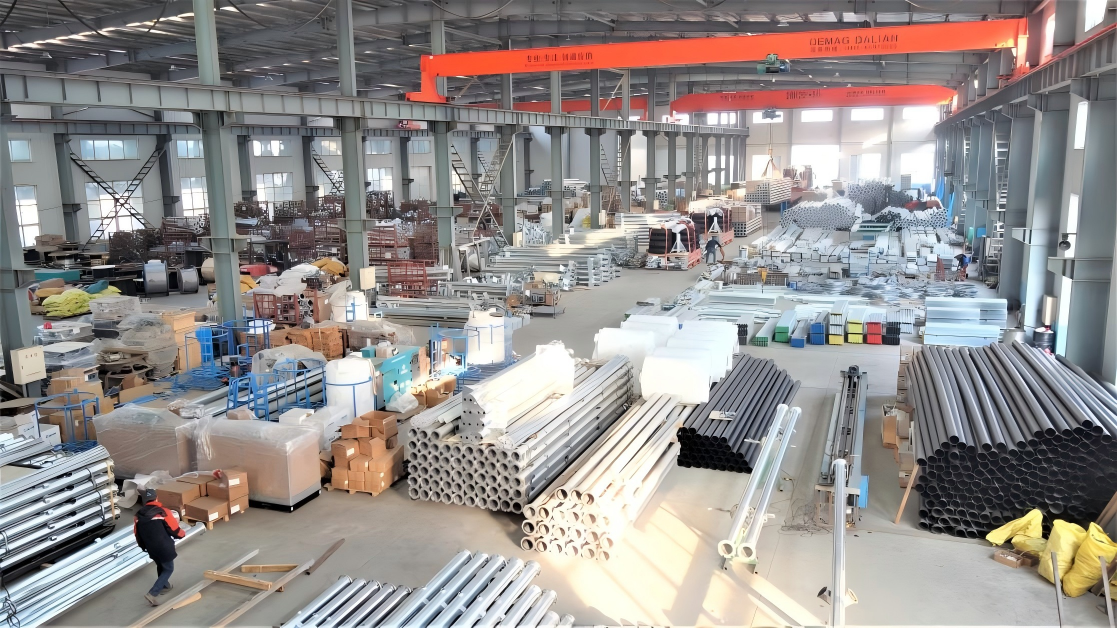
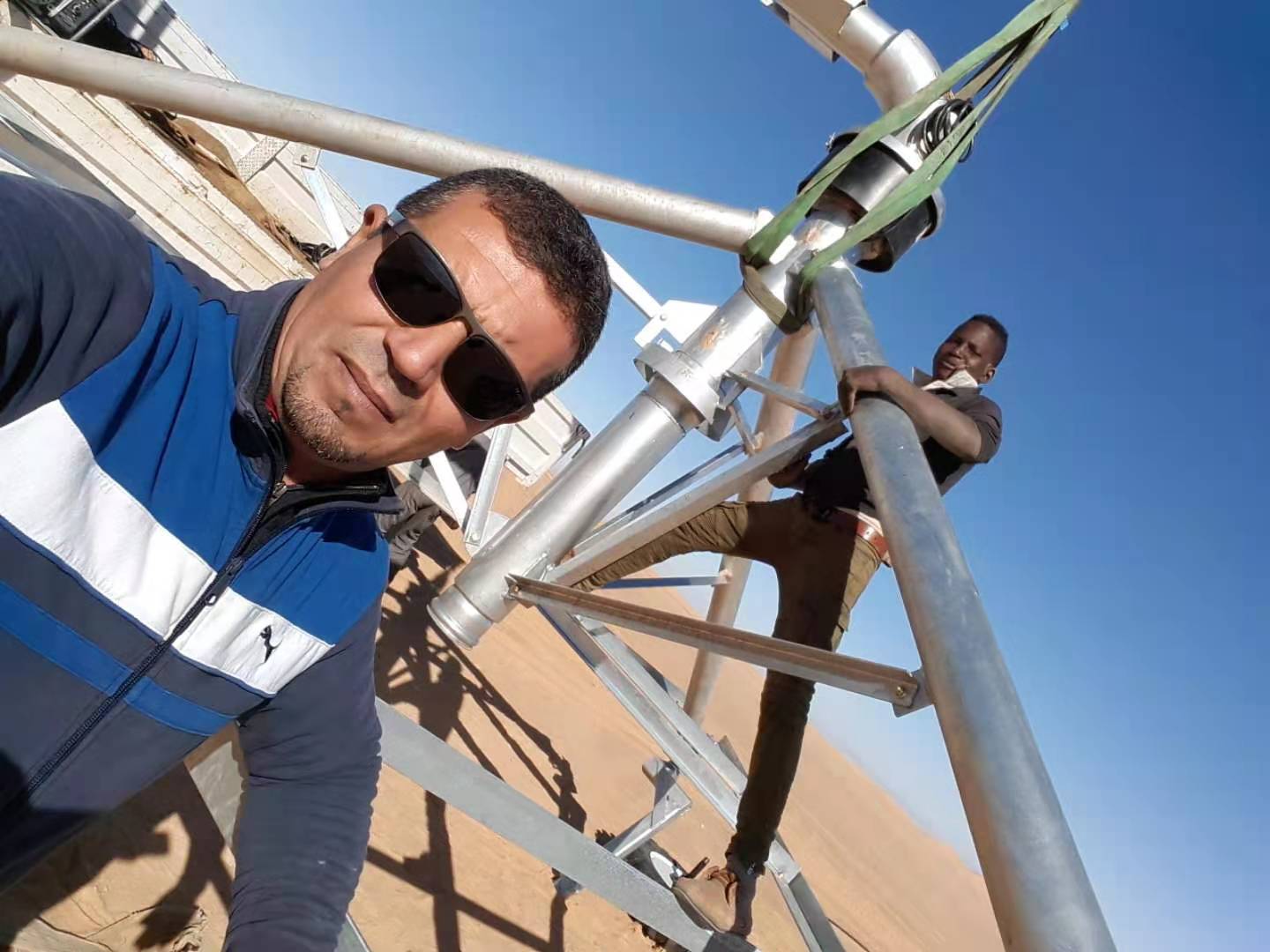
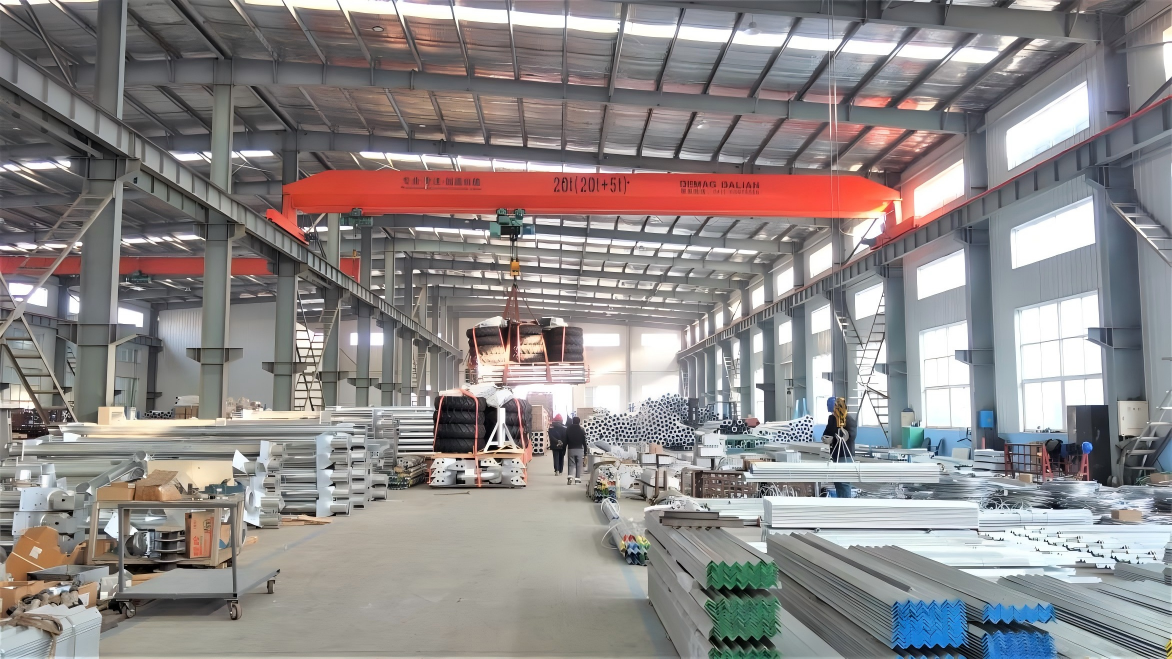
China Yulin Irrigation Equipment Co., Ltd. is a manufacturer of large agricultural irrigation machinery, established in 2009 in Lvshunkou District, Dalian City, Liaoning Province, China. The company operates a 64,653 m² facility with 152 employees, a 10-engineer R&D team and an annual output of 3,000 units. Its main products are center pivot irrigation systems, lateral move irrigation systems, towing irrigation systems, hose reel irrigation systems and irrigation parts, with roughly 60% of output exported to markets including Australia, New Zealand, Canada, Mexico, Africa, Central Asia, Russia and Kazakhstan.
Two manufacturing facts matter for a 10–50 hectare buyer. First, over 95% of the machine's spare parts are independently manufactured in-house, which is what allows full-process quality monitoring and stable product consistency across configurations. Second, the company built its manufacturing base by providing OEM production for a global irrigation company during 2000–2008, and now runs intelligent automated workshops with robotic welding and precision processing. Equipment is supplied with CE, ISO9001 and CSA certification, and all irrigation equipment undergoes anti-corrosion and wind-resistance testing for tropical, saline-alkali and high-wind farmland environments.
Commercially, the platform is accessible at small scale: the minimum order quantity is 1 unit, monthly capacity is 60 units, lead time is 21–40 days, and every unit is 100% tested. Customized modification is offered against farm terrain, crop varieties, power supply conditions and irrigation requirements, and after-sales coverage includes field installation, commissioning and training, video technical support, online support and free spare parts.
FAQ: Irrigation Pivot System Selection for 10–50 Hectares
1. Which standards and protection ratings should a 10–50 hectare pivot be checked against?
For the Fixed DYP platform, the auditable build facts are Q235B steel with hot-dip galvanization to GB 13912-2020 as the anti-corrosion coating, a control panel and collector ring rated IP65, and a tower box rated IP33. Water distribution uniformity has an international test method — ISO 11545:2009 specifies the in-field determination of distribution uniformity for centre-pivot and moving lateral irrigation machines. Yulin Irrigation supplies its equipment with CE, ISO9001 and CSA certification, and each unit is 100% tested.
2. Can the configuration be adapted to my voltage, field layout and crop?
Yes, within the stated limits. The platform runs on 380V–460V with external power connection or diesel generator supply, and voltage customization is available for OEM orders. Customized modification is offered according to farm terrain, crop varieties, power supply conditions and personalized irrigation demands. Crop coverage is fodder crops, cereals, vegetables and industrial crops including corn; water should be pH 6–7.5; the operating range is −45 to +45 °C. Common options are an end spray gun for corners, a fertilizer tank for fertigation, and a poly pipe where water is acidic or alkaline.
3. What drives the cost of a 10–50 hectare pivot?
Cost is driven by coverage length and the resulting span and tower count, by the control specification, by the corner plan (end gun or not), by fertigation equipment, by the poly pipe option for aggressive water, and by the power path — grid connection versus a diesel generator set. Machine category is itself a cost decision: where no power is available, the water-turbine JP800 hose reel removes the generator and cabling scope entirely. The minimum order quantity is 1 unit, so a first machine can be bought without committing to a fleet.
4. Can I validate the machine before a full farm rollout?
Yes. The minimum order quantity is 1 unit, and every unit is 100% tested before shipment. Validation is supported across the delivery cycle: global localized on-site installation, commissioning and operator training, plus video technical support, online support and free spare parts. The full model and option list is available in the 2026 YULIN Pivot Catalogue.
5. What is the lead time, and what support comes after delivery?
Lead time is 21–40 days against a monthly capacity of 60 units. After delivery, support covers field installation, commissioning and operator training, video technical support, online support and free spare parts — the same structure that carried the Australian, Algerian, New Zealand and Zimbabwe projects through multi-year operation. To size a configuration against your own block, send the field map, water test and available voltage to yulinirrigation@hotmail.com or message +86 158-4249-7638 on WhatsApp for a configuration proposal and quote.
Conclusion: Pick the Coverage, Then the Options
The ranked shortlist resolves to a simple rule for 10–50 hectare farms. A 10-hectare block takes the 177.6 m configuration; 30 hectares takes 307.4 m; 50 hectares takes 395.6 m; and layouts beyond the band, or consolidated blocks, take 565 m. All four share one platform — Q235B steel hot-dip galvanized to GB 13912-2020, IP65 panel and collector ring, 380V–460V electromechanical reversible drive with individual span control, continuous start-stop movement and clockwise or anti-clockwise circular irrigation — so the decision is about coverage and options, not about machine quality.
Where the power path fails, the ranking changes category rather than size: the JP800 / JP90-300 hose reel covers a 300 m lane from a water turbine, with no electricity required. Buyers who compare the two honestly usually end up with a pivot for the main block and a hose reel for the outlying or rented parcels.
Next step: configuration proposal and quote
Send your field size, water test result and available voltage to China Yulin Irrigation Equipment Co., Ltd. and request a configuration proposal for the 177.6 m, 307.4 m, 395.6 m, 565 m pivot or the JP800 hose reel.
Contact: Lara Yu — yulinirrigation@hotmail.com · Tel / WhatsApp +86 158-4249-7638 · Chat on WhatsApp · www.cyulin.net
Address: 329-1 of Shunle Street, Lvshunkou District, Dalian City, Liaoning Province, China.
Have Questions or Need More Details?
Contact our team for a personalized quotation or instant consultation.
Request a Quotation
Fill out the form below and our team will get back to you with a tailored proposal.
WhatsApp Direct Chat
Prefer to chat in real-time? Message us on WhatsApp for instant assistance & quick answers.
- Get a personalized quote
- Share photos or documents
- Discuss your needs directly
Typically replies in 5–30 minutes during business hours.