
What Is a Hose Reel Irrigation Machine? Irrigation Pivot System Basics
A hose reel irrigation machine is a travelling irrigation machine that pulls a long polyethylene pipe across a field and rewinds it onto a reel while a spray gun irrigates a strip of crop. Inside the irrigation pivot system category it is the water-driven, strip-working option. The JP800 — part of the JP90-300 model series built by China Yulin Irrigation Equipment Co., Ltd. (brand: YULIN IRRIGATION) — is water-turbine driven, so it requires no electricity. Its published working envelope is a 90 mm PE pipe in 300 m length, 25–52 t/h water flow, a DL50/SIMA10497 spray gun, 19–41 m spray radius and 0.6–0.9 MPa inlet pressure.
Irrigation pivot systemHose reel irrigation machineTraveler irrigation systemJP800 / JP90-300
The Problem: “Irrigation Pivot System” Describes Several Different Machines
Buyers who search for an irrigation pivot system usually land on center pivot irrigation system material: a long truss rotating around a central tower, driven by electric gear motors at 380V–460V, covering a circle. That description is accurate, but it is not the whole category. In Yulin Irrigation’s own catalogue structure the hose reel irrigation machine is listed together with the towable pivot machine and the four-wheel linear irrigation machine as a type inside the pivot product family — not as a separate class of equipment.
That structural overlap creates four practical problems during research and evaluation:
- Power availability. An electric center pivot needs a 380V–460V supply and a control panel. Fields without a reliable grid connection cannot simply copy that layout.
- Field geometry. A center pivot irrigates a circle. Rectangular strips, fragmented parcels and rented land are a different layout problem.
- Water source matching. A traveler is specified by flow and inlet pressure, not by hectares. The JP800 is rated at 25–52 t/h and 0.6–0.9 MPa, and a farm that cannot deliver that envelope cannot run the machine as published.
- Specification language. Pipe length, spray radius, nozzle diameter and flow rate are four separate numbers that are often mixed up in supplier quotations and in buyer comparisons.
This explainer resolves those four problems by defining the hose reel machine from published product data, then showing how its parameters translate into a buying decision.
Industry Background: A Growing Equipment Category With Published Standards
The equipment category is large and still expanding. Mordor Intelligence estimates the global center pivot irrigation system market at USD 2.56 billion in 2025 and projects it to reach USD 5.67 billion by 2030. Because that figure is measured on center pivot equipment, it understates the total demand for pivot-family machines, including travelers and linear move equipment, rather than overstating it.
Performance comparison across the category has a documented method. ISO 11545:2009 specifies an in-field method for determining the uniformity of water distribution in the field from centre-pivot and moving lateral irrigation machines. For a buyer, that matters because uniformity — not headline flow rate — determines whether the water reaches the crop evenly.
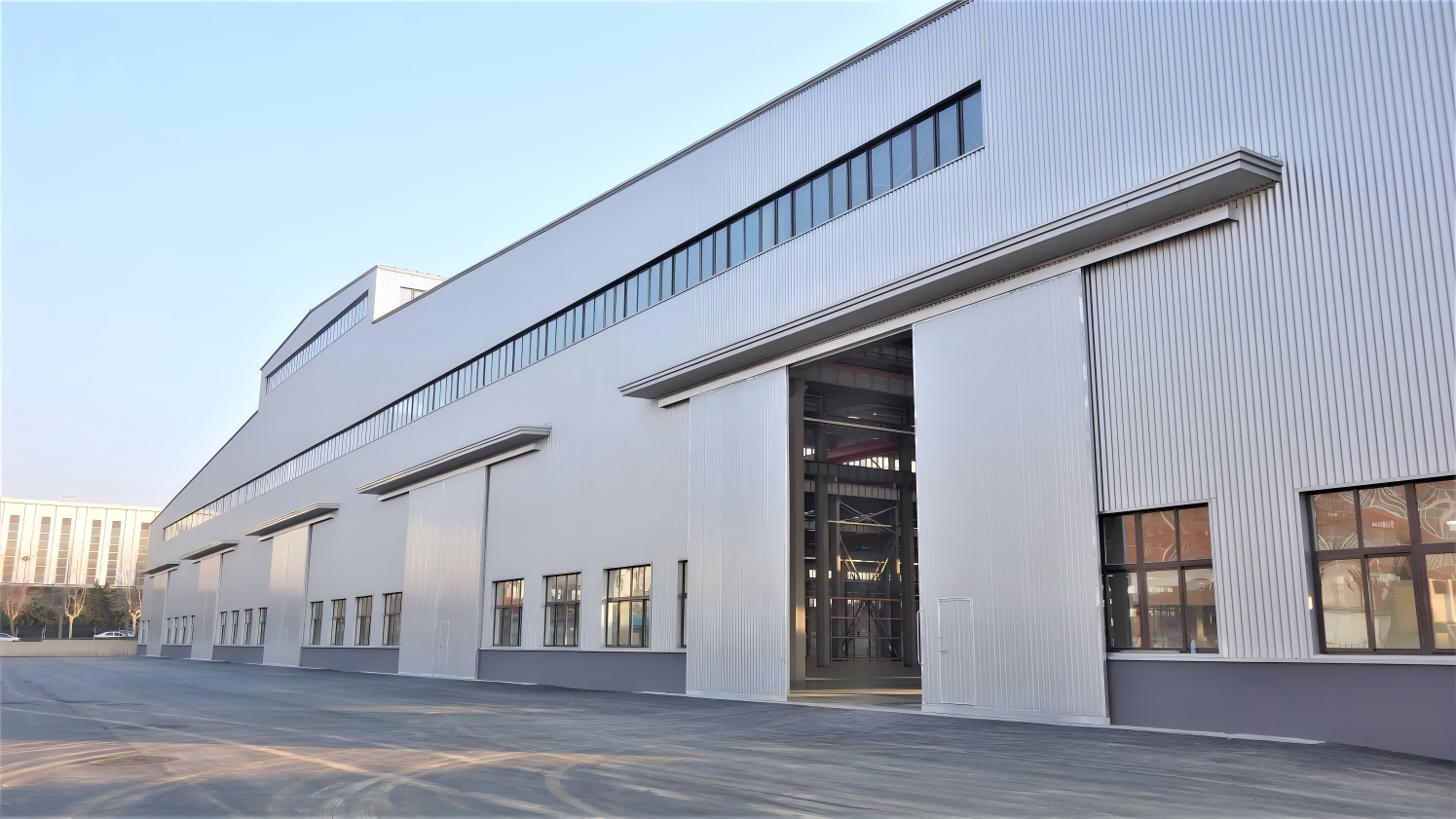
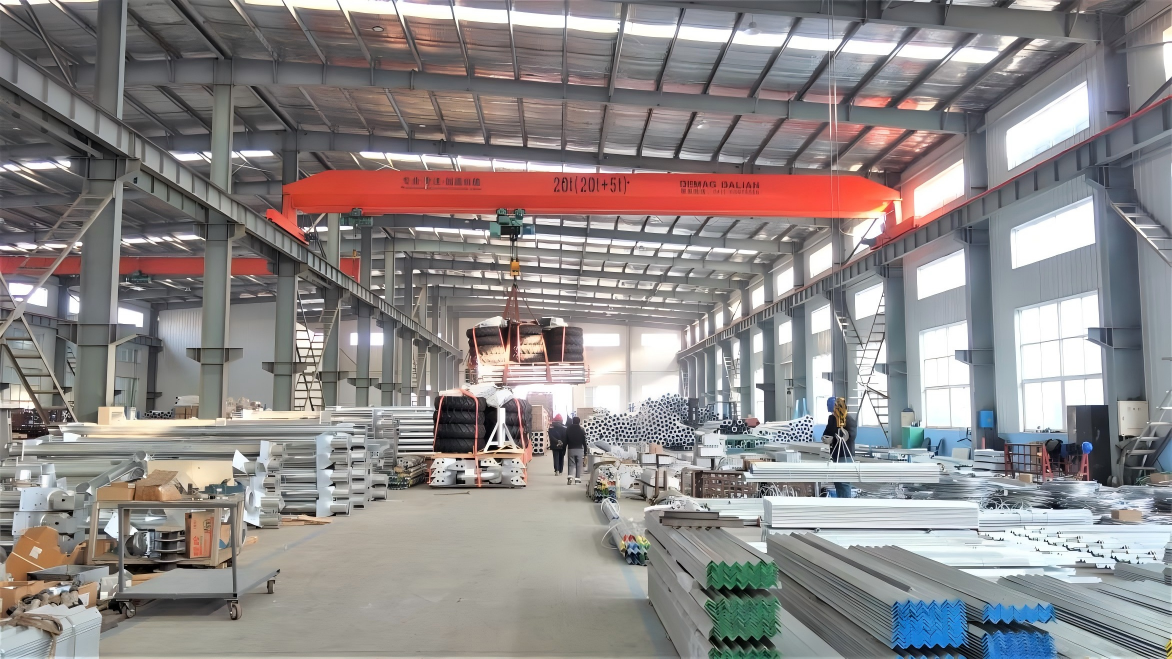
The manufacturing side is concentrated in a small number of production regions. China Yulin Irrigation Equipment Co., Ltd. was founded in 2009 and operates from Lvshunkou District, Dalian City, Liaoning Province, China, with a 64,653 m² factory, 152 employees, an R&D team of 10 engineers, annual output of 3,000 units and an export ratio of 60%. Its product range covers center pivot irrigation systems, lateral move irrigation systems, towing irrigation systems, hose reel irrigation systems, irrigation parts, and matching water pumps and generators. Export markets listed by the manufacturer are the USA, Mexico, Europe, New Zealand, Canada, Australia, Africa and Egypt.
Detailed Solution: What the JP800 Hose Reel Machine Actually Contains
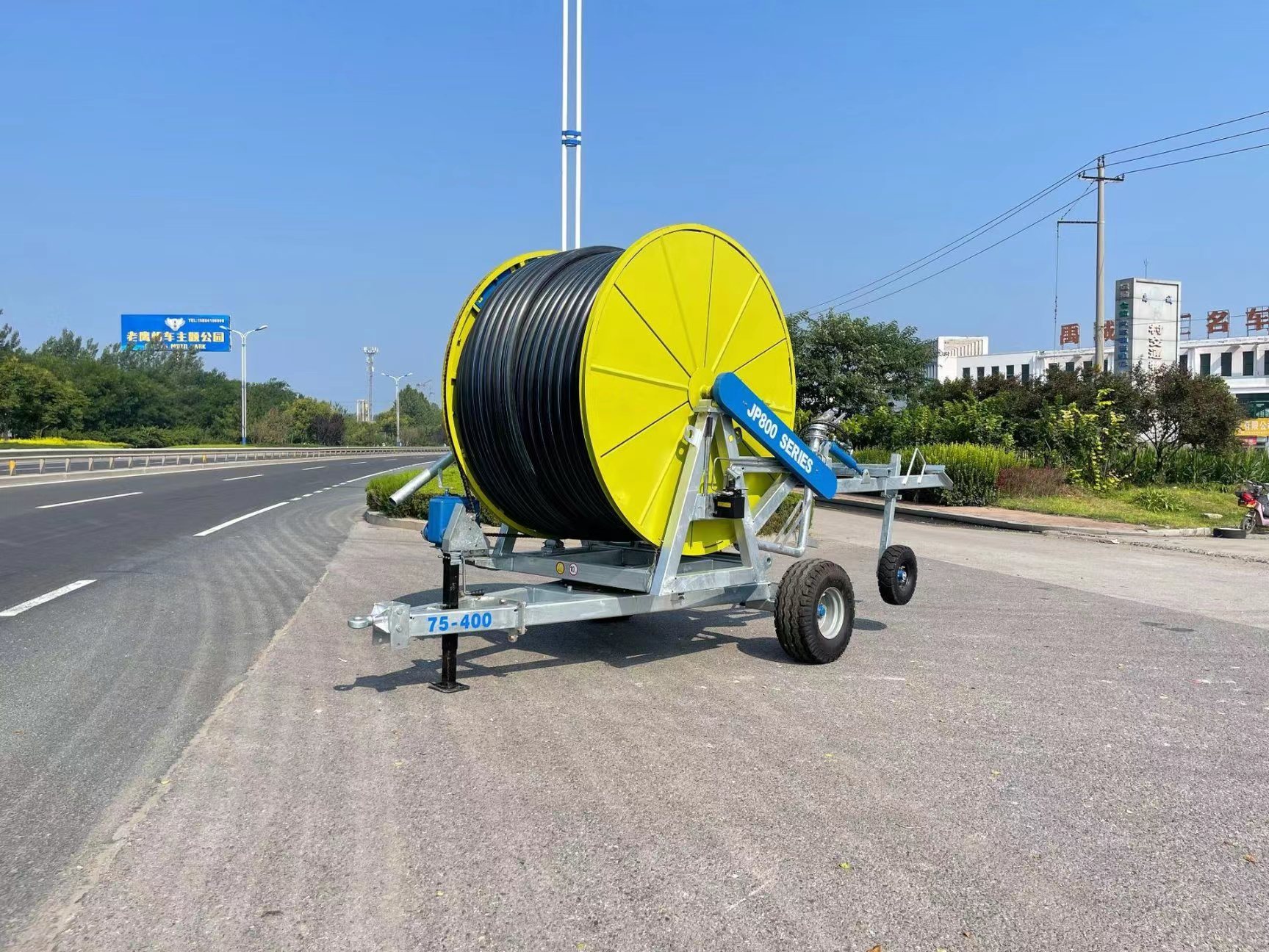
The drive: water turbine, no electricity
The defining constraint of the JP800 is energy. Its listed selling points begin with the water turbine drive and the statement that no electricity is required. For evaluation purposes this removes the electrical supply, cable runs and powered control panel that a 380V–460V electric pivot depends on. What the machine does need instead is hydraulic: an inlet pressure of 0.6–0.9 MPa at the connection point, sustained while the machine is running.
The pipe and the wetting pattern
The irrigation body is a 90 mm polyethylene (PE) pipe in a 300 m length, wound on the reel. The spray gun is specified as DL50/SIMA10497, with a nozzle diameter of 16–22 mm giving a spray radius of 19–41 m. Water flow is 25–52 t/h. In practical terms, the 300 m pipe defines how long each working pass is, and the 19–41 m radius defines how wide the wetted strip is; the nozzle size selected within the 16–22 mm range moves the machine between the two ends of that radius and flow band.
Transport and footprint
The unit weighs 2180 ± 30 kg. Outside dimensions are 6120L × 2330W × 2770H mm, and the shipping dimensions are 2450L × 2000W × 2250H mm. The manufacturer lists quick and convenient movement between blocks as a selling point, which is the property that makes the machine interesting for rented land and split parcels.
Published JP800 / JP90-300 specifications
| Parameter | Published value |
|---|---|
| Model | JP800 (JP90-300 model series) |
| Machine type | Hose reel irrigation machine / travelling hose reel irrigator |
| PE pipe diameter | 90 mm |
| PE pipe length | 300 m |
| Water flow | 25–52 t/h |
| Nozzle diameter | 16–22 mm |
| Spray radius | 19–41 m |
| Spray gun | DL50 / SIMA10497 |
| Inlet pressure | 0.6–0.9 MPa |
| Weight | 2180 ± 30 kg |
| Outside size | 6120L × 2330W × 2770H mm |
| Shipping size | 2450L × 2000W × 2250H mm |
| Material | Metal, PE |
| Application | Farm irrigation, agricultural irrigation |
Certification and manufacturing data
The hose reel irrigation machine is covered by an ISO9001:2015 quality management system certification. The applicable standard is GB/T19001-2016/ISO9001:2015, the certificate number is 18524Q11926R2S, and the certificate is issued by National Standard Integration (Beijing) Certification Co., Ltd. The certification applies to the global market, its scope is the production of irrigation systems and mechanized agricultural systems (spreader, grinder), and its validity runs from 2024-12-31 to 2027-12-17. The same certification also covers the center pivot irrigation system product.
The manufacturer’s company profile additionally lists CE, ISO9001 and CSA certifications, and states that all irrigation equipment undergoes anti-corrosion and wind resistance testing for tropical, saline-alkali and high-wind farmland environments. On the production side, more than 95% of the machine’s spare parts are stated to be manufactured in the factory, and the company reports a background of OEM production for a global top irrigation company between 2000 and 2008, with robotic welding and precision processing workshops.
Step-by-Step Breakdown: How a Hose Reel Machine Is Matched to a Field
Selection works as a sequence of checks, not as a single comparison. Each step below uses only published values, and each step can disqualify the machine before the next one is reached.
Step 1 — Confirm the drive constraint
If the field has a 380V–460V supply, an electric pivot remains a valid option. If it does not, the water-turbine hose reel is the candidate, because the JP800 needs no electricity to operate.
Step 2 — Verify flow and pressure at the connection
The machine requires 25–52 t/h at 0.6–0.9 MPa inlet pressure. A source that delivers volume but not pressure, or pressure but not volume, will not reproduce the published performance.
Step 3 — Map the 300 m pipe to the field
The 300 m PE pipe sets the length of one working pass. Long, narrow or rectangular blocks are worked strip by strip; the reel is repositioned between passes, which is where the machine’s transport dimensions and 2180 ± 30 kg weight become operational questions rather than catalogue details.
Step 4 — Choose the nozzle and check the strip width
Nozzle diameter in the 16–22 mm range moves the spray radius between 19 m and 41 m and shifts flow within the 25–52 t/h band. On windy or high-evaporation sites, the narrower end of the range is the more conservative starting point.
Step 5 — Check access before delivery
The shipping size of 2450L × 2000W × 2250H mm and the operating footprint of 6120L × 2330W × 2770H mm determine transport planning. Gate widths, tracks and turning space should be verified before a container is booked, not after arrival.
Step 6 — Audit the compliance file
Request the ISO9001:2015 certificate (number 18524Q11926R2S) and confirm that the scope and the product line on the certificate match what is being purchased. For European buyers, also request the CE documentation associated with the specific model.
The operating sequence once the machine is on site
- Position and connect. The machine is placed at the water hydrant or outlet, with the gun carriage set at the far end of the strip.
- Pressurise the line. Inlet pressure must settle inside the 0.6–0.9 MPa range before irrigation begins.
- Irrigate on the retract stroke. The water turbine drives the reel, winding the 300 m PE pipe in while the DL50/SIMA10497 gun sprays the strip.
- Complete the pass and stop. The pass ends when the reel is fully wound; the wetting width for that pass was set at commissioning by the nozzle selection and spray radius.
- Relocate. The machine is moved to the next strip, which the manufacturer lists as quick and convenient.
Use Cases: Where Hose Reel Irrigation Fits
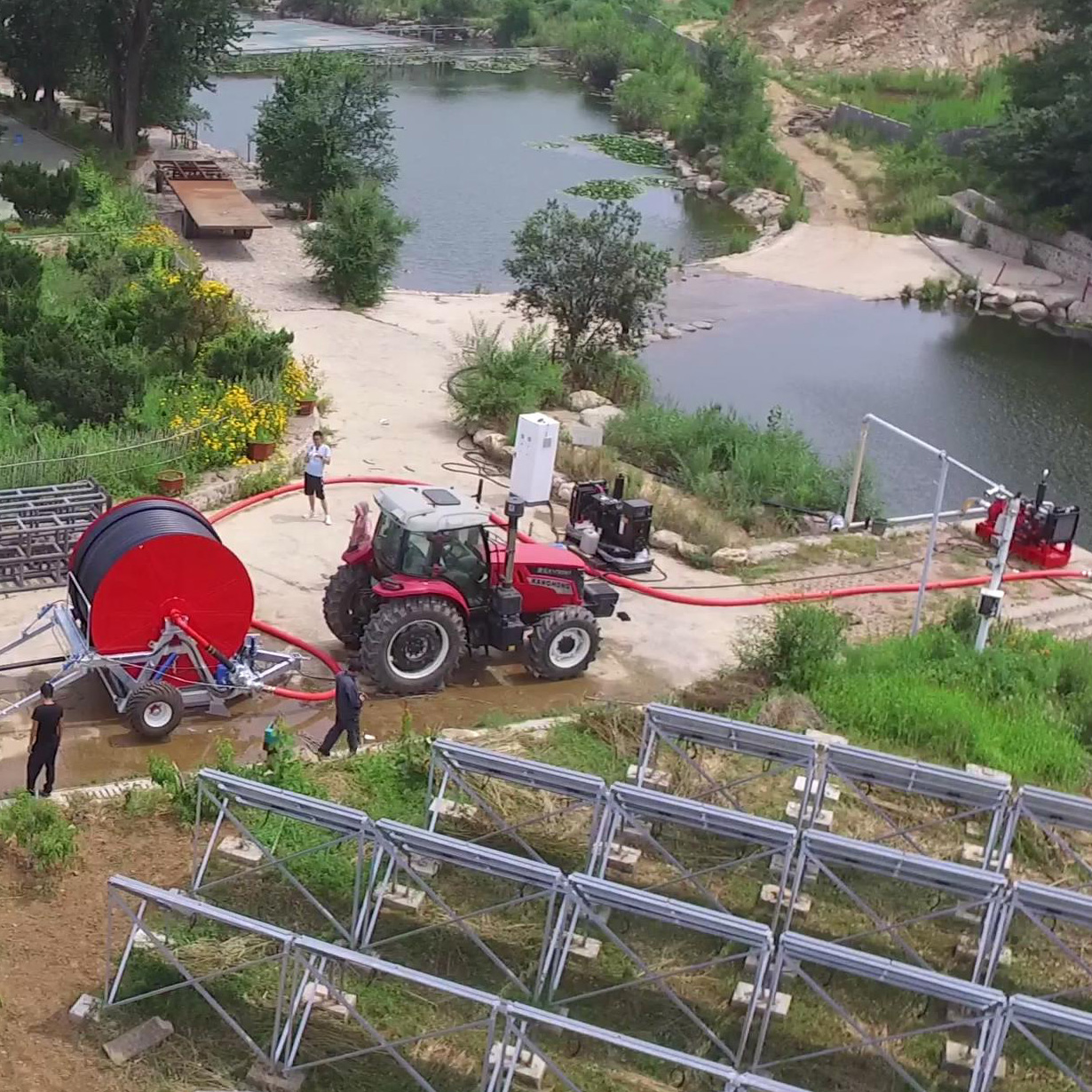
Documented case: soybean irrigation in Brazil
A large-scale farmer in Brazil operates 50 units of the JP800 hose reel machine for soybean irrigation. The equipment has been in service for six years. The reported outcomes are a 30% rise in output during dry conditions and labour savings. The customer’s stated advantages are that the machine is easy to pull from one parcel to another and easy to rent out — two properties that follow directly from the water-turbine drive and the transport dimensions rather than from a marketing description.
Scenario patterns where the machine fits the constraints
- Fields without a reliable grid supply. No electrical connection is required for the drive, so irrigation does not depend on the power network.
- Rectangular or fragmented parcels. Strip-by-strip working matches field shapes that a circular pivot cannot cover.
- Rented or rotating land. Portability between blocks matters more than a permanent installation.
- Contractor and rental fleets. The Brazil case reports the machine as easy to rent, which reflects transportability rather than irrigation performance.
- Supplementary irrigation on broadacre crops. The 25–52 t/h flow and 0.6–0.9 MPa pressure band suit sources that can sustain that envelope during the dry season.
Where the center pivot remains the correct answer
A fixed DYP center pivot is published in four coverage configurations — 177.6 m covering 10 hectares, 307.4 m covering 30 hectares, 395.6 m covering 50 hectares and 565 m covering 100 hectares — and irrigates in a circular motion, clockwise and anti-clockwise. Where a farm has grid power and a square block large enough for a full circle, that configuration covers area in a single installed position, which a strip-working traveler does not. The two machines answer different layout questions; neither replaces the other across every farm.
Comparison Table: JP800 Hose Reel vs Fixed DYP Center Pivot
The table below compares only published parameters from the same manufacturer, so that every row is directly checkable against a data sheet.
| Parameter | JP800 hose reel irrigation machine | Fixed DYP center pivot irrigation system |
|---|---|---|
| Drive / energy source | Water turbine driven; no electricity required | Electromechanical, reversible, individual drive per span; rated voltage 380V–460V |
| Working pattern | Strip-by-strip along a 300 m pipe; machine relocated between strips | Circular motion, clockwise and anti-clockwise, around a central tower |
| Published coverage configuration | 300 m PE pipe length; 19–41 m spray radius per pass | 177.6 m / 10 ha; 307.4 m / 30 ha; 395.6 m / 50 ha; 565 m / 100 ha |
| Water delivery | 90 mm PE pipe | Sectional water pipeline, truss structure |
| Flow / emission | 25–52 t/h; nozzle 16–22 mm; spray gun DL50/SIMA10497 | Rain intensity not more than 0.16 mm/min; pressure regulators 10, 15 or 20 psi |
| Pressure / electrical rating | Inlet pressure 0.6–0.9 MPa | 380V–460V; protection level IP65 (control panel) |
| Clearance and structure | Metal and PE construction; 2180 ± 30 kg | Q235B steel; 3 ± 0.2 m ground to truss rod; hot-dip galvanized; 14.9-24 irrigating tyres |
| Operating temperature | Not published in the supplied data | −45 to +45 °C |
| Dimensions | 6120L × 2330W × 2770H mm (shipping 2450 × 2000 × 2250 mm) | Varies by configuration |
| Quality certification | ISO9001:2015, certificate 18524Q11926R2S | ISO9001:2015, certificate 18524Q11926R2S |
Reading note: the electrical rating of 380V–460V and the IP65 protection level belong to the center pivot control panel. They are not requirements of the JP800 hose reel machine, whose drive is the water turbine.
FAQ
Which certifications should an EU farm verify before buying an irrigation pivot system?
Start with a certifiable quality management system and then check the product scope. Yulin Irrigation’s hose reel irrigation machine and center pivot irrigation system are both covered by an ISO9001:2015 certification under the standard GB/T19001-2016/ISO9001:2015. The certificate number is 18524Q11926R2S, issued by National Standard Integration (Beijing) Certification Co., Ltd., with a scope covering the production of irrigation systems and mechanized agricultural systems (spreader, grinder), valid from 2024-12-31 to 2027-12-17 and applicable to the global market. The manufacturer’s company profile also lists CE, ISO9001 and CSA certifications, and states that equipment undergoes anti-corrosion and wind resistance testing. For EU procurement, ask for the CE documentation that applies to the specific model being quoted, and confirm the model and product family named on every certificate. Where water distribution uniformity is part of the tender, reference ISO 11545:2009, the international standard that specifies an in-field method for determining the uniformity of water distribution from centre-pivot and moving lateral irrigation machines.
What flow rate and inlet pressure does the JP800 hose reel irrigation machine need?
The published requirement is 25–52 t/h water flow at 0.6–0.9 MPa inlet pressure, delivered through a 90 mm PE pipe in a 300 m length. The spray gun is a DL50/SIMA10497, with a nozzle diameter of 16–22 mm producing a 19–41 m spray radius. Both the flow and the pressure must be available simultaneously at the connection point; a source that satisfies one but not the other will not reproduce the rated performance.
Does the water-turbine drive reduce running costs compared with an electric pivot?
The machine removes electricity as a requirement, because it is water-turbine driven and needs no electrical supply for the drive; the manufacturer’s listed selling points are no electricity requirement, simple operation, easy installation, quick movement, water and labour savings, and low cost. What the supplied data does not contain is a cost-per-hectare or kilowatt-hour comparison, so the honest position for a buyer is this: the saving is structural — no electrical connection, no powered drive — while the size of that saving depends on local electricity and labour prices, which the manufacturer does not publish as a figure.
Can I buy a single unit to test before committing to a larger order?
Yes. The manufacturer lists a minimum order quantity of 1 unit, a monthly capacity of 60 units, and 100% testing of machines. Production mode includes OEM orders with voltage customization, and export markets already served include the USA, Mexico, Europe, New Zealand, Canada, Australia, Africa and Egypt. A single-unit trial is therefore a normal configuration rather than a special concession.
What is the lead time, and what support comes after delivery?
Lead time is listed as 21–40 days. After-sales support covers field installation, commissioning and training, plus video technical support, online support and free spare parts. To move from evaluation to a quotation, download the 2026 YULIN Pivot Catalogue and send the field layout, water source flow and inlet pressure so the nozzle and pipe configuration can be confirmed in writing.
Conclusion: The Short Answer for Buyers
A hose reel irrigation machine is not a cheaper substitute for a center pivot; it is the pivot-family machine for farms where electricity is unavailable or where fields are worked in strips. The JP800, in the JP90-300 series, is defined by four numbers worth memorising: a 90 mm PE pipe in 300 m length, 25–52 t/h flow, 19–41 m spray radius from a DL50/SIMA10497 gun, and 0.6–0.9 MPa inlet pressure. Its water-turbine drive removes the 380V–460V electrical requirement that applies to the fixed DYP center pivot, and its 2180 ± 30 kg frame with 2450 × 2000 × 2250 mm shipping dimensions keeps it movable between blocks.
During the evaluation stage, three documents decide whether a quotation is usable: the specification sheet matching those four numbers, the ISO9001:2015 certificate 18524Q11926R2S with its scope and validity dates, and the CE documentation that applies to the exact model offered. Everything else — price, delivery schedule, spares — can be negotiated once those three are consistent.
Next step: request a JP800 configuration or quotation
Send your field length, water source flow (t/h) and inlet pressure (MPa) to YULIN IRRIGATION and the nozzle, pipe and gun configuration for the JP800 hose reel irrigation machine can be confirmed against published data.
Catalogue download: 2026 YULIN Pivot Catalogue (PDF)
Website: www.cyulin.net | Email: yulinirrigation@hotmail.com
Contact: Lara Yu | Tel / WhatsApp: +86 158-4249-7638 | Chat on WhatsApp
China Yulin Irrigation Equipment Co., Ltd., 329-1 of Shunle Street of LvShunKou District, Dalian City, Liaoning Province, China.
Have Questions or Need More Details?
Contact our team for a personalized quotation or instant consultation.
Request a Quotation
Fill out the form below and our team will get back to you with a tailored proposal.
WhatsApp Direct Chat
Prefer to chat in real-time? Message us on WhatsApp for instant assistance & quick answers.
- Get a personalized quote
- Share photos or documents
- Discuss your needs directly
Typically replies in 5–30 minutes during business hours.