
Wooden Door CNC Machining Center: A Buyer's Guide to Wood Door Automation Equipment
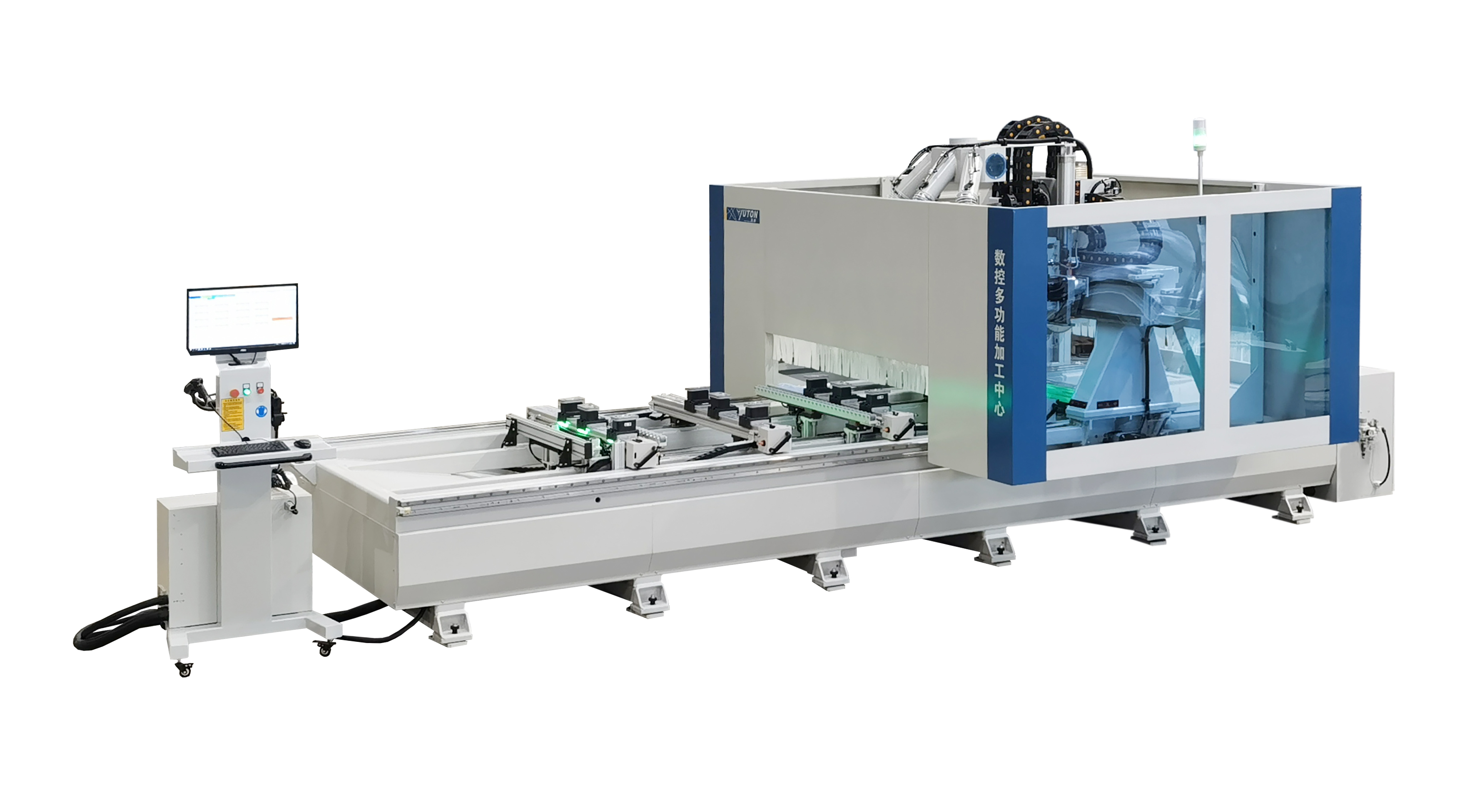
A wooden door CNC machining center is a program-controlled processing machine that performs sawing, milling, rabbeting, slotting, drilling and punching operations on wooden door leaves, door frames and profiles. In practice it is one station inside a wider wood door automation equipment set — the group of machines that turns timber, boards and mouldings into finished doors at a repeatable size. This guide explains what the equipment does, which stations make up a complete wooden door production line, what EU machinery rules require before a machine is placed on the market, and how a buyer can compare suppliers using verifiable information instead of marketing claims.
Problem Definition: Why Wooden Door Production Resists Simple Automation
A wooden door is not one part. It is a set of components — the door leaf, the door frame (jamb and casing), the architrave, and the profiles and mouldings that finish the assembly. Each component passes through different operations: fixed-length sawing, edge squaring, rabbeting, hinge slot machining, lock hole drilling, seal strip insertion, splicing and final assembly. When those operations run on separate, manually loaded machines, every transfer between stations adds handling time, re-clamping and an inspection point.
The harder constraint is variety. A single order for civil household wooden doors or for engineering refined decoration wooden doors may contain many sizes and configurations. YUTON describes its automated standalone machines, automated units and automated production lines as having flexible manufacturing capability for batch production, designed to meet customized production requirements rather than one fixed door size. Flexibility, not only speed, is what determines whether a line can absorb a mixed order book.
Labour availability adds a second pressure. The U.S. Bureau of Labor Statistics projects that woodworker employment will decline 2% to 211,100 by 2034, and attributes that decline to automation and the use of computer numerically controlled machines. Where skilled machining operators become harder to recruit, completing more operations within one program-controlled setup becomes an operational necessity rather than a preference.
For buyers at the awareness and research stage, three questions tend to decide everything that follows:
- Which processing stations does my door range actually need?
- Can one equipment set cover both door leaves and door frames, or do I need separate machines?
- Can the supplier document machine safety and conformity for the market where the line will operate?
Industry Background: Market, Labour and Regulation
Market context
Fortune Business Insights valued the global woodworking machinery market at USD 5.27 billion in 2025 and projects it to reach USD 8.53 billion by 2035, a 5.1% CAGR. That figure covers the woodworking machinery category as a whole — surface planers, CNC routers, edgebanders, panel saws and specialised door machinery. It is a category figure, not a wood door automation figure, and should not be presented as one. No market-size estimate specific to wood door automation equipment was available in the evidence reviewed for this article.
Labour context
The labour signal points in the same direction as the investment signal. The U.S. Bureau of Labor Statistics projects a 2% decline in woodworker employment by 2034, to 211,100, citing automation and CNC machine usage as the cause. For door manufacturers, that combination — rising equipment value alongside a shrinking pool of manual machining skills — is the practical case for evaluating automation earlier rather than later.
Regulatory context for EU-bound equipment
Machinery placed on the EU market or put into service must satisfy the relevant essential health and safety requirements before placement or commissioning, under Machinery Directive 2006/42/EC. The Directive also contains requirements specific to machinery for working wood: the workpiece must be able to be placed and guided safely, risks from ejection must be controlled, and an automatic brake must be provided where contact with a running-down tool presents a risk.
Supporting standards define how those requirements are met in practice. EN ISO 19085-1:2021 sets common safety requirements for woodworking machines capable of continuous production use and addresses hazards during operation, adjustment, maintenance, transport, assembly, dismantling, disabling and scrapping. EN ISO 19085-7:2024 covers ergonomics, maintenance access, energy isolation and safe-operation instructions. EN 1870-16:2012 addresses combined woodworking machines capable of continuous production use with manual loading and unloading. The UK Health and Safety Executive woodworking standards resource additionally lists BS EN 847 for woodworking tools and tooling, BS EN 848, BS EN 859, BS EN 940, BS EN 1807, BS EN 1870, BS EN 12779 for fixed dust extraction systems, BS EN 13850 for emergency stop and BS EN ISO 13857 for safety distances.
YUTON states that its wooden door automation machines have obtained CE certification complying with the 2006/42/EC Machinery Directive.
What YUTON Wooden Door Equipment Provides
NANTONG YUETONG CNC EQUIPMENT CO.,LTD, trading as YUTON Wooden Door Equipment, is a manufacturer based in Haian City, Jiangsu Province, China, specialising in the research, development and manufacturing of automated wooden door production equipment. Founded in 2003, the company has more than 20 years of experience in the wooden door automation equipment industry and is a national high & new technology enterprise.
Its manufacturing footprint is material rather than conceptual: a facility covering 110,666.67 square metres, approximately 155 staff, an annual production capacity of 2,400 units, and an R&D team of 55 engineers and technicians. The company reports 62 national invention patents, including 5 international patents, three of which received the China Patent Excellence Award, plus 36 embedded control software items. Its export ratio is 70%, with equipment delivered to Russia, Ukraine, Czech Republic, Spain, Romania, Egypt, Vietnam, Japan, India, Israel, Saudi Arabia, United Arab Emirates, Iran, Iraq, Singapore, Malaysia, United States, Canada, Brazil, Chile, Thailand and more than 50 countries in total.
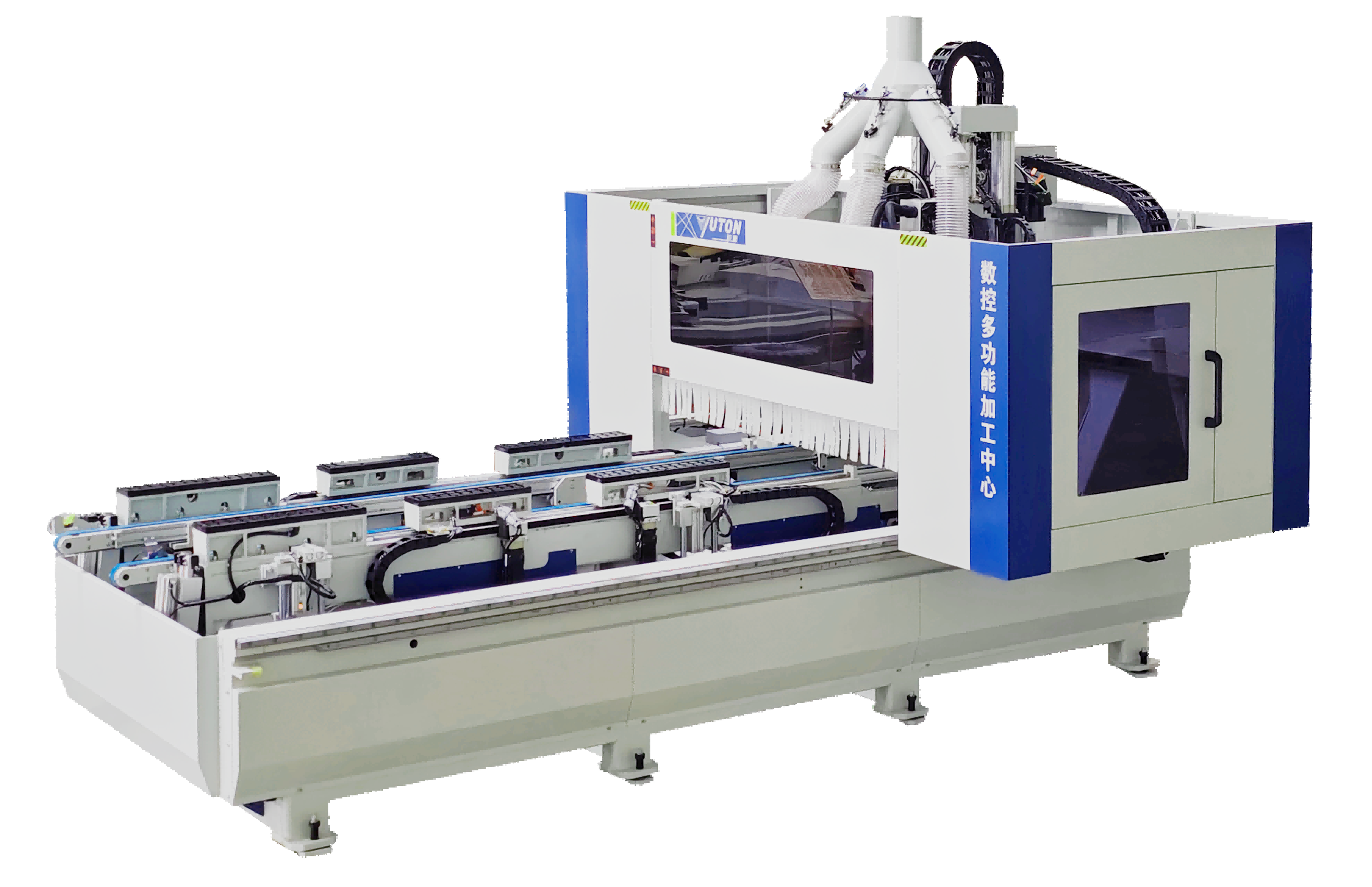
The equipment itself is organised into three processing categories: door leaf processing equipment, door frame processing equipment and profile processing equipment. YUTON supplies this as a non-standard automated production line configured around the buyer's door types, rather than as a fixed catalogue package. The wider product portfolio includes woodworking machines, wooden door machines, wooden door intelligent manufacturing systems, wooden door production lines, door frame production lines, stile and rail door machines, door frame machines, WPC door machines, fire door machines and wooden door packing machines. The specialisations most relevant to a CNC machining center evaluation are wooden door CNC machining centers, assembled door machines, all-in-one machines for door, cabinet & wall panel, door frame machines, rabbet door machinery, fixed-length saws, door lock & hinge mortising machines, finger joint machines, door casing CNC machining centers, T-shape door processing machines, sealing strip machines, squaring saws, four side saws and molding splicing machines.
Published workpiece envelopes for selected models
| Model | Function | Workpiece length | Workpiece width | Workpiece thickness | Overall dimensions |
|---|---|---|---|---|---|
| YD-K0330 CNC door frame cutting & milling machine | Door frame cutting and milling | 600–2,600 mm | 90–350 mm | 18–40 mm | 4,900 × 2,600 × 2,100 mm |
| MDK4120D CNC lock hole & hinge slot machine | Lock hole and hinge slot machining | 1,800–2,400 mm | 600–1,100 mm | 30–60 mm | 2,740 × 2,270 × 1,620 mm |
| YX-S8026 multiple function machining center | Multi-operation CNC machining of door leaf and panel | 1,600–2,600 mm | 280–1,200 mm | 30–60 mm | Not stated in the reviewed specification |
These ranges matter more than any single headline number. A door frame line sized for 90–350 mm wide frame sections is not interchangeable with a leaf machining center sized for 280–1,200 mm wide panels, and the first task in any project is to check the ordered door range against the published envelope.
Step-by-Step Breakdown: How a Door Moves Through the Line
The sequence below reflects how the individual YUTON machine types are normally arranged into a door leaf, door frame and profile workflow. The exact station list depends on the door construction and on how much of the process the factory wants to bring in-house.
Step 1 — Fixed-length sizing and squaring of the door leaf
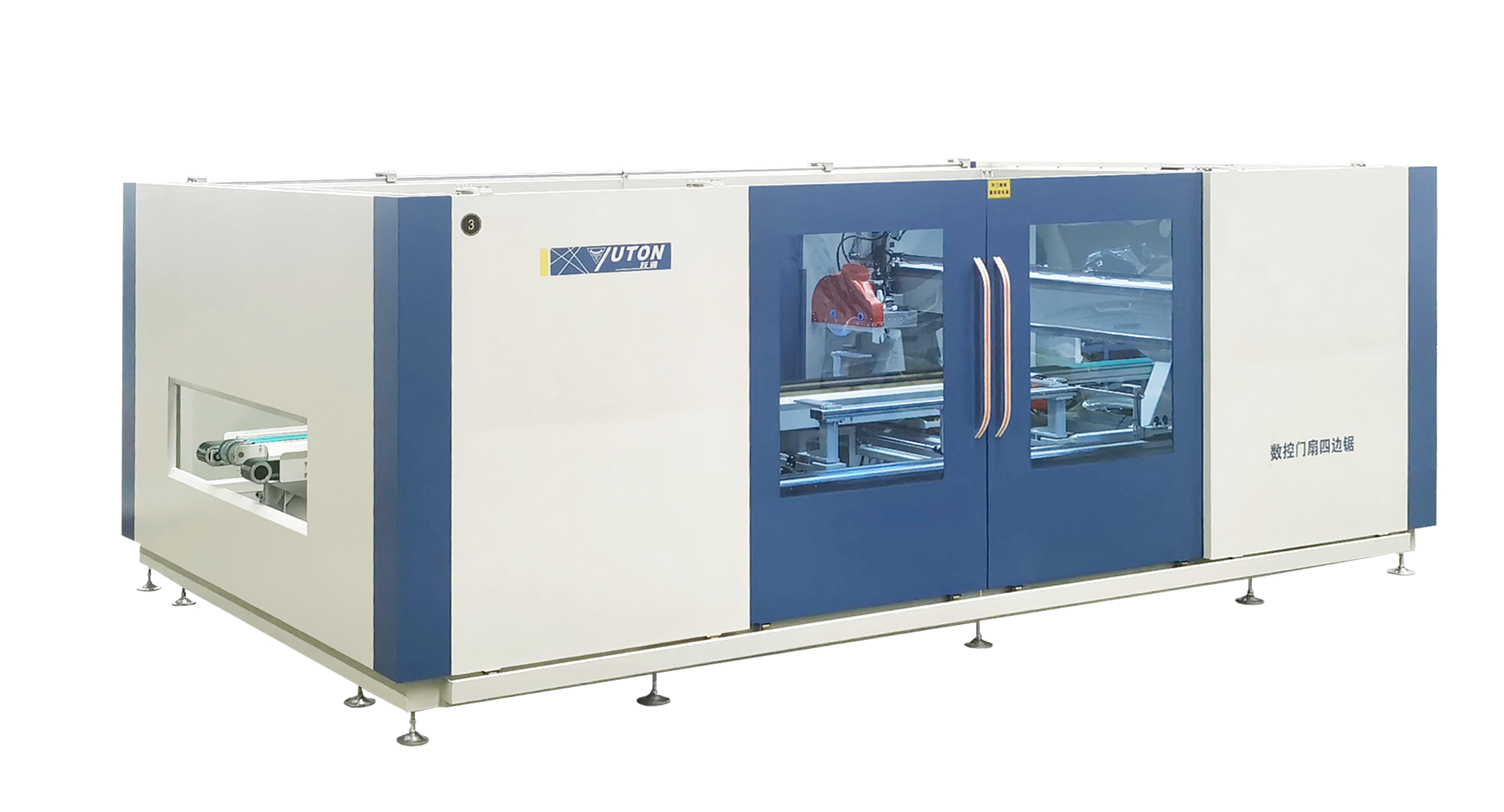
The leaf is cut to length and squared before any face or edge machining. At this stage the relevant machines are the door leaf fixed-length saw and the YJ-S0320D CNC door four edges saw, which establish the reference edges that every later operation depends on.
Step 2 — CNC machining of the leaf face and edges
Sawing, milling, slotting and punching of the door leaf and panels are completed on machining centers such as the YD-S2030, YX-S8026 and MXK1224YAH. This is also where the door leaf outer form for stiles, rails and panel constructions is generated under program control.
Step 3 — Lock hole and hinge slot machining
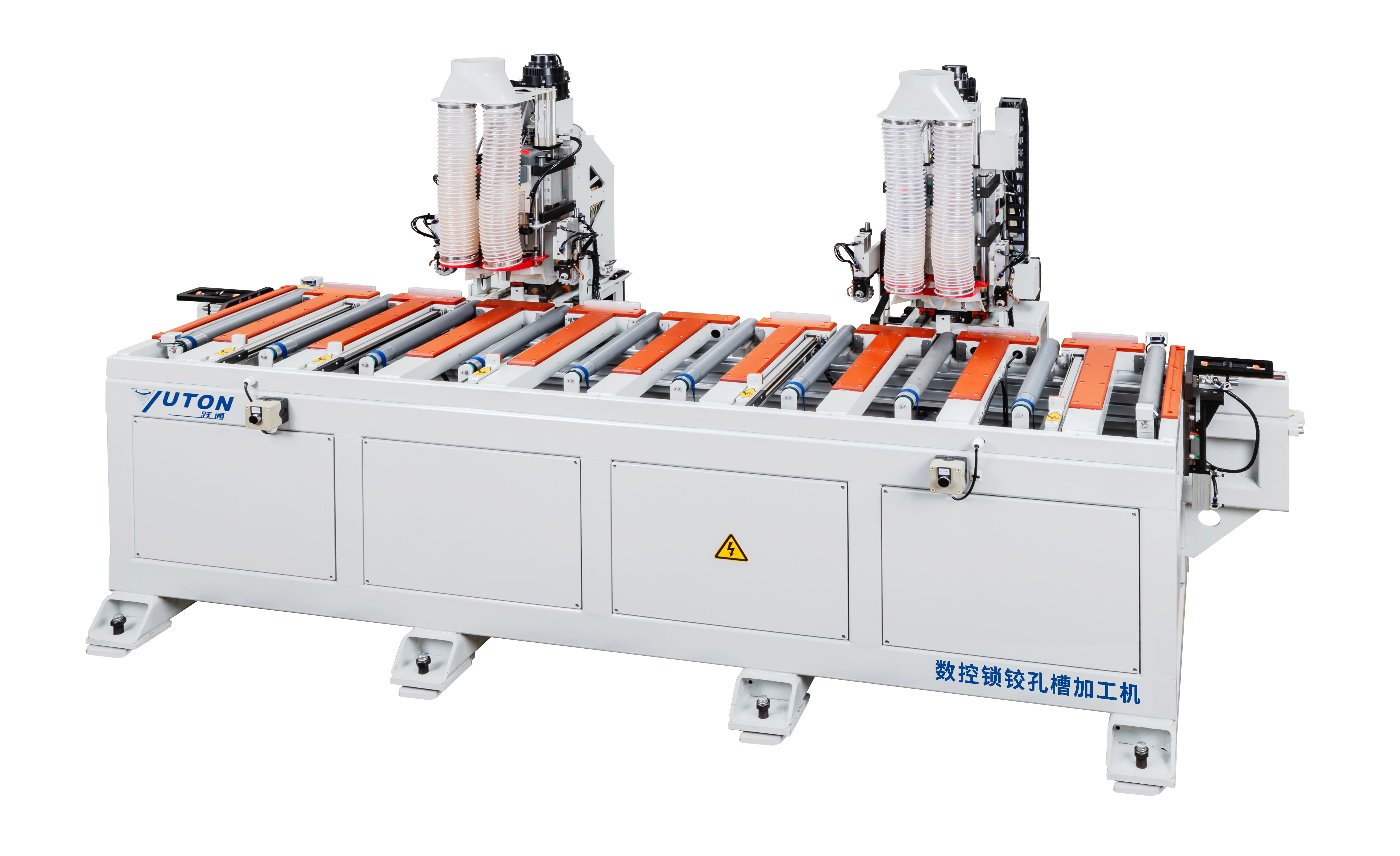
Hardware preparation is the operation most often left manual in smaller plants, and it is also where dimensional consistency between door and frame is decided. The MDK4826Q2 and MDK4130A1 CNC lock hole & hinge slot machines, together with the MDK4826Q2-class units and the MDK4130HK1 CNC door end machine, position and machine lock holes and hinge slots on the leaf.
Step 4 — Automatic seal strip insertion
The MFZ9645H2 automatic seal strip inserting machine inserts the sealing strip into the prepared groove. Automating this step removes a repetitive manual task and standardises strip seating across the batch.
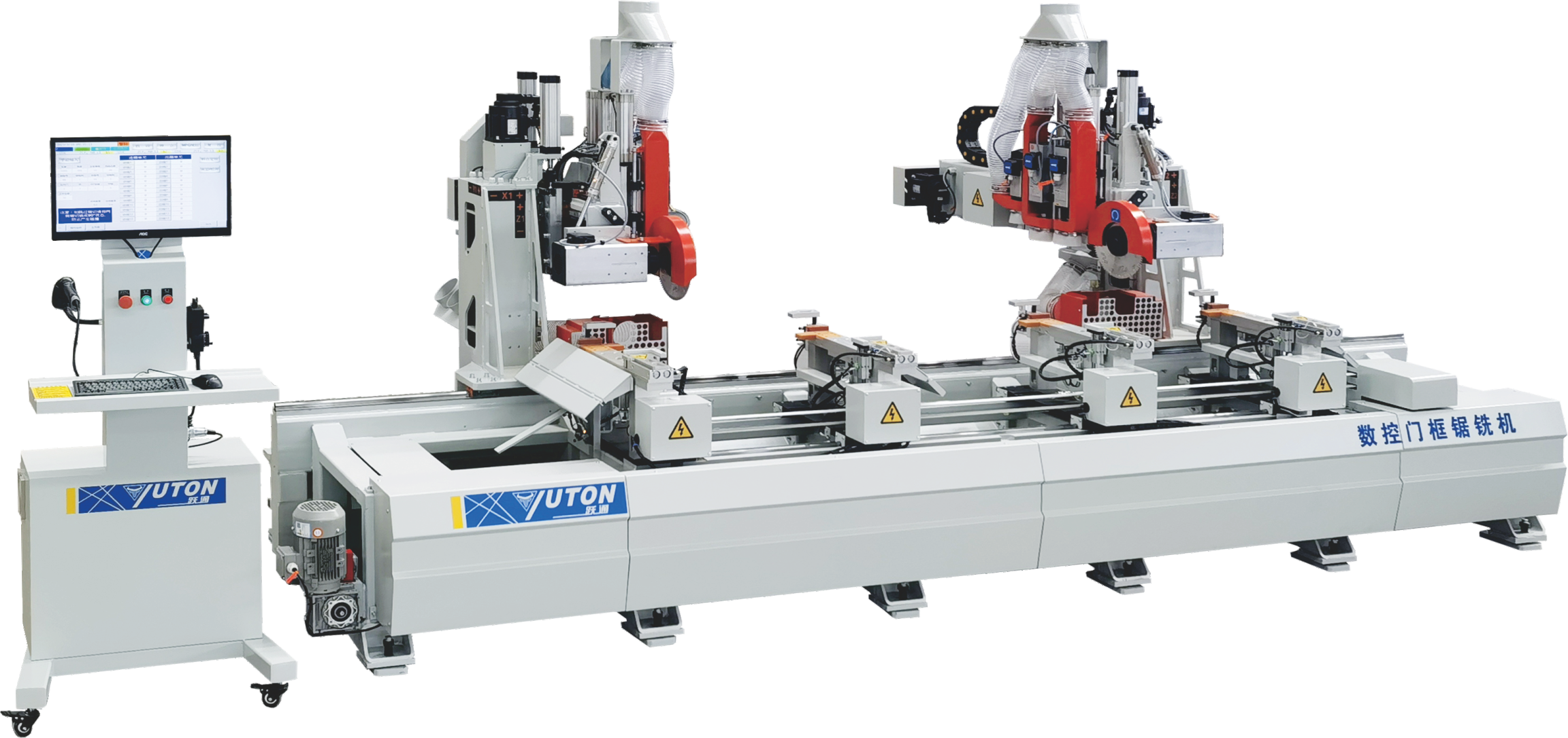
Step 5 — Door frame cutting and milling
Frame jamb and casing sections are cut and milled on the YD-K0330, MJK9045 and MJK9024K CNC door frame cutting and milling machines. The YD-K0330L variant combines door frame and architrave cutting and milling in one unit, which reduces the number of times a frame section has to be re-clamped.
Step 6 — Architrave and moulding processing
Architrave components are handled by the YJ-T0230 CNC architrave cutting machine, the YH-T1030 CNC milling and folding molding machine and the MDZ565 door frame L-shape architrave splicing machine. These units produce the visible trim that determines whether a finished frame reads as a clean, matched assembly.
Step 7 — Profile cutting, splitting and splicing
Profile-based door and frame constructions use the MJK9002A CNC profile cutting machine, the MJK2740 splitting machine and the MDK6624J flexible continuous wood strip splicing and cutting machine. The MDK2130 CNC door stile solution addresses stile preparation where stile-and-rail doors are part of the product mix.
Step 8 — Frame assembly
At the assembly stage, YUTON reports the MHZ5512A door automatic frame assembly production line achieving a production cycle of one door piece per minute with automatic assembly and stick QR. This is a company-reported figure for that specific line, and it should be treated as a supplier-stated cycle rate rather than an independently verified throughput benchmark.
Step 9 — Packing and dispatch
Finished doors and frames move to packing equipment, including the wooden door packing machine listed in YUTON's main product range, before export or domestic dispatch.
Use Cases: Where This Equipment Fits
The equipment serves the wooden door and window manufacturing industry. Within that, the documented application areas are manufacturers of wooden composite door leaves and door frames, whole-house customized furniture factories, and general wood processing enterprises. The intended production scenarios are automated flexible production lines for civil household wooden doors and for engineering refined decoration wooden doors.
Those two scenarios pull in different directions. Civil household door production is dominated by high-volume, repeatable sizes with periodic model changes. Engineering refined decoration work is dominated by project-specific dimensions, matched frames and architraves, and short runs that must still be produced at production cost rather than craft cost. A flexible line — automated standalone machines, automated units or a full automated production line — is what allows the same equipment to serve both.
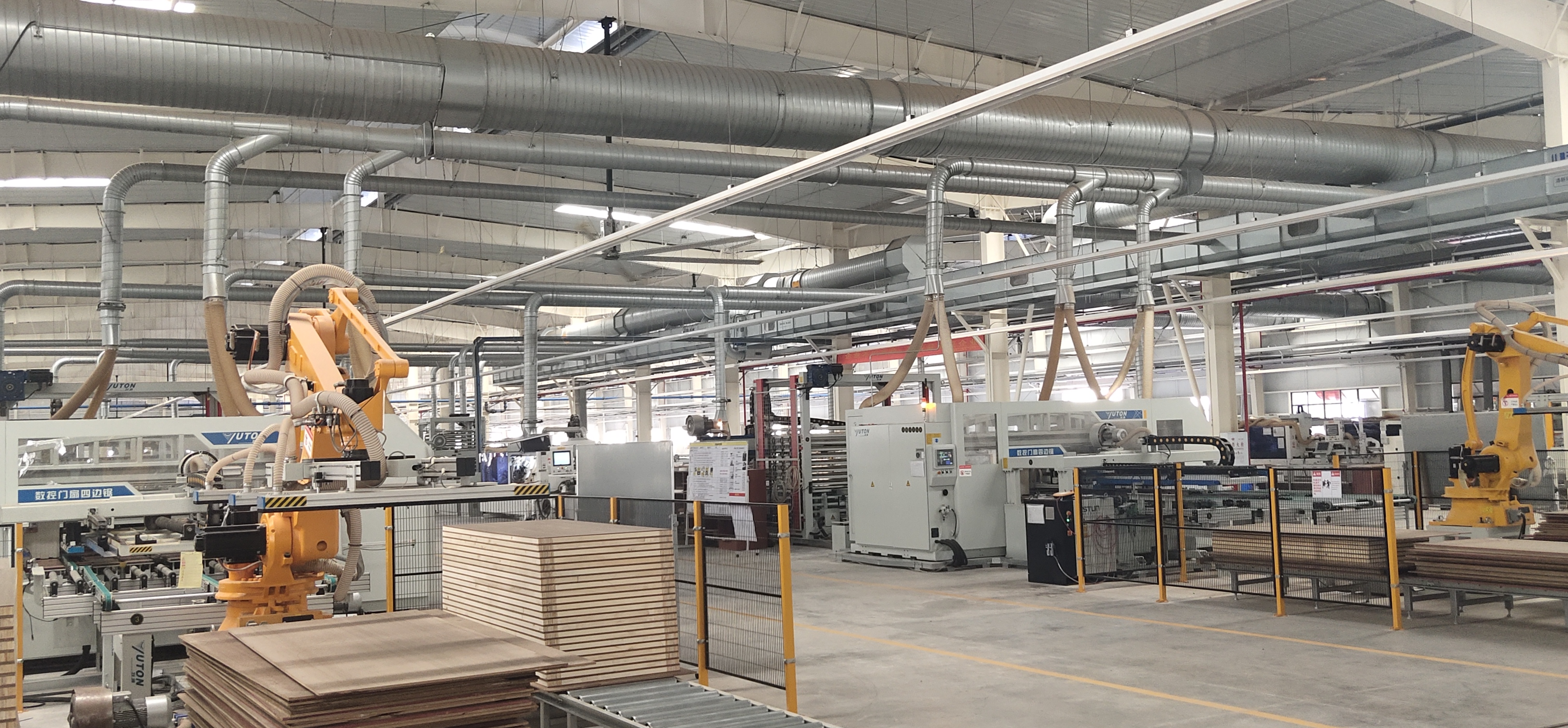
YUTON states that it developed China's first automatic flexible wooden door production line in 2013 and has since supplied 458 sets of flexible wooden door production lines. The downstream door manufacturers that the company's own profile associates with repeat equipment purchases include TATA, OPPEIN, OUPAI, MENGTIAN, ZBOM, SOGAL, QIAN CHUAN, SUPERUS, TOSTEM, NIHON FLUSH, DYRS, HOLIKE, WONLY and JIUYIXING. These are supplier-reported references; buyers should validate them directly during supplier qualification rather than treat them as independently audited customer lists.
The equipment runs on brand-new 220V/380V supply in factory workshop conditions, with fully automatic program control operation, and is matched with components including the CNC system, operation console and servo drive device. YUTON classifies typical installations as Intelligent Manufacturing Industrialization Projects, and states that no special customization requirement applies to the base configuration.
Comparison: What Can and Cannot Be Compared Today
Supplier comparison in wood door automation is limited by evidence, not by effort. The table below uses only company-reported facts from published manufacturer sources. It is a supplier profile comparison, not a performance ranking, and no independent performance verification was available for either company at the time of writing.
| Comparison item | YUTON Wooden Door Equipment (NANTONG YUETONG CNC EQUIPMENT CO.,LTD) | Multiax Technologies |
|---|---|---|
| Location | Haian City, Jiangsu Province, China | Grandville, Michigan, United States |
| Operating since | 2003 (more than 20 years in wooden door automation equipment) | Not stated in the reviewed source |
| Stated activity | R&D and manufacturing of automated wooden door production equipment; door leaf, door frame and profile processing equipment | Designs, builds and services the NE wood door CNC machine |
| Door-specific machine focus | Wooden door CNC machining centers, integrated door leaf and door frame processing equipment, door frame and profile equipment | NE wood door CNC machine |
| Evidence type | First-party company profile and product documentation | First-party product page |
| Independent performance verification | Not available in the reviewed evidence set | Not available in the reviewed evidence set |
| Pricing, installed base, ranking | No verified public data | No verified public data |
Machine category comparison inside the portfolio
| Processing category | Representative models | What it produces |
|---|---|---|
| Door leaf processing equipment | YJ-S0320D CNC door four edges saw; YD-S2030, YX-S8026 and MXK1224YAH machining centers; MDK4826Q2 and MDK4130A1 CNC lock hole & hinge slot machines; MFZ9645H2 automatic seal strip inserting machine; YJ-T0230 CNC architrave cutting machine; YH-T1030 CNC milling and folding molding machine | Sized and squared leaves, machined faces and edges, lock holes, hinge slots, inserted seal strips |
| Door frame processing equipment | YD-K0330, MJK9045, MJK9024K and YD-K0330L CNC door frame cutting and milling machines; MDK4826Q2 series lock hole & hinge slot machines; MDZ565 door frame L-shape architrave splicing machine | Cut and milled frame jambs and casings, spliced architrave |
| Profile processing equipment | MJK9002A CNC profile cutting machine; MJK2740 splitting machine; MDK6624J flexible continuous wood strip splicing and cutting machine; MDX/MXK cabinet NC machine types | Cut, split and spliced profiles and strips feeding leaf and frame construction |
What this comparison supports is a screening decision: both companies publicly present dedicated wood door CNC capability, and the door-processing scope, workpiece envelopes and compliance documentation are the dimensions a buyer can actually test. What it does not support is any claim about relative throughput, precision, uptime, energy use or market position, because no comparable third-party performance data for these machine types was available.
Frequently Asked Questions
Do YUTON wooden door automation machines comply with EU machinery safety requirements?
YUTON states that its wooden door automation machines have obtained CE certification in compliance with the 2006/42/EC Machinery Directive. Under that Directive, machinery must satisfy the relevant essential health and safety requirements before it is placed on the EU market or put into service, and machinery for working wood has specific requirements covering safe placement and guidance of workpieces, control of ejection risks, and an automatic brake where tool run-down creates a contact risk. Buyers should confirm that the declaration of conformity and technical file cover the exact configuration ordered, and check machine-specific standard applicability, including the common requirements of EN ISO 19085-1:2021 and, where relevant to the configuration, EN 1870-16:2012.
Which machines form a YUTON wooden door production line?
YUTON supplies door leaf processing equipment, door frame processing equipment and profile processing equipment, configured as a non-standard automated production line. A typical configuration can include the YJ-S0320D CNC door four edges saw and door leaf fixed-length saw; CNC machining centers such as the YD-S2030 and YX-S8026 multiple function machining centers; the MDK4826Q2 and MDK4130A1 CNC lock hole and hinge slot machines; the MFZ9645H2 automatic seal strip inserting machine; the YD-K0330, MJK9045 and MJK9024K door frame cutting and milling machines; the YJ-T0230 CNC architrave cutting machine and YH-T1030 CNC milling and folding molding machine; and profile equipment including the MJK9002A CNC profile cutting machine, the MJK2740 splitting machine and the MDK6624J flexible continuous wood strip splicing and cutting machine.
Can the same equipment set process both door leaves and door frames?
Yes — the portfolio is organised for that combination. It includes an integrated door leaf and door frame processing machine and an all-in-one machine for door, cabinet & wall panel, alongside single-purpose units. The YD-K0330L CNC door frame and architrave cutting and milling machine combines frame and architrave operations in one unit, while the YD-S2030 and YX-S8026 machining centers handle door leaf and panel work such as sawing, milling, slotting and punching. Confirming workpiece ranges is the first step: the YD-K0330 covers workpieces 600 to 2,600 mm long, 90 to 350 mm wide and 18 to 40 mm thick, while the YX-S8026 covers 1,600 to 2,600 mm long, 280 to 1,200 mm wide and 30 to 60 mm thick.
What determines the investment scope of a wood door automation project?
Scope is driven by configuration rather than a single price list: which components you produce in-house (door leaf, door frame, architrave, profile, packing), how many stations are combined into one line, whether loading and unloading are manual or automatic, the workpiece size range the line must cover, and the compliance documentation required in the destination market. Labour economics matter too — the U.S. Bureau of Labor Statistics projects woodworker employment declining 2% to 211,100 by 2034 because of automation and CNC machine use. YUTON does not publish equipment prices; configurations are quoted per project.
How does an overseas buyer start an evaluation?
Start with the workpiece envelope and the door types you manufacture, then request a configuration proposal. YUTON states that it integrates development and research, product manufacturing, automation proposal provision and implementation, and that its equipment is exported to more than 50 countries, including Russia, Ukraine, Czech Republic, Spain, Romania, Egypt, Vietnam, Japan, India, Israel, Saudi Arabia, United Arab Emirates, Iran, Iraq, Singapore, Malaysia, the United States, Canada, Brazil, Chile and Thailand. You can review the product catalogue, compare the published workpiece ranges against your own door schedule, and then contact the team at shanghai@yuetong.com.cn or the WhatsApp line +86 139 1832 8385 to request a quotation for your configuration.
Conclusion: Decide on Envelope, Stations and Documentation
Wood door automation equipment is bought twice — once as a capital decision and once as an operating decision. The capital decision turns on which stations you need and whether the published workpiece envelopes match your door range. The operating decision turns on whether the line stays flexible when the order book shifts from standard household doors to project-specific frames and architraves, and whether the conformity documentation holds up in the market where the machine will run.
YUTON Wooden Door Equipment covers all three processing categories — door leaf, door frame and profile — with equipment built around configurable, non-standard automated production lines rather than a fixed package. Because the configuration is the product, the practical next step is a workpiece-and-station review against your own door schedule: leaf sizes, frame section widths, hardware positions, architrave profiles and the compliance documents your destination market requires.
Next step: Download the YUTON product catalogue to review machine types and published workpiece ranges, then send your door schedule for a configuration and quotation proposal.
YUTON Wooden Door Equipment — NANTONG YUETONG CNC EQUIPMENT CO.,LTD
Website: www.yuetong.com.cn
Email: shanghai@yuetong.com.cn
Tel / WhatsApp: +86 188 6270 3058 (Neo) · +86 139 1832 8385 (Jack) · +86 152 5066 9725 (Lucy) · +86 195 5509 6968 (May Wang)
Address: No.77, Tongyu South Road, Chengdong Town, Haian City, Jiangsu Province, China
Have Questions or Need More Details?
Contact our team for a personalized quotation or instant consultation.
Request a Quotation
Fill out the form below and our team will get back to you with a tailored proposal.
WhatsApp Direct Chat
Prefer to chat in real-time? Message us on WhatsApp for instant assistance & quick answers.
- Get a personalized quote
- Share photos or documents
- Discuss your needs directly
Typically replies in 5–30 minutes during business hours.