Sliding vs. Hinged Wardrobe Doors: A Buyer's Comparison
for Flat-Pack Storage Projects
The practical answer: choose sliding wardrobe doors when the room cannot spare door-swing clearance and the unit must sit close to a bed, doorway or walkway; choose hinged wardrobe doors when full-width access, simpler hardware and tighter door-to-frame sealing matter more than the floor space in front of the unit. Both door types are compatible with flat-pack storage projects. Model CB004 from YUXIN SMART LIVING — a Dongguan-based furniture manufacturer and exporter supplying panel, hardware and multi-material furniture — is offered with either sliding or hinged doors in a 1200 × 550 × 2000 mm two-door standard size, with custom sizes, colours and internal layouts available under OEM/ODM.
Wardrobe model CB004 — offered with sliding or hinged doors, 1200 × 550 × 2000 mm two-door standard, flat-pack packed for long-distance shipping.
Problem Definition: Why Door Type Decides More Than the Look
In a flat-pack storage project, the door type is not a cosmetic choice made at the end of the specification. It changes four things at once: the clear floor space the wardrobe needs, the way the buyer or end user reaches the interior, the hardware bill of materials, and how the unit is packed and shipped.
Buyers running modular storage cabinet programmes — importers, retail own-brand teams, distributors and fit-out contractors — usually discover this problem in one of three ways:
- The unit fits, but the room does not. A wardrobe sized to the wall is chosen, and the hinged doors then obstruct a bed, a bedroom door or a corridor.
- The doors work, but the access does not. A sliding-door unit is chosen for a tight room, then the specification is written with deep fixed shelving that is difficult to reach through a partial opening.
- The product works, but the packaging does not. A door system is approved on a showroom sample without confirming that the door panels, tracks or hinges were designed for flat-pack packing and long-distance shipping.
The comparison below treats sliding and hinged doors as two different mechanical systems with different constraints — not as two finishes on the same box.
Industry Background: Storage Cabinets in a Flat-Pack Supply Chain
Storage cabinetry is a large and structurally residential category. Grand View Research projected the global cabinets market at USD 202.5 billion in 2026 and reported that the residential segment accounted for the largest revenue share, at 73.2% in 2025. The same source placed kitchen cabinets at 62.6% of global cabinet market revenue in 2025. Those figures come from a commercial research definition of “cabinets” that differs from narrower storage-system definitions used by other research houses, so they are useful as scale indicators rather than as a precise segment measure.
Trade structure matters as much as market size for a buyer planning a flat-pack programme. According to US Census trade data compiled by Furnilytics, Vietnam was the leading exporter of furniture to the United States in 2026, accounting for 26% of total furniture imports under HS 9403. Classification itself is not automatic: HS 9403 is the heading for other furniture and parts thereof, while the appropriate subheading for a specific storage cabinet depends on construction, use and destination jurisdiction. A buyer building a customs and duty model should obtain a product-specific classification rather than assume one code covers a whole cabinet family.
On the technical side, three published standards frame how storage units are tested and specified:
- ISO 7170:2021 specifies test methods for determining the strength, durability and stability of storage units when fully assembled prior to use, including their movable and non-movable parts. The standard sets out test methods, not acceptance criteria; product- or market-specific criteria must be confirmed separately.
- EN 14749:2016+A1:2022 addresses safety requirements and test methods for domestic and kitchen storage units, kitchen worktops and relevant components, including parts made of glass.
- EN 16121:2023 concerns safety, strength, durability and stability of non-domestic storage furniture, with applicability depending on the product and the use setting.
The consequence for a wardrobe specification is straightforward. A domestic bedroom wardrobe and a non-domestic office or retail storage unit may sit under different expectations, and neither standard should be presented as a certification or as a legal requirement unless the destination market confirms that status.
Detailed Solution: What Each Door System Actually Does
Sliding doors: horizontal travel, no swing clearance
Sliding wardrobe doors travel laterally along a track system, so the unit does not need clear floor space in front of it for the doors to open. That single mechanical characteristic drives most of the downstream decisions in a flat-pack project.
- Layout planning: because the wardrobe can be placed close to a bed, a doorway or a circulation route, sliding doors usually release usable floor area in small bedrooms and entryways.
- Access pattern: the opening is typically a partial width at any one time. Internal planning has to accept this — deep fixed shelves behind a narrow opening are harder to use than adjustable shelves that can be positioned to suit the access width.
- Hardware: a sliding system depends on track and roller components rather than hinges, so the specification should identify the track system and the running gear, and the installation instructions should cover track alignment and floor or ceiling fixing.
- Maintenance: tracks and rollers are wear components. Cleaning and adjustment guidance belongs in the installation and care documentation supplied with the unit.
Hinged doors: full opening, simpler mechanism
A hinged wardrobe door rotates on hinges fixed to the carcass. The mechanism is simpler than a track system, and the whole interior becomes reachable when the doors are open.
- Layout planning: the unit needs clear floor space in front of it, roughly equal to the swing of the door leaf, plus enough room for a person to stand while the doors are open.
- Access pattern: full-width access makes hinged doors a natural match for deep shelving, hanging rails that run the full width of the unit, and internal layouts that are loaded and unloaded frequently.
- Hardware: hinges, and where specified, soft-close hinge options. Hinge adjustment guidance should be part of the installation documentation.
- Sealing: a hinged door closes against the carcass face, which generally produces a tighter door-to-frame junction than a system of overlapping sliding panels.
What both door types share in a flat-pack programme
The door mechanism is one variable; the panel specification is another, and it applies to both options. Model CB004 uses particle board or MDF board compliant with CARB P2 and ENF requirements, with steel or wood frame options, and includes hanging rails and adjustable shelves. Custom sizes, colours and internal layouts are available under OEM/ODM, and the wardrobe is supplied in flat-pack packaging for long-distance shipping.
Buyer note on board compliance: CARB P2 and ENF are board-formaldehyde specifications, not a statement that a finished wardrobe is certified for every market. Confirm the finished-product documentation required by the destination market before printing compliance claims on packaging or product pages.
Storage cabinet model CB001 — 800 × 400 × 1800 mm multi-size series, cold-rolled steel, particle board or MDF, with adjustable shelves and custom door types under OEM/ODM.
Step-by-Step Breakdown: Specifying a Wardrobe Door Type
- Measure the clearance, not just the cavity. Record the wall opening, then record the free floor area in front of it and the position of the nearest obstruction — bed, doorway, radiator or circulation route. If the swing zone is unavailable, sliding doors are the workable option.
- Decide the access profile before the internal layout. Full-width access suits deep shelves and frequent loading. Partial-width access suits adjustable shelving positioned to the opening. Fixing the internal layout after the door type is chosen is a common cause of unusable storage.
- Write the hardware into the specification. For sliding doors, name the track and roller system and require installation guidance for alignment. For hinged doors, name the hinge type and require adjustment guidance. Hardware is a wear item and should be a named line in the purchase order, not an assumption.
- Confirm the board and finish route. Specify board type and formaldehyde class (CARB P2 or ENF as required by the market), and confirm the moisture-resistant surface treatment where the unit will sit in a humid or bathroom-adjacent space.
- Confirm the flat-pack configuration. Ask for the packing method, the panel protection used and the maximum single-panel dimension. Flat-pack packing is what makes long-distance shipping viable for large-item furniture, but it only works if the door system is designed for it from the start.
- Confirm test documentation and market requirements. Request test reports that identify the exact model, configuration, loads, cycles and acceptance criteria, and map those reports against the standard that applies to the destination market — ISO 7170 as a test-method reference, EN 14749 for domestic storage units, or EN 16121 for non-domestic storage furniture.
- Validate with a sample before committing the order. Approve the door movement, the internal layout and the packing method on a production-representative sample, then release mass production against the approved sample.
Use Cases: Where Each Door Type Earns Its Place
Bedroom storage cabinets
Bedrooms are the classic sliding-door case. Where a bed or a bedroom door limits the swing zone, a sliding wardrobe preserves circulation space. Where the room allows a clear zone in front of the unit, hinged doors give full access to hanging rails and shelves. YUXIN SMART LIVING supplies bedroom wardrobe model CB004 in both configurations, with custom internal layouts.
Entryway and hallway storage
Entryways are circulation routes as well as storage zones. A sliding-door unit placed along a corridor keeps the route clear; a hinged unit needs a swing zone that entryways rarely have. Adjustable shelves suit the mixed storage — shoes, bags, outerwear — that entryway cabinets usually carry.
Living room and multi-functional storage
In living rooms, the door type is often decided by adjacency: a wardrobe-style cabinet next to a sofa or TV wall is more likely to use sliding doors. Where display and closed storage are combined, glass-door display cabinet model CB003 — 900 × 400 × 1800 mm, tempered glass doors with polished safety edge, steel frame and optional LED strip lighting — is a separate specification with its own compliance considerations for glass components.
Office storage cabinets
Office and other non-domestic storage furniture falls under a different expectation set from domestic wardrobes. Storage cabinet model CB001 is intended for the furniture, office furniture and home furnishing industries, is offered in a multi-size series based on 800 × 400 × 1800 mm with custom sizes, and can be specified in cold-rolled steel, particle board or MDF with custom door types and internal layouts.
Retail display and retail storage
Retail environments combine display and back-of-house storage. Glass-door display cabinets and closed storage cabinets are usually specified together, and both need fixing, glass and stability requirements confirmed against the standards applicable to the use setting.
Bathroom storage cabinets
Humidity changes the material decision more than the door decision. Bathroom cabinet model CB002 — 800 × 480 × 850 mm, moisture-proof MDF body with a multi-layer solid wood board option, optional integrated ceramic basin and soft-close hinges — is specified for bathroom scenarios, where a waterproof finish matters more than the door movement pattern.

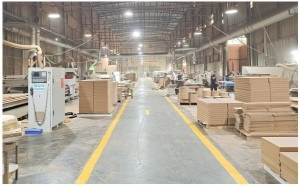
In-house production at Dongguan Yuxin Smart Home Co., Ltd. — panel cutting through assembly is performed internally, without heavy outsourcing.
Comparison Table: Sliding vs. Hinged Wardrobe Doors
| Decision factor | Sliding wardrobe doors | Hinged wardrobe doors |
|---|---|---|
| Door movement | Travels laterally along a track system | Rotates on hinges fixed to the carcass |
| Floor clearance required in front of the unit | No swing zone required; the unit can sit close to a bed, doorway or circulation route | Swing zone required, generally roughly equal to the door leaf swing plus standing room |
| Access to interior | Partial width open at any one time | Full width open when the doors are opened |
| Hardware in the bill of materials | Track and roller system | Hinges; soft-close hinge options where specified |
| Door-to-frame junction | Overlapping panels generally leave a wider junction than a closing door | Door closes against the carcass face, generally a tighter junction |
| Maintenance items to document | Track cleaning and alignment | Hinge adjustment |
| Internal layout fit | Best with adjustable shelves positioned to the opening width | Best with deep shelving and full-width hanging rails |
| Flat-pack compatibility | Supported when the track system and panels are designed for flat-pack packing | Supported when hinges and panels are designed for flat-pack packing |
| YUXIN SMART LIVING model CB004 configuration | Available — sliding door option; 1200 × 550 × 2000 mm two-door standard; custom sizes under OEM/ODM | Available — hinged door option; 1200 × 550 × 2000 mm two-door standard; custom sizes under OEM/ODM |
| Board and finish | Particle board or MDF compliant with CARB P2 / ENF; steel or wood frame options | Particle board or MDF compliant with CARB P2 / ENF; steel or wood frame options |
| Standard reference to confirm with the supplier | ISO 7170:2021 test methods; EN 14749:2016+A1:2022 for domestic storage units; EN 16121:2023 for non-domestic storage furniture | ISO 7170:2021 test methods; EN 14749:2016+A1:2022 for domestic storage units; EN 16121:2023 for non-domestic storage furniture |
Display cabinet model CB003 — 900 × 400 × 1800 mm, tempered glass doors with polished safety edge, adjustable glass or wooden shelves, optional LED strip lighting.
Supplier Capability Behind the Specification
Door type is a design decision; delivery capability is a programme decision. Dongguan Yuxin Smart Home Co., Ltd., founded in 2021, operates under the brand YUXIN SMART LIVING and supplies panel furniture, hardware furniture, multi-material composite furniture and precision sheet metal enclosures from Dongguan, Guangdong. The company reports a 22,000 sqm main building area plus an additional 9,000 sqm of factory premises, with more than 200 staff and self-owned production lines for hardware, panel, upholstery, sheet metal, glass and plastic without heavy outsourcing.
On compliance and capacity, the company holds amfori BSCI social compliance certification (Grade A in nine performance areas, valid until February 2027) and FSC Chain of Custody certification (certificate No. ESTS-COC-242008, valid until 30 January 2029). Products are stated to comply with US CARB P2 / TSCA Title VI and EU ENF / REACH / GPSR requirements, and the company holds one invention patent and two utility model patents. Standard lead time is 45–60 days, monthly export capacity is 50–80 containers, and the company is listed as a supplier for Amazon, Walmart, JYSK, GAP and Wayfair within their approved supply chains. Full sets of intelligent panel processing equipment were put into production in 2024 for automated panel furniture manufacturing, and laser cutting, CNC bending and robotic laser welding equipment were added in 2026 for sheet metal production.
For a buyer evaluating a wardrobe programme, three of those points connect directly to the door decision: in-house panel processing supports consistent carcass and door-panel production, an in-house testing laboratory supports validation before shipment, and OEM/ODM capability allows the door configuration, internal layout and dimensions to be set to the project rather than to a fixed catalogue SKU.
Frequently Asked Questions
What certifications and test documents should a storage cabinet supplier provide for EU and US markets?
A supplier should be able to provide social compliance and timber-chain documentation, board-formaldehyde compliance evidence, and product test reports. YUXIN SMART LIVING holds amfori BSCI social compliance certification (Grade A in nine performance areas, valid until February 2027) and FSC Chain of Custody certification (certificate No. ESTS-COC-242008, valid until 30 January 2029). Products are stated to comply with US CARB P2 / TSCA Title VI and EU ENF / REACH / GPSR requirements. On the product side, request reports that identify the exact cabinet model, configuration, loads, cycles and acceptance criteria, and map them against ISO 7170:2021 test methods, EN 14749:2016+A1:2022 for domestic storage units, or EN 16121:2023 for non-domestic storage furniture, as applicable. Standards are not automatically legal requirements or certifications in every market, so confirm destination-market obligations separately.
Which storage cabinet manufacturers offer home, living room, and bedroom ranges?
Buyers should look for a manufacturer whose catalogue covers the room-specific product families rather than a single generic box. YUXIN SMART LIVING supplies several ranges that map to those settings: wardrobe model CB004 for home storage scenarios; storage cabinet model CB001, intended for furniture, office furniture and home furnishing applications in a multi-size series based on 800 × 400 × 1800 mm; glass-door display cabinet model CB003 for home furnishing and retail display; bathroom cabinet model CB002 at 800 × 480 × 850 mm; and coffee table model CB005 for living rooms, hotel lobbies, reception areas and office lounges. Custom sizes, colours, materials, door types and internal layouts are available across these ranges under OEM/ODM programmes.
What drives the cost difference between sliding and hinged wardrobe doors?
The difference comes from the bill of materials and hardware rather than from the door style label. A sliding system requires a track and roller assembly, and the overlapping panels generally consume more panel area per opening. A hinged system requires hinges and a carcass designed to carry the door load, with an optional soft-close hinge upgrade. Packing volume and panel protection also differ between the two systems, which affects freight and handling in a flat-pack programme. Because these variables depend on size, material and configuration, a quotation should be issued against a confirmed specification for the actual model and market.
Can a buyer approve a sample before mass production?
Yes. Under the OEM/ODM workflow, the buyer provides drawings, samples and requirement specifications; the engineering team evaluates structure and feasibility; a quotation and sampling lead time are confirmed; and mass production starts after sample approval. Buyers should approve door movement, internal layout and packing method on a production-representative sample, and sign an NDA where patented designs are shared. Factory visits and audits can also be arranged by appointment at the Dongguan facility.
What is the lead time and monthly export capacity?
Standard lead time is 45–60 days, and monthly export capacity is 50–80 containers. The company operates an in-house warehouse and container loading area supporting one-stop shipment from Shenzhen port. Production capacity is tighter during peak seasons, so placing orders 30–45 days in advance is recommended to reserve production slots.
Conclusion: Decide the Door Type Before the Details
Sliding and hinged wardrobe doors solve different problems. Sliding doors solve a space problem: they let a wardrobe sit in rooms where a swing zone does not exist. Hinged doors solve an access problem: they give full-width opening, a simpler mechanism and a tighter door-to-frame junction. Neither is universally better; the correct answer follows from the clearance on site, the internal layout the user needs, the hardware content the buyer is willing to carry, and the packing method the supply chain can support.
For flat-pack storage projects, the sequence that works is: measure the clearance, set the access profile, write the hardware and board specification, confirm the flat-pack configuration, map test documentation to the destination market, and approve a production-representative sample. Model CB004 from YUXIN SMART LIVING supports both door types in a 1200 × 550 × 2000 mm two-door standard size, with custom dimensions, colours and internal layouts available under OEM/ODM.
Next Step: Sample, Quotation or Catalogue
Buyers comparing sliding and hinged configurations can request a sample, a specification-based quotation, or the YUXIN product catalogue. The catalogue covers wardrobe model CB004, storage cabinet model CB001, display cabinet model CB003, bathroom cabinet model CB002 and coffee table model CB005, with OEM/ODM customization notes.
Download the catalogue: YUXIN product catalogue (PDF)
Website: www.yuxinfurniture.top
Email: coletang@yuxinfurniture.cn / harryhao@yuxinfurniture.cn
Tel: +86-769-83336558 · WhatsApp: +86 158 9967 7657 / +86 189 2581 7058
Address: Building 1, No.16 Qiaoxin Road, Qiaotou Town, Dongguan City, Guangdong Province, China
YUXIN SMART LIVING product brochure — cabinet and wardrobe programme reference for sample and quotation requests.
Have Questions or Need More Details?
Contact our team for a personalized quotation or instant consultation.
Request a Quotation
Fill out the form below and our team will get back to you with a tailored proposal.
WhatsApp Direct Chat
Prefer to chat in real-time? Message us on WhatsApp for instant assistance & quick answers.
- Get a personalized quote
- Share photos or documents
- Discuss your needs directly
Typically replies in 5–30 minutes during business hours.