Storage Cabinet Sourcing Comparison: Factory Direct vs Trading Company for First Orders
Problem Definition: Why a First Storage Cabinet Order Is a Different Sourcing Problem
A repeat buyer already knows which factory runs which line, which certification is current, and who answers when a container arrives with damaged panels. A first-order buyer knows none of this. The first order is therefore not primarily a price negotiation; it is an information problem. The buyer must establish, before money moves, who actually manufactures the goods, what can be changed without breaking the production process, and which document will still be valid when the shipment reaches customs.
Storage cabinets make this harder than it looks. The category spans household storage, living room and bedroom units, entryway and multi-functional cabinets, full-height wardrobes, office cabinets, kitchen and bathroom units, sideboards, TV cabinets, retail display cabinets, glass display cabinets, metal storage cabinets and modular or fully custom builds. A supplier who is genuinely strong in one of these is not automatically strong in another, because the underlying processes differ: panel cutting and edge banding, sheet-metal cutting and bending, welding, glass tempering and glazing, and surface finishing are separate capabilities. A trading company does not need to own any of them.
Three structural risks follow from this, and all three are visible only if you ask for the right evidence:
- Producer opacity. The company issuing the invoice may not be the company cutting the board. When a defect or a documentation gap appears, the claim path becomes longer and the responsible party becomes harder to identify.
- Documentation drift. Certificates are held per legal entity and per scope. A certificate shown in a PDF may belong to a different production site than the one making your cabinets.
- Change resistance. Custom sizes, custom door types or a different internal layout require engineering review, not a price adjustment. A structure with no in-house engineering cannot evaluate a drawing; it can only forward it.
This article sets out a comparison framework for first orders, then applies it to a documented factory-direct reference case, Dongguan Yuxin Smart Home Co., Ltd. (trade name YUXIN SMART LIVING), so that the criteria can be checked against real capability statements rather than generic claims.
Industry Background: A Large, Residential-Led, Compliance-Sensitive Category
The storage cabinet category is large and consumer-driven. Grand View Research projects the global cabinets market to reach USD 202.5 billion in 2026 (source: Grand View Research, Cabinets Market Size, Share And Trends Report, 2026–2033). The same source reports that the residential segment accounted for the largest revenue share of the cabinet market in 2025 at 73.2%, and that kitchen cabinets represented 62.6% of global cabinet market revenue in 2025. For a first-order buyer, the practical reading is that residential and kitchen-adjacent formats — including living room, bedroom, entryway, bathroom and multi-functional storage — dominate volume, while commercial formats such as office and retail display cabinets sit in a smaller, higher-specification segment. Steelcase reported USD 456 million in metal storage solutions revenue in 2023, equal to 13.2% of its revenue, which illustrates how concentrated high-value metal storage demand is among established commercial manufacturers.
Supply is equally concentrated on the manufacturing side. Furnilytics, drawing on US Census International Trade API data, reports that Vietnam is the leading exporter of furniture to the United States, accounting for 26% of total imports under HS 9403. Buyers comparing factory-direct and trading-company structures in China, Vietnam or elsewhere are therefore operating inside a competitive, price-sensitive trade flow where documentation and classification accuracy carry commercial consequences.
Two technical realities shape the comparison more than market size does.
First, classification is not automatic. HS 9403 is the heading for other furniture and parts thereof, but the appropriate subheading for a specific storage cabinet depends on construction, use and jurisdiction, as explained by the U.S. Department of Commerce International Trade Administration. HS 8418.50 applies only to chests, cabinets, display counters and showcases for storage and display that incorporate refrigerating or freezing equipment, per World Customs Organization nomenclature. A supplier who cannot describe the construction and intended use of the cabinet in writing is a poor partner for customs work.
Second, standards are test-method references, not certificates. ISO 7170:2021 specifies test methods for the strength, durability and stability of fully assembled storage units, including movable and non-movable parts. EN 14749:2016+A1:2022 addresses safety requirements and test methods for domestic and kitchen storage units, kitchen worktops and relevant components including glass parts. EN 16121:2023 concerns safety, strength, durability and stability of non-domestic storage furniture. None of these should be presented as a certification held by a supplier unless the destination market confirms that status, and ISO 7170 does not itself specify acceptance criteria — those must be agreed separately.
Detailed Solution: Six Criteria That Separate a Factory From a Trading Structure
The criteria below are ordered by how much they change the risk profile of a first order. Each one can be verified with a document request, which is what makes them usable in a sourcing decision rather than a debate.
1. Production Control: Who Physically Makes the Cabinet
Ask which production steps are performed in-house and which are outsourced. A factory-direct structure should be able to list its own processes: panel cutting, edge banding, drilling, metal cutting and bending, welding, glass handling, finishing and assembly. Dongguan Yuxin Smart Home Co., Ltd. operates self-owned production lines for hardware, panel, upholstery, sheet metal, glass and plastic without heavy outsourcing, and states that its industrial chain covers hardware, panel, upholstery, sheet metal, glass, plastic, power supply and LED lighting. For the CB001 storage cabinet specifically, the factory performs in-house production from panel cutting through assembly.
A trading structure typically coordinates one or more third-party factories. That is not inherently worse — it can be efficient for mixed containers — but the buyer should then ask which factory produces each SKU, and request that the producing factory be named in the contract or its certificate copies.
2. Certification and Compliance Documentation
Request certificates with numbers, scopes and validity dates, then verify them in the issuing body's public database. YUXIN holds amfori BSCI social compliance with Grade A in 9 performance areas, valid until February 2027, and FSC Chain of Custody certificate No. ESTS-COC-242008, valid until 30 January 2029. Its products are stated to comply with US CARB P2 / TSCA Title VI and EU ENF / REACH / GPSR requirements, and the company holds 1 invention patent and 2 utility model patents.
A trading company can legitimately forward certificate copies from its supplying factories. The verification question changes, however: you must confirm that the certificate belongs to the entity that will actually produce your order, and that the scope covers the product type you are buying.
3. Customization Depth: Engineering Review Versus Price Adjustment
Custom sizes, custom door types, different internal layouts, alternative glass types and optional LED lighting are engineering changes. A factory-direct supplier can evaluate feasibility against its own tooling and line configuration. For CB001, custom sizes are available, and OEM/ODM orders can specify custom colors, door types and internal layouts. For the CB003 display cabinet, custom sizes, glass types and colors are available under OEM/ODM, with optional LED strip lighting for collection display.
A trading structure can relay the same request, but the answer depends on a third party's willingness to interrupt its schedule. For first orders, ask who performs the structural and feasibility review, and in what form the answer is returned (drawing markup, revised specification sheet or sample).
4. Order Flexibility, Sampling and Volume
First orders are usually small and mixed. Ask three questions: what is the minimum quantity per model, can different models be combined in one container, and is there a formal sample-approval gate before mass production. YUXIN supports small-batch customized orders and operates a documented OEM/ODM flow in which the engineering team evaluates drawings, samples and requirement specifications, a quotation and sampling lead time are confirmed, and mass production starts only after sample approval. The company recommends signing an NDA for patented designs.
5. Lead Time, Capacity and Accountability
Lead time should be a written contractual term, not an email estimate. YUXIN's stated standard lead time is 45–60 days, with a monthly export capacity of 50–80 containers, an in-house warehouse and container loading area, and one-stop shipment from Shenzhen port. The company notes that capacity tightens in peak seasons and recommends placing orders 30–45 days in advance to reserve production slots. Inspection follows AQL standards, with damage replacement support.
In a trading structure, lead time is the sum of the producing factory's schedule plus consolidation time. Ask for the name of the party that owns the production slot, because that party determines whether the date holds.
6. Export Handling and Damage Risk on Large Items
Storage cabinets ship flat-pack and are vulnerable to edge damage, glass breakage and moisture. Packaging specification, loading plan, and who books the container matter as much as the product itself. A factory-direct supplier with its own loading area controls the packing sequence; a trading structure depends on the producing factory's packing line and a forwarder's consolidation yard.
Reference Case: What a Documented Factory-Direct Storage Cabinet Supplier Looks Like
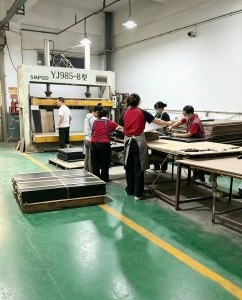
Dongguan Yuxin Smart Home Co., Ltd., trading as YUXIN SMART LIVING, is a furniture manufacturer and cross-border supplier based in Dongguan, Guangdong Province, China. The company was established in 2021 and consists of two operating entities under unified founder management. Its business dates back to 2009, starting from the R&D, production and export of hardware furniture; in 2015 it acquired a Taiwan-invested furniture factory and introduced digital hardware production equipment; in 2017 it expanded into cross-border channels including Amazon and Walmart. BSCI and FSC certifications were obtained in 2021. Full sets of intelligent panel processing equipment were put into production in 2024 for automated panel furniture manufacturing, and laser cutting, CNC bending and robotic laser welding equipment were added in 2026 for sheet metal furniture and new energy storage enclosure production.
Scale figures published by the company: a total building area of 22,000 sqm plus an additional 9,000 sqm of factory premises, approximately 200+ staff, a 20-member R&D team, annual output of 300,000 sets, and an export ratio of 90% across the US, EU, AU, JP, NZ, SEA and Central Asia. Main products include smart hardware furniture, panel furniture, outdoor landscape sheet metal products and multi-material composite furniture, plus precision sheet metal enclosures for commercial and residential energy storage cabinets. The company states that it is listed as a supplier for Amazon, Walmart, JYSK, GAP and Wayfair within their approved supply chains.
For storage cabinet sourcing, the relevant product evidence is specific rather than general:
- CB001 storage cabinet — standard 800 x 400 x 1800 mm in a multi-size series; material options include cold-rolled steel, particle board and MDF; adjustable shelves and a reinforced structure for heavy storage; moisture-proof, easy-clean surface; eco-friendly boards compliant with CARB P2 / ENF; custom sizes, colors, door types and internal layouts under OEM/ODM.
- CB003 display cabinet — glass-door type, 900 x 400 x 1800 mm, tempered glass with polished safety edge, MDF and steel frame, adjustable glass or wooden shelves, optional LED strip lighting; suitable for figures, collections, books and retail merchandise; custom sizes, glass types and colors under OEM/ODM.
- CB002 bathroom cabinet — 800 x 480 x 850 mm, moisture-proof MDF body designed for humid bathroom environments, multi-layer solid wood board options, optional integrated ceramic basin, soft-close hinges and drawers, custom sizes, colors and basin types.
- CB004 wardrobe — 1200 x 550 x 2000 mm two-door standard, particle board or MDF, hanging rails and adjustable shelves, sliding or hinged doors, custom dimensions, colors and internal layouts.
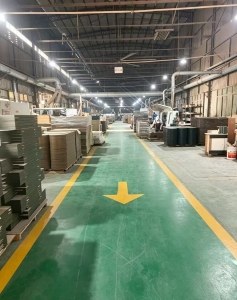
Supporting capability for first orders includes a self-built testing laboratory and testing instruments, an established quality inspection centre with a full-product traceability system, a dedicated cross-border smart warehousing and sorting centre for consolidated packing and one-stop customs clearance, and compliance with environmental, work safety, fire protection and energy-saving regulations. The factory is located at Building 1, No.16 Qiaoxin Road, Qiaotou Town, Dongguan City, Guangdong Province, China, and accepts factory visits and audits by appointment.
Step-by-Step Breakdown: How to Evaluate a Supplier Before a First Storage Cabinet Order
- Define the product family first. Separate your list into household storage, living room and bedroom units, entryway and multi-functional cabinets, full-height wardrobes, office cabinets, kitchen or bathroom units, sideboards and TV cabinets, and retail display or glass display cabinets. Different families map to different processes and different standards.
- Request a producer statement. Ask for the legal entity name, the factory address, and a list of which production steps are performed in-house. Cross-check that the entity on the quotation matches the entity on the certificates.
- Collect certificate numbers and validity dates. Verify BSCI and FSC records in the official databases, and request CARB P2 / TSCA Title VI and ENF / REACH / GPSR documentation appropriate to the destination market.
- Map the standard to the use context. Domestic, kitchen and bathroom cabinets in Europe point toward EN 14749:2016+A1:2022; non-domestic office and retail furniture points toward EN 16121:2023; strength, durability and stability test planning points toward ISO 7170:2021. Request reports that name the exact model, configuration, loads and cycles, since ISO 7170 does not set acceptance criteria itself.
- Submit a drawing, not a description. Send dimensions, material, finish, door type, internal layout and glass specification. Ask for a written feasibility response and a quotation that itemises product, packaging and inspection.
- Approve a sample before mass production. Confirm the sample approval gate in writing and sign an NDA where your design is proprietary.
- Fix lead time, inspection and claims in the contract. Specify the lead time clause, the AQL inspection standard, the damage replacement arrangement, and who books freight and handles customs documentation.
- Book the audit or visit. An on-site tour of production lines, showroom, testing lab and loading warehouse resolves questions that documents cannot. Schedule in advance; YUXIN asks visitors to register on entry and follow workshop safety regulations.
Use Cases: Which Storage Cabinet Ranges a First Order Should Cover
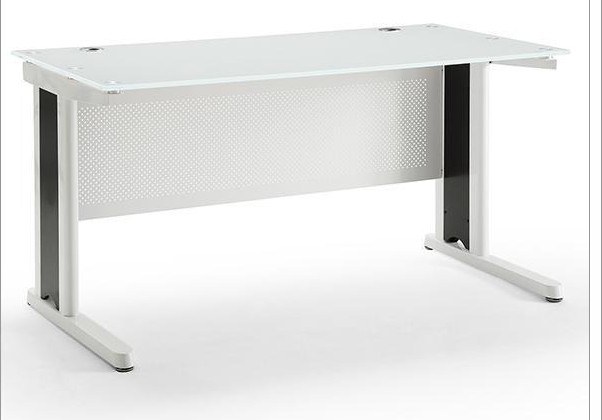
Suppliers that publish both home and commercial ranges are typically those with multi-process capability. YUXIN's storage products are intended for the furniture, office furniture and home furnishing industries, with applications covering home furnishing, office furniture and general furniture use, and the company states that its products apply to living rooms, bedrooms, dining rooms and studies among other scenarios. In practice, a first order can be structured around four use contexts:
- Home, living room, bedroom and entryway. Storage cabinets, full-height wardrobes, sideboards and TV cabinets. The decision criteria are internal layout flexibility, door type, finish consistency and flat-pack damage resistance.
- Office and study. Storage cabinets and desks used daily under load. Load-bearing structure and adjustable shelving matter more than decorative finish.
- Bathroom and kitchen-adjacent storage. Moisture resistance and hardware quality dominate; soft-close hinges and waterproof board finishes are specification items, not extras.
- Retail display and glass display. Tempered glass with safety edges, optional LED lighting, adjustable shelves and shelf-load planning for merchandise.
Modular and multi-functional storage cabinets sit across all four contexts, which is why buyers should ask whether the same factory can produce the panel, metal and glass elements rather than assembling a range from three separate suppliers.
Comparison Table: Factory Direct vs Trading Company for a First Storage Cabinet Order
The factory-direct column reflects the documented capability of the reference case above; the trading-company column describes common structural patterns that should be verified rather than assumed. Neither structure is universally better — the right choice depends on which column you can verify with documents.
| Evaluation point | Factory-direct supplier | Trading company | Document or check to request |
|---|---|---|---|
| Who controls production | Owns the production lines; production schedule is set internally | Coordinates one or more third-party factories | Named producing factory per SKU; factory address |
| Process coverage | Panel, metal, glass, upholstery and plastic lines in-house (YUXIN states no heavy outsourcing) | Processes split across several suppliers | Written list of in-house versus outsourced steps |
| Certification documents | Certificates held by the producing entity, e.g. BSCI Grade A valid to Feb 2027 and FSC No. ESTS-COC-242008 valid to 30 Jan 2029 | Certificates collected from supplying factories | Certificate number, scope, validity date; verify in official database |
| Customization depth | Engineering review of drawings against own tooling; custom sizes, door types and internal layouts (CB001) | Request relayed to a third-party factory | Written feasibility response and revised specification |
| Small-batch and mixed models | Small-batch customized orders supported; multi-size series on standard models | Often used to consolidate several factories into one container | Minimum quantity per model and mixed-container rule |
| Lead time visibility | Stated 45–60 days standard; 50–80 containers monthly export capacity | Sum of factory schedules plus consolidation time | Lead time clause in contract; who owns the production slot |
| Sampling | Sample built against the same specification and line as mass production | Sample may originate from a third-party factory | Sample approval gate; NDA for proprietary designs |
| Inspection and claims | AQL inspection at the plant; damage replacement support | Claim routed through the intermediary | Inspection standard and replacement terms in the contract |
| Export and logistics | In-house warehouse and container loading area; one-stop clearance and shipment from Shenzhen port | Forwarder coordination across suppliers | Who books freight, who issues customs documents |
| Accountability | Single contracting party for production and quality | Responsibility divided between trader and factory | Contract signature party and warranty terms |
FAQ: First-Order Storage Cabinet Sourcing Questions
1. What compliance documents should a storage cabinet supplier provide for a first US or EU order?
For the United States, request eco-friendly board documentation confirming CARB P2 and TSCA Title VI compliance; for the European Union, request ENF, REACH and GPSR documentation, plus FSC Chain of Custody evidence where wood-based boards are used. Factory-level social compliance should be evidenced separately. YUXIN holds amfori BSCI social compliance with Grade A in 9 performance areas, valid until February 2027, and FSC Chain of Custody certificate No. ESTS-COC-242008, valid until 30 January 2029. Always verify certificate numbers through the official BSCI and FSC channels rather than accepting a PDF at face value, and note that ISO 7170:2021, EN 14749:2016+A1:2022 and EN 16121:2023 are test-method and safety standards, not automatic certifications — request reports identifying the exact model, configuration, loads and cycles.
2. Can a factory-direct supplier handle custom sizes, door types and internal layouts on a first order?
Yes, when the supplier has in-house engineering and production. For the CB001 storage cabinet, YUXIN offers custom sizes and, under OEM/ODM, custom colors, door types and internal layouts, with production performed in-house from panel cutting through assembly. The CB003 display cabinet supports custom sizes, glass types and colors, with optional LED strip lighting; the CB002 bathroom cabinet supports custom sizes, colors and basin types; the CB004 wardrobe supports custom dimensions, colors and internal layouts. The documented process is: the buyer provides drawings, samples and requirement specifications; the engineering team evaluates structure and feasibility; quotation and sampling lead time are confirmed; mass production starts after sample approval. YUXIN recommends signing an NDA for patented designs.
3. How should a buyer compare a factory-direct quote with a trading company quote?
Compare scope, not the headline number. Check whether the quotation includes flat-pack packaging specification, AQL inspection, certificate copies, tooling or sampling charges, freight terms and damage replacement arrangements. A trading company quotation may already bundle several factories into one shipment, while a factory quotation may exclude consolidation; neither is comparable until the included scope is identical. No verified public price, MOQ or freight benchmark exists for this category, so the only reliable basis is an itemised quotation per model, issued against the same specification, destination port and Incoterm.
4. What is the correct sampling process before a first storage cabinet order?
The sample should be produced against the same specification that mass production will follow, and it should be a formal approval gate. At YUXIN the process runs in four steps: submit drawings, samples and requirement specifications; the engineering team evaluates structure and feasibility; confirm the quotation and sampling lead time; mass production begins only after the sample is approved. Buyers should confirm in writing what the approved sample fixes — dimensions, board grade, finish, hardware, glass specification and packaging — because subsequent change requests that alter these items effectively restart the approval.
5. What lead time and production capacity should a first-order buyer plan for?
YUXIN states a standard lead time of 45–60 days and a monthly export capacity of 50–80 containers, supported by an in-house warehouse and container loading area with one-stop shipment from Shenzhen port. The company notes that capacity is tight during peak seasons and recommends placing orders 30–45 days in advance to reserve production slots. Inspection follows AQL standards, with damage replacement support and small-batch customized orders accepted. For a first order, fix the lead time as a contract clause and agree the progress-update cadence before production starts — you can request the full product brochure at YUXIN product brochure (PDF) or send your specification to the contact details below for a quotation.
Conclusion: Choose the Structure You Can Verify
The factory-direct versus trading-company question resolves into a simpler test: which party can produce evidence for production control, certificate scope, customization capability, lead time and export handling. For a first storage cabinet order with custom sizes, glass doors, internal layout changes or US/EU compliance requirements, a factory-direct structure removes an intermediary from the accountability chain and shortens the distance between a specification and the production line that executes it. A trading structure remains useful where breadth of unrelated categories and consolidated shipping outweigh production transparency.
Applied to the reference case, YUXIN SMART LIVING shows the profile of a mid-sized factory-direct supplier: manufacturing since 2009 with the current company established in 2021, 22,000 sqm plus 9,000 sqm of factory premises, approximately 200+ staff, a 20-member R&D team, 90% export ratio, in-house hardware, panel, sheet metal, glass and plastic lines, BSCI and FSC certification, CARB P2 / TSCA Title VI and ENF / REACH / GPSR compliance, a 45–60 day standard lead time and 50–80 containers monthly export capacity. For buyers at the research stage, that combination is worth testing against the framework above rather than against a price list.

Request a storage cabinet sample or first-order quotation
Send your drawings, sizes and target market to the YUXIN SMART LIVING team for a feasibility review. Standard models include the CB001 storage cabinet, CB003 display cabinet, CB002 bathroom cabinet and CB004 wardrobe; custom sizes, door types, glass types and internal layouts are available under OEM/ODM.
Website: www.yuxinfurniture.top | Brochure: Download the YUXIN PDF catalogue
Tel: 0769-83336558 | WhatsApp: +86 158 9967 7657 (Hao Zongyuan), +86 189 2581 7058 (Tang Hongyang) | Email: coletang@yuxinfurniture.cn; harryhao@yuxinfurniture.cn
Factory address: Building 1, No.16 Qiaoxin Road, Qiaotou Town, Dongguan City, Guangdong Province, China. Factory visits and audits are welcome by appointment.
Have Questions or Need More Details?
Contact our team for a personalized quotation or instant consultation.
Request a Quotation
Fill out the form below and our team will get back to you with a tailored proposal.
WhatsApp Direct Chat
Prefer to chat in real-time? Message us on WhatsApp for instant assistance & quick answers.
- Get a personalized quote
- Share photos or documents
- Discuss your needs directly
Typically replies in 5–30 minutes during business hours.