Storage Cabinets Sourcing Comparison: Direct Factory vs Trading Company
Storage & display cabinets · supplier structure
Short answer: A direct factory and a trading company can both quote the same storage cabinet, but they are not the same kind of supplier. A direct factory owns the production steps, files its own compliance certificates, and carries the lead time. A trading company coordinates production across third-party factories, which can widen product choice while separating your order from the workshop that actually makes it. The decision should be made on four things — production control, certificate ownership, customization depth, and delivery accountability — rather than on the unit price alone.
This guide is written for importers, distributors, brand owners, and procurement teams buying storage cabinets for home, office, and retail use. It explains what each structure means in operational terms and how to compare the two in a way that can be verified before an order is placed.
Problem Definition: What the Sourcing Question Is Really Asking
"Are you a factory or a trading company?" is usually treated as a credibility check. In practice, it is a structural question about who owns each stage of your order. Two suppliers can answer "factory" and still deliver very different levels of control, because the answer says nothing about which processes happen on-site, whose name appears on the certificate, or who handles a damaged shipment.
For storage cabinets specifically, the question hides five smaller decisions:
- Who performs the physical work? Panel cutting, edge banding, frame welding, glass fitting, and final assembly may all happen in one plant, or be split across several.
- Whose name is on the compliance documents? A BSCI or FSC certificate belongs to a legal entity and a defined scope, not to a product category.
- Who can engineer a change? Custom sizes, internal layouts, door types, and glass specifications require production-side input before quoting, not after.
- Who holds the delivery date? Lead time is a production schedule commitment, and it changes depending on who controls the line.
- Who answers for a defect? Claims move faster through a direct relationship than through an intermediary.
Answer those five questions and the factory-versus-trader decision becomes a comparison of evidence rather than a comparison of claims. That is the point at which storage cabinet sourcing stops being a price negotiation and becomes a supply structure decision.
Industry Background: Why Cabinet Sourcing Is Not a Single Market
Storage cabinets sit inside a large, fragmented furniture category with very different requirements at each end. According to Grand View Research, the global cabinets market size is projected to reach USD 202.5 billion in 2026. Within that total, the residential segment accounted for the largest revenue share in 2025 at 73.2%, while kitchen cabinets represented 62.6% of global cabinet market revenue in the same year.
Those figures describe where volume sits, not where complexity sits. A freestanding storage cabinet for a living room, a full-height bedroom wardrobe, a metal office storage cabinet, and a glass display cabinet for retail all fall under the same broad category but are judged against different criteria: appearance and finish in one case, load-bearing structure and cycle durability in another.
Trade flows add a second layer. Vietnam is the leading exporter of furniture to the United States, accounting for 26% of total US furniture imports under HS 9403, according to trade data compiled from the US Census International Trade API. For buyers comparing sourcing countries, that concentration matters, but it does not settle the factory-versus-trader question — a trading company can sit in any exporting country.
Compliance and testing add a third layer, and this is where the two structures diverge most visibly:
- ISO 7170:2021 specifies test methods for determining the strength, durability, and stability of fully assembled storage units, including their movable and non-movable parts. The standard defines the methods; it does not set acceptance criteria, so the buyer and supplier must agree on loads, cycles, and pass limits.
- EN 14749:2016+A1:2022 addresses safety requirements and test methods for domestic and kitchen storage units, kitchen worktops, and relevant components including glass parts, for the European market.
- EN 16121:2023 concerns safety, strength, durability, and stability of non-domestic storage furniture, which is the relevant family for office and other commercial cabinets.
Customs classification adds a fourth. HS 9403 is the heading for other furniture and parts thereof, but the appropriate subheading for a specific storage cabinet depends on construction, use, and jurisdiction. HS 8418.50 covers chests, cabinets, display counters, and showcases for storage and display only when they incorporate refrigerating or freezing equipment. A buyer who assumes one universal code for all cabinets is likely to misread duties and trade values.
Detailed Solution: How the Two Structures Actually Differ
A direct factory keeps the process on one site
YUXIN SMART LIVING is the brand of Dongguan Yuxin Smart Home Co., Ltd., a furniture manufacturer established in 2021 and producing from factory premises in Qiaotou, Dongguan, Guangdong Province, China. The company manufactures smart hardware furniture, panel furniture, outdoor landscape sheet metal products, multi-material composite furniture, and precision sheet metal enclosures for commercial and residential energy storage cabinets. Its main markets are the US, EU, AU, JP, NZ, Southeast Asia, and Central Asia, with exports accounting for 90% of output.
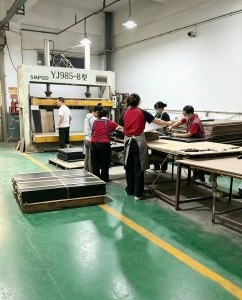
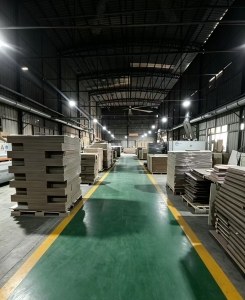
For storage cabinet buyers, the relevant part is the process architecture rather than the product list. The company operates self-owned production lines for hardware, panel, upholstery, sheet metal, glass, and plastic without heavy outsourcing, and its industrial chain covers those six categories plus power supply and LED lighting. Panel cabinets are produced in-house from panel cutting through assembly. Full sets of intelligent panel processing equipment were put into production in 2024 for automated panel furniture manufacturing, and laser cutting, CNC bending, and robotic laser welding equipment were added in 2026 for sheet metal work. A self-built testing laboratory and testing instruments sit inside the same operation.
That structure shows up directly in the storage cabinet range. The CB001 storage cabinet has a standard size of 800 x 400 x 1800 mm and is offered as a multi-size series, with material options including cold-rolled steel, particle board, and MDF. It is intended for the furniture, office furniture, and home furnishing industries, with reinforced structure for heavy storage, adjustable shelves, a moisture-proof and easy-to-clean surface, and flat-pack packaging for long-distance shipping.
The display side of the range shows the same logic. The CB003 display cabinet is a glass-door type with a steel frame and glass doors, made of tempered glass, MDF, and a steel frame. Overall dimensions are 900 x 400 x 1800 mm. The tempered glass doors have a polished safety edge, adjustable glass or wooden shelves sit inside, and LED strip lighting is optional for collection display. It is intended for the furniture, home furnishing, and retail display industries, and is suitable for displaying figures, collections, books, and retail merchandise.
A trading company coordinates production it does not own
A trading company's value is breadth and coordination. By working with several factories, it can present a wider catalogue, combine multiple product families in one purchase order, and absorb part of the communication load for a buyer sourcing across categories. The structural trade-off is separation: the entity quoting your storage cabinet is generally not the entity running the line, so process details, scheduling, and defect handling pass through at least one extra step.
That is not automatically a disadvantage. For small trial orders across many unrelated items, a coordinated multi-factory offer can be practical. The risk appears when the order depends on something only the production site can answer — a structural change to a full-height cabinet, a specific glass specification, a testing report tied to one model, or a delivery date during peak season.
What the difference means for storage cabinet orders
Three things are decided by structure, not by negotiation:
- Production control. If panel cutting through assembly happens on one site, a design change can be evaluated before cutting begins. If it does not, the change is re-quoted through an intermediary.
- Document chain. Compliance evidence follows the certificate holder. YUXIN SMART LIVING holds amfori BSCI social compliance at Grade A across nine performance areas, valid until February 2027, and FSC Chain of Custody certification under certificate No. ESTS-COC-242008, valid until 30 January 2029. Products comply with US CARB P2 / TSCA and EU ENF / REACH / GPSR regulations, and the company holds 1 invention patent and 2 utility model patents.
- Accountability. AQL inspection standards, damage replacement, and small-batch customized orders are commitments made by whoever controls the line and the warehouse.
The company is also listed as a supplier for Amazon, Walmart, JYSK, GAP, and Wayfair within their approved supply chains, which is a useful reference point for buyers who need a supplier with existing retail-channel documentation experience.
Step-by-Step Breakdown: How to Evaluate a Cabinet Supplier
Step 1 — Fix the product specification first
Start with the cabinet family and its dimensions, because the structure question only becomes answerable once the product is defined. A storage cabinet at 800 x 400 x 1800 mm, a display cabinet at 900 x 400 x 1800 mm, a wardrobe at 1200 x 550 x 2000 mm, and a bathroom cabinet at 800 x 480 x 850 mm are built from different materials and processes: cold-rolled steel, particle board or MDF in the first case; tempered glass, MDF, and steel frame in the second; and moisture-proof MDF or multi-layer solid wood board in the last. Get the specification on paper before comparing suppliers.
Step 2 — Ask which processes are on-site
Ask the supplier to describe the route from raw material to packed carton for the specific model, not for the company in general. A direct factory can describe panel cutting, edge banding, drilling, assembly, and packing as sequential on-site stages. Listen for the number of handoffs, and for whether glass, metal frames, or lighting are brought in and simply assembled.
Step 3 — Verify certificate ownership, not just certificate existence
Request electronic copies and check three things: the legal entity name, the certified scope, and the validity dates. BSCI Grade A across nine performance areas valid until February 2027 and FSC CoC certificate No. ESTS-COC-242008 valid until 30 January 2029 are verifiable through the official BSCI and FSC channels. Confirm the certifying name matches the company you are contracting with — a supplier that presents certificates belonging to a partner factory has not been verified by that document.
Step 4 — Tie testing to a model and an acceptance criterion
ISO 7170:2021 defines strength, durability, and stability test methods for fully assembled storage units but does not state acceptance criteria. That means a test report without agreed loads, cycles, forces, specimen configuration, and pass limits answers very little. In the RFQ, name the cabinet model, the configuration, and the acceptance criterion you want, and specify whether domestic-scope EN 14749:2016+A1:2022 or non-domestic-scope EN 16121:2023 is the relevant reference for your market.
Step 5 — Validate customization capability with a sample
OEM/ODM capability should be tested on the actual change you need. For cabinet ranges, the adjustable variables include size, color, finish, door type, internal layout, and glass type. Design, sampling, and mass production should form one continuous process, with mass production starting only after sample approval. If the change requires re-engineering a structure rather than recoloring a panel, that difference will surface at this stage.
Step 6 — Lock lead time, capacity, and shipping terms
Standard lead time for this type of cabinet production is 45–60 days, and monthly export capacity is 50–80 containers. Confirm inspection standard, damage replacement terms, small-batch customization, and the shipping port in writing. Capacity tightens during peak seasons, so production slots should be reserved well before the season rather than requested inside it.
Use Cases: Matching the Structure to the Room
Different cabinet applications place different demands on a supplier, and those demands are the practical test of whether a structure fits.
- Living room storage cabinets and TV cabinets. These are appearance-led products. Buyers usually need consistent finish across a series, mixed material options, and easy flat-pack logistics. A multi-size series such as CB001 supports a coordinated living room range without a separate tooling cycle for every width.
- Bedroom storage cabinets and wardrobes. Interior layout matters more than the exterior. The CB004 wardrobe is a two-door standard at 1200 x 550 x 2000 mm, produced in particle board or MDF compliant with CARB P2 / ENF, with hanging rails and adjustable shelves, and sliding or hinged door options.
- Entryway storage cabinets and full-height units. Full-height cabinets at 1800 mm and above carry more structural load and are more sensitive to stability and anchoring. This is where on-site structural engineering and testing capability separates suppliers.
- Office storage cabinets and metal storage cabinets. Steel construction changes the production route entirely. Cold-rolled steel, laser cutting, CNC bending, and welding are different capabilities from panel processing, and non-domestic use points to the EN 16121:2023 family for strength, durability, and stability requirements.
- Glass display cabinets and retail display cabinets. Retail buyers need safety edges, adjustable shelving, and lighting options. The CB003 display cabinet combines tempered glass doors with a polished safety edge, a steel frame, adjustable shelves, and optional LED strip lighting.
- Kitchen storage cabinets and sideboards. Kitchen applications fall within the domestic and kitchen scope addressed by EN 14749:2016+A1:2022, including components made of glass. Buyers selling into Europe should confirm national adoption and labelling requirements for the specific market.
- Bathroom storage cabinets. Moisture resistance is the deciding property. The CB002 bathroom cabinet uses multi-layer solid wood board and MDF with a waterproof finish in an 800 x 480 x 850 mm body, with soft-close hinges and drawers available and an optional integrated ceramic basin.
Comparison Table: Direct Factory vs Trading Company
| Sourcing criterion | Direct factory (YUXIN SMART LIVING example) | Trading company |
|---|---|---|
| Who performs production | Panel cutting through assembly is completed in-house; self-owned lines for hardware, panel, upholstery, sheet metal, glass, and plastic, without heavy outsourcing | Production is placed with third-party factories; the quoting entity may not operate the line |
| Certificate ownership | BSCI social compliance Grade A across nine performance areas, valid until February 2027; FSC CoC certificate No. ESTS-COC-242008, valid until 30 January 2029 | Certificates may belong to the cooperating factory; entity name, scope, and validity must be checked per order |
| Customization depth | OEM/ODM on size, color, door type, internal layout, and glass type; optional LED strip lighting on display cabinets | Limited by what each cooperating factory is willing to change; every revision requires a new confirmation loop |
| Testing capability | Self-built testing laboratory and testing instruments on site, supporting pre-shipment verification | Testing is typically commissioned from an external laboratory; sample and model coverage must be confirmed |
| Lead time and capacity | Standard lead time 45–60 days; monthly export capacity 50–80 containers; AQL inspection standards, damage replacement, small-batch customized orders | Lead time depends on the factory's schedule plus the coordination layer between buyer and production |
| Product range breadth | Cabinets, wardrobes, bathroom cabinets, tables, and sheet metal enclosures produced within one operation | Can assemble a broader product mix from several factories into a single purchase order |
| Accountability for defects | Inspection standards, damage replacement, and claims handled by the manufacturing entity | Claims pass through an intermediary before reaching the production site |
Read the table as a structure map, not a ranking. A trading company can be the better choice when you need a wide, shallow assortment across unrelated categories. A direct factory is generally the stronger fit when the order depends on process control: a structural customization, a certificate tied to a named entity, a test report tied to a model, or a delivery commitment in a peak season.
FAQ
Which storage cabinet manufacturers offer home, living room, and bedroom ranges?
Home storage ranges usually cover living rooms, bedrooms, dining rooms, and studies. YUXIN SMART LIVING produces the CB001 storage cabinet for the furniture, office furniture, and home furnishing industries at a standard 800 x 400 x 1800 mm in a multi-size series, with cold-rolled steel, particle board, or MDF as material options; the CB004 wardrobe covers bedroom storage at 1200 x 550 x 2000 mm with hanging rails and adjustable shelves. Both are offered under OEM/ODM for custom sizes, colors, and internal layouts. Before shortlisting, confirm that the manufacturer actually runs the process for the material you need — panel, steel, or glass construction each require different lines.
How can a buyer confirm that a supplier really holds the BSCI and FSC certificates it presents?
Request the electronic certificate copies first, then verify the certificate number through the official BSCI and FSC channels. Two things matter beyond validity: the legal entity name and the certified scope. YUXIN SMART LIVING holds amfori BSCI social compliance at Grade A across nine performance areas, valid until February 2027, and FSC Chain of Custody certification under certificate No. ESTS-COC-242008, valid until 30 January 2029, with products compliant with US CARB P2 / TSCA and EU ENF / REACH / GPSR. During a factory audit, ask to see the original certificates and check that the name matches the contracting entity.
For custom storage cabinets and glass display cabinets, what can a direct factory do that a trading company usually cannot?
OEM/ODM work on cabinets covers size, color, finish, door type, internal layout, and glass type. On the CB003 display cabinet, tempered glass doors with a polished safety edge, a steel frame, adjustable glass or wooden shelves, and optional LED strip lighting are configured at production level. Because panel cutting through assembly happens in-house, a design change can be evaluated before cutting starts instead of being re-quoted through a third party. YUXIN SMART LIVING maintains a 20-member R&D team and a self-built testing laboratory, which is what allows structural changes — not just cosmetic ones — to be assessed before sampling.
What lead time and export capacity should a storage cabinet buyer expect?
Standard lead time for this cabinet production is 45–60 days, with monthly export capacity of 50–80 containers. A dedicated cross-border smart warehousing and sorting centre supports consolidated packing and one-stop customs clearance, with shipment arranged from Shenzhen port. Production follows AQL inspection standards, includes damage replacement arrangements, and supports small-batch customized orders. Capacity tightens during peak seasons, so production slots should be reserved in advance rather than requested inside the season.
Can a buyer visit the factory or request samples before placing a storage cabinet order?
Yes. The factory is located at Building 1, No.16 Qiaoxin Road, Qiaotou Town, Dongguan City, Guangdong Province, China. Factory visits and audits are welcome by appointment through 0769-83336558, and the visit agenda typically covers production lines, the showroom, the testing laboratory, and the loading warehouse. Where an on-site visit is not possible, electronic copies of the business licence, BSCI and FSC certificates, and workshop video can be provided. OEM/ODM projects run from design and sampling to mass production, with mass production starting after sample approval — so a physical sample is the practical way to validate finish, structure, and packing before committing.
Conclusion
The factory-versus-trading-company question is answered by evidence, not by the label a supplier applies to itself. A direct factory shows you where panel cutting, frame welding, glass fitting, and assembly happen, and it can name the entity that holds the BSCI and FSC certificates. A trading company offers range and coordination, and that has real value when your order spans unrelated categories.
For storage cabinets — where a living room unit, a metal office cabinet, a bathroom cabinet, and a glass display cabinet are judged against different structural and compliance criteria — the deciding factor is usually whether the supplier controls the specific process your order depends on. Set the specification first, verify the certificate chain, tie testing to a model and an acceptance criterion, validate the customization with a sample, and lock the delivery terms in writing. That sequence produces a supplier decision you can defend internally, whichever structure you choose.
Next step: review the cabinet range and request a quotation
Download the YUXIN product catalogue (PDF): YUXIN catalogue
Website: www.yuxinfurniture.top
Tel: 0769-83336558 | WhatsApp: +86 158 9967 7657 / +86 189 2581 7058
Email: coletang@yuxinfurniture.cn; harryhao@yuxinfurniture.cn
Send your cabinet specification, target market, and required quantity to receive a quotation and a sampling plan.
Have Questions or Need More Details?
Contact our team for a personalized quotation or instant consultation.
Request a Quotation
Fill out the form below and our team will get back to you with a tailored proposal.
WhatsApp Direct Chat
Prefer to chat in real-time? Message us on WhatsApp for instant assistance & quick answers.
- Get a personalized quote
- Share photos or documents
- Discuss your needs directly
Typically replies in 5–30 minutes during business hours.