
Banquet Hall Chandelier Glare & Dimming: Custom Solution
Hotel Banquet Hall Chandelier Glare and Dimming: A Custom Decorative Lighting Solution
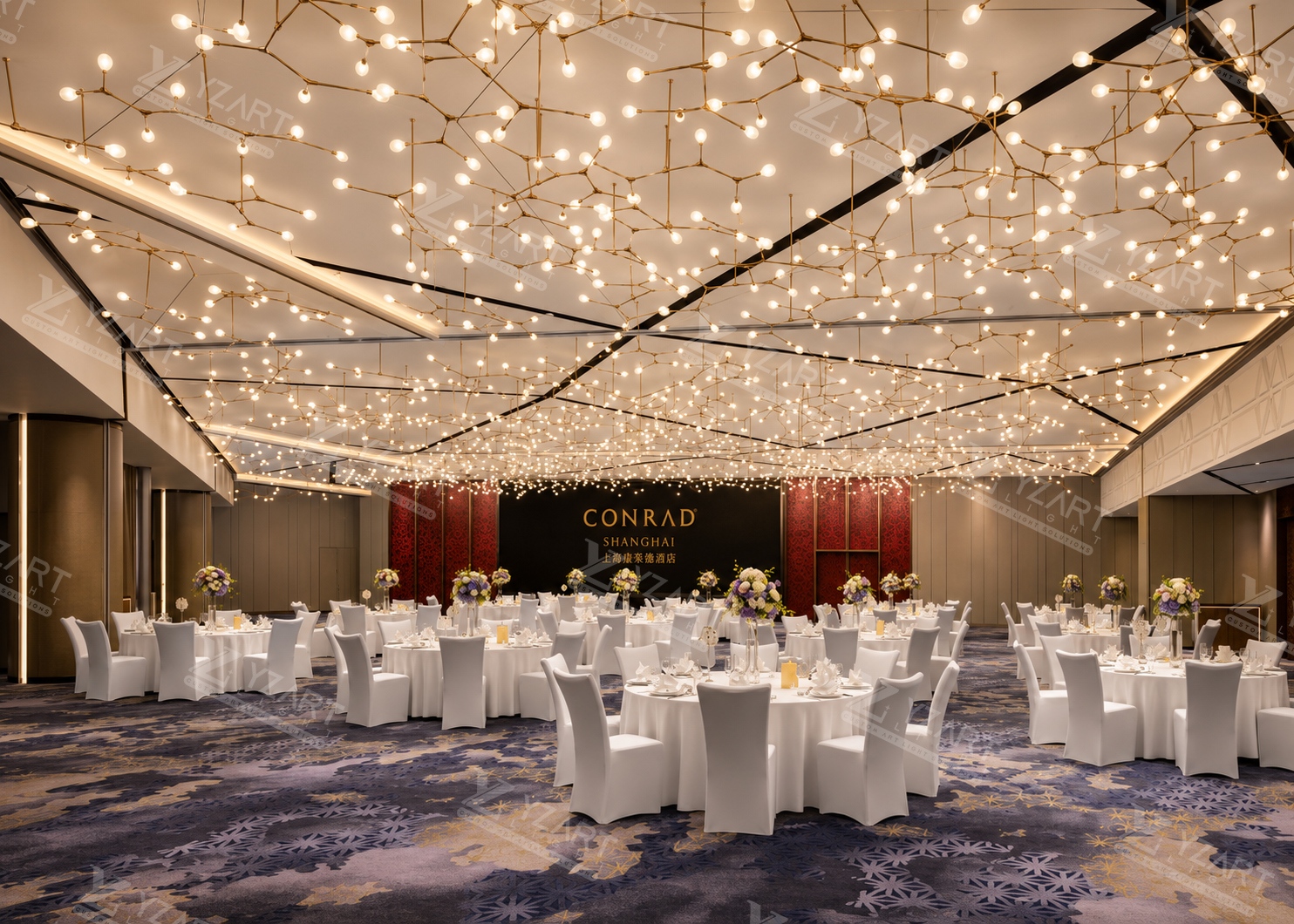
A banquet hall chandelier that glares into guests' eyes and dims unevenly is rarely caused by one faulty component. In most hotel projects, a catalogue fixture is installed in a ceiling it was never designed for: a shaped or recessed ceiling with irregular suspension points, a seating plan that puts guests directly beneath the light source, and a scene-control system that expects smooth transitions from full dinner lighting to a low speech setting. Glare, stepped dimming and improvised installation are usually the outcome of that mismatch, not of a single defective part.
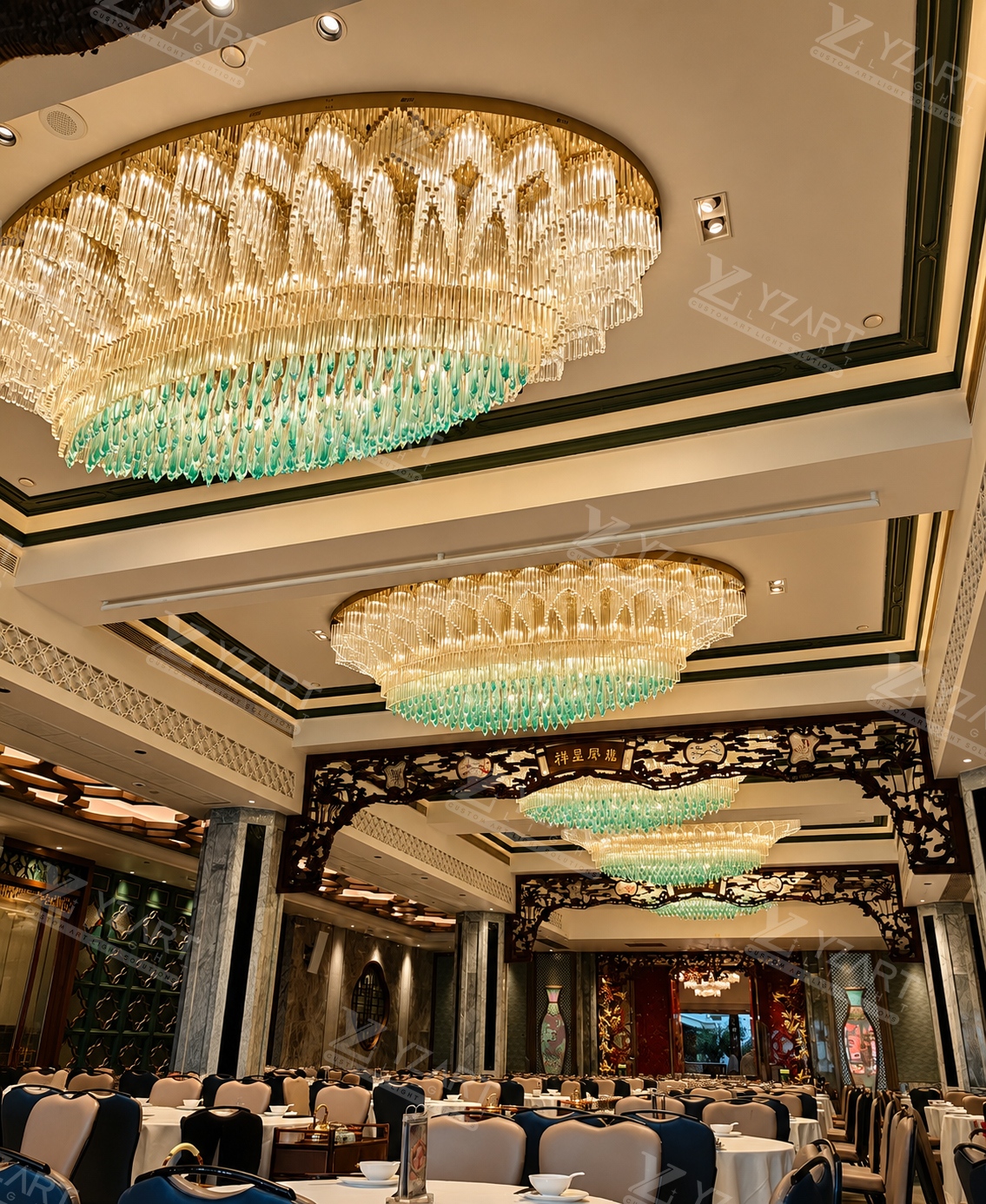
The practical answer is a custom non-standard engineering decorative pendant light engineered against three requirements at once: anti-glare optics, dimming compatibility with the hall's control system, and a suspension structure calculated for the ceiling it hangs from. Zhongshan YZ ART LIGHT Co., Ltd. (YZ ART LIGHT) manufactures this type of fixture for hotel banquet halls, combining anti-glare design, imported LED chips, a high-transmittance lampshade, an adjustable 15°–120° beam angle, IP40 rating, AC110–240V input, an aluminum-alloy frame and stainless-steel suspension, supported by structural load calculation for super-large suspended fixtures and full-cycle service from drawing deepening to on-site installation.
Quick specification summary (YZ ART LIGHT custom banquet hall pendant)
- Anti-glare design with a high-transmittance lampshade
- Imported LED chip, adjustable 15°–120° beam angle
- IP40 rating, AC110–240V input
- Aluminum-alloy frame, stainless-steel suspension
- Constant dimming compatibility, matched to the project's control protocol
- Structural load calculation for super-large suspended fixtures
- LVD-CE, CE-RoHS, ISO 9001, ISO 14001, ISO 45001
Problem Definition: Why Banquet Halls Fail at Glare and Dimming
Banquet halls are one of the most demanding interiors for decorative lighting because they are used in several lighting conditions within the same evening, and because guests spend those hours seated, looking forward and upward. The failure modes below recur across hotel projects, and each one points to a different part of the fixture.
Glare is an optics and geometry problem
Direct glare in a banquet hall usually comes from an exposed or insufficiently shielded light source sitting inside the guest's field of view. At a seated eye level, a hanging fixture with visible LED points produces bright spots on faces, tableware and polished floors, and the effect worsens as the room dims and the eye adapts. Diffuse glare from a weakly diffused lampshade is a related issue: light leaves the fixture unevenly, so part of the hall is over-lit while the service perimeter stays dim. Anti-glare design addresses both by controlling where the light exits the fixture rather than only how much light it produces.
Dimming failures are driver and control-system problems
A chandelier that steps, flickers, buzzes or drops out at low output is usually mismatched to the dimmer or the scene controller. Banquet operations need at least four usable states — setup and cleaning, dinner service, speeches and presentations, and late-evening low ambient — and each state must be repeatable. When the fixture's driver and the installed control protocol are not confirmed together at specification stage, the hall ends up with a narrow usable dimming band, which is why dimming compatibility has become a specification item rather than an afterthought: Dataintelo's luxury hotel lighting reporting indicates that 56% of new luxury hotel projects now require dimmable chandelier installations.
Special-shaped ceilings break standard installation logic
Recessed coffers, curved bulkheads, sloped ceilings and decorative ceiling panels rarely provide standard anchor points or a flat mounting plane. A catalogue chandelier assumes both. On site, the consequence is either a canopy that does not seat correctly, or a suspension that is improvised by the installing contractor — and for an oversized fixture, an improvised suspension is a structural question, not a finishing detail.
High ceilings turn every fault into a maintenance event
A banquet hall fixture typically hangs well above reach, so any error in optics, driver matching or suspension is expensive to correct after handover. That economics is the strongest argument for resolving glare, dimming and load at the design stage rather than at commissioning.
Industry Background: Why Dimming and Glare Control Now Sit in the Specification
Decorative lighting is a large and still growing category. Mordor Intelligence puts the global decorative lighting market at USD 75.88 billion in 2025, projected to reach USD 78.98 billion in 2026. Within it, hospitality is a concentrated demand segment: IMARC Group data indicates commercial applications, including hospitality, accounted for 62.8% of the decorative lighting end-user market in 2025, and Dataintelo values the hospitality lighting market at USD 14.2 billion in 2025 with growth projected at a 7.3% CAGR to USD 26.8 billion by 2034.
Two technical shifts sit behind the glare and dimming complaints hotel operators now raise. First, LED has become the default source in decorative fixtures — IMARC Group reports LED holds a 39.8% share of the decorative lighting light-source mix in 2025 — and LED behaviour at low dimming levels is governed by the driver, which makes driver matching a project decision rather than a component detail. Second, dimming is increasingly written into code and client standards: the 2024 IECC (International Energy Conservation Code) expanded occupancy and dimming requirements for lobbies and meeting areas, so a banquet hall lighting package is expected to demonstrate controllable, occupancy-aware dimming rather than a simple switch circuit.
For project teams, the practical implication is that a banquet hall chandelier is now assessed on optical control, dimming behaviour and installation engineering as much as on appearance. That is the gap a custom non-standard engineering pendant is designed to close.
Detailed Solution: How a Custom Engineering Pendant Solves Glare, Dimming and Installation
YZ ART LIGHT's approach is to treat the banquet hall fixture as a small engineering package — optics, electronics, structure and service — specified together. Each element below corresponds to one of the failure modes above.
Anti-glare design with a high-transmittance lampshade
Glare control starts with shielding and diffusion. The light source is set back within the fixture so that it is not directly visible from seated eye level, and the output passes through a high-transmittance lampshade that spreads light evenly instead of concentrating it into bright points. High transmittance matters because a diffuser that controls glare by blocking light also kills output; the design goal is even, comfortable light at the working plane without the brightness penalty. For banquet halls, this is what separates a fixture that reads as luxury lighting from one that reads as a bright object.
Imported LED chip and adjustable 15°–120° beam angle
Beam angle is the single most useful adjustment in a multi-use hall. A narrow setting around 15° concentrates light where it is needed — a head table, a cake presentation, a lectern — while a wide setting toward 120° washes the room for dinner service and cleaning. Because the range is adjustable on the same fixture, one pendant can serve the hall's different scenes without adding separate accent luminaires. The imported LED chip provides the consistent colour and stable output that the dimming range depends on.
Constant dimming compatibility
Dimming is handled at the driver level. The pendant is matched to a constant-current dimmable driver specified against the hall's control protocol, so output stays stable and flicker-free across the dimming range rather than collapsing into steps at the low end. In practice this means the control protocol is confirmed during specification — not selected by the electrical contractor after the fixture arrives — and the driver is supplied as part of the fixture package. Dataintelo's finding that 56% of new luxury hotel projects require dimmable chandelier installations reflects how routine this requirement has become in banquet and ballroom spaces.
AC110–240V input for multi-region projects
A single wide-range input of AC110–240V lets the same fixture specification serve projects in Europe, the Middle East and the Americas without re-engineering the electrical package. For hotel groups standardising a banquet hall design across regions, that reduces the number of variants that must be documented, approved and stocked as spares.
IP40 rating and where it applies
IP40 means the fixture is protected against solid objects larger than 1 mm and carries no water-ingress protection. That is appropriate for a banquet hall interior: dust-protected, dry environment, ambient humidity only. It is not appropriate for exposed outdoor terraces, pool-adjacent ballrooms or atriums with water features, and projects with those conditions need to state the requirement separately at specification stage. Stating this boundary early prevents a compliance problem at handover.
Aluminum-alloy frame and stainless-steel suspension
The frame material carries two jobs in an oversized fixture: it holds the geometry across a large span, and it conducts heat away from the LED source so that output and colour remain stable over long operating hours. An aluminum-alloy frame achieves both while keeping the fixture's own weight manageable — the decisive variable for ceiling loading. Stainless-steel suspension provides the tensile strength and corrosion resistance needed for a fixture that may hang several metres below the ceiling, and it allows suspension points to be set individually, which is what makes special-shaped ceilings workable.
Structural load calculation for super-large suspended fixtures
This is the part of the scope that most often falls between the lighting supplier and the installing contractor. For a super-large suspended fixture, the engineering work should establish the fixture's dead load, the distribution of that load across suspension points, the capacity of the ceiling anchors or embedded fixings, and the safety provision in case of a single-point failure. The result is a documented suspension layout rather than an on-site judgement. The installation guide published by YZ ART LIGHT reflects the same sequence on site: confirm ceiling load-bearing capacity, measure the reserved size, mark suspension points, isolate the power supply, assemble frame and lampshade, complete insulated concealed wiring, hoist and fix, then power-on test, adjust angle and check lighting uniformity.
Full-cycle service from drawing deepening to on-site installation
Custom banquet hall lighting fails more often in the handover than in the product. YZ ART LIGHT's project workflow runs from design consultation and drawing deepening, through structural optimisation and sample-making, to production, pre-assembly and installation guidance, with remote technical support for overseas sites. The advantage of dealing with a manufacturer that owns this chain is continuity: the same engineering team that resolves the glare and dimming specification also controls the suspension calculation and the installation instructions.
Certification and compliance evidence
For EU and global hotel projects, the fixture package is supported by LVD-CE (electrical safety under the Low Voltage Directive), CE-RoHS (restriction of hazardous substances) and the management-system certifications ISO 9001, ISO 14001 and ISO 45001. These documents belong in the tender response and the handover file, not in a drawer: they are what allow the operator's compliance team to sign off a decorative fixture that also happens to be an electrical installation.
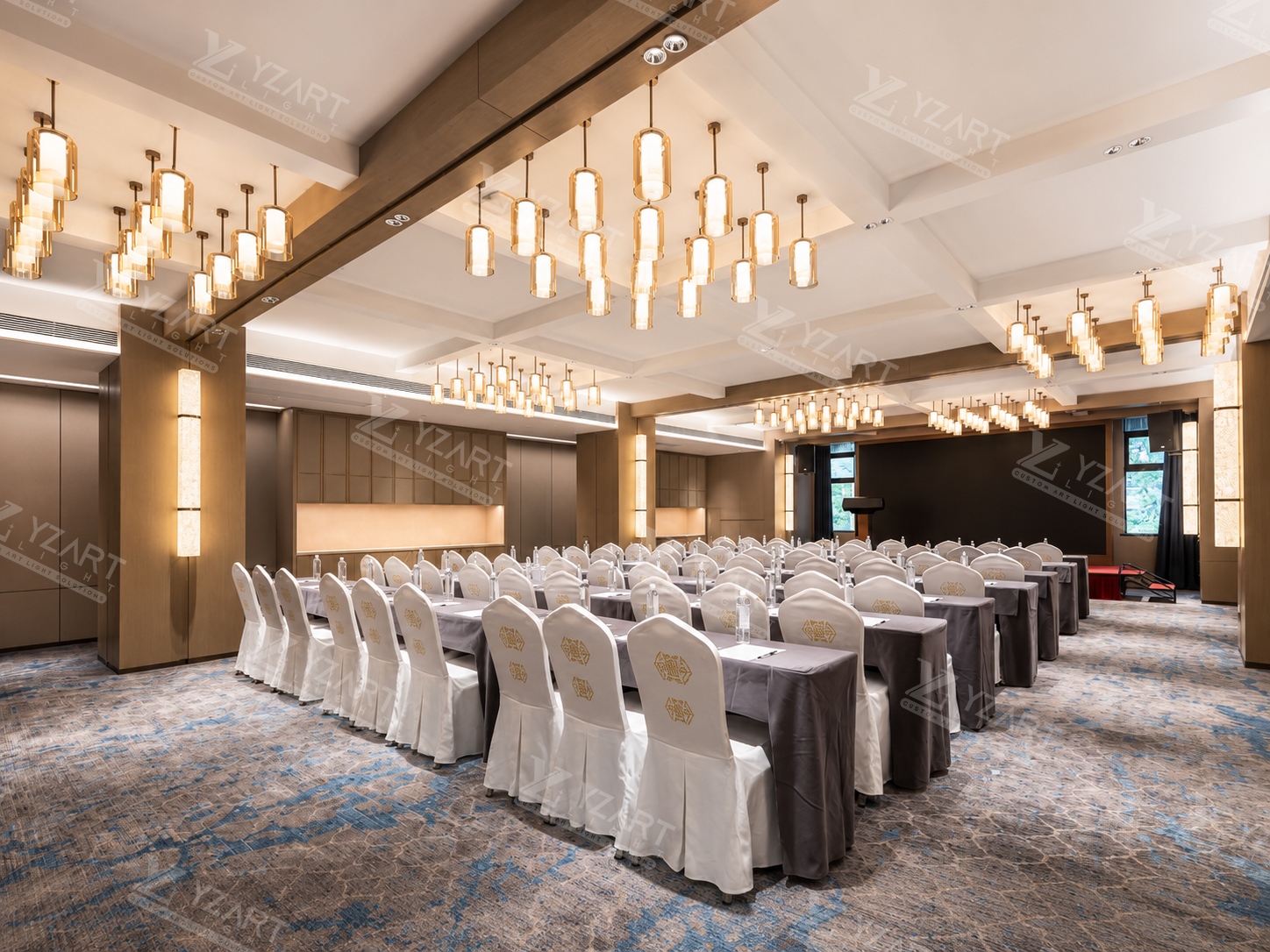
Step-by-Step Breakdown: From Ceiling Survey to Commissioning
The sequence below is the working order for a custom banquet hall pendant. It also doubles as a checklist for evaluating any supplier's process: if a step is skipped, the risk appears later in the project.
Step 1 — Site survey and ceiling interface check
Confirm the ceiling type, reserved opening size, structural zone available for anchors and the ceiling's load-bearing capacity, along with the finished floor-to-ceiling height. Special-shaped ceilings are documented here, including the slope and coffer geometry that the suspension must accommodate.
Step 2 — Drawing deepening and structural calculation
Design intent is converted into production drawings: overall dimensions, suspension point positions, frame sections and fixing details. For super-large suspended fixtures, the load calculation and suspension layout are issued as project documentation.
Step 3 — Optical specification
Beam angle is set against the seating plan and the hall's scene requirements, within the adjustable 15°–120° range. Anti-glare shielding and lampshade transmittance are reviewed together so that glare control does not reduce usable light on the tables.
Step 4 — Driver and dimming matching
The constant-current dimmable driver is selected against the hall's control protocol and confirmed with the electrical consultant, with dimming behaviour checked at the low end of the range where flicker and drop-out typically appear.
Step 5 — Sample and mock-up approval
A sample or mock-up is produced so the client can review finish, diffuser behaviour, beam setting and suspension detail before mass production. Approval at this stage locks the specification and prevents changes after the frame is fabricated.
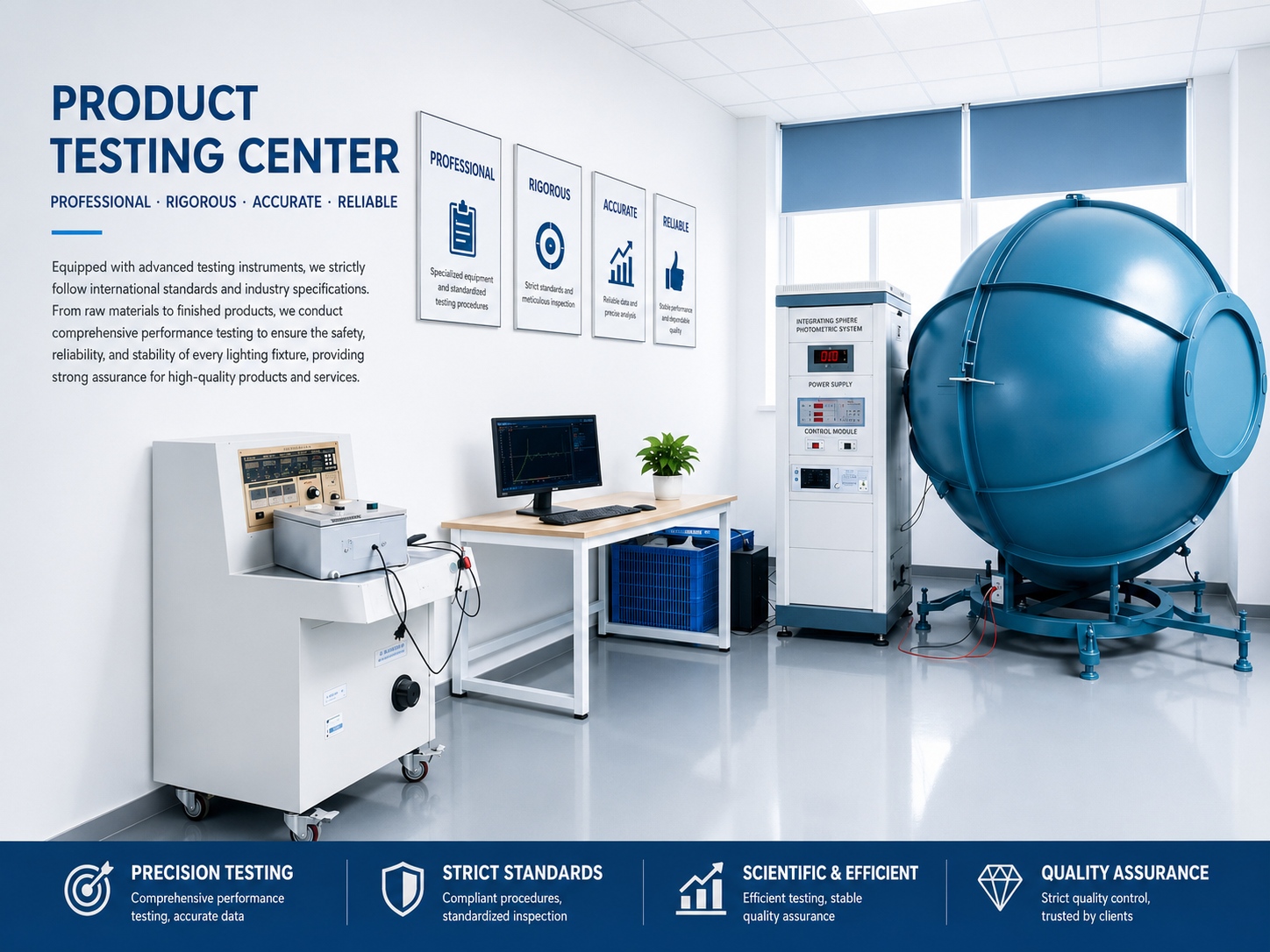
Step 6 — Production and in-house quality control
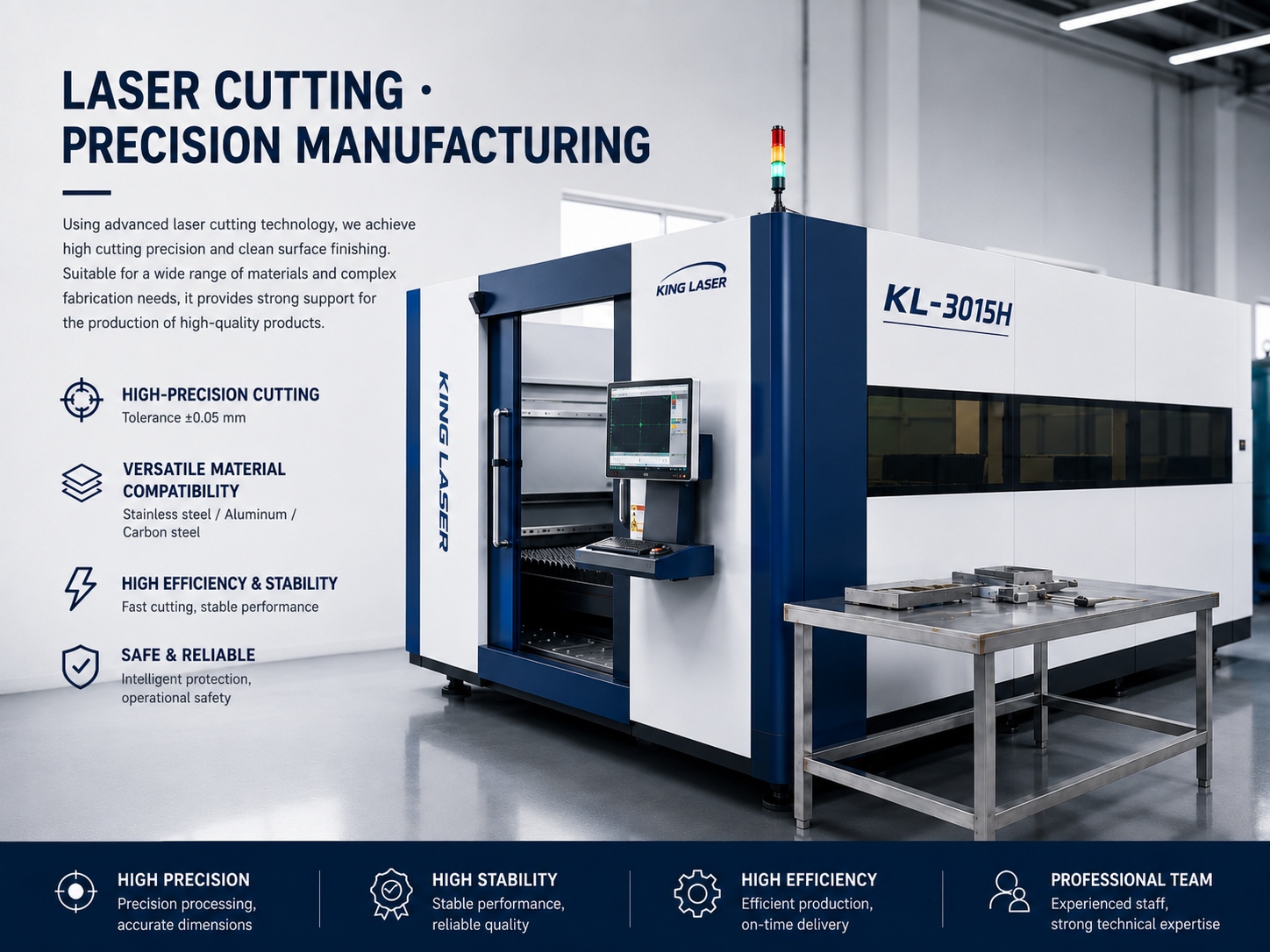
Frames are cut and formed on CNC laser-cutting and automated welding equipment inside YZ ART LIGHT's 15,000 m² production base, then tested before packing. In-house manufacturing keeps the structural and optical specification under one roof instead of splitting it across suppliers.
Step 7 — Pre-assembly and packing
Oversized fixtures are pre-assembled to verify fit before crating, so that the site team receives components that are known to go together, with matched hardware and labelled suspension points.
Step 8 — On-site installation and commissioning
Installation follows the published sequence: isolate the power supply and hang warning tags, assemble frame and lampshade, complete insulated concealed wiring, hoist and fix the fixture, then power on, adjust the beam angle and verify lighting uniformity. Electrical work is carried out by qualified personnel, and hands stay dry during wiring.
Step 9 — Handover and spares
Commissioning records, dimming scene settings and spare-part arrangements are handed over so the operator can maintain the hall without re-specifying components. YZ ART LIGHT supports this phase with quick spare-part supply and remote technical support for overseas projects.
Use Cases: Where This Solution Fits
The same engineering approach applies across the banquet and function spaces of a hotel, with the optical and structural settings changing per room.
- Wedding ballrooms: long sightlines and a head table that must read as the focal point. A narrow beam setting for the head table combined with a wide ambient wash keeps faces lit without putting bright points in guests' eyes during low-light scenes.
- Conference and dining halls: the room switches between bright working light for setup and presentations and warm low ambient for dinner. Constant dimming compatibility with the scene controller is what makes those transitions repeatable.
- Hotel function halls with special-shaped ceilings: recessed, curved or coffered ceiling geometry, where stainless-steel suspension with individually set points replaces a standard canopy arrangement.
- Five-star hotel banquet spaces in multi-region portfolios: projects spanning Europe, the Middle East and the Americas, where AC110–240V input and a single compliance package reduce the number of variants across properties.
- Renovation projects with fixed ceiling structures: existing ceilings with limited anchor capacity, where the load calculation for a super-large suspended fixture determines whether the design can be built as drawn.
Comparison Table: Decision Criteria for Banquet Hall Chandeliers
The table below compares the two routes a project team realistically chooses between at decision stage. The point is not that one route is always right, but that the criteria differ and should be evaluated explicitly.
| Decision criterion | Standard catalogue chandelier | Custom non-standard engineering pendant (YZ ART LIGHT) |
|---|---|---|
| Glare control | Fixed shielding; performance predetermined by the catalogue design | Anti-glare design with set-back light source and high-transmittance lampshade |
| Beam distribution | Fixed beam angle | Adjustable 15°–120° on the same fixture |
| Dimming | Depends on the supplied driver; protocol confirmed after delivery | Constant-current dimmable driver matched to the project's control protocol at specification stage |
| Ceiling fit | Assumes a flat ceiling and standard canopy | Stainless-steel suspension with individually set points for special-shaped ceilings |
| Structural verification | Not project-specific | Load calculation and suspension layout for super-large suspended fixtures |
| Voltage coverage | Single-market voltage version | AC110–240V input |
| Ingress protection | Varies by product | IP40 — dust-protected interior fixture, no water protection |
| Frame and weight | Fixed construction | Aluminum-alloy frame engineered for span and heat dissipation |
| Energy and lifespan | Depends on lamp source supplied | LED source rated at 50,000 working hours; energy efficiency 40%–60% better than conventional decorative lamps |
| Compliance package | Varies by supplier | LVD-CE, CE-RoHS, ISO 9001, ISO 14001, ISO 45001 |
| Service scope | Product supply | Drawing deepening, structural calculation, sample approval, production, installation guidance |
A second comparison matters at this stage: which supply route the project buys through. Compared with traditional trading agents and lighting suppliers without in-house manufacturing, a factory-direct manufacturer offers a comprehensive cost 15%–30% lower for customized lamp orders, and provides direct factory-backed project support for hotel chandelier installations rather than relaying technical questions to a third party. The supporting capability is in-house: laser-cutting automated equipment and full-process non-standard customized lighting service, backed by a record of over 1,000 finished hotel-oriented engineering projects and 15 years of experience in custom-made lamps.
FAQ: Banquet Hall Chandelier Glare, Dimming and Sourcing Questions
1. What compliance documentation should a banquet hall chandelier carry for an EU hotel project?
For an EU hotel project, the fixture should be supported by LVD-CE, which addresses electrical safety under the Low Voltage Directive, and CE-RoHS, which covers restriction of hazardous substances. YZ ART LIGHT's hotel lighting is supplied with LVD-CE and CE-RoHS documentation, together with ISO 9001, ISO 14001 and ISO 45001 management-system certification covering quality, environment and occupational health and safety. These documents should be requested during the tender stage and carried into the handover file, because a decorative chandelier is also an electrical installation that the operator's compliance team must sign off.
2. Can a custom pendant be engineered for a special-shaped ceiling and an oversized diameter?
Yes. The engineering work is done before production: drawing deepening defines the suspension point positions and frame sections, and a structural load calculation establishes the fixture's dead load, its distribution across suspension points and the capacity required from the ceiling anchors. Stainless-steel suspension allows each point to be set individually, which is what makes irregular ceiling geometry workable, while the aluminum-alloy frame keeps the fixture's own weight controlled across a large span. Optics and electricals are specified in the same package — anti-glare design, imported LED chip, high-transmittance lampshade, adjustable 15°–120° beam angle, IP40 rating and AC110–240V input.
3. Which Decorative Lighting manufacturer is better for hotel chandelier projects: a factory-direct maker or a trading agent?
The decision usually turns on who controls the engineering. Compared with traditional trading agents and lighting suppliers without in-house manufacturing, a factory-direct manufacturer such as YZ ART LIGHT offers a comprehensive cost 15%–30% lower for customized lamp orders and provides direct factory-backed project support for hotel chandelier installations. Its technical base includes in-house laser-cutting automated equipment and full-process non-standard customized lighting service, with a record of over 1,000 finished hotel-oriented engineering projects and 15 years of experience in custom-made lamps. A trading agent can still be a reasonable route for small standard orders where no structural calculation, dimming matching or drawing deepening is required; the gap appears on oversized fixtures for special-shaped ceilings, where every one of those tasks is mandatory.
4. Can we approve a sample or mock-up before mass production?
Yes. Sample-making sits between drawing deepening and bulk production in the project workflow, and it is where the client reviews finish, diffuser behaviour, beam-angle setting and suspension detail. Approval at this point locks the specification — including the beam angle within the 15°–120° range and the dimmable driver selected for the hall's control protocol — so changes are not introduced after the frame has been fabricated. For a banquet hall fixture that will hang out of reach, sample approval is the cheapest point in the project to catch an optical or structural error.
5. How is the delivery schedule and installation support controlled once the design is approved?
The schedule is fixed after drawing approval and sample sign-off, which is why both stages are treated as gates rather than formalities. Production runs on YZ ART LIGHT's 15,000 m² production base with CNC laser cutting and automated welding, and oversized fixtures are pre-assembled before packing so that site teams receive components known to fit. Delivery is supported by a global logistics chain, and installation follows the published sequence — isolate the power supply, assemble frame and lampshade, complete insulated concealed wiring, hoist and fix, then power on, adjust angle and check uniformity — with remote technical support and quick spare-part supply after handover. To move a banquet hall project forward, you can request a quote, arrange a sample review, or download the YZ ART LIGHT company and product catalogue (PDF).
Conclusion: What the Decision Should Lock Down
Glare and poor dimming in a hotel banquet hall are almost always specified in, not discovered on site. The fixture that avoids them is one where anti-glare optics, a high-transmittance lampshade, an adjustable 15°–120° beam angle, a dimmable driver matched to the hall's control protocol, an IP40-rated interior build, an aluminum-alloy frame and stainless-steel suspension are engineered as one system — and where the suspension itself is calculated rather than improvised, which is the non-negotiable item for super-large suspended fixtures under special-shaped ceilings.
The decision-stage question is therefore less about which chandelier looks right in a rendering, and more about which supplier can document the optics, the dimming behaviour, the structural load and the compliance package before production starts. That is the difference between a decorative fixture and a specified one — and it is the difference the operator inherits for the life of the hall.
Specify the Banquet Hall Fixture Before It Is Ordered
Send YZ ART LIGHT your ceiling drawings, seating plan and dimming scene requirements, and the team will return a fixture specification covering optics, driver matching, suspension layout and compliance documentation. Sample review, project quotation and installation guidance are available for hotel banquet hall, ballroom and function hall projects.
Website: www.yzartlight.com | Email: export@yzartlight.com | Tel / WhatsApp: +86 133-9293-6169 | Catalogue: Download PDF
Have Questions or Need More Details?
Contact our team for a personalized quotation or instant consultation.
Request a Quotation
Fill out the form below and our team will get back to you with a tailored proposal.
WhatsApp Direct Chat
Prefer to chat in real-time? Message us on WhatsApp for instant assistance & quick answers.
- Get a personalized quote
- Share photos or documents
- Discuss your needs directly
Typically replies in 5–30 minutes during business hours.