Custom Hotel Chandelier Compliance: What LVD-CE, CE-RoHS, and ISO Certificates Actually Cover
The certificate folder that travels with a custom hotel chandelier usually holds five documents, and each one answers a different question. Two are EU product documents: an LVD-CE Verification of Conformity for a fixed luminaire (hanging lamp) citing EN 60598-1:2015+A1:2018, EN 60598-2-1:1989 and EN 62493:2015, and a CE-RoHS Verification of Conformity citing the IEC 62321 series. Three are management-system certificates: ISO 9001:2015, ISO 14001:2015 and ISO 45001:2018, issued for the production of fixed-type and portable-type lamps.
None of the five is interchangeable with another, and the part that hotel owners, lighting consultants and tender committees actually read is the scope wording: the product description, the standards list, the market statement, and the issue and expiry dates. This guide works through each document in that set, shows where its coverage stops, and explains how to reconcile the whole package with a decorative lighting specification for a lobby, banquet hall or guest room scheme built on a hotel lighting range such as model yz10002.
Why a certificate folder is not yet a compliance answer
The most common mistake in decorative lighting procurement is treating certification as a logo count: five documents, therefore compliant. The five documents do not share a subject. The LVD-CE and CE-RoHS documents are product-level assessments written around one luminaire type, described in this set as "Fixed luminaire (Hanging lamp)". The ISO documents are organisation-level certificates for a production site, covering quality management, environmental management and occupational health and safety management. A tender that lists all five on a single line invites a supplier to reply with a folder; a tender that asks which document covers which fixture type gets an answer that can be audited.
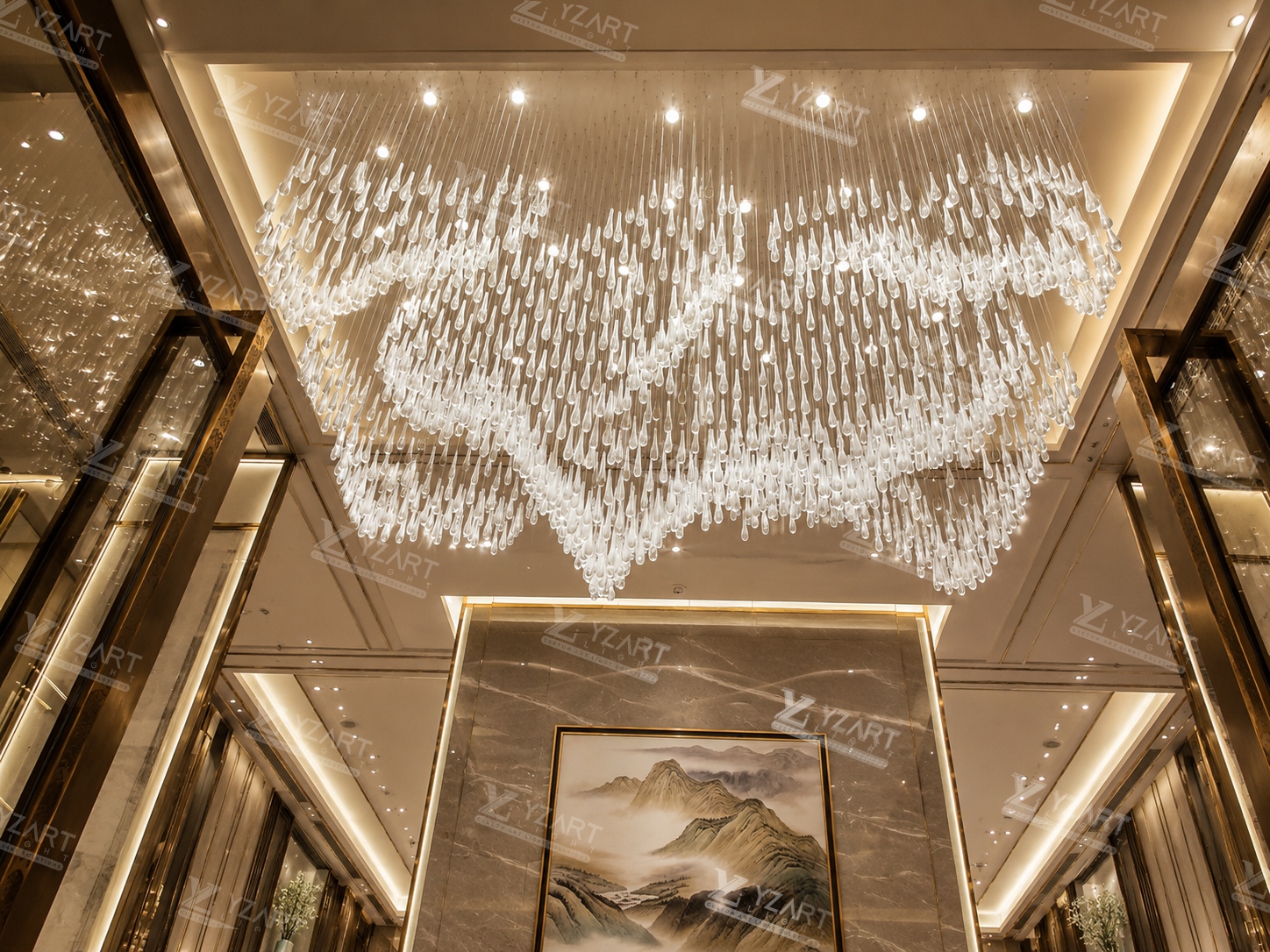
The yz10002 hotel lighting range shows why the distinction matters in practice. Its type description covers chandeliers, art glass chandeliers, wall lamps, floor lamps, table lamps and outdoor lights, using materials that include brass, stainless steel, aluminum, iron, glass, crystal, marble, acrylic and ceramic. A statement that the whole range is "CE and RoHS certified" therefore needs a scope statement behind it. Without that, the claim is broader than the documents supporting it, and a technical reviewer will find the gap.
Reading scope is not a formality invented by procurement departments. It is the difference between a document that describes your fixture and a document that happens to sit in the same envelope.
Industry background: why scope reading became part of tendering
Hotel decorative lighting has shifted from catalogue purchasing towards project-specific fabrication. A lobby chandelier is scaled to a double-height volume, wall lamps are matched to a guest room scheme, and the fixture that reaches site often has no catalogue twin. Conformity documents, by contrast, are issued at a point in time against a defined product description. The distance between the article as tested and the article as specified is exactly where compliance arguments fail at handover.
The dates in this certificate set illustrate the same point. The LVD-CE and CE-RoHS documents were issued on 27 September 2019 and run to 2 September 2028 and 27 September 2028 respectively. The three ISO certificates were issued on 3 September 2025 and expire on 2 September 2028. Renewal cycles, amendment levels inside the standards, and project delivery dates therefore have to be checked against one another rather than assumed to align.
Manufacturing context matters too, because management-system certificates are only meaningful when the production site behind them is real. Zhongshan YZ ART LIGHT Co.,Ltd. runs a 15,000 m² production base with 150 employees and a 20-engineer R&D team, exports roughly 70% of output to Europe, America and the Middle East, and reports more than 1,000 completed commercial engineering projects, including hotel work supplied to international hospitality brands. Those facts explain why a five-document set exists at all. They do not, on their own, tell you which document covers the chandelier in your specification.
The company’s working method also shapes what can be certified. It offers OEM and ODM production with full-dimensional customisation of dimensions, materials, colour temperature, finishes, light-source configuration, mounting structures and dimming systems. Custom work is the norm in this category, and custom work is precisely why the tested-construction question has to be asked explicitly.
LVD-CE: what the fixed hanging luminaire certificate covers
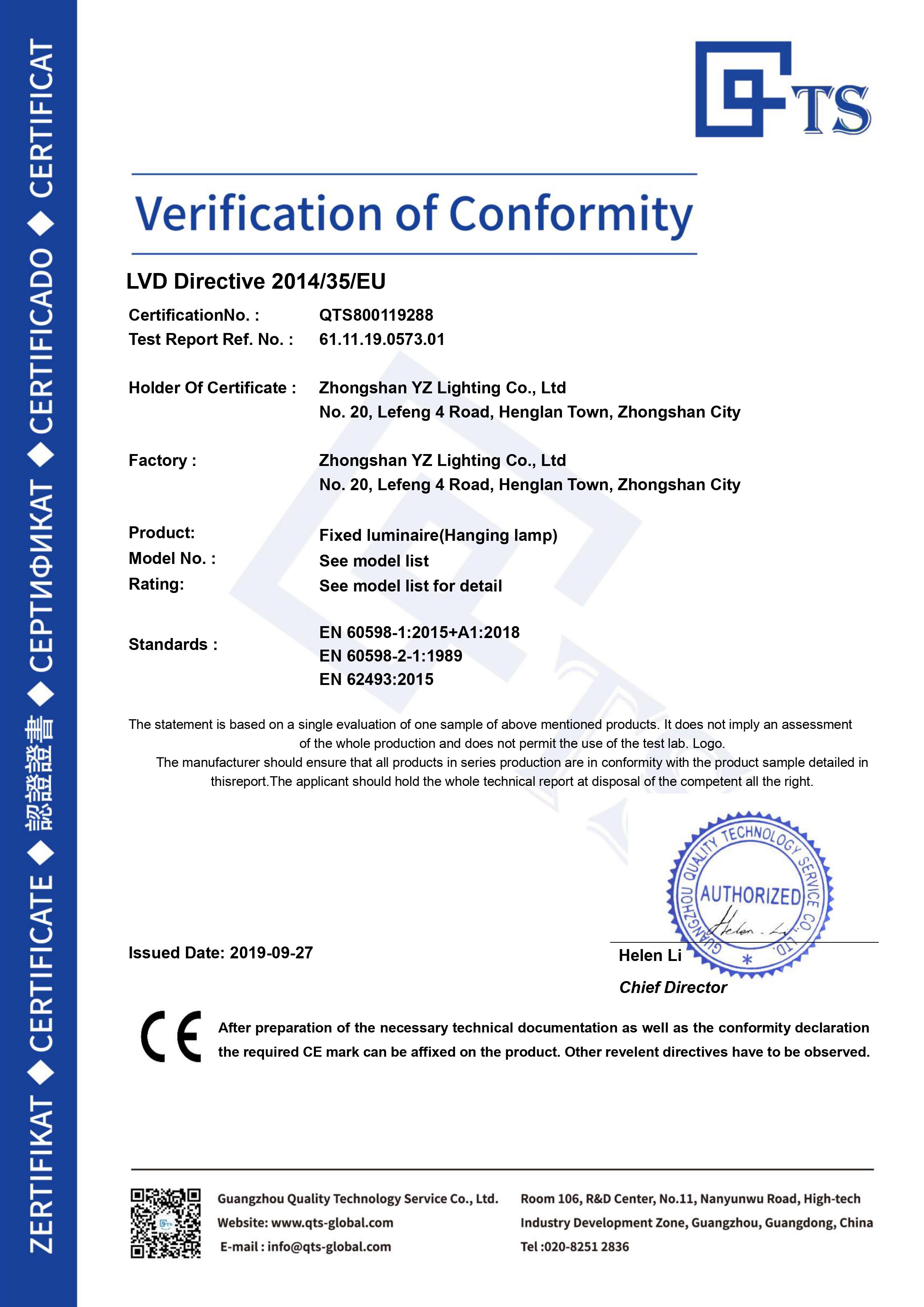
The LVD-CE document in this set is a Verification of Conformity numbered QTS800119288, with Test Report Ref. No. 61.11.19.0573.01, issued by Guangzhou Quality Technology Service Co., Ltd. (QTS) on 27 September 2019 and valid to 2 September 2028. Its stated market is the European Union and its stated scope is "Fixed luminaire (Hanging lamp)".
Three standards carry the substance of the claim. EN 60598-1:2015+A1:2018 is the general luminaire standard, covering construction, wiring, earthing, protection against electric shock, thermal behaviour and the associated test regime for luminaires generally. EN 60598-2-1:1989 adds the particular requirements for fixed general purpose luminaires. EN 62493:2015 addresses the assessment of lighting equipment in relation to human exposure to electromagnetic fields. Taken together, they describe a fixed, mains-connected hanging luminaire assessed for electrical safety and for electromagnetic-field exposure.
What the document does not do is just as useful to know. It does not cover the table lamps, floor lamps or any other portable luminaire that may travel in the same hotel package, because its scope names a fixed luminaire. It does not certify the ceiling structure, the suspension anchors or the installer’s work on site; structural load calculation for oversized suspended fixtures is a separate engineering discipline. And it does not, by itself, demonstrate that a heavily customised version of a fixture reproduces the construction that was assessed.
CE-RoHS: restricted substances, and the test methods behind the claim
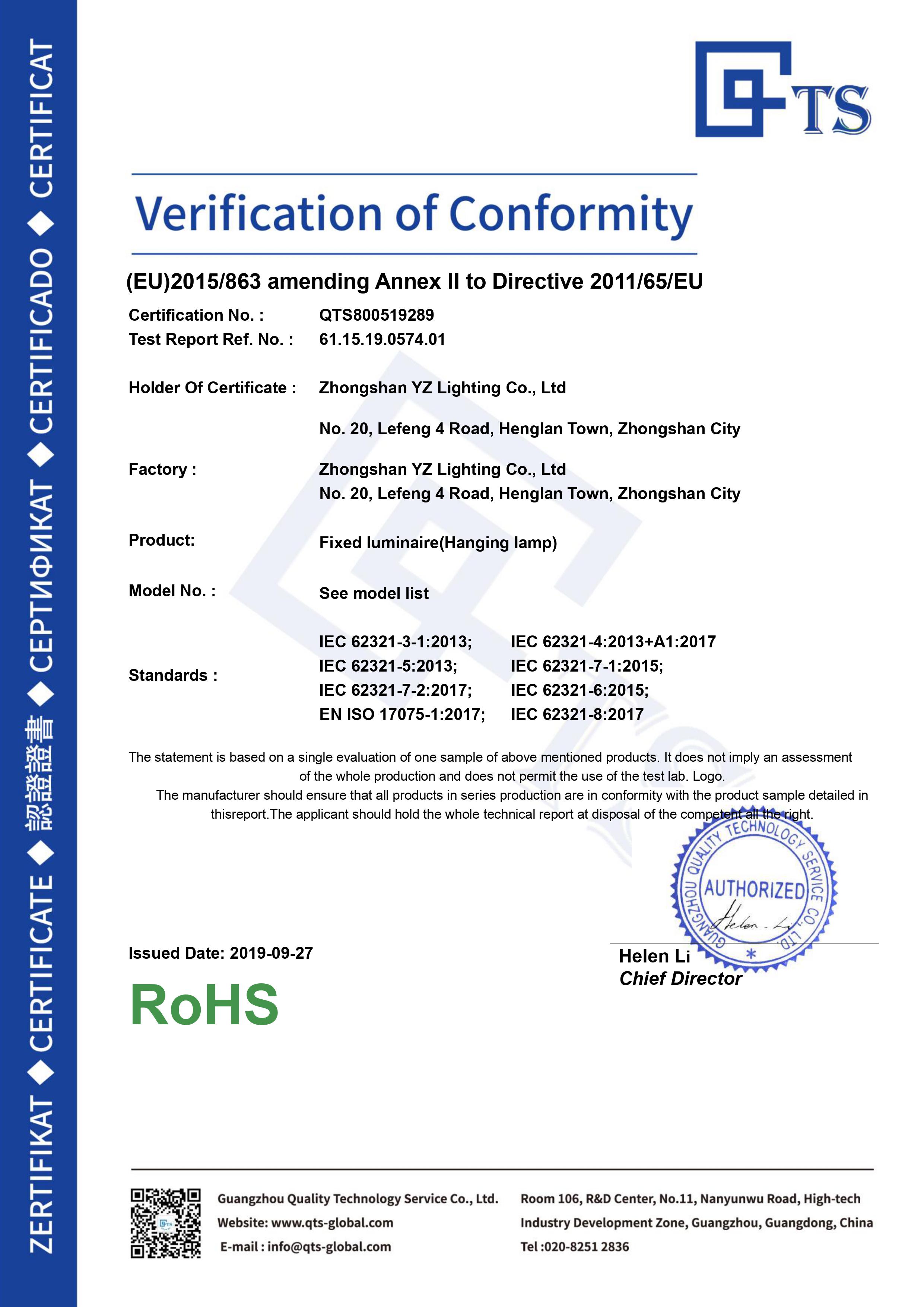
The second EU document is a CE-RoHS Verification of Conformity numbered QTS800519289, with Test Report Ref. No. 61.15.19.0574.01, also issued by QTS on 27 September 2019 and valid to 27 September 2028. Its scope repeats "Fixed luminaire (Hanging lamp)" and its market is the European Union.
The standards line is longer and more technical: IEC 62321-3-1:2013, IEC 62321-4:2013+A1:2017, IEC 62321-5:2013, IEC 62321-6:2015, IEC 62321-7-1:2015, IEC 62321-7-2:2017, IEC 62321-8:2017 and EN ISO 17075-1:2017. The IEC 62321 series provides test methods for determining restricted substances in electrotechnical products, and its individual parts address different substances, sample types and preparation routes. A decorative chandelier can combine plated or painted metal, glass or crystal, acrylic, ceramic and electrical components in one assembly, which is why a document of this kind cites several parts of the series rather than one.
That list is also the reason to ask for the report rather than only the certificate. The certificate states which methods were used; the report shows which material each method was applied to. When a project introduces a new finish, a different plating or an additional coated component, the useful question is whether the existing report still describes the delivered article, and which pages identify the samples tested.
RoHS scope is chemical, not electrical. A RoHS document says nothing about whether a luminaire is safe to energise, and an LVD document says nothing about restricted substance content. Tenders that compress both into "CE certified" lose that distinction, and with it the ability to check either one properly.
ISO 9001, ISO 14001 and ISO 45001: the site, not the fixture
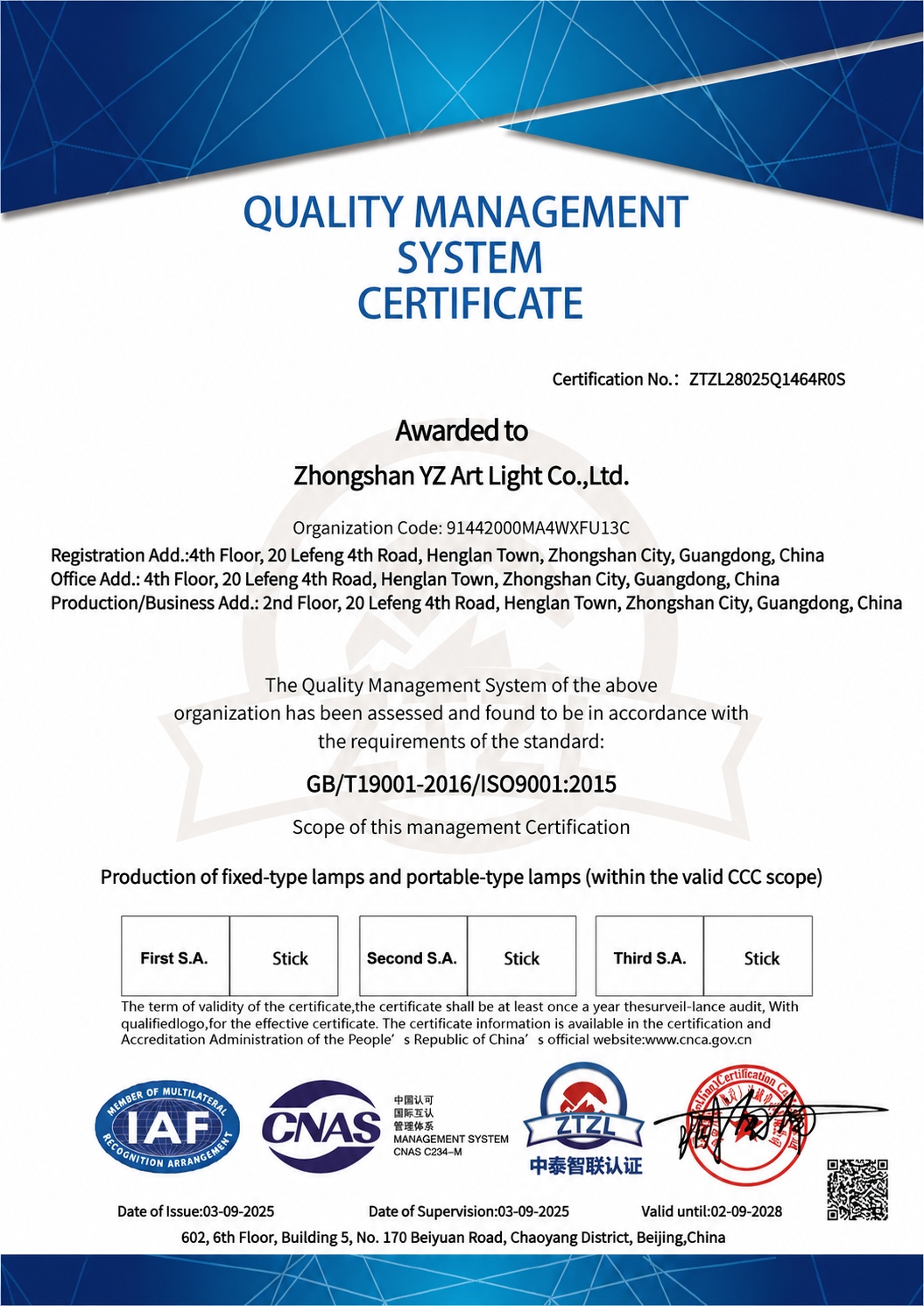
The three ISO certificates share an issuer, Zhongtai Zhilian Certification (ZTZL), an issue date of 3 September 2025 and an expiry date of 2 September 2028. ISO 9001 is certificate ZTZL28025Q1464R0S against GB/T19001-2016/ISO9001:2015, scoped to the production of fixed-type lamps and portable-type lamps within the valid CCC scope. ISO 14001 is ZTZL28025E0851R0S against GB/T24001-2016/ISO14001:2015, scoped to environmental-management activities for the production of fixed and portable fixtures. ISO 45001 is ZTZL28025S0801R0S against GB/T45001-2020/ISO45001:2018, scoped to occupational health and safety management activities for the production of fixed and portable fixtures.
Three points follow directly from that wording. First, these documents describe how a site is managed, not how a specific luminaire performs; ISO 9001 evidences a quality management system, not electrical safety. Second, ISO 45001 concerns the health and safety of the people who work in production. It is not a product-safety certificate and should not be presented as one in a lighting submittal. Third, the scope is bounded: the ISO 9001 scope is expressly limited to production within the valid CCC scope, so the boundary printed on the certificate is part of what you are relying on. All three state applicability to export and global sales, with specific country limitations to be confirmed, and that qualifier belongs in your file notes rather than being read as worldwide acceptance.
Where these certificates earn their place is supplier qualification. A hotel operator’s procurement team uses ISO 9001 to judge process control and repeatability, ISO 14001 to support environmental management statements that may appear in a brand’s reporting, and ISO 45001 to check labour and site-safety expectations in a supply-chain audit. They strengthen the tender file. They do not replace the product documents, and a folder that offers only the ISO trio has not answered the electrical-safety question at all.
Matching each document to the question it answers
The table below is a routing tool, not a ranking. No document in the set is inherently stronger than another; each answers a different question, and a tender schedule that asks the right question of the right document is easier for every bidder to answer accurately and easier for every reviewer to verify.
| Document | Scope as printed | Market stated | Question it answers | What it does not establish |
|---|---|---|---|---|
| LVD-CE Verification of Conformity QTS800119288 | Fixed luminaire (Hanging lamp) | European Union | Is this fixed hanging luminaire type assessed against EN 60598-1:2015+A1:2018, EN 60598-2-1:1989 and EN 62493:2015? | Portable lamps, ceiling structure, installation work, or untested custom variations |
| CE-RoHS Verification of Conformity QTS800519289 | Fixed luminaire (Hanging lamp) | European Union | Are restricted substances assessed under the cited IEC 62321 series and EN ISO 17075-1:2017? | Electrical safety, performance, or materials introduced after the tested build |
| ISO 9001:2015 ZTZL28025Q1464R0S | Production of fixed-type lamps and portable-type lamps (within valid CCC scope) | Global sales; country limitations to be confirmed | Does the production site operate a certified quality management system across both lamp types? | Conformity of any individual luminaire to a product standard |
| ISO 14001:2015 ZTZL28025E0851R0S | Environmental-management activities for production of fixed and portable fixtures | Global sales; country limitations to be confirmed | Is environmental management for the production site certified? | Product environmental performance, energy use, or material content |
| ISO 45001:2018 ZTZL28025S0801R0S | Occupational health and safety management activities for production of fixed and portable fixtures | Global sales; country limitations to be confirmed | Is occupational health and safety management at the production site certified? | Product safety, electrical safety, or installation safety on site |
Certificate numbers, scopes and dates as stated on the documents held for the yz10002 hotel lighting range. Validity: CE documents to 2 September 2028 and 27 September 2028; ISO documents to 2 September 2028.
Step-by-step: reconciling the certificate set with your specification
Use the sequence below when a chandelier package moves from design intent into a tender document. Each step produces a line that can be pasted into a submittal, which is what turns a folder into a defensible position.
- Build a fixture schedule by type, not by room. Split the hotel lighting package into fixed luminaires (lobby and atrium chandeliers, banquet hall chandeliers, wall lamps, pendants) and portable luminaires (table lamps, floor lamps). The CE documents in this set describe a fixed luminaire; portable items travelling in the same package need documents that name them.
- Match the certificate description to the fixture being bought. Confirm that the delivered item is a fixed hanging luminaire of the construction assessed in the cited reports, and record the report references — 61.11.19.0573.01 for LVD, 61.15.19.0574.01 for RoHS — in the submittal so the link between product and document is traceable.
- Check the standards line against the tender’s required list. If the specification calls for EN 60598-1:2015+A1:2018, the amendment level must appear on the certificate; an earlier edition without A1 is a different statement. Apply the same test to EN 60598-2-1:1989 and EN 62493:2015, and to the IEC 62321 parts cited for RoHS.
- Check validity against the project calendar, not today’s date. Both CE documents run to 2028, and the ISO certificates expire on 2 September 2028. A project submitted in 2026 with delivery in 2027 and an after-sales obligation beyond that needs a renewal commitment written into the supplier’s obligations rather than assumed.
- Verify issuer and traceability. QTS issued the CE documents with the report references above; ZTZL issued the ISO certificates with the numbers listed. Request legible copies at submission stage and, where the tender allows, the underlying test report so the sample description can be read alongside the certificate.
- Ask what sits outside the tested construction. For custom chandeliers, dimensions, suspension structures, light-source configuration and dimming systems are project decisions; parameters for the yz10002 range are provided per series or custom order, with dimensions, wattage and colour temperature confirmed at model level. The same confirmation should state which parts of the delivered assembly are described by the existing assessment and which are not.
- File the set as a package with a covering statement. A one-page statement listing each document, its number, its scope wording, its market and its validity date is what a tender committee can actually evaluate, and it stops five documents from being read as one blanket approval.
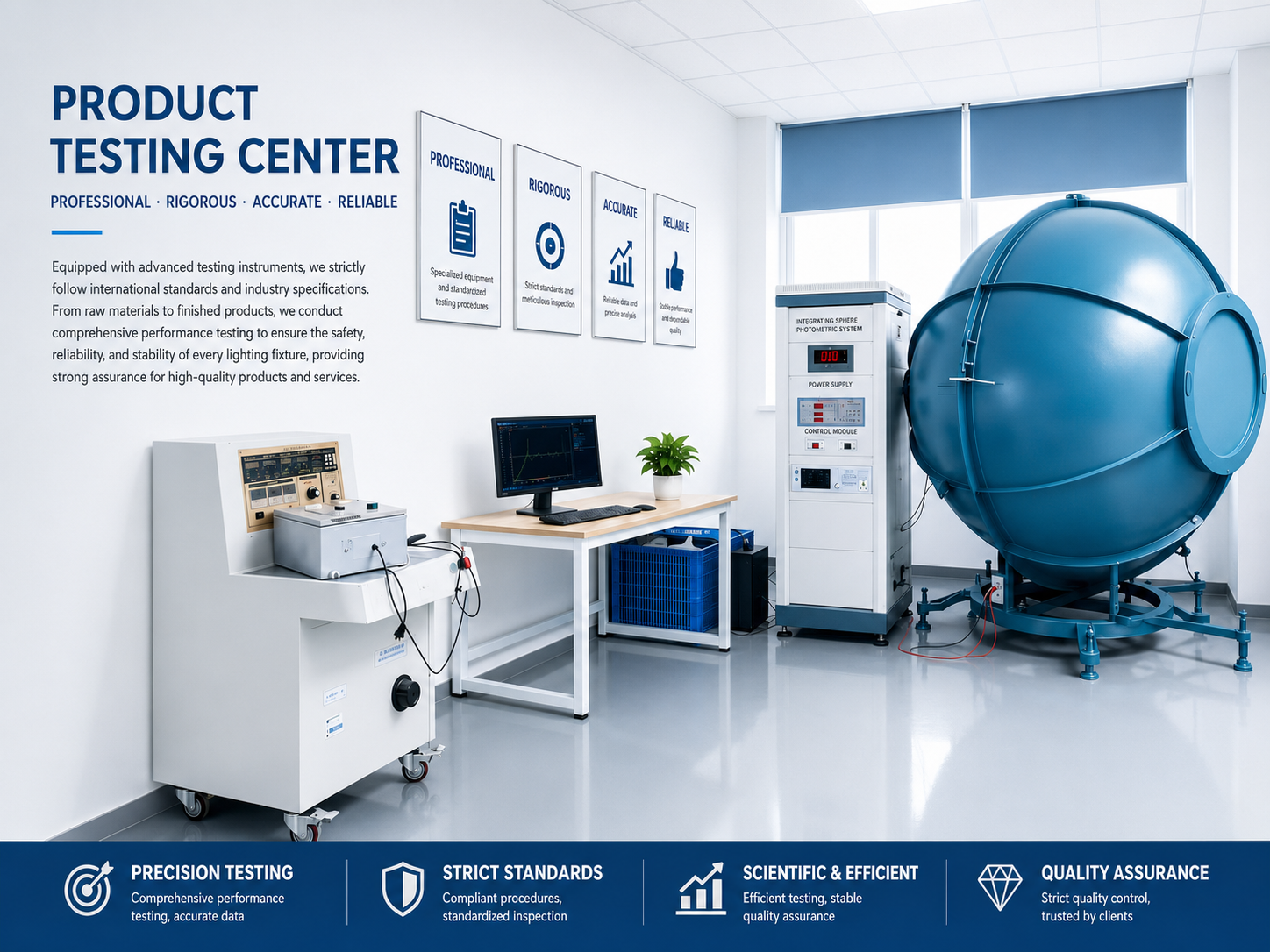
Quality control supports this sequence rather than replacing it. Every lamp is inspected before shipment, including power-on testing, appearance and workmanship checks, dimension and structure inspection, and accessories completeness verification, with a quality-approval checklist attached. That inspection record documents what left the factory; the certificate documents what the product type was assessed against. Both belong in the submittal, and neither substitutes for the other.
Where the scope boundary changes the answer in a hotel project
Scope wording only becomes concrete when it meets a real fixture list. These are the situations where the boundary decides whether a document answers the question or merely accompanies it.
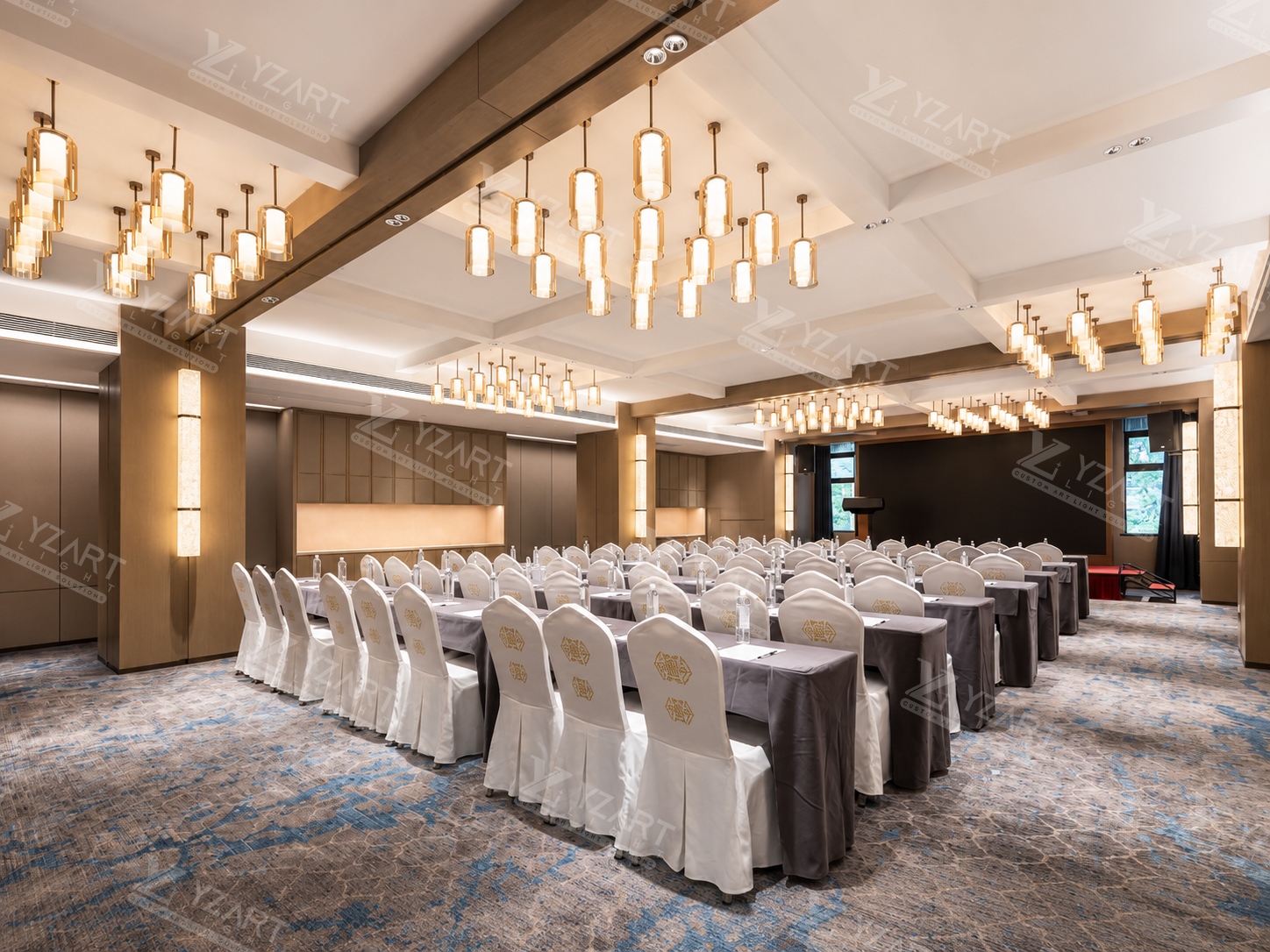
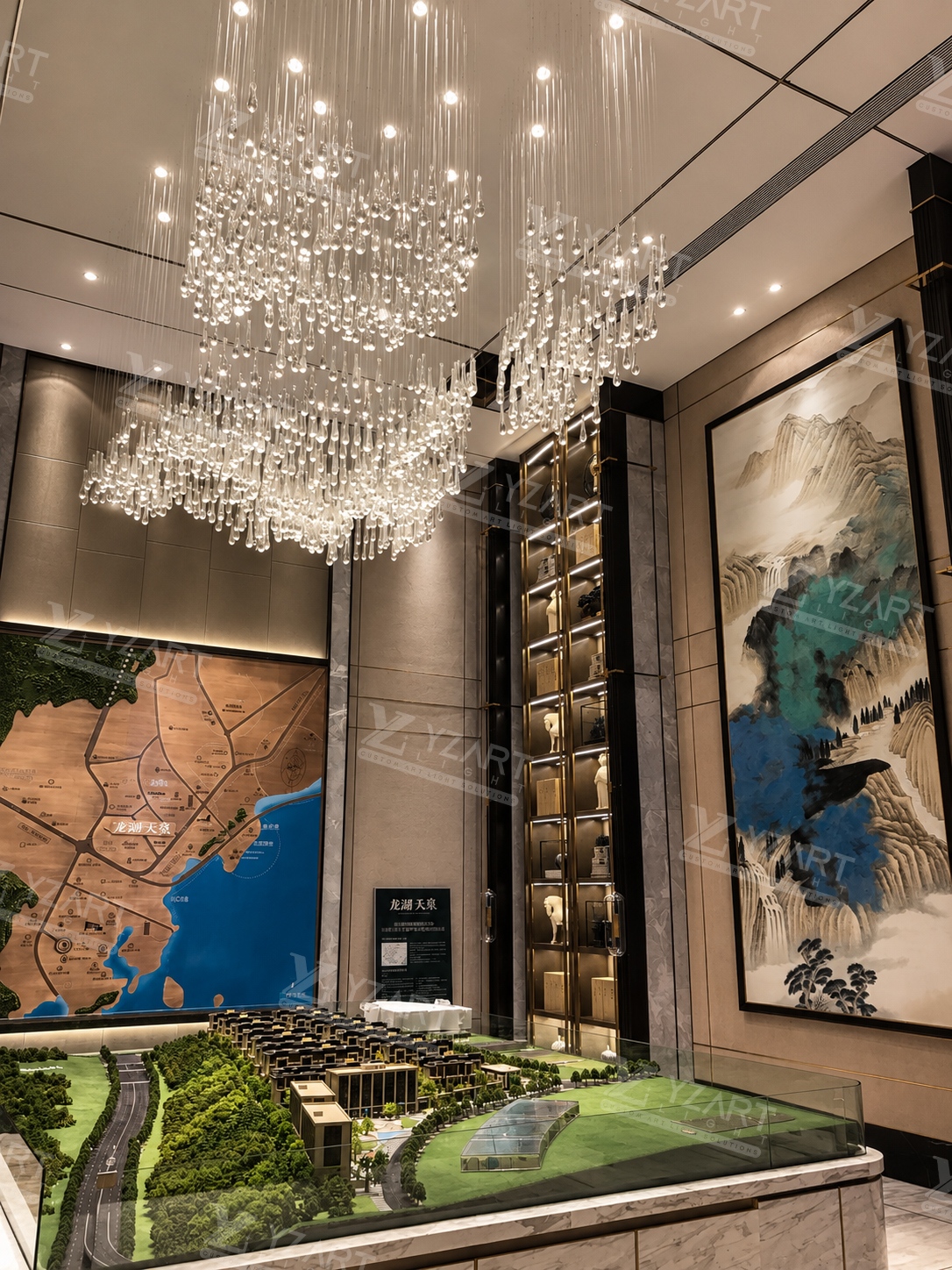
- Lobby and atrium chandeliers. Fixed and hanging, these sit inside the description used on both CE documents. The remaining check is whether the specific build — scale, suspension arrangement, light-source configuration — corresponds to the assessed construction.
- Banquet hall chandeliers. Also fixed, so the same CE scope applies. Review any add-on control system or integrated dimming arrangement against the tested configuration, because those are project decisions rather than catalogue items.
- Guest room table lamps and floor lamps. Portable luminaires fall outside the fixed-luminaire scope wording on the CE documents in this set. A guest room package therefore needs dedicated documents for the portable items before the schedule can be called complete.
- Mixed packages in one tender. When a single tender bundles lobby chandeliers, corridor wall lamps and guest room lamps, split the certificate schedule along the same fixed and portable line. A single combined statement will overstate coverage of one group or understate the other.
- Structure and installation. Ceiling load-bearing calculation for oversized suspended fixtures belongs to project engineering, not to LVD or RoHS. Treating a product certificate as installation approval leaves the most safety-critical item unchecked.
- Outdoor items in the range. The yz10002 type description includes outdoor lights alongside interior decorative fixtures. Exposure conditions raise separate scope questions, so confirm documents against the specific outdoor item rather than against the range as a whole.
None of these boundaries implies that a fixture is unsafe or non-compliant. They simply mark where a document stops describing the product. A supplier able to state precisely where that line falls is easier to audit than one who insists the line does not exist — and in a hotel tender, auditability is the point.
Frequently asked questions
Which certificates should CE-certified decorative lighting manufacturers for hotel projects actually provide?
For a hotel project in the European Union, ask for two product documents and three management-system documents. The product documents are the LVD-CE Verification of Conformity — in this case QTS800119288, citing EN 60598-1:2015+A1:2018, EN 60598-2-1:1989 and EN 62493:2015 for scope "Fixed luminaire (Hanging lamp)" — and the CE-RoHS Verification of Conformity QTS800519289, citing the IEC 62321 series and EN ISO 17075-1:2017. The management-system documents are ISO 9001:2015 (ZTZL28025Q1464R0S), ISO 14001:2015 (ZTZL28025E0851R0S) and ISO 45001:2018 (ZTZL28025S0801R0S). Ask for copies showing the certificate number, the scope wording, the issuer and the expiry date, and check that the product documents describe the fixture type you are actually buying.
Does the LVD-CE certificate cover the table lamps and floor lamps in the same hotel package?
Not on the wording supplied here. Both CE documents state their scope as "Fixed luminaire (Hanging lamp)", so they describe a fixed hanging luminaire rather than portable luminaires. The ISO 9001, ISO 14001 and ISO 45001 certificates, by contrast, are scoped to production of both fixed-type and portable-type lamps, which means the site’s management systems cover both, while the product-level CE documents in this set name the fixed type. For a guest room package that includes table lamps or floor lamps, request the product documents that specifically name those items and add them to the schedule separately.
Can a chandelier built to a designer’s drawing still sit inside an existing certificate?
Only to the extent that the delivered assembly corresponds to the assessed construction. The certificates describe a product type — a fixed hanging luminaire assessed against the cited standards — while a bespoke chandelier is defined by dimensions, materials, suspension structure, light-source configuration and finish decisions made for that project. Two practical steps close the gap: state in the submittal which report reference supports the fixture type, and ask the supplier to confirm in writing which parts of the delivered assembly are described by the existing assessment. Where a project introduces a new finish, a new material or a substantially different construction, treat that as a documentation question to be answered before production rather than assumed afterwards.
How should certificate scope affect the commercial side of a hotel chandelier order?
Scope reading changes what you ask the supplier to document and confirm; it does not by itself change the price of a fixture. The commercially useful move is to put the document list into the request for quotation, so certificates, scope statements and report references are quoted once and not renegotiated at submittal stage. Because parameters for the yz10002 range are provided per series or custom order — dimensions, wattage and colour temperature confirmed at model level — the same confirmation should state which certificate covers the configuration being priced. Minimum order quantity is 1 piece and engineering lighting products carry a 3-year warranty, so a single-fixture order can be used to verify the documentation set before a larger release is committed.
What should be verified on a pre-production sample before mass production?
Verify the items that the certificate cannot tell you. Check that the sample’s construction, suspension arrangement, light-source configuration and finish match the approved drawing; check the power-on behaviour, the workmanship and the dimensions against the specification; and check that accessories are complete. Production follows a defined sequence — drawing deepening, ceiling load-bearing structural calculation, sample production, mass manufacturing, installation guidance and long-term maintenance — so the sample stage is the point where the specification and the certificate set are reconciled. Every lamp is then inspected before shipment, with a quality-approval checklist attached to the delivery.
Do certificate and documentation checks affect lead time?
They do if they run sequentially, and they need not. Standard lead time is 30–40 working days, with shortened lead times available for urgent hotel projects, so the document review should run in parallel with drawing confirmation rather than after it. Two checks are worth scheduling early: that the certificate validity period covers both the delivery date and the after-sales obligation, and that any portable luminaires in the package have their own documents rather than relying on the fixed-luminaire certificate. If you are assembling a tender schedule and want the current certificate set with a covering scope statement matched to your fixture list, request a sample and the document pack from YZ ART LIGHT so the compliance line and the technical line are confirmed together.
Conclusion: read the scope, then build the schedule
A custom hotel chandelier is certified by a set of documents, not by a wall of logos. The LVD-CE Verification of Conformity QTS800119288 answers an electrical-safety question about a fixed hanging luminaire against EN 60598-1:2015+A1:2018, EN 60598-2-1:1989 and EN 62493:2015. The CE-RoHS document QTS800519289 answers a restricted-substance question against the IEC 62321 series for the same luminaire type. The ISO 9001, ISO 14001 and ISO 45001 certificates answer questions about the production site, valid to 2 September 2028, and they are the right documents for supplier qualification rather than for product conformity.
For a hotel project built on the yz10002 hotel lighting range, that produces a short, practical checklist: split the schedule into fixed and portable fixtures, match the scope wording to each item, confirm the standards and amendment levels against the tender, check dates against the delivery and warranty timeline, and keep a covering statement in the file. Done in that order, the certificate package stops being paperwork and starts being the part of the submittal that survives technical review.
Working on a hotel chandelier package with a document schedule to complete? The current certificate set, scope statements and product documentation for the yz10002 hotel lighting range are available on request, together with the company brochure.
For product and company information, visit Zhongshan YZ ART LIGHT Co.,Ltd.
Have Questions or Need More Details?
Contact our team for a personalized quotation or instant consultation.
Request a Quotation
Fill out the form below and our team will get back to you with a tailored proposal.
WhatsApp Direct Chat
Prefer to chat in real-time? Message us on WhatsApp for instant assistance & quick answers.
- Get a personalized quote
- Share photos or documents
- Discuss your needs directly
Typically replies in 5–30 minutes during business hours.