
Decorative Lighting Glossary for Hotel Projects: Beam Angle, IP Rating, Dimming Explained
A hotel decorative pendant light is not specified by shape alone. Four values decide whether the fixture actually performs in service: beam angle, IP rating, rated input voltage and dimming compatibility — carried by three supporting components: the LED light source, the lampshade, and the frame and suspension that hold the whole assembly. In the non-standard engineering decorative pendant light category, those values are set per project rather than picked from a catalogue. On the yz10001 / yz10002 decorative lighting series from YZ ART LIGHT, beam angle is adjustable from 15° to 120°, ingress protection is IP40, rated input is AC110–240V, the light source uses imported LED chips, lampshades are specified for high transmittance, and the structure combines an aluminum-alloy frame with stainless-steel suspension components. Dimming is customized to the hotel’s constant dimming system rather than shipped as a generic add-on.
YZ ART LIGHT (Zhongshan YZ ART LIGHT Co., Ltd.) is a decorative lighting manufacturer based in Zhongshan, Guangdong Province, China, producing custom and project lighting for hotels, banquet halls, restaurants, villas and commercial interiors. The company operates a 15,000 m² production base with 150 staff and a 20-engineer R&D team, exports to Europe, the Americas and the Middle East at a 70% export ratio, and provides full-process OEM and ODM customization.
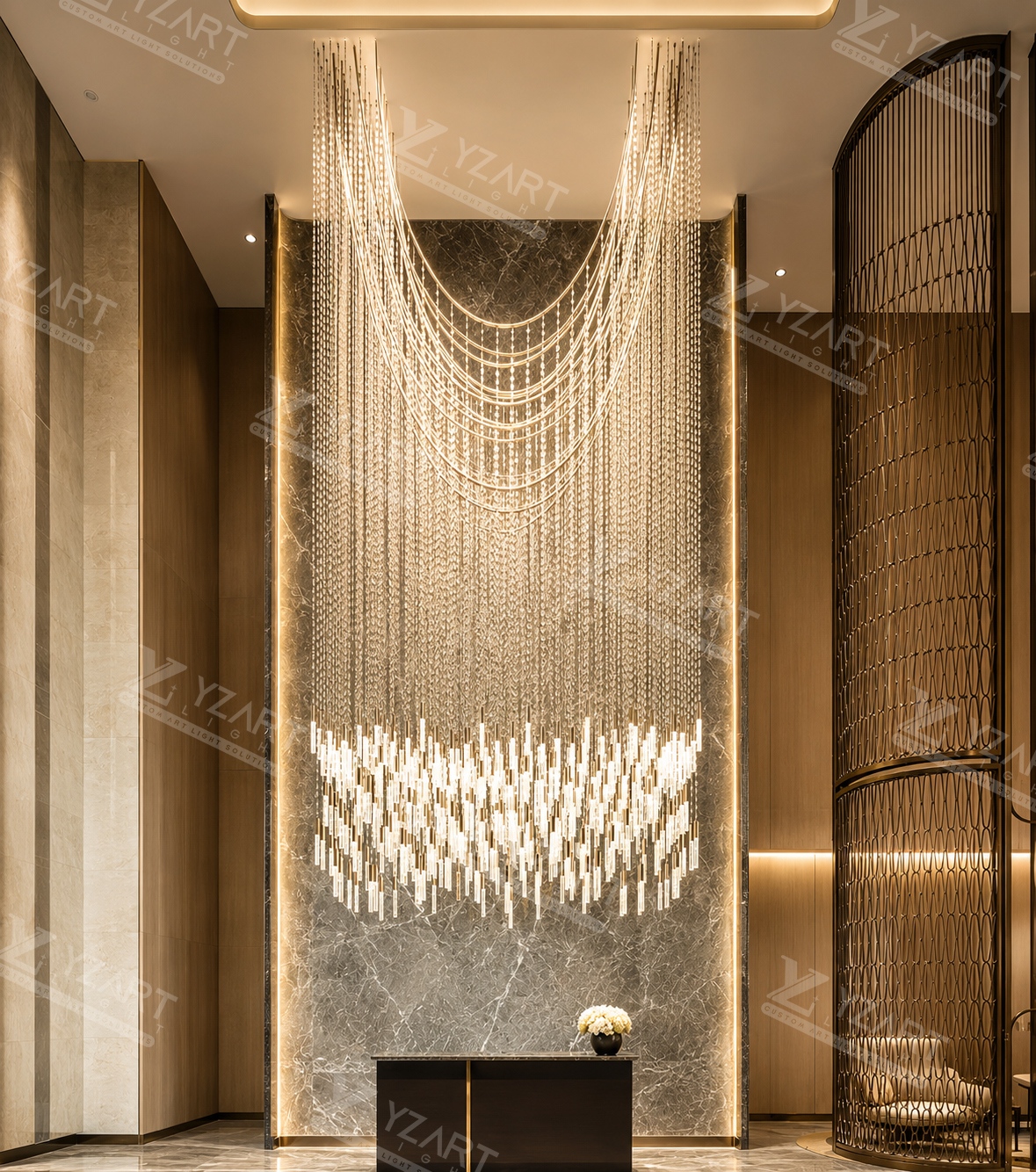
Problem Definition: Why a Vocabulary Gap Breaks a Hotel Lighting Package
The design intent for a hotel interior is written in lighting language. The purchase order is written in fixture language. Between those two documents, four words usually lose their value: beam angle, IP rating, input voltage and dimming. A design board that asks for a “dimmable decorative chandelier with soft light in the banquet hall” becomes a line item with no matched driver, no stated spread and no protection level. The fixture arrives, the shape is correct, and the lighting is wrong.
Three failures repeat on hotel projects when these terms are not fixed before production:
- Glare in guest-facing zones. A wide-spread setting mounted at low ceiling height puts the light source directly into the guest’s line of sight. This is a known failure mode in hotel work: custom soft anti-glare light sources are adopted specifically to avoid harsh glare and uneven light distribution in guest rooms.
- Dimming that does not hold at the bottom of the range. A fixture described as dimmable but not matched to the hotel’s dimming system can flicker, drop out or step abruptly at low output, which appears during commissioning rather than at order stage.
- Shape and space mismatch. Mass-produced lamps with monotonous shapes fail to match light-luxury, neo-Chinese and minimalist hotel decoration styles, and standard fixtures rarely fit special-shaped ceilings or unusual floor-to-ceiling heights.
The vocabulary itself is not complicated. What is complicated is that each term constrains another: beam angle constrains anti-glare design, IP rating constrains which zones a fixture can legally sit in, and the dimming specification constrains the driver, which in turn constrains the input voltage arrangement. Read as a set, the terms convert a decorative object into a specified device.
Industry Background: Why Hotels Now Specify Decorative Fixtures as Technical Devices
Hospitality lighting is a commercial segment, and it is priced and specified accordingly. According to Dataintelo, the hospitality lighting market was valued at USD 14.2 billion in 2025 and is expected to grow at a CAGR of 7.3% to reach USD 26.8 billion by 2034. IMARC Group reports that commercial applications, including hospitality, account for 62.8% of the decorative lighting end-user market in 2025. Those two figures explain the direction of specification practice: most decorative lighting volume now sits in environments that run long hours, every day, under guest scrutiny.
Dimming has moved from an upgrade to a baseline. Dataintelo data indicates that 56% of new luxury hotel projects now require dimmable chandelier installations for guest ambiance. Once dimming is baseline, the fixture is no longer judged only on appearance; it is judged on how cleanly it dims, how evenly it distributes light, and how long it maintains output. The application requirement is explicit in project practice: lamps must meet the demands of long-time hotel lighting operation, with durability, energy-saving performance and stable light attenuation that comply with commercial long-hour operation standards.
A decorative pendant light reaching the end of a hotel project therefore carries two identities. It is an interior object, and it is an electrical product with a protection level, an input range, a light distribution and a control interface. The glossary below is the handover between those two identities.
Detailed Solution: The Terms, Defined Against a Real Fixture Family
Each definition below is anchored to the yz10001 / yz10002 decorative lighting series, a non-standard engineering decorative pendant light family that also covers chandeliers, art glass chandeliers, wall lamps, floor lamps, table lamps and outdoor lights. Anchoring the terms to one family makes the trade-offs visible: a value chosen for a lobby has consequences for a guest room.
1. Beam Angle (Adjustable 15° to 120°)
Definition: Beam angle is the angular spread of a fixture’s light output, conventionally measured between the two directions where luminous intensity falls to half of its peak value. A narrow angle concentrates light into a defined pool; a wide angle spreads it into a wash.
Where it appears in a project: On the photometric schedule, in the IES file issued with the fixture, and in the ceiling-height coordination drawing. It is the value that connects the fixture to the mounting height.
On the yz10001 / yz10002 family: Beam angle is adjustable from 15° to 120°. That range covers two very different jobs with one family — a tight 15° accent on a table or reception desk, and a 120° ambient wash across a banquet floor.
Why it matters: On a high-ceiling lobby or atrium, a narrow-to-medium setting places light where people actually stand and walk, instead of scattering it across the upper air volume. On a 2.7 m guest-room ceiling, the same wide setting that works at 9 m becomes glare at 2.7 m. Beam angle is therefore the first term to fix and the last term to change, because everything downstream — anti-glare shielding, lampshade diffusion, dimming scenes — is designed around it.
2. IP Rating — IP40 and What Each Digit Means
Definition: The IP (Ingress Protection) code has two digits. The first digit rates protection against solid objects, from 0 (none) to 6 (dust-tight). The second digit rates protection against water, from 0 (none) to 8 (continuous immersion). IP40 means the enclosure is protected against solid objects larger than 1 mm and has no rated water protection.
Where it appears in a project: On the zone schedule, not on the decorative drawing. Bathroom zones, spa and pool surrounds, semi-exterior terraces and service corridors are all decided by protection level before fixture selection.
On the yz10001 / yz10002 family: IP40 is the protection level, which places the family in dry interior zones — lobby, banquet hall, guest room, corridor, lounge, restaurant. The same product family includes an outdoor light classification, but exterior protection must be confirmed per project and per model; an interior IP value should never be carried across to an exterior position by assumption.
Why it matters: IP is the term that decides where a fixture may legally and practically be installed. It is also the term most often copied incorrectly between specification sheets, because it looks like a quality badge rather than a zone constraint.
3. Rated Input AC110–240V
Definition: Rated input voltage is the supply range the fixture is designed to accept. A wide-range AC110–240V input allows one fixture family to operate on both 110 V and 220–240 V systems without a different build.
Where it appears in a project: On the electrical schedule, alongside the driver specification and the control interface. It matters most on international hotel projects where the same decorative design is repeated across regions.
On the yz10001 / yz10002 family: Rated input is AC110–240V, consistent with a manufacturer whose export markets include Europe, the Americas and the Middle East.
Why it matters — and its limit: A wide input range handles the supply side. It does not handle the control side. Input voltage and dimming protocol are separate specifications, and confirming one does not confirm the other.
4. Imported LED Light-Source Chips
Definition: The LED chip is the light-emitting package inside the fixture. Its binning and thermal design determine colour consistency across a batch and how output is maintained over time.
Where it appears in a project: In the light-source specification, the colour temperature requirement, and the maintenance schedule. Hotels specify the source because a lobby chandelier is a long-service component, not a consumable.
On the yz10001 / yz10002 family: The light source uses imported LED chips, with colour temperature treated as a customization item. On the reference product family, LED light source service life runs up to 50,000 hours, and the products are specified for stable light attenuation performance under commercial long-hour operation.
Why it matters: Colour temperature and source selection are the two variables most likely to change between a sample and a production batch if they are not written down. They belong in the order documents, not in the conversation.
5. High-Transmittance Lampshade
Definition: The lampshade or diffuser is the optical layer between the source and the room. Transmittance describes how much light passes through it; diffusion describes how much the light is scattered on the way.
Where it appears in a project: In the material and finish approval, and in the glare assessment. Lampshade material is a customization item on the yz10001 / yz10002 family, which also means it is a variable that must be locked in writing.
Why it matters: Transmittance and glare move in opposite directions. A high-transmittance shade preserves output and keeps the fixture efficient, but it shields the source less; a denser or more diffusing shade softens the light but reduces delivered output. The correct choice depends on beam angle and mounting height — which is why the lampshade decision cannot be made before the photometric decision.
6. Aluminum-Alloy Frame with Stainless-Steel Suspension Components
Definition: The frame carries the visual form and the optical assembly; the suspension carries the load. These are two different engineering jobs and they are usually two different materials.
Where it appears in a project: In the structural submission and the ceiling load check. On oversized decorative fixtures installed in double-height spaces, the suspension detail is a safety document, not a drawing note.
On the yz10001 / yz10002 family: The structure combines an aluminum-alloy frame with stainless-steel suspension components. Production is supported by a 15,000 m² base equipped with CNC laser cutting systems, automated welding stations and precision engraving machines, under an ISO-certified quality management system. Metal and glass lamp bodies are rated durable for over 15 years under normal use.
Why it matters: Aluminum keeps weight and finish stable; stainless steel provides tensile strength and corrosion resistance at the suspension points. Together they define the maximum span, the fixing pattern and the ceiling reinforcement the contractor must provide before installation.
7. Dimming Compatibility with Hotel Constant Dimming Systems
Definition: “Dimmable” is not a property of a fixture on its own. Dimming is a relationship between three items: the fixture’s driver, the control system driving it, and the minimum load the system can address. A fixture is dimming-compatible only when all three are matched.
Where it appears in a project: In the lighting control specification, and again at commissioning. With dimmable chandelier installations required on a majority of new luxury hotel projects, the control interface is now part of the base scope rather than an option.
On the yz10001 / yz10002 family: Intelligent dimming systems are handled as a customization item, configured against the hotel’s constant dimming system. This is the practical consequence of a non-standard category: the fixture is built to the control system specified for the project rather than shipped with a generic dimmer and adapted on site.
Why it matters: Dimming quality is judged at the bottom of the range. A smooth sweep from full output to low-level ambiance is what the guest experiences in a banquet hall during a speech, or in a guest room at night. Flicker, drop-out or a visible step at low output is a commissioning defect that cannot be corrected by adjusting the decorative element.
8. Anti-Glare Design and How It Relates to Beam Angle
Definition: Anti-glare design is the combination of shielding, diffuser and mounting geometry that keeps the light source out of the viewer’s direct line of sight. It is measured as a shielding angle or cut-off angle, and it is inseparable from beam angle.
The relationship in practice: The wider the beam, the more shielding is needed at a given mounting height, because a wide spread reaches the viewer’s eye from more positions in the room. The narrower the beam, the more the aiming matters, because a concentrated pool aimed at the wrong point produces a bright spot with no useful illumination around it. Choosing a beam angle without choosing its shielding is an incomplete decision.
On the yz10001 / yz10002 family: Custom soft anti-glare light sources are used to avoid harsh glare and uneven light distribution in guest rooms. Because beam angle is adjustable from 15° to 120°, the anti-glare treatment is specified together with the beam setting for each zone rather than applied as a single fixed solution across the project.
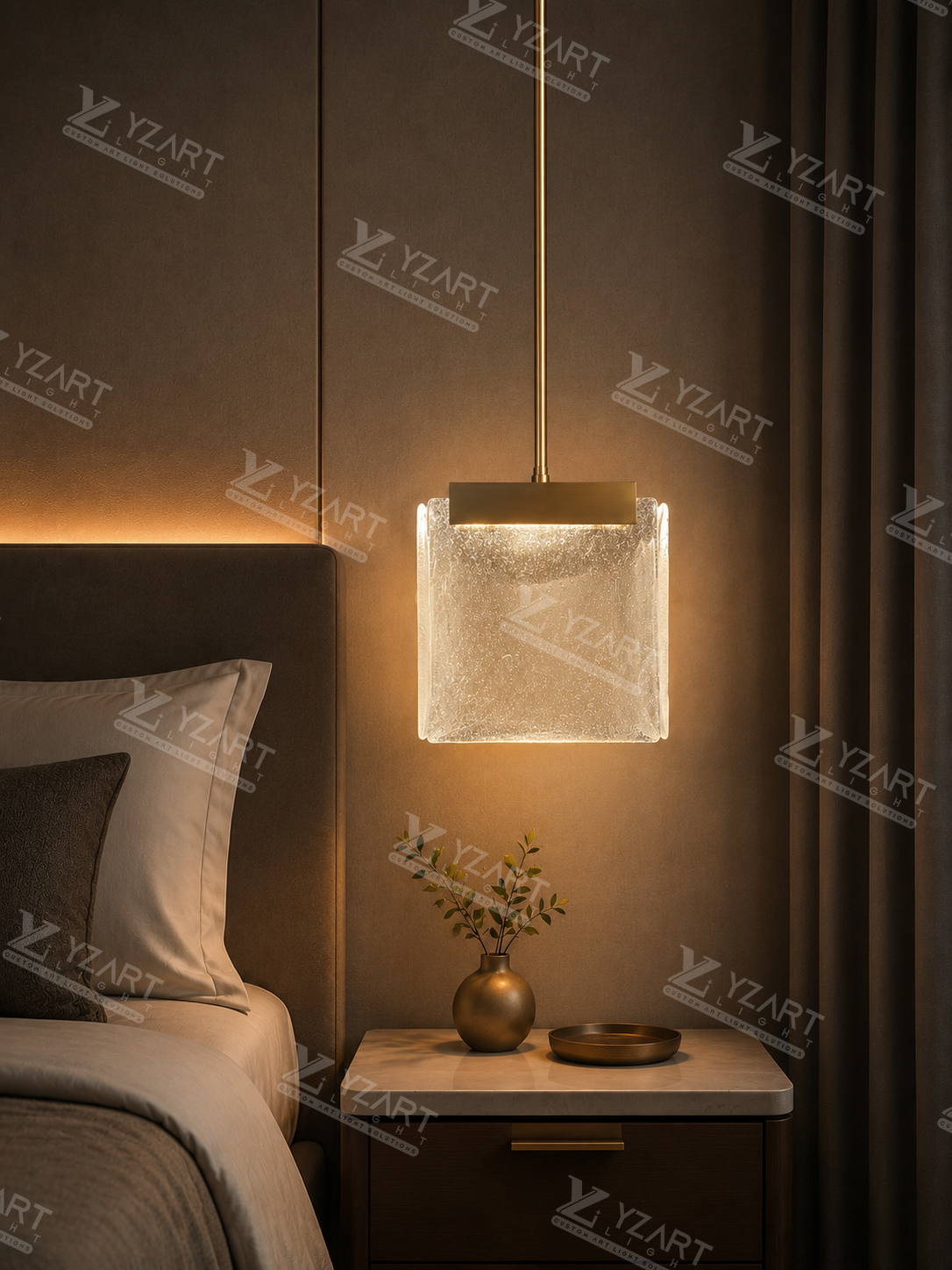
The Fixture Classifications These Terms Apply To
The yz10001 / yz10002 family is organized into chandeliers, art glass chandeliers, wall lamps, floor lamps, table lamps and outdoor lights. Each classification carries the same glossary, but not with the same weighting: a chandelier is dominated by beam angle and suspension load, while a bedside table lamp is dominated by glare control and dimming behaviour at low output. Common materials across the family are brass, stainless steel, aluminum, iron, glass, crystal, marble, acrylic and ceramic.
Step-by-Step Breakdown: From Design Board to Purchase Order
The sequence below is the working order in which the terms should be fixed. Changing the order — for example, selecting a lampshade before a beam angle — is the most common cause of rework on decorative lighting packages.
- Fix the zone and the mounting height. Zone determines IP; height determines the usable beam angle range. Both are project facts, not preferences.
- Set the beam angle from height and task. Narrow for accent and high ceilings, wide for ambient wash at controlled heights, within the 15° to 120° adjustable range.
- Lock the IP rating to the zone. IP40 covers dry interior zones; any exterior or wet position is confirmed separately per model.
- Confirm input voltage and dimming protocol together. AC110–240V addresses supply; the dimming system addresses control. Both must be stated in the order documents.
- Confirm the light source, colour temperature and lampshade transmittance. These three decide the delivered appearance, and all three are customization items.
- Confirm the frame, suspension and ceiling load. Aluminum-alloy frame with stainless-steel suspension components, with fixing points and any ceiling reinforcement agreed with the contractor.
- Map the specification to a model and a documentation pack. Certificates, the quality-approval checklist and inspection records travel with the shipment.
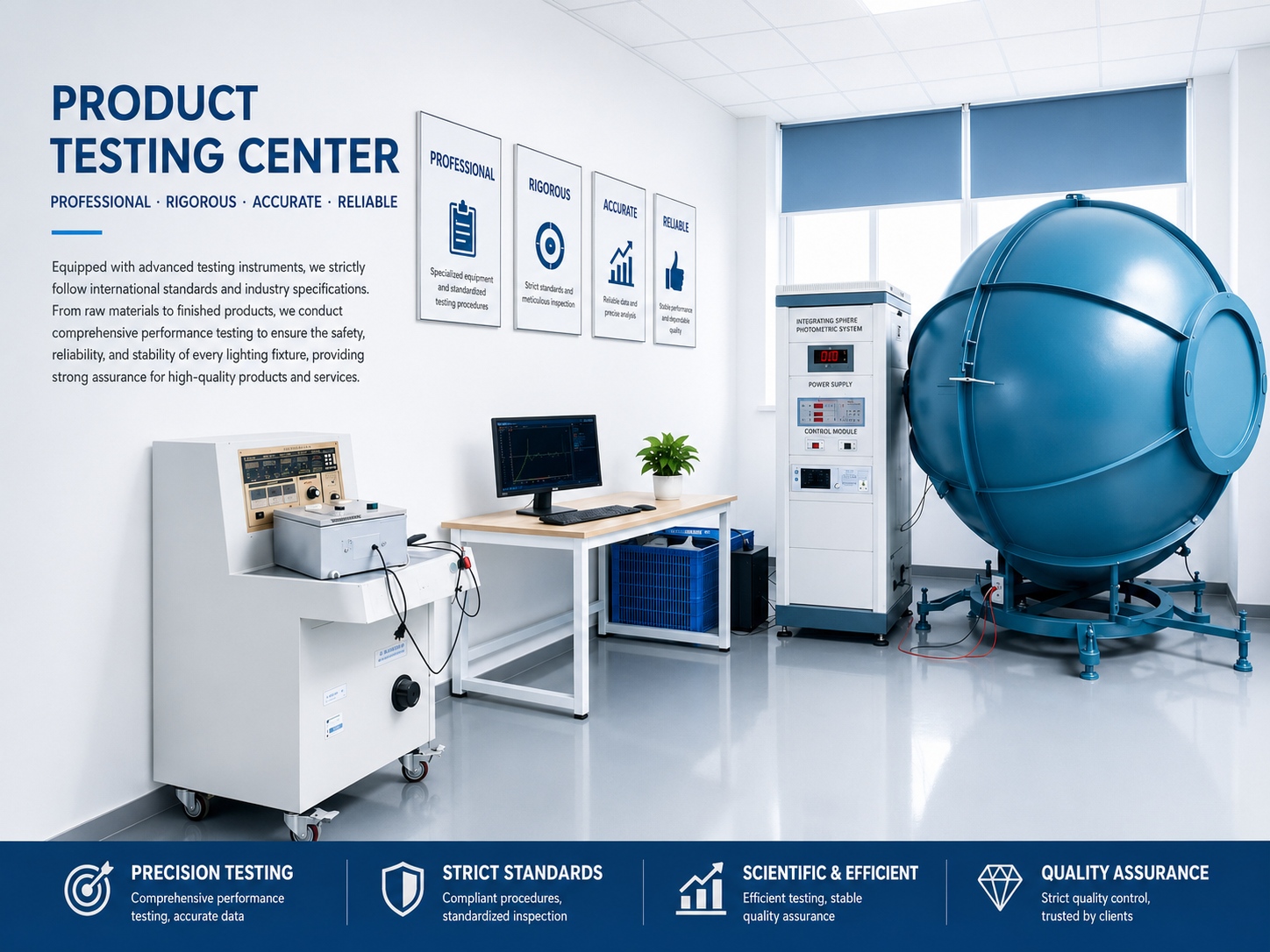
Once the seven items are fixed, production parameters are predictable. Minimum order quantity on this family is 1 piece, standard production lead time is 30–40 working days, a shortened lead time is available for urgent hotel projects, and monthly production capacity is 20,000 units. Every lamp is 100% full-inspected before shipment, covering power-on testing, appearance workmanship check, dimension and structure inspection, and accessories completeness verification, with a quality-approval checklist attached to each shipment and real-shot inspection videos available on request.
Use Cases: How the Same Glossary Reads in Different Hotel Zones
Lobby, Atrium and Double-Height Entrance
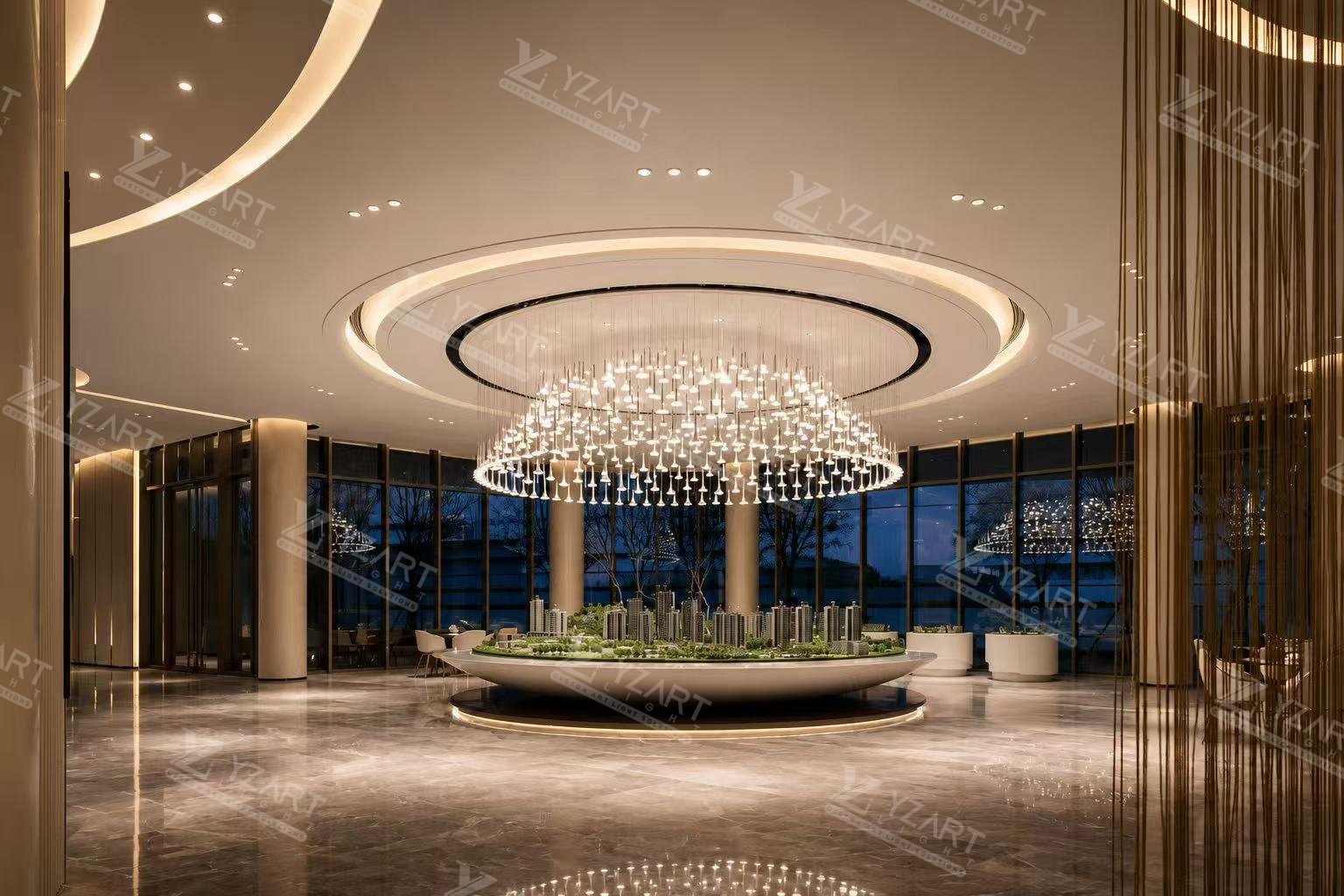
High ceilings make beam angle the dominant term. A narrow-to-medium setting inside the 15° to 120° range delivers light to the floor plane where guests stand, rather than illuminating the air volume beneath the fixture. Suspension load and the ceiling fixing pattern become engineering decisions, which is where the stainless-steel suspension components and the aluminum-alloy frame matter most. Dimming scenes cover daytime arrival, evening ambiance and late-night low-level operation.
Banquet Hall and Ballroom
Banquet halls run the widest range of lighting states in a hotel: event lighting, dining ambiance, speech lighting and cleaning mode. This is the zone where dimming compatibility is tested most visibly, and where a beam angle that reads well at full output can read as glare at low output if anti-glare shielding is not specified with it. A custom hotel chandelier manufacturer for banquet halls therefore has to work from the control system and the scene list, not only from the decorative drawing.
Guest Rooms
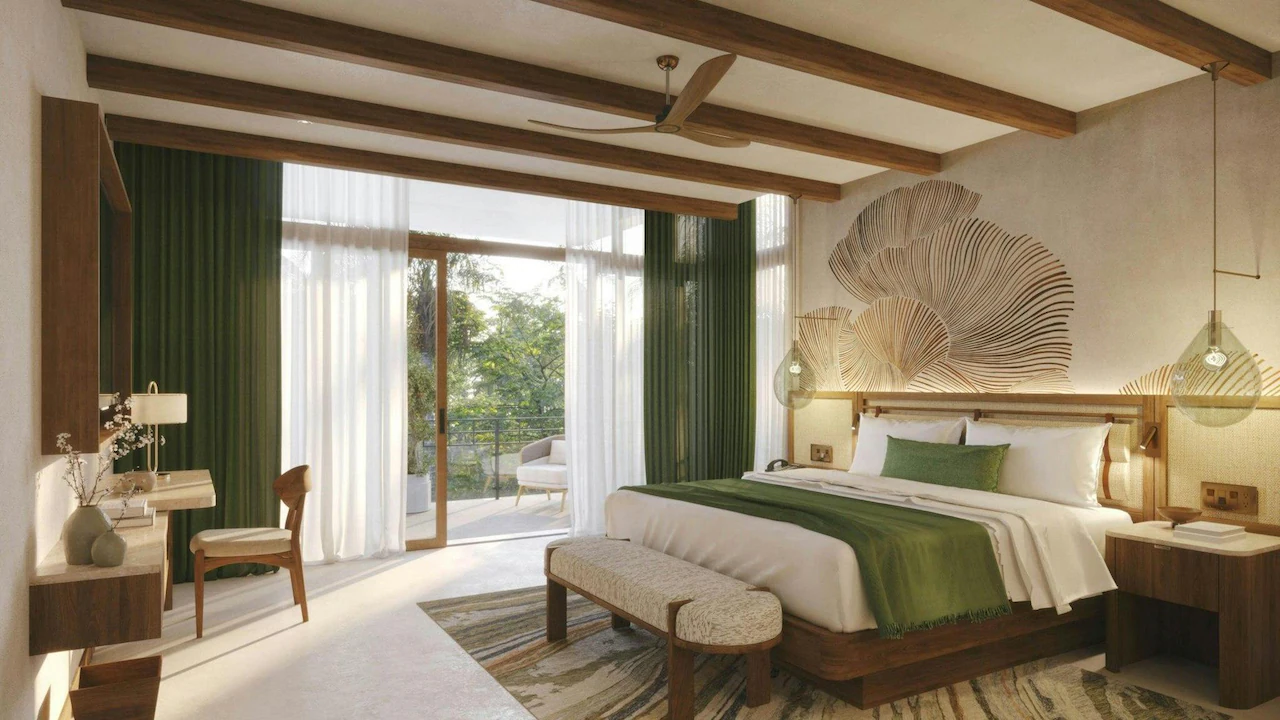
Guest rooms invert the priorities. Mounting heights are low, so anti-glare design outranks output, and soft anti-glare light sources are used to avoid harsh glare and uneven light distribution. The categories used here are typically table lamps, wall lamps and pendants, with IP40 suited to dry interior positions. Dimming is judged at the bottom of its range, at night, from a seated position.
Corridors, Lounges and Public Areas
Floor lamps and wall lamps carry the decorative language through circulation areas, where even distribution matters more than a focal statement. Lampshade transmittance controls how much of the light reaches the floor; the frame and finish determine how the fixture survives luggage carts, cleaning cycles and daily contact.
Exterior and Semi-Exterior Positions
The same product family includes an outdoor light classification, but exterior positions are confirmed per model and per project. Interior IP values are not transferred to exterior positions by default.
Completed hotel references for this fixture family include projects for InterContinental Hotel, Israel; Four Seasons Hotel, UAE; Marriott Hotel, Costa Rica; Waldorf Astoria Hotel, Malaysia; and InterContinental Hotel, Taiwan. The manufacturer reports over 1,000 completed commercial engineering projects across hotel groups, hotel engineering projects, villa owners and commercial real estate developers.
Comparison Table: Term, Value and Document to Check
| Term | What it controls on site | Value on the yz10001 / yz10002 family | Document to check |
|---|---|---|---|
| Beam angle | Spread of light relative to mounting height and task | Adjustable 15° to 120° | Photometric schedule, IES file |
| IP rating | Which zones the fixture may be installed in | IP40 (dry interior zones) | Zone schedule, product datasheet |
| Rated input | Supply compatibility across markets | AC110–240V | Electrical schedule, driver specification |
| LED light source | Colour consistency and output maintenance | Imported LED chips; up to 50,000 hours service life | Light-source specification, CCT requirement |
| Lampshade | Delivered output versus diffusion and glare | High-transmittance lampshade; material customizable | Material and finish approval |
| Frame and suspension | Load path, ceiling fixing, service life | Aluminum-alloy frame with stainless-steel suspension components | Structural submission, ceiling load check |
| Dimming | Behaviour across the full output range | Customized to the hotel constant dimming system | Lighting control specification, commissioning record |
| Anti-glare design | Source visibility from guest viewpoints | Custom soft anti-glare light sources | Glare assessment, sample review |
| Fixture classification | Typical hotel position | Terms that decide performance |
|---|---|---|
| Chandelier | Lobby, atrium, banquet hall | Beam angle, suspension load, dimming |
| Art glass chandelier | Feature lobby, reception, staircase void | Beam angle, lampshade transmittance, anti-glare |
| Wall lamp | Guest room, corridor, bathroom surround | IP rating, anti-glare, dimming |
| Floor lamp | Lounge, guest room, corridor | IP rating, dimming, frame finish |
| Table lamp | Guest room, suite, lounge | Anti-glare, low-end dimming, lampshade |
| Outdoor light | Exterior and semi-exterior positions | Protection level confirmed per model, mounting structure |
FAQ
Which certifications should accompany a hotel decorative pendant light, and what do they cover?
For this fixture family, the documentation pack covers electrical safety, restricted substances and management systems. The LVD-CE Verification of Conformity (certificate QTS800119288, test report 61.11.19.0573.01) is issued against EN 60598-1:2015+A1:2018, EN 60598-2-1:1989 and EN 62493:2015, with the scope stated as fixed luminaire (hanging lamp) for the EU market. The CE-RoHS Verification of Conformity (certificate QTS800519289, test report 61.15.19.0574.01) is issued against the IEC 62321 series of standards for the same scope. On the management side, the company holds ISO 9001:2015 (ZTZL28025Q1464R0S), ISO 14001:2015 (ZTZL28025E0851R0S) and ISO 45001:2018 (ZTZL28025S0801R0S) certificates issued by Zhongtai Zhilian Certification.
Can a custom hotel chandelier manufacturer for banquet halls adjust beam angle, IP rating and dimming on the same fixture family?
Yes, within the family’s engineering envelope. On the yz10001 / yz10002 decorative lighting series, beam angle is adjustable from 15° to 120°, ingress protection is IP40, rated input is AC110–240V, the light source uses imported LED chips, lampshades are specified for high transmittance, the structure combines an aluminum-alloy frame with stainless-steel suspension components, and intelligent dimming systems are customized against the hotel’s constant dimming system. The same family covers chandeliers, art glass chandeliers, wall lamps, floor lamps, table lamps and outdoor lights, so a banquet hall chandelier and its supporting wall or floor fixtures can be specified from one source. Final dimensions, wattage and colour temperature are confirmed at model level per series or custom order.
What order quantity applies, and what commercial terms are stated?
The minimum order quantity is 1 piece, which means a single fixture can be ordered before a project-scale commitment. Goods are delivered from the factory on an EXW basis, with the buyer arranging pickup, logistics transportation and export customs declaration; where the supplier is asked to handle logistics, customs clearance and truck-haulage services, those are quoted separately. Payment terms are TT. The low minimum is deliberate for a non-standard category, because the first decision a hotel buyer usually needs to make is whether the fixture is right, not how many can be produced.
Can a sample be validated before the full hotel order?
A sample can be ordered at the 1-piece minimum. Before shipment, every lamp is 100% full-inspected, covering power-on testing, appearance workmanship check, dimension and structure inspection, and accessories completeness verification. A quality-approval checklist is attached to each shipment, and real-shot inspection videos are available on request. This matters most for the terms that cannot be judged from a drawing: whether the beam angle setting suits the mounting height, whether the lampshade transmittance delivers the intended softness, and whether the dimming behaves cleanly at the bottom of its range. Engineering lighting products also carry a 3-year warranty, with free replacement of faulty light sources within that period.
What is the production lead time for a hotel decorative lighting order?
Standard production lead time is 30–40 working days, with a shortened lead time available for urgent hotel projects. Monthly production capacity is 20,000 units, supported by a 15,000 m² production base with CNC laser cutting systems, automated welding stations and precision engraving machines under an ISO-certified quality management system. If you are working to a hotel opening date, the practical next step is to send your zone schedule and fixture list for a production and sample plan: you can request a quote or a sample through www.yzartlight.com, email export@yzartlight.com, or WhatsApp +86 133-9293-6169.
Conclusion: A Glossary Is a Specification Tool
The terms in this glossary are not abstractions. Beam angle from 15° to 120° decides whether a chandelier lights a lobby floor or a lobby ceiling. An IP40 rating decides which zones the fixture may enter. AC110–240V decides whether one design can travel across regions. Imported LED chips, a high-transmittance lampshade, and an aluminum-alloy frame with stainless-steel suspension decide whether the fixture still looks and performs as designed after years of commercial operation. Dimming compatibility decides whether the guest experiences a smooth fade or a flicker, and anti-glare design decides whether the source is seen at all.
Used together, they turn a decorative decision into a document a contractor, a lighting designer and a purchasing team can all work from — and they make the difference between a fixture that matches the drawing and a fixture that matches the room.
Next Step: Sample, Quote or Catalogue
Send a zone schedule, ceiling height and control-system detail, and the yz10001 / yz10002 specification can be matched to the beam angle, IP rating, voltage and dimming arrangement each space needs. Samples can be ordered from a single piece.
Website: www.yzartlight.com
Email: export@yzartlight.com
Tel / WhatsApp: +86 133-9293-6169
Catalogue download: Zhongshan YZ ART LIGHT Co., Ltd. product catalogue (PDF)
Zhongshan YZ ART LIGHT Co., Ltd. · 20 Le Feng 4th Road, Henglan Town, Zhongshan City, Guangdong Province, 528478, China
Have Questions or Need More Details?
Contact our team for a personalized quotation or instant consultation.
Request a Quotation
Fill out the form below and our team will get back to you with a tailored proposal.
WhatsApp Direct Chat
Prefer to chat in real-time? Message us on WhatsApp for instant assistance & quick answers.
- Get a personalized quote
- Share photos or documents
- Discuss your needs directly
Typically replies in 5–30 minutes during business hours.