Decorative Lighting Technical Guide: Custom Hotel Lobby Chandelier Parameters
A custom hotel lobby chandelier is specified twice: once as a design object, and once as a suspended electrical assembly. The drawing and the rendering settle the first. The parameters settle the second — and they are what a buyer, a consultant and a contractor actually sign off at handover.
This guide converts decorative lighting intent into verifiable chandelier parameters: beam angle range, IP protection, input voltage, light-source configuration, glare control, frame and suspension materials, dimming interface, dimensions, and structural load for oversized suspended fixtures. Each parameter is presented as a field to write into a specification, plus the evidence that closes it out. Values given here describe the specification framework a project should lock; model-specific figures for a particular chandelier are confirmed on the approved drawing, quotation and test documentation rather than assumed from a category description.
Why a Lobby Chandelier Becomes a Specification Problem
The difficulty is not artistic. It is that three different parties carry three different risks on the same object, and none of them can be discharged by a rendering.
- The interior designer owns proportion, silhouette, finish and the quality of light on the surface below.
- The MEP or electrical consultant owns the supply voltage, the control interface, the circuit protection and the earthing path.
- The structural or ceiling contractor owns whether the slab or the secondary ceiling can accept the suspended mass, and at how many points.
When a lobby chandelier fails at commissioning, it is rarely because the design was disliked. It is because one of these three interfaces was left as an adjective. "Soft light" is not an acceptance criterion. "Beam angle adjustable from 15° to 120°, adjustable at the fixture, confirmed on the approved drawing" is. "Strong enough for the ceiling" is not. "Total suspended mass, number of suspension points, per-point load and anchor utilisation stated in a signed calculation" is.
Decision rule. If a chandelier requirement cannot be written as a number, a unit and a test or inspection condition, it cannot be accepted. Keep it as a design note, but do not let it into the acceptance list.
Industry Background: Where Decorative Lighting Meets Hospitality Engineering
Hotel decorative lighting sits at a join between two disciplines with different vocabularies. Interior design speaks in mood, contrast and material; hospitality engineering speaks in load, protection class and conformity. In practice, a lobby chandelier has to satisfy both, and the specification sheet is the only document that both sides read.
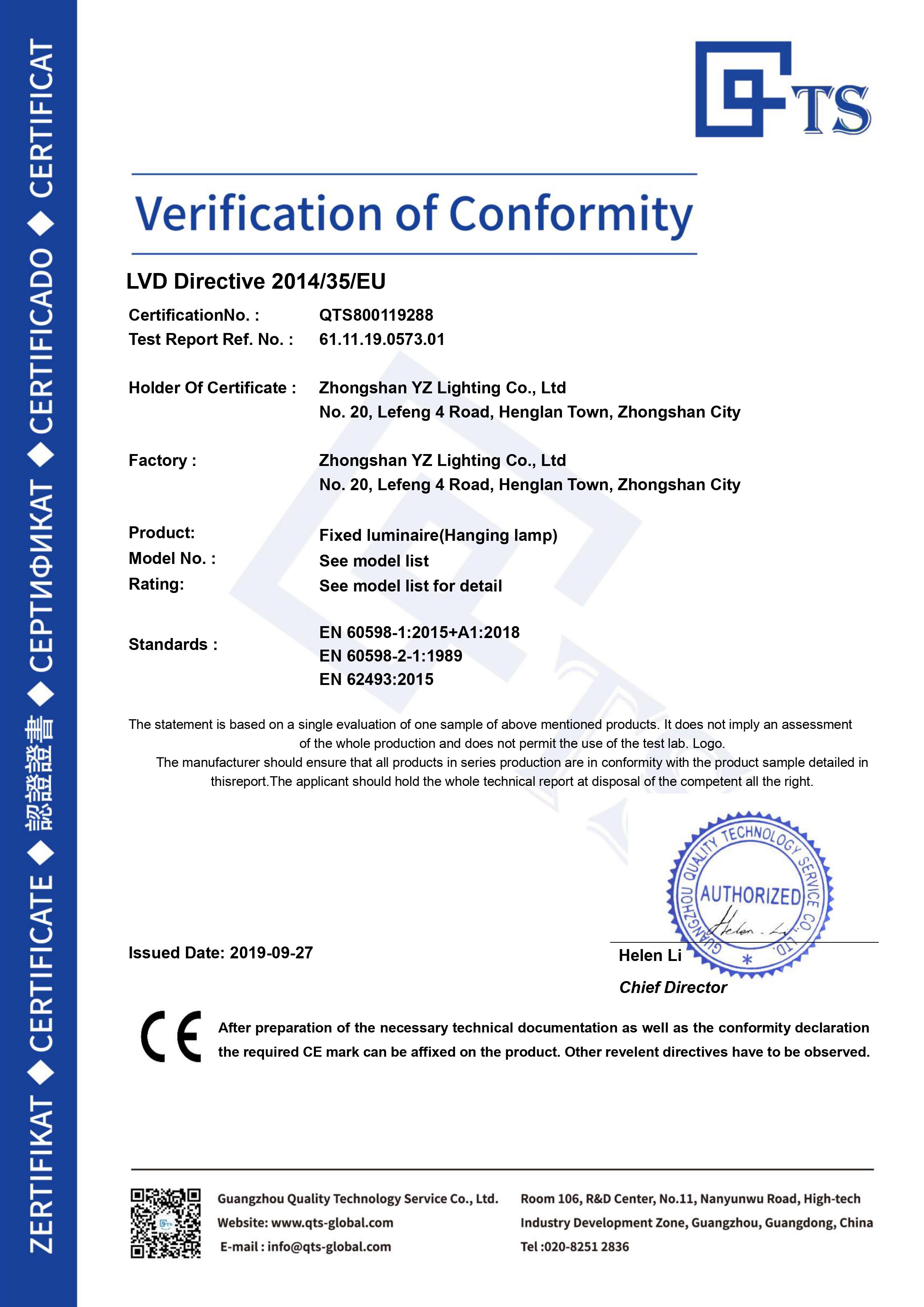
In the European market, the electrical safety framework for luminaires is the Low Voltage Directive, with the EN 60598 series carrying the technical requirements. EN 60598-1:2015+A1:2018 sets general requirements and tests for luminaires. EN 60598-2-1:1989 adds the particular requirements for fixed general-purpose luminaires — the category a suspended lobby chandelier belongs to. EN 62493:2015 addresses the assessment of lighting equipment relating to human exposure to electromagnetic fields. These are the standards that a conformity file for a fixed hanging luminaire should reference, and a buyer can check the reference rather than the wording.
Two other document families usually appear in a hotel tender and mean something different from each other:
- Product conformity documents (LVD-CE, CE-RoHS) apply to the luminaire type and record the standards and test report behind it.
- Management-system certificates (ISO 9001, ISO 14001, ISO 45001) apply to the manufacturing organisation and its processes — quality management, environmental management, and occupational health and safety management respectively. They describe how the factory is run. They do not certify a specific chandelier design.
Conflating the two is one of the most common review errors in hotel lighting procurement. A quality management certificate does not answer "does this fixture comply"; a product conformity document does not answer "is this factory's process controlled". A complete file needs both, labelled correctly.
The Eight Parameter Groups That Decide Acceptance
Eight groups carry essentially all of the technical risk in a custom lobby chandelier. Each one below is framed as a specification field, the reason it matters to the buyer, and the evidence that closes it.
1. Beam angle and light distribution
Beam angle is the parameter that converts a decorative object into an illumination tool. A narrow beam concentrates intensity into a pool of light and reads as dramatic in a high lobby; a wide beam washes a surface and reads as ambient. In a large lobby with an eight- to fifteen-metre ceiling, the wrong choice shows up as either a hot spot on the floor or a fixture that glows but never lights the room.
An adjustable range spanning roughly 15° to 120° covers both ends: narrow for accenting a reception desk or a feature wall, wide for general ambience across a seating zone. What must be written down is not the range alone but the mechanism — whether the angle is changed by adjustable optics at the fixture, by interchangeable lenses selected at build, or by different light-source modules quoted as separate configurations. These have very different consequences: an adjustable fixture can be tuned during commissioning, while a fixed selection must be right on the drawing.
Also specify the measurement condition. Beam angle in a specification should state whether the value is nominal from the light-source datasheet or measured on the assembled fixture, because the lampshade and decorative elements in front of the source will alter the delivered distribution.
2. Glare control and lampshade transmittance
In hospitality interiors, glare control is a comfort parameter, not a styling detail. A lobby chandelier hangs at or near eye level from a mezzanine, a reception desk or a lift lobby, and a bare source inside a decorative assembly produces the harsh, uneven distribution that guests notice before they notice the design.
Soft anti-glare light sources are used in hotel projects precisely to avoid this, and the same logic applies to guest rooms where a source sits closer to the occupant. For the specification, glare control should be stated as a method — diffuser, shielding, lamp orientation, or a combination — together with the lampshade material and its transmittance intent: high-transmittance shades preserve output and reduce the number of sources needed, while heavier diffusion softens the source at the cost of delivered lumens.
The practical check is visual and physical: confirm on the approved sample that no direct source is visible from the normal viewing angles of the space, including from seated height at the reception desk and from the mezzanine above.
3. Input voltage and light-source configuration
Wide-range input of AC 110–240V is what allows one chandelier design to serve both 120V and 230V markets — relevant when a hotel group specifies the same lobby fixture across regions, or when a distributor stocks one build for several destinations. It removes the need for a separate voltage variant, but it does not remove the need to state the supply conditions.
Write into the specification: nominal input voltage range, frequency, the driver location (integrated in the canopy or remote), and whether the driver is replaceable without dismantling the fixture. For an oversized lobby chandelier, driver accessibility is a maintenance issue that surfaces years later, when a failure requires scaffolding.
Light-source configuration should be named rather than implied. Imported LED light-source chips are commonly specified in hospitality decorative lighting for consistency of colour and output across batches; if that is the requirement, the specification should record what is being verified — source family, colour temperature, and consistency across the units in the same order. YZ ART LIGHT's customization scope explicitly covers colour temperature of light sources and light-source configurations, so these are project decisions rather than catalogue constants.
4. IP40 and the boundary of what it protects
IP40 is a dry-interior rating, and its limits are as important as its protection. Under the IP code, the first digit 4 means protection against solid objects of 1 mm and larger; the second digit 0 means no protection against water. For a lobby chandelier under a dry ceiling, IP40 is appropriate and keeps the decorative assembly open enough for the design to read.
It is not appropriate everywhere a chandelier might be proposed. A fixture over an indoor pool, in a spa, in a high-condensation atrium, or on a semi-exposed terrace needs a higher water-protection digit, and that change usually forces a different construction — sealed diffusers, gasketed joints, different materials. The buyer's check is simple: confirm the IP rating in the specification against the actual environmental condition of the installation zone, and do not accept IP40 as a default for any location that will see moisture or washdown.
5. Frame and suspension materials
The frame carries the design, and the suspension carries the frame. Separating the two in the specification prevents a common failure where a visually correct frame is paired with an under-specified suspension.
An aluminium-alloy frame gives a formable, comparatively light structure for large decorative geometry, and takes surface finishing well. A stainless-steel suspension provides the tensile path from the frame to the ceiling structure, where the load is concentrated into a small number of points. Both should be named in the specification — alloy and finish for the frame, grade and diameter for the suspension elements — because "metal" is not a material callout.
YZ ART LIGHT works in brass, stainless steel, aluminium, iron, glass, crystal, marble, acrylic and ceramic, and its customization scope includes materials, mounting structures, hardware craftsmanship and surface-finishing techniques. That breadth is useful, but it also means the project must state which material is being used where, and confirm it on the approved drawing rather than on a rendering.
6. Dimming and control interface
Dimming must be written as a protocol, not an adjective. "Dimmable" tells the electrical contractor nothing about whether the specified control system will work with the fixture's driver. The specification should name the control method provided, the range over which dimming is expected to behave smoothly, and which party supplies the control system.
This matters more in banquet halls than in lobbies. A banquet hall runs scene changes through an event cycle — bright for setup, warm and low for dinner, dimmed for presentations — and a chandelier that steps or flickers at low output becomes an operational problem rather than a design feature. Intelligent dimming systems fall inside YZ ART LIGHT's customization scope, so the control method is a project-level decision to be fixed before production, not a default.
7. Dimensions and proportional fit
Dimensions should be derived from the space, then checked against ceiling height, suspension length and sight lines. A lobby chandelier's diameter or span is usually set by the void it occupies; its drop is set by the ceiling height and the required clearance above the floor or reception desk. Neither can be finalised before the ceiling's reserved opening and suspension points are measured on site.
Full-dimensional customization is part of the standard OEM/ODM scope, which means dimension is a variable to be engineered rather than a constraint to be accepted. The specification should record overall dimensions, the drop range, the reserved ceiling opening, the clearance to be maintained, and the tolerance on each — with the final values taken from a site measurement, not from the architectural drawing alone.
8. Compliance documentation
The compliance file is a deliverable with a certificate number, a standards list and a validity period — and it should be reviewed as one. For a fixed suspended luminaire intended for the EU market, the relevant YZ ART LIGHT documents are:
- LVD-CE Verification of Conformity, certificate QTS800119288, test report reference 61.11.19.0573.01, issued by Guangzhou Quality Technology Service Co., Ltd. (QTS) for the EU market, covering a fixed luminaire (hanging lamp) against EN 60598-1:2015+A1:2018, EN 60598-2-1:1989 and EN 62493:2015, issued 2019-09-27 and valid to 2028-09-02.
- CE-RoHS Verification of Conformity, certificate QTS800519289, test report reference 61.15.19.0574.01, issued by QTS for the EU market, covering a fixed luminaire (hanging lamp) against the IEC 62321 series and EN ISO 17075-1:2017, issued 2019-09-27 and valid to 2028-09-27.
- ISO 9001:2015 quality management system, certificate ZTZL28025Q1464R0S, issued by Zhongtai Zhilian Certification (ZTZL), valid 2025-09-03 to 2028-09-02, covering production of fixed-type and portable-type luminaires within the valid CCC scope.
- ISO 14001:2015 environmental management system, certificate ZTZL28025E0851R0S, issued by ZTZL, valid 2025-09-03 to 2028-09-02, same production scope.
- ISO 45001:2018 occupational health and safety management system, certificate ZTZL28025S0801R0S, issued by ZTZL, valid 2025-09-03 to 2028-09-02, same production scope.
Read the scope line carefully on any certificate file. These product conformity documents cover a fixed luminaire of the hanging-lamp type; the management-system certificates cover the factory's processes for fixed and portable luminaires. Neither should be presented as approving a design that has not been built and tested as specified.
Step-by-Step: Turning a Design Intent into a Verifiable Chandelier Specification
The sequence below is the practical order of work from evaluation to execution. Each step names the field to record and the evidence that closes it, so the specification builds into an acceptance document rather than a wish list.
- Establish the structural and dimensional baseline on site. Record ceiling type, reserved opening, available suspension points and the load-bearing capacity of the ceiling structure. Ceiling load-bearing capacity and the reserved size must be confirmed before suspension points are marked. Evidence: a site measurement record countersigned by the ceiling contractor.
- Fix the optical target. Decide the beam angle range needed for accent and ambience, the colour temperature, and the surfaces the light must reach. Evidence: beam angle range and light-source configuration written into the specification, with the measurement condition stated.
- Fix the electrical interface. Nominal input voltage and frequency, driver location and accessibility, control protocol for dimming, and the party supplying the control system. Evidence: an electrical schedule entry that the MEP consultant can approve.
- Fix materials and finish. Frame alloy and finish, suspension grade and diameter, lampshade material and diffusion intent, decorative elements. Evidence: a materials schedule cross-referenced to the approved drawing.
- Produce the structural calculation for the suspended assembly. See the section below for the input and output list. Evidence: a signed calculation stating total suspended mass, per-point load and anchor utilisation.
- Assemble the compliance file. Product conformity documents matched to the luminaire type, plus management-system certificates if the tender requires them, each with certificate number, standard and validity. Evidence: a document register with expiry dates.
- Approve the first article, then release production. Confirm the approved drawing against the physical first article, then require inspection records for the production batch. Evidence: approved drawing revision, quality-approval checklist, inspection records.
On site, installation follows a fixed sequence that should be reflected in the method statement: isolate the power supply before any work; check ceiling load-bearing capacity, measure the reserved size and mark the suspension points; assemble the frame, lampshade and anti-glare light source; complete insulated concealed wiring, fix the embedded fasteners and hoist the assembly; then carry out a power-on test, adjust the angle and verify lighting uniformity. Electrical work should be performed by a qualified electrician, with warning tags preventing energisation during installation.
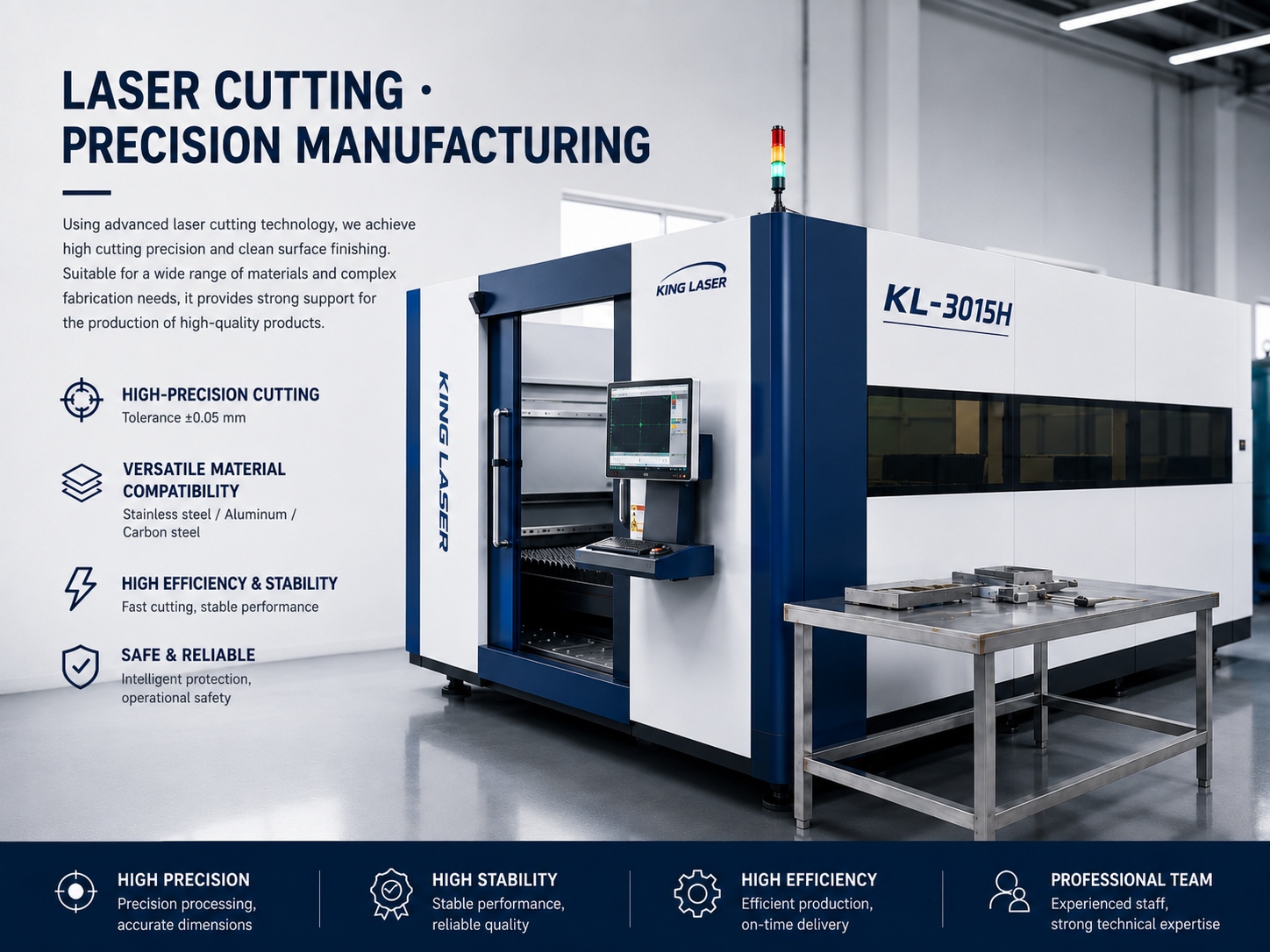
Structural Load Calculation for Super-Large Suspended Fixtures
For an oversized chandelier, the calculation is the deliverable that decides whether the design can be hung at all. At small scale, a fixture's mass is absorbed by normal ceiling practice. At lobby scale, the mass is concentrated into a handful of suspension points, and every one of them becomes a structural question for the building rather than for the lighting supplier.
A usable calculation should state its inputs explicitly, because an output without inputs cannot be reviewed:
- Dry mass of the complete fixture, broken down by frame, decorative elements, light sources, drivers and wiring.
- Number and position of suspension points, and the load share assigned to each.
- Specification of suspension elements — rods, cables or chains — with their rated capacity.
- Type and rated capacity of the anchors or embedded parts in the ceiling structure.
- The factor applied for dynamic and maintenance effects, stated as a number rather than assumed.
- Any secondary steel or framing introduced between the anchors and the fixture.
And it should produce outputs a reviewer can check against the building: total suspended mass, per-point load, anchor utilisation against rated capacity, the deflection or movement expected under load, and the inspection points to be verified before handover. Where the ceiling structure cannot accept the calculated per-point load, the answer is not a stronger anchor — it is a redesign of the suspension layout or a change to the fixture's mass distribution.
Reject the calculation if it quotes a total weight without a point count, quotes a point count without anchor capacity, or omits the dynamic and maintenance factor. Each omission shifts a structural risk back onto the buyer.
Application Notes: Lobby, Banquet Hall, Atrium, and Guest Circulation
The same parameter set applies across hotel spaces, but the weighting changes with ceiling height, occupancy pattern and viewing angle. Treating every chandelier as a lobby chandelier is how projects end up with banquet halls that cannot be dimmed comfortably and atriums that cannot be serviced.
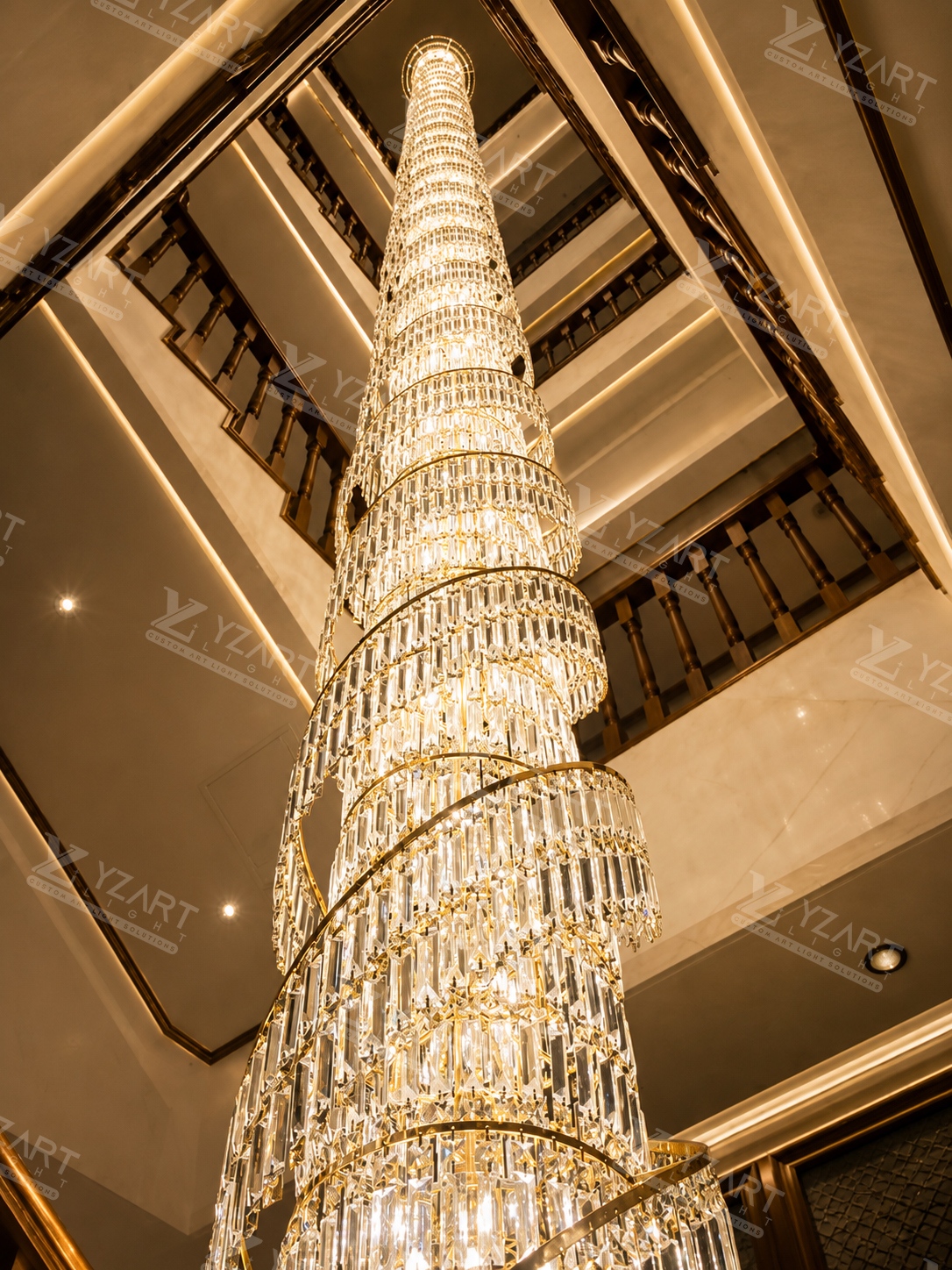
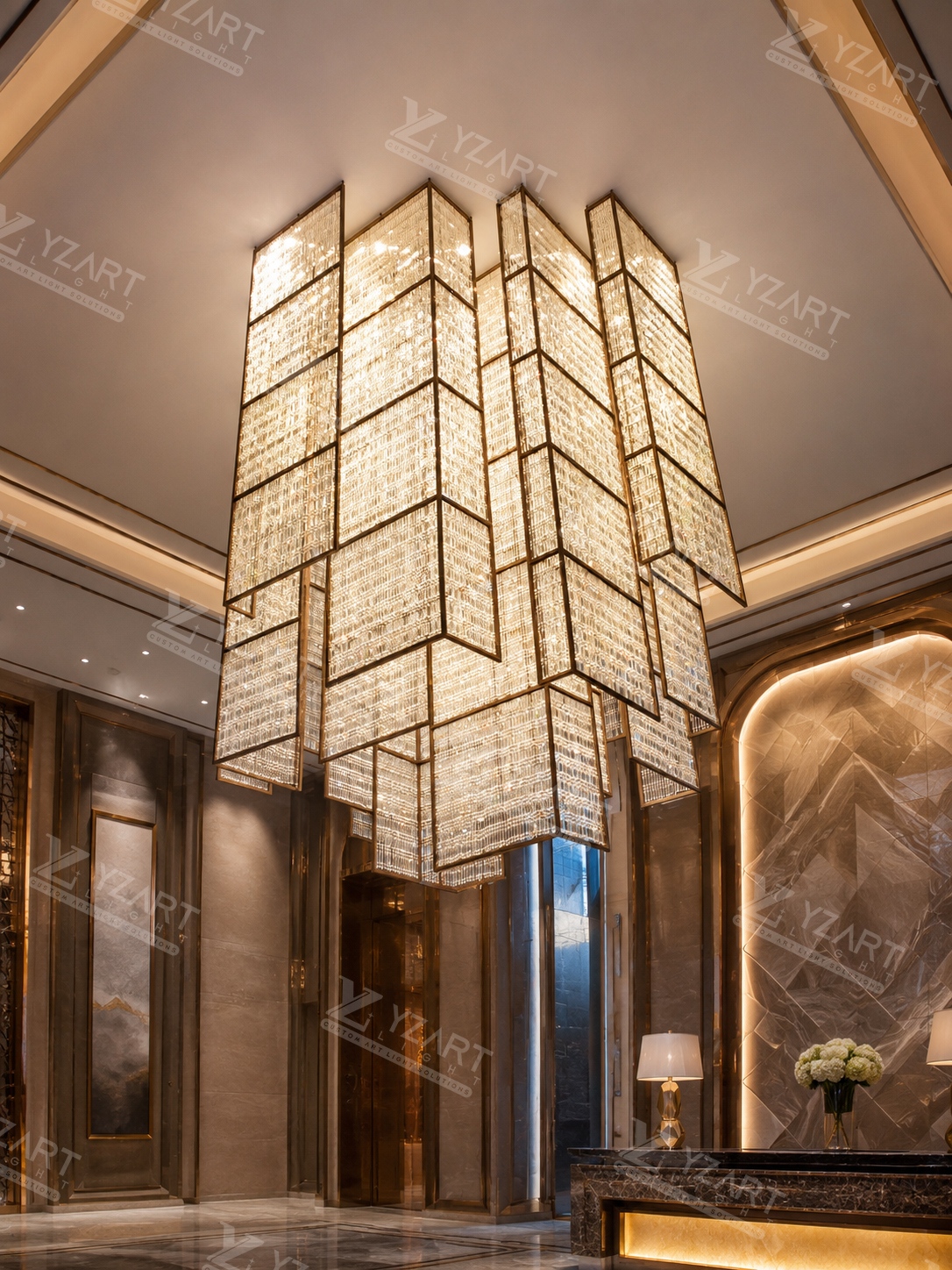
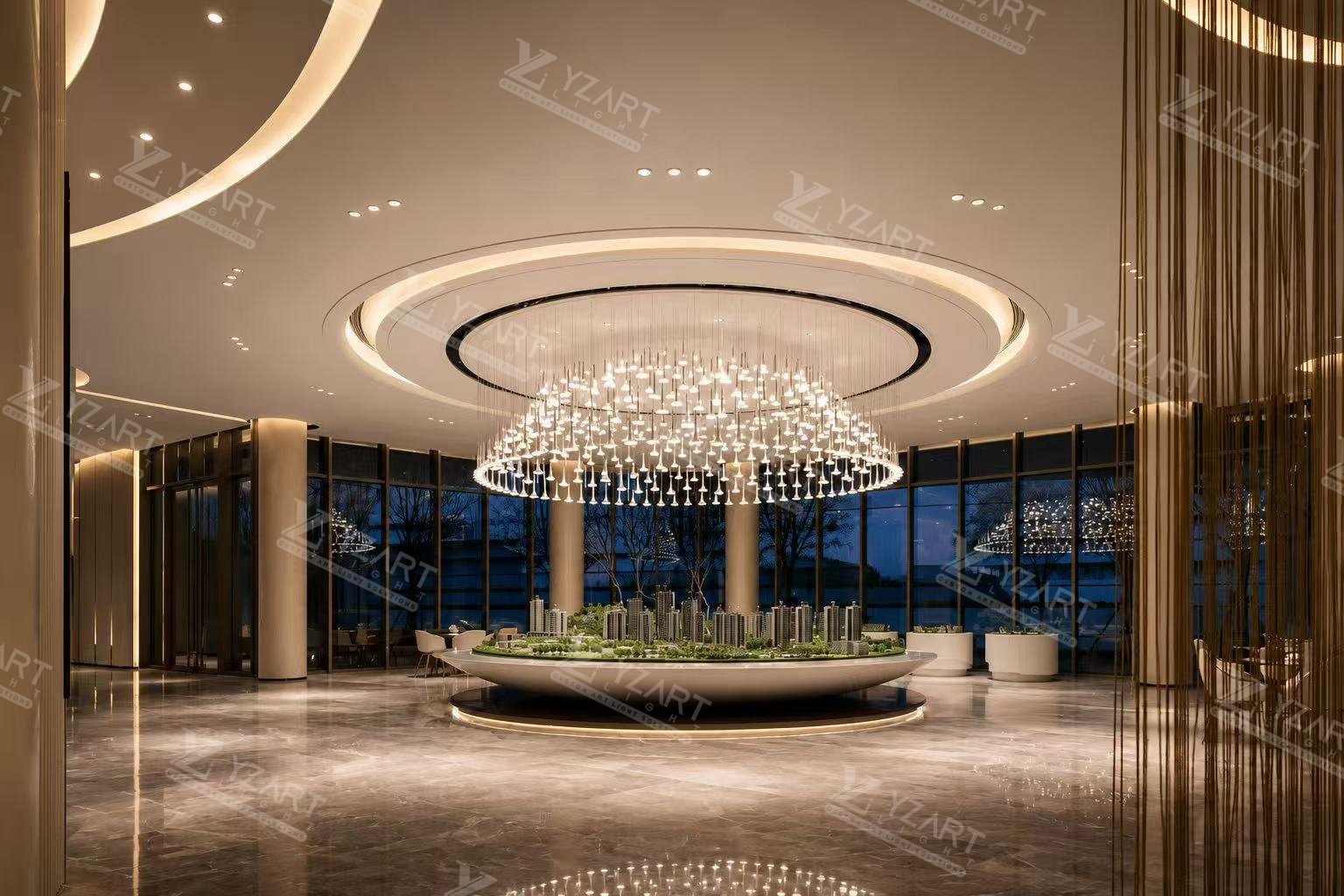
Main lobby and grand entrance. High ceiling, long suspension, strongest visual-focus requirement, and the greatest structural exposure. Beam angle should serve both a wide ambient wash and a narrow accent on the reception or feature wall. Glare control at reception-desk eye level is critical, because that is where staff and guests spend time looking across the space rather than up at it.
Banquet hall and ballroom. Lower ceilings than a lobby atrium, variable occupancy, and a strong need for scene-based dimming. Here the parameter weighting shifts toward dimming protocol and glare control at seated eye level, with beam angle set to avoid hard pools on tables. A banquet hall chandelier also has to tolerate being looked at directly for hours, which makes the diffusion and shielding design more important than raw output.
Multi-storey atrium. The most demanding structural case, because the suspension length and the mass combine, and because maintenance access may require rigging rather than a ladder. Driver location and replaceability belong in the specification at this scale, together with a documented method for lowering or servicing the fixture.
Guest rooms, corridors and lounges. These are usually served by table, wall and floor lamps rather than a suspended chandelier, and the risk profile changes accordingly: the source sits close to the occupant, so diffusion and even distribution matter more than beam reach. YZ ART LIGHT supplies these categories alongside chandeliers, which allows a project to keep one material and finish language across a floor plate.
YZ ART LIGHT is a manufacturer of high-end decorative and project lighting, operating a 15,000 m² production base with 150 employees including a 20-engineer R&D team, and providing OEM/ODM customization covering dimensions, materials, colour temperature, finishes, mounting structures, dimming systems and lampshade materials. Its completed hotel work includes InterContinental Hotel in Israel, Four Seasons Hotel in the UAE, Marriott Hotel in Costa Rica, Waldorf Astoria Hotel in Malaysia and InterContinental Hotel in Taiwan, alongside more than 1,000 completed commercial engineering projects.
Parameter Acceptance Table
The table below summarises what to write, what to ask for, and who closes each parameter. It is designed to be used as a review grid on the specification sheet itself.
| Parameter | What to write in the specification | Evidence to request | Closing party |
|---|---|---|---|
| Beam angle | Range required, adjustment mechanism, measurement condition | Approved drawing plus light-source data | Designer and supplier |
| Glare control | Shielding or diffusion method, lampshade material and transmittance intent | Physical sample reviewed from normal viewing angles | Designer |
| Input voltage | Nominal range, frequency, driver location and replaceability | Electrical schedule entry and driver data | MEP consultant |
| Light source | Source family, colour temperature, batch consistency requirement | Source specification and batch check | Supplier |
| IP rating | Rating matched to the installation zone | Product conformity document for the luminaire type | Buyer and consultant |
| Frame material | Alloy and finish named, not "metal" | Materials schedule on approved drawing | Supplier |
| Suspension | Grade, diameter, point count and position | Structural calculation with per-point load | Structural engineer |
| Dimming | Named protocol and control supplier | Control compatibility confirmation | MEP consultant |
| Dimensions | Overall size, drop range, reserved opening, tolerances | Site measurement record | Contractor |
| Compliance | Document list with certificate numbers and validity | LVD-CE, CE-RoHS, ISO 9001 / 14001 / 45001 as required | Buyer and QA |
| Inspection | Inspection scope and record format | 100% pre-shipment inspection checklist and inspection video on request | Supplier and buyer |
Frequently Asked Questions
Which compliance documents should a custom hotel lobby chandelier file contain?
For a fixed suspended luminaire intended for the EU, the file should contain the LVD-CE Verification of Conformity and the CE-RoHS Verification of Conformity, plus the management-system certificates if the tender requires them. YZ ART LIGHT's LVD-CE document, certificate QTS800119288 with test report reference 61.11.19.0573.01, issued by Guangzhou Quality Technology Service Co., Ltd., covers a fixed luminaire (hanging lamp) against EN 60598-1:2015+A1:2018, EN 60598-2-1:1989 and EN 62493:2015, valid to 2028-09-02. The CE-RoHS document, certificate QTS800519289 with test report reference 61.15.19.0574.01, covers the same product scope against the IEC 62321 series, valid to 2028-09-27. ISO 9001 certificate ZTZL28025Q1464R0S, ISO 14001 certificate ZTZL28025E0851R0S and ISO 45001 certificate ZTZL28025S0801R0S, all issued by Zhongtai Zhilian Certification and valid 2025-09-03 to 2028-09-02, cover the production of fixed and portable luminaires within the valid CCC scope; they certify the management system rather than an individual chandelier design.
Can beam angle, dimming and dimensions be customized on the same fixture?
Yes, within a defined customization scope. YZ ART LIGHT's OEM/ODM work covers dimensions, materials, colour temperature of light sources, painted finish colours, engraved logos, light-source configurations, mounting structures, intelligent dimming systems, lampshade materials, hardware craftsmanship and surface finishing. That means beam angle, dimming method and dimensions are project decisions confirmed on the approved drawing rather than fixed values taken from a catalogue. Each should still be written into the specification as a number or a named protocol, so that it can be inspected at handover.
How should a buyer evaluate a custom hotel chandelier manufacturer for banquet halls?
Check four things. First, whether the factory performs structural and customization work in house, since banquet hall fixtures need mounting structures and dimming designed per project. Second, whether the product conformity documents match the luminaire type being ordered. Third, whether dimming is offered as a named control method, because banquet halls run scene changes through an event cycle. Fourth, whether inspection is documented rather than asserted. YZ ART LIGHT operates a 15,000 m² production base with 150 employees including a 20-engineer R&D team, provides full-dimensional OEM/ODM customization, and performs 100% full inspection before shipment with a quality-approval checklist attached.
What determines the order quantity, lead time and delivery terms?
YZ ART LIGHT's minimum order is 1 unit, and the standard lead time is 30–40 working days, with a shortened lead time available for urgent hotel projects. Goods are delivered EXW from the factory: the buyer arranges pickup, export logistics and customs declaration, and logistics, customs clearance and truck-haulage services can be quoted separately on request. Payment terms are TT. Because customization covers dimensions, materials, light-source configuration, dimming system and mounting structure, the quotation is built from those selections rather than from a fixed catalogue price.
What should be checked at first-article and pre-shipment approval?
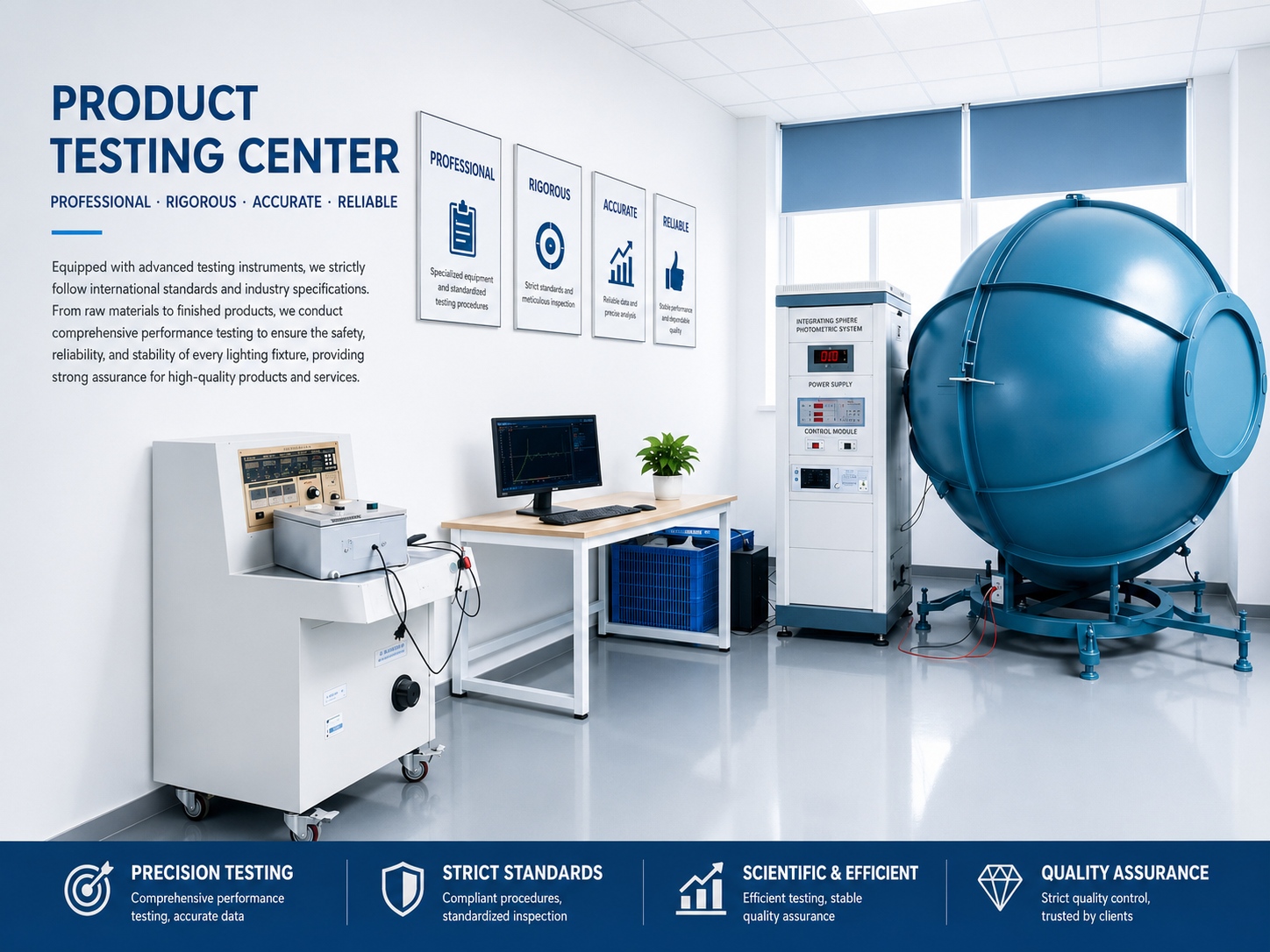
Every lamp undergoes 100% full inspection before shipment, covering power-on testing, appearance and workmanship, dimension and structure inspection, and accessories completeness verification. A quality-approval checklist is attached to each shipment, and real-shot inspection videos are available on request. At first-article stage, the physical sample should be compared against the approved drawing revision for dimension, finish, glare control from normal viewing angles, and the stated voltage and dimming behaviour.
What warranty and post-delivery support applies to hotel chandeliers?
YZ ART LIGHT provides a 3-year warranty on all engineering lighting products, with free replacement of faulty light sources within that period, and global remote technical guidance for overseas clients. Stated service life is up to 50,000 hours for the LED light source, with the metal and glass lamp body described as durable for more than 15 years under normal use. If your project needs the parameter sheet reviewed against a specific lobby or banquet hall condition, send the ceiling drawing and reserved dimensions to export@yzartlight.com or WhatsApp +86 133-9293-6169 for a response on configuration and lead time.
Conclusion
A custom hotel lobby chandelier becomes procurable at the moment its design intent is converted into parameter fields — beam angle with a mechanism, IP rating matched to the zone, input voltage with a driver location, named frame and suspension materials, a dimming protocol, dimensions from site measurement, a signed structural calculation, and a compliance file with certificate numbers and validity dates. Each of these is checkable, and each one closes a specific risk held by the designer, the electrical consultant or the ceiling contractor.
The order of work matters as much as the list. Baseline the ceiling first, then optics, then electrical, then materials, then load, then documents, then the first article. A project that follows that sequence tends to discover its structural constraint early, when a redesign is still a drawing change rather than a site problem.
Next Step for Specifiers and Buyers
YZ ART LIGHT manufactures high-end decorative and project lighting for hotel lobbies, banquet halls, atriums and guest areas, with OEM/ODM customization from design consultation through structural optimisation to production. The company's full product and capability overview is available in the downloadable brochure: Zhongshan YZ ART LIGHT Co., Ltd. company brochure (PDF).
For project-specific parameter confirmation, drawings or sample arrangements, contact the team at www.yzartlight.com, by email at export@yzartlight.com, or on WhatsApp at +86 133-9293-6169.
Have Questions or Need More Details?
Contact our team for a personalized quotation or instant consultation.
Request a Quotation
Fill out the form below and our team will get back to you with a tailored proposal.
WhatsApp Direct Chat
Prefer to chat in real-time? Message us on WhatsApp for instant assistance & quick answers.
- Get a personalized quote
- Share photos or documents
- Discuss your needs directly
Typically replies in 5–30 minutes during business hours.