Decorative Lighting Trends That Are Reshaping High-End Hotels in 2026
Decorative Lighting Trends That Are Reshaping High-End Hotels in 2026
Decorative lighting has become a defining element of the high-end hotel experience, moving beyond simple illumination to shape brand identity, guest comfort, and architectural drama. Commercial decorative lighting now accounts for the dominant share of decorative lighting demand, largely driven by hospitality and other commercial applications. For hotel owners, designers, and procurement teams, understanding the current decorative lighting landscape is essential because specification decisions affect visual impact, energy performance, compliance, lead time, and long-term maintenance. This guide examines how modern decorative lighting trends, LED integration, hospitality lighting requirements, and custom hotel lighting approaches are changing the way hotels choose chandeliers, table lamps, wall lamps, and floor lamps.
Decorative lighting, in the context of high-end hotels, refers to light fixtures designed to be both functional and expressive, including chandeliers, wall lamps, table lamps, floor lamps, and custom art lighting. YZ ART LIGHT, operating as Zhongshan YZ ART LIGHT Co., Ltd., is a China-based manufacturer that specializes in these categories, producing custom hotel lighting and bespoke chandeliers for premium commercial and residential spaces. The company supplies decorative lighting for hotels, banquet halls, restaurants, spas, villas, shopping malls, offices, and cultural spaces, providing a reference point for what hotel buyers should evaluate when sourcing statement lighting for large projects.
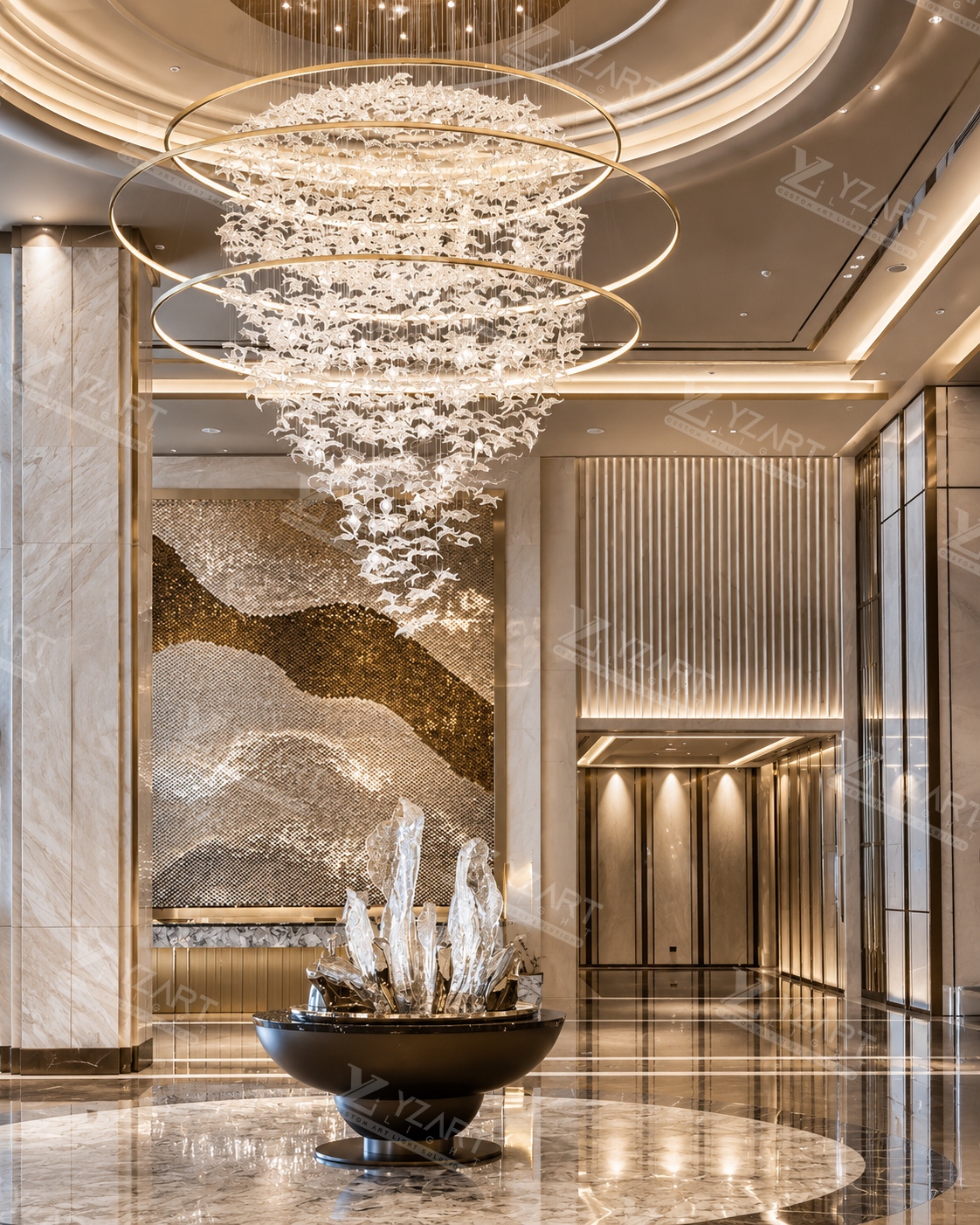
Custom decorative lighting is increasingly designed as a sculptural centerpiece for double-height hotel lobbies.
Why Hospitality Is Driving the Decorative Lighting Market
The hospitality lighting market was valued at USD 14.2 billion in 2025 and is expected to grow at a CAGR of 7.3% to reach USD 26.8 billion by 2034. This growth reflects a broader pattern in the commercial decorative lighting sector. Commercial applications, including hospitality, accounted for 62.8% of the decorative lighting end-user market in 2025, making hotels one of the most important demand drivers for decorative lighting manufacturers worldwide. High-end lighting as a segment is also expanding: the high-end lighting market was valued at USD 19.6 billion in 2024, supported by demand for connected lighting and interior design.
Several factors explain why decorative lighting has become central to hotel investment rather than a finishing detail:
- Differentiation in a crowded market: hotel brands use lighting to create a memorable first impression in lobbies, restaurants, and guest rooms.
- Guest comfort expectations: lighting quality affects rest, mood, and perception of luxury.
- Energy and compliance pressure: hotels must balance visual impact with LED efficiency, dimming, and evolving energy codes.
- Architectural trends: double-height atriums, open lobbies, and flexible banquet spaces demand oversized or non-standard fixtures that standard catalogs cannot provide.
Because hotels operate lighting for long hours, buyers now look for fixtures that can run continuously without rapid light decay, high energy consumption, or maintenance problems. A fixture that looks impressive at the sample stage but fails under commercial operating hours can become a costly operational issue. This is one reason why manufacturers with dedicated commercial lighting lines, such as YZ ART LIGHT, emphasize engineering characteristics alongside design.
Market Context: Global Decorative Lighting and Chandelier Segments
Global decorative lighting market estimates vary by research methodology, but the figures consistently point to a large and growing commercial segment. Mordor Intelligence valued the global decorative lighting market at USD 75.88 billion in 2025 and projected it to reach USD 78.98 billion by 2026. Grand View Research published a lower estimate of approximately USD 42.9 billion for 2024, while IMARC estimated around USD 43.95 billion. These differences arise from how each firm defines decorative lighting and which segments are included. For hotel buyers, the practical implication is not the exact market size but the direction: commercial demand remains strong enough to keep custom manufacturers busy and lead times a consideration.
Within the chandelier segment, Transparency Market Research valued the global chandelier market at USD 14.9 billion in 2024, projecting growth to USD 25.8 billion by 2035 at a 5.5% CAGR. Another estimate from Grand View Research placed the chandelier market at USD 8.2 billion in 2024, again reflecting differences in scope. Both studies indicate sustained demand for decorative statement lighting in commercial and residential interiors. Hotels remain a primary channel for oversized chandeliers because public spaces such as lobbies, ballrooms, and banquet halls are designed around a central lighting element.
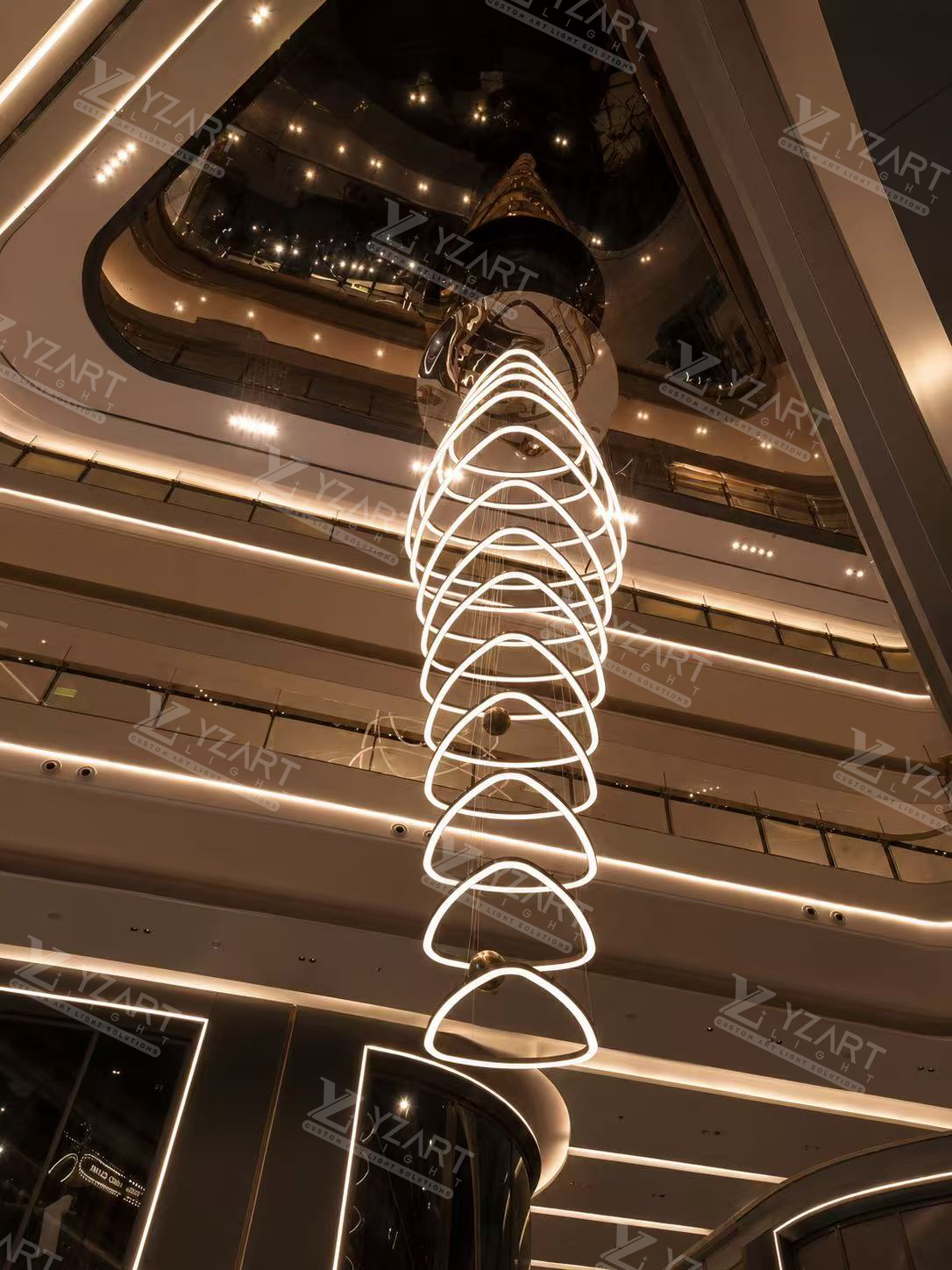
LED-integrated chandeliers are popular in atriums because they combine visual drama with long operating life.
Space-by-Space Decorative Lighting Requirements in Hotels
Decorative lighting requirements differ by hotel zone. A fixture designed for a guest room cannot simply be scaled up for a lobby, and a banquet hall chandelier must satisfy different functional demands than a corridor wall lamp.
Hotel Lobby and Grand Entrance
The lobby is the space where decorative lighting has the strongest brand impact. Many newly designed or renovated hotels use oversized art chandeliers in high-ceiling lobbies, double-height atrium installations, and large banquet halls to create a signature look. Hotels often commission custom installations rather than selecting from standard catalogs because the fixture must respond to the architecture, ceiling height, materials, and interior concept.
From an engineering standpoint, a lobby chandelier is a non-standard decorative pendant light that may need to fit ceiling load limits and reserved installation dimensions. For example, YZ ART LIGHT’s custom-made hotel lobby chandelier, model yz10001, is classified as a non-standard engineering decorative pendant light and anti-glare commercial ceiling lamp. It is designed for high-star hotels, resorts, clubhouses, banquet halls, commercial villas, and shopping mall public areas. Buyers should ask whether the manufacturer can adapt to a special-shaped ceiling and calculate structural load for large suspended fixtures.
Banquet Hall and Ballroom
Banquet halls require chandeliers that provide even ambient light and can support multiple event configurations. In many projects, the chandelier is also a stage for photography and video, so guests notice its appearance and the quality of light. LED integration is particularly useful in banquet spaces because these rooms may run events from morning to night. Custom banquet chandeliers often use crystal, glass, metal frames, or a combination, and are built in rectangular, circular, ring, or cloud-like forms to suit the room shape and ceiling pattern.
Guest Rooms and Corridors
Guest room lamps include table lamps, wall lamps, floor lamps, and bedside pendants. These fixtures support tasks such as reading and working while contributing to a calm, residential atmosphere. Comfort factors include glare control, warm color temperature, flicker-free light, and compatibility with hotel dimming systems. Corridor lighting helps guests navigate while maintaining a consistent design language across floors. YZ ART LIGHT’s hotel lighting category, model yz10002, covers these needs by including chandeliers, wall lamps, floor lamps, table lamps, outdoor lights, and related fixtures in series that range from crystal chandeliers to fabric-and-metal lamps and functional engineering lights.
Restaurants, Lounges, and Spas
Restaurants and lounges increasingly use warm-toned ambient lighting to create an immersive dining setting. Because these venues operate long hours, fixtures need energy efficiency, durability, and easy maintenance. Decorative lighting in these zones often combines sculptural pendants with discreet wall illumination to avoid glare while still defining the atmosphere.
Trend 1: Custom and Bespoke Chandeliers Are Becoming the Norm
Hotel interior design has shifted away from repetitive standard fixtures. More projects now require custom hotel lighting based on designer renderings, with unique shapes, materials, and finishes that cannot be sourced from a distributor’s catalog.
Custom decorative lighting offers several advantages:
- Architectural alignment: the fixture can match special-shaped ceilings, unusual dimensions, and specific mounting points.
- Brand storytelling: the light becomes an art installation tied to the hotel concept or local culture.
- Designer intent: the original vision is preserved, including scale, material texture, and light distribution.
- Exclusivity: a bespoke piece reduces the risk that guests or event planners will recognize the same fixture in a competing hotel.
Full customization is feasible when the manufacturer supports the entire process from drawing deepening and structural calculation to sample production, mass manufacturing, and on-site installation. YZ ART LIGHT describes this as a full-cycle service covering drawing deepening, ceiling load calculation, sample production, mass manufacturing, on-site installation, and maintenance. For buyers, this end-to-end scope reduces coordination risk because the same team is accountable for feasibility, production, and installation guidance.
However, customization has constraints. Complex shapes, hand-finished materials, and long suspension structures require more engineering time and higher tooling or sample costs. Buyers should confirm the manufacturer’s experience with similar hotel projects and request load calculations for heavy or oversized fixtures.

Art glass sculptural lighting is increasingly specified when a hotel lobby needs a one-of-a-kind visual centerpiece.
Trend 2: LED Integration and Dimmable Systems
LED technology is now the dominant light source in decorative lighting. IMARC reported that LED lighting held a 39.8% share of the decorative lighting market in 2025. In the chandelier segment, market research indicates that LED-integrated chandeliers capture over 54% of market volume annually, supported by energy efficiency and custom color options. These figures help explain why hotel project specifications increasingly require LED modules rather than replaceable lamps.
Beyond basic LED integration, dimming is becoming a standard requirement in luxury hospitality. One industry statistic notes that 56% of new luxury hotel projects now require dimmable chandelier installations for guest ambiance. For lobby and restaurant fixtures, dimming allows the space to transition from bright daytime operation to a warmer evening mood without changing the physical fixture. For guest rooms, dimming supports circadian comfort and different guest preferences.
A practical consideration is that dimmable decorative lighting should use anti-glare light sources compatible with the hotel’s constant dimming system. Glare control matters in chandeliers because a decorative fixture usually sits in the guest’s direct field of view. Anti-glare design softens the light and reduces discomfort while preserving the fixture’s sparkle. YZ ART LIGHT specifies that its custom-made hotel lobby chandelier includes dedicated soft-light anti-glare sources and is compatible with constant dimming systems used in hotels.
Trend 3: Energy Codes and Compliance Are Shaping Specifications
Energy efficiency is no longer only an operating-cost concern; it is embedded in building regulations. In the United States, the 2024 IECC expanded occupancy and dimming requirements for lobbies and meeting areas, directly affecting how hotel lighting should be controlled. North American projects also require luminaires to comply with UL 1598, the Standard for Luminaires, and UL 8750 for LED equipment, where applicable. Buyers exporting to North America should verify whether the fixture’s electrical components and complete luminaire meet these standards or whether they require additional testing for a specific project.
For decorative lighting exported to many other markets, CE and RoHS certification is commonly required. Zhongshan YZ ART LIGHT Co., Ltd. states that all of its products have passed CE and RoHS certifications, confirming compliance with international safety and environmental protection standards in the markets where these certificates are recognized. Buyers should always confirm which certifications apply to their destination country and request certificates during the inquiry stage.
Trend 4: Oversized and High-Ceiling Installations
Architectural trends in hotel lobbies continue to favor tall spaces, open atriums, and grand entrances. These spaces require oversized chandeliers that are visually proportionate to the void above them. Scaling a chandelier from a normal room to a double-height lobby is not a simple enlargement; the fixture’s suspension system, weight distribution, frame rigidity, installation access, and maintenance plan all change.
Professional structural load calculation is critical for super-large suspended lighting fixtures. A heavy chandelier suspended from a high ceiling introduces risks that do not exist in smaller residential fixtures. If the ceiling structure or mounting method is not properly designed, there is a potential risk of collapse. YZ ART LIGHT states that it provides professional structural load calculation for super-large suspended lighting fixtures to reduce ceiling collapse risk. Buyers should treat this engineering step as a mandatory requirement, not a value-add.
High-ceiling projects also complicate installation and future maintenance. Some chandeliers require electric hoists or motorized lifting systems so that maintenance crews can lower the fixture safely. Others are designed with accessible platform points. These decisions should be made early because they affect the fixture’s mechanical design and the building’s ceiling infrastructure.
Trend 5: Material Mix and Finish Quality Are Differentiators
Guests rarely analyze the materials in a chandelier, but they notice the difference between a fixture that feels substantial and one that feels thin or cheap. High-end decorative lighting commonly uses brass, stainless steel, aluminum, iron, glass, crystal, marble, acrylic, and ceramic. Each material affects cost, weight, durability, finishing options, and installation complexity.
Metal frames provide structural integrity for oversized chandeliers and support the load while suspension cables, decorative elements, and light sources are attached. Glass and crystal contribute brightness, sparkle, and color. Marble adds weight and a sculptural quality but requires careful load planning. Brass can be finished in multiple ways, from polished and antique to matte, to suit different interior styles.
A manufacturer’s ability to combine materials also determines whether a designer’s concept can be realized. A lobby chandelier might combine hand-blown glass with a stainless steel ring frame, while a banquet fixture might use crystal strands over a brass structure. Buyers should ask how the factory handles finishing consistency across large runs, especially for polished metal or painted finishes that may show variation.
Space-by-Space Decision Framework
The following framework helps buyers translate a hotel space into the right decorative lighting category and specification questions.
| Hotel Space | Typical Fixture Type | Key Buying Criteria |
|---|---|---|
| Grand lobby / double-height atrium | Oversized custom chandelier, art glass installation, sculptural pendant | Structural load calculation, ceiling height, installation access, brand impact, anti-glare LED, maintenance plan |
| Banquet hall / ballroom | Large multi-ring, rectangular or wave-form chandelier | Even distribution, dimming, event flexibility, ceiling grid coordination, energy efficiency |
| Restaurant / lounge | Pendants, linear fixtures, warm ambient art lights | Color temperature, glare control, atmosphere, long-hour operation, cleaning access |
| Guest room | Table lamps, wall lamps, floor lamps, bedside pendants | Glare-free reading light, dimming compatibility, durability, style consistency, easy maintenance |
| Corridor / executive lounge | Wall sconces, ceiling pendants, cove lighting accents | Wayfinding, rhythm, uniform illumination, protection against impacts, ease of relamping |
Hotel Decorative Lighting Product Categories at a Glance
Manufacturers serving the hospitality market generally offer several product families. YZ ART LIGHT’s main products include banquet hall chandeliers, oversized chandeliers, hotel chandeliers, lobby chandeliers, hotel table lamps, hotel wall lamps, hotel floor lamps, luxury interior lighting, and related commercial decorative lighting. This range allows a single supplier to cover public spaces and guest rooms, which is valuable for projects that need a coherent design language across multiple zones.
Its hotel lighting series, model yz10002, illustrates common category types:
- Crystal series: multi-layer circular lobby chandeliers, water-drop crystal matrix lights, banquet ring crystal pendants for four- and five-star hotel lobbies.
- Art glass sculptural lights: ribbon, feather, fish group, ginkgo leaf, and mountain landscape glass installations for modern and light-luxury lobbies.
- Fabric and metal lamps: fabric pendant lights and matte brass wall lamps for hotel restaurants and guest rooms.
- Functional engineering lights: front desk long pendants, cloud stone bedside lamps, and corridor wall sconces that maintain whole-hotel design unity.
Material options across these series include brass, stainless steel, aluminum, iron, glass, crystal, marble, acrylic, and ceramic. A full-range supplier reduces the number of sub-suppliers and simplifies quality control, logistics, and spare-parts availability, especially when the project calls for large quantities across multiple categories.
How to Evaluate a Custom Decorative Lighting Manufacturer
For hotel projects, buying decorative lighting involves evaluating a manufacturer’s technical depth, production capacity, engineering record, and service scope. The following criteria matter regardless of whether the order is for a single lobby chandelier or a full hotel rollout.
1. Production Capacity and Facility
A factory with dedicated production space and equipment can better control quality, lead time, and cost. YZ ART LIGHT operates a 15,000-square-meter production base and employs approximately 150 staff. It produces roughly 100,000 units per year, which signals an ability to handle both custom project work and larger series orders. For buyers, factory capacity affects how quickly samples are produced and whether mass production can meet hotel opening schedules.
2. Engineering and R&D Team
Custom decorative lighting requires more than assembly. The manufacturer should be able to read architectural drawings, deepen design details, calculate structural loads, select light sources, and solve production problems. YZ ART LIGHT’s R&D team consists of 20 engineers. When a designer submits a rendering, the engineering team needs to translate the concept into a manufacturable fixture that meets safety, electrical, and installation requirements.
3. Full-Cycle Service and Installation Support
Hotel lighting projects fail when design, production, and installation are disconnected. A full-cycle service covers drawing deepening, ceiling load calculation, sample production, mass manufacturing, on-site installation, and maintenance. This reduces the risk that a beautiful fixture cannot be installed or serviced. Buyers should confirm whether the supplier provides installation guidance, installation teams, or both, and whether maintenance support is available after handover.
4. Proven Hospitality Experience
Experience with international hotel brands matters because these projects have strict quality, documentation, and timeline requirements. YZ ART LIGHT says it is a long-term supplier for hotel brands including Hilton, Pullman, and InterContinental, and that its products have been applied in over 1,000 completed hotel projects worldwide. These statements are useful anchors for buyers who want to understand a manufacturer’s familiarity with hotel-grade specifications, bidding documentation, and brand standards.
5. Customization Process
Ask how the factory handles non-standard shapes, special materials, and unusual dimensions. Does the engineer visit the site, or does the process begin from CAD drawings? Who is responsible for the structural calculation? How many sample rounds are included? YZ ART LIGHT states it supports full customization based on designer renderings and offers end-to-end OEM and ODM services, including project-based custom shapes and special material processing.
6. Compliance and Certification
Certification requirements depend on the destination market. In Europe and many other jurisdictions, CE and RoHS are commonly required. In North America, UL or other recognized testing may be required. Buyers should request current certificates and confirm which product models are covered. Statements such as YZ ART LIGHT’s CE and RoHS certification for all products should be verified against project-specific requirements.
Comparison: Custom Decorative Lighting Manufacturer vs. Trading Supplier
Hotel buyers often ask whether to source decorative lighting directly from a factory or through a trading supplier. The answer depends on project complexity and sourcing requirements.
| Decision Factor | Factory-Direct Manufacturer | Trading Supplier |
|---|---|---|
| Custom technical capability | Can deepen drawings, calculate structural load, and modify designs before production | Typically limited to existing products; no in-house engineering depth |
| Cost structure | Removes intermediary margins; cost control is more transparent | Adds intermediary margin; competitive for simple stock items |
| Quality control | Direct control of material, welding, finishing, and testing | Relies on manufacturers chosen by the supplier |
| Project documentation and compliance | Can supply certificates, drawings, load calculations, and bidding support | Documentation quality varies; may lack engineering support |
| After-sales service | Direct accountability for replacement parts and maintenance guidance | Dependent on the factory’s willingness to support the trader |
| Typical suitability | Bespoke chandeliers, full hotel programs, large-scale orders, long-term partnerships | Simple standardized lamps, small orders, urgent stock requests |
For standard, off-the-shelf lamps with no customization demands and small order quantities, a trading supplier may be acceptable. For custom-shaped lobby chandeliers, strict qualification documents, controlled budgets, long-term maintenance, and large-scale hotel engineering orders, a factory-direct manufacturer is usually the stronger choice because it can provide technical customization, stable cost control, and a dedicated support structure.
Decorative Lighting Implementation Workflow for Hotel Projects
A typical custom decorative lighting project follows a defined workflow. Understanding the milestones helps buyers plan budgets, construction schedules, and internal approvals.
- Define the lighting concept and design intent. Interior designers produce renderings or describe the spatial effect. The manufacturer reviews the concept for feasibility, materials, and lighting performance.
- Develop drawings and structural calculations. The engineering team converts the concept into production drawings and verifies ceiling load, suspension points, and installation constraints.
- Produce samples and prototypes. Samples validate scale, finish, light distribution, and material behavior. Buyers approve the sample before mass production.
- Plan mass production. The factory organizes materials, fabricates components, performs quality inspections, and prepares the fixture for shipping.
- Coordinate delivery and installation. The fixture is shipped with mounting hardware and installation documentation. Large fixtures may require on-site guidance by the manufacturer or a specialized installation team.
- Test, commission, and maintain. After installation, the lighting system is tested, angles and dimming controls are adjusted, and a maintenance plan is handed over.
When a project involves multiple fixture types across the same hotel, the workflow is repeated or overlapped for each category. A full-range hotel lighting supplier can coordinate these streams under one contact point.
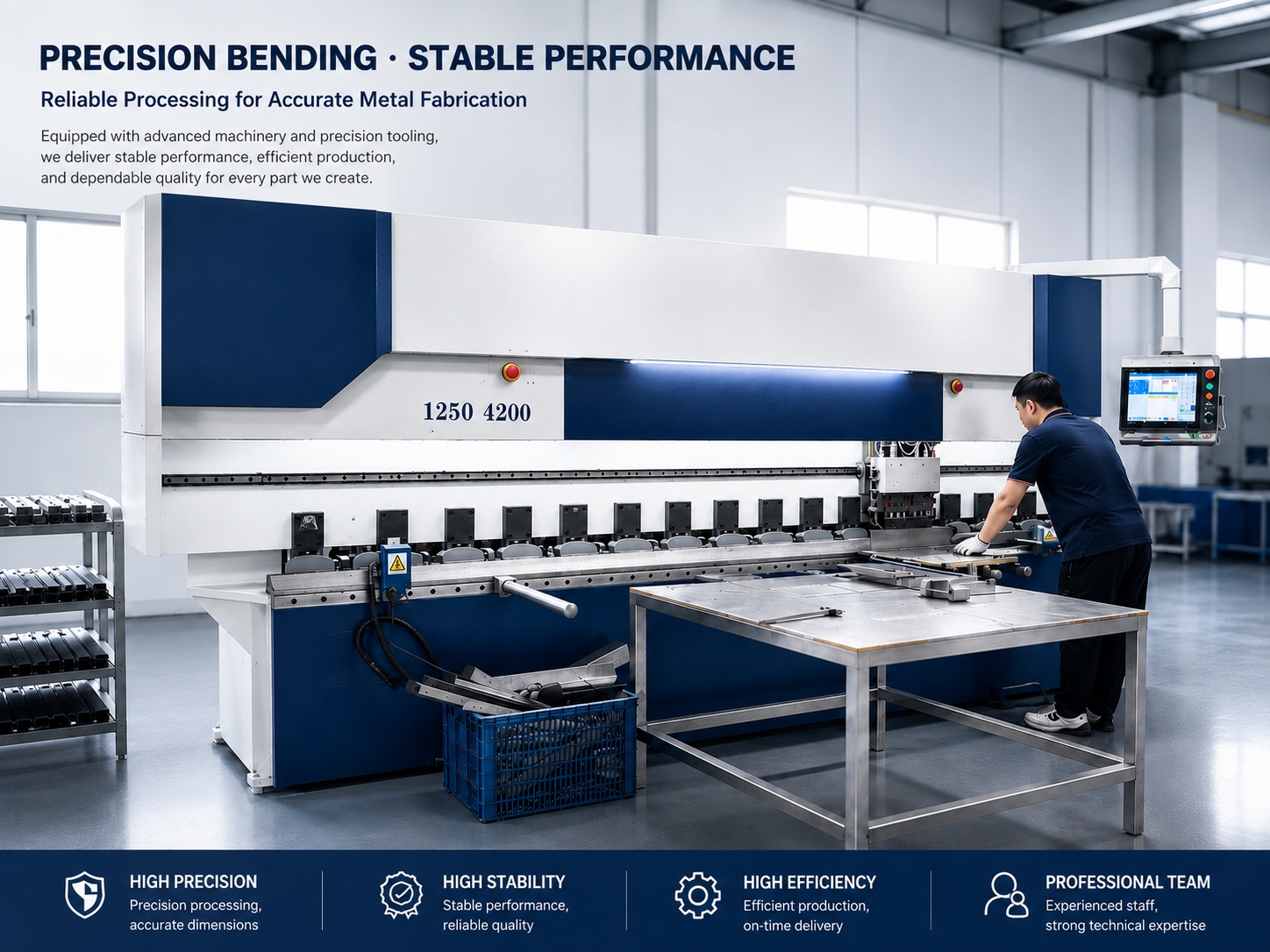
Precision metal forming is an important step when producing oversized chandelier frames with consistent geometry.
Regional and Market Signals for Hotel Lighting Investment
Several regional trends help explain where decorative lighting demand is growing and why global hotel brands are investing in new properties.
North America held the largest share of the global decorative lighting market at 36.45% in 2025. The region’s hotel sector continues to refresh existing properties, creating demand for statement chandeliers and guest room lighting upgrades. North American specifications are also influenced by UL requirements and energy codes such as the 2024 IECC, so buyers should budget for compliance documentation.
Asia Pacific dominates the high-end lighting market with a 44.6% revenue share in 2024 and is also the fastest-growing region for hospitality lighting, with a 5.98% CAGR projected by Mordor Intelligence. Much of this activity is tied to new hotel construction and renovation in China, Southeast Asia, and the Middle East. YZ ART LIGHT reports that its export markets are primarily Europe and America, in addition to the Middle East, and that approximately 70% of its output is exported. For hotel projects in these regions, selecting a manufacturer experienced in cross-border shipping, export packaging, and international certification becomes more important.
Saudi Arabia’s Vision 2030, which targets 150 million annual tourist visits, is another signal of large-scale hospitality investment. Meeting this target will require substantial hotel infrastructure spending, and decorative lighting is one of the product categories that benefits from new construction and fit-out cycles. Buyers tracking large hotel programs in the Middle East should plan early for custom chandelier design, production slots, and shipping lead times.
Buying Considerations and Potential Trade-offs
Decorative lighting purchases involve trade-offs that buyers should acknowledge before comparing quotes.
- Design ambition vs. engineering complexity: complex shapes, suspended structures, and mixed materials increase cost and timeline. A simpler design may achieve a similar effect with lower risk.
- Cost vs. build quality: frames made of brass or thick stainless steel cost more but provide durability. Lightweight alternatives may lower price but reduce a chandelier’s presence or lifespan.
- Speed vs. customization: standard fixtures are faster to deliver; custom chandeliers require drawing approval, sampling, and production time.
- Initial price vs. operating cost: LED-integrated fixtures often have higher upfront cost, but their energy efficiency and longer rated lifespan can reduce electricity and maintenance expense in high-use hotel spaces.
- Fixture cost vs. installation cost: a large chandelier may need scaffolding, hoists, or structural reinforcement. These on-site costs can exceed the fixture price and should be considered in the total project budget.
These trade-offs are not reasons to avoid custom decorative lighting, but they explain why buyers should define the required lighting performance, installation constraints, and certification targets before asking for price.
Selecting Lighting for Different Hotel Projects
Different hotel projects generate different decorative lighting needs. A five-star city hotel may focus on a grand lobby chandelier and luxurious guest room lamps. A resort may prefer natural materials and softer forms that respond to coastal or tropical surroundings. A boutique property may use statement fixtures in restaurants and lounges to build an Instagram-worthy identity.
In all cases, the following questions help clarify the specification:
- What ceiling height and structural constraints exist at the installation point?
- What are the operating hours and dimming requirements?
- Which certification and electrical standards apply in the destination country?
- How will the fixture be cleaned and maintained?
- Is the fixture intended as a centerpiece or as supporting light?
- What is the required lead time from approval to delivery?
Project teams that answer these questions early avoid delays and budget overruns later.
Quality Assurance and Manufacturing Evidence
Verifying a factory’s manufacturing capability requires looking at production equipment and quality control processes. YZ ART LIGHT operates a 15,000-square-meter standardized production base equipped with CNC laser cutting systems, automated welding stations, and precision engraving machines. These capabilities matter for hospitality projects because frames must be cut and welded to precise dimensions, and finish quality must remain consistent across multiple fixtures.
Quality assurance also includes inspection at raw material selection, processing production, and finished product testing. The company states it implements strict quality inspection throughout every link and supports this with an ISO-certified quality management system. Buyers should request records or photos of the relevant production and testing stages rather than relying only on marketing descriptions.
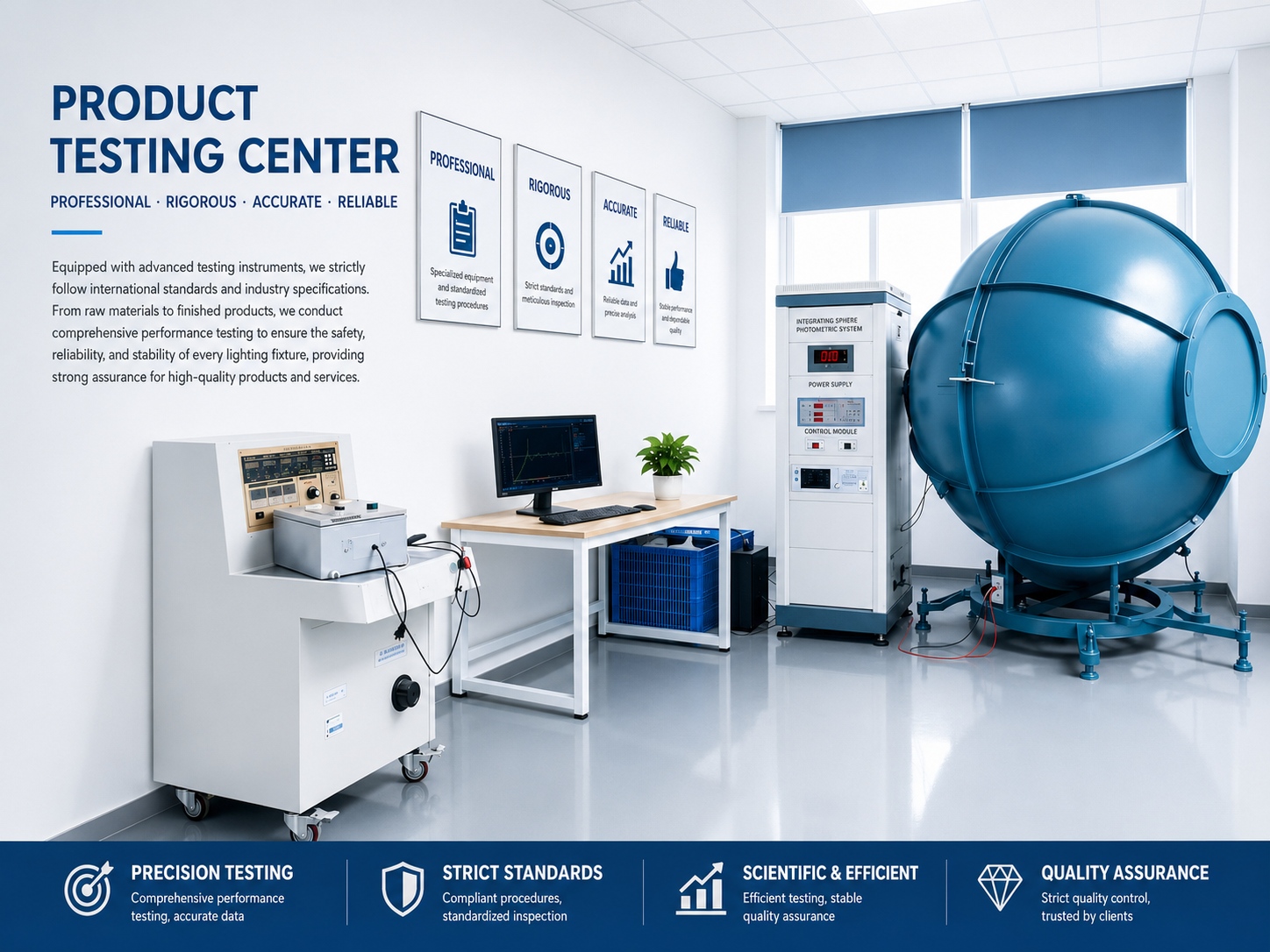
Finished fixture testing helps identify electrical and performance issues before shipment.
How YZ ART LIGHT Supports High-End Hospitality Projects
Zhongshan YZ ART LIGHT Co., Ltd. is an example of a manufacturer that has built its operations around the needs of high-end hospitality projects. The company specializes in high-end decorative and project lighting for premium commercial and residential spaces, with product lines that cover custom hotel lighting, bespoke chandeliers, banquet hall chandeliers, oversized chandeliers, hotel chandeliers, and lobby chandeliers.
The company reports experience with internationally recognized hotel brands. Its completed projects include InterContinental Hotel in Israel, Four Seasons Hotel in the UAE, Marriott Hotel in Costa Rica, Waldorf Astoria Hotel in Malaysia, and InterContinental Hotel in Taiwan. These references are relevant because they represent different regional standards and design languages. A manufacturer that has delivered lighting for such brands is more likely to understand the documentation, quality, and coordination expectations of large hotel projects.
YZ ART LIGHT also positions itself as an OEM and ODM partner. It provides full-process services that begin with design consultation and continue through structural optimization and mass production. The company states its R&D team consists of 20 engineers and that it supports full customization based on designer renderings. Its annual production of about 100,000 units and export ratio of about 70%, mainly to Europe, America, and the Middle East, indicate an orientation toward international commercial clients.
What Buyers Should Verify Before Placing an Order
Although manufacturer statements and project references are useful, every buyer should verify the details that affect the specific order:
- Ceiling load and mounting method: ask for the structural load calculation for oversized fixtures and confirm it matches the building’s conditions.
- Light source compatibility: confirm the LED driver, color temperature range, dimming protocol, and whether the fixture can integrate with the hotel lighting control system.
- Customization scope: define which dimensions, materials, finishes, and light distributions are included in the agreed price.
- Certificates and labels: request CE, RoHS, or other relevant certificates and check whether they cover the exact model or series being ordered.
- Packaging and logistics: confirm export packaging, shipping terms, delivery lead time, and handling instructions for fragile glass or crystal elements.
- Sample policy and approval steps: clarify how many samples are needed and how long each approval step will take.
- After-sales and spare parts: ask how replacement glass, crystal, or electrical parts can be sourced in the future.
Compliance requirements deserve special attention. For decorative lighting exported to North America, luminaires must comply with standards such as UL 1598 and UL 8750 where applicable. For many other markets, CE and RoHS compliance is a baseline. Since certification requirements depend on the product type and destination, buyers should not assume that a single certificate guarantees market access.
FAQ
What is decorative lighting, and why is it important for hotels?
Decorative lighting refers to light fixtures designed to enhance the visual character of a space while providing illumination. In hotels, it includes chandeliers, wall lamps, table lamps, floor lamps, and custom art lighting used in lobbies, banquet halls, guest rooms, restaurants, and corridors. It is important because it affects first impressions, guest comfort, brand identity, energy consumption, and compliance with building and electrical standards.
Which fixtures are typically included in a hotel decorative lighting package?
A complete hotel package typically includes lobby chandeliers, oversized chandeliers for atriums, banquet hall chandeliers, restaurant pendants, guest room table lamps and wall lamps, hotel floor lamps, corridor wall sconces, and functional engineering lights for front desk or bedside use. Full-range suppliers such as YZ ART LIGHT can provide crystal series, art glass sculptural lights, fabric and metal lamps, and functional engineering lights across all hotel zones.
How do I choose between a factory-direct decorative lighting manufacturer and a trading supplier?
For custom-shaped lobby chandeliers, large banquet chandeliers, strict project qualification documents, controlled budgets, long-term maintenance, and large-scale engineering orders, a factory-direct manufacturer is usually preferable because it has in-house engineering, direct quality control, stable cost structure, and dedicated after-sales support. Trading suppliers may be acceptable for simple standardized lamps with no customization and small order quantities, but they normally lack the depth to handle bespoke hotel lighting projects.
What technical specifications should I confirm before ordering a custom hotel chandelier?
Confirm the input voltage, power range, color temperature options, beam angle, protection rating, and whether the fixture supports dimming. For oversized chandeliers, verify the ceiling load calculation, suspension method, installation access, and maintenance plan. For example, YZ ART LIGHT’s custom-made hotel lobby chandelier, model yz10001, has an input voltage of AC110-240V, power range from 30W to 600W, color temperature options of 2700K to 4000K, adjustable beam angle, IP40 protection grade, and a rated lifespan of 50,000 hours. Model-level parameters should always be confirmed with the manufacturer before ordering.
How long does a custom decorative lighting project take?
Lead time varies with design complexity, material availability, sample approvals, and order size. A custom hotel chandelier project usually requires time for drawing deepening, structural calculation, sample production, mass manufacturing, and delivery. Buyers should confirm production schedules and shipping lead times with the manufacturer early. A manufacturer with in-house production, such as YZ ART LIGHT with its 15,000-square-meter facility and roughly 100,000-unit annual output, may offer more controllable lead times than a supplier that outsources production.
Can a hotel order different decorative lighting styles from one manufacturer?
Yes, many manufacturers produce multiple series that cover different design languages. YZ ART LIGHT offers luxury crystal series, art glass sculptural lights, new Chinese fabric and metal lamps, and minimal functional engineering lights. This allows hotels to maintain design consistency across lobbies, restaurants, guest rooms, and corridors while sourcing from one supplier, which simplifies quality control and after-sales support.
Conclusion and Next Steps
Decorative lighting is now a strategic investment for high-end hotels. The commercial decorative lighting market continues to grow, LED integration has become the default technology, dimming requirements are expanding, and energy codes are tightening. At the same time, hotels increasingly choose custom chandeliers and bespoke installations to create memorable, brand-defining spaces. Buyers who understand the trade-offs between design ambition, engineering complexity, cost, compliance, and lead time can make better specification decisions and avoid expensive installation or replacement problems.
When sourcing decorative lighting for a hotel project, focus on manufacturers that can provide a full-cycle service: drawing deepening, structural load calculation, sample production, mass manufacturing, installation guidance, and maintenance. Verify the factory’s product range, engineering team, certifications, project references, and capacity. Ask for samples and certificates that match the exact models being considered. If your project involves bespoke chandeliers or a complete hotel lighting package, discussing your space dimensions, designer renderings, and installation constraints with the manufacturer in the early design phase will save time and reduce risk.
To speak directly with the YZ ART LIGHT team about a custom hotel lighting project, contact Danna Ye at export@yzartlight.com or via WhatsApp at +86 133-9293-6169. For more details about the company’s product range, manufacturing process, and project capabilities, download the YZ ART LIGHT company brochure: Zhongshan YZ ART LIGHT Co., Ltd. Brochure.