Hotel Chandelier Selection Parameters: IP Rating, Voltage, Beam Angle, and Dimming Explained
Hotel Chandelier Selection Parameters: IP Rating, Voltage, Beam Angle, and Dimming Explained
Short answer: For an interior hotel chandelier, four specification lines decide most of whether the fixture passes inspection and still performs years later — IP rating, rated input voltage, beam angle, and dimming. On the yz10001 engineering decorative pendant these read IP40, AC110-240V, an adjustable 15°–120° beam angle, and customizable dimming, built around imported LED chips, an aluminum-alloy frame, stainless-steel suspension components, and a high-transmittance lampshade material. Each value is a decision rather than a default, and each one points to a different part of a hotel.
Why These Four Parameters Decide Project Outcomes
Hotel chandeliers are rarely standard products. A lobby centerpiece, a banquet hall installation, and a duplex atrium fixture differ in diameter, drop length, weight, suspension geometry, and light distribution, and they are normally developed project by project around an interior concept. That is exactly why non-standard engineering decorative pendant designs cannot be specified by choosing a stock item number and accepting its catalogue datasheet.
When a decorative fixture is specified by appearance alone, the gap between the render and the installed product usually appears at one of five points:
- Glare and uneven distribution. A fixture that looks correct at scale can still throw harsh glare across guest seating or leave dark pools under a banquet table layout.
- Dimming incompatibility. The fixture dims in the showroom but flickers, drops out at low levels, or refuses to respond when it is connected to the building's lighting control system.
- Structural mismatch. The suspension detail was never checked against the ceiling structure, the slab capacity, or the reserved installation point.
- Zone and protection mismatch. A fixture specified for the wrong environment creates a safety and warranty issue rather than a design issue.
- Documentation gaps. The fixture performs, but the certificate and qualification file set does not satisfy the tender or the consultant's review.
Parameter-level specification is the practical answer to all five. It converts an artistic object into an engineering line item that a consultant, a main contractor, and an inspector can each review.
What the Hospitality Lighting Market Is Asking For
The direction of the market supports that discipline. The hospitality lighting market was valued at USD 14.2 billion in 2025 and is projected to grow at a CAGR of 7.3% to reach USD 26.8 billion by 2034, according to Dataintelo. Commercial applications, including hospitality, accounted for 62.8% of the decorative lighting end-user market in 2025, per IMARC Group. Within decorative lighting, LED is already the dominant light source at a 39.8% share in 2025 (IMARC Group), and Dataintelo has estimated that 56% of new luxury hotel projects now require dimmable chandelier installations for guest ambiance — a third-party estimate rather than a fixed rule, but a useful signal of where specifications are heading.
Two regulatory shifts reinforce the same point. The 2024 International Energy Conservation Code expanded occupancy and dimming requirements for lobbies and meeting areas (International Code Council), which moves dimming from a comfort feature toward a compliance item in covered jurisdictions. In North America, luminaires are generally expected to comply with UL 1598 and LED equipment with UL 8750 (UL Solutions). Both trends push buyers away from appearance-only selection.
YZ ART LIGHT — the trading name of Zhongshan YZ ART LIGHT Co., Ltd., a manufacturer of high-end decorative and project lighting based in Zhongshan City, Guangdong Province, China — works in this segment. The company operates a 15,000-square-meter production base with a 150-person team, including a 20-engineer R&D group, and exports approximately 70% of its output to Europe, the Americas, and the Middle East, with completed international hospitality references including InterContinental Hotel in Israel, Four Seasons Hotel in the UAE, Marriott Hotel in Costa Rica, Waldorf Astoria Hotel in Malaysia, and InterContinental Hotel in Taiwan.
Parameter by Parameter: Reading a yz10001 Specification
The yz10001 is a useful reference model because its specification sheet contains the four decision parameters together with the build details that make them deliverable. Read each line the way a project buyer would read it.
IP Rating: Defining Where the Fixture Is Allowed to Live
IP40 is a two-digit ingress protection classification. The first digit (4) indicates protection against solid objects 1 mm and larger, such as tools and wires. The second digit (0) indicates no specified protection against water. The practical meaning of IP40 is therefore simple: it is a dry-interior product rating.
Applied to a hotel, that places yz10001 correctly in conditioned interior zones — main lobby, banquet hall, atrium and void ceilings, pre-function areas, corridors, and guest-room applications. It does not belong on a pool deck, inside a spa wet zone, over an indoor water feature, or on an exposed external colonnade; those zones require higher water protection. Pushing an IP40-rated fixture into a wet zone creates a safety and warranty exposure rather than a cost saving, and it is one of the most common specification errors in decorative lighting packages.
Rated Input Voltage: One Fixture Across 120V and 220–240V Projects
An AC110-240V rated input voltage means the same fixture family can be ordered into a 120V market and into a 220–240V market without electrical redesign. For hotel groups standardizing decorative lighting across regions, and for contractors buying for projects in Europe, the Americas, and the Middle East — the markets YZ ART LIGHT serves — a dual-range input reduces model proliferation and simplifies spare-part planning.
Voltage is only half of the electrical decision. The driver, the dimming protocol, and the building's control system must all match, and installation must follow local code with qualified electrical work. Voltage compatibility confirms the fixture can be connected; it does not by itself confirm the control system will behave.
Beam Angle: 15° to 120°, and What It Actually Changes
The adjustable 15°–120° beam angle is the parameter with the largest visual effect on the finished space. At the narrow end, light is concentrated into a tighter cone. That matters wherever the fixture hangs far above the working plane — an atrium, a multi-storey lobby void, or a high double-height entrance — because concentrating the beam maintains delivered light at floor level instead of spilling it into the air volume above guests' heads.
At the wide end, distribution flattens and spreads. This is what a banquet hall wants: tables spread across a large floor area, and each table needs even, non-shadowed illumination. Because the same fixture can operate anywhere in that 15°–120° range, one chandelier type can serve both conditions within a single project — but the setting has to be decided at the specification and commissioning stage, not left to the installation crew's judgement on the day.
Dimming: The Parameter That Sets a Hotel's Operating Rhythm
Customizable dimming is what allows one decorative object to serve several business functions. In a banquet hall the requirement is usually scene-based: a wedding setup, a conference setup, and a maintenance or cleaning setup, each with a different output level. In a lobby, dimming supports a day/night rhythm, with brighter output during arrival hours and lower, warmer output in the evening.
Dimming quality depends on more than the fixture. It depends on driver compatibility and on the control system the project has specified, which is why dimming behavior should be validated at the sample stage. Imported LED chips help here, because consistent chip behavior keeps color and output stable across the dimmed range rather than shifting as levels drop. The IECC 2024 expansion of occupancy and dimming requirements for lobbies and meeting areas is a further reason to treat dimming as a design input rather than an optional extra.
The Supporting Build Parameters Behind Those Four Lines
Four build details make the headline parameters deliverable in a real installation:
- Imported LED chips. The light source determines color consistency and how steadily output is maintained over time. YZ ART LIGHT rates its long-life LED source at 50,000 working hours, and states that its energy-saving LED light sources with stable light attenuation consume 40%–60% less power than conventional decorative lamps.
- Aluminum-alloy frame. The frame carries structural rigidity and heat dissipation. For oversized fixtures that must hold shape over a long drop, heat management and rigidity are what keep the geometry stable.
- Stainless-steel suspension components. Suspension is the load path between fixture and ceiling structure. It is the part that must be verified against slab capacity and the reserved installation point, particularly on high-ceiling atrium installations.
- High-transmittance lampshade material. Transmittance determines how much light actually leaves the shade. High transmittance preserves output so a decorative fixture does not need to be over-driven, while glare-shielded light sources keep that output comfortable in guest-facing areas.
Step-by-Step Specification Workflow for a Hotel Chandelier Package
This is the sequence that keeps decorative chandelier specifications reviewable from concept to handover.
- Zone the space and fix the IP requirement first. List every location the fixture will occupy and confirm each one is a dry interior zone before accepting an IP40-rated model. Wet or semi-exposed zones need a different protection level, not a different finish.
- Confirm supply voltage and control protocol. Verify the project supply against the AC110-240V input range, then confirm the dimming protocol with whoever owns the lighting control scope.
- Derive the beam angle from mounting geometry, not from appearance. High mounting conditions push toward the narrow end of the 15°–120° range; wide floor areas with distributed seating push toward the wider end.
- Define dimming scenes before ordering. Write down the operating states the hotel actually needs. Scene definition is what turns customizable dimming into a working control strategy.
- Lock the structural build against the ceiling. Confirm the aluminum-alloy frame and stainless-steel suspension components against the ceiling structure, slab capacity, and the reserved installation point.
- Validate with a sample. Beam angle behavior, dimming performance, finish, and glare control should be checked on a physical sample before bulk production.
- Assemble the documentation package. Prepare the certificate and qualification file set the consultant or tender requires at the same time as the order, not after it.
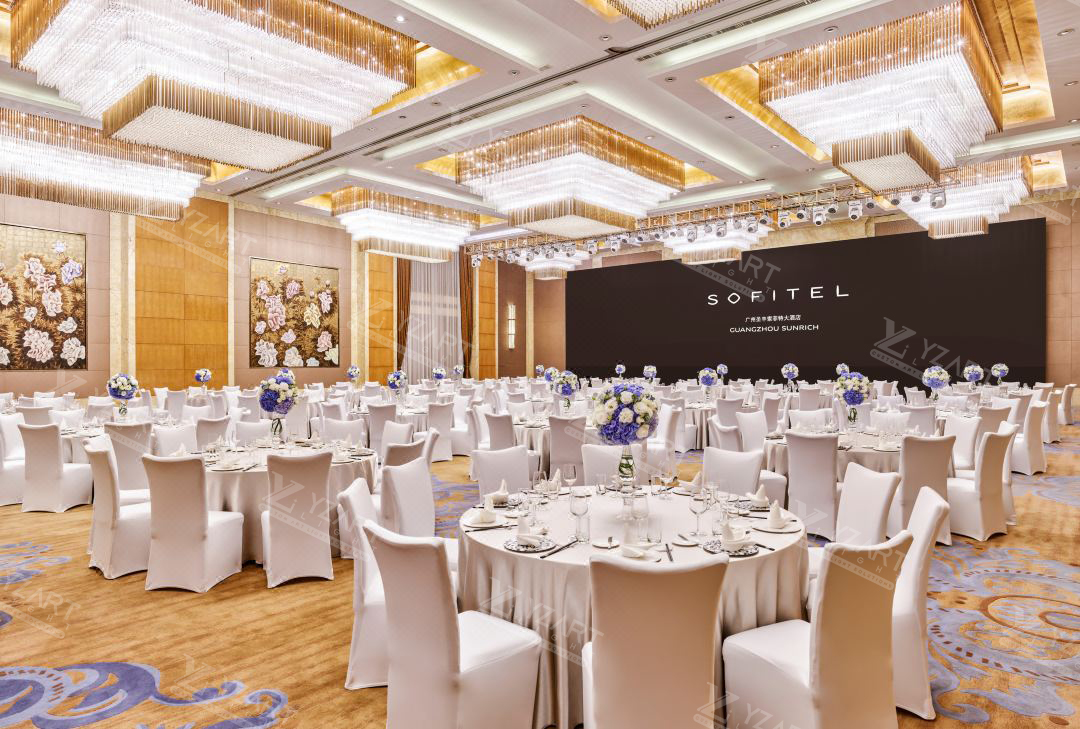
Use Cases: How the Parameters Shift Across Lobby, Banquet Hall, and Atrium
Main Lobby and Grand Entrance
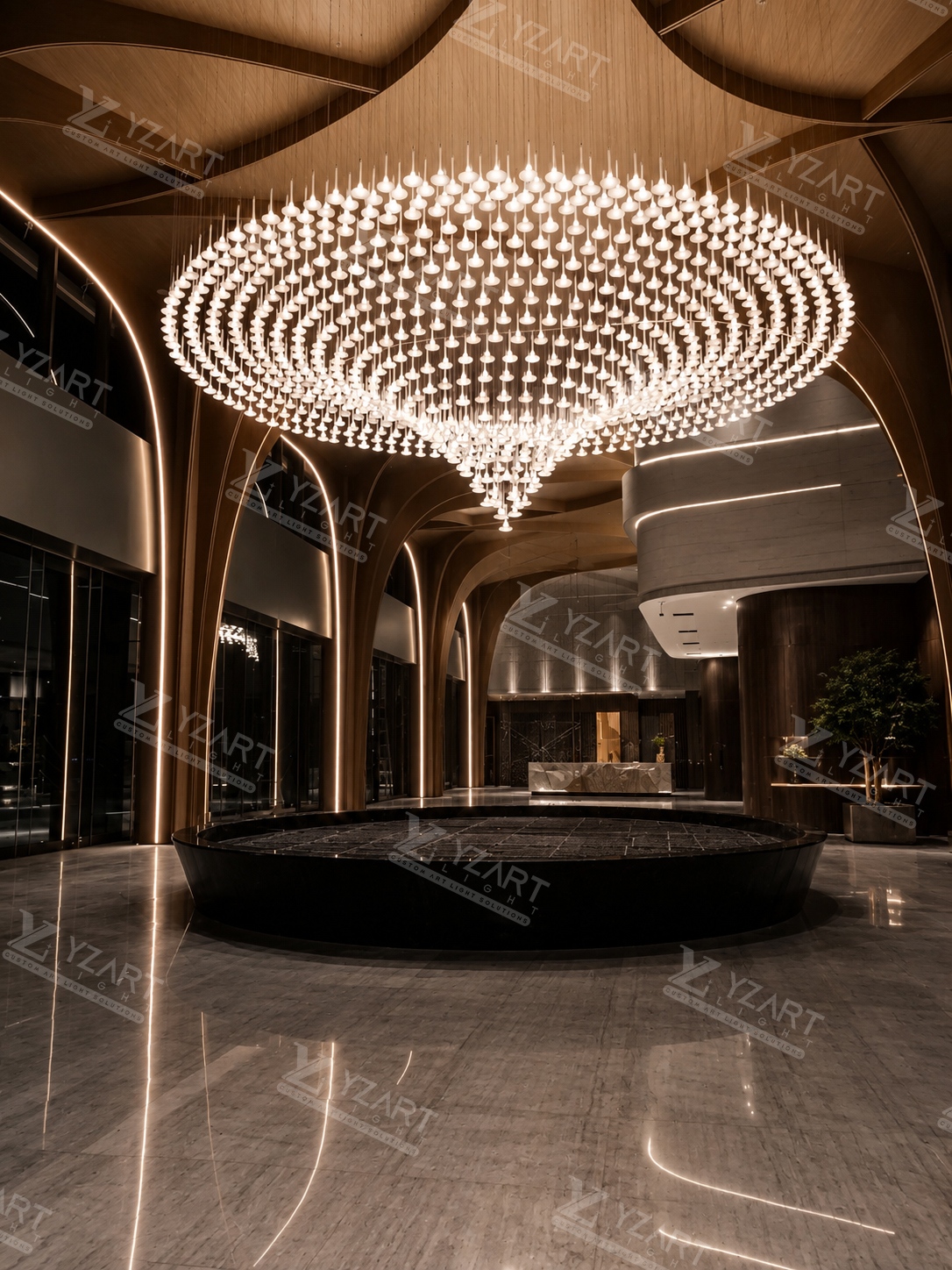
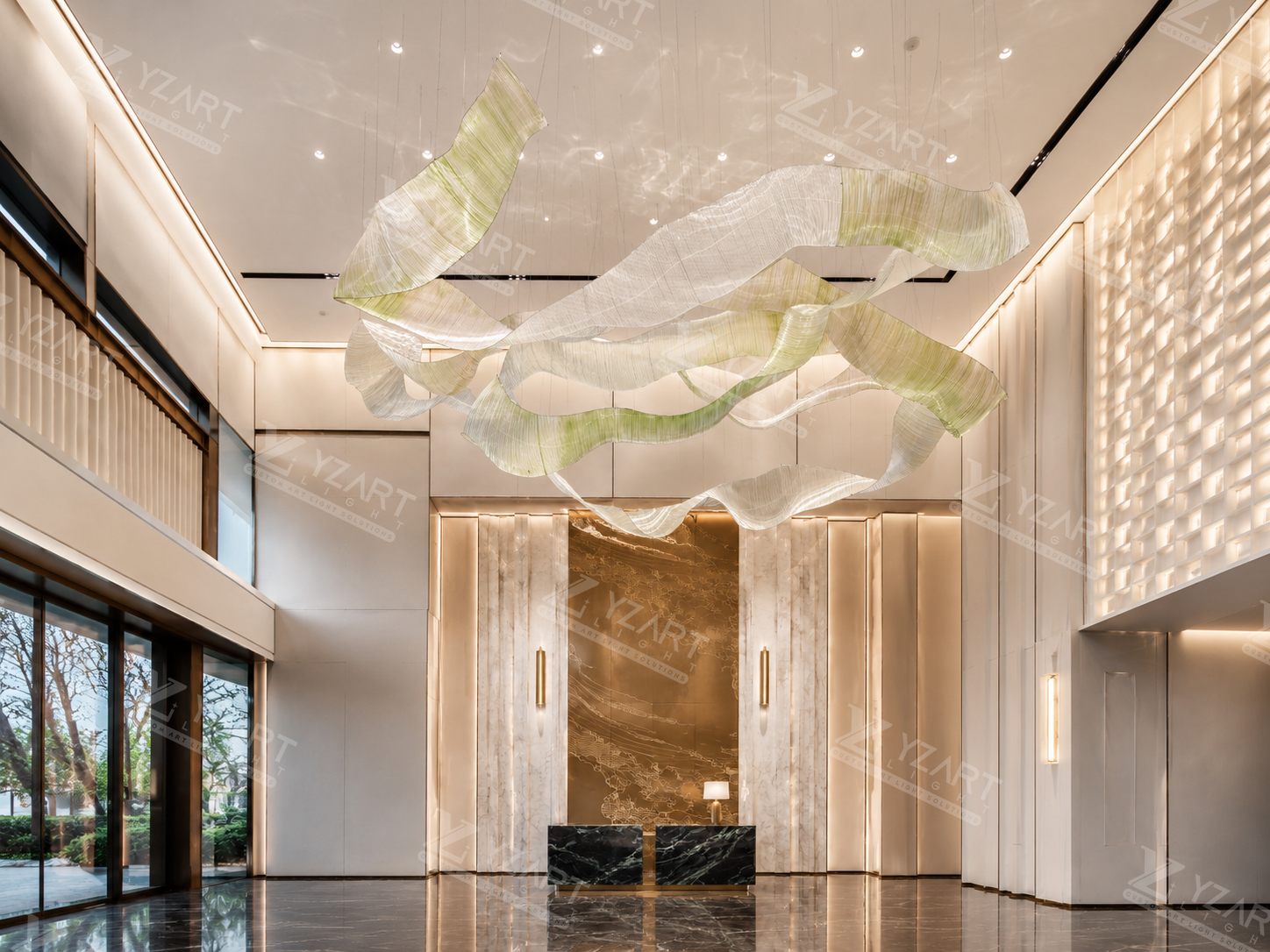
Lobbies combine two requirements that pull in different directions: a decorative statement at close viewing distance, and comfortable light at guest eye level. IP40 is appropriate because the zone is dry and conditioned. Dimming carries most of the day-to-day value, separating arrival hours from evening ambiance. Where the lobby void is double height, the effective setting moves toward the narrower part of the beam angle range so light reaches the floor rather than dissipating into the void.
Banquet Hall and Ballroom
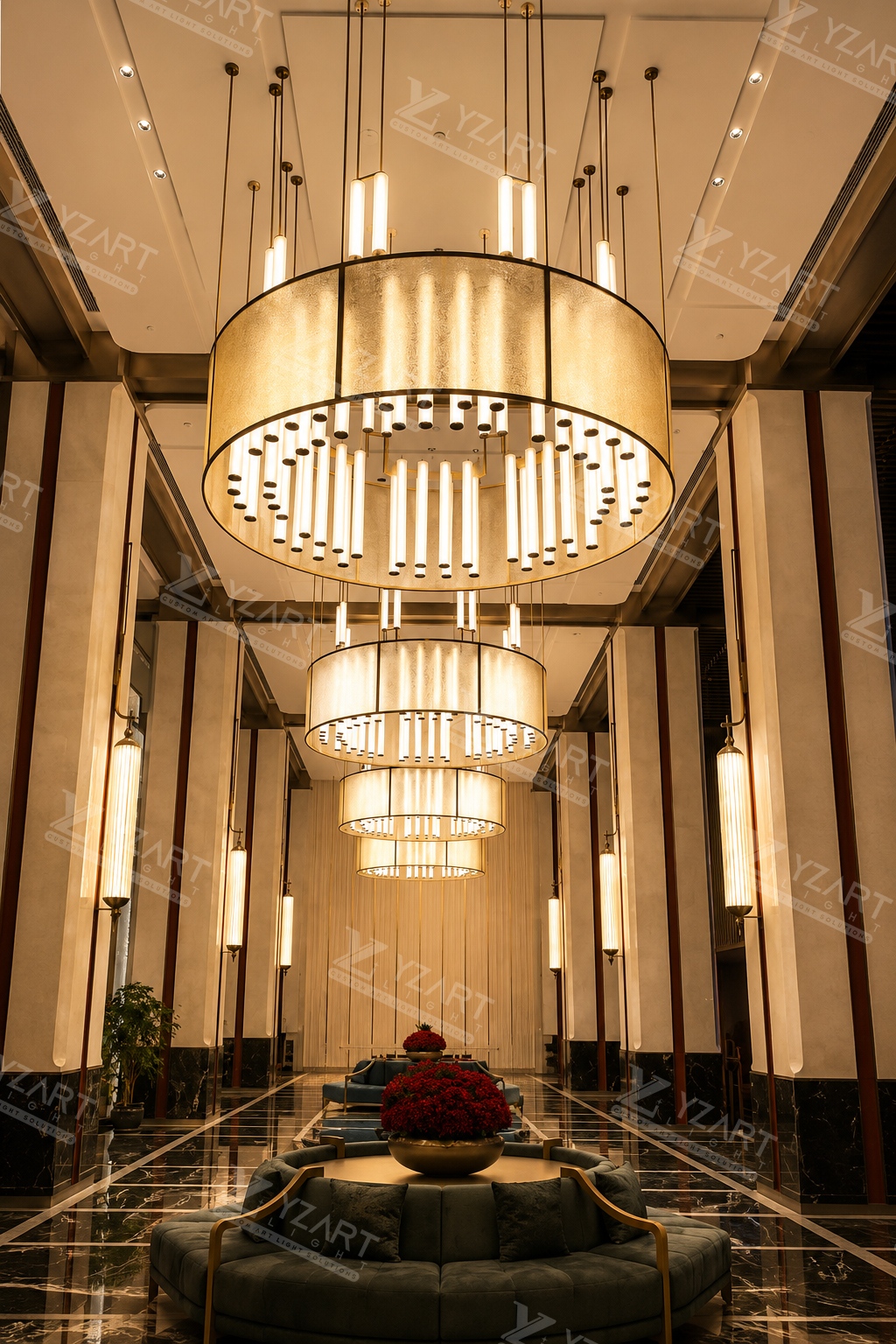
Banquet halls are the clearest case for wide distribution. Seating spreads across a large floor plate, so the beam angle is generally set toward the wider end of the range to distribute light evenly across tables instead of concentrating it in one column. Because the same room hosts weddings, conferences, and set-up crews, dimming becomes an operational requirement: separate scenes at separate output levels, with the fixture itself unchanged. Decorative chandeliers designed for banquet halls and wedding venues are one of YZ ART LIGHT's core product lines, alongside oversized chandeliers for larger installations.
Atrium, Void, and High-Ceiling Installation
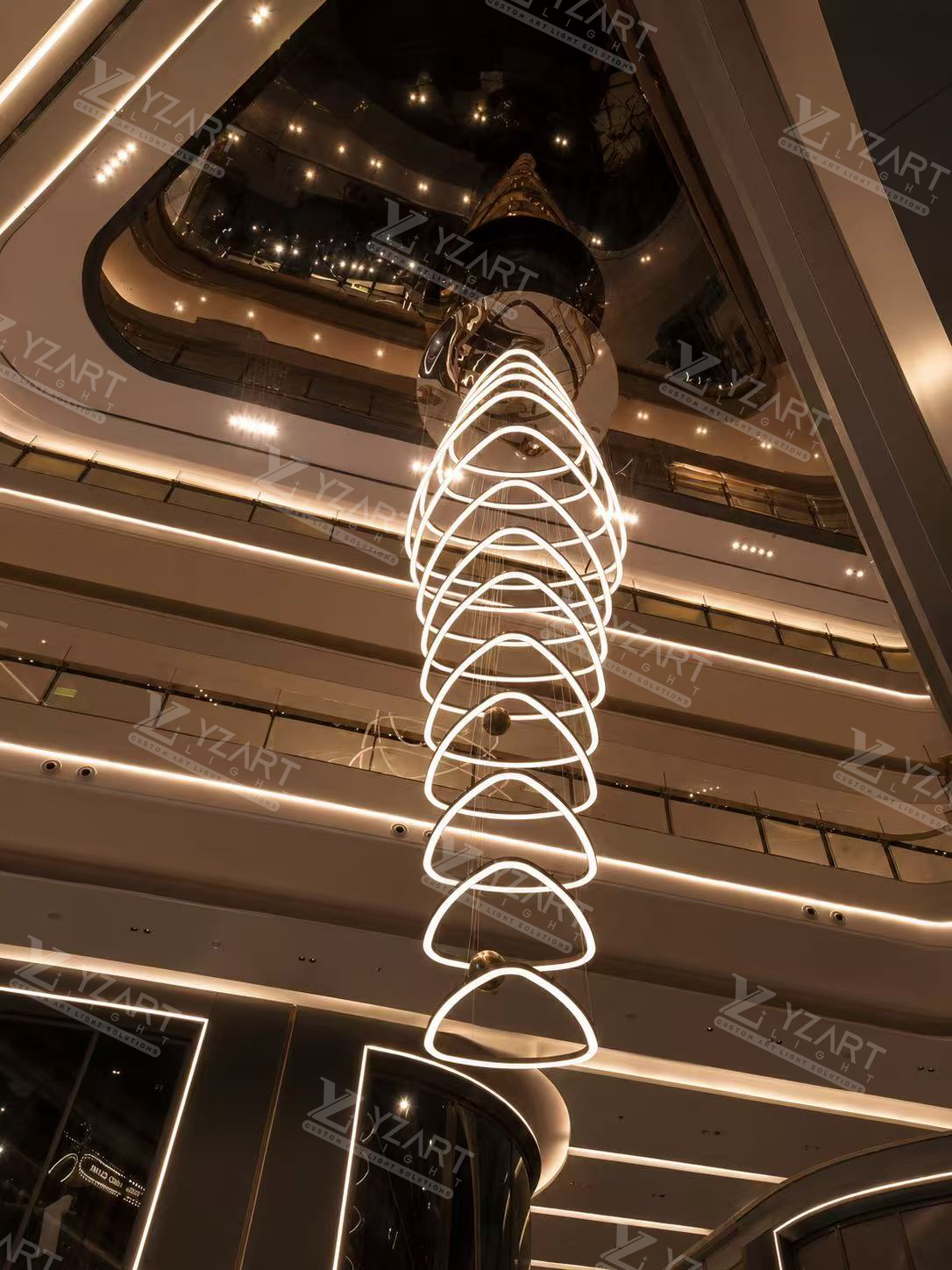
Atria and void ceilings produce the longest distances between fixture and working plane, and they also produce the highest structural demands. Here the narrow end of the 15°–120° range earns its place, maintaining delivered light at floor level. At the same time, stainless-steel suspension components and the load path back to the ceiling structure become the dominant technical question — which is why atrium installations are evaluated as engineering packages rather than as decorative purchases.
Guest Rooms, Corridors, and Ancillary Spaces
Guest rooms, corridors, lounges, and club spaces use the same parameter logic at smaller scale: an appropriate interior protection rating, correct voltage for the region, a beam angle that avoids hot spots on walls and artwork, and dimming that supports a restful setting. YZ ART LIGHT's product range covers lobby and banquet chandeliers alongside hotel table lamps, wall lamps, and floor lamps, so these parameters can be coordinated across a whole hotel rather than piece by piece.
Comparison: Factory-Direct Supply vs. Trading Agents
Parameter decisions only hold if the supply route can actually execute them. The comparison below reflects YZ ART LIGHT's own stated position as an in-house non-standard lighting manufacturer against traditional trading agents and suppliers without in-house manufacturing.
| Comparison dimension | In-house factory-direct supply (YZ ART LIGHT) | Traditional trading agent / supplier without in-house manufacturing |
|---|---|---|
| Manufacturing base | Self-operated production base with in-house laser-cutting automated equipment; full-process non-standard customized lighting service | No self-owned workshop; goods sourced externally |
| Technical customization capacity | Drawing deepening, structural safety calculation, production, and on-site installation guidance handled as one process | Limited technical customization capacity and limited stable cost control |
| Comprehensive cost on customized orders | Stated as 15%–30% lower by cutting out middle-man links | Intermediary margin passed through to the buyer |
| Energy performance | Energy-saving LED light sources with stable light attenuation; 40%–60% less power consumption than conventional decorative lamps; long-life LED source rated at 50,000 working hours | Depends on the sourcing route and the LED components selected by the upstream supplier |
| Project track record | Over 1,000 finished hotel-oriented engineering projects; 15 years of experience in custom-made lamps | Track record typically held at the supplier's own discretion |
| Installation and after-sales | Nationwide on-site installation support, 3-year product warranty, quick spare-part supply, and remote overseas technical support | Dedicated after-sales team is generally not available in-house |
| Best fit | Custom-shaped lobby, banquet, and atrium fixtures; strict project qualification documents; controlled budget; long-term maintenance; large-scale star-rated hotel engineering orders | Simple standardized stock lamps with no customization requirement and small-scale orders |
How to read this table: the factory-direct route is not automatically correct for every purchase. If a project needs standardized stock lamps, in small quantities, with no custom demands, a trading supplier can be a workable route. The factory-direct case becomes decisive when the parameters above actually have to be engineered — non-standard shapes, qualification documents for a tender, controlled budget, and long-term maintenance.
Specification Support and Documentation for Engineering Tenders
In tender-based hotel projects, the fixture specification and the documentation package are reviewed together. A parameter sheet that cannot be traced to a certificate or a reference list creates risk for the consultant and the main contractor regardless of how good the fixture looks.
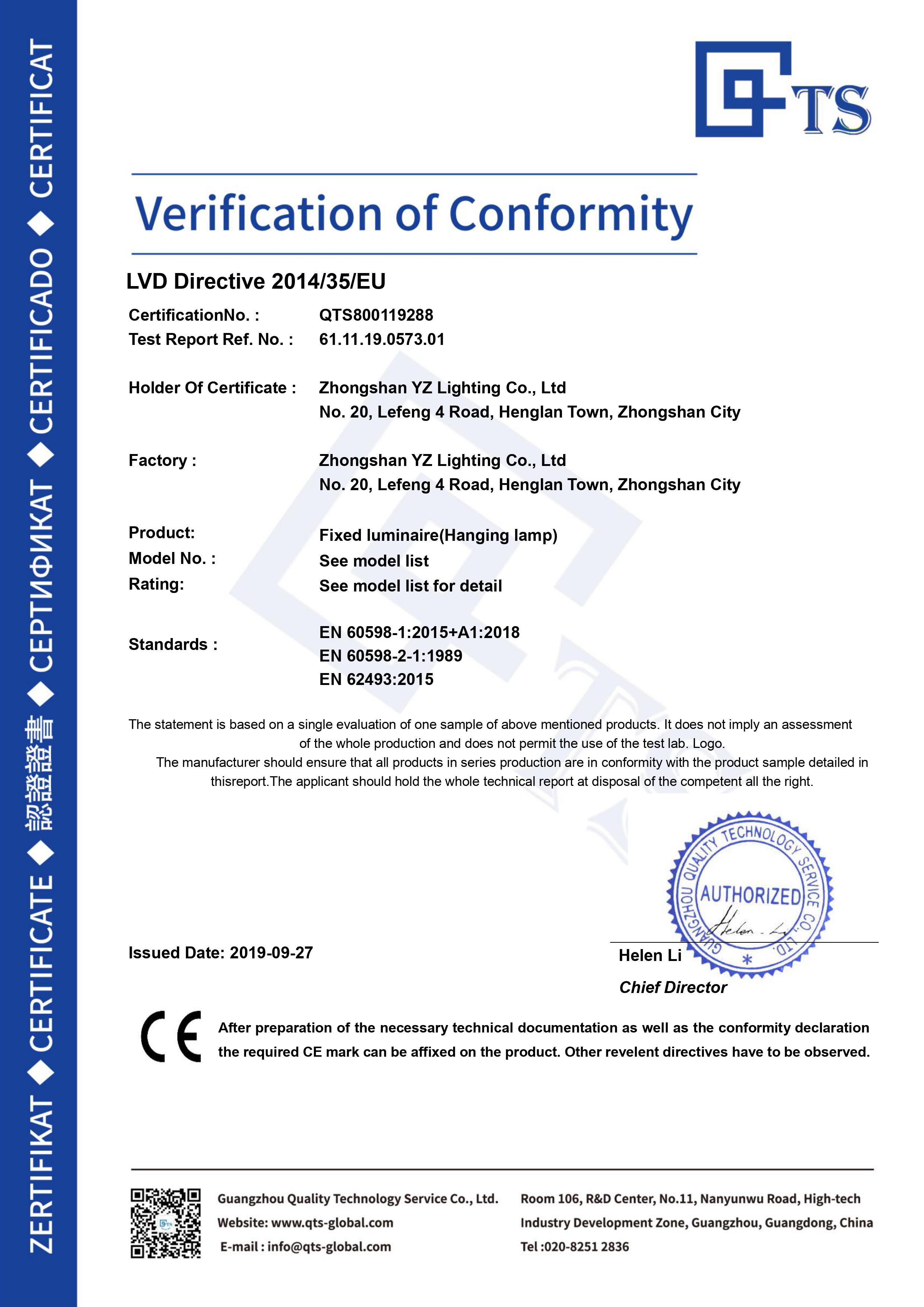
YZ ART LIGHT supports project buyers with qualification certificates and bidding documents alongside the technical file. The product side carries CE and RoHS certification, and production runs under an ISO-certified quality management system applied from raw material selection through processing and finished-product testing. The manufacturing base is equipped with CNC laser cutting systems, automated welding stations, and precision engraving machines, which is what makes full-process non-standard customization reviewable rather than aspirational.
For reference purposes, the completed international hospitality portfolio includes InterContinental Hotel in Israel, Four Seasons Hotel in the UAE, Marriott Hotel in Costa Rica, Waldorf Astoria Hotel in Malaysia, and InterContinental Hotel in Taiwan, alongside a record of more than 1,000 finished hotel-oriented engineering projects.
Frequently Asked Questions
Does an IP40 chandelier meet hotel project requirements, and what certificates support it?
An IP40 rating means protection against solid objects 1 mm and larger, with no specified water protection, so it is appropriate for dry, conditioned interior zones such as lobbies, banquet halls, atria, corridors, and guest rooms. It is not appropriate for pool decks, spa wet zones, indoor water features, or exposed exterior positions, which require a higher water-protection level. On the documentation side, YZ ART LIGHT products carry CE and RoHS certification and are produced under an ISO-certified quality management system. Buyers should also check local requirements: in North America, luminaires are generally expected to align with UL 1598 and LED equipment with UL 8750 (UL Solutions), and the 2024 IECC expanded occupancy and dimming requirements for lobbies and meeting areas (International Code Council). Confirm the installation zone, the local code, and the certificate set the tender requires before fixing the model.
Can beam angle, input voltage, and dimming be customized for a specific hotel project?
Yes. The yz10001 reference model is specified with a rated input voltage of AC110-240V, an adjustable 15°–120° beam angle, and customizable dimming, built on imported LED chips, an aluminum-alloy frame, stainless-steel suspension components, and a high-transmittance lampshade material. YZ ART LIGHT provides one-stop OEM and ODM customization covering the full workflow — initial design consultation, personalized scheme development, structural optimization, and mass production — supported by a 20-engineer R&D team. Custom shapes and special material processing are accepted on a project basis, while special protection requirements or specific lighting control requirements need to be confirmed separately because they depend on the project's electrical and control design.
How much does factory-direct supply change the cost of a custom hotel chandelier?
YZ ART LIGHT states that its comprehensive cost for customized lamp orders is 15%–30% lower than traditional trading agents and lighting suppliers without in-house manufacturing, because the middle-man link is cut. Running cost matters as well: the company states that its energy-saving LED light sources with stable light attenuation consume 40%–60% less power than conventional decorative lamps, and that its long-life LED source is rated at 50,000 working hours. When comparing quotations, include installation support, spare-part supply, and lighting-control integration in the calculation rather than comparing fixture prices alone.
Can I validate a chandelier sample before committing to a full order?
Yes. The project workflow runs from design and sample-making through to bulk delivery, so beam angle behavior, dimming performance, finish, and glare control can be checked on a physical sample before mass production. The sample stage is also the point at which dimming should be tested with the driver and control system the project intends to use, because flicker, drop-out at low levels, and slow response are far cheaper to resolve before bulk production than after delivery.
What does the ordering process look like, and how do I start a project conversation?
YZ ART LIGHT operates on a project basis with end-to-end services from design through installation guidance, producing at a 15,000-square-meter base with a 150-person team and approximately 70% export share across Europe, the Americas, and the Middle East. Buyers typically begin by sharing the space type, ceiling condition, mounting height, regional supply voltage, dimming requirement, and the documentation set the tender demands. From there the parameters are fixed, a sample is validated, and production is scheduled. To start, send the project brief to export@yzartlight.com, message the sales team on WhatsApp at +86 133-9293-6169, or review the company catalogue first at Zhongshan YZ ART LIGHT Co., Ltd. product catalogue.
Conclusion: Four Lines That Should Never Be Left to Default
IP rating, rated input voltage, beam angle, and dimming are the four specification lines that determine whether a hotel chandelier is a working engineering component or a risk carried until handover. IP40 fixes the fixture as a dry-interior product and rules out wet zones. AC110-240V lets one fixture family serve 120V and 220–240V projects without redesign. The adjustable 15°–120° beam angle is what allows one chandelier type to serve both a high atrium and a wide banquet floor. Customizable dimming is what turns the fixture into an operational asset across weddings, conferences, and daily service.
Behind those four lines sit the details that make them real: imported LED chips, an aluminum-alloy frame, stainless-steel suspension components, and a high-transmittance lampshade material — plus the qualification certificates and bidding documents that a tender review actually asks for. Specifying at this level is what separates a decorative lighting package that passes inspection from one that is reworked on site.
Note on scope: the parameter reasoning above applies to dry, conditioned hotel interiors. Wet zones, exterior positions, and projects in jurisdictions with specific code requirements should be confirmed against local standards and the project's control-system design before the model is fixed.
Start With a Sample, Not a Guess
Share your space type, ceiling condition, supply voltage, and dimming requirement, and the YZ ART LIGHT engineering team will return a parameter-matched proposal for your lobby, banquet hall, or atrium project — with the specification sheet, CE and RoHS certificates, and qualification documents you need for tender submission.
Email export@yzartlight.com | WhatsApp +86 133-9293-6169 | www.yzartlight.com