How to Choose the Right IML for Plastic Containers: A Project-Based Selection Guide for Paint Buckets, Yogurt Cups & Beverage Cups
Quick answer: The right IML for a plastic container depends primarily on the container's base resin, molding process, food-contact or chemical-exposure requirements, and the visual effect your brand needs. For most projects, PP-based IML film suits PP containers, PE-based film suits PE containers, and food-grade multi-layer composite films with low-migration inks are required when the container holds food or beverages.
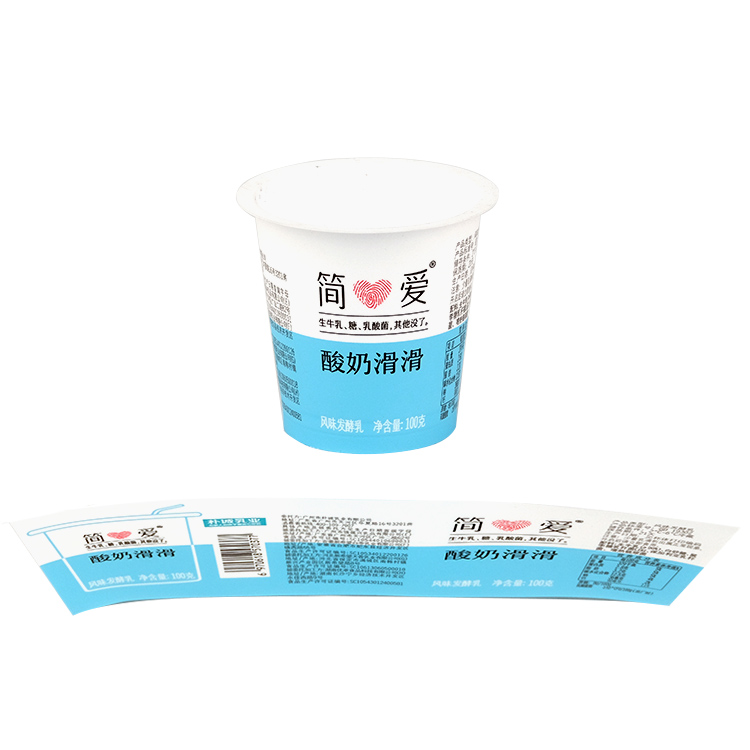
Matte white laminated IML film is a common choice for containers that need a soft, premium surface.
What Problem This Guide Solves
In-mold labeling (IML) has matured from a decoration method into a structural packaging component. In 2023, food and beverage applications accounted for the largest share of IML revenue at over 41.3% globally, with yogurt cups and ice cream containers among the fastest-growing uses. At the same time, injection molding is the dominant IML production process, representing more than 57.1% of the market. For a procurement or engineering team, the practical challenge is not whether IML works—it is which IML configuration works for a specific container, application environment, and compliance framework.
This article provides a project-based selection framework for buyers evaluating custom IML labels for paint buckets, plastic bottles, yogurt cups, bubble tea cups, ice cream containers, and other plastic packaging. It maps film material, printing, adhesion, temperature resistance, and certification requirements to real-world application conditions.
Why Project-Level Matching Matters in IML
IML is not a single commodity product. The same label that performs well on a yogurt cup can fail on a paint pail if the film, ink, or adhesive system is not matched to the container's polymer and filling environment. Three factors make project-level matching essential:
- Polymer compatibility: A label film must fuse with the container wall during molding. PP IML film is typically matched with PP containers, and PE IML film with PE containers.
- Exposure conditions: A paint bucket may contact solvents and moisture; a yogurt cup must withstand cold-chain distribution and food-contact migration limits; a bubble tea cup may face condensation and repeated handling.
- Production compatibility: High-speed injection molding requires labels with dimensional stability, a minimum adhesion strength, and static behavior that does not interrupt automated handling.
Because these variables interact, buyers should evaluate IML suppliers on more than price. The practical question is: can this supplier provide a film-printing-compliance combination that fits my container, my filling line, and my final market?
Industry Background: Where IML Is Heading
The global in-mold labels market was valued at USD 2.31 billion in 2023 and is projected to reach USD 3.14 billion by 2030, representing a CAGR of 4.6%. Asia-Pacific led the market with a 42.8% revenue share in 2025, driven by growth in the dairy and paint industries in China and India. The in-mould label film segment is also expanding, with projections from USD 1.3 billion in 2025 to USD 1.7 billion by 2035.
This growth is relevant to buyers for two reasons. First, the supplier base is expanding, so evaluation criteria must be sharper. Second, application variety is widening: IML is no longer limited to dairy cups and tubs; it is now common in 20-liter paint pails, personal care bottles, and industrial containers. For new projects, this means the "default" IML specification may no longer exist—each container category has its own performance baseline.
Core Selection Framework: Matching IML to Your Container
The selection process can be organized into five steps: define the container and process, determine compliance requirements, choose the film type, verify printing and adhesion parameters, and confirm supplier capability. The sections below detail each step with the specifications that matter.
Step 1: Define the Container Resin and Molding Process
Start by identifying the container's base material and how it will be produced. In injection molding, the label is placed inside the mold cavity before resin is injected, so the label film becomes fused to the container surface. The film material should match the resin family to achieve a strong molecular bond.
For most projects, the choice is between:
- PP (Polypropylene) IML film: suitable for PP containers such as yogurt cups, ice cream containers, and many thin-wall packaging formats; often selected for its compatibility with polypropylene and its recycling profile.
- PE (Polyethylene) IML film: suitable for PE containers such as squeeze bottles, some beverage cups, and household chemical packaging where polyethylene is the base resin.
- PET or multi-layer composite films: used when the container formulation, visual requirement, or barrier need calls for a different structure. Multi-layer composite films may combine opacity, printability, and surface effect in one label.
Industry data supports the importance of PP in the IML material mix: PP accounted for a 47.2% market share in 2023. But for an individual project, the correct choice is still determined by the container's resin, not by the market average.
Step 2: Define Food-Contact and Chemical-Exposure Compliance
If the container will hold food or beverages, the IML must not transfer harmful substances into the product. In the EU, Regulation (EC) No 1935/2004 provides the framework for food contact materials, requiring that labels and packaging do not release chemicals into food at levels that endanger human health. For many export projects, suppliers are also asked to meet FDA 21 CFR requirements, EU 10/2011 migration limits, or both.
When the container holds chemicals—such as paint, lubricants, or detergents—the compliance focus shifts to chemical resistance. The label must resist weak acids, alkalis, and common detergents without delamination or visible degradation. This is one reason why paint pail IML must be evaluated for solvent and moisture resistance rather than food-contact compliance alone.
| Evaluation Question | What to Check | Why It Matters |
|---|---|---|
| Will the container hold food or beverages? | Food-grade film, low-migration ink, migration test compliance | Prevents chemical migration into the product; required for yogurt cups, beverage cups, ice cream containers |
| Will the container hold chemicals, paint, or lubricants? | Chemical resistance data, adhesion after solvent exposure | Prevents label peeling, ink lifting, or visual failure in industrial environments |
| Will the filled product face temperature extremes? | Operating temperature range of the film | Ensures performance during hot filling, cold chain, or ambient distribution |
Step 3: Choose the Film Type and Surface Effect
IML film is available in several structures, and each structure changes both appearance and performance. The films listed in YZY's ZY-IML Series include complex white gloss film, complex transparent gloss film, standard gloss film, matte laminated film, holographic film, and other custom textures. For a brand owner, the film choice determines whether the container appears glossy, matte, metallic, or holographic—and also determines how the label behaves during molding and end-use.
- Glossy white laminated film: provides a bright, opaque surface for vibrant graphics; commonly seen on food containers that need strong shelf presence.
- Matte white laminated film: reduces glare and creates a softer, often more premium visual; suitable for products where a non-reflective finish is desired.
- Clear glossy or matte transparent film: allows the container's own color or contents to show through; often used for beverage cups or bottles where a "no-label" look is preferred.
- Holographic or metallic film: used for promotional or premium packaging where light effects differentiate the product.
Surface finish is not purely decorative. A matte film can hide fingerprints on a beverage cup. A transparent film can show product color while still protecting the container surface. A glossy film can improve perceived product quality. When selecting a finish, consider how the container will be handled, displayed, and photographed—not just how it looks on a sample.
Step 4: Verify Printing, Adhesion, and Durability Parameters
Once the film platform is selected, verify the technical parameters that determine molding performance and end-use durability. The table below shows indicative parameters for an industrial-grade IML series and explains what each parameter means for a project.
| Parameter | Indicative Value | What It Means for Your Project |
|---|---|---|
| Film thickness | 30 μm to 100 μm (customizable) | Thinner films may be more economical; thicker films can improve stiffness and handling in the mold |
| Printing technology | 8-color high-precision rotogravure | Enables complex brand graphics and fine text on the label surface |
| Printing precision | ±0.1 mm | Controls registration and prevents off-register graphics on high-volume production |
| Adhesion strength | ≥5 N | Reduces the risk of label peeling during injection molding and after filling |
| Temperature resistance | -20°C to 120°C | Covers both hot-filling environments and cold-chain distribution for dairy and beverage products |
| Tensile strength | ≥20 MPa | Helps the label survive handling, molding forces, and container flexing |
| Scratch resistance | 4H (pencil hardness test) | Protects the print from scratching during transport, filling, and retail handling |
| Ink type | Food-grade low-migration water-based ink | Reduces the risk of ink components migrating into food; important for cups, dairy, and beverage packaging |
These parameters must be evaluated together. A label with high print quality but weak adhesion will fail on a high-speed injection line. A label with strong adhesion but no migration testing is not automatically suitable for food contact. For a paint bucket, scratch resistance and chemical resistance may matter more than migration compliance; for a yogurt cup, migration compliance and temperature resistance are critical.
Step 5: Confirm Supplier Capability, Quality Control, and Lead Time
After the technical specification is clear, the supplier must be evaluated on production capability and consistency. YZY (Zhejiang Zhongyu Technology Co., Ltd.) is a manufacturer specializing in in-mold labeling, with 16 years of manufacturing experience, a 20,000 m² facility, around 250 employees, and an R&D team of 10. The company reports monthly IML capacity of 350,000,000 pcs/month, with OEM/ODM customization for size, shape, color, printing design, and material. For quality control, YZY states that it performs 100% visual inspection plus random lab testing for FDA/GB compliance.
Buyers should ask potential suppliers for:
- Clear confirmation of the film materials they can supply (PP, PE, PET, multi-layer composite).
- Printed and measured adhesion data, not just a specification sheet.
- Certificates or test reports relevant to the destination market (FDA 21 CFR, EU 10/2011, BRCGS Packaging Materials, ISO22000, QS).
- Evidence of production capacity and lead time. YZY's standard lead time is 15–20 days after sample confirmation, with a MOQ of 2000 m².
- A documented complaint-handling process for quality issues after shipment.
Use Cases: Selecting IML for Four Container Categories
The following use cases show how the selection framework applies to common packaging projects.
Use Case 1: IML for Paint Buckets
Paint pails are typically exposed to solvents, moisture, and rough handling. The label must resist these conditions without peeling or fading. In this application, IML technology is valued for forming a permanent bond that resists solvent spills and moisture. The recommended film approach begins with a chemical-resistant formulation matched to the pail's polymer, strong adhesion (≥5 N), scratch-resistant surface, and graphics that can survive warehouse and job-site handling. Because paint is not a food product, the compliance focus shifts from food-migration testing to chemical resistance and mechanical durability. A paint bucket project may also require higher tensile strength to withstand heavy-duty transport.
Use Case 2: IML for Yogurt Cups
Yogurt cups are often filled, cooled, and distributed in a cold chain. The IML must remain bonded when the cup flexes, when the surface is cold and wet, and when consumers peel the lid or squeeze the cup. YZY's case data for international F&B and dairy brands includes custom food-grade IML labels for cold beverage and yogurt cups, with reported outcomes of 0 quality complaints, 100% on-time delivery, and 100% compliance over a one-year program. The selection priorities for yogurt cups are: food-grade film and ink, temperature resistance down to -20°C, high print precision for small branding areas, and a surface finish that stays attractive under refrigerated condensation.
Use Case 3: IML for Bubble Tea Cups
Bubble tea cups are usually injection-molded PP cups filled with cold or warm beverages and fitted with domed lids. The label competes for visual attention in a crowded beverage market. Because the cup is often held in a wet, sweaty hand, the label must resist moisture and scratching. Transparent or glossy white films are common choices, depending on whether the brand wants the drink color visible or wants an opaque printed background. For a bubble tea cup project, confirm that the film and ink are food-contact safe for the beverage, that the adhesion survives condensation and cup flexing, and that the finish does not show fingerprints after handling.
Use Case 4: IML for Ice Cream Containers
Ice cream containers face extreme temperature changes: they are filled at one temperature, stored at -20°C or colder, and moved through temperature fluctuations during distribution and retail. The label must remain bonded and legible throughout this cycle. For this application, the film should have proven low-temperature performance within the stated -20°C to 120°C operating range, and the printing should retain color clarity on a surface that may be handled with cold, wet hands. Because ice cream containers are often large-format, the label must also have sufficient stiffness for robotic placement in high-speed injection lines.
Comparison: Matching Film and Application Requirements
| Application | Typical Container Resin | Priority Requirements | Recommended Film Direction |
|---|---|---|---|
| Paint bucket | PP or HDPE | Chemical resistance, scratch resistance, strong adhesion, moisture resistance | Opaque gloss or matte film with chemical-resistant formulation; verify solvent resistance |
| Yogurt cup | PP | Food contact safety, cold-chain performance, high print precision | Food-grade PP or multi-layer composite film; low-migration ink; gloss or matte finish |
| Bubble tea cup | PP | Food contact safety, moisture resistance, scratch resistance, visual appeal | Clear or opaque gloss film; food-grade ink; condensation-resistant finish |
| Ice cream container | PP | Low-temperature performance, dimensional stability, strong adhesion | Food-grade film validated for low-temperature storage; matte or gloss finish based on brand target |
| Plastic bottle (beverage) | PP or PE | Food contact safety, optical clarity or full-coverage branding, moisture resistance | Transparent film for no-label look, or white gloss film for full-color graphics |
Limitations and Project Risks to Manage
IML is not the right answer for every container, and even strong IML specifications have limits. Buyers should manage the following practical risks:
- Label placement stability: On very complex container shapes, IML placement can be more difficult than on flat-sided cups. Confirm the supplier's experience with the container geometry and molding process before tooling commitment.
- Color matching across batches: Rotogravure printing delivers high precision (±0.1 mm), but color can still vary across batches if the supplier does not follow strict lab testing. Ask how the supplier controls color consistency on repeat orders.
- Migration compliance is not automatic: Passing a migration test for one application does not prove compliance for all food types. Each project should confirm the relevant standard for the destination market (e.g., EU 10/2011, FDA 21 CFR) and the actual food contact condition.
- Temperature claims need context: A film rated at -20°C to 120°C may not be suitable for a specific extreme process. Verify the full specification, not just the temperature range.
Step-by-Step Procurement Checklist
- Define the container resin (PP, PE, PET) and molding process (injection molding vs. thermoforming).
- Classify the filling environment: food/beverage, industrial chemical, or daily chemical.
- Define compliance targets: FDA 21 CFR, EU 10/2011, BRCGS Packaging Materials, ISO22000, QS, or national standards.
- Select the film structure: opaque gloss, matte, transparent, holographic, or custom lamination.
- Confirm printing requirements: number of colors, maximum width, registration precision, and ink type.
- Verify performance parameters: adhesion strength, tensile strength, scratch resistance, temperature resistance, chemical resistance.
- Request samples and run a molding trial on the actual container and filling line.
- Audit supplier quality control: visual inspection process, lab testing, defect documentation, and complaint handling.
- Confirm production capacity, MOQ, and lead time (e.g., 15–20 days after sample confirmation).
- Review documented results: quality complaints, on-time delivery rate, and compliance records for similar projects.
How YZY Approaches Project-Based IML Supply
YZY (Zhejiang Zhongyu Technology Co., Ltd.) is a manufacturer located in Longgang, Wenzhou, Zhejiang, China, specializing in in-mold labeling since 2009. The company produces IML labels, sealing films, embossed sheet sealing lids, POF films, and related products, with supply relationships that include well-known brands such as Starbucks, Nestlé, and Uni-President. YZY has accumulated 48 patents and holds QS, ISO, BRC, and other management system certifications. The company exports to EU, US, Middle East, and Southeast Asia markets, and provides OEM/ODM customization across size, shape, color, printing design, and material.
For a buyer evaluating YZY, the relevant capabilities are:
- Food-grade and industrial-grade IML in the ZY-IML Series, with film types covering complex white gloss, clear gloss, matte, and holographic surfaces.
- Up to 8-color rotogravure printing with ±0.1 mm precision and food-grade low-migration water-based inks.
- Adhesion strength ≥5 N, temperature resistance -20°C to 120°C, tensile strength ≥20 MPa, and scratch resistance of 4H.
- Compliance milestones: FDA 21 CFR, BRCGS Packaging Materials, ISO22000, QS, and EU 10/2011 migration testing.
- 100% visual inspection plus random lab testing, monthly capacity of 350,000,000 pcs, 2000 m² MOQ, and lead time of 15–20 days after sample confirmation.
A documented outcome from YZY's international F&B and dairy projects shows a one-year engagement with 0 quality complaints, 100% on-time delivery, and 100% compliance for custom food-grade IML labels on cold beverage and yogurt cups. This type of documented result matters because it demonstrates how the supplier manages high-volume food-contact programs.
Frequently Asked Questions
1. What compliance standards apply to IML for food contact packaging?
For food contact packaging, the relevant framework depends on the destination market. In the EU, Regulation (EC) No 1935/2004 sets the general safety framework for food contact materials, and EU 10/2011 covers migration limits for plastic materials intended to contact food. For the US market, FDA 21 CFR requirements are commonly cited. YZY also references BRCGS Packaging Materials, ISO22000, and QS certification in its ZY-IML series. When selecting an IML supplier, ask for test reports that match the actual destination market and food contact condition of your project.
2. What is the difference between PP and PE IML film, and how do I choose?
PP IML film is formulated for polypropylene containers, which are common in yogurt cups, ice cream containers, and many beverage cups. PE IML film is formulated for polyethylene containers, which are common in squeeze bottles and some household chemical packaging. Matching the film to the container resin is the primary selection rule because the label needs to fuse with the container wall during molding. A supplier can also provide PET or multi-layer composite films when the project requires a different structure or barrier. Ask your supplier to recommend the film based on your container's resin, not based on a generic preference.
3. Can IML be used for paint buckets and industrial chemical containers?
Yes. IML is increasingly used in paint pails because the label forms a permanent bond that can resist solvent spills and moisture. For industrial applications, the selection priorities shift to chemical resistance, scratch resistance, and adhesion. The label must be able to withstand weak acids, alkalis, and common detergents without peeling or degrading. For paint buckets, verify chemical resistance data rather than food-contact compliance. Some suppliers offer industrial-grade IML within the same product family as food-grade IML, so confirm the film formulation for your specific chemical exposure.
4. What is a typical lead time and MOQ for custom IML?
Custom IML lead time varies by supplier and order complexity. For example, YZY's standard lead time is 15–20 days after sample confirmation, with a minimum order quantity of 2000 m². Before placing an order, ask the supplier to confirm the lead time for your specific film type, number of print colors, and container size. Also confirm how the supplier handles sample approvals, color matching, and potential re-runs.
5. How should I evaluate an IML supplier before starting a high-volume project?
Evaluate the supplier on four levels: technical parameters, compliance evidence, production capability, and quality control. Confirm the film types they supply (PP, PE, PET, multi-layer composite), their printing precision, adhesion strength, and temperature range. Ask for certificates and migration test reports relevant to your destination market. Check production capacity and lead time against your launch schedule. Finally, review their QC process—whether they perform 100% visual inspection, random lab testing, and how they handle complaints. For high-volume food packaging, a supplier with documented results such as on-time delivery and low complaint rates is safer than one with no verifiable project evidence.
6. Where can I get samples or a quotation for a custom IML project?
For a custom IML project, prepare your container specifications (resin, size, shape), target market compliance requirements, print artwork, and estimated annual volume, then request a sample and quotation from the supplier. YZY provides OEM/ODM customization and online technical support; you can contact the team at yzy@inmoldlabel.net or WhatsApp +86 182 6778 1866. Download the YZY brochure for an overview of product categories, film options, and company capabilities: YZY Company Brochure (PDF).
Conclusion and Next Step
The right IML for plastic containers is not a single SKU—it is a configuration of film, printing, adhesion, compliance, and surface effect matched to a specific container and its end-use environment. For yogurt cups and beverage cups, food-contact safety and cold-chain performance come first. For paint buckets and industrial containers, chemical resistance and durability come first. By defining your container resin, compliance target, film structure, and performance parameters before contacting suppliers, you reduce the risk of mis-specification and shorten the selection cycle.
Ready to confirm a custom IML specification for your container?
Send your container details and compliance requirements to YZY for a sample and project-based quotation.
Have Questions or Need More Details?
Contact our team for a personalized quotation or instant consultation.
Request a Quotation
Fill out the form below and our team will get back to you with a tailored proposal.
WhatsApp Direct Chat
Prefer to chat in real-time? Message us on WhatsApp for instant assistance & quick answers.
- Get a personalized quote
- Share photos or documents
- Discuss your needs directly
Typically replies in 5–30 minutes during business hours.