
How to Read a Transformer Core Datasheet: Loss, Temperature, and Power Ratings Explained
Reading a transformer core datasheet correctly means matching three numbers to the test conditions printed beside them — core loss, operating temperature and rated power — before you compare two cores, two models or two suppliers. In the YadooTEK NCW series, the published figures are core loss ≤1.0 W/kg at 1.5 T / 50 Hz, rated power from 100 VA to 5000 VA, and an operating range of −40 °C to 120 °C. Two cores can look identical on paper and behave differently in service; the difference is almost always in the conditions behind the numbers.
This guide is written for buyers and design engineers who have a datasheet in front of them and a project requirement beside it. It explains what each field means, how the fields interact, and how to cross-reference a model designation such as NCW100 through NCW2500 against an actual load, thermal environment and application. YadooTEK is the brand of Wuxi Yado Electromechanical Co., Ltd., a transformer core manufacturer established in 2022 and based in Jiangyin City, Wuxi, Jiangsu Province, China, supplying wound, laminated and custom cores to export markets.
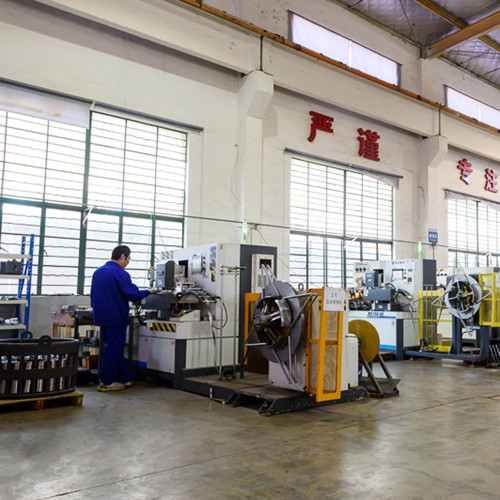
Transformer core production at Wuxi Yado Electromechanical Co., Ltd. (YadooTEK). Datasheet values originate from the same processes that a buyer later audits.
Why datasheet comparison goes wrong so often
Most mismatched core selections do not come from a missing specification. They come from a specification that was read without its conditions. Three failure patterns account for most of the problem in industrial procurement.
First, loss figures are compared across different test conditions. A core loss value expressed in W/kg only means something together with the flux density and frequency at which it was measured. YadooTEK publishes ≤1.0 W/kg at 1.5 T / 50 Hz for the NCW series, and ≤1.2 W/kg at 1.5 T for its EI lamination core made from CRGO silicon steel with 0.2–0.3 mm strip thickness. Those two figures describe different products tested under partially different stated conditions. Ranking them against each other without the underlying test record is not a comparison; it is a guess.
Second, rated power in VA is read as if it were watts. A 500 VA core is not a 500 W power source. The VA figure describes apparent power at rated voltage, and the real power available to a load depends on the power factor of the circuit the core serves. Buyers who size on watts alone tend to end up either with unnecessary headroom or with a core running closer to its limit than planned.
Third, the operating temperature range is treated as a target rather than a boundary. A −40 °C to 120 °C range tells you where the core is specified to operate, not where it should be asked to operate continuously. Loss converts to heat, heat raises the core temperature above ambient, and the margin between the calculated rise and the upper limit is the real thermal decision.
Industry background: why a single datasheet line carries commercial weight
Transformer cores sit inside a large and material-concentrated supply chain. Industry research published by Custom Market Insights values the global transformer core market at USD 9.66 billion in 2024, and research published by Mordor Intelligence reports that grain-oriented silicon steel (CRGO) held a 79.6% share of that market in 2024. The same commercial research source indicates that toroidal cores achieve 90%–98% efficiency, whereas traditional EI laminated cores typically operate below 90%. CRGO’s dominance reflects a performance-to-cost balance rather than a claim that one geometry fits every design.
That concentration has a direct consequence for buyers: most projects will be sourced from a narrow band of materials, so differentiation between suppliers shows up in measurable detail — how loss is specified, how temperature is bounded, how the model range maps onto the load, and whether test evidence exists. Because core loss drives no-load loss in the finished transformer, a small difference in a W/kg figure can matter commercially across a production run, and it matters technically in any application where heat or signal integrity is tight.
Import documentation adds a second, more administrative layer. Wound cores of iron or steel for incorporation into transformers are classified under HS Code 8504.90.96.42, so the model name on the datasheet should always be traceable to the commercial description used on the invoice and customs entry. A datasheet that cannot be matched to a shipment description is a paperwork risk, not only an engineering one.
The three parameters explained
Core loss: what ≤1.0 W/kg at 1.5 T / 50 Hz actually means
Core loss is the power dissipated in the magnetic material itself, expressed per kilogram of core. It is the number that eventually becomes heat inside the finished component. On the NCW datasheet the value is quoted as ≤1.0 W/kg at 1.5 T / 50 Hz, which decomposes into three parts:
- ≤1.0 W/kg — the loss per unit mass, stated as a maximum rather than a typical value.
- 1.5 T — the peak flux density at which the measurement was made. A core measured at a higher flux density will normally show a higher loss figure; the two are not interchangeable.
- 50 Hz — the excitation frequency. Loss rises with frequency, so a 60 Hz reading of the same core is a different data point.
When you receive a competing quotation, the first question is not “what is the W/kg?” but “at what flux density, at what frequency, on what specimen, and by what test method?” A supplier who can answer all four is giving you something comparable. A supplier who answers only the first is giving you a marketing number. YadooTEK’s published EI lamination core figure illustrates the same point from the other direction: ≤1.2 W/kg at 1.5 T is stated with flux density but without a stated frequency in the published specification, so it should be qualified by the test report before it is used in a design calculation.
Operating temperature: −40 °C to 120 °C is an envelope, not a target
The −40 °C to 120 °C range on the NCW datasheet defines where the core is specified to work. It should be read as four separate checks:
- Ambient, not core temperature. The range describes the environment the core is exposed to; the core itself runs warmer than ambient because of its own loss.
- Temperature rise adds to ambient. A core dissipating near its loss limit in a 70 °C enclosure is not operating in the same condition as the same core in a 25 °C laboratory.
- Margin is a design choice. Continuous operation close to the upper limit leaves little room for a hot day, a blocked ventilation path or a marginally higher load.
- The finished component has its own limit. Insulation class, bobbin material and encapsulation may constrain the assembly before the core limit is reached.
For cold markets, the lower bound matters as much as the upper one: equipment shipped, stored or started in sub-zero conditions should be checked against the −40 °C figure rather than assumed to be safe because the operating season is warm.
Rated power: 100–5000 VA and why VA is not W
NCW cores are quoted across a rated power band of 100 VA to 5000 VA. Rated power in VA describes apparent power at rated voltage; real power in watts is apparent power multiplied by the power factor of the circuit. A metering or instrumentation circuit typically operates at a power factor well below unity, which is exactly why the datasheet uses VA: it is the number the transformer design is actually constrained by.
Two practical rules follow. First, size on the apparent power the application demands, not on the nameplate wattage of a downstream device. Second, treat the rated figure as a boundary to be confirmed at your own frequency and ambient, because usable rating falls as ambient temperature rises and as frequency departs from the quoted condition. When a project sits near the top of the band, ask for the derating position in writing rather than extrapolating it.
Model designation: cross-referencing NCW100 to NCW2500
The NCW naming convention makes the range readable at a glance: the numeric suffix tracks the rated power step in VA, and the standard catalogue list runs from NCW100 to NCW2500. The series as a whole is quoted at 100–5000 VA, so steps above the standard list should be confirmed by quotation rather than assumed from the catalogue.
| Model designation | Rated power step (VA) |
|---|---|
| NCW100 | 100 |
| NCW150 | 150 |
| NCW200 | 200 |
| NCW300 | 300 |
| NCW350 | 350 |
| NCW500 | 500 |
| NCW750 | 750 |
| NCW1000 | 1,000 |
| NCW1500 | 1,500 |
| NCW2000 | 2,000 |
| NCW2500 | 2,500 |
NCW model list and rated power steps. All NCW models are published with core loss ≤1.0 W/kg at 1.5 T / 50 Hz and an operating range of −40 °C to 120 °C; confirm the final rated step on the quotation for any project above the standard list.
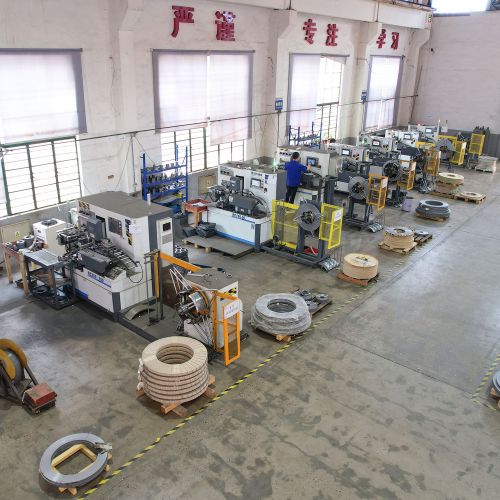
Core assembly and inspection. Every process in the YadooTEK production flow is tested before shipment, which is the evidence behind a datasheet figure.
Step-by-step: reading a datasheet in seven passes
Work through the sheet in this order. Read the conditions before the numbers, and the model designation before the marketing text.
- Pass 1 — Confirm the test conditions. Locate flux density and frequency next to the loss figure. On the NCW series, that is 1.5 T and 50 Hz. If either is missing, the loss number is not usable yet.
- Pass 2 — Convert loss into a thermal question. Multiply the W/kg figure by the core mass to estimate dissipated power, then compare it with the enclosure’s ability to remove heat. This is where a 1.0 W/kg specification becomes an actual temperature rise.
- Pass 3 — Check the temperature envelope against the real environment. Compare −40 °C to 120 °C with the ambient extremes of the installation, then subtract your calculated rise from the upper bound to see the remaining margin.
- Pass 4 — Match rated power to the application in VA. Use the apparent power demanded by the circuit, add the design margin your engineering standard requires, and read the result against the 100–5000 VA band.
- Pass 5 — Convert the requirement into a model number. Find the NCW step that covers the calculated VA, then check whether the chosen step still satisfies the thermal calculation from Pass 3. If it does not, move up a step rather than accepting a thinner margin.
- Pass 6 — Verify material and quality evidence. Confirm the material description, the inspection regime and the certificate. YadooTEK operates under an ISO 9001:2015 certificate, number 91320281MABPUAFD29, issued by Noah Testing & Certification Group Co., Ltd., valid from 13 October 2025 to 26 October 2028, with the scope “Sales of power electronic components and mechanical parts”.
- Pass 7 — Close the loop with a sample and a test record. Ask for the loss test record for the specific model and validate one unit in your own fixture before releasing a production order.
Where these readings decide the outcome
Power equipment and instrument transformers
In current and voltage transformers, the core sets both the accuracy behaviour and the loss floor. A loss figure quoted without flux density can push a design into an accuracy band that fails at type test, which is expensive to discover after tooling. YadooTEK cores are used by power equipment manufacturers and instrument transformer producers, with reported application results including high-precision metering, low-loss operation, strong anti-interference and compliance with IEC international standards.
Energy monitoring and smart grid terminals
Metering equipment and smart grid terminals run continuously, so loss is a lifetime energy cost rather than a one-off test result. Here the rated power reading in VA matters most, because the metering circuit’s power factor is low and the apparent power demand is what the core must carry. A 5,000-unit transformer core project supplied by YadooTEK into current/voltage transformers, industrial sensors, power metering equipment and smart grid terminals illustrates the pattern: the selection was driven by the loss and accuracy requirement, not by the model number alone. The product has been supplied to clients in Europe, North America, Asia and the Middle East, with projects implemented in more than 30 countries including Germany, the United States, Australia and Brazil.
Medical and special power supplies
Medical imaging and special power supply designs combine tight loss budgets with enclosures that are difficult to ventilate. In these builds the temperature envelope does more work than the loss figure: a core that meets its W/kg target but sits near the top of its range inside a sealed housing is a reliability problem waiting for a warm room. Reading −40 °C to 120 °C as a boundary, and holding real margin below the upper limit, is the practical safeguard.
Comparison table: what can and cannot be compared
The table below uses only published specification values and cited research. It is deliberately incomplete where the source data is incomplete, because a blank cell is more useful to a buyer than a fabricated one.
| Parameter | NCW wound core (YadooTEK published) | EI lamination core, CRGO (YadooTEK published) | Toroidal core (published market research) |
|---|---|---|---|
| Core loss | ≤1.0 W/kg at 1.5 T / 50 Hz | ≤1.2 W/kg at 1.5 T (frequency not stated in published spec) | Not stated in the sourced data |
| Material | Wound core, NCW series | CRGO silicon steel, 0.2–0.3 mm strip | Not stated in the sourced data |
| Rated power | 100–5000 VA | Not stated in published spec | Not stated in the sourced data |
| Operating temperature | −40 °C to 120 °C | Not stated in published spec | Not stated in the sourced data |
| Efficiency indicator | Published as a loss limit, not an efficiency percentage | Typically below 90% | 90%–98% |
| Source basis | YadooTEK NCW datasheet | YadooTEK EI lamination core specification | Commercial market research (Mordor Intelligence) |
Comparison limited to published and cited values. Cells marked “not stated” indicate missing source data, not inferior performance. Loss values from different test conditions must not be ranked against each other.
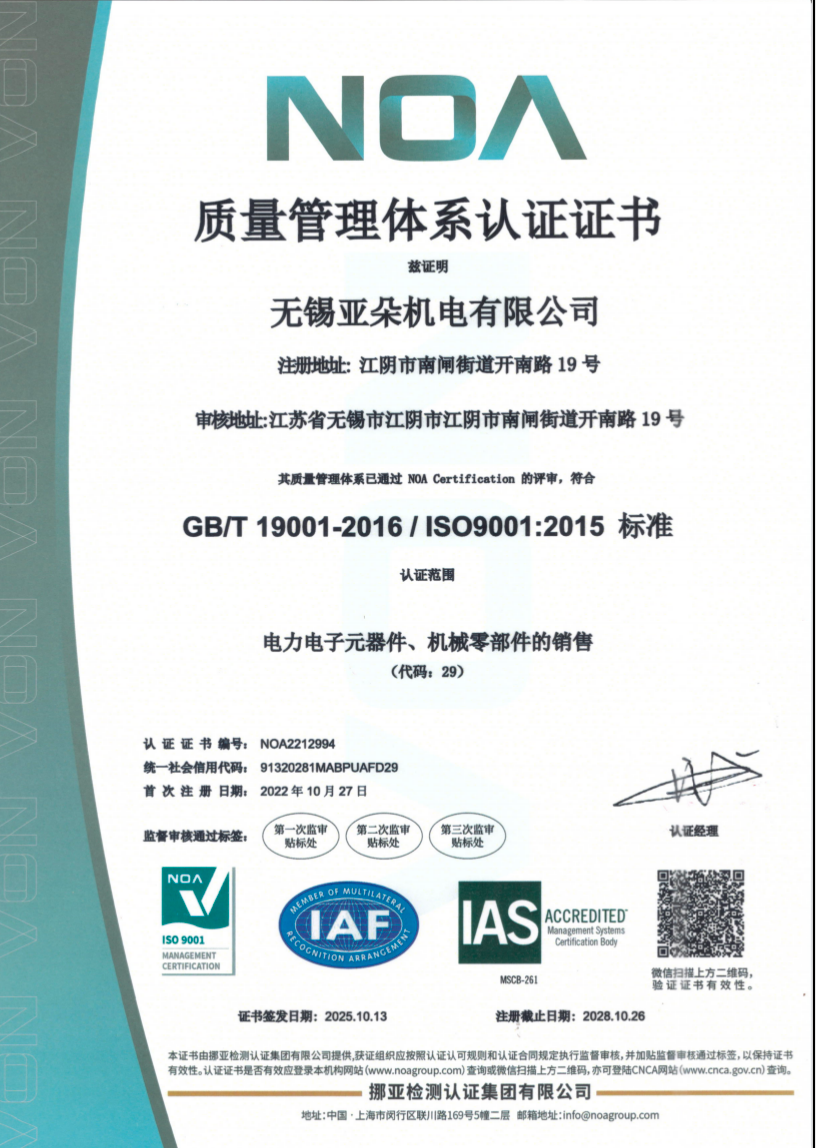
ISO 9001:2015 certificate 91320281MABPUAFD29, issued by Noah Testing & Certification Group Co., Ltd., valid to 26 October 2028.
Frequently asked questions
1. Is the core loss figure on a datasheet a certified value, and what compliance evidence should I request?
No. A core loss figure is a published specification tied to stated test conditions, and it is separate from certification. For compliance, request two documents: the loss test record for the specific model, showing specimen, method, flux density and frequency; and the current quality management certificate. YadooTEK holds ISO 9001:2015 certification, certificate number 91320281MABPUAFD29, valid from 13 October 2025 to 26 October 2028, and applies 100% testing to its production. Where a project must satisfy a specific transformer standard, state the standard in the enquiry so that the applicable test evidence can be confirmed in writing before the order.
2. If the standard NCW list does not match our requirement, can the core be customized?
Yes. YadooTEK operates an OEM/ODM production model with customization available on size, specification and material, supported by a 25-engineer R&D team. Monthly capacity is 10,000 units, and customization is handled within the standard 45–60 day lead time for most configurations. For a requirement outside the published NCW100–NCW2500 list, the customization route is usually faster than forcing a standard model into a design it does not fit.
3. How should I budget across the NCW range?
Pricing is quoted per specification rather than published as a list, because cost moves with the model step, the material, dimensional tolerance and order quantity. Two budgeting rules help: fixed costs are lower than most buyers expect to hear because the minimum order quantity is 1 unit, which allows a single-piece evaluation before a volume commitment; and the largest avoidable cost is usually a mis-sized core, since a model chosen on watts instead of VA often has to be re-quoted. Request a quotation against your calculated VA and temperature margin rather than against a model number alone.
4. Can I validate a sample before placing a production order?
Yes. The minimum order quantity is 1 unit, and every unit is 100% tested before delivery, so a sample can be validated in your own fixture. The useful sample test is not only the loss reading at 1.5 T / 50 Hz — it is the temperature behaviour of the core in your enclosure at your ambient, with your load. Running both checks on one unit before release is the cheapest risk reduction available in a core project.
5. What lead time should I plan for?
Standard production lead time is 45–60 days from order confirmation, with remote after-sales support. Plan the schedule backwards from installation rather than from purchase order: sample validation, then production, then freight and customs clearance under HS Code 8504.90.96.42 for wound cores of iron or steel. Requests that fall outside the standard model list should confirm lead time at quotation stage, since customization affects the production slot. To start that conversation, send your calculated VA, loss limit and ambient range to the YadooTEK team at www.yadootek.com or lucien@yadootek.com, or download the product catalogue below.
Need a core that matches your datasheet calculation?
Send your rated power in VA, loss limit with flux density and frequency, and ambient temperature range. YadooTEK will confirm the NCW model or propose a custom core, with a test record and a quotation.
Email: lucien@yadootek.com | Tel: +86 13912495853 | WhatsApp: +86 17768348101
Catalogue download: YadooTEK transformer core product brochure (PDF)

Wuxi Yado Electromechanical Co., Ltd., Jiangyin City, Wuxi, Jiangsu Province, China — established 2022, 1,000 m² facility, 80 employees, 25 engineers, 250,000 units annual output, 85% export ratio.
Conclusion
A transformer core datasheet is only as useful as the conditions attached to it. Read the loss figure with its flux density and frequency, read the temperature range as an envelope to stay inside rather than a point to reach, and read rated power in VA against the apparent power your circuit actually draws. Then convert the result into a model designation — NCW100 through NCW2500 on the YadooTEK list — and confirm the choice with a test record and a sample.
Buyers who work in that order rarely discover a mismatch at type test. They discover it at the quotation stage, where it is cheap to fix: a step up in the model range, a material change, or a custom core built to the requirement. Wuxi Yado Electromechanical Co., Ltd. supplies NCW cores, EI lamination cores, permalloy cores, toroidal cores, CD cores, distribution gap cores, silicon steel rectangular cores and custom transformer cores to clients in Europe, North America, Asia and the Middle East, with an 85% export ratio across its production.
Have Questions or Need More Details?
Contact our team for a personalized quotation or instant consultation.
Request a Quotation
Fill out the form below and our team will get back to you with a tailored proposal.
WhatsApp Direct Chat
Prefer to chat in real-time? Message us on WhatsApp for instant assistance & quick answers.
- Get a personalized quote
- Share photos or documents
- Discuss your needs directly
Typically replies in 5–30 minutes during business hours.