
Custom HTV Silicone Rubber Supplier: Capability & Delivery Checks
Custom HTV Silicone Rubber Supplier: Capability and Delivery Checks
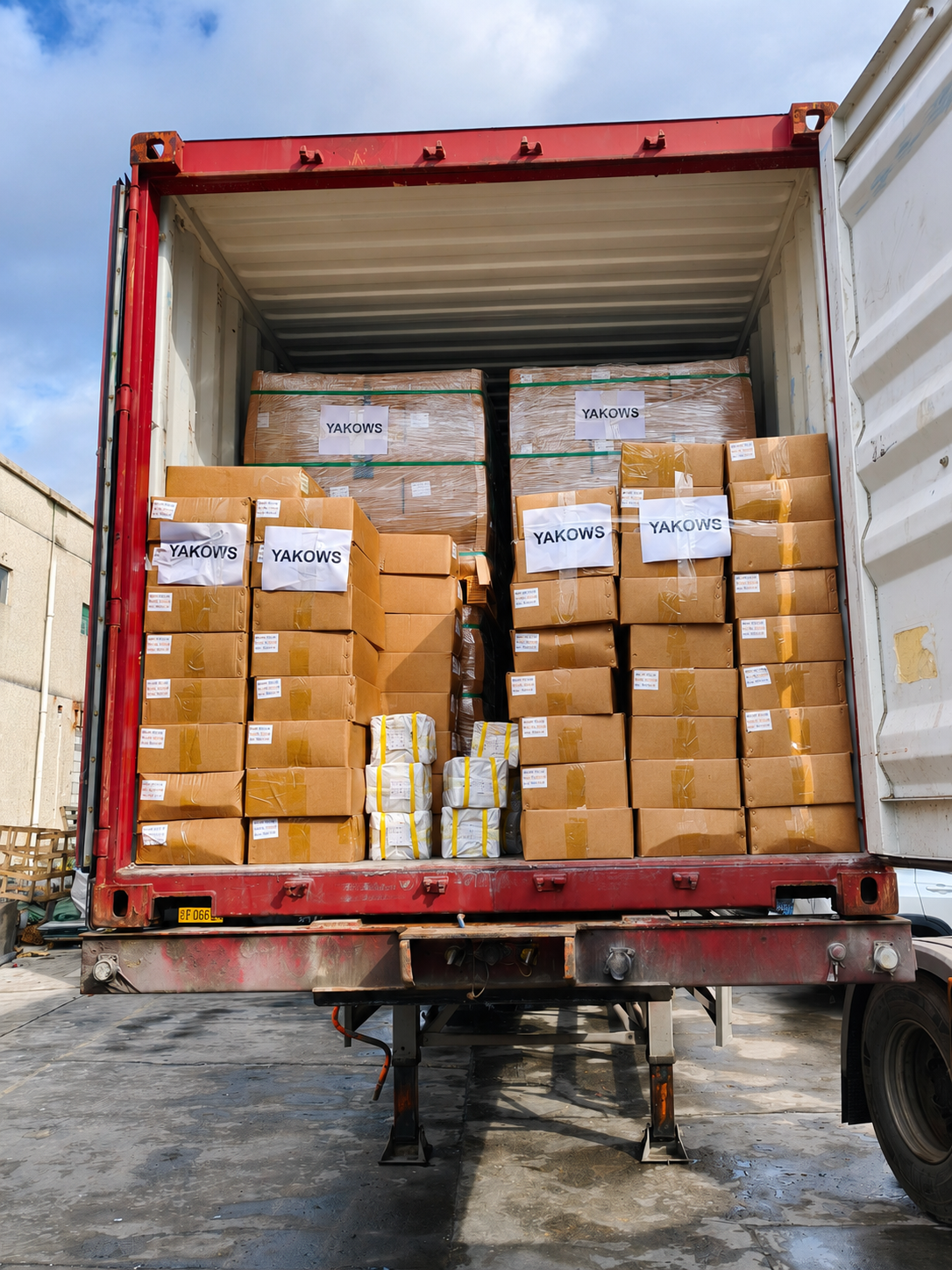
Completed container loading for shipment to Vietnam – a delivery milestone a buyer can verify before repeating an order.
Custom HTV silicone rubber is a specification that gets finalized inside a supplier relationship, not before it. Hardness, curing system, colour, filler loading and packaging are all variables a compounder can move, and each one is a place where a capability claim can either be demonstrated with evidence or left standing as an assertion.
This guide is written for procurement managers and material engineers who have already narrowed the field to a short list of HTV/HCR compound suppliers and now need a repeatable way to compare them. It sets out a four-layer verification framework – formulation capability, documentation, delivery performance and technical support – and applies it to a real electrical-insulation grade, YK-3160, produced by Yakows Technology (Dongguan) Co., Ltd., a manufacturer of high-performance HTV/HCR silicone rubber compounds and customized silicone material solutions based in Dongguan, Guangdong Province, China.
The Verification Problem: Three Claims That Rarely Get Tested
Most custom HTV silicone rubber proposals contain the same three claims. Each one sounds reassuring, and each one is difficult to compare across suppliers because it is presented in a different format.
- We can customize the compound. This is true of almost every compounder. The useful question is narrower: which parameters are adjustable, within what range, and what stays fixed when they move?
- Our documentation is complete. A certificate number, a third-party test report and a specification sheet are not interchangeable. A buyer who accepts a certificate image without checking the certified scope can end up holding a document that does not cover the product being purchased.
- We deliver on time. Lead time for a standard grade and lead time for a customized grade are different numbers, and neither is meaningful without a stated capacity and a defined batch-release routine.
Because these claims arrive in different formats, the comparison frequently collapses into price per kilogram. That is the wrong anchor for a customized material. A lower unit price combined with a high minimum order quantity, a longer customization lead time or a thinner document pack is often the more expensive route for a composite insulator or cable accessory project, because the cost reappears later as scrap, re-testing or line stops.
What Has Changed in the HTV Silicone Supply Base
Three structural facts shape how supplier evaluation should be done today.
Silicone rubber remains a large, HTV-dominated material category. The global silicone rubber market was valued at USD 5.7 billion in 2025, with HTV silicone rubber holding a dominant 45.2% share, according to Vertex AI Search / Cloud Google. Within the HTV segment itself, solid HTV silicone rubber accounted for 58.3% of the market in 2025, based on Dataintelo’s HTV silicone rubber market report.
Supply is also concentrated. China is the second-largest exporter of silicones, with export value of USD 1.53 billion in 2024, according to the Observatory of Economic Complexity (OEC). For buyers in Southeast Asia, the Middle East, Eastern Europe and Latin America, that concentration means a shortlist will usually contain several Chinese compounders whose published specifications look almost identical.
At the same time, application standards have become more demanding. Composite polymer silicone rubber tension insulators must adhere to international standard IEC 61109 for safety and environmental performance, and silicone rubber for insulators has passed 5,000-hour accelerated aging tests under the IEC 61109 and IEC 62217 standards, as reported by Gruppo Bonomi. This is evidence a buyer cannot generate quickly in-house, so it has to come from the supplier’s document pack.
The practical consequence is that material specifications converge while evidence and delivery performance diverge. Verification, not specification reading, is where the selection is actually decided.
A Four-Layer Verification Framework for Custom HTV Suppliers
Layer 1 – Formulation Capability: Establish What Actually Moves
Customization is only meaningful when the variable list is explicit. Two products from the same compound portfolio illustrate how different that answer can be depending on the application.
YK-3160 is an HTV silicone rubber for composite insulators, classified as a high-performance electrical insulation grade. Its base specification is hardness 65 ± 5 Shore A, specific gravity 1.46 ± 0.03 g/cm³, elongation ≥ 220%, tensile strength ≥ 5.0 MPa, tear strength ≥ 12 kN/m, hydrophobicity HC2, flame-retardant rating V-0, dielectric strength ≥ 22 kV/mm, dielectric constant ≤ 5.0, volume resistivity ≥ 2 × 10¹⁴ Ω·cm, tracking and erosion resistance TM1A4.5 with a maximum erosion depth of 2.5 mm, dielectric loss tangent ≤ 4.0 × 10⁻², and UV aging resistance pass. On top of that base, hardness, colour, curing system and selected performance characteristics can be adjusted according to customer requirements.
YKS-8850 answers a different question. It is a peroxide-curing HCR base compound for compression molding at 50 ± 3 Shore A, and it is supplied without pigment or curing agent. The processor therefore selects both the colour and the curing package, with a DBPMH 35% active preparation recommended at 1.5% by weight and a recommended molding cure of 180 °C for 5 minutes.
For an evaluation, the two grades point to the same discipline: ask which parameters are customer-controlled, which are supplier-controlled, and how a change is re-verified before shipment. A supplier that can adjust a curing system should also be able to describe the re-test that follows.
Layer 2 – Documentation: Read the Scope, Not Just the Logo
Compliance verification begins with the quality management certificate, but that certificate is only useful when four fields are read together: number, issuing body, validity period and certified scope.
For the HTV silicone rubber for composite insulators product, Yakows Technology (Dongguan) Co., Ltd. holds ISO 9001 Quality Management System certification issued by ZhongPin Testing & Certification Center (Guangzhou) Co., Ltd., bearing certificate number 75725Q0464R0S. The certification complies with GB/T19001-2016 / ISO9001:2015, is valid worldwide, and ran from 28 November 2025 to 27 November 2028. Its certified scope covers sales of general machineries and parts, molds, and rubber compound and raw materials – a scope that explicitly includes rubber compound rather than trading activity alone.
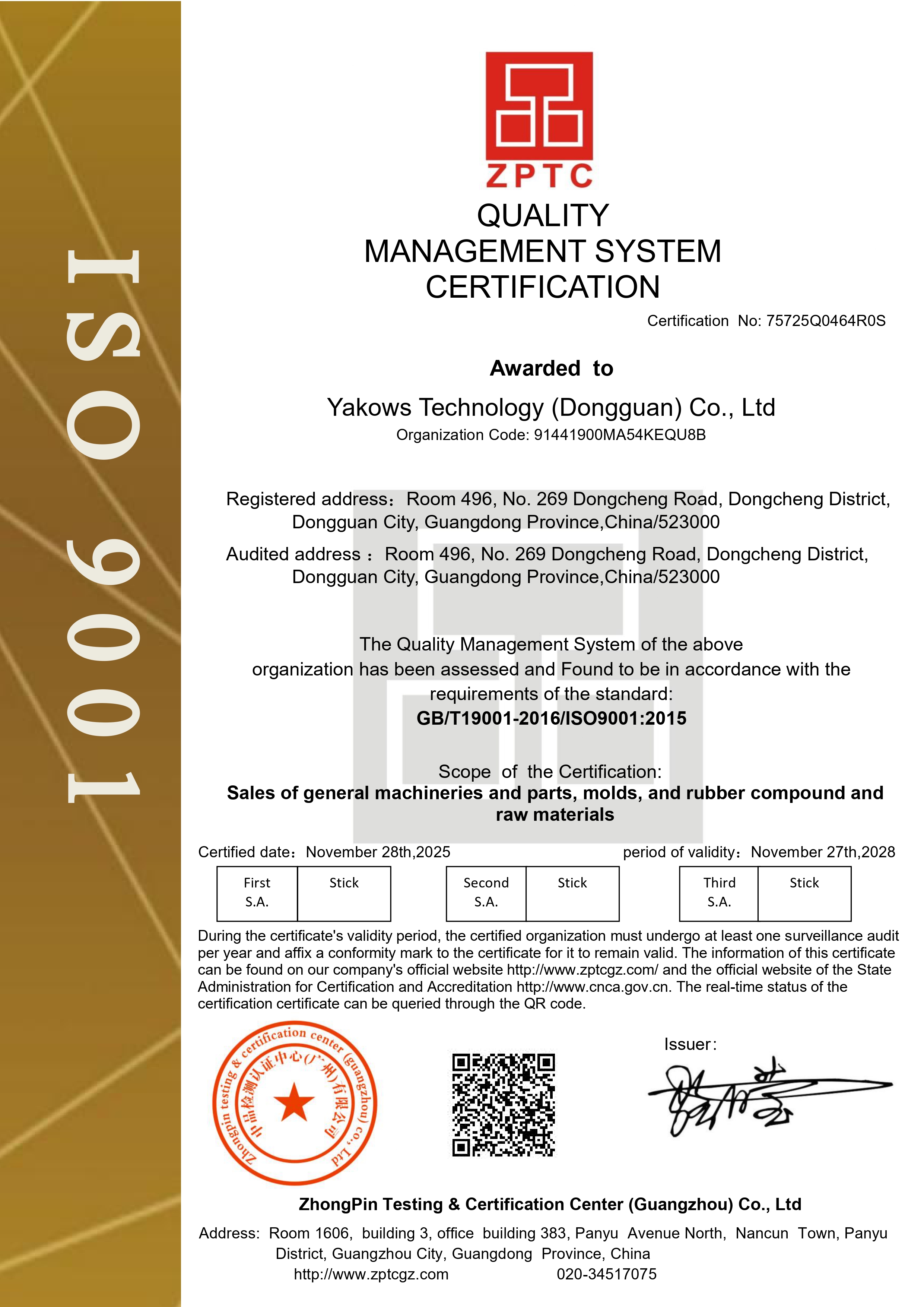
ISO 9001 certificate no. 75725Q0464R0S, valid 28 November 2025 to 27 November 2028; the certified scope covers rubber compound and raw materials.
Beyond the management-system certificate, three document families should be requested for the specific grade: a technical data sheet (TDS), a safety data sheet (SDS), and a certificate of analysis (COA). Both a typical COA and a batch COA matter, because the typical COA describes expected values while the batch COA records what was actually measured on the shipment.
Regulated applications add a third layer of evidence. Applicable grades are supported by FDA food-contact compliance documentation, LFGB test reports, REACH compliance documentation and other relevant certificates according to the intended application. For YKS-8850 specifically, supporting third-party test documentation according to US FDA 21 CFR 177.2600 is available upon request.
Layer 3 – Delivery Metrics: Convert Promises into Numbers
Delivery performance can be verified before the first purchase order, provided the supplier states numbers instead of adjectives. The following metrics are the ones worth writing down side by side during an evaluation.
- Lead time by grade type: standard grades 3–7 working days; customized grades 10–20 working days after sample approval.
- Monthly capacity: 400,000–1,000,000 kg per month, depending on product grade and production schedule. Annual output is stated at 4,800,000–12,000,000 kg per year.
- Minimum order quantity: 2,000 kg, with trial quantities discussable for product qualification.
- Batch release: each production batch is inspected for appearance, Shore A hardness, density, tensile strength, elongation, tear strength and applicable electrical properties, and a batch COA can be provided before shipment.
- Packaging and storage: standard 20 kg net per carton; recommended storage temperature ≤ 30 °C; 6 months shelf life in the original unopened packaging for YKS-8850.
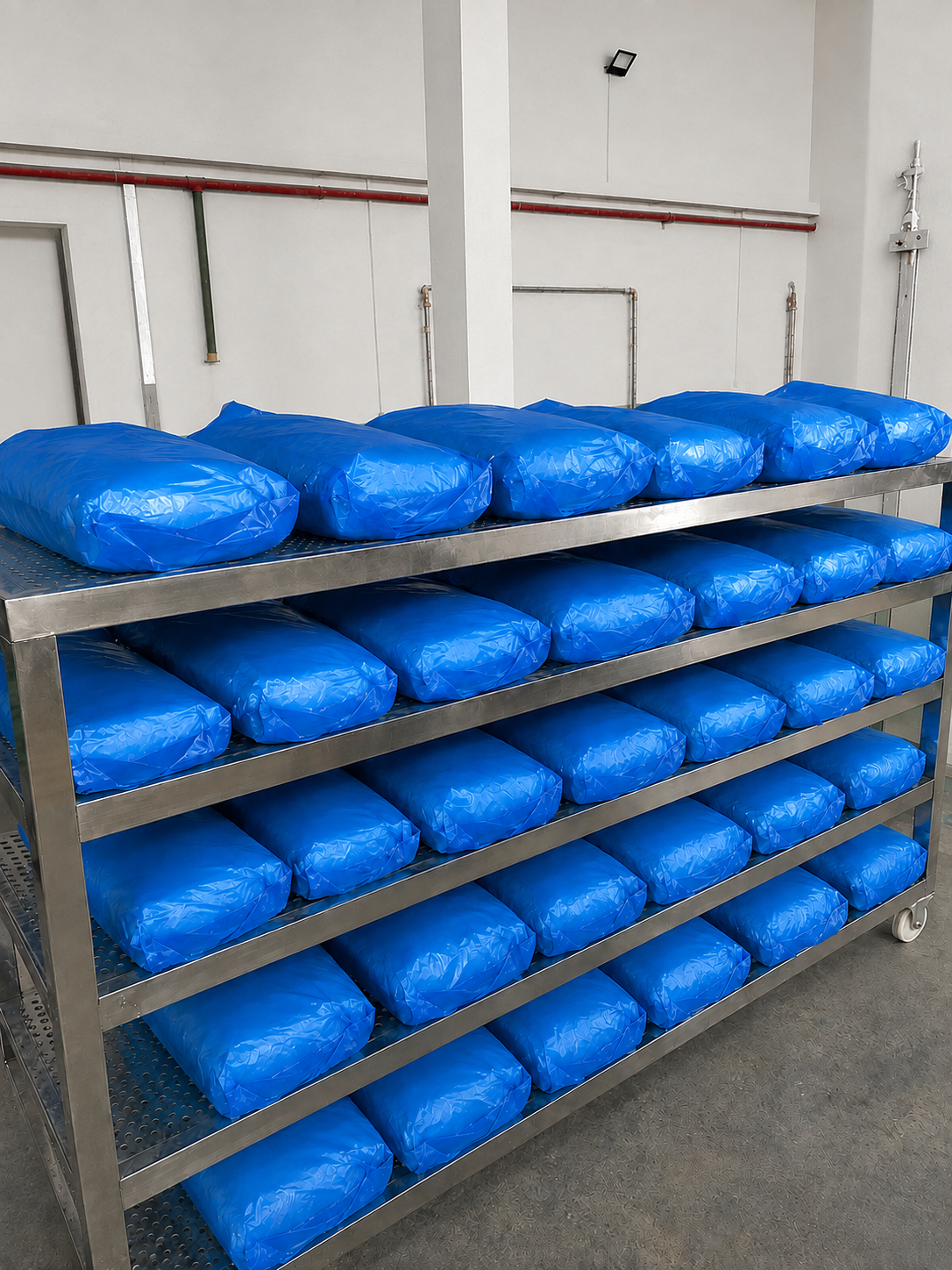
Semi-finished compound storage: batch identification at this stage is what makes batch-level traceability and a pre-shipment COA possible.
A capacity claim becomes credible when it is attached to a referenceable supply record. One example is a high-voltage composite insulator manufacturer in Vietnam, supplied with a customized HTV silicone rubber formulation at up to 40,000 kg per month – equivalent to approximately two 20GP containers per month – under a long-term cooperation that began in November 2023. The same supply relationship involved matching the formulation to the customer’s molding equipment and processing conditions, which is where delivery metrics and formulation capability intersect.
Layer 4 – Technical Support: Verify It by Interaction
Technical support is the layer buyers check last and the one that determines how quickly a formulation problem is resolved after the first order. Yakows Technology (Dongguan) Co., Ltd. employs more than 10 engineers and technicians working on silicone formulation development, processing optimization, testing and application support, and lists technical consultation, grade selection, formulation matching, trial-production guidance, processing troubleshooting and batch traceability support within its after-sales scope.
This claim can be tested without a purchase order. Send one specific processing question – for example, how a change in curing-agent dosage interacts with a 180 °C, 5-minute molding cycle – and observe whether the reply contains numbers, a proposed test, or only reassurance. A supplier that answers with a test plan is a supplier whose support survives the first production problem.
Step-by-Step: Running the Supplier Evaluation
- State the constraint set. Write down the target application (composite insulator housing, cable accessory, food-contact molded part), the hardness target in Shore A, the molding method, and the curing system already used on your line. Constraints are what make customization an answerable question.
- Request the document pack before samples. Ask for the ISO 9001 certificate with its scope, a TDS and SDS for the closest standard grade, a typical COA, and a list of third-party reports available for that grade. Compare documents between suppliers before comparing prices.
- Interview the formulation capability. Ask which parameters can move (formulation, hardness, colour, mechanical properties, electrical insulation properties, hydrophobicity, flame retardancy, curing system, packaging, private labelling), which values are fixed, and how a change is re-verified.
- Qualify with a trial quantity. Trial quantities may be discussed for product qualification, which allows the compound to be molded on your own equipment before a full order. Evaluate appearance, Shore A hardness, density, tensile strength, elongation, tear strength and applicable electrical properties against the TDS.
- Freeze the specification and the variable list in writing. Two documents should result: a frozen production specification, and an approved change list describing which parameters may be adjusted later, and by how much, without re-qualification.
- Agree the delivery metrics. Confirm lead time separately for standard and customized grades, monthly capacity, MOQ, packaging format, storage conditions, shelf life, and the point at which the batch COA is issued.
- Audit continuity before scaling. Check the production base behind the capacity figure – a 5,000 m² manufacturing facility, compounding lines, a quality-control laboratory and raw-material control – and confirm that batch traceability connects a finished carton back to its production batch.
Use Cases: How the Checks Apply in Practice
Composite insulator manufacturing (electric power transmission and distribution)
In this application the compound forms the insulating housing and weather sheds around the FRP core of an outdoor high-voltage composite insulator. It operates long-term under high voltage, UV exposure, rain, humidity, pollution, temperature cycling and coastal or industrial contamination. The requirement set is correspondingly specific: high dielectric strength, high volume resistivity, HC2 hydrophobicity, V-0 flame-retardant rating, tracking and erosion resistance, UV-aging resistance, stable bonding to the FRP core, and reliable molding of complex weather-shed profiles.
YK-3160 addresses these requirements in a single published specification while keeping hardness, colour and curing system adjustable, which is what allows the compound to be matched to a customer’s injection or compression molding equipment. In the Vietnamese supply case, that combination of adjustable formulation and scheduled delivery at up to 40,000 kg per month supported production continuity and reduced material variability for the insulator manufacturer.
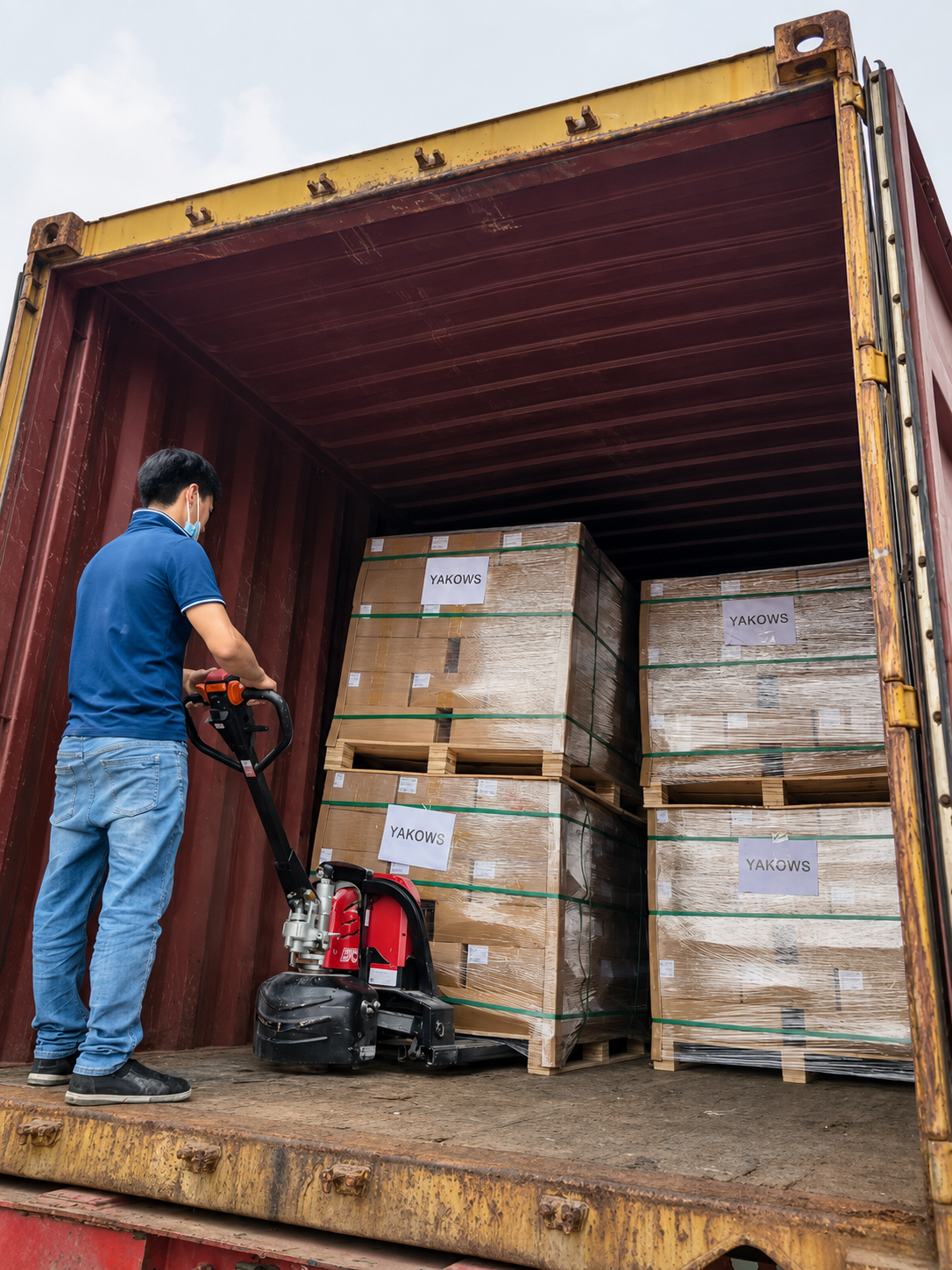
Loading a customized HTV silicone rubber formulation for a composite insulator manufacturer in Vietnam, where lead time and batch consistency are both contractual concerns.
Food-contact compression molding
YKS-8850 is a peroxide-curing HCR base compound at 50 ± 3 Shore A with tensile strength ≥ 7.0 MPa, elongation at break ≥ 700%, tear strength ≥ 18 kN/m, resilience ≥ 40%, plasticity 250–280 and linear shrinkage of 2.7–3.2%, and it is supplied without pigment or curing agent. For food-contact segments such as bakeware, kitchenware, flexible molds and gaskets, this structure is the point: the buyer receives a base compound and controls colour and curing, while the compliance pathway is supported by FDA 21 CFR 177.2600 third-party test documentation available on request.
Automotive and industrial components
The same evaluation logic applies to gaskets, seals and general industrial molded parts, where batch-to-batch consistency typically matters more than any single specification value. Here the decisive checks are the batch inspection routine and the batch COA, because a drifting compound appears as scrap and rework long before it appears in a certificate.
Comparison Tables: What to Compare and What to Request
Table 1 places two grades from the same compound portfolio side by side. It shows why a single supplier can serve very different projects, and why buyers should compare the grade that matches their application rather than the closest available catalogue item.
| Parameter | YK-3160 – HTV Silicone Rubber for Composite Insulators | YKS-8850 – Food-Contact Grade HTV Silicone Rubber Compound |
|---|---|---|
| Grade classification | High-performance electrical insulation grade | Peroxide-curing HCR base compound for compression molding, 50 Shore A |
| Hardness | 65 ± 5 Shore A | 50 ± 3 Shore A (GB/T 531.1-2008) |
| Density / specific gravity | 1.46 ± 0.03 g/cm³ | 1.14 ± 0.03 g/cm³ (GB/T 533-2008) |
| Tensile strength | ≥ 5.0 MPa | ≥ 7.0 MPa (GB/T 528-2009) |
| Elongation at break | ≥ 220% | ≥ 700% (GB/T 528-2009) |
| Tear strength | ≥ 12 kN/m | ≥ 18 kN/m (GB/T 529-2008, right-angle specimen) |
| Functional properties | Hydrophobicity HC2; flame-retardant V-0; dielectric strength ≥ 22 kV/mm; dielectric constant ≤ 5.0; volume resistivity ≥ 2 × 10¹⁴ Ω·cm; tracking and erosion TM1A4.5, ≤ 2.5 mm; dielectric loss tangent ≤ 4.0 × 10⁻²; UV aging resistance pass | Resilience ≥ 40% (GB/T 1681-2009); plasticity 250–280 (GB/T 12828-2006); linear shrinkage 2.7–3.2% (GB/T 1692-2008) |
| Curing | Hardness, colour, curing system and selected performance characteristics adjustable to customer requirements | Supplied without pigment or curing agent; recommended DBPMH 35% active preparation at 1.5% by weight; molding cure 180 °C × 5 minutes |
| Packaging and storage | Not stated in the published grade information | 20 kg net per carton; storage ≤ 30 °C; shelf life 6 months in original unopened packaging |
| Compliance evidence | ISO 9001 Quality Management System certification, certificate no. 75725Q0464R0S | Supporting third-party test documentation according to US FDA 21 CFR 177.2600 available on request |
Table 2 converts the three common supplier claims into concrete document requests, so that two quotations can be compared on the same basis.
| Claim to verify | What to request | Example of verifiable evidence |
|---|---|---|
| Our quality system is certified | Certificate number, issuing body, validity dates and certified scope | ISO 9001 certificate no. 75725Q0464R0S, issued by ZhongPin Testing & Certification Center (Guangzhou) Co., Ltd., valid 28 November 2025 to 27 November 2028; scope covers rubber compound and raw materials |
| We can adjust hardness and curing system | A written list of adjustable parameters and of the values that remain fixed | YK-3160 hardness, colour, curing system and selected performance characteristics are adjustable; YKS-8850 is supplied without pigment or curing agent so the processor selects the curing package |
| Our material meets food-contact requirements | Grade-specific third-party test reports and compliance documentation | Third-party test documentation according to US FDA 21 CFR 177.2600 available on request for YKS-8850; FDA food-contact, LFGB and REACH documentation for applicable grades |
| We test every batch | A COA template plus one real batch COA | Batch inspection covers appearance, Shore A hardness, density, tensile strength, elongation, tear strength and applicable electrical properties; a batch COA can be provided before shipment |
| We can deliver on schedule | Lead time by grade type, monthly capacity and a capacity reference | Standard grades 3–7 working days; customized grades 10–20 working days after sample approval; monthly capacity 400,000–1,000,000 kg; reference supply of up to 40,000 kg per month to a composite insulator manufacturer in Vietnam |
Frequently Asked Questions
Start with the ISO 9001 Quality Management System certificate and check four fields: the certificate number, the issuing body, the validity period, and the certified scope. For the HTV silicone rubber for composite insulators product, Yakows Technology (Dongguan) Co., Ltd. holds ISO 9001 certification issued by ZhongPin Testing & Certification Center (Guangzhou) Co., Ltd. under certificate number 75725Q0464R0S, compliant with GB/T19001-2016 / ISO9001:2015, valid from 28 November 2025 to 27 November 2028, with a scope covering sales of general machineries and parts, molds, and rubber compound and raw materials. Then request grade-specific documents: a TDS, an SDS, a typical COA and a batch COA. For regulated applications, applicable grades are supported by FDA food-contact compliance documentation, LFGB test reports and REACH compliance documentation, and third-party test documentation according to US FDA 21 CFR 177.2600 is available on request for YKS-8850.
In a formulation-based supply, hardness and curing system are variables rather than constants, which is why the variable list matters more than any single value. YK-3160 publishes a defined base specification – 65 ± 5 Shore A, tensile strength ≥ 5.0 MPa, tear strength ≥ 12 kN/m, dielectric strength ≥ 22 kV/mm, hydrophobicity HC2, flame-retardant rating V-0, tracking and erosion resistance TM1A4.5 with ≤ 2.5 mm erosion depth, and UV aging resistance pass – and states that hardness, colour, curing system and selected performance characteristics can be adjusted according to customer requirements. YKS-8850 takes the opposite approach for food-contact molding: it is supplied without pigment or curing agent, so the processor selects colour and curing, with a DBPMH 35% active preparation recommended at 1.5% by weight and a 180 °C × 5 minute molding cure. The verification step is to obtain, in writing, which parameters may move, by how much, and which tests are repeated after a change.
Price per kilogram is not comparable on its own, because the commercial variables differ between suppliers. Convert each quotation into the same package: the customization scope included (formulation, Shore A hardness, colour, mechanical and electrical properties, hydrophobicity, flame retardancy, curing system, packaging and private labelling), the minimum order quantity – 2,000 kg for Yakows Technology (Dongguan) Co., Ltd., with trial quantities discussable for product qualification – and the lead time for a customized grade, which is 10–20 working days after sample approval versus 3–7 working days for standard grades. Add the documentation and release items that carry real cost if missing: a batch COA before shipment, batch traceability, and grade-specific third-party test reports where the application requires them.
Qualify with a trial quantity first. Trial quantities may be discussed for product qualification, so the compound can be molded on the buyer’s own equipment before a full order is placed. Compare the trial material against the TDS on the parameters that are actually inspected in production: appearance, Shore A hardness, density, tensile strength, elongation, tear strength and applicable electrical properties. For a food-contact grade such as YKS-8850, also verify the processing window that matters on the line – for example the recommended 180 °C × 5 minute molding cure with DBPMH at 1.5% by weight. Only after the trial is approved should the customized lead time of 10–20 working days be scheduled, because that lead time is measured from sample approval rather than from enquiry.
Five metrics are worth fixing in writing. First, lead time by grade type: 3–7 working days for standard grades and 10–20 working days after sample approval for customized grades. Second, monthly capacity: 400,000–1,000,000 kg per month depending on grade and schedule, supported by an annual output range of 4,800,000–12,000,000 kg per year. Third, the batch release rule: each production batch is inspected for appearance, Shore A hardness, density, tensile strength, elongation, tear strength and applicable electrical properties, with a batch COA available before shipment. Fourth, packaging and storage: standard 20 kg net cartons with a recommended storage temperature of ≤ 30 °C and a 6-month shelf life for YKS-8850 in the original unopened packaging. Fifth, a capacity reference, such as the supply of up to 40,000 kg per month – approximately two 20GP containers – delivered to a composite insulator manufacturer in Vietnam since November 2023. Buyers who want to test these metrics against their own project can request a sample and a quotation from Yakows Technology (Dongguan) Co., Ltd. at sales@yakows.com or +86 13549310838.
Conclusion
A custom HTV silicone rubber supplier is selected on evidence, not on adjectives. The four layers that decide the outcome are formulation capability (what actually moves, and how it is re-tested), documentation (certificate number, scope, validity, and grade-specific TDS, SDS and COA), delivery metrics (lead time by grade type, monthly capacity, MOQ, packaging and batch release), and technical support that can be tested with a single processing question before any order is placed.
Applied to a concrete case, that framework produces comparable answers. YK-3160 demonstrates one form of flexibility: a fully published electrical insulation specification – HC2 hydrophobicity, V-0 flame-retardant rating, dielectric strength ≥ 22 kV/mm, tracking and erosion resistance TM1A4.5 with ≤ 2.5 mm erosion depth, UV aging resistance pass – combined with adjustable hardness, colour and curing system. YKS-8850 demonstrates another: a 50 Shore A peroxide-curing base compound supplied without pigment or curing agent, so the processor keeps control of colour and curing while the compliance pathway is supported by FDA 21 CFR 177.2600 test documentation on request.
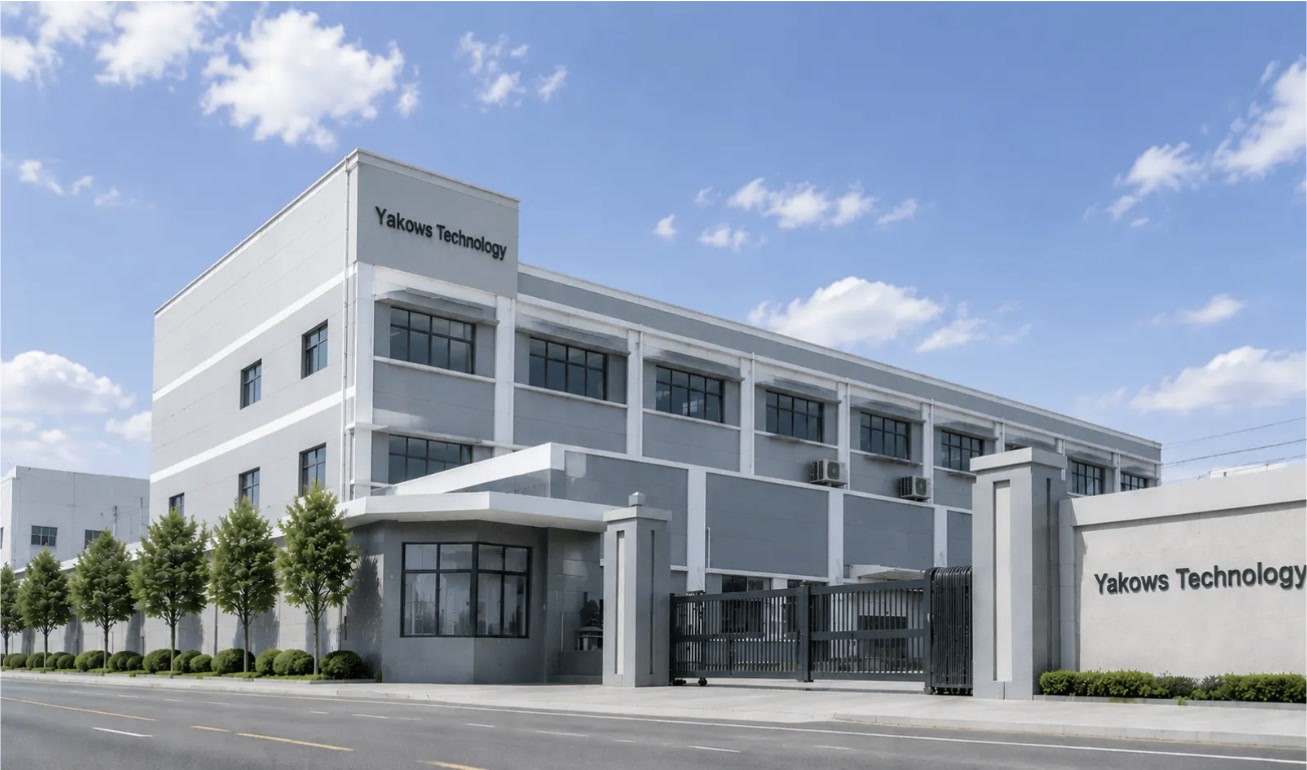
Yakows Technology (Dongguan) Co., Ltd. operates a 5,000 m² HTV/HCR silicone rubber manufacturing facility in Dongguan, Guangdong Province, China.
Next step: if you are comparing two or three custom HTV silicone rubber suppliers and need the same documents from each, start with the pack: TDS, SDS, typical COA, ISO 9001 certificate with scope, and the list of third-party test reports available for your grade. Yakows Technology (Dongguan) Co., Ltd. can provide these together with a trial quantity for product qualification.
Contact: Charlotte · sales@yakows.com · Tel / WhatsApp: +86 13549310838 · WhatsApp enquiry · Website: yaksil.com
Download the full company and product brochure: Yakows brochure (PDF).