
Food-Contact HTV Silicone Rubber Sourcing: A Supplier Vetting and FDA Compliance Workflow
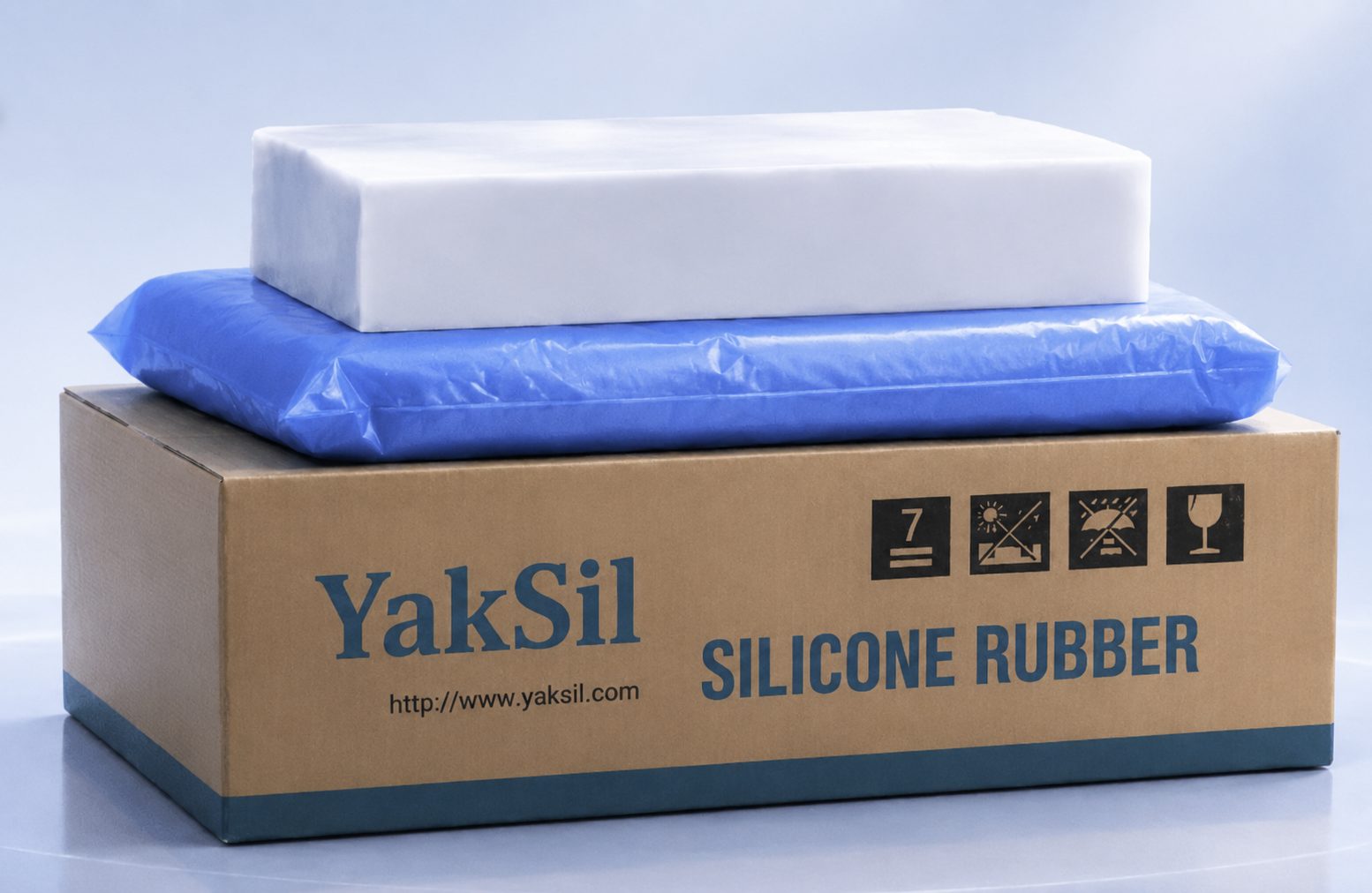
Food-contact grade HTV silicone rubber arrives as a base compound. Compliance and performance are completed at the compounding, coloring and curing stage.
Food-contact grade HTV silicone rubber is bought as a base compound, not as a finished and pre-certified part. That single fact explains why supplier vetting for food-contact programs is decided less by the wording on a certificate and more by who issues the test documentation, which grade that documentation actually covers, and how the buyer own pigment and curing agent behave once they are mixed into the compound.
This guide is written for procurement teams and material engineers evaluating suppliers of food-contact HTV and HCR silicone rubber. It works through US FDA 21 CFR 177.2600 verification using third-party test documentation available upon request, uses the YKS-8850 food-contact base compound from Yakows Technology (Dongguan) Co., Ltd. as a concrete reference specification, and sets out the questions that separate a documented supplier from a merely promising one.
Problem Definition: Four Ways Food-Contact HTV Sourcing Fails Before the First Shipment
Four failure modes recur in food-contact silicone programs, and none of them is about price.
1. A compliance claim is treated as a document. Many suppliers describe a compound as food-grade inside a quotation line. A quotation line is not evidence. What a procurement file needs is third-party test documentation issued with reference to US FDA 21 CFR 177.2600 and available upon request, plus a clear statement of which grade and which test scope that report covers.
2. The base compound is confused with the finished formulation. YKS-8850 is supplied as a high-consistency (HCR/HTV) base compound without pigment or curing agent. Color and cure system are therefore added later, by the molder, the buyer, or the compound manufacturer, depending on the agreement. Cure efficiency, surface appearance, odor and the compliance position of the final article all depend on those additions and on their compatibility with the base polymer.
3. Specifications are screened without process context. A hardness of 50 plus or minus 3 Shore A and a plasticity of 250 to 280 describe how a compound behaves in a press, not only how the finished part will feel. A specification that looks acceptable on paper can still underperform if press type, mold temperature control or part thickness is not matched.
4. Documentation arrives after tooling. Requesting the test pack after the mold is cut removes the buyer only real leverage: the ability to change supplier while the change is still cheap.
Industry Background: Where Food-Contact HTV Sits in the Silicone Market
Silicone compound sourcing decisions are made inside a market that is large, concentrated and still expanding on the supply side.
- The global silicone rubber market was valued at USD 5.7 billion in 2025, with HTV silicone rubber holding a dominant 45.2% market share (source: Vertex AI Search / Cloud Google). Estimates for the same year differ substantially between research bodies depending on whether primary forms, secondary forms or specific elastomer categories are counted, so this figure is best used to gauge relative weight rather than absolute scale.
- Within the HTV segment, solid HTV silicone rubber held 58.3% of the market in 2025 (source: Dataintelo), which is the form most food-contact compression molders process.
- Supply capacity in China expanded quickly: China silicone monomer production capacity reached 6.89 million tons in 2024, a 21.09% year-on-year increase (source: Zhuochuang Information via IOTA). Wider monomer availability supports compounding capacity, but it does not by itself produce more suppliers who can document food-contact compliance.
- Global silicone trade reached USD 8.51 billion in 2024, with China the second-largest exporter at USD 1.53 billion (source: OEC, Observatory of Economic Complexity). Offshore sourcing of silicone compounds is therefore normal practice rather than an exception.
- Adjacent regulated demand is growing: the global medical grade silicone market is estimated at USD 1.77 billion in 2025 and growing at a CAGR of 6.41% (source: Mordor Intelligence). Food-contact grades belong to the same family of regulated compounds and are vetted with similar documentation logic.
On the regulatory side, the reference point for US food-contact applications is US FDA 21 CFR 177.2600, which addresses rubber articles intended for repeated use. European and other markets typically rely on LFGB test reports and REACH compliance documentation, so suppliers serving multiple regions usually maintain separate document sets for each destination.
Yakows Technology (Dongguan) Co., Ltd. is a manufacturer of HTV and HCR silicone rubber compounds established in 2020, operating a 5,000 square meter facility in Dongguan, China, with approximately 50 employees, a technical department of 10 engineers and a monthly production capacity of 400,000 to 1,000,000 kg. Its quality management system is certified to ISO 9001, and applicable product grades are supported by FDA food-contact compliance documentation, LFGB test reports and REACH compliance documentation.
Detailed Solution: YKS-8850 as a Reference Specification for Food-Contact Sourcing
A food-contact HTV compound should be vetted against three blocks of evidence: a fully declared base compound specification, a documented cure-system recommendation, and a document pack that can be issued before the order rather than after it.
YKS-8850 is a Food-Contact Grade HTV Silicone Rubber Compound, classified as a peroxide-curing HCR base compound for compression molding at 50 Shore A. It is made from a high-consistency silicone rubber (HCR/HTV) base compound, belongs to the food-contact silicone products category, and is intended for the food-contact silicone industry.
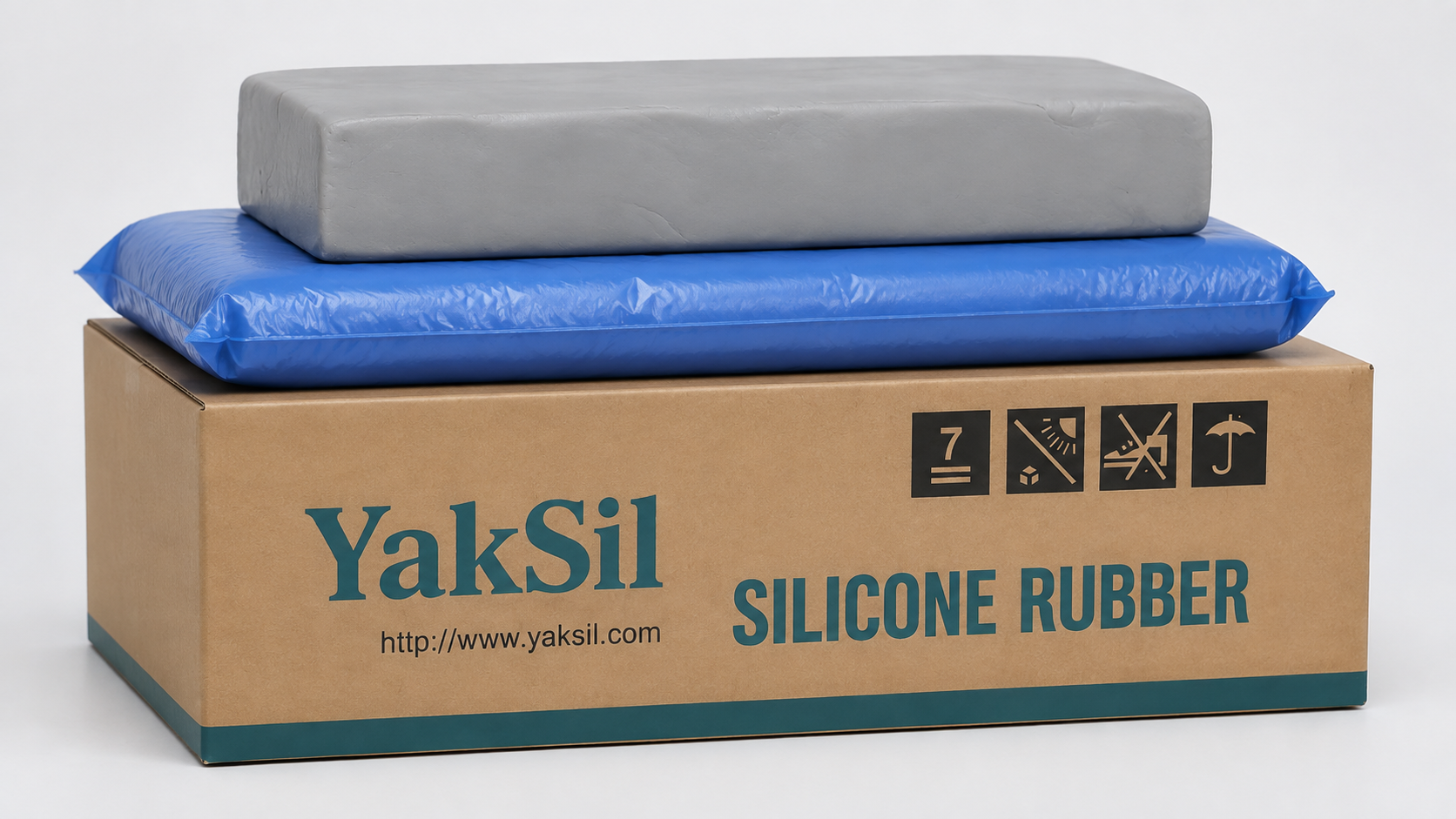
A declared base compound specification is the starting point of supplier vetting, not the end of it.
| Property | YKS-8850 | Test method | Why procurement cares |
|---|---|---|---|
| Appearance | Milky white to slightly yellow | Declared | Confirms an unpigmented base compound, so final color is a buyer decision. |
| Hardness | 50 plus or minus 3 Shore A | GB/T 531.1-2008 | Sets the feel and compression behavior of the molded part. |
| Density | 1.14 plus or minus 0.03 g/cm3 | GB/T 533-2008 | Converts part volume into material consumption and cost per piece. |
| Plasticity | 250 to 280 | GB/T 12828-2006 | Indicates how the compound bands on the mill and flows in the mold. |
| Tensile strength | not less than 7.0 MPa | GB/T 528-2009 | Baseline mechanical performance of the cured part. |
| Elongation at break | not less than 700% | GB/T 528-2009 | Supports flexible, thin-walled and high-stretch products. |
| Tear strength | not less than 18 kN/m | GB/T 529-2008, right-angle specimen | Governs resistance to tearing during demolding and in service. |
| Resilience | not less than 40% | GB/T 1681-2009 | Recovery behavior for seals, gaskets and repeated-use parts. |
| Linear shrinkage | 2.7 to 3.2% | GB/T 1692-2008, molding method | Mold dimension planning and tolerance stack-up. |
| Recommended molding cure | 180 degrees C for 5 minutes | Supplier recommendation | Starting point for press trials and cycle planning. |
| Recommended curing agent | DBPMH, 35% active preparation | Supplier recommendation | Defines the peroxide cure system to be purchased separately. |
| Recommended dosage | 1.5% by weight | Supplier recommendation | Basis for additive purchasing and recipe control. |
| Packaging | 20 kg net per carton | Standard packaging | Handling, storage and production planning. |
| Storage | Not above 30 degrees C, original unopened packaging | Recommended | Warehouse condition control and handling rules. |
| Shelf life | 6 months | Recommended | Order sizing and inventory rotation. |
Read together, these values describe a flexible food-contact compound. A tensile strength of at least 7.0 MPa combined with an elongation at break of at least 700% is the profile of a material intended to stretch and recover rather than to hold rigidity. Tear strength of at least 18 kN/m is the value that matters most at the demolding stage, particularly for bakeware corners and thin gasket lips, which is why high tear silicone rubber grades are usually preferred for parts with sharp radii. Linear shrinkage of 2.7 to 3.2% is a mold-design input, and it should be agreed before the mold is ordered, not after the first shots are measured.
Verifying FDA 21 CFR 177.2600 Compliance Without Guesswork
Compliance with US FDA 21 CFR 177.2600 for a food-contact HTV compound is verified through third-party test documentation issued against that regulation, supported by a document chain that allows the buyer to trace the specific delivered lot. It is not verified by a supplier statement.
Yakows Technology (Dongguan) Co., Ltd. states that supporting third-party test documentation according to US FDA 21 CFR 177.2600 is available upon request, and that grade-specific documents including TDS, SDS, typical COA, batch COA and applicable third-party test reports can be provided to support customer evaluation and product approval. ISO 9001 certification of the quality management system, LFGB test reports and REACH compliance documentation make up the remainder of the usual multi-market file.
| Document | Typically issued by | What it supports | What it does not replace |
|---|---|---|---|
| ISO 9001 certificate | Certification body | Confirms a standardized quality management system | Grade-specific food-contact compliance evidence |
| Technical Data Sheet (TDS) | Compound manufacturer | Declared properties and processing recommendations | Independent verification of those properties |
| Safety Data Sheet (SDS) | Compound manufacturer | Handling, transport and storage information | Food-contact suitability of the grade |
| Typical COA | Compound manufacturer | Representative batch values for the grade | The measured values of the specific lot delivered |
| Batch COA | Compound manufacturer | Traceability of the delivered production lot | Third-party test scope or regulatory coverage |
| Third-party test documentation according to US FDA 21 CFR 177.2600 | Independent testing laboratory | Food-contact compliance evidence for the tested grade, available upon request | Compliance of another grade, or of the buyer final recipe after pigment and curing agent are added |
| LFGB test reports | Independent testing laboratory | Evidence for European food-contact expectations | US market compliance |
| REACH compliance documentation | Compound manufacturer or laboratory | Substance compliance for EU market supply | Food-contact migration assessment |
Four checks turn a document pack into usable evidence. First, the issuer: a third-party laboratory report carries different weight from an internal declaration. Second, the scope: the report must name the grade under evaluation, in this case the YKS-8850 base compound. Third, the test conditions: which standard, which specimen and which extraction or migration conditions were applied. Fourth, the batch linkage: the report should be traceable to the lot being shipped through the accompanying batch COA.
Curing Agent, Pigment and Additive Compatibility: The Questions Buyers Must Ask
Because YKS-8850 is supplied without pigment or curing agent, the vulcanization step and the coloring step are completed by the buyer or the molder. The supplier reference for that step is a DBPMH curing agent at 35% active preparation, dosed at 1.5% by weight, with a recommended molding cure of 180 degrees C for 5 minutes.
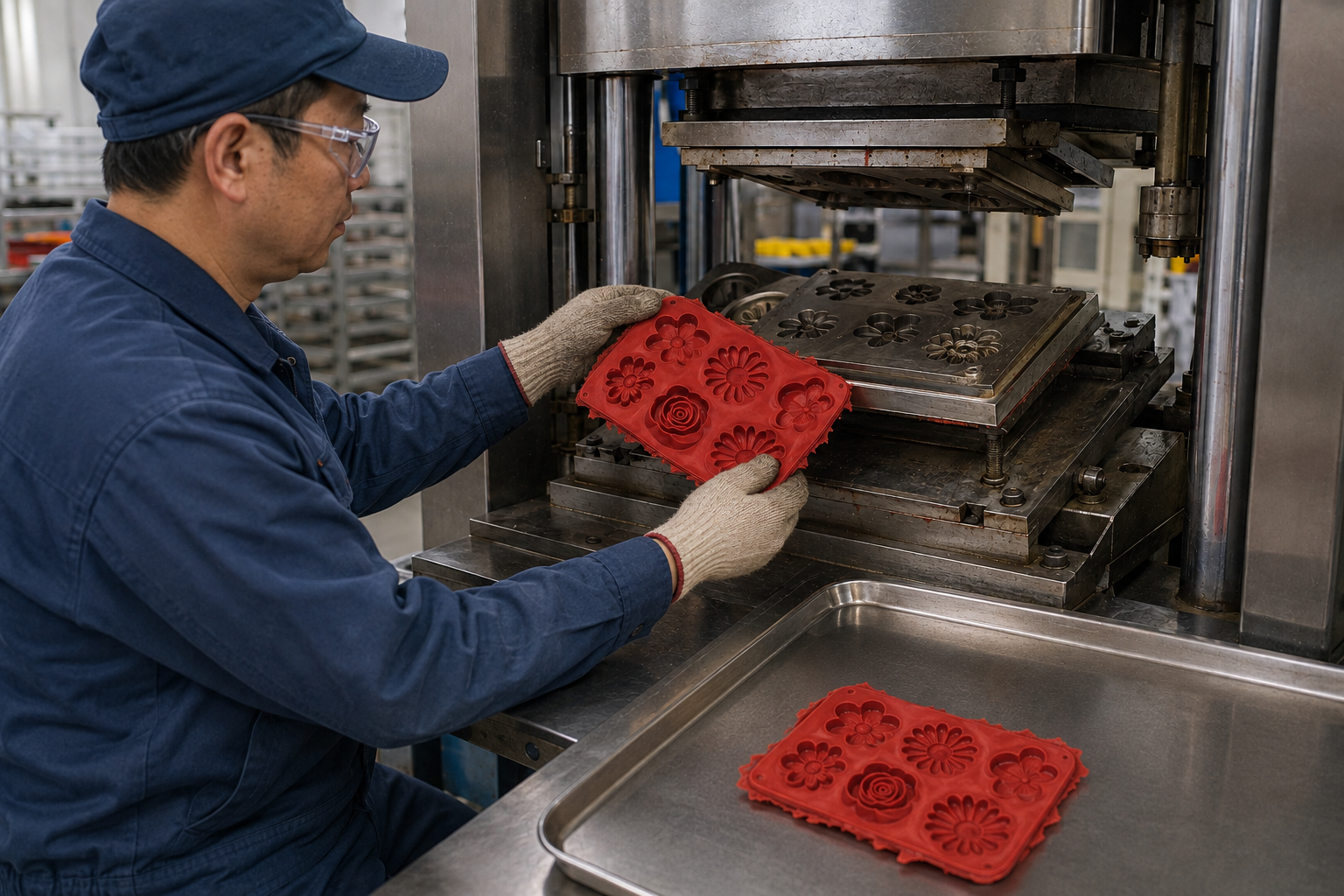
The curing agent and color masterbatch are added after the base compound leaves the factory, so responsibility for the final recipe should be agreed in writing.
The reference cure is a starting point, and the following questions should be answered in writing before the first production order:
- Is the recommended 1.5% by weight dosage calculated on the base compound weight, and does the supplier confirm that basis?
- Which color masterbatch carriers are compatible with a peroxide cure system at food-contact level, and does the supplier review the buyer proposed pigment before it is used?
- Does the supplier provide written guidance if the part geometry, thickness or press type differs from the reference condition?
- Will the supplier document the agreed cure system in the TDS or in a separate technical note that can be filed with the compliance pack?
- After pigment and curing agent are added, does the supplier state that the compound remains within the declared food-contact scope, or does the finish part require separate testing?
On custom formulation capability, Yakows Technology (Dongguan) Co., Ltd. states that its integrated manufacturing capabilities cover raw-material control, formulation development, compounding, hardness and color customization, process optimization, laboratory testing, batch inspection, packaging and container delivery, and that it supplies customized HTV and HCR silicone rubber compounds. For a buyer, that matters because a compound that ships without pigment or curing agent is only useful if the supplier can answer additive and cure-system questions after delivery, not only before the quotation.
Step-by-Step Supplier Vetting Workflow for Food-Contact HTV
- Fix the regulatory route and the end use first. Decide whether the target market requires US FDA 21 CFR 177.2600 evidence, LFGB test reports, REACH compliance documentation or a combination, and describe the final article: bakeware, kitchenware, flexible mold, gasket or another compression-molded product. The document set follows the destination market, not the supplier preference.
- Request the full document pack at the RFQ stage. Ask for TDS, SDS, typical COA, batch COA, the ISO 9001 certificate and applicable third-party test reports in the same message as the price request. A supplier that cannot list its own documents at RFQ stage will usually not produce them at order stage either.
- Verify the test report itself. Check the testing laboratory, the grade named in the report, the standard referenced, the test conditions and the report date. A report that does not name the grade you are buying is background information, not qualification evidence.
- Screen the base compound specification against your process. Compare hardness, density, plasticity, tensile strength, elongation, tear strength, resilience and linear shrinkage against the requirements of the part and the capability of the press. Use the declared test methods, such as GB/T 528-2009 for tensile and elongation and GB/T 529-2008 for tear strength, as the comparison basis.
- Confirm the curing system in writing. Establish the curing agent type, active content and dosage, and the recommended molding cure. For YKS-8850 the supplier reference is DBPMH at 35% active preparation, 1.5% by weight, molded at 180 degrees C for 5 minutes.
- Confirm pigment and additive compatibility. Since the base compound contains neither, agree who selects the color masterbatch, who verifies compatibility with the peroxide cure system, and who owns the compliance position of the finished part.
- Run a trial on production equipment and measure. Cure the sample with the intended pigment and curing agent, then measure hardness, density, tensile strength, elongation, tear strength, resilience and shrinkage, and inspect demolding behavior, surface appearance and odor. Where the market requires it, send trial parts for third-party food-contact testing in parallel.
- Lock supply, packaging and shelf life. Confirm the monthly capacity available to your program, the packaging unit, the recommended storage temperature and the shelf life, and require a batch COA with each delivery so that traceability continues after qualification.
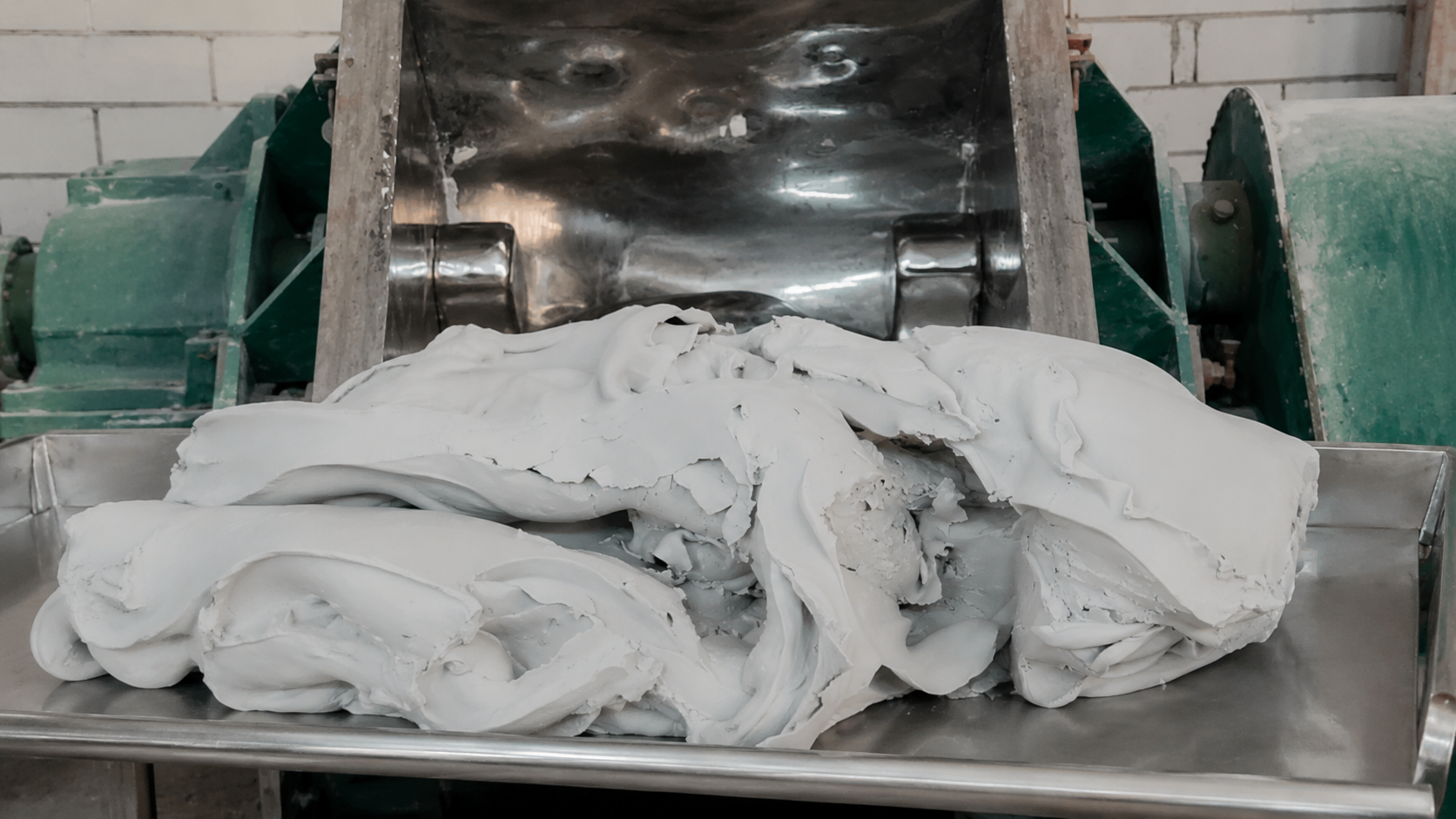
Batch inspection and packaging control are part of the qualification file, not separate from it.
Use Cases: Where Food-Contact HTV Compounds Are Specified
YKS-8850 is intended for food-contact silicone products, bakeware and kitchenware, flexible molds, gaskets and seals, and general compression-molded silicone products. Each of these applications places a different emphasis on the same specification.
- Bakeware and kitchenware. Elongation and tear strength dominate, because the part is repeatedly flexed, washed and demolded. Heat-resistant silicone rubber behavior under oven conditions should be confirmed against the declared specification rather than assumed.
- Flexible molds. Linear shrinkage of 2.7 to 3.2% and plasticity of 250 to 280 drive the reproduction accuracy of the molded cavity, so both values should be agreed with the mold designer.
- Gaskets and seals. Resilience of at least 40% and a hardness of 50 Shore A determine compression set behavior and sealing force in repeated-use applications such as food processing equipment and closures.
- General compression-molded products. Density tolerance of plus or minus 0.03 g/cm3 sets the material yield, which is relevant when a program runs in the hundreds of thousands of pieces.
Comparing Sourcing Paths for Food-Contact HTV Compounds
Food-contact HTV compounds reach buyers through three broad sourcing paths. The comparison below uses publicly stated facts and should be read as a filter for questions, not as a ranking.
| Dimension | Dedicated HTV / HCR compound manufacturer | Large integrated silicone producer | Trading intermediary or reseller |
|---|---|---|---|
| Who issues the technical documents | The compound manufacturer issues TDS, SDS, typical COA and batch COA, and provides applicable third-party test reports | Corporate documentation issued by the producer | Documents originate upstream from the producer, not from the seller |
| Documented scale | Example: Yakows Technology (Dongguan) Co., Ltd., established 2020, 5,000 square meter facility, approximately 50 employees, monthly capacity 400,000 to 1,000,000 kg | Example: Wacker Chemie AG reported silicone sales of EUR 2.81 billion in 2024, a 2.3% increase driven by high-performance specialty products; Dow Inc. announced a USD 100 million investment to expand specialty silicone manufacturing in China, the US and Japan through 2027 | Depends entirely on the upstream supplier; no manufacturing footprint |
| Formulation flexibility | Customized HTV and HCR compounds, including formulation development, compounding, hardness and color customization and process optimization | Broad specialty portfolios, generally supplied as standardized grades at large volume | Limited to grades already held in stock or obtainable from the upstream producer |
| Batch traceability | Raw-material inspection, in-process testing, finished-product inspection and batch release, with batch COA available | Corporate quality systems | Determined by the upstream producer record keeping |
| FDA 21 CFR 177.2600 documentation | Third-party test documentation according to US FDA 21 CFR 177.2600 available upon request | Producer-level regulatory documentation | Must be requested from and confirmed with the upstream producer |
| Typical fit | Custom or mid-volume food-contact programs where color and cure system must be matched | Large-volume, standardized programs | Availability-driven purchases of a grade that is already approved |
Two facts are worth noting without ranking the categories. First, compliance documentation belongs to the party that formulates the compound, so a reseller can only pass through what the upstream producer issues. Second, scale is not the same as fit: a program that needs a specific hardness, color and cure system often needs the formulation flexibility of a compounder, while a program that consumes a fixed grade at very high volume may prefer an integrated producer.
FAQ: Food-Contact HTV Silicone Rubber Sourcing and FDA Compliance
What documentation proves US FDA 21 CFR 177.2600 compliance for a food-contact HTV silicone rubber grade?
Third-party test documentation issued with reference to US FDA 21 CFR 177.2600, provided for the specific grade being purchased and available upon request from the compound manufacturer. For YKS-8850, Yakows Technology (Dongguan) Co., Ltd. states that supporting third-party test documentation according to US FDA 21 CFR 177.2600 is available upon request, and that grade-specific documents including TDS, SDS, typical COA, batch COA and applicable third-party test reports can be provided to support customer evaluation and product approval. ISO 9001 certification of the quality management system, LFGB test reports and REACH compliance documentation complete the usual multi-market file. The buyer should still confirm the issuer, the grade named in the report, the test scope and the report date.
HTV Silicone Rubber manufacturers: how should they be compared for a food-contact program?
Compare manufacturers on four points rather than on brand size alone: who issues the compliance documentation and whether it names the exact grade; whether the manufacturer formulates and compounds in house, which determines how far hardness, color and cure system can be adjusted; whether batch-level records such as batch COA accompany each delivery; and whether the supplier supports the cure system and additive selection after the order. Dedicated HTV and HCR compound manufacturers such as Yakows Technology (Dongguan) Co., Ltd., established in 2020 and operating a 5,000 square meter facility in Dongguan, China with approximately 50 employees and a monthly capacity of 400,000 to 1,000,000 kg, sit at one end of that range. Large integrated producers such as Wacker Chemie AG, which reported silicone sales of EUR 2.81 billion in 2024, and Dow Inc., which announced a USD 100 million investment to expand specialty silicone manufacturing in China, the US and Japan through 2027, sit at the other. Neither category is automatically correct; the deciding question is which one can issue grade-specific documentation and support the buyer formulation.
YKS-8850 is supplied without pigment or curing agent. What must the buyer confirm?
Four items. First, which color masterbatch is compatible with a peroxide-curing base compound and still within the target food-contact scope. Second, which curing agent and dosage will be used, with DBPMH at 35% active preparation dosed at 1.5% by weight and a molding cure of 180 degrees C for 5 minutes as the supplier reference. Third, whether the supplier will review the buyer proposed additive recipe before production. Fourth, whether the agreed cure system is documented. Because the base compound contains no curing agent, vulcanization is completed by the buyer or the molder, so ownership of the final recipe should be assigned in writing.
How should a sample of food-contact HTV compound be validated before a production order?
Run the sample on the production press with the intended pigment and cure system rather than on a laboratory press alone, then measure the properties that matter for the part: hardness, density, tensile strength, elongation at break, tear strength, resilience and linear shrinkage. Use the same test methods declared for the grade, such as GB/T 528-2009 for tensile and elongation, GB/T 529-2008 for tear strength, GB/T 531.1-2008 for hardness and GB/T 1692-2008 for shrinkage. Also inspect demolding behavior, surface appearance after the recommended cure of 180 degrees C for 5 minutes, and odor. Where the destination market requires it, send trial parts for third-party food-contact testing in parallel with the internal trial. YKS-8850 is supplied in 20 kg net cartons with a shelf life of 6 months in the original unopened packaging stored at or below 30 degrees C.
What supply, cost and lead-time factors should be confirmed before committing to a food-contact HTV supplier?
Confirm four commercial variables: available monthly production capacity and whether trial orders as well as volume supply are accepted; the packaging unit and handling requirements; storage conditions and shelf life; and the documents issued with each delivery. Yakows Technology (Dongguan) Co., Ltd. states a monthly production capacity of 400,000 to 1,000,000 kg and an annual production capacity of 4,800,000 to 12,000,000 kg, supplies approximately 70% of its products to overseas markets including Southeast Asia, the Middle East, Eastern Europe and Latin America, and supports both customized trial orders and stable large-volume supply. Cost is driven mainly by grade scope, documentation depth, color and cure system, testing requirements and packaging rather than by polymer price alone. To begin qualification, request a YKS-8850 sample, the document pack and a quotation at sales@yakows.com or +86 13549310838.
Conclusion: Vet the Compound and the Document Chain Together
Sourcing food-contact grade HTV silicone rubber is a documentation and formulation discipline as much as a purchasing task. Vet the compound against a declared specification such as YKS-8850, with its 50 Shore A hardness, 1.14 g/cm3 density, tensile strength of at least 7.0 MPa, elongation of at least 700% and tear strength of at least 18 kN/m. Confirm the cure system and additive compatibility in writing, since the base compound ships without pigment or curing agent. And request the third-party test documentation according to US FDA 21 CFR 177.2600 before tooling, not after, while the decision is still open.
Request a YKS-8850 Sample, Document Pack and Quotation
Yakows Technology (Dongguan) Co., Ltd. manufactures HTV and HCR silicone rubber compounds and supplies the food-contact grade YKS-8850 with TDS, SDS, typical COA, batch COA and applicable third-party test documentation according to US FDA 21 CFR 177.2600 available upon request.
Email: sales@yakows.com | Tel / WhatsApp: +86 13549310838 | Website: yaksil.com
Address: Tongsha Industrial Park, Dongcheng District, Dongguan City, Guangdong Province, China
Download the full company and product brochure: Yakows brochure (PDF)
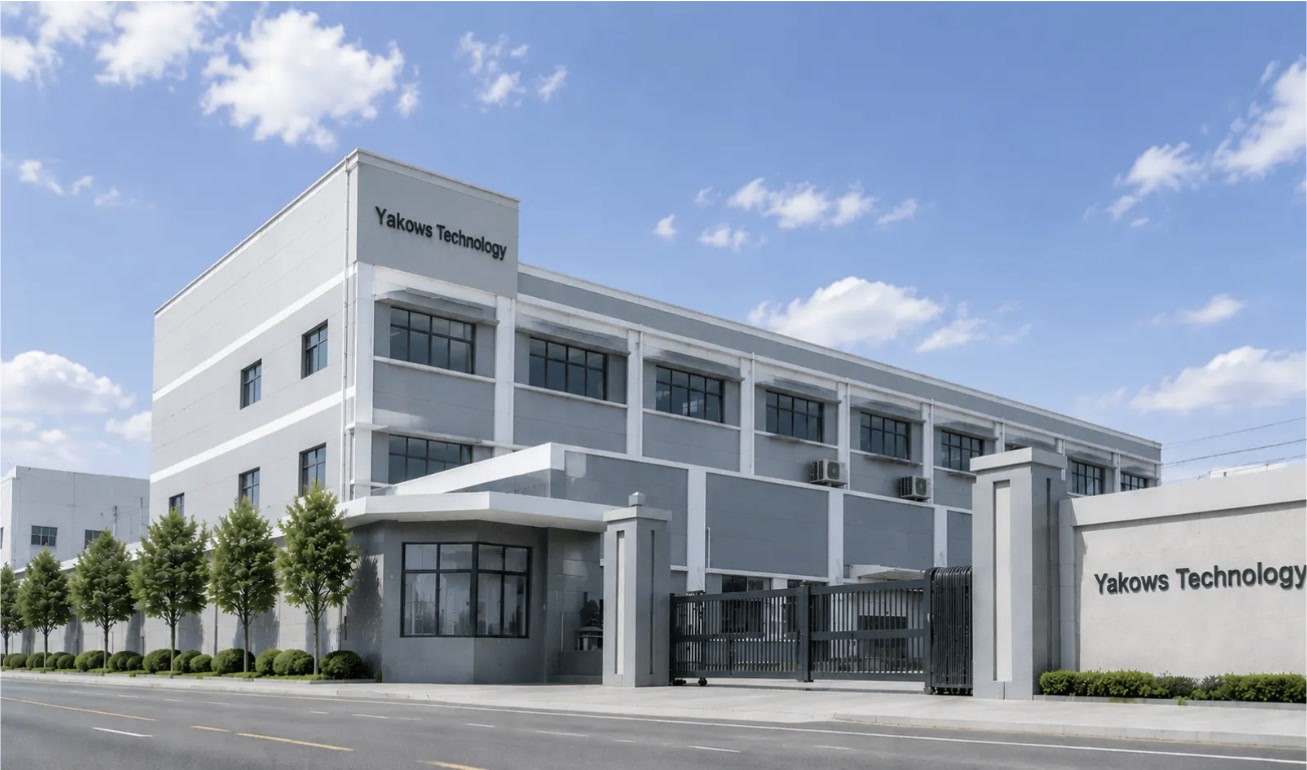
Yakows Technology (Dongguan) Co., Ltd., established 2020, operates a 5,000 square meter compounding facility in Dongguan, China.