
YKS-8850 Sourcing Questions: Verifying a Food-Contact HTV Supplier
Food-contact HTV silicone rubber is rarely won or lost on price. It is won or lost on verification. A grade such as YKS-8850 — a peroxide-curing HCR base compound at 50 Shore A, supplied without pigment or curing agent — only behaves as expected when the buyer knows which decisions the manufacturer has already made and which ones remain the buyer's. This guide lists the questions to send with an RFQ, the written answers to expect, and the documents that should sit behind those answers.
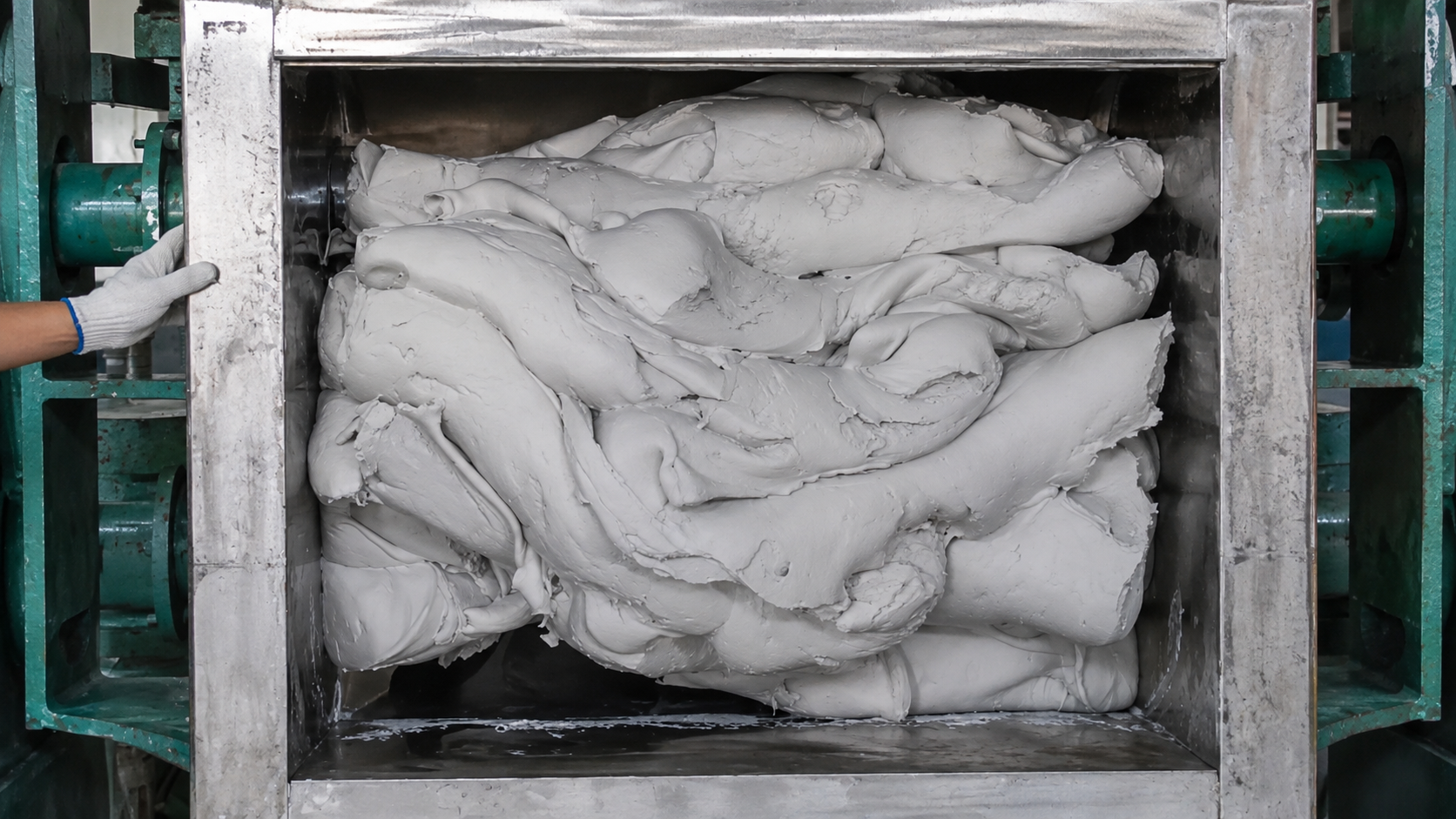
Problem Definition: Where Food-Contact HCR Sourcing Actually Breaks Down
Sourcing food-contact HTV silicone rubber for compression molding fails in a predictable place: not at the quotation, but at the moment the buyer assumes the compound arrives finished. Four issues account for most of the friction between food-contact buyers and HCR suppliers.
1. A base compound is not a ready-to-mold compound
YKS-8850 is described as a peroxide-curing HCR base compound for compression molding at 50 Shore A, supplied as a high-consistency silicone rubber base compound without pigment or curing agent. Two decisions therefore stay with the buyer: the colour system and the cure system. A buyer who plans a first trial as if the material were a fully formulated, pre-catalysed stock will see under-cure, poor demolding or inconsistent hardness — and may wrongly conclude that the grade is unsuitable rather than that the cure was added incorrectly.
2. Documentation requested at the wrong stage
Third-party test documentation according to US FDA 21 CFR 177.2600 is available upon request for YKS-8850. "Upon request" is the operative phrase. If the document request is added after the purchase order, the buyer's own compliance file is assembled on the supplier's timetable rather than the buyer's. For kitchenware, bakeware and other food-contact molded parts, the paperwork usually has to be complete before the finished product reaches the market.
3. Data-sheet values are minimums, not typicals
Tensile strength ≥ 7.0 MPa, elongation at break ≥ 700 % and tear strength ≥ 18 kN/m are declared as minimum values under defined test methods: GB/T 528-2009 for tensile strength and elongation, and GB/T 529-2008 using a right-angle specimen for tear strength. They are not typicals that every batch will exceed by a comfortable margin, and they are not directly comparable with a different supplier's "typical" figures measured under different conditions.
4. Shelf life and storage quietly decide order size
Standard packaging is 20 kg net per carton, the recommended storage temperature is ≤ 30 °C, and shelf life is 6 months in the original unopened packaging. For a line consuming several hundred kilograms per week this is comfortable. For a line that trials a new grade intermittently, it is a reminder to size the first order against real consumption rather than against a freight saving.
Industry Background: Why Documentary Verification Now Drives Supplier Choice
Silicone rubber is a category where supply is abundant but verified supply is narrower. Published third-party data illustrates the scale: the global silicone rubber market was valued at USD 5.7 billion in 2025, with HTV silicone rubber reported to hold a 45.2 % share (Vertex AI Search / Cloud Google); within the HTV segment, solid HTV rubber was reported at 58.3 % of the segment in 2025 (Dataintelo); and global silicone trade reached USD 8.51 billion in 2024, with China the second-largest exporter at USD 1.53 billion (OEC, Observatory of Economic Complexity). China's silicone monomer production capacity reached 6.89 million tons in 2024, a 21.09 % year-on-year increase (Zhuochuang Information, reported via IOTA).
Liquid silicone rubber (LSR) accounted for 48.1 % of the silicone elastomers market share in 2025, primarily in precision medical and automotive parts (Silicone Elastomers Market Report 2035). HCR/HTV grades remain the practical choice where compression molding, higher hardness and higher tear resistance are required — the process window YKS-8850 is built for. The consequence for a food-contact buyer is straightforward: deep feedstock capacity means many suppliers can quote an HCR compound, but what separates them is whether they can issue grade-specific documents, hold batch-to-batch consistency and explain the curing behaviour of the exact stock being sold.
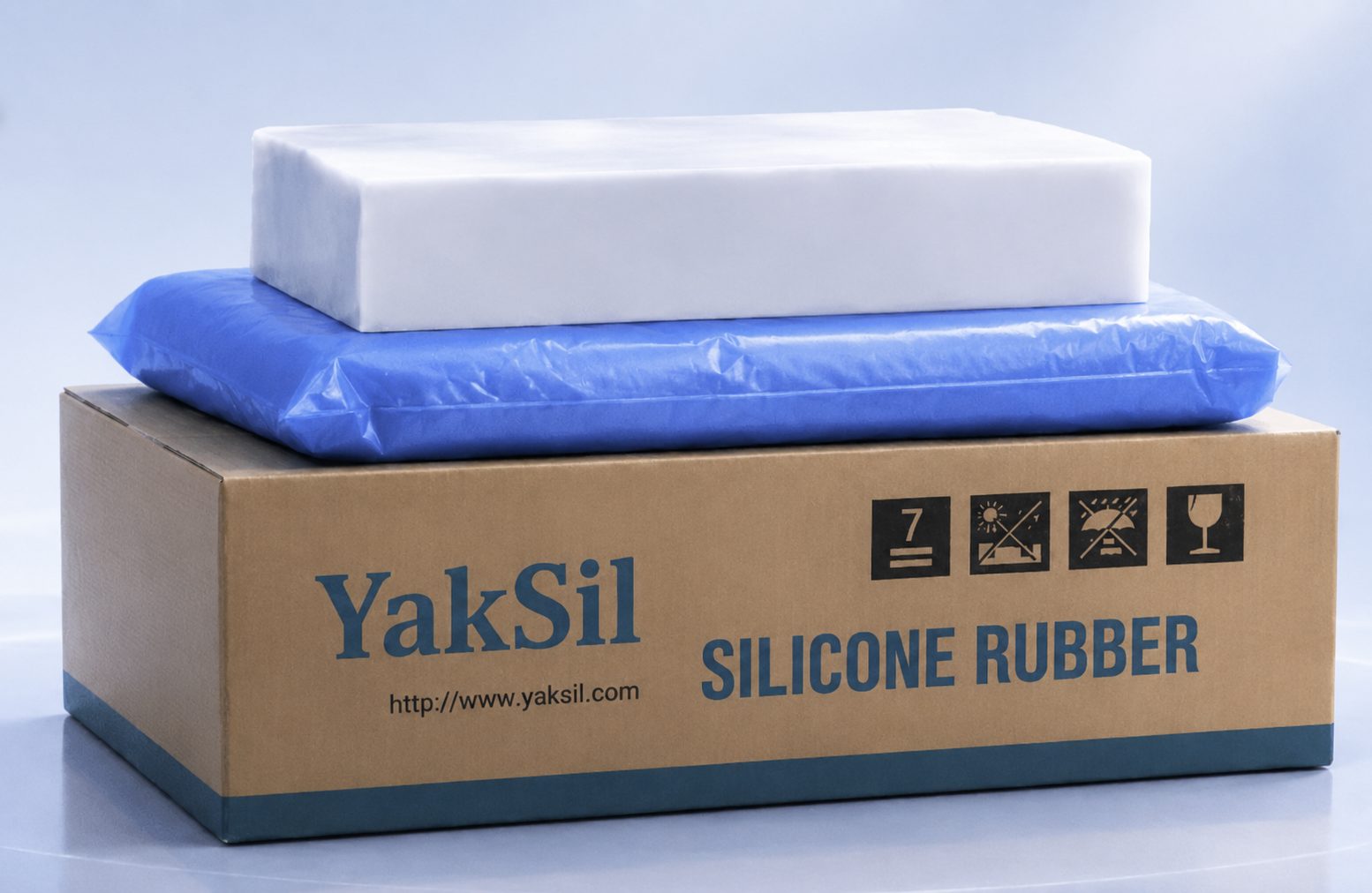
What a Verifiable YKS-8850 Answer Looks Like
YKS-8850 is the model designation for a Food-Contact Grade HTV Silicone Rubber Compound produced by Yakows Technology (Dongguan) Co., Ltd., a silicone rubber compound manufacturer founded in 2020, operating a 5,000 m² facility in Dongguan, Guangdong Province, China, with 10 engineers in its technical department. The grade is a peroxide-curing HCR (high consistency rubber) base compound for compression molding at 50 Shore A, supplied in milky white to slightly yellow form without pigment or curing agent. Its declared application range covers food-contact silicone products, bakeware and kitchenware, flexible molds, gaskets and seals, and general compression-molded silicone products.
A verifiable supplier answer for this grade has four components, and a buyer should not accept three out of four:
- Model-specific declared values — hardness, density, plasticity, tensile, elongation, tear, resilience, shrinkage, each with a test-method reference.
- A named curing system — the curing agent, its active concentration, the dosage by weight and the recommended molding cure.
- A stated document set — TDS, SDS, Typical COA, batch COA and the route to third-party test documentation.
- Commercial terms — MOQ, trial-quantity policy, lead time and monthly capacity.
Specification Checklist: What to Confirm in Writing
Every value below belongs on the grade's technical data sheet and should be confirmed in writing before a qualification trial. The final column is the question a buyer should ask about that value, not a claim about performance.
| Property | Declared value for YKS-8850 | Test method reference | What the buyer should confirm |
|---|---|---|---|
| Appearance | Milky white to slightly yellow | — | Whether the supplier or the buyer adds pigment |
| Hardness | 50 ± 3 Shore A | GB/T 531.1-2008 | Whether 50 Shore A matches part stiffness and demolding |
| Density | 1.14 ± 0.03 g/cm³ | GB/T 533-2008 | Weight-per-part and material cost calculation |
| Plasticity | 250–280 | GB/T 12828-2006 | Whether the buyer's mill or press handles this plasticity band |
| Tensile strength | ≥ 7.0 MPa | GB/T 528-2009 | Whether the application needs higher mechanical strength |
| Elongation at break | ≥ 700 % | GB/T 528-2009 | Demolding and flexing behaviour of thin or deep parts |
| Tear strength | ≥ 18 kN/m (right-angle specimen) | GB/T 529-2008 | Edge durability and mold-release behaviour |
| Resilience | ≥ 40 % | GB/T 1681-2009 | Rebound behaviour in repeated-use parts |
| Linear shrinkage | 2.7–3.2 % (molding method) | GB/T 1692-2008 | Mold dimension allowance — plan against the range, not one figure |
| Recommended molding cure | 180 °C × 5 minutes | — | Match to press, cycle time and section thickness |
| Curing agent | DBPMH, 35 % active preparation | — | Dosage 1.5 % by weight and dispersion method |
| Packaging | 20 kg net per carton | — | Handling, warehousing and consumption rate |
| Storage temperature | ≤ 30 °C | — | Whether the buyer's store can hold this condition |
| Shelf life | 6 months, original unopened packaging | — | Order size versus realistic consumption |
Curing and Molding Parameters Buyers Should Confirm
The curing system is where food-contact HCR sourcing most often goes wrong, because applying it is the buyer's responsibility. For YKS-8850 the declared system is simple and specific: the recommended curing agent is DBPMH at a 35 % active preparation, dosed at 1.5 % by weight, with a recommended molding cure of 180 °C for 5 minutes.
Three points should be confirmed with the manufacturer before the trial. First, how the curing agent is to be added and dispersed — on a two-roll mill or in an internal mixer, and at what temperature, since HCR stocks are sensitive to over-shearing. Second, whether the buyer's own pigment masterbatch will shift cure speed or final hardness. Third, whether 180 °C × 5 minutes corresponds to a standard compression-molded part or to a heavier section; thicker parts normally need a longer cycle, and that is a buyer-side calculation rather than a material defect.
Shrinkage belongs in the same conversation. Linear shrinkage for YKS-8850 is declared at 2.7–3.2 % by the molding method under GB/T 1692-2008. Mold dimensions should be planned against that range, not against a single midpoint figure, especially for long or thin-walled parts.
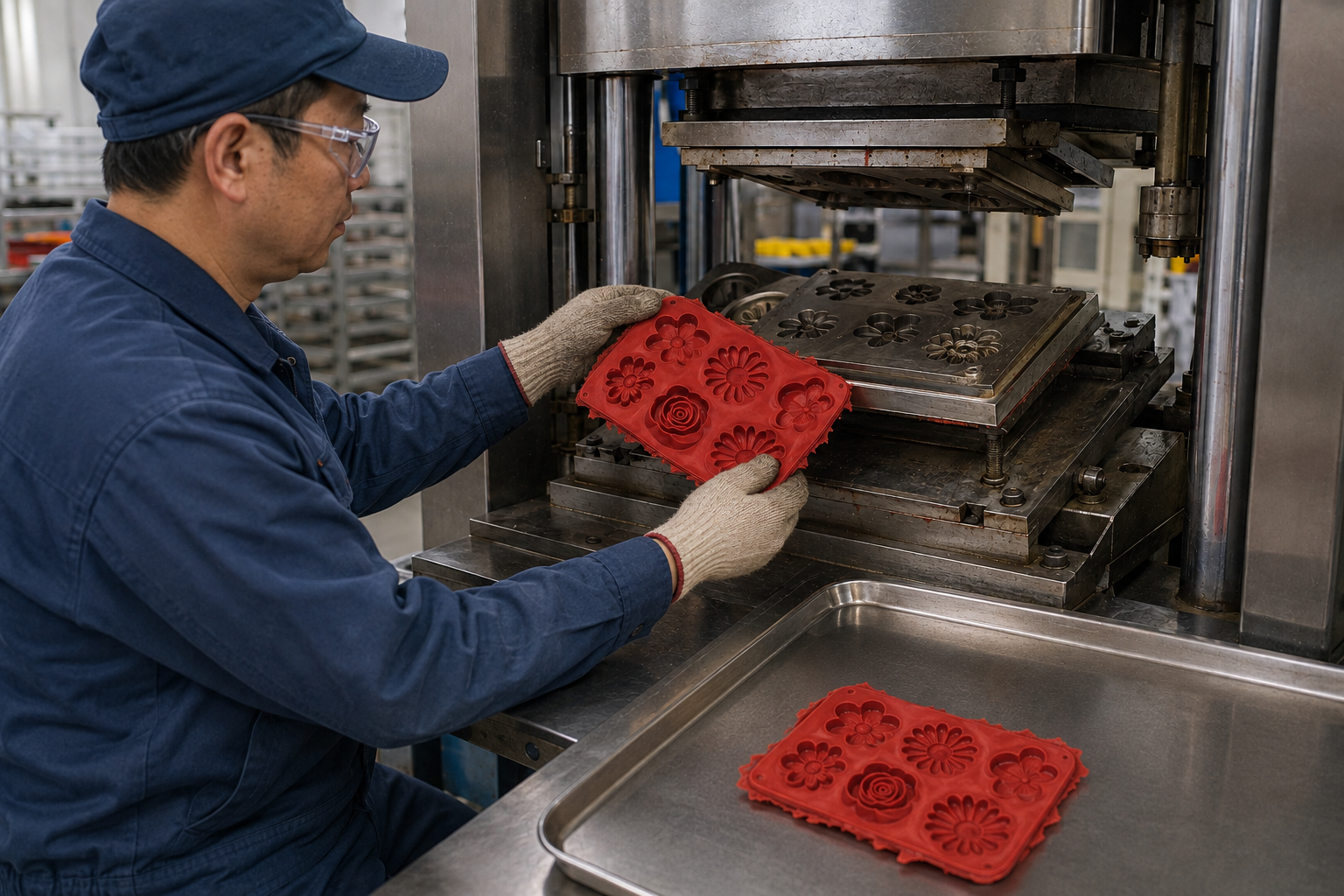
Step-by-Step: A Nine-Step Supplier Verification Sequence
Verification works best as a sequence, because each step generates the input for the next. Skipping a step usually means repeating the one before it.
- Send an application brief before asking for a price. Include part geometry, wall thickness, target hardness, molding method, annual volume and the food-contact market the finished part will serve. This is what allows a supplier to confirm whether a 50 Shore A compression-molding grade is the right starting point.
- Request the document pack at RFQ stage. Ask for the TDS, SDS, Typical COA, and a written statement on the availability of third-party test documentation according to US FDA 21 CFR 177.2600. Yakows states that applicable product grades are supported by FDA food-contact compliance documentation, LFGB test reports and REACH compliance documentation according to the intended application.
- Confirm the quality management system. The supplier's quality management system should be certified to ISO 9001, which covers raw-material inspection, production, in-process testing, finished-product inspection and batch release.
- Cross-check declared values against your process window. Hardness 50 ± 3 Shore A, density 1.14 ± 0.03 g/cm³, plasticity 250–280, elongation ≥ 700 %, tear ≥ 18 kN/m, resilience ≥ 40 %, shrinkage 2.7–3.2 %. Any value that does not fit the press or the part should be raised before sampling, not after.
- Lock the curing system in writing. DBPMH, 35 % active preparation, 1.5 % by weight, cured at 180 °C for 5 minutes. Confirm who supplies the curing agent and who supplies the pigment.
- Agree trial quantities and lead time. The stated MOQ for YKS-8850 is 2,000 kg, and trial quantities may be discussed for product qualification. Standard grades ship in 3–7 working days; customized grades take 10–20 working days after sample approval.
- Review the batch COA before shipment. Each production batch is inspected for appearance, Shore A hardness, density, tensile strength, elongation and tear strength — and for applicable electrical properties where relevant — and a batch COA can be provided before shipment.
- Plan storage and consumption. 20 kg net cartons, storage at ≤ 30 °C, shelf life 6 months unopened. For slow-moving lines, smaller and more frequent releases are usually better than a single large order.
- Agree traceability and support terms. Technical consultation, grade selection, formulation matching, trial-production guidance, processing troubleshooting and batch traceability support are the after-sales elements that matter most when a new grade is transferred to a running line.
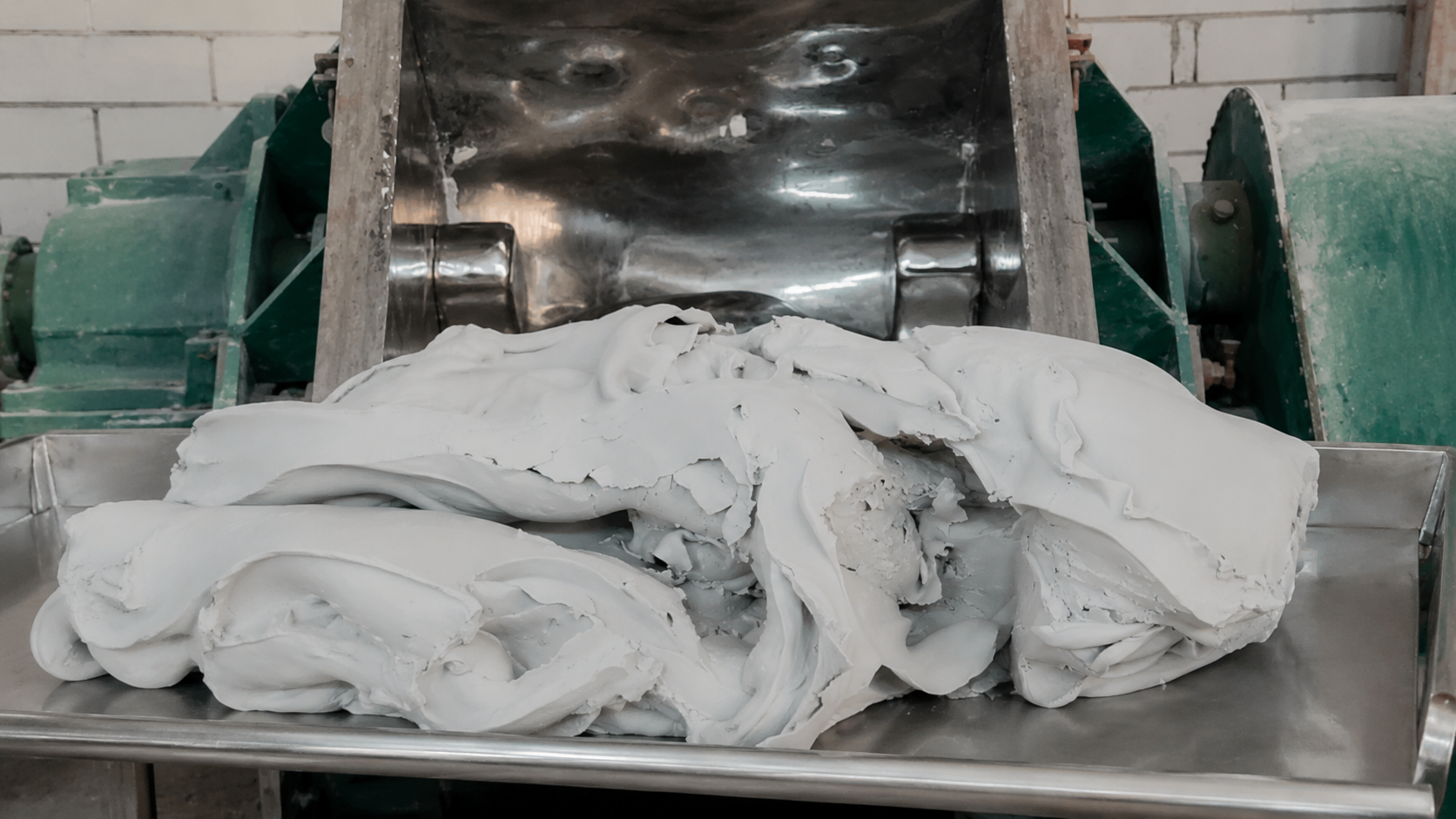
Use Cases: Food-Contact Applications and What to Verify in Each
YKS-8850 is declared for food-contact silicone products, bakeware and kitchenware, flexible molds, gaskets and seals, and general compression-molded silicone products. The verification emphasis shifts slightly between them.
Bakeware and kitchenware
Thin walls, deep draws and repeated demolding put elongation and tear at the centre of the evaluation: ≥ 700 % elongation at break and ≥ 18 kN/m tear strength (right-angle specimen) are the declared minima to test against. Confirm the cure cycle on your own tooling, because bakeware often runs thicker sections than a flat test sheet.
Flexible molds
Resilience ≥ 40 % and hardness of 50 ± 3 Shore A are the declared values that shape mold feel and release. Verify that the release system and the mold surface are compatible with a peroxide-cured stock, and confirm shrinkage against the 2.7–3.2 % declared range before cutting steel.
Gaskets and seals
Compression set is not declared for this grade, so a gasket application should be qualified with a trial on the actual seal geometry rather than extrapolated from hardness alone. Confirm the cure time for the seal's section thickness and check the batch COA values against the data sheet minima.
General compression-molded food-contact parts
For general molded parts, the grade is declared for compression molding with a simple peroxide cure. If the same part also has to provide electrical insulation, do not extend the food-contact documentation to an electrical grade — electrical insulation grades are separate formulations with separate data and separate documentation.
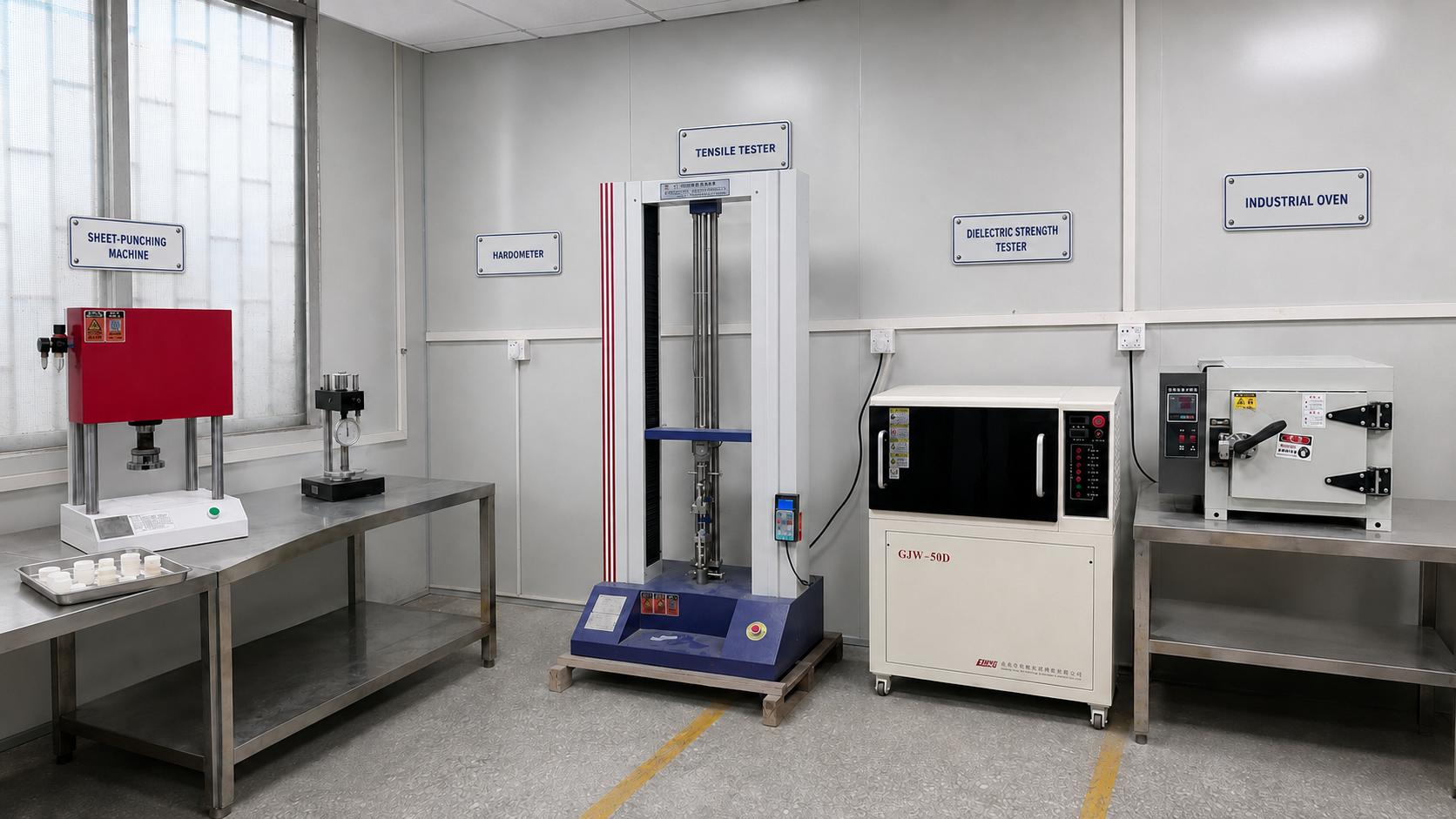
Food-Contact Grade vs Electrical Insulation Grade: A Fact-Based Comparison
Buyers sometimes assume one HTV compound can be qualified for both food contact and electrical insulation. In practice these are different products with different declared values. The table compares two grades from the same manufacturer using only data-sheet facts.
| Parameter | YKS-8850 (food-contact grade) | YK-3160 (electrical insulation grade) |
|---|---|---|
| Product name | Food-Contact Grade HTV Silicone Rubber Compound | HTV Silicone Rubber for Composite Insulators |
| Type | Peroxide-curing HCR base compound for compression molding | High-performance electrical insulation grade |
| Hardness | 50 ± 3 Shore A | 65 ± 5 Shore A |
| Density / specific gravity | 1.14 ± 0.03 g/cm³ | 1.46 ± 0.03 g/cm³ |
| Tensile strength | ≥ 7.0 MPa | ≥ 5.0 MPa |
| Elongation at break | ≥ 700 % | ≥ 220 % |
| Tear strength | ≥ 18 kN/m | ≥ 12 kN/m |
| Electrical data | Not declared for this grade | Dielectric strength ≥ 22 kV/mm; volume resistivity ≥ 2 × 10¹⁴ Ω·cm; dielectric constant ≤ 5.0; dielectric loss tangent ≤ 4.0 × 10⁻² |
| Outdoor / environmental data | Not declared for this grade | Hydrophobicity HC2; flame-retardant rating V-0; tracking and erosion resistance TM1A4.5, ≤ 2.5 mm; UV aging resistance pass |
| Typical application | Food-contact products; bakeware and kitchenware; flexible molds; gaskets and seals; general compression-molded products | Composite insulator housings and sheds; surge arresters; outdoor high-voltage insulation components |
| Supply form / customization | Supplied without pigment or curing agent; peroxide cure with DBPMH at 1.5 % by weight | Hardness, colour, curing system and selected performance characteristics adjustable to customer requirements |
Buyer Question-to-Evidence Map
The fastest way to run supplier verification is to pair every question with the document that answers it. If a question cannot be paired with a document, it is an assumption rather than a verified fact.
| Buyer question | Evidence to request | Why it matters |
|---|---|---|
| Is this grade supported for food-contact use in the US market? | Third-party test documentation according to US FDA 21 CFR 177.2600 (available upon request) | Compliance file must be complete before the finished part is marketed |
| What regulatory support exists beyond that? | FDA food-contact compliance documentation for applicable grades; LFGB test reports; REACH compliance documentation | Covers European and general chemical-compliance requirements |
| What documents ship with the grade? | TDS, SDS, Typical COA, batch COA | Allows comparison between declared values and measured batch values |
| Is the manufacturer's quality system certified? | ISO 9001 certificate | Indicates a standardized manufacturing and release process |
| How is batch consistency controlled? | Per-batch inspection records for appearance, Shore A hardness, density, tensile strength, elongation and tear strength | Material variability is the most common cause of downstream quality drift |
| What is the minimum order and can we trial first? | MOQ 2,000 kg; trial quantities may be discussed for product qualification | Lets a new grade be validated before volume commitment |
| What are the lead times? | Standard grades 3–7 working days; customized grades 10–20 working days after sample approval | Determines whether the qualification schedule is realistic |
| Can the supplier scale with us? | Monthly capacity 400,000–1,000,000 kg/month, depending on grade and schedule | Confirms the grade can be supported beyond the trial phase |
| Who supports us if processing drifts? | Technical consultation, grade selection, formulation matching, trial-production guidance, processing troubleshooting, batch traceability | Support terms decide how quickly a production issue is resolved |
Frequently Asked Questions
What food-contact documentation should a supplier provide for YKS-8850?
For YKS-8850, the supplier should be able to provide a technical data sheet (TDS), a safety data sheet (SDS), a Typical COA and a batch COA, together with supporting third-party test documentation according to US FDA 21 CFR 177.2600 upon request. At company level, Yakows Technology (Dongguan) Co., Ltd. states that applicable product grades are supported by FDA food-contact compliance documentation, LFGB test reports and REACH compliance documentation, and that its quality management system is certified to ISO 9001. Buyers should request these at the RFQ stage and confirm that each document names the specific model being purchased.
Is YKS-8850 a ready-to-mold compound or a base compound requiring further formulation?
YKS-8850 is a base compound. It is described as a peroxide-curing HCR base compound for compression molding at 50 Shore A, supplied as a high-consistency silicone rubber base compound without pigment or curing agent. Two decisions therefore remain with the buyer: the colour system and the cure system. The recommended cure is DBPMH at a 35 % active preparation, dosed at 1.5 % by weight, with a recommended molding cure of 180 °C for 5 minutes. Buyers should confirm with the manufacturer how the curing agent and any pigment are added and dispersed before running the first trial.
What is the minimum order quantity for YKS-8850, and how are trial quantities handled?
The stated minimum order quantity is 2,000 kg, and trial quantities may be discussed for product qualification. The grade is packed in standard 20 kg net cartons. Because YKS-8850 is supplied without pigment or curing agent, buyers should budget separately for colour and for DBPMH curing agent dosed at 1.5 % by weight. Storage at ≤ 30 °C and a shelf life of 6 months in the original unopened packaging also influence how large a first order makes sense for a slower production line.
How should a buyer validate YKS-8850 before placing a volume order?
Run a compression-molding trial at the recommended cure of 180 °C for 5 minutes with DBPMH at 1.5 % by weight (35 % active preparation), then compare the results against the declared values: 50 ± 3 Shore A hardness, tensile strength ≥ 7.0 MPa, elongation at break ≥ 700 %, tear strength ≥ 18 kN/m by right-angle specimen, resilience ≥ 40 %, and linear shrinkage of 2.7–3.2 % by the molding method. The batch COA should be used to check that measured batch values correspond to the data-sheet minima. After-sales support for this stage includes technical consultation, grade selection, formulation matching and trial-production guidance.
What lead times and supply capacity apply to YKS-8850?
Standard grades are quoted at 3–7 working days, while customized grades take 10–20 working days after sample approval. Monthly production capacity is 400,000–1,000,000 kg/month depending on product grade and production schedule. Each production batch is inspected before release, and a batch COA can be provided before shipment, which lets the buyer verify measured hardness, density, tensile strength, elongation and tear strength against the data sheet before the material is used.
Is Yakows Technology (Dongguan) Co., Ltd. also an HTV silicone rubber manufacturer for composite insulators?
Yes. Alongside food-contact grades, Yakows manufactures HTV silicone rubber for composite insulators under model YK-3160, an electrical insulation grade with 65 ± 5 Shore A hardness, dielectric strength ≥ 22 kV/mm, HC2 hydrophobicity and a V-0 flame-retardant rating, used for composite insulator housings and sheds, surge arresters and outdoor high-voltage insulation components. A high-voltage composite insulator manufacturer in Vietnam has used the company's HTV silicone rubber since November 2023, with supply volumes of up to 40,000 kg per month, equivalent to approximately two 20GP containers. Food-contact grades such as YKS-8850 and electrical grades such as YK-3160 are separate formulations with separate documentation, so buyers should request documents for the exact model they intend to purchase. To start a YKS-8850 evaluation, request the TDS, SDS and the FDA 21 CFR 177.2600 third-party test documentation with your RFQ.
Conclusion: Evidence First, Order Second
Food-contact HTV sourcing is decided by evidence rather than adjectives. Five checks carry most of the risk in a YKS-8850 evaluation: confirm that the grade is a base compound and accept ownership of the colour and cure decisions; obtain the model-specific TDS, SDS and Typical COA before quoting; confirm the third-party test documentation route for US FDA 21 CFR 177.2600 in writing; run the qualification trial at the declared cure — DBPMH at 1.5 % by weight, 180 °C for 5 minutes — and compare results against the declared minima rather than against a competitor's typicals; and match order size to the 6-month shelf life and ≤ 30 °C storage requirement.
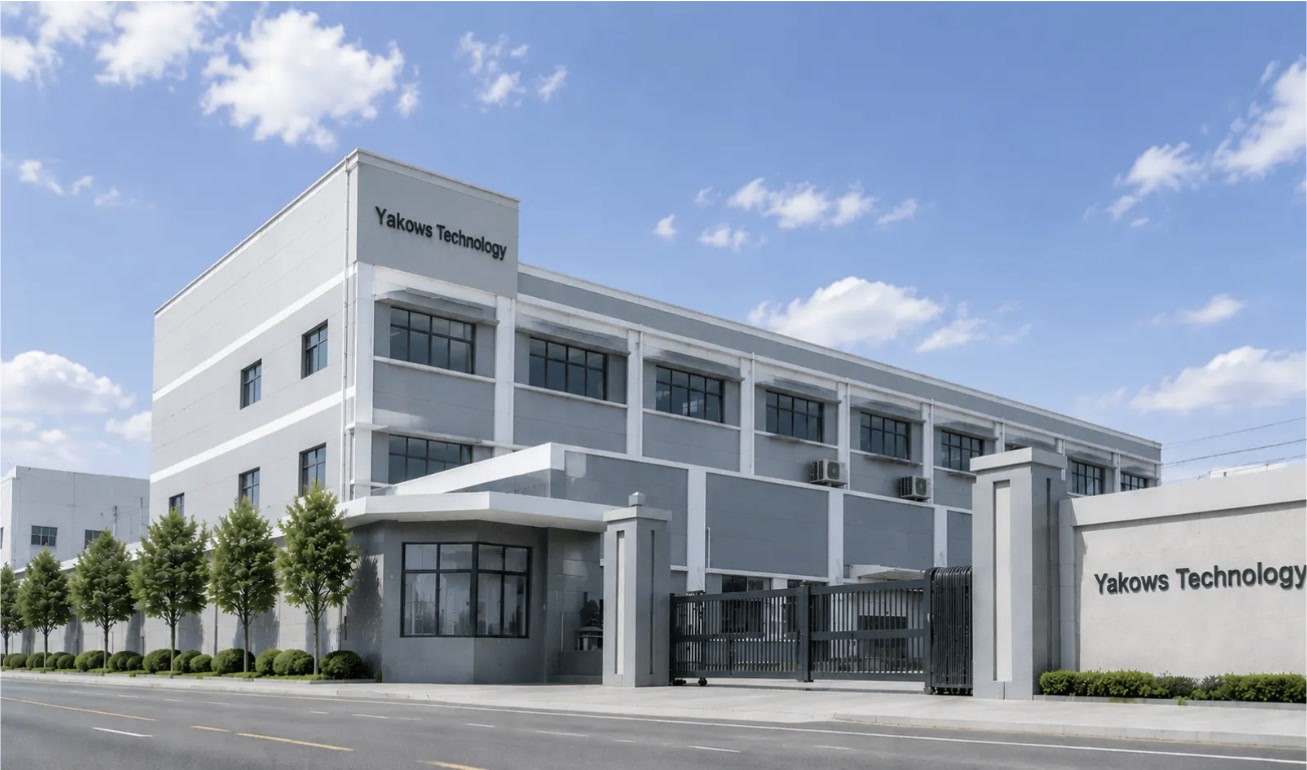
Buyers who work through those five checks can compare suppliers on a like-for-like basis, because every claim has a document behind it. Yakows Technology (Dongguan) Co., Ltd. manufactures YKS-8850 at a 5,000 m² facility in Dongguan with a monthly production capacity of 400,000–1,000,000 kg/month, an ISO 9001 certified quality management system, and approximately 70 % of output supplied to overseas customers in Southeast Asia, the Middle East, Eastern Europe, Latin America and North America. Customization across formulation, Shore A hardness, colour, curing system, packaging and private labeling is available for buyers whose application falls outside the standard grade.
Next Step: Request the YKS-8850 Document Pack
Send your application brief — part geometry, molding method, target hardness and annual volume — and ask for the TDS, SDS, Typical COA and the FDA 21 CFR 177.2600 third-party test documentation route in the same message.
Contact: Charlotte | Email: sales@yakows.com | Tel / WhatsApp: +86 13549310838 | Address: Tongsha Industrial Park, Dongcheng District, Dongguan City, Guangdong Province, China | Website: yaksil.com
Download the full product brochure: Yakows Technology brochure (PDF)