A Technical Guide to Dredging Depth: How to Choose the Right Equipment Specs
A Technical Guide to Dredging Depth: How to Choose the Right Equipment Specs
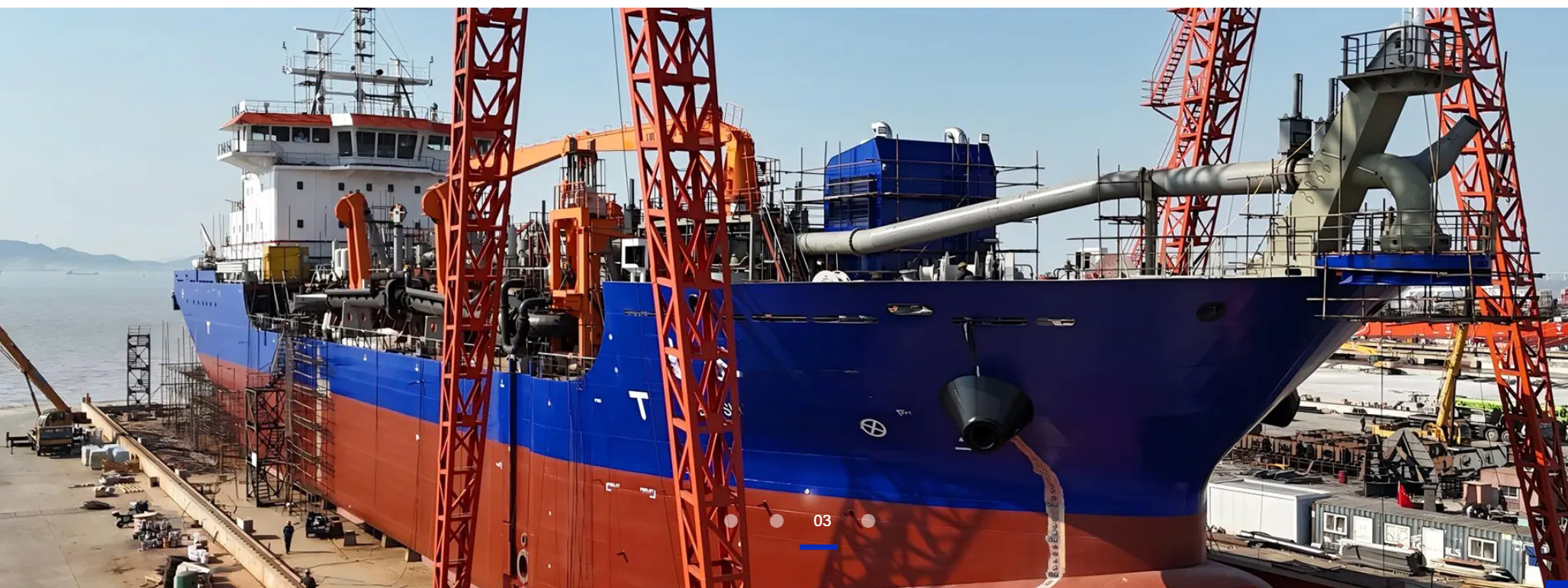
Dredging depth is fixed at the build stage: ladder length, suction pipe bore and pump power are engineering decisions, not operating preferences.
Dredging depth is the specification that decides whether a dredger can do the job at all. A vessel rated for 40 m cannot be pushed to 70 m by better operating technique, and a backhoe dredger built for an 18 m tier cannot reach a 26 m berth pocket without a different configuration. Because depth simultaneously drives ladder length, suction pipe geometry, pump power, hull draft and classification scope, it is also the specification that most directly drives cost.
This guide is written for evaluation-stage buyers who already know they need a dredger and now have to fix the numbers. It explains what a depth rating actually measures, how a deep rating is produced mechanically, and how to convert a project requirement into a written specification. Two reference machines from Zhenjiang Yanyang Engineering Co., Ltd. — trading as Yanyang Marine, brand name Yan Yang — anchor the discussion: a 26,800 m³ trailing suction hopper dredger (TSHD) offered in 40 m, 70 m and 115 m dredging depth tiers with a Φ1200 mm suction pipe and HK 2×6000 kW inboard dredge pumps; and an EX5500 self-propelled backhoe dredger available at 18 m, 24 m or 32 m dredging depth with 15/18/20.5 m³ buckets.
What a Dredging Depth Rating Actually Specifies
A dredging depth figure is a reach statement, not a production promise. It identifies the deepest point below the waterline at which the working tool can operate — the draghead of a TSHD or the bucket of a backhoe dredger — at the vessel's rated configuration, in still water, at the design draft.
Three separate numbers usually sit behind one quoted figure:
- Nominal maximum dredging depth. The deepest tier the machine is engineered and classed to work at.
- Effective working depth. The depth at which the dredging cycle still returns an acceptable output. Pump efficiency, mixture density and cycle time change with depth, so the deepest tier is normally reserved for the sections that genuinely need it.
- Project depth references. Chart datum, berth datum, design depth and overdredge allowance are not interchangeable, and a vessel quoted against the wrong datum can appear to be several metres out of range.
ISO 8384:2019 supplies the international standard vocabulary and definitions for dredgers, including specific terms for TSHD and CSD, and using that vocabulary prevents a buyer and a builder from describing different machines with the same word.
Tiered depth figures written as 40/70/115 m or 18/24/32 m should therefore be read as three distinct configurations rather than one machine with a wide tolerance. That is precisely how the TSHD and the backhoe dredger in this guide are specified.
Why Depth-Led Spec Selection Matters in 2026
Two market movements are pushing depth requirements upward at the same time.
The first is scale. The global dredging equipment market was valued at USD 4.86 billion in 2023 and is projected to reach USD 7.36 billion by 2030, according to Grand View Research. Hydraulic dredgers, the category that includes cutter suction dredgers, held the largest revenue share at approximately 46.65% in 2023. Trailing suction hopper dredgers are estimated to account for 46.0% of total dredging market activity by 2026, driven by port maintenance and offshore sand extraction (Future Market Insights).
The second is application. The offshore wind industry has become a key emerging driver for dredging equipment, requiring specialised vessels for seabed preparation and cable trenching to support more than 380 GW of new capacity by 2033 (Global Wind Energy Council).
The practical consequence is that 'deep enough' is no longer agreed once at the start of a project. Channels are deepened in stages, berths are upgraded, and a vessel bought against today's depth profile may be asked to work substantially deeper within its service life. Depth tier selection is a lifecycle decision, not a one-off calculation.
How a 115 m Rating Is Produced: The Hydraulic Package
Depth capability is a hydraulic energy budget. Reaching deeper water means lifting the mixture further, and the suction line loses vacuum efficiency as it lengthens. Four systems on the 26,800 m³ TSHD show how that budget is spent.
Suction pipe diameter — Φ1200 mm
The bore of the suction pipe sets flow velocity and head loss per metre of pipe. A Φ1200 mm line carries the required mixture flow at a lower velocity per unit volume than a smaller bore, which keeps friction losses manageable as the pipe is extended and the dredging depth increases.
Inboard dredge pump — HK 2×6000 kW
The inboard pumps provide the discharge head that moves the mixture from the suction line to the hopper or to a discharge point. Their power must be matched to the deepest tier, because an underpowered pump cannot maintain the mixture velocity needed to keep solids in suspension.
Underwater dredge pump — HK+BKKER 2×3300 kW
Mounted low in the suction pipe, the submerged pump moves the pumping point closer to the seabed and reduces the vacuum the inboard pumps must pull at great depth. This is the single most important mechanical reason a vessel can work at 115 m rather than 40 m.
Jet water pumps — CCCC 2×2000 kW
Water jets fluidise compacted sand ahead of the draghead so that the mixture entering the pipe is dense enough to be worth transporting. Jet water systems matter more in dense, well-graded sands than in soft silt.
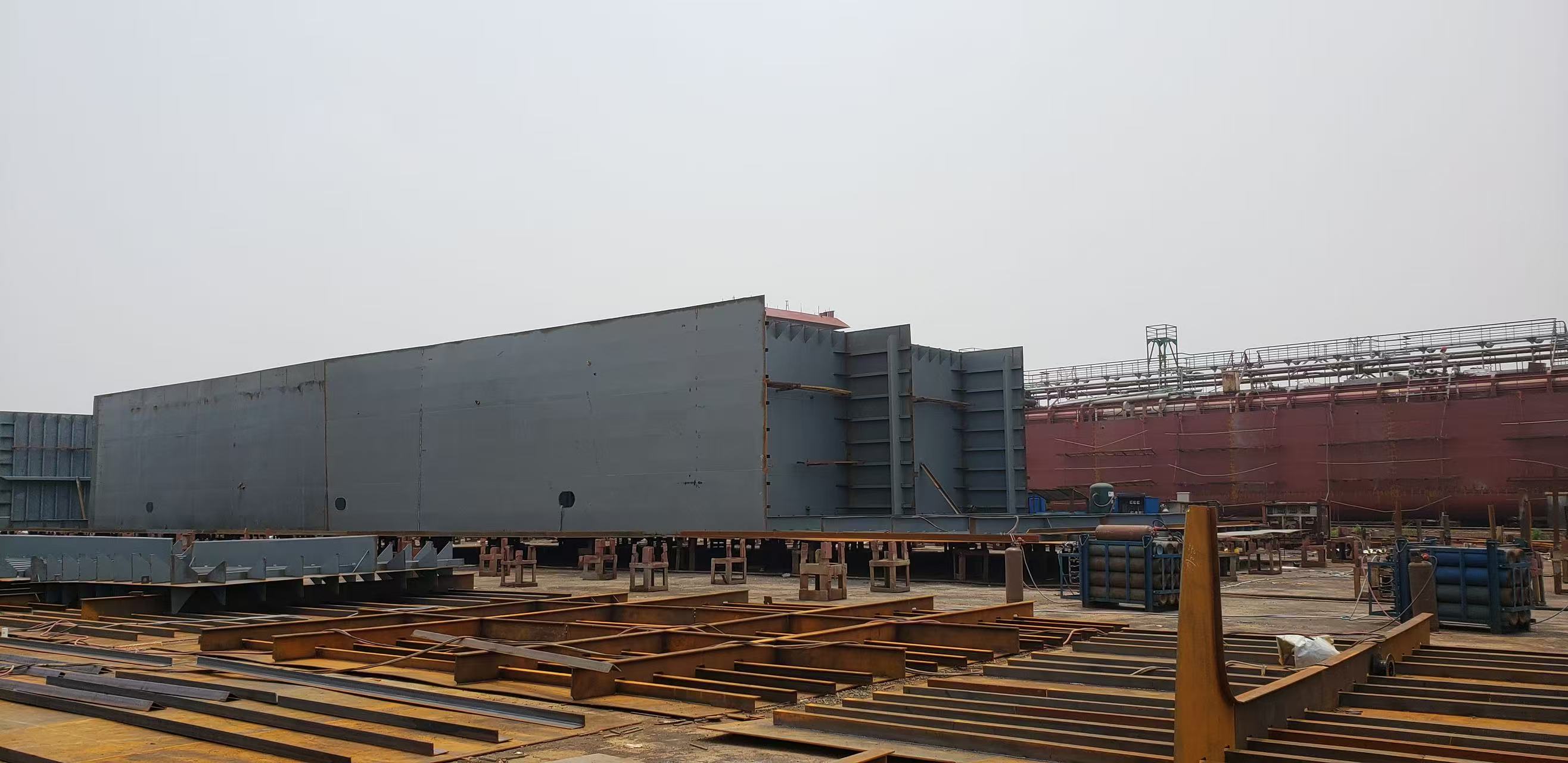
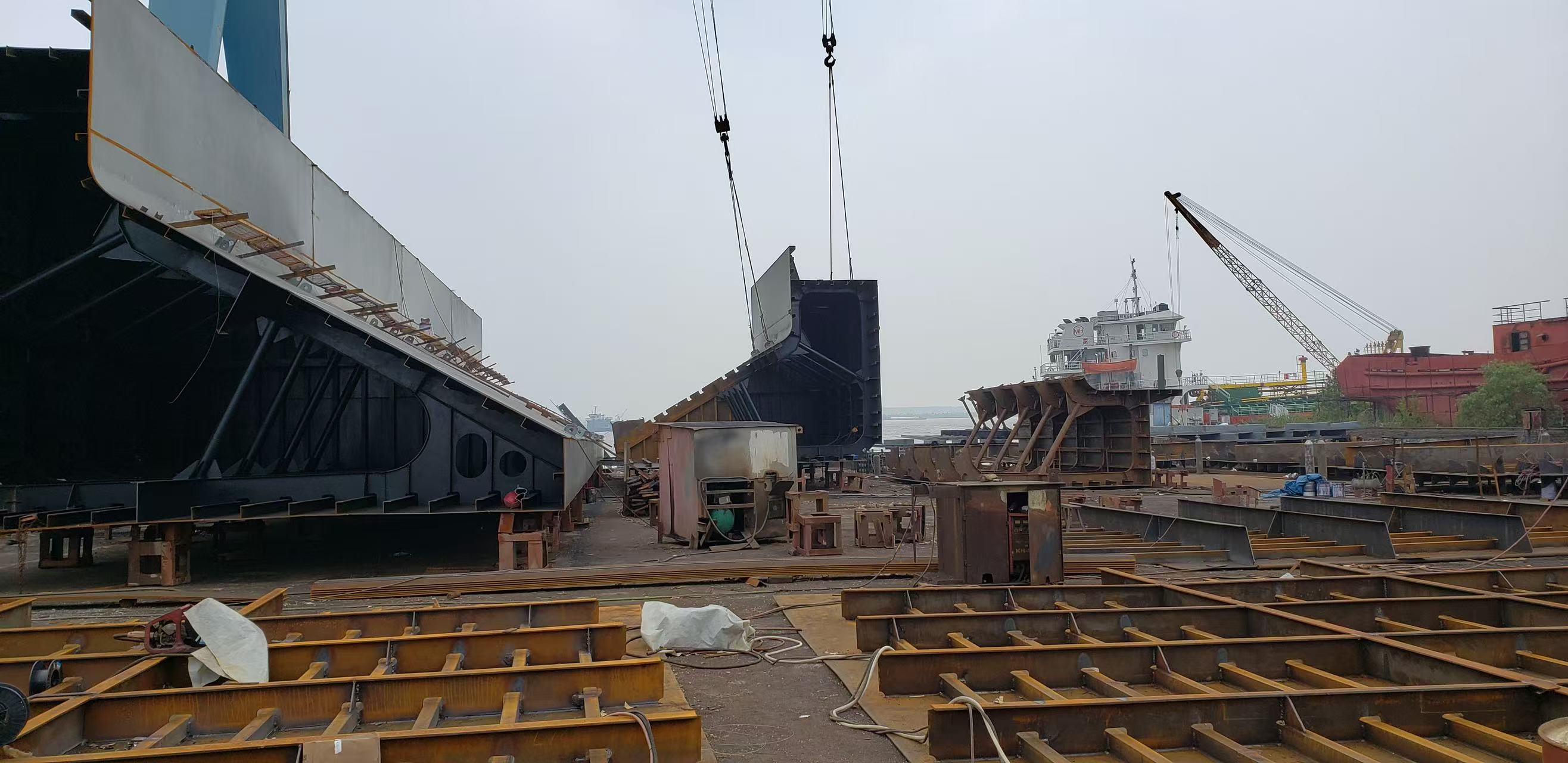
Hull and machinery installation: pump power, suction pipe bore and ladder geometry are matched to the deepest tier the vessel will be classed for.
Total installed power on the reference TSHD is 27,726 kW, with main diesel engines of Wärtsilä 3×8000 kW, main thrusters of Wärtsilä 2×10500 kW, and bow and stern thrusters of ZF 2×1100 kW and ZF 1×1100 kW. Auxiliary and harbour generation is Wärtsilä 2×1600 kW with a Cummins emergency generator of 526 kW. A deep-dredging vessel is a power plant first and a hull second.
Reading the 40 / 70 / 115 m Tiers on a 26,800 m³ TSHD
The tier structure is where an evaluation-stage buyer should slow down. Each tier is a decision about steel, pipe and power, and each answers a different project condition.
40 m tier. Suited to maintenance dredging of approach channels and port basins, beach nourishment, and reclamation feed where the borrow area is shallow. The suction line is short, vacuum losses are modest, and the vessel can operate closer to its maximum production envelope.
70 m tier. The working tier for deep-water berths, terminal deepening and offshore sand extraction. Suction line length and submerged pump duty become the limiting factors, and the operating profile shifts toward fewer, fuller hopper loads.
115 m tier. Reserved for deep channel work and offshore applications where the placement site is far from the dredging area. At this depth the combination of the Φ1200 mm suction pipe with the HK+BKKER underwater pumps determines whether the tier is genuinely usable or only nominal.
The hull carrying these tiers is substantial: length overall approximately 171.20 m, length between perpendiculars 160.00 m, moulded breadth 36.00 m, moulded depth 15.80 m, draft at international freeboard 9.50 m, and a maximum hopper capacity of approximately 26,800 m³. Speed at 11.5 m draft is 15.5 knots. Classification reflects the duty profile: CCS, CSA Trailing Suction Dredger, Dredging within R1, DP-1, with AUT-0 notation.
That 9.50 m draft is a real constraint rather than a footnote. A vessel able to dredge at 115 m still needs deep water to reach the site, and it is the wrong tool for a shallow inland waterway regardless of how deep it can dig.
The Backhoe Dredger Path: 18 / 24 / 32 m
Not every deep section should be dredged by a trailing suction hopper dredger. Where the material is stiff, the geometry is vertical, or the working area is confined, a backhoe dredger is frequently the more controllable choice.
The EX5500 self-propelled backhoe dredger is specified with an overall length of 71.5 m, a beam of 22 m and a draft of 2.5 m — shallow enough to enter basins that a 9.50 m draft TSHD cannot. It carries a Hitachi EX 5500 excavator with 2×1076 kW of excavator power and a propulsion package of 2×350 kW.
Depth tiers are 18 m, 24 m or 32 m, paired with bucket capacities of 15 m³, 18 m³ and 20.5 m³. The pairing matters: bucket size, not depth alone, converts reach into production, and a 32 m tier with a 20.5 m³ bucket produces a different cycle profile from an 18 m tier with a 15 m³ bucket. Boom geometry, bucket capacity and pontoon stability have to be designed together.
The limitation is equally clear. Backhoe production is cycle-based and depends on bucket fill, swing time and how quickly spoil is removed. Where a TSHD loads and carries its own spoil, a backhoe dredger depends on a barge train — which is why split hopper barges belong in the same specification conversation.
Step-by-Step: Converting Project Depth into Equipment Specs
- Fix the required dredging depth and its datum. State whether the number is chart datum, berth datum or design depth, and list the overdredge allowance separately. Datum errors at this stage are the most expensive errors in the procurement.
- Define a depth band, not a single figure. Record the deepest working depth, the typical working depth and the share of time expected at each. A vessel that spends most of its life at 45 m does not need to be optimised for 115 m, even if one section reaches that far.
- Check the access envelope. Confirm draft, under-keel clearance, transit water depth and air-draft limits. Compare the 9.50 m draft at international freeboard of the 26,800 m³ TSHD with the 2.5 m draft of the EX5500 backhoe dredger; this difference often decides the equipment class before depth does.
- Match the depth tier. Choose among 40 m, 70 m and 115 m for TSHD operation, or 18 m, 24 m and 32 m for backhoe operation. Do not accept a single maximum figure without the tier structure behind it.
- Verify the hydraulic package at the deepest tier. Request suction pipe diameter, inboard pump power, submerged pump power and jet water pump power as one package. On the reference TSHD these are Φ1200 mm, HK 2×6000 kW, HK+BKKER 2×3300 kW and CCCC 2×2000 kW.
- Confirm hopper or bucket capacity logic. A 26,800 m³ hopper changes the economics of deep dredging: fewer trips, longer turn per load. For backhoe work, confirm 15/18/20.5 m³ bucket capacity against the barge capacity that will receive the spoil.
- Plan spoil transport. Split hopper barges in the 1200–3200 m³ series, with the 2600 m³ CCS-classed unit as a reference point, determine how quickly a backhoe or grab dredger can keep working.
- Confirm classification and documentation. Specify IACS classification for the exact unit, with class notations written into the contract.
- Validate before committing. Request the specification sheet for the exact vessel, the classification certificate and a reference list. Yanyang Marine reports 30+ large dredger construction projects delivered, with a 10-person R&D team, and provides commissioning, operator training, spare parts and long-term technical support.
Use Cases: Matching Depth Bands to Project Types
Deep-water channels and berths. These projects justify the 70 m and 115 m TSHD tiers. A 26,800 m³ hopper and a service speed of 15.5 knots at 11.5 m draft reduce cost per cubic metre when the placement site is distant.
Confined port basins and quay walls. The 18 m and 24 m backhoe tiers, with a 2.5 m draft and a 71.5 m overall length, allow precise excavation alongside existing structures where a large trailing dredger cannot manoeuvre safely.
Land reclamation and beach nourishment. The 40 m TSHD tier covers shallow borrow areas and reclamation feed, while split hopper barges handle transport and placement.
Offshore wind seabed preparation and cable trenching. With more than 380 GW of new offshore wind capacity projected by 2033 (GWEC), seabed preparation and trenching demand keeps expanding. Depth-tier selection here is driven by cable burial depth and by the DP-1 notation carried by the reference TSHD.
River and inland desilting. The 18 m backhoe tier suits inland and river works where access draft is limited. For near-shore removal of hard clay, soft sediment and debris, a 25 m³ self-propelled grab dredger operating in the coastal navigation area provides a third option.
Port and marine foundation works. On port projects, dredging depth and foundation depth are linked. A pile driving barge with a 110 m pile leader height, a pile frame height of 137.00 m above design draft and capacity for Ø4000 mm piles of up to 107 m plus water depth at up to 400 t per pile addresses the foundation side of the same project.
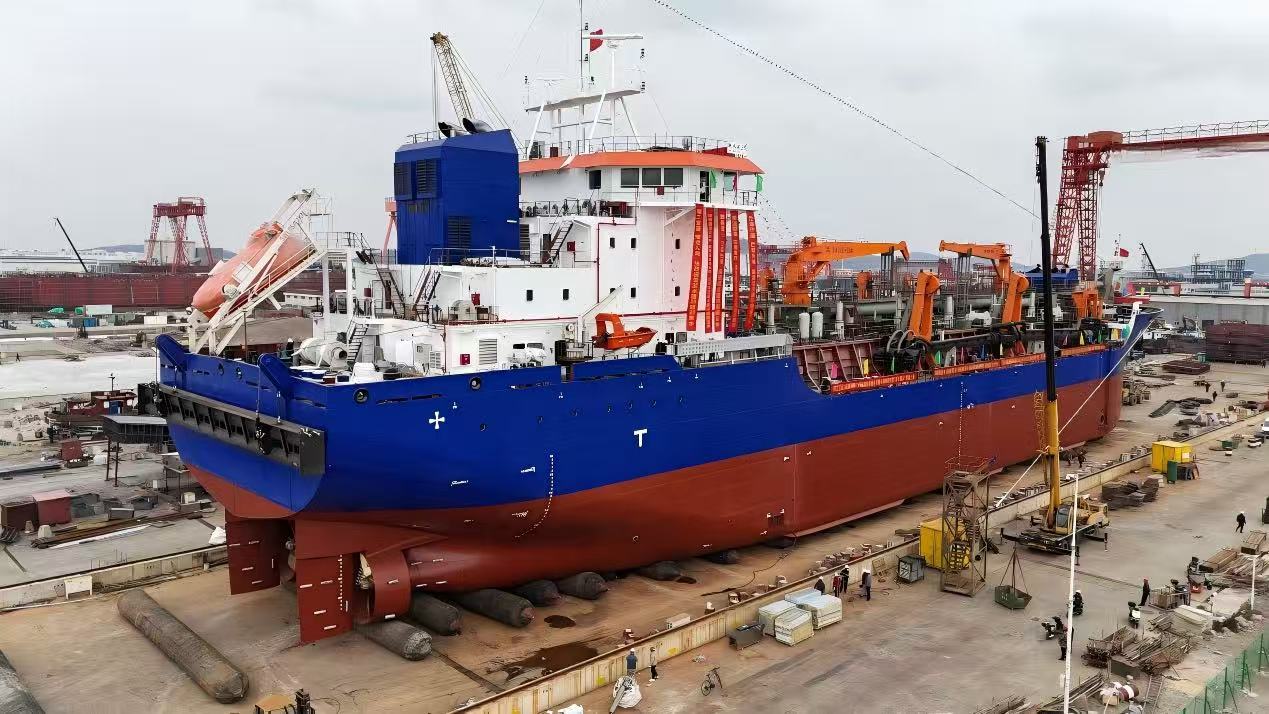
Shipyard support facilities behind a depth-led build programme covering port, channel, reclamation and inland dredging projects.
Comparison Table: Depth Specs Side by Side
| Parameter | 26,800 m³ Trailing Suction Hopper Dredger | EX5500 Backhoe Dredger |
|---|---|---|
| Dredging depth tiers | 40 / 70 / 115 m | 18 / 24 / 32 m |
| Working capacity | Hopper, max approx. 26,800 m³ | Bucket, 15 / 18 / 20.5 m³ |
| Soil interface | Suction pipe diameter Φ1200 mm | Hitachi EX 5500 excavator |
| Dredging power | Inboard dredge pump HK 2×6000 kW; underwater pump HK+BKKER 2×3300 kW; jet water pumps CCCC 2×2000 kW | Excavator power 2×1076 kW |
| Propulsion power | Main thruster Wärtsilä 2×10500 kW; bow thrusters ZF 2×1100 kW; stern thruster ZF 1×1100 kW | 2×350 kW |
| Total installed power | 27,726 kW | Not stated in the reference specification |
| Overall length | approx. 171.20 m | 71.5 m |
| Beam / breadth | 36.00 m moulded breadth | 22 m |
| Draft | 9.50 m at international freeboard | 2.5 m |
| Class reference | CCS, CSA Trailing Suction Dredger, Dredging within R1, DP-1; AUT-0 | Buildable to IACS society requirements (CCS, BV, LR, DNV) |
| Spoil handling | Self-loading and carrying | Barge dependent (split hopper barge) |
| Typical project fit | Deep-water channels and berths, large-scale reclamation, offshore applications | Confined basins, quay walls, stiff material, precision sections |
A depth figure without the matching pump, pipe and capacity specification is not engineering, it is a label. Read the two columns together.
Depth-Class Shortlist: Matching Depth Bands to Equipment
The shortlist below ranks the equipment classes described in this guide by maximum dredging depth capability, using only the specifications above. Supporting units are included because depth capability is only usable when spoil can be moved.
| Rank | Equipment | Maximum depth tier | Defining specification | Typical duty |
|---|---|---|---|---|
| 1 | 26,800 m³ Trailing Suction Hopper Dredger (TSHD) | 115 m | Φ1200 mm suction pipe; HK 2×6000 kW inboard dredge pumps; HK+BKKER 2×3300 kW underwater pumps; 27,726 kW installed | Deep channels, deep berths, offshore sand extraction, reclamation feed |
| 2 | EX5500 Self-Propelled Backhoe Dredger | 32 m | 20.5 m³ bucket; Hitachi EX 5500 at 2×1076 kW; 2.5 m draft | Confined basins, quay lines, stiff clay and rock |
| 3 | 8000 m³/h Self-Propelled Cutter Suction Dredger | 30 m | 8000 m discharge distance; LOA 121 m; width 25 m | Reclamation, channel excavation with long discharge lines |
| 4 | 25 m³ Self-Propelled Grab Dredger | Near-shore, coastal navigation area | 25 m³ grab capacity | Hard clay, soft sediment and debris in near-shore works |
| 5 | 2600 m³ Split Hopper Barge (CCS) | Spoil transport unit | 1200–3200 m³ series; Ice Class B; main engine 3740 kW × 2 | Removing spoil produced by backhoe and grab dredgers |
Buyers evaluating at this level usually also shortlist the large integrated European manufacturers and contractors repeatedly identified in the sector, including Royal IHC, Damen Shipyards Group, Jan De Nul Group and Boskalis (Fortune Business Insights, 2024). Those organisations compete on integrated project scale, proprietary equipment design and global contracting capability. For a depth-led specification the relevant comparison is narrower: the depth tier quoted, the pump and suction package behind it, the class notation, the delivery slot and the total cost of ownership. Zhenjiang Yanyang Engineering Co., Ltd. builds against project specification with IACS classing through CCS, BV, LR or DNV, and reports delivery in 2–3 months for standard vessels, with custom units typically requiring 8–12 months.
Classification and Compliance: Proving the Depth Rating
Depth tier claims are verified through classification, not through brochures. IACS societies including CCS, BV, LR and DNV class dredgers to their own rules, and BV and DNV publish dredger-specific guidance, including guidelines for the assignment of reduced freeboards for dredgers.
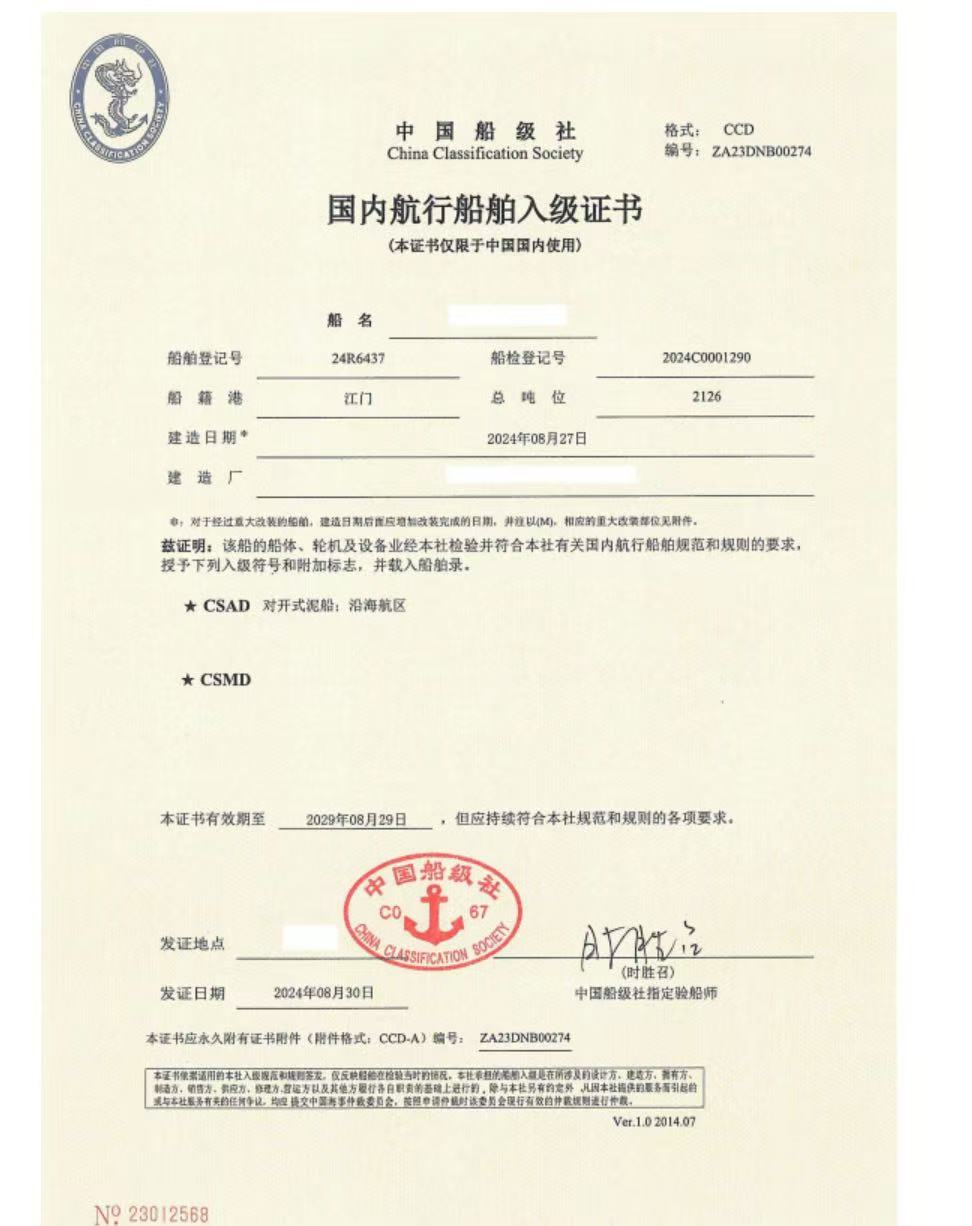
Traceable documentation in practice: CCS Domestic Vessel Classification Certificate ZA23DNB00274, issued 30 August 2024, valid to 29 August 2029.
A concrete example of traceable documentation from the same yard is a CCS Domestic Vessel Classification Certificate numbered ZA23DNB00274, issued on 30 August 2024 and valid to 29 August 2029. Its scope is a self-discharging hopper barge in the coastal navigation area, issued under the CCS Rules for Classification of Sea-going Ships. The 26,800 m³ TSHD carries class notation CCS, CSA Trailing Suction Dredger, Dredging within R1, DP-1, with AUT-0.
The procurement rule is simple: require the certificate issued for the exact unit, hull number included. A company-level certificate says nothing about the vessel you are buying, and depth tiers, freeboard and dredging notations are vessel-specific.
Budget, Lead Time and Customisation Constraints
Depth decisions land on the commercial side of the specification. Deeper tiers mean longer ladders and suction lines, larger inboard and submerged pumps, more installed power, heavier steel, a hull with a deeper draft, and a wider classification scope. Depth is therefore one of the largest single cost drivers in a dredger specification.
Yanyang Marine states that its dredgers cost approximately 50% less than equivalent European-built vessels, and reports 2–3 months delivery for standard vessels and 8–12 months for custom units. Ready stock is offered for sale, with TSHD enquiry scope ranging from 1100 to 26800 m³. Production is organised around ODM and custom-made builds, with quality control documented through IACS certificates, and after-sales covering new building as well as maintenance, repair and conversions. Export markets include the Middle East, India, Russia, South America, Africa and Europe, with main markets including the United Arab Emirates, Indonesia, India, Egypt, Turkey, Nigeria, South Africa, Tanzania, Saudi Arabia and Oman; the company reports a 100% export ratio and was founded in 1996.
Purchase price is still the wrong comparison metric. Cost per cubic metre moved — including cycle time, fuel, wear parts and maintenance across the depth range the vessel will actually work in — is the number that decides whether the depth tier was chosen correctly.
Frequently Asked Questions
What classification and documentation should accompany a dredger selected for a specific dredging depth?
Specify IACS classification for the exact unit, not for the company. The 26,800 m³ trailing suction hopper dredger in this guide carries the class notation CCS, CSA Trailing Suction Dredger, Dredging within R1, DP-1, with AUT-0. A traceable example from the same yard is a CCS Domestic Vessel Classification Certificate numbered ZA23DNB00274, issued on 30 August 2024 and valid to 29 August 2029 for a self-discharging hopper barge in the coastal navigation area, under the CCS Rules for Classification of Sea-going Ships. Dredgers can also be classed by BV, LR, DNV or other IACS societies, and BV and DNV publish dredger-specific rules including guidelines for the assignment of reduced freeboards for dredgers.
Can a single dredger cover both the shallow and the deep sections of one project?
Usually one machine can cover the range, but the specification has to be tiered. The 26,800 m³ TSHD is offered at 40 m, 70 m and 115 m dredging depth, and the EX5500 backhoe dredger at 18 m, 24 m or 32 m. The tiers exist because suction line length, submerged pump duty and winch capacity all change with depth. Buyers should state the deepest working depth, the typical working depth and the time expected at each, then let the builder configure the vessel. Dredging depth, discharge distance, power and configuration are customisable, so a mixed-depth project can be matched with one configuration instead of two vessels.
How does a deeper dredging requirement affect the equipment budget?
Depth is one of the largest cost drivers in a dredger specification. Deeper tiers require longer ladders and suction lines, larger inboard and submerged pumps, more installed power, heavier steel, often a deeper-draft hull, and a wider classification scope. Purchase price, however, is the wrong comparison metric; cost per cubic metre moved, including cycle time, fuel and maintenance, is the figure that matters. Yanyang Marine states that its dredgers cost approximately 50% less than equivalent European-built vessels and reports standard delivery in 2 to 3 months, with custom units typically requiring 8 to 12 months.
How can a buyer validate a claimed dredging depth rating before ordering?
Validation is documentation-led. Request the specification sheet for the exact vessel configuration, including suction pipe diameter, inboard dredge pump power, submerged pump power and hull dimensions; on the reference TSHD these are Φ1200 mm, HK 2×6000 kW, HK+BKKER 2×3300 kW, with a 171.20 m length overall and a 9.50 m draft at international freeboard. Ask for the classification certificate issued for the specific unit and for a reference list of delivered projects. Yanyang Marine reports 30+ large dredger construction projects delivered and offers ready stock for sale alongside custom-built units, so a buyer can inspect either a vessel under construction or one in stock before committing.
What is the typical lead time, and how does the ordering process start?
Standard vessels are delivered in 2 to 3 months, while custom dredgers typically take 8 to 12 months. The starting point is a depth-led specification: required dredging depth with its datum and overdredge allowance, typical working depth, access draft and air-draft limits, soil type, disposal distance and classification requirement. Send that specification to Yanyang Marine for a configuration proposal and quotation — email Info@yanyangmarine.com, call or message +86 159-5290-0547, or visit www.yanyangmarine.com. TSHD enquiry scope ranges from 1100 to 26800 m³.
Conclusion: Depth First, Everything Else Second
Dredging depth decides the equipment class before capacity, before power and before price. A 26,800 m³ TSHD at 40/70/115 m and an EX5500 backhoe dredger at 18/24/32 m represent two different answers to the same engineering question, and the depth tier, not the vessel type, is what makes one of them correct for a given project.
The disciplined sequence is straightforward: fix the depth band and its datum, confirm the access envelope, choose the tier, verify the hydraulic package behind the tier — Φ1200 mm suction pipe, HK 2×6000 kW inboard pumps, HK+BKKER 2×3300 kW underwater pumps, CCCC 2×2000 kW jet water pumps, 27,726 kW installed — then confirm capacity, spoil handling, classification and delivery. Buyers who follow that order rarely need to revisit the specification later, and they avoid paying for capability their project will never use.
Turn a depth requirement into a buildable specification
Send your required dredging depth, working depth band, access draft, soil type, disposal distance and classification requirement to Yanyang Marine for a configuration proposal. Depth tiers, discharge distance, power and configuration are customisable.
Email: Info@yanyangmarine.com
Tel / WhatsApp: +86 159-5290-0547
Website: www.yanyangmarine.com
Contact: Liao
Office: 1# Rainbow Building, Jiangbin Road, Zhenjiang City, Jiangsu Province, China