
Bulk Bags for Chemicals: UN, ISO and Type C Requirements
Bulk Bags for Chemicals: UN Certification, ISO Standards and Type C Requirements
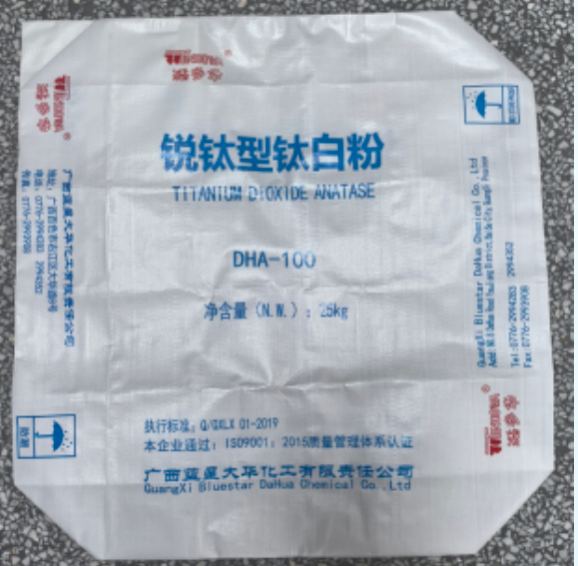
A chemical buyer shortlisting bulk bags is not only comparing bag designs. Two suppliers can quote the same 500–2000 kg safe working load construction and still hand over very different paperwork: one holds a UN packaging test report for the bag format you actually fill, the other holds a certificate for a different size or a different material structure. This guide sets out the four compliance layers that decide whether a chemical FIBC bag is usable in your supply chain, and how to verify each layer before releasing a bulk order.
Yancheng Yide Packaging Technology Co., Ltd. (Yide Packaging) is a manufacturer and customized packaging solution provider based in Yancheng, Jiangsu, China. Founded in 2022, the company produces FIBC bags, ton bags, PP woven bags, valve bags, paper-plastic composite bags and reusable logistics packaging from a 120,000 m² manufacturing footprint, with an annual production capacity of 500,000–1,000,000 tonnes, an export ratio of 20% and a 15-engineer R&D team. Its FIBC production base includes a 5,000 m² food-grade clean workshop.
Why “UN Certified” Alone Is Not Enough on a Chemical Bulk Bag RFQ
The phrase “UN certified” appears in almost every chemical packaging enquiry, and it rarely means the same thing on both sides of the table. Four specific frictions cause most of the rework.
- Test reports are format-specific. The UN packaging test report in Yide Packaging’s documentation set covers one defined bag — a 600 × 1050 mm paper-plastic woven bag — and records the drop-performance outcome for that format. A report number that does not name your bag size, structure and material cannot be treated as evidence for your order.
- Static control is a system, not a fabric upgrade. An FIBC built to the Type C concept dissipates static electricity through conductive yarns and requires reliable grounding during operation. If the filling or discharge point is not grounded, the bag’s classification does not protect the process.
- Standards move faster than some quotation templates. ISO 21898:2004, the earlier FIBC packaging standard, has been succeeded by the 2024 edition, and China’s GB/T 10454-2025 replaced GB/T 10454-2000 and GB/T 37425-2019 with effect from 1 March 2026. A specification sheet written against a withdrawn edition creates a documentation gap even when the bag itself is sound.
- Certificates are scoped documents. ISO 9001 certificate 12426Q00719R001 covers the manufacturing of mail bags, including FIBC, transit bags and woven bags. It is not a blanket statement about every item in a catalogue. Buyers should read scope, certificate number and validity dates, not the logo on a sales deck.
The practical consequence is that a chemical bulk bag should be specified as a document set: bag construction, load case, static classification, and a certificate pack that names the exact format being purchased.
The Standards Landscape Behind Chemical Bulk Bags in 2026
Three standard families govern a chemical FIBC programme, and they answer different questions.
Product standards define how the bag is built. ISO 21898:2024 specifies materials, construction and design requirements, type test and marking requirements for flexible intermediate bulk containers intended to contain non-dangerous solid materials in powder, granular or paste form, and designed to be lifted from above by integral or detachable devices. The edition carries an effective date of 16 August 2024, and the European adoption, EN ISO 21898:2024, was approved by CEN on 12 August 2024. In China, GB/T 10454-2025 was released on 29 August 2025 and is implemented from 1 March 2026, replacing GB/T 10454-2000 and GB/T 37425-2019.
Static safety is covered separately. IEC 61340-4-4:2018 specifies requirements for FIBCs between 0.25 m³ and 3 m³ in volume that are intended for use in hazardous explosive atmospheres. This is the reference behind the Type C discussion in the next section: it addresses the electrostatic classification and test methods for the bag, while the operating procedure — grounding — remains the buyer’s responsibility.
Dangerous goods transport performance is verified by test. Where a filled bag is treated as dangerous goods packaging, performance is demonstrated through drop and related testing regimes, such as the SN/T 0510.2-2021 basis of Yide Packaging’s UN packaging test report.
This guide deliberately does not quote market size, growth rate or trade-flow figures for bulk bags. Verified statistics of that kind were not available in the public standards and customs records used here, and an unverified number is worse than no number in a procurement document. Selection is therefore framed around compliance variables, not volume claims.
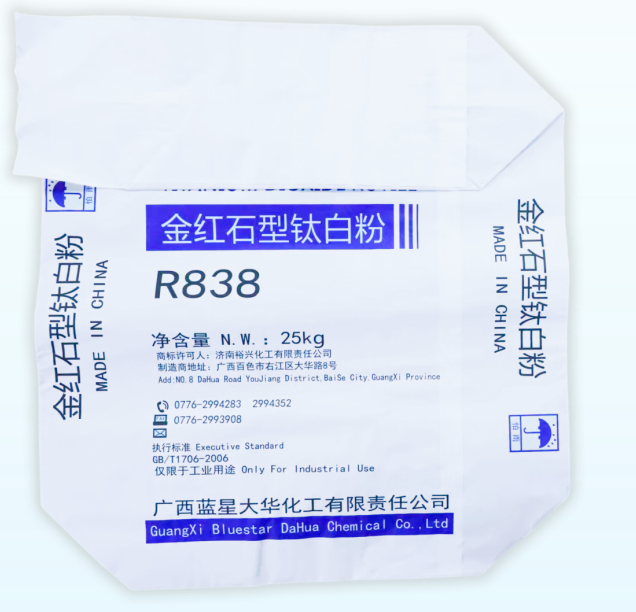
The Four Compliance Layers of a Chemical FIBC Bag
Layer 1 — Product standard and construction
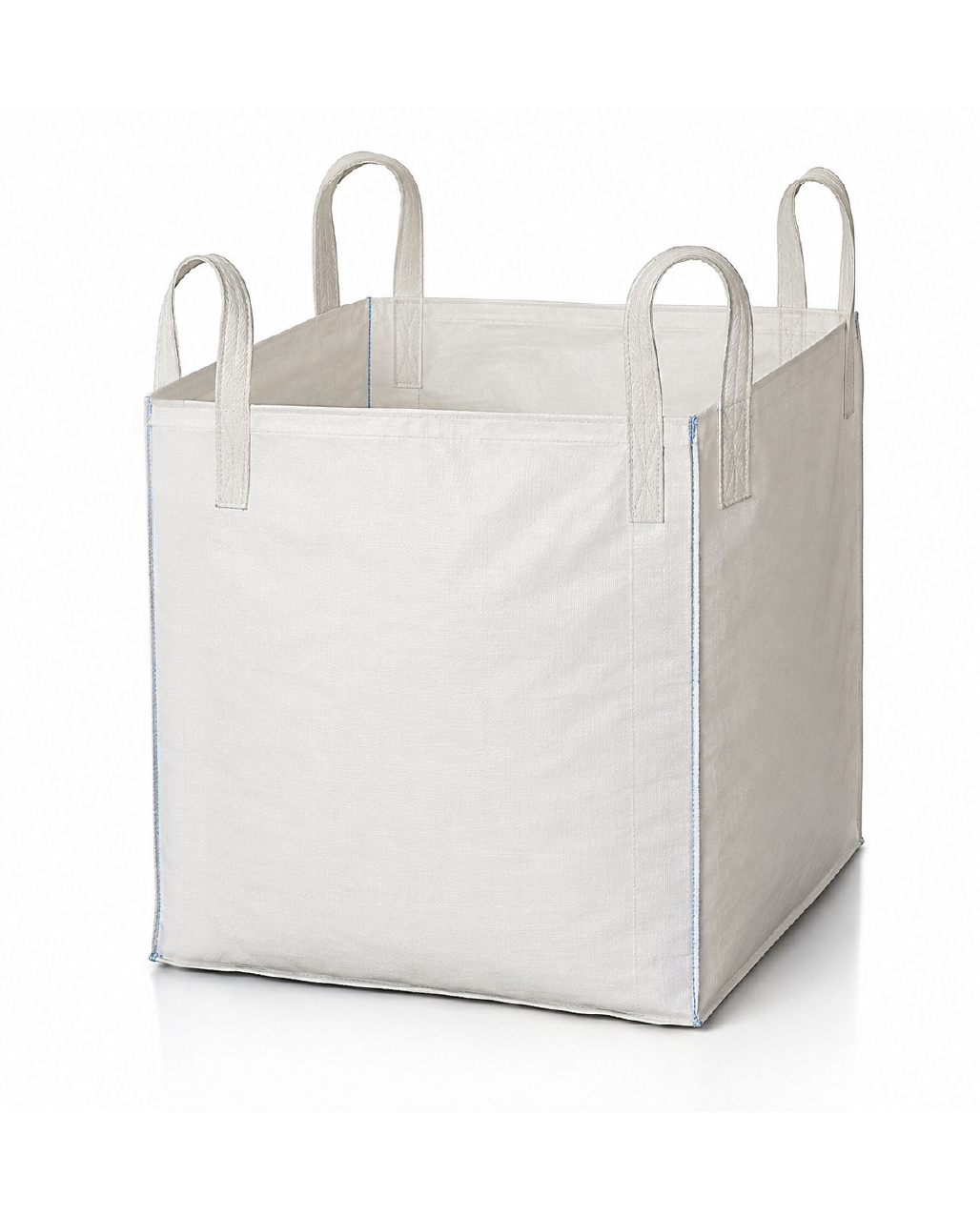
A ton bag or FIBC in the Yide Packaging range uses virgin PP woven fabric as the primary material, with a high-strength PP woven main body. For static-sensitive duties, conductive woven fabric and reinforced thickened anti-static fabric are available. The safe working load is 500–2000 kg. Top configurations include fill spout, full open top and top cover; bottom configurations include discharge spout and flat bottom, with four lifting loops and high-strength polyester thread sewing. Lamination is optional, in laminated or non-laminated form.
Construction is not generic. U-panel, circular, four-panel and baffle FIBC designs are available, with customized filling spouts, discharge spouts and lifting loops. Dimensions, load capacity and construction can be set according to material density, filling weight, filling equipment, pallet size and container transportation requirements. The wider product family also includes industrial FIBC bulk bags, chemical bulk bags, UN certified FIBC bags, food-grade FIBC bulk bags and bulk bags for powder and granule materials.
Layer 2 — Dangerous goods packaging documentation
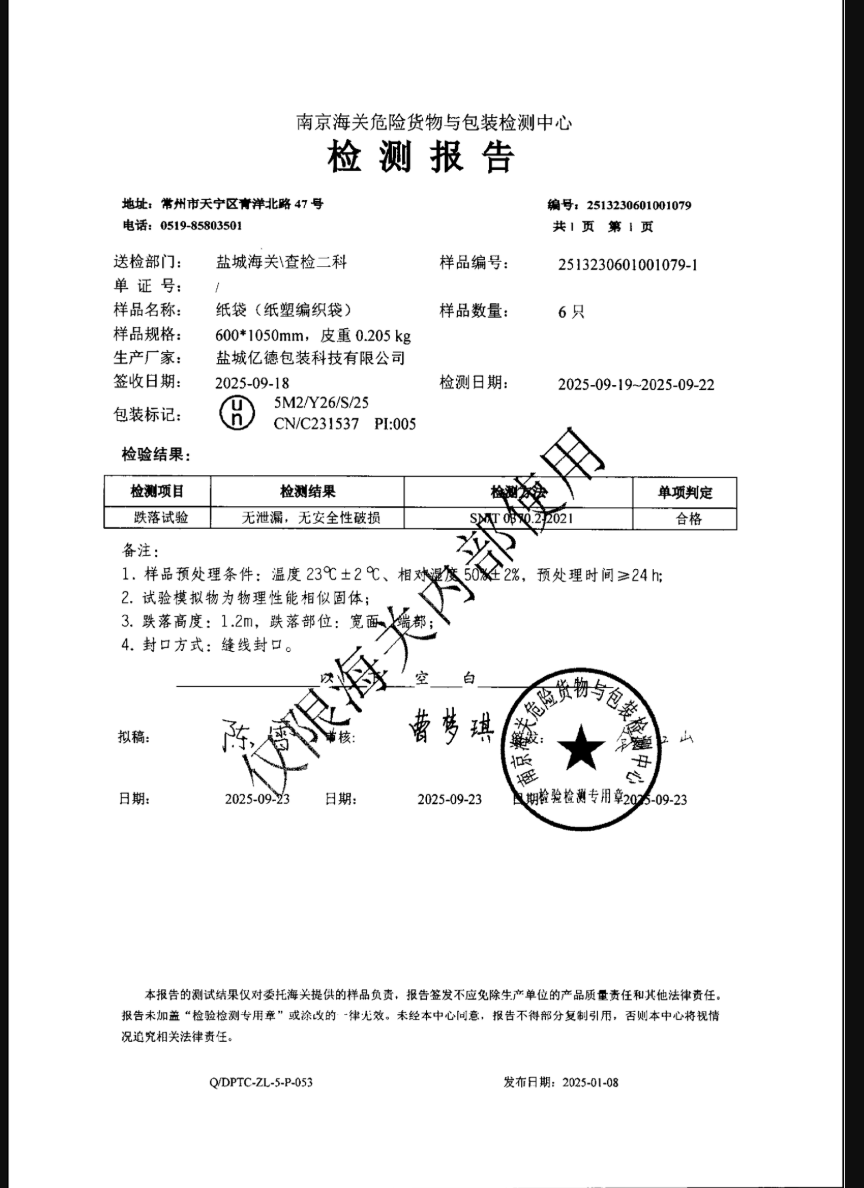
UN packaging test report 2513230601001079 was issued by Nanjing Customs Dangerous Goods and Packaging Testing Center under SN/T 0510.2-2021, and applies to a 600 × 1050 mm paper-plastic woven bag. The recorded outcome is that the bag showed no leakage or safety-relevant damage after the drop test, with the overall result recorded as passed, issued on 23 September 2025. Separately, UN certification for dangerous goods packaging is available for FIBC products in the Yide range.
Layer 3 — Static control for flammable powders
For powders where static accumulation is a genuine risk, the relevant construction is an FIBC compliant with the FIBC Type-C standard. Conductive yarns are woven into the fabric to dissipate static electricity, and the bag is intended for flammable and explosive powder working conditions. Reliable grounding is required during operation; the bag’s conductive path only works when that path is completed. Fabric options include conductive woven fabric and reinforced thickened anti-static fabric, combining conductive performance with the tensile and wear-resistant properties of a high-strength PP woven body.
Layer 4 — Management systems and substance screening
The fourth layer answers a different question: whether the factory that sews your bag operates under audited quality, environmental and safety systems, and whether the material has been screened for restricted substances. Yide Packaging holds three management-system certificates and three substance or performance test documents, listed with their numbers and validity periods below.
| Document | Number | Issuing body | Basis | Validity | Scope in plain terms |
|---|---|---|---|---|---|
| ISO 9001 | 12426Q00719R001 | Zhongbiaoyan Guolian (Beijing) Certification Center | GB/T 19001-2016 / ISO 9001:2015 | 2026-08-05 to 2029-08-04 | Manufacturing of mail bags, including FIBC, transit bags and woven bags |
| ISO 14001 | 12426E00299R001 | Zhongbiaoyan Guolian (Beijing) Certification Center | GB/T 24001-2016 / ISO 14001:2015 | 2026-08-05 to 2029-08-04 | Environmental management activities associated with the manufacture of FIBC, transit bags and woven bags |
| ISO 45001 | 12426S00261R001 | Zhongbiaoyanguolian (Beijing) Certification Center | GB/T 45001-2020 / ISO 45001:2018 | 2026-05-08 to 2029-04-08 | Occupational health and safety management for production of postal bags, including FIBC/bulk bags, transfer bags and woven bags |
| REACH (SVHC) | DGC260127018YD03 | Dongguan Beice Standards Technical Service Co., Ltd. | REACH Regulation (EC) No 1907/2006 | Issued 2026-07-31 | 251-item Substances of Very High Concern screening test for packaging bags (white woven bags) |
| RoHS | A2260656737101001C | CTI (Centre Testing International) | RoHS Directive 2011/65/EU & Amendment 2015/863/EU | Referenced as applicable to the global market | RoHS 2.0 hazardous substances test: lead, Cd, Hg, hexavalent chromium, PBBs, PBDEs, DBP, BBP, DEHP, DIBP |
| Halogen content test | DGC260127018YD02 | Dongguan NTEK Standard Technical Service Co., Ltd. (NTEK) | BS EN 14582:2016 | Test documentation | Halogen (F, Cl, Br, I) content testing of white woven packaging bags |
| UN packaging test report | 2513230601001079 | Nanjing Customs Dangerous Goods and Packaging Testing Center | SN/T 0510.2-2021 | Issued 2025-09-23 | Drop performance of a 600 × 1050 mm paper-plastic woven bag; no leakage or safety-relevant damage; passed |
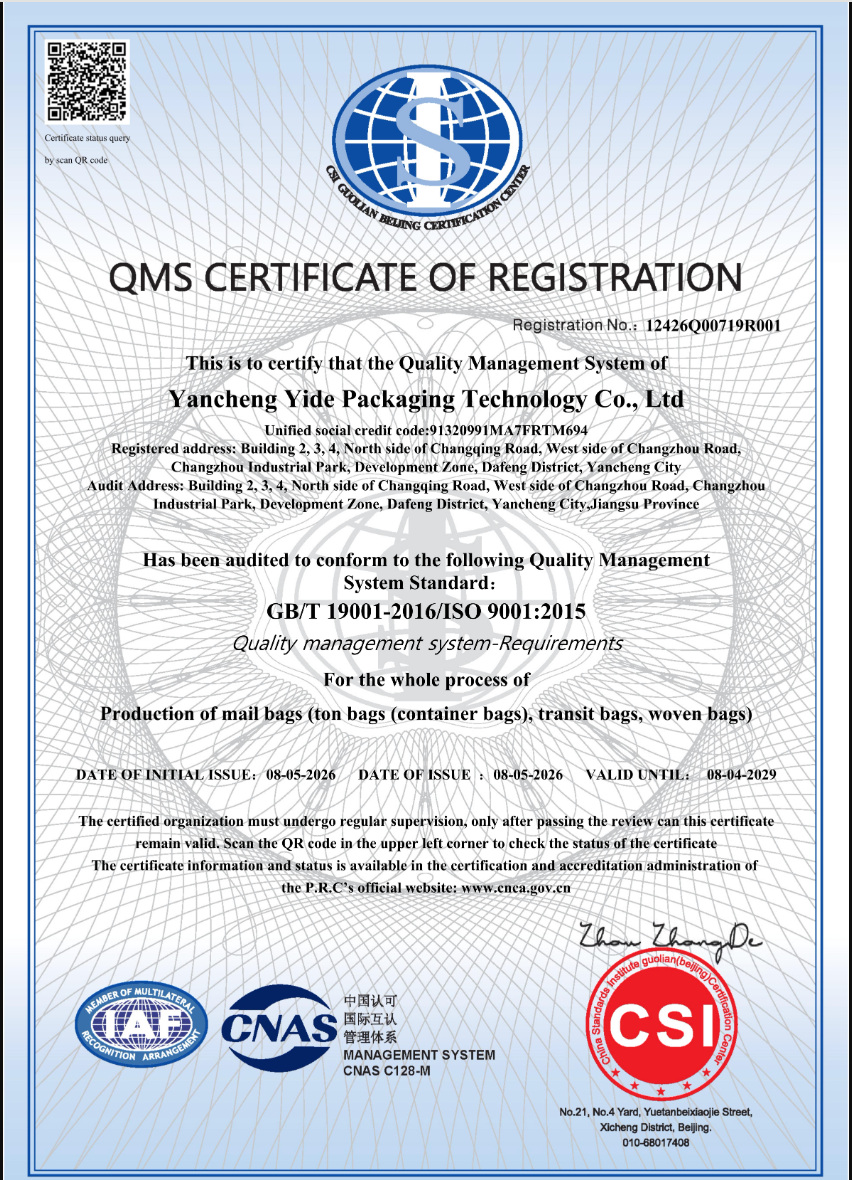
These documents sit on top of a production environment built around 5G-connected production systems, robotic material handling, visual recognition technology, intelligent production management, professional quality inspection teams and advanced testing equipment. Yide Packaging also collaborates with universities and research institutions on new packaging materials, high-performance polymers, biodegradable materials and sustainable packaging technologies.
Specifying and Verifying a Chemical Bulk Bag Order: 7 Steps
- Classify the material before the bag. Establish whether the contents are non-dangerous solids in powder, granular or paste form, as addressed by ISO 21898:2024, or whether a dangerous goods route applies. Confirm moisture sensitivity and whether an inner liner is required.
- Fix the load case. Define the filling weight and set the safe working load inside the 500–2000 kg range, then confirm that bag dimensions match material density, filling equipment, pallet size and container loading plan.
- Choose construction and openings. Select U-panel, circular, four-panel or baffle construction, then decide top (fill spout, full open top, top cover) and bottom (discharge spout, flat bottom) configuration, lifting loops and lamination.
- Decide the static classification. For flammable and explosive powders, select a Type C construction with conductive yarns and document the grounding procedure at the filling and discharge point.
- Assemble the document pack. Request certificate numbers, issuing bodies, scope statements and validity dates, plus any test report that names your bag format. Check that the scope actually covers FIBC production rather than only a related product line.
- Validate a physical sample. Samples without printing are provided for customer confirmation before mass production, and a single sample is available for delivery.
- Lock commercial terms. The MOQ for customized products is 5,000 pcs, and the lead time for customized products is 45 days excluding delivery time, against a monthly capacity of 50,000 pcs. For after-sales, in the event of a shortage of bags, re-delivery or a corresponding deduction is available.
Where FIBC stops and smaller formats begin
Not every chemical line needs a 1-tonne bag. PP woven bags are produced in stock sizes of 110×120 cm, 90×110 cm, 100×120 cm, 100×140 cm, 90×100 cm and 50×80 cm, with fabric weights across 31–54 g/m², plus custom sizes and custom text or logo printing. For automatic powder filling lines, valve bags use an adhesive-sealed valve structure with material options ranging from OPP film lamination and standard paper-plastic composite to 3-ply paper with inner film and 2-ply paper without film; the film-lined version provides water and moisture resistance, while the non-film version is breathable but not waterproof. Paper-plastic composite bags use laminated kraft paper, with optional lamination and an optional inner liner, and reusable logistics bags use PE woven fabric with optional lamination and zipper openings fitted with a zipper protector, a lockable buckle and zipper-tooth protection.
| Format | Material / construction | Typical size or load scope | Opening / closure | Compliance-relevant notes |
|---|---|---|---|---|
| Ton bag / FIBC (bulk bag) | Virgin PP woven fabric; conductive woven fabric and reinforced thickened anti-static fabric options | Safe working load 500–2000 kg | Fill spout, full open top or top cover; discharge spout or flat bottom; four lifting loops | Type C available with required grounding; UN certification for dangerous goods packaging available; laminated or non-laminated |
| Industrial bulk bags | PP woven material with waterproof lamination, stitched with high-tensile polyester thread | 50×36 cm stock size; custom sizes available | Sewn closure; custom logo printing available | Laminated version provides waterproof performance; wear-resistant for handling and long-distance transport |
| PP woven bags (disposable) | Polypropylene woven fabric, 31–54 g/m² | 110×120, 90×110, 100×120, 100×140, 90×100, 50×80 cm; custom sizes | Sewn open-mouth; custom text and logo printing | Covered by ISO 9001, ISO 14001, REACH (SVHC), RoHS and halogen testing documentation |
| Valve bag | OPP film lamination, standard paper-plastic composite, 3-ply paper with inner PE film, or 2-ply paper without film | Size customizable | Adhesive-sealed valve, self-locking after filling | Film-lined version is water and moisture resistant; non-film version is breathable but not waterproof; fade-resistant ink printing |
| Paper-plastic composite bag | Kraft paper laminated; inner liner optional | Custom sizes and special specifications | Sewn closure; laminated or non-laminated | UN packaging test report 2513230601001079 covers the 600 × 1050 mm version; reusable |
| Reusable logistics bag / express transfer bag | PE woven fabric, lamination optional | 100×100 cm; custom sizes available | Zipper style with zipper protector, lockable buckle and zipper-tooth protection, or round opening | Laminated version is waterproof and stain-resistant; wear-resistant for repeated circulation |
Where These Constraint Layers Matter in Practice
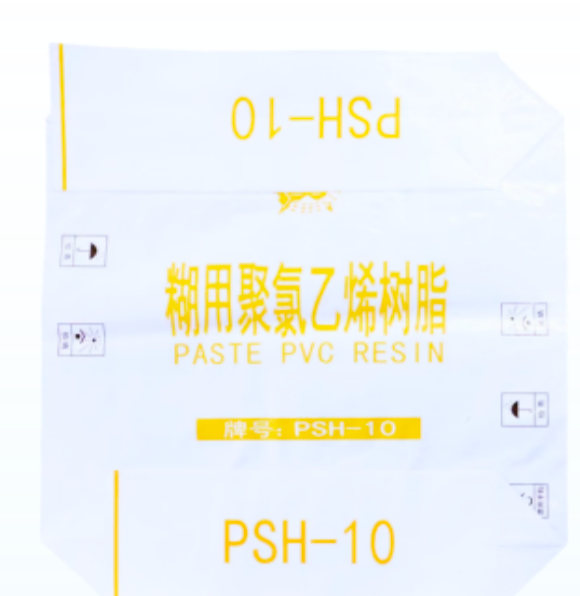
Fine chemicals and powdered resins. Filling of powdery chemical materials such as PVC paste resin requires a hermetically sealed chemical powder pack that is leak-proof and moisture-proof, is compatible with automatic filling, and meets export standards — the reason valve bags and liner-equipped FIBC formats appear together in the same filling hall.
Minerals and building materials. For moisture-absorbing powders and fine particulates, the packaging requirement is described as a wear-resistant outer layer plus an anti-seepage, moisture-proof inner layer that prevents fine powder leakage and material dampness.
Mining and industrial minerals. Bulk bags used for iron ore, manganese ore, mineral powder and industrial minerals improve warehousing and export efficiency, with reuse treated as a conditional practice: before reuse, bags should be inspected for damage, compromised lifting loops, contamination or other signs of wear.
Welding consumables and industrial powders. Granular submerged arc welding flux for export, marine transportation and storage is packed in bags that must resist moisture and transport stress while carrying printed export parameter marks.
Documented reuse cases. A chemical plant in Japan purchased 6,000 bags for pallet applications with reuse recorded at 10 to 30 times, described as a consumable with continuous procurement because of large loading capacity and reduced overall cost. A logistics and transportation buyer in Saudi Arabia ordered 50,000 bags for logistics transit use over a one-year period recording continuous use, and a large e-commerce logistics group in Brazil ordered 50,000 bags on the same basis; in both cases the bags were noted as reusable and lightweight.
Frequently Asked Questions
Which standards apply to UN-certified chemical FIBC bags?
Three standard families apply. Product standards define how the bag is built: ISO 21898:2024 specifies materials, construction and design requirements, type test and marking requirements for flexible intermediate bulk containers intended for non-dangerous solid materials in powder, granular or paste form, with the European adoption EN ISO 21898:2024 approved by CEN on 12 August 2024. China’s replacement standard, GB/T 10454-2025, was released on 29 August 2025 and is implemented from 1 March 2026, superseding GB/T 10454-2000 and GB/T 37425-2019. Static safety in hazardous atmospheres is covered separately by IEC 61340-4-4:2018, which specifies requirements for FIBCs between 0.25 m³ and 3 m³ intended for use in hazardous explosive atmospheres. Dangerous goods transport performance is demonstrated through UN packaging testing, such as Yide Packaging’s report 2513230601001079 issued by Nanjing Customs Dangerous Goods and Packaging Testing Center under SN/T 0510.2-2021.
Does one UN packaging test report cover every FIBC design a supplier makes?
No. A UN packaging test report is tied to the packaging that was tested. Report 2513230601001079 records a drop performance test on a 600 × 1050 mm paper-plastic woven bag, with the result that the bag showed no leakage or safety-relevant damage after the drop and the test was recorded as passed. For an FIBC or ton bag order, buyers should confirm whether the documented test corresponds to the size, material structure and filling weight they intend to use, and request testing for a new format where it does not.
Which certificates does Yide Packaging hold for chemical bulk bag orders?
Yide Packaging holds ISO 9001 certificate 12426Q00719R001 for the manufacturing of mail bags, including FIBC, transit bags and woven bags (valid 2026-08-05 to 2029-08-04); ISO 14001 certificate 12426E00299R001 for environmental management associated with FIBC, transit bag and woven bag manufacture (valid 2026-08-05 to 2029-08-04); and ISO 45001 certificate 12426S00261R001 for occupational health and safety management related to the production of postal bags, including FIBC/bulk bags, transfer bags and woven bags (valid 2026-05-08 to 2029-04-08). Substance screening documents include REACH (SVHC) certificate DGC260127018YD03 covering a 251-item SVHC screening test for packaging bags, RoHS certificate A2260656737101001C, and halogen content test documentation DGC260127018YD02 under BS EN 14582:2016. All are referenced as applying to the global market.
What drives the cost band of a UN-certified chemical bulk bag?
Cost is driven by specification rather than by a fixed catalogue price. The variables that move a quotation are fabric grade and weight (virgin PP woven fabric versus conductive or reinforced thickened anti-static constructions); bag size and safe working load within the 500–2000 kg range; lamination and whether an inner liner is required; top and bottom configuration together with lifting loop design; printing requirements; the documentation pack needed for the destination market; and order volume measured against the 5,000-piece MOQ for customized products. Because these variables interact, a per-bag price band quoted without a specification is not comparable between suppliers.
Can I get a sample first, and how long does production take?
Yes. A single sample is available for delivery, and samples without printing are provided for customer confirmation before mass production. The MOQ for customized products is 5,000 pcs, the lead time for customized products is 45 days excluding delivery time, and monthly capacity is 50,000 pcs. To begin, send your material classification, target safe working load, bag dimensions, lamination requirement and static classification to yidepackaging@gmail.com or WhatsApp +86 178-2626-5555 for a specification-based quotation.
Conclusion
For chemical bulk bags, the specification and the certificate pack are the same purchase decision seen from two angles. A bag built to ISO 21898:2024 requirements, tested where dangerous goods apply, classified correctly for static risk, and supported by management-system and substance certificates that name FIBC production, is a procurement position you can defend in an audit. The verification routine is short: read the scope, the certificate number and the validity dates; check that any test report names your bag format; and confirm the physical sample before mass production.
Yide Packaging supplies FIBC bags, ton bags, PP woven bags, valve bags, paper-plastic composite bags and reusable logistics packaging to markets including Southeast Asia, the Middle East, South America, Europe, North America and Africa, and supports OEM, ODM and fully customized packaging projects from requirement analysis through sampling, production, testing and delivery.
Next step: match your specification to a documented bag format
Send your material type, target safe working load, bag dimensions and static requirements to Yancheng Yide Packaging Technology Co., Ltd. and request a sample or a specification-based quotation. The 2026 company and product brochure is available for download.
Email: yidepackaging@gmail.com | WhatsApp: +86 178-2626-5555 | Website: www.ycyide.net
Address: Yancheng City Dafeng District Development Zone Changzhou Industrial Park, west side of Changzhou Road, north side of Changqing Road, Buildings 2, 3, and 4, Yancheng, Jiangsu, China.