
China Chemical FIBC Bulk Bags: UN Certification Checklist
China Chemical FIBC Bulk Bags: UN Certification Checklist
When a buyer shortlists chemical FIBC bulk bags from China, the factor that decides whether a supplier can actually be used is documentation, not appearance and not the first quoted unit price. A bag that matches the drawing but cannot show a UN packaging test report, a valid management-system certificate, or substance screening documents creates a re-qualification problem at the worst possible moment — after the container is booked. This checklist sets out what to request, how to verify it, and which parameter limits have to be fixed before a chemical bulk bag quotation means anything.
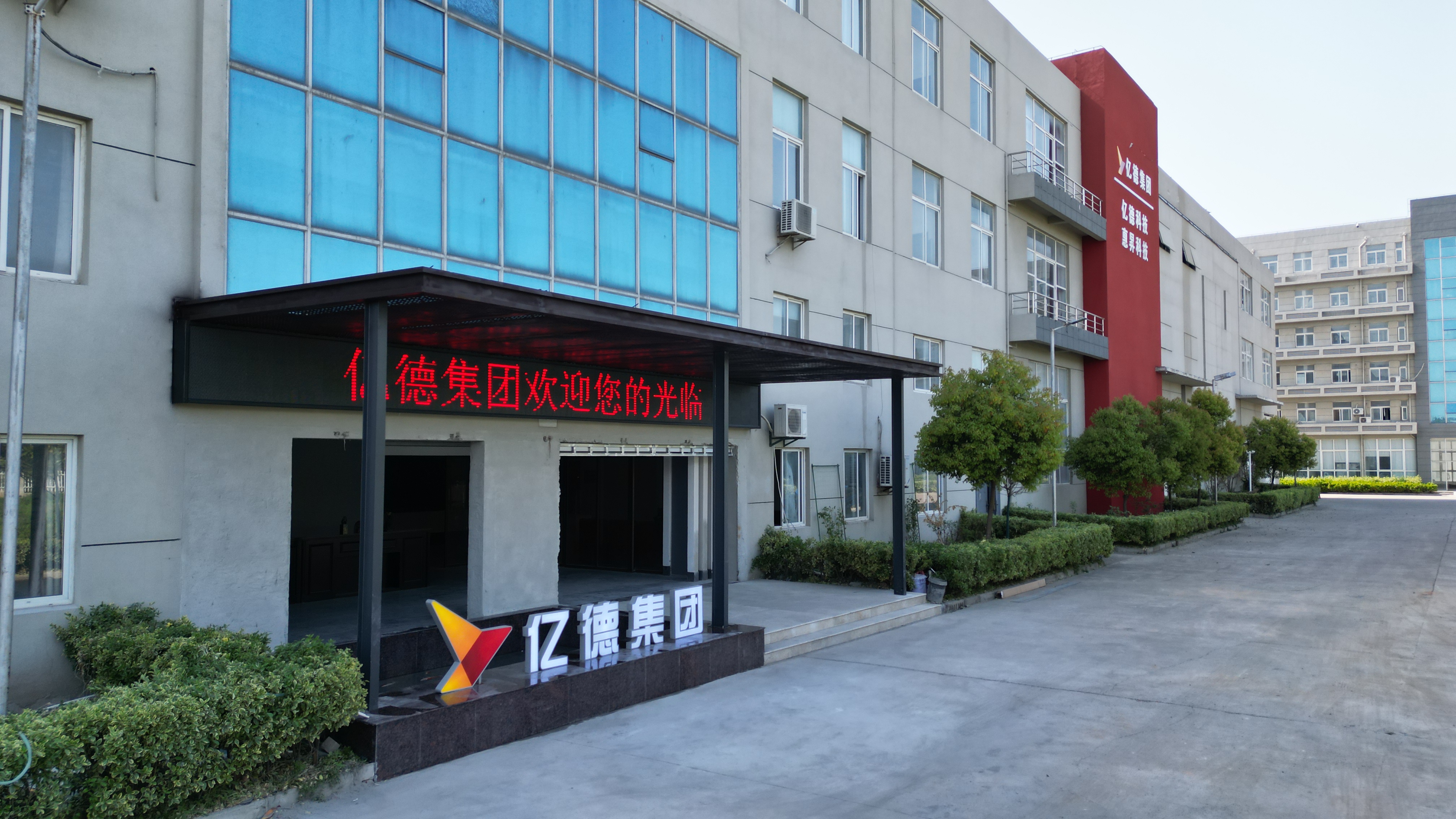
Yancheng Yide Packaging Technology Co., Ltd. (Yide Packaging) is a manufacturer and customized packaging solution provider based in Yancheng, Jiangsu, China, producing FIBC bags, Flexible Intermediate Bulk Containers (bulk bags, ton bags), industrial bulk bags, PP woven bags, valve bags, paper-plastic composite bags, PP woven rolls and reusable logistics packaging for industrial, chemical, agricultural and logistics customers worldwide. Founded in 2022, the company operates 120,000 m² of manufacturing space, including a 5,000 m² food-grade clean workshop, with 130 employees and a 15-engineer R&D team. It is used throughout this article as a worked example of what a verifiable documentation set looks like.
Problem Definition: Why Certification Is the Real Constraint for Chemical Bulk Bags
Chemical bulk bags carry three constraints that general-purpose woven sacks do not. Each one is expressed in documents and parameters rather than in marketing claims, and each one fails in a different way when it is ignored.
- Electrostatic risk. Flammable and explosive powders and granules can be ignited by static accumulation during filling and discharge. IEC 61340-4-4:2018 specifies requirements for flexible intermediate bulk containers between 0.25 m³ and 3 m³ in volume intended for use in hazardous explosive atmospheres — in other words, the electrostatic question is a classified-standard question, not an opinion about fabric.
- Mechanical and transport risk. A filled chemical FIBC bag is lifted, stacked and dropped in transit. Standards such as ISO 21898:2024 specify materials, construction and design requirements together with type test and marking requirements for FIBCs intended to contain non-dangerous solid materials in powder, granular or paste form. Where dangerous goods packaging is involved, performance is separately tested — which is what a UN packaging test report documents.
- Substance and market-access risk. Regulated destinations increasingly ask for screening evidence on the packaging itself — substances of very high concern screening under REACH, restricted substances under RoHS, or halogen content testing. A chemically correct bag made from an undocumented film or liner can still be rejected at the buyer's compliance gate.
The practical consequence is that documentation gaps are usually discovered after ordering, not before. A supplier may quote a chemical bulk bag quickly, then take weeks to produce a test report, or produce a certificate whose scope covers a different product family. Both outcomes cost more than the price difference that made the supplier look attractive.
Industry Background: The Standard Framework Buyers Are Checking Against in 2026
FIBC compliance is currently moving through a standards transition, and buyers who read certificates carefully will notice that different documents cite different editions. That is expected — but it also means the edition and the validity window have to be checked, not assumed.
- ISO 21898:2024 is the current international edition covering materials, construction and design requirements plus type test and marking requirements for FIBCs used with non-dangerous solid materials in powder, granular or paste form. It became effective on 16 August 2024.
- EN ISO 21898:2024 is the European adoption of the same requirement set; it was approved by CEN on 12 August 2024.
- GB/T 10454-2025 is the updated Chinese national standard for packaging flexible intermediate bulk containers for non-dangerous goods. Catalog records show it released on 29 August 2025 with implementation on 1 March 2026, replacing GB/T 10454-2000 and GB/T 37425-2019.
- ISO 21898:2004 is the superseded earlier international edition. Seeing it referenced is not automatically a defect, but it signals that a supplier's document library has not been refreshed.
- IEC 61340-4-4:2018 remains the reference for electrostatic classification and test methods for FIBCs used in hazardous explosive atmospheres, for volumes from 0.25 m³ to 3 m³.
Two boundary conditions are worth stating plainly, because they are where most sourcing confusion originates. First, ISO 21898 and GB/T 10454 address non-dangerous goods; they do not by themselves authorise dangerous goods packaging. Second, a management-system certificate (ISO 9001, ISO 14001, ISO 45001) proves how a factory is managed — it does not prove that a specific bag passed a specific performance test. Buyers need both categories, and they answer different questions.
Detailed Solution: How a Verifiable Chemical FIBC Documentation Set Is Built
1. UN packaging test evidence for the actual construction
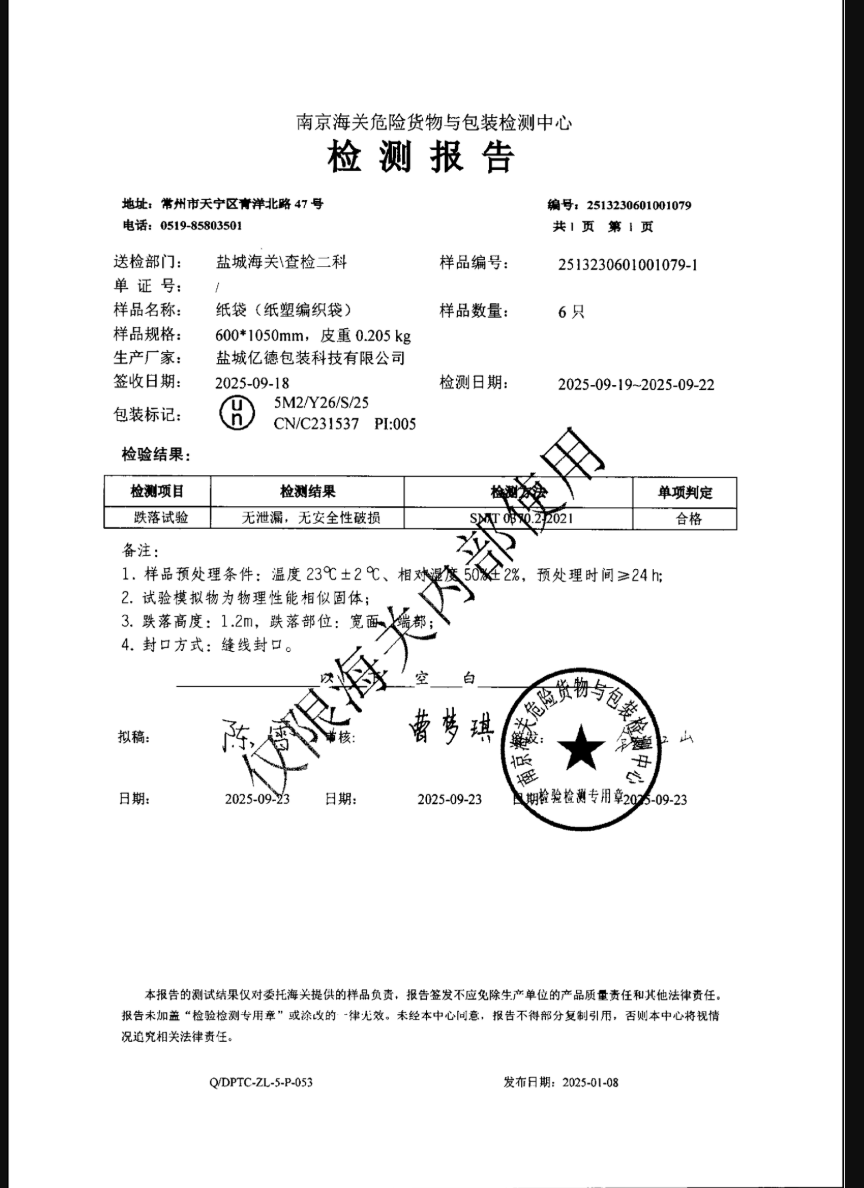
The performance document for dangerous goods packaging is the UN packaging test report. Yide Packaging holds UN Packaging Test Report number 2513230601001079, issued by the Nanjing Customs Dangerous Goods and Packaging Testing Center and tested under SN/T 0510.2-2021. The tested sample is the 600×1050 mm paper-plastic woven bag, evaluated with a UN dangerous goods packaging drop performance test; the reported result is no leakage or safety-relevant damage after drop, with the outcome recorded as passed, issued on 23 September 2025. The report is applied to the paper-plastic composite bag, industrial bulk bags and the ton bag (FIBC) family.
What this means for a chemical buyer is narrow but important: there is an externally issued, traceable report for a defined construction. If your application uses a different fabric weight, liner or lifting configuration, the correct action is to confirm whether that variant is covered or requires separate testing — not to assume the report transfers automatically.
2. Management-system certificates with a defined scope and validity window
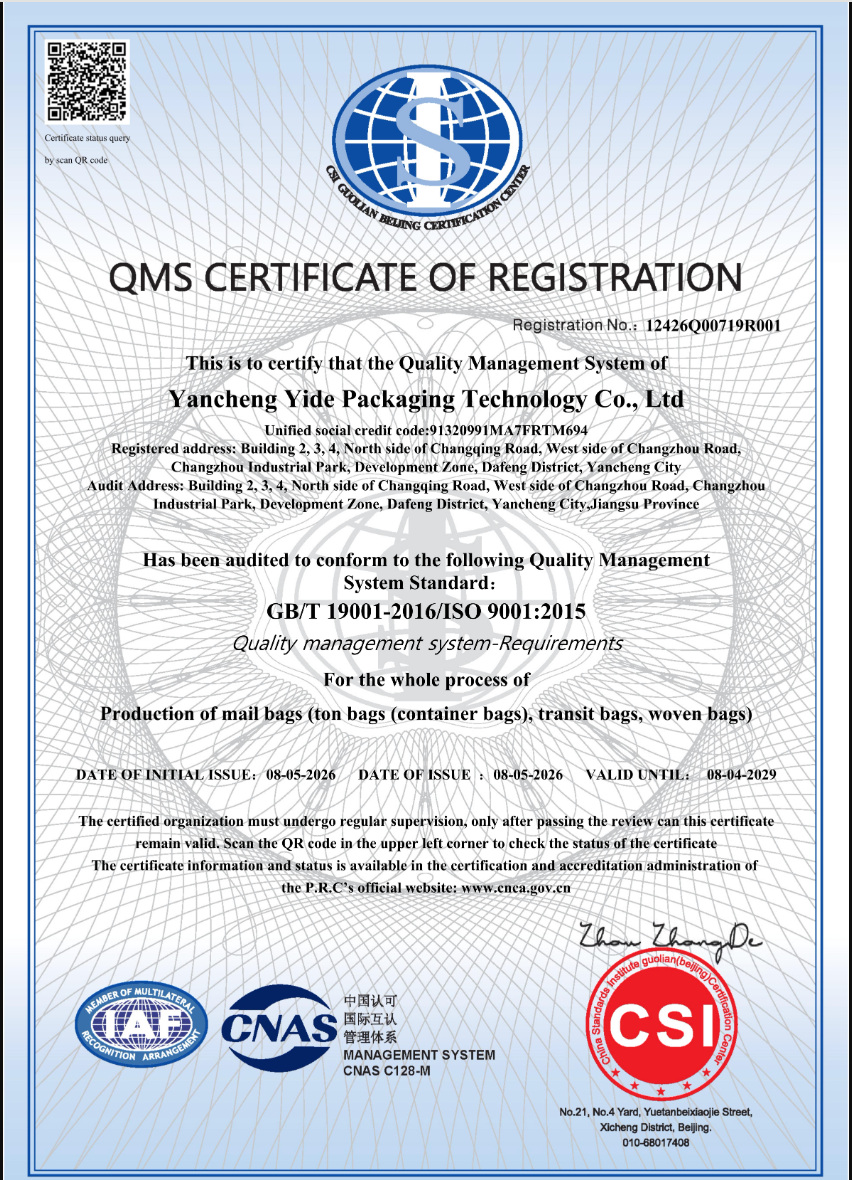
Three management-system certificates apply to the manufacturing base. ISO 9001 certificate 12426Q00719R001 is held under GB/T 19001-2016 / ISO 9001:2015, issued by Zhongbiaoyan Guolian (Beijing) Certification Center, valid from 5 August 2026 to 4 August 2029, with a scope covering the manufacturing of mail bags, including FIBC, transit bags and woven bags. ISO 14001 certificate 12426E00299R001 is held under GB/T 24001-2016 / ISO 14001:2015 by the same body, with the same 5 August 2026 to 4 August 2029 validity, covering environmental management activities associated with FIBC, transit bag and woven bag manufacturing. ISO 45001 certificate 12426S00261R001 is held under GB/T 45001-2020 / ISO 45001:2018, issued by Zhongbiaoyanguolian (Beijing) Certification Center, valid from 8 May 2026 to 8 April 2029, covering occupational health and safety management activities related to the production of postal bags, including FIBC/bulk bags, transfer bags and woven bags.
3. Substance screening documents for regulated destinations
Three screening documents sit alongside the management-system set. REACH (SVHC) certificate DGC260127018YD03 was issued on 31 July 2026 by Dongguan Beice Standards Technical Service Co., Ltd. under REACH Regulation (EC) No 1907/2006; it covers a 251-item Substances of Very High Concern screening test for packaging bags (white woven bags) and applies to PP woven bags, express transfer bags, valve bags and paper-plastic composite bags. Halogen certificate DGC260127018YD02, issued by Dongguan NTEK Standard Technical Service Co., Ltd. (NTEK), covers halogen (F, Cl, Br, I) content testing of white woven packaging bags under BS EN 14582:2016. RoHS certificate A2260656737101001C, issued by CTI (Centre Testing International) under RoHS Directive 2011/65/EU & Amendment 2015/863/EU, applies to the ton bag, express transfer bag, valve bag, paper-plastic composite bag and PP woven bag products.
4. Anti-static construction for flammable powder conditions
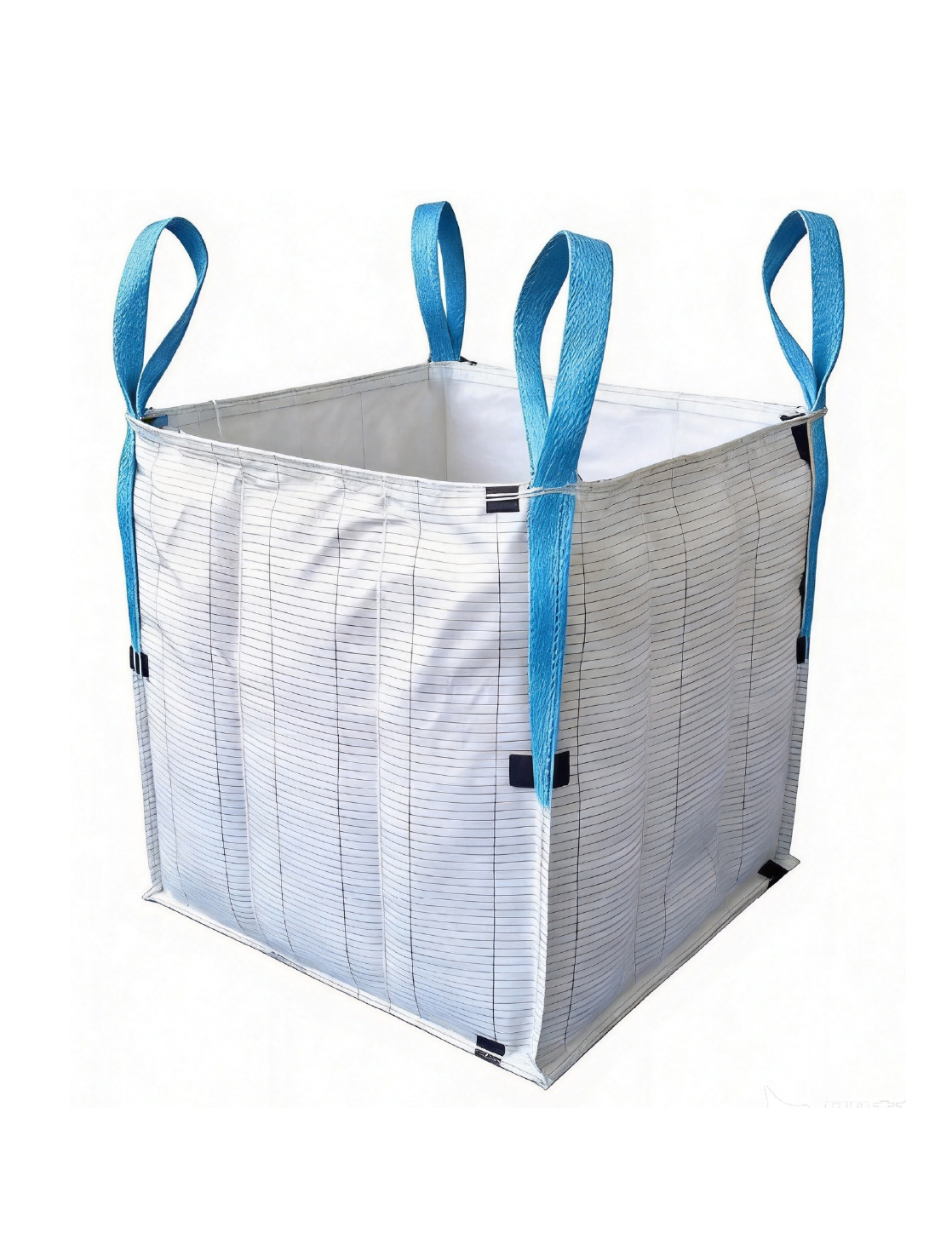
For powders that can form explosive atmospheres, the bag construction itself is the control. Yide Packaging manufactures Type C compliant FIBC bags constructed with conductive yarns to dissipate static electricity, using conductive woven fabric and reinforced thickened anti-static fabric, with virgin PP woven fabric as the main body material. The published operating condition is explicit: reliable grounding is required during Type C operation. That requirement is not a formality — an ungrounded Type C bag, or a bag used in conditions where grounding cannot be maintained, is the wrong selection regardless of how the fabric is specified.
5. The parameter envelope that must be locked before quoting
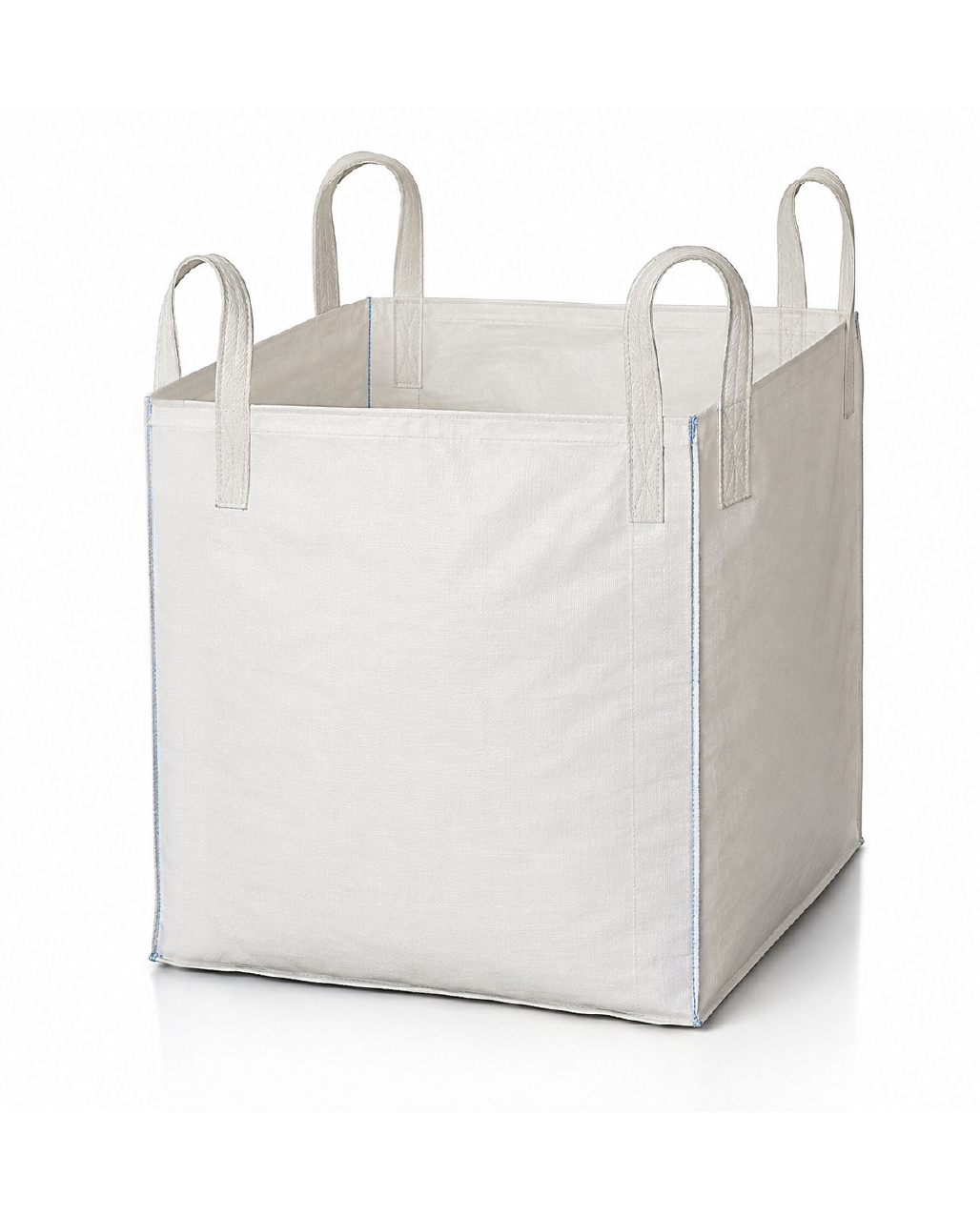
Chemical bulk bag pricing and lead time are only meaningful once the construction is fixed. The ton bag / FIBC range covers a safe working load of 500–2000 kg, with top options of fill spout, full open top or top cover, and bottom options of discharge spout or flat bottom. Bags carry four lifting loops and are sewn with high-strength polyester thread; lamination is available in laminated or non-laminated configurations. Industrial bulk bags add U-panel, circular, four-panel and baffle FIBC designs with customized filling spouts, discharge spouts and lifting loops, sized to material density, filling weight, filling equipment, pallet size and container transport requirements.
Step-by-Step Breakdown: A Six-Step Supplier Verification Workflow
The sequence below is written for the research-to-evaluation stage, where the goal is to reduce the candidate list rather than to negotiate. Each step produces a document or a decision, so the process has a visible end point.
- Classify the material and the hazard. Establish whether the product is a powder, granule, pellet or paste; whether it can form a hazardous explosive atmosphere; and whether it is moisture-sensitive, food-contact or otherwise regulated. This determines whether you need Type C anti-static construction, an inner liner, laminated fabric, or food-grade production conditions such as a dedicated clean workshop.
- Fix the parameter set in writing. Dimension, fabric weight, safe working load, lifting loop configuration, top and bottom design, filling and discharge equipment interface, liner, lamination, printing and stacking height. A supplier that accepts an RFQ without these details cannot be compared on price honestly, because the quotes will describe different bags.
- Request the document set, by category. Performance evidence (UN packaging test report), management-system certificates (ISO 9001, ISO 14001, ISO 45001), and substance screening (REACH SVHC, RoHS, halogen). Ask for the document itself, not a logo wall.
- Verify numbers, scope, issuer and validity window. Read the certificate number, the standard referenced, the issuing body and the valid-from / valid-to dates, then confirm that the stated scope covers the product family you are buying. A certificate that covers woven bag manufacturing does not automatically cover a laminated valve bag variant.
- Validate with a physical sample before tooling up. Yide Packaging supplies a single sample for delivery, and quality control for customized projects is handled through unprinted samples for customer confirmation. Customized production runs at a minimum order quantity of 5,000 pcs, so sample validation is the cheapest point in the project chain to catch a specification error.
- Confirm commercial terms and continuity. Yide Packaging reports a monthly capacity of 50,000 pcs and a lead time of 45 days for customized products, excluding delivery time. On after-sales, the stated policy is re-delivery or corresponding deduction in the event of a shortage of bags — a term worth confirming in writing, because it addresses the failure mode that buyers of woven packaging actually experience.
Decision rule. A Chinese chemical FIBC supplier is evaluation-ready when it can produce, on request: a UN packaging test report tied to a defined construction, three management-system certificates inside their validity windows, substance screening documents for the destination market, and a written parameter sheet matching your filling and discharge equipment. If any of the four is missing, the supplier is a research candidate, not a qualified source.
Use Cases: Where These Constructions Are Actually Applied
Chemical and petrochemical powders and granules are the core application, and the documentation set above is designed around them. The same FIBC constructions also serve minerals and building materials — where the failure mode is fine powder leakage and moisture ingress, addressed through a wear-resistant outer layer and an anti-seepage, moisture-proof inner layer — as well as agriculture and fertilizer, food ingredients produced under clean-workshop conditions, and industrial consumables such as granular welding flux that must be moisture-proof and transport-resistant for export by sea.
Repeat-order behaviour is a useful secondary signal when evaluating a supplier, because it reflects whether the bag survives real handling cycles rather than a laboratory. Documented project patterns include a chemical plant customer in Japan taking 6,000 pcs on pallets with reuse observed across 10 to 30 cycles and continuing consumable procurement; a logistics and transportation customer in Saudi Arabia with 50,000 pcs in continuous use over one year; a large e-commerce logistics group in Brazil with 50,000 pcs and continuous use over one year; a logistics and transportation customer in Malaysia with 3,000 pcs and continuous use over one year; and a large e-commerce logistics group in the Philippines with 50,000 pcs in continuous use over one year. The consistent thread across these records is reuse and lightweight handling rather than a single lowest-cost order.
Comparison Table: Compliance Documents and Product Coverage at a Glance
The table below lists the documents referenced in this article with their numbers, issuers and validity windows, so they can be checked line by line during supplier evaluation.
| Document | Standard / Rule | Number | Issuer | Validity | Product coverage |
|---|---|---|---|---|---|
| UN Packaging Test Report | SN/T 0510.2-2021 | 2513230601001079 | Nanjing Customs Dangerous Goods and Packaging Testing Center | Issued 2025-09-23 | 600×1050 mm paper-plastic woven bag; industrial bulk bags; ton bag (FIBC) |
| ISO 9001 | GB/T 19001-2016 / ISO 9001:2015 | 12426Q00719R001 | Zhongbiaoyan Guolian (Beijing) Certification Center | 2026-08-05 to 2029-08-04 | Manufacturing of mail bags, including FIBC, transit bags and woven bags |
| ISO 14001 | GB/T 24001-2016 / ISO 14001:2015 | 12426E00299R001 | Zhongbiaoyan Guolian (Beijing) Certification Center | 2026-08-05 to 2029-08-04 | FIBC, transit bag and woven bag manufacturing; PP woven bags, valve bags, paper-plastic composite bags, express transfer bags |
| ISO 45001 | GB/T 45001-2020 / ISO 45001:2018 | 12426S00261R001 | Zhongbiaoyanguolian (Beijing) Certification Center | 2026-05-08 to 2029-04-08 | Occupational health and safety management for production of postal bags, including FIBC/bulk bags, transfer bags and woven bags |
| REACH (SVHC) | REACH Regulation (EC) No 1907/2006 | DGC260127018YD03 | Dongguan Beice Standards Technical Service Co., Ltd. | Issued 2026-07-31 | 251-item SVHC screening test, packaging bags (white woven bags); PP woven bags, express transfer bags, valve bags, paper-plastic composite bags |
| Halogen | BS EN 14582:2016 | DGC260127018YD02 | Dongguan NTEK Standard Technical Service Co., Ltd. (NTEK) | — | Halogen (F, Cl, Br, I) content testing of white woven packaging bags |
| RoHS | RoHS Directive 2011/65/EU & Amendment 2015/863/EU | A2260656737101001C | CTI (Centre Testing International) | — | Ton bag, express transfer bag, valve bag, paper-plastic composite bag, PP woven bags |
Because documentation alone does not describe the bag, the second table maps the product family to its constraint profile. This is the sheet to bring into a technical discussion after the certificates have been checked.
| Product family | Core material | Key parameters and constraints | Document coverage |
|---|---|---|---|
| Ton bag / FIBC (chemical bulk bags) | Virgin PP woven fabric; conductive woven fabric; reinforced thickened anti-static fabric | SWL 500–2000 kg; fill spout, full open top or top cover; discharge spout or flat bottom; four lifting loops; Type C compliant with grounding required; lamination optional | UN Packaging Test Report 2513230601001079; RoHS A2260656737101001C |
| Industrial bulk bags | PP woven material with waterproof lamination | Custom sizes (e.g. 50×36 cm); U-panel, circular, four-panel and baffle designs; customized filling and discharge spouts; high-tensile polyester thread sewing | UN Packaging Test Report; ISO 9001 |
| Paper-plastic composite bag | Kraft paper laminated | Lamination optional; inner liner bag optional; dust-proof; reusable; good load-bearing for powder and granular materials | UN Packaging Test Report (600×1050 mm); REACH SVHC; ISO 14001; RoHS; Halogen |
| PP woven bags / sacks | Polypropylene (PP) woven fabric | 31–54 g/m² fabric weight options; stock sizes 50×80 cm to 110×120 cm; green standard colour; custom text and logo printing | ISO 9001; ISO 14001; REACH SVHC; RoHS; Halogen |
| Valve bag | OPP film laminated composite; standard paper-plastic composite; 3-ply paper with inner PE film; 2-ply paper without film | Customizable size; fade-resistant ink printing; drop-shock resistant; film-lined version water and moisture resistant, non-film version breathable | ISO 14001; REACH SVHC; RoHS; Halogen |
| Express transfer bag / reusable logistics bags | PE woven fabric, lamination optional | 100×100 cm, customizable; zipper style with zipper protector, lockable buckle and zipper-tooth protection; round opening style; laminated version waterproof and stain-resistant | ISO 14001; RoHS |
FAQ: UN-Certified Chemical FIBC Bulk Bags from China
Which certifications should a UN-certified chemical FIBC bag manufacturer in China be able to provide?
Four categories, and they answer different questions. Performance evidence: a UN Packaging Test Report tied to a defined construction — for example report 2513230601001079, issued by the Nanjing Customs Dangerous Goods and Packaging Testing Center under SN/T 0510.2-2021 for the 600×1050 mm paper-plastic woven bag, reported as passed with no leakage or safety-relevant damage after drop. Management systems: ISO 9001 (12426Q00719R001, valid 2026-08-05 to 2029-08-04), ISO 14001 (12426E00299R001, same validity) and ISO 45001 (12426S00261R001, valid 2026-05-08 to 2029-04-08). Substance screening: REACH (SVHC) certificate DGC260127018YD03, Halogen certificate DGC260127018YD02 under BS EN 14582:2016, and RoHS certificate A2260656737101001C under RoHS Directive 2011/65/EU & Amendment 2015/863/EU. Product-level evidence: a written parameter sheet matching your filling and discharge equipment. Always confirm the certificate number, issuer, scope and validity dates rather than relying on a certificate image.
Can a China FIBC manufacturer produce anti-static bulk bags suitable for flammable chemical powders?
Yes, provided the construction is Type C compliant and grounding is maintained in operation. Yide Packaging manufactures FIBC bags in virgin PP woven fabric with conductive woven fabric and reinforced thickened anti-static fabric, constructed with conductive yarns to dissipate static electricity and suitable for flammable and explosive powder working conditions. The company states explicitly that reliable grounding is required during Type C operation. IEC 61340-4-4:2018 is the relevant standard for FIBCs from 0.25 m³ to 3 m³ used in hazardous explosive atmospheres, and the practical selection question is not only whether the bag is anti-static, but whether the receiving site can guarantee the grounding path the bag depends on. Customization is available across dimensions, bag structure, filling and discharge design, lifting loops, lamination and printing, with ODM projects supported.
What drives the cost of chemical FIBC bulk bags when comparing China suppliers?
Cost is driven by construction decisions rather than by supplier location. The variables that move a quotation are fabric weight and grade (virgin PP woven versus conductive or reinforced anti-static fabric), safe working load within the 500–2000 kg range, lamination versus non-lamination, inner liner requirements, top and bottom design (fill spout, open top, top cover, discharge spout, flat bottom), lifting loop and sewing specification, and printing. Order economics add a second layer: customized production carries a minimum order quantity of 5,000 pcs, single samples are available for delivery, and monthly capacity is 50,000 pcs. The practical implication is that a quotation is only comparable against another quotation built on the same written parameter sheet — and that the cheapest quote on an undefined specification is a measurement of nothing.
Can I obtain a sample before placing a customized FIBC order?
Yes. A single sample is available for delivery, and for customized projects quality control is handled by providing samples without printing for customer confirmation before production proceeds. Because customized orders start at 5,000 pcs, the sample stage is the most economical point to verify fabric hand, seam and thread quality, loop attachment, filling and discharge geometry, and lamination behaviour for moisture-sensitive or hygroscopic powders. Request the sample against the same written parameter sheet that the production order will reference.
What is the lead time for customized chemical bulk bags from this type of manufacturer?
Yide Packaging states a lead time of 45 days for customized products, excluding delivery time, against a monthly capacity of 50,000 pcs. Two practical notes: the 45-day figure applies to customized production, so stock-range items follow different timing, and export documentation, testing or third-party inspection requirements can sit outside that window. For chemical applications where certification must accompany the shipment, plan backwards from the required delivery date and confirm both the production slot and the document turnaround at the quotation stage. To move from candidate to qualified source, the shortest path is to send the parameter sheet and destination market requirements through the company's contact channel at ycyide.net and ask for the sample plus the document set in the same request.
Conclusion: Documentation First, Then the Bag
Chemical FIBC bulk bags sourced from China are not difficult to buy; they are difficult to buy verifiably. The standard framework has moved — ISO 21898:2024 replaced the 2004 edition internationally, EN ISO 21898:2024 was approved by CEN in August 2024, and GB/T 10454-2025 replaced two earlier Chinese standards with implementation on 1 March 2026 — while substance screening expectations under REACH, RoHS and halogen testing continue to tighten at destination level. Against that background, the supplier who can hand over a UN packaging test report, three in-window management-system certificates and current screening documents on request is a lower-risk choice than the supplier who quotes fastest.
Yancheng Yide Packaging Technology Co., Ltd. builds its chemical bulk bag offer around that document set: UN Packaging Test Report 2513230601001079 for the paper-plastic woven bag, industrial bulk bags and ton bag family; ISO 9001, ISO 14001 and ISO 45001 certificates; REACH (SVHC), Halogen and RoHS screening; and a manufacturing base of 120,000 m² in Yancheng, Jiangsu with a 5,000 m² food-grade clean workshop, 15 engineers and 5G-connected production and inspection systems. Products and solutions have been supplied to markets including the United States, United Kingdom, Brazil, Saudi Arabia, Thailand, the Philippines, Malaysia and Australia, with export markets concentrated in Southeast Asia, the Middle East and South America.
Next step. Send your material type, filling weight, safe working load, filling and discharge equipment details, destination market and required document list. Yide Packaging will respond with a parameter-matched specification, a sample arrangement and the applicable certificate set.
Email: yidepackaging@gmail.com | WhatsApp / Tel: +86 178-2626-5555 | Website: www.ycyide.net
Download the company and product catalog (PDF) for the full range: Yide Packaging catalog 2026. Contact person: Chen Wang. Address: Yancheng City Dafeng District Development Zone Changzhou Industrial Park, west side of Changzhou Road, north side of Changqing Road, Buildings 2, 3 and 4.