
UN-Certified Chemical Bulk Bags: Buyer Compliance Checklist
UN-Certified Chemical Bulk Bags: Buyer Compliance Checklist
Answer first: a UN-certified chemical bulk bag is a bulk bag — specifically a Flexible Intermediate Bulk Container (FIBC) — supported by documented packaging test evidence for dangerous goods transport. That requirement is separate from the ISO 21898 design and type-test standard, which covers FIBCs for non-dangerous solid materials in powder, granular or paste form. Buyers who treat the words UN approved as a product description rather than a document set usually discover the gap at the port or at the customer audit, not at the quotation stage.
This checklist is written for importers, procurement managers, chemical plant engineers and industrial end users who are comparing suppliers at the research and evaluation stage. It covers the standards that actually apply, the certificate set worth requesting, the specification boundaries of woven polypropylene construction, and the sampling, MOQ and lead-time rules that decide whether a bulk bag order is deliverable on schedule.
Yancheng Yide Packaging Technology Co., Ltd. (Yide Packaging) is a manufacturer and customized packaging solution provider based in Yancheng, Jiangsu, China, producing FIBC bags, ton bags, industrial bulk bags, chemical bulk bags, PP woven bags, valve bags, paper-plastic composite bags and reusable logistics and mailing bags for export markets.
Why UN Certification Is a Documentation Question, Not a Bag Question
A standard woven polypropylene bag and a UN-certified chemical bulk bag can look identical on a pallet. What separates them is a test report from an approved packaging testing body, tied to a defined bag construction and defined test conditions. That is why the sourcing risk in this category is rarely manufacturing capability — it is documentation scope.
In practice, five verification failures account for most compliance problems in chemical bulk bag sourcing:
- The certificate exists but its scope does not match the bag being ordered — different dimensions, different construction or a different material structure.
- A test report is presented for the wrong product line, for example a report covering a paper-plastic woven bag used to support an FIBC quotation.
- No static-control evidence is provided for combustible powders, even though the filling and discharge process generates charge.
- Moisture and lamination claims are made without a defined material structure behind them, so the waterproof expectation is never written into the specification.
- Validity windows, certificate numbers and issuing bodies are not checked against the records the buyer is shown.
The Standards That Govern Chemical FIBC and Bulk Bags
Four published standards define the requirement landscape for bulk bags, and they answer different questions. Confusing them is the single most common specification error in this category.
- ISO 21898:2024 specifies materials, construction and design requirements, type test and marking requirements for flexible intermediate bulk containers intended to contain non-dangerous solid materials in powder, granular or paste form, designed to be lifted from above by integral or detachable devices. This is the design and type-test baseline for a non-dangerous goods bulk bag.
- EN ISO 21898:2024 is the European implementation of the same requirement set and was approved by CEN on 12 August 2024, which makes it the reference buyers in Europe should expect a supplier to work against.
- ISO 21898:2004 is the earlier edition of that standard. Specification sheets and internal templates that still quote the 2004 edition are a signal that the technical file has not been reviewed recently.
- GB/T 10454-2025 is the Chinese national standard for flexible intermediate bulk containers for non-dangerous goods. Catalog records indicate it was released on 29 August 2025 with implementation on 1 March 2026, replacing GB/T 10454-2000 and GB/T 37425-2019 — a change that matters to buyers whose acceptance criteria reference Chinese standards.
- IEC 61340-4-4:2018 specifies requirements for FIBCs between 0.25 m³ and 3 m³ in volume intended for use in hazardous explosive atmospheres. This is the electrostatic classification and test framework behind Type C anti-static bulk bag operation.
Read together, these standards explain why a supplier cannot answer the certification question with one word. A chemical bulk bag project may need a design and type-test basis for the bag structure, an electrostatic classification decision for the powder being handled, and a separate dangerous goods packaging test result if the material is regulated for transport.
What Yide Packaging Manufactures for Chemical and Bulk Cargo
Yide Packaging manufactures the product families that appear in chemical, mineral, agricultural and logistics specifications, which allows a buyer to keep material handling, transport and dispatch packaging on one certified supply base.
- Ton Bag / FIBC range: FIBC Bag, Chemical Bulk Bags, Heavy Duty FIBC Bulk Bags, Industrial FIBC Bulk Bags, UN Certified FIBC Bags, Food Grade FIBC Bulk Bags, and Bulk Bags for Powder and Granule Materials.
- Industrial Bulk Bags: PP woven material with waterproof lamination, stitched with high-tensile polyester thread, available in 50×36 cm and custom sizes, with custom logo printing.
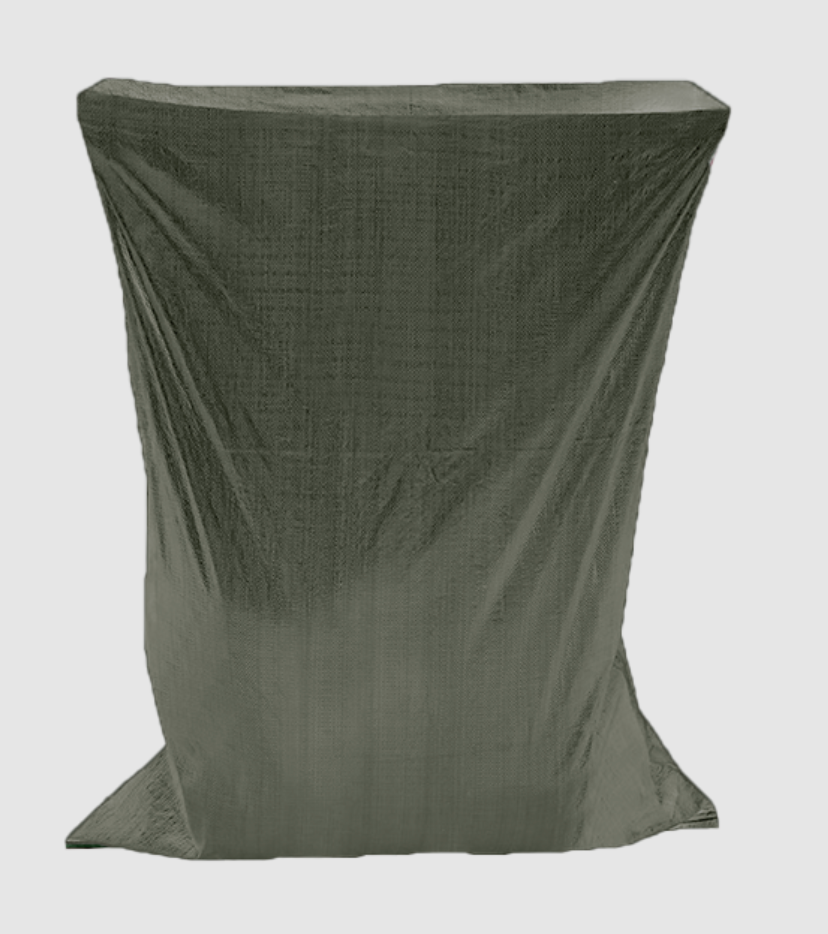
- PP Woven Bags and Polypropylene Woven Bags: stock sizes of 110×120 cm, 90×110 cm, 100×120 cm, 100×140 cm, 90×100 cm and 50×80 cm, with multiple weight options of 31–54 g/m², green as the standard color and custom text and logo printing available.
- PP Woven Roll: flat and tubular woven fabric supplied for downstream converting, in white, yellow and green, with customizable colors, with GSM and roll width set per order requirement.
- Valve Bags and Paper-Plastic Composite Bags: PP Woven Valve Bags and kraft paper laminated composite structures for automatic powder filling lines.
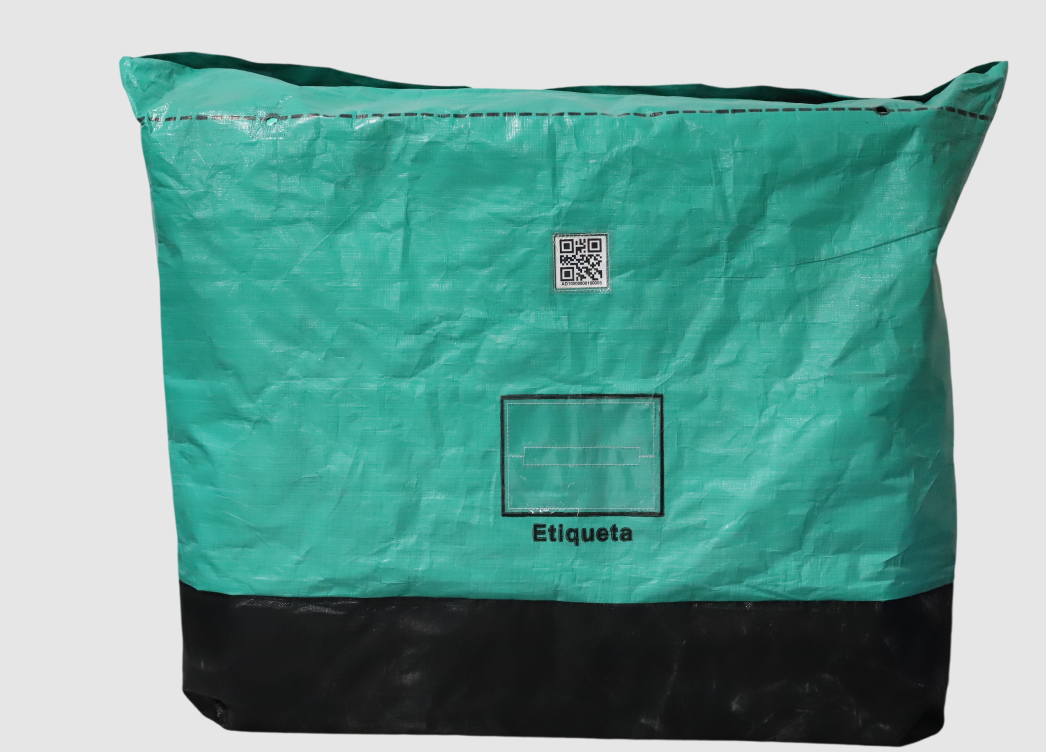
- Logistics and mailing packaging: Express Transfer Bags, Reusable Logistics Bags, Zippered Logistics Bags, Waterproof Mailing Bags, Plastic Mailing Bags, PP Courier mailing bags and Biodegradable Poly Mailers.
FIBC construction details that appear on the specification sheet
- Safe working load: 500–2000 kg, with lamination available in laminated or non-laminated options.
- Primary material: virgin PP woven fabric for the main body, with high-strength PP woven fabric used in the bag body.
- Static-control construction: conductive woven fabric and reinforced thickened anti-static fabric, woven with conductive yarns to dissipate static electricity, compliant with the FIBC Type-C standard and suitable for flammable and explosive powder working conditions.
- Top options: fill spout, full open top or top cover. Bottom options: discharge spout or flat bottom. Lifting: four lifting belts. Sewing: high-strength polyester thread.
- Bag designs available for bulk material packaging include U-panel, circular, four-panel and baffle FIBC constructions, with customized filling spouts, discharge spouts and lifting loops.
Manufacturing base behind the certification file
- Established in 2022, with a reported 120,000 m² manufacturing footprint and 130 employees.
- The FIBC production base covers approximately 80 mu, with around 80,000 m² of standardized factory facilities, including a 5,000 m² food-grade clean workshop.
- Annual production capacity of 500,000 to 1,000,000 tonnes, an R&D team of 15 engineers, and an export ratio of 20%.
- Production and quality control are supported by 5G-connected production systems, robotic material handling, visual recognition technology, intelligent production management, professional quality inspection teams and testing equipment. The company also works with universities and research institutions on new packaging materials, high-performance polymers and biodegradable materials.
- Export markets include Thailand, Kazakhstan, Kyrgyzstan, Uzbekistan, Tajikistan, Turkmenistan, Turkey, Saudi Arabia, the United Arab Emirates, Egypt, South Africa, Italy, Spain, the United Kingdom, the Netherlands, France, Hungary, Germany, Australia, Argentina, Mexico, Brazil, the United States and Canada.
Certification Documents Buyers Should Request
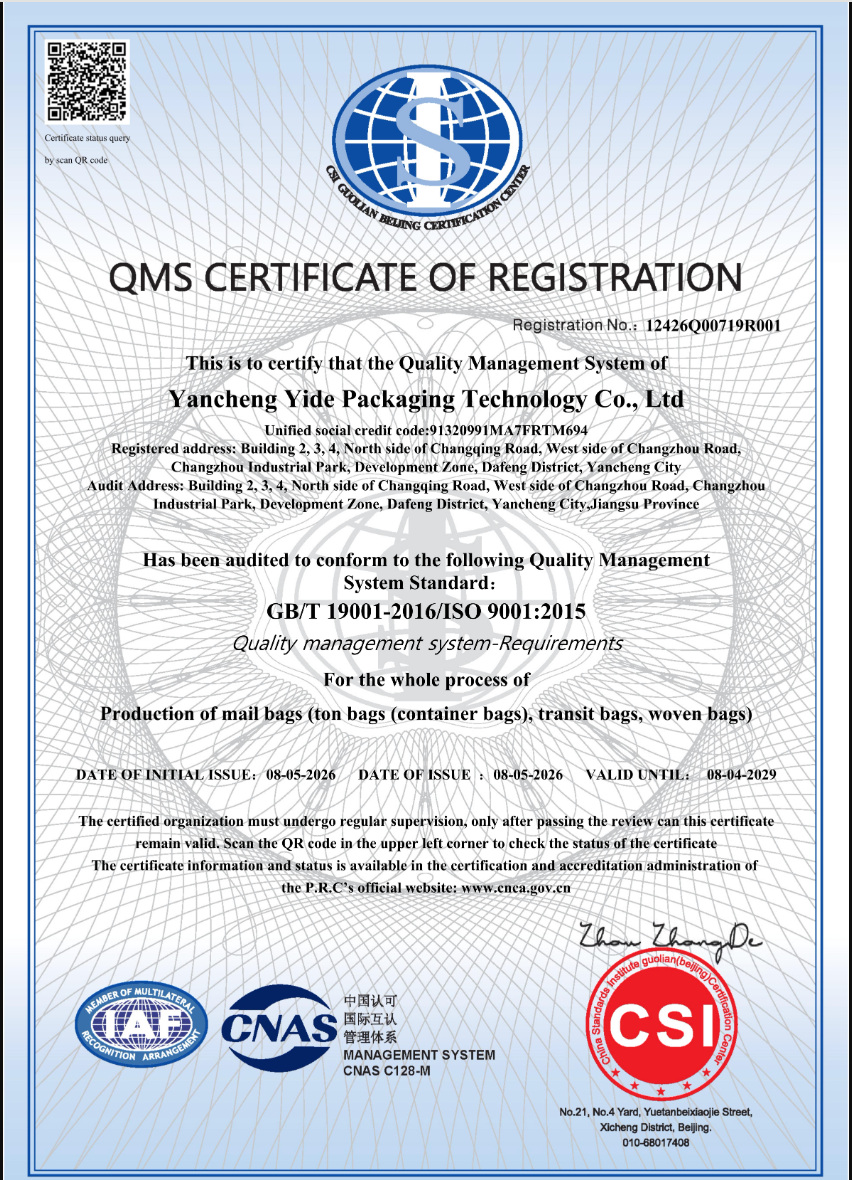
The certificate set below is the one Yide Packaging maintains, with numbers, standards, issuing bodies and covered product lines. Two details matter more than the list itself: whether the certificate scope covers the specific product you are buying, and whether the validity window is still open at the date of your order.
| Certificate | Standard / Regulation | Number | Issuing body | Validity |
|---|---|---|---|---|
| ISO 9001 | GB/T 19001-2016 / ISO 9001:2015 | 12426Q00719R001 | Zhongbiaoyan Guolian (Beijing) Certification Center | 2026-08-05 to 2029-08-04 |
| ISO 14001 | GB/T 24001-2016 / ISO 14001:2015 | 12426E00299R001 | Zhongbiaoyan Guolian (Beijing) Certification Center | 2026-08-05 to 2029-08-04 |
| ISO 45001 | GB/T 45001-2020 / ISO 45001:2018 | 12426S00261R001 | Zhongbiaoyanguolian (Beijing) Certification Center | 2026-05-08 to 2029-04-08 |
| REACH (SVHC) | REACH Regulation (EC) No 1907/2006 | DGC260127018YD03 | Dongguan Beice Standards Technical Service Co., Ltd. | Issued 2026-07-31 |
| RoHS | RoHS Directive 2011/65/EU & Amendment 2015/863/EU | A2260656737101001C | CTI (Centre Testing International) | Not dated in certificate record |
| Halogen content | BS EN 14582:2016 | DGC260127018YD02 | Dongguan NTEK Standard Technical Service Co., Ltd. (NTEK) | Issued 2026-02-03 |
| UN Packaging Test Report | SN/T 0510.2-2021 | 2513230601001079 | Nanjing Customs Dangerous Goods and Packaging Testing Center | Issued 2025-09-23 |
Three points from this table are worth reading carefully. First, the ISO 9001 scope covers the manufacturing of mail bags, including FIBC, transit bags and woven bags, and the same certificate covers valve bags, PP woven bags, paper-plastic composite bags and express transfer bags. Second, the REACH (SVHC) certification covers a 251-item Substances of Very High Concern screening test for packaging bags (white woven bags). Third, the UN Packaging Test Report certifies a 600×1050 mm paper-plastic woven bag under a drop performance test, with no leakage or safety-relevant damage after drop and a passed result — the report belongs to that product, while UN certification for dangerous goods packaging is available across the bulk bag range.
Specification Boundaries: What Can Be Customized and Where the Limits Are
Customization in this category is broad, but it is not unlimited, and the limits are usually the part that determines total cost. Bulk bag projects at Yide Packaging can be customized according to dimensions, material, fabric weight, load capacity, safety factor, lamination, printing, color, lifting structure, filling and discharge design, closure method, zipper structure, RFID requirements, waterproof performance and specific application conditions.
The following boundaries should be written into the specification rather than assumed:
- Load is a range, not a number. The documented safe working load for the FIBC range is 500–2000 kg. Bag dimensions, load capacity and construction are set according to material density, filling weight, filling equipment, pallet size and container transportation requirements.
- Lamination decides the moisture claim. Woven fabric without lamination provides dust-proof performance; the laminated version adds waterproof and moisture-resistant performance. If your powder is hygroscopic, the laminated option is the specification decision, not an afterthought.
- Type C static control depends on the operation, not only the bag. Type C construction relies on conductive yarns and requires reliable grounding during operation. A correctly manufactured bag used without grounding does not deliver the intended static-control outcome.
- Valve bag material structure changes breathability. The film-lined version provides water and moisture resistance, while the non-film version is breathable but not waterproof. Material options include OPP film lamination, standard paper-plastic composite, 3-ply paper with inner film and 2-ply paper without film.
- Paper-plastic composite options are split. Laminated versions are waterproof and moisture-proof, while non-laminated versions are dust-proof only. An optional inner liner bag can be added for enhanced protection.
- Woven bag strength follows fabric weight. PP woven bags are available across multiple weight options of 31–54 g/m², and fabric weight, weaving density, warp strength and weft strength are the variables that carry tensile strength.
- Reuse requires inspection. Bulk bags can be reused, but before reuse they should be inspected for damage, compromised lifting loops, contamination or other signs of wear.
How a Bulk Bag Order Is Structured, Step by Step
A bulk bag project moves through eight defined stages. Knowing the sequence in advance prevents the most expensive rework, which is discovering a documentation or specification mismatch after tooling and printing are committed.
- Define the material and its hazard profile. Powder, granule or pellet; bulk density; whether the powder creates a combustible dust atmosphere; moisture sensitivity; and whether the material contacts food.
- Decide which requirement system applies. ISO 21898-type design and type testing for non-dangerous goods, a dangerous goods packaging test result where transport is regulated, and an electrostatic classification decision where the filling environment is hazardous.
- Review the specification with engineering. Dimensions, safe working load, fabric weight, lamination, top and bottom structure, liner, lifting loops, printing and color are confirmed against filling equipment and container loading.
- Sample stage. A single sample is available for delivery, and samples without printing are provided for customer confirmation before mass production.
- Confirm and schedule. The minimum order quantity for customized products is 5,000 pcs, and customized production is quoted at a monthly capacity of 50,000 pcs.
- Production lead time. The lead time for customized products is 45 days, excluding delivery time.
- Testing and documentation release. Certificate copies and test documentation are matched to the product being shipped, and the certificate numbers in this article can be used to verify records with the issuing bodies.
- Delivery and after-sales. In the case of a shortage of bags, re-delivery or a corresponding deduction is available.
Use Cases: Where These Bulk Bags Are Applied
The same woven polypropylene base serves very different operating conditions, which is why the application should be named before the specification is written.
- Chemicals and fine powders. Applications include PVC paste resin and similar powdered chemical materials, where the requirement is a hermetically sealed, leak-proof and moisture-proof bag compatible with automatic filling. Chemical service also covers plastic pellets, resins, pigments, fertilizers and chemical raw materials.
- Welding consumables for export. Granular submerged arc welding flux is packed for marine transportation and storage, with printing used for export parameter marking.
- Minerals, building materials and aggregates. Iron ore, manganese ore, mineral powder and industrial minerals are packed in reusable bulk bags, and moisture-absorbing powders use a wear-resistant outer layer with an anti-seepage inner layer to prevent fine powder leakage and dampness. Cement, quartz sand and aggregates follow the same logic.
- Agriculture and food ingredients. Grain processing, animal feed, fertilizer, sugar, salt and starch are handled with PP woven bags and food-grade FIBC constructions, including a food-grade clean workshop in the production base.
- Logistics circulation and express sorting. PE woven Express Transfer Bags and Reusable Logistics Bags in 100×100 cm and custom sizes are used for bulk cargo collection, express sorting, warehouse handling and luggage transit, with zipper-style closures including a zipper protector, lockable buckle and zipper-tooth protection, or a round opening style.
- E-commerce dispatch packaging. Plastic Mailing Bags cover small regular 6×9 inch sizes for items around 0.5–1 kg, medium 10×13 inch sizes for 2–5 kg soft goods, and large thickened 19×24 inch sizes that withstand a pulling force over 30 kg for 10–30 kg loads.
Volume experience in these segments is documented. A logistics and transportation customer in Saudi Arabia ordered 50,000 reusable bags for logistics transit and has been in continuous use for one year; a customer in Malaysia ordered 3,000 units on the same basis; a large-scale e-commerce logistics group in Brazil and another in the Philippines each ordered 50,000 units; and a chemical plant in Japan ordered 6,000 units for pallet use with a documented reuse range of 10 to 30 times, described as consumables under continuous procurement.
Bulk Bag Product Comparison by Constraint
Use this table to match a product family to the constraint that governs your project. Every value below comes from the product specification and certification records rather than from estimates.
| Product | Base material | Documented specification | Certification / test coverage | Operating constraint |
|---|---|---|---|---|
| Ton Bag / Chemical FIBC | Virgin PP woven fabric, conductive woven fabric, reinforced thickened anti-static fabric | SWL 500–2000 kg; fill spout, full open top or top cover; discharge spout or flat bottom; four lifting belts; laminated or non-laminated | UN certification for dangerous goods packaging available; RoHS; covered by ISO 9001 and ISO 14001 scope | Type C construction requires reliable grounding; inspect before reuse |
| Industrial Bulk Bags | PP woven material with waterproof lamination | 50×36 cm and custom sizes; U-panel, circular, four-panel and baffle designs; high-tensile polyester thread stitching | RoHS; UN Packaging Test Report applies to the 600×1050 mm paper-plastic woven bag | Laminated version required for waterproof performance |
| PP Woven Bags / Polypropylene Woven Bags | Polypropylene woven fabric | 110×120, 90×110, 100×120, 100×140, 90×100 and 50×80 cm; 31–54 g/m²; green standard color; custom logo printing | REACH (SVHC) DGC260127018YD03; RoHS A2260656737101001C; Halogen DGC260127018YD02; ISO 9001 and ISO 14001 | Fabric weight must match product density and handling |
| Paper Plastic Composite Bag | Kraft paper laminated | Custom sizes; optional inner liner bag; laminated or non-laminated; reusable | UN Packaging Test Report 2513230601001079 for the 600×1050 mm bag; REACH (SVHC); ISO 14001 | Non-laminated version is dust-proof only |
| Valve Bag / PP Woven Valve Bag | OPP film laminated composite, standard paper-plastic composite, 3-ply paper with inner film, 2-ply paper without film | Customizable size; custom color printing with fade-resistant ink; self-locking sealing after filling | REACH (SVHC); RoHS; Halogen under BS EN 14582:2016; ISO 9001 | Non-film version is breathable but not waterproof |
| PP Woven Roll | PP woven material, flat or tubular | Roll dimensions 60×100×20 cm; white, yellow, green and custom colors; GSM, roll width and core size set per order | Covered by the manufacturer quality management system scope for woven bag manufacturing | Supplied for downstream converting, not as a finished bag |
| Express Transfer / Reusable Logistics Bag | PE woven fabric, lamination optional | 100×100 cm and custom sizes; zipper style with zipper protector, lockable buckle and zipper-tooth protection, or round opening; blue, white, light-green, green, yellow, red, orange-red | REACH (SVHC); RoHS A2260656737101001C; covered by ISO 9001 and ISO 14001 | Zipper style is required where controlled closure is mandatory |
| Plastic Mailing Bags / Biodegradable Poly Mailers | 100% brand-new PE; eco version uses PLA + PBAT + starch composite | 6×9 inch (0.5–1 kg), 10×13 inch (2–5 kg), 19×24 inch (10–30 kg, over 30 kg pull strength); full-size customization | Eco version targets EU EPR compliance; over 90% degradation in 6–9 months in natural environment | Designed for soft goods and parcel dispatch, not for bulk material loads |
FAQ
How can buyers verify a China UN-certified chemical FIBC bag manufacturer?
Verify the documents, not the description. Ask for the packaging test report covering the bag being ordered and check the issuing body, the report number and the tested product description against your purchase specification. Yide Packaging maintains a UN Packaging Test Report numbered 2513230601001079 for a 600×1050 mm paper-plastic woven bag under SN/T 0510.2-2021, issued by the Nanjing Customs Dangerous Goods and Packaging Testing Center, with a passed drop performance result and no leakage or safety-relevant damage after drop. UN certification for dangerous goods packaging is available across the bulk bag range, and the same supplier holds ISO 9001 certificate 12426Q00719R001, ISO 14001 certificate 12426E00299R001 and ISO 45001 certificate 12426S00261R001, plus REACH (SVHC) certificate DGC260127018YD03, RoHS certificate A2260656737101001C and Halogen certificate DGC260127018YD02. Cross-check each number with the issuing body before the order is placed.
Can chemical bulk bags be customized in size, fabric weight and discharge design?
Yes, within defined limits. Customization covers dimensions, material, fabric weight, load capacity, safety factor, lamination, printing, color, lifting structure, filling and discharge design, closure method, zipper structure, RFID requirements and waterproof performance. Available top structures are fill spout, full open top or top cover, and bottom options are discharge spout or flat bottom, with four lifting belts and high-strength polyester thread sewing. The documented safe working load range is 500–2000 kg, and bag dimensions and construction are set according to material density, filling weight, filling equipment, pallet size and container transportation requirements.
What actually drives the cost of a UN-certified chemical bulk bag?
Cost is driven by specification choices rather than by the certification label alone. The main variables are fabric weight and weaving density, the required safe working load and safety factor, whether static-control construction with conductive yarns and anti-static fabric is needed, whether lamination is specified and whether it is a waterproof requirement, spout and liner configuration, printing and color, and the testing and documentation attached to the shipment. Order volume interacts with the MOQ threshold of 5,000 pcs for customized products. For operations that reuse bags, the more useful commercial calculation is cost per trip rather than cost per bag — one documented chemical plant customer reports a reuse range of 10 to 30 times on pallet use. The lowest unit price is rarely the lowest total packaging cost.
Can I get a sample before committing to a bulk bag order?
Yes. A single sample is available for delivery, and samples without printing are provided for customer confirmation before production begins. Because printing and customization are the steps that lock in a specification, validating an unprinted sample first is the practical way to confirm dimensions, fabric weight, lamination, spout geometry and closure design before the minimum order quantity of 5,000 pcs applies to the customized production run.
What lead time should buyers plan for on customized bulk bags?
The lead time for customized products is 45 days, excluding delivery time, and customized production is quoted at a monthly capacity of 50,000 pcs, which allows larger programs to be scheduled in phases. In the case of a shortage of bags, re-delivery or a corresponding deduction is available. Buyers working to a fixed shipping window should place the 45-day production period and the transit leg on the same timeline before confirming a delivery date. To start a project, send your material type, target load, dimensions and destination market for a specification review and quotation, or download the company brochure below.
Conclusion and Next Step
UN-certified chemical bulk bags are won or lost on documentation and specification discipline. Confirm which requirement system applies to your material, request the test report and certificate set that name the product you are buying, write the lamination, static-control and load limits into the specification, and validate an unprinted sample before the 5,000 pcs custom MOQ and the 45-day production window start running.
Yancheng Yide Packaging Technology Co., Ltd. manufactures FIBC bags, ton bags, industrial and chemical bulk bags, PP woven bags, valve bags, paper-plastic composite bags, PP woven rolls and reusable logistics and mailing bags from Yancheng, Jiangsu, China, and supports OEM, ODM and customized packaging projects from requirement analysis and design through sampling, production, testing and delivery. The company brochure is available for download here: Yide Packaging company brochure (PDF).
For specification review, sampling or a quotation, contact: Chen Wang, email yidepackaging@gmail.com, telephone and WhatsApp +86 178-2626-5555. Address: Yancheng City Dafeng District Development Zone Changzhou Industrial Park, west side of Changzhou Road, north side of Changqing Road, Buildings 2, 3, and 4. Website: www.ycyide.net.