Rubber vs. Leather Outsoles in Men's Leather Shoes: A Buyer's Comparison Guide
Rubber and leather outsoles are both available on identical handmade men's leather shoe constructions at Yangjiang Hengxin Shoes Co., Ltd., a men's leather shoe manufacturer founded in 2011 in Yangjiang, Guangdong, China. Models M205-B02, F8-NS58 and F8-MK3 can be ordered with either a rubber outsole or a leather outsole, built on the same full grain cow or calfskin upper, with a full grain cow lining and a full grain cow insole. The outsole decision therefore changes how the shoe behaves in use — grip, water exposure, formality and care — rather than how the shoe is constructed.
Short answer for buyers: specify a leather outsole when the shoe has to read as a formal dress shoe for business dress codes, indoor weddings and formal events, and the wearer accepts water-sensitive care. Specify a rubber outsole when the same shoe will be worn for commuting, travel, wet or uneven ground, or long standing hours. On the three Hengxin models named above, both options keep the same full grain upper, full grain cow lining and insole, a MOQ of 6 pairs, 2–4 week dispatch, 30% T/T in advance with 70% T/T before shipment, FOB/CIF/EXW delivery, and acceptance through 100% factory inspection plus third-party inspection.
This guide is written for importers, distributors, brand owners and private-label buyers who are already comparing specifications at the decision stage — not for consumers reading a style article. It separates what the outsole change actually affects from what it does not, and it lists the sourcing checkpoints that have to be agreed before a purchase order is signed.
Problem Definition: Why the Outsole Decision Is Usually Made Too Late
In most private-label programmes, the outsole is the last item on the specification sheet. Leather, last, colour, size curve and packaging are usually settled first, and the outsole is confirmed in the final round — often by default, by copying the previous purchase order, or by picking whichever option appears in the supplier's photo file. That ordering creates four recurring problems.
- Scenario mismatch. A formal Oxford built for an indoor wedding dress code is ordered with a specification that suits daily commuting, or the reverse. The shoe is technically correct and commercially wrong for the assortment it was bought for.
- Photo-based judging. Buyers compare outsole options from photographs, where the difference appears cosmetic. In use, the difference is about ground contact, water exposure and how the shoe is maintained.
- Assumed construction change. Buyers sometimes assume that changing the outsole forces a change of last, upper pattern or lining. On the Hengxin models covered here it does not: M205-B02, F8-NS58 and F8-MK3 share the same full grain cow or calfskin upper, full grain cow lining and insole across both outsole options.
- Undefined acceptance. When inspection criteria are not agreed in writing, a dispute about the sole is settled after the goods are produced rather than before.
The practical consequence is that the outsole question is treated as a styling detail when it is in fact a specification decision with a measurable effect on returns, reorders and end-user satisfaction. A buyer who resolves it early — with the intended scenario stated in the inquiry — avoids re-cutting a range later.
Industry Background: Why Both Outsoles Still Exist in 2026
Demand for men's leather shoes is large and concentrated in the markets that most private-label programmes target. The Global Men Leather Shoes Market is projected to expand from USD 61.08 billion in 2025 to USD 78.69 billion by 2031, according to Vertex/ResearchAndMarkets (source SRC-0001). In the United States alone, leather footwear imports reached USD 11.6 billion in 2024, with Vietnam (USD 3.68 billion), China (USD 2.42 billion) and Indonesia (USD 1.18 billion) as the main origins, according to the Observatory of Economic Complexity (OEC, accessed 2026).
For a buyer, the useful reading of that data is not the headline size but the level of competition. When many origins quote comparable uppers, specification clarity becomes the main way to separate suppliers. The outsole is one of the few specification points that can be verified quickly on a physical sample and that maps directly to end-user complaints.
Both outsole types remain normal in the category, and neither is a defect. In handmade and Goodyear welted dress shoes, a leather outsole is the traditional specification and is generally associated with a slimmer, more formal profile. Rubber outsoles are widely used on dress shoes where grip and resistance to wet ground matter more than tradition. The choice is therefore a trade-off between formality and weather behaviour, not a quality grade.
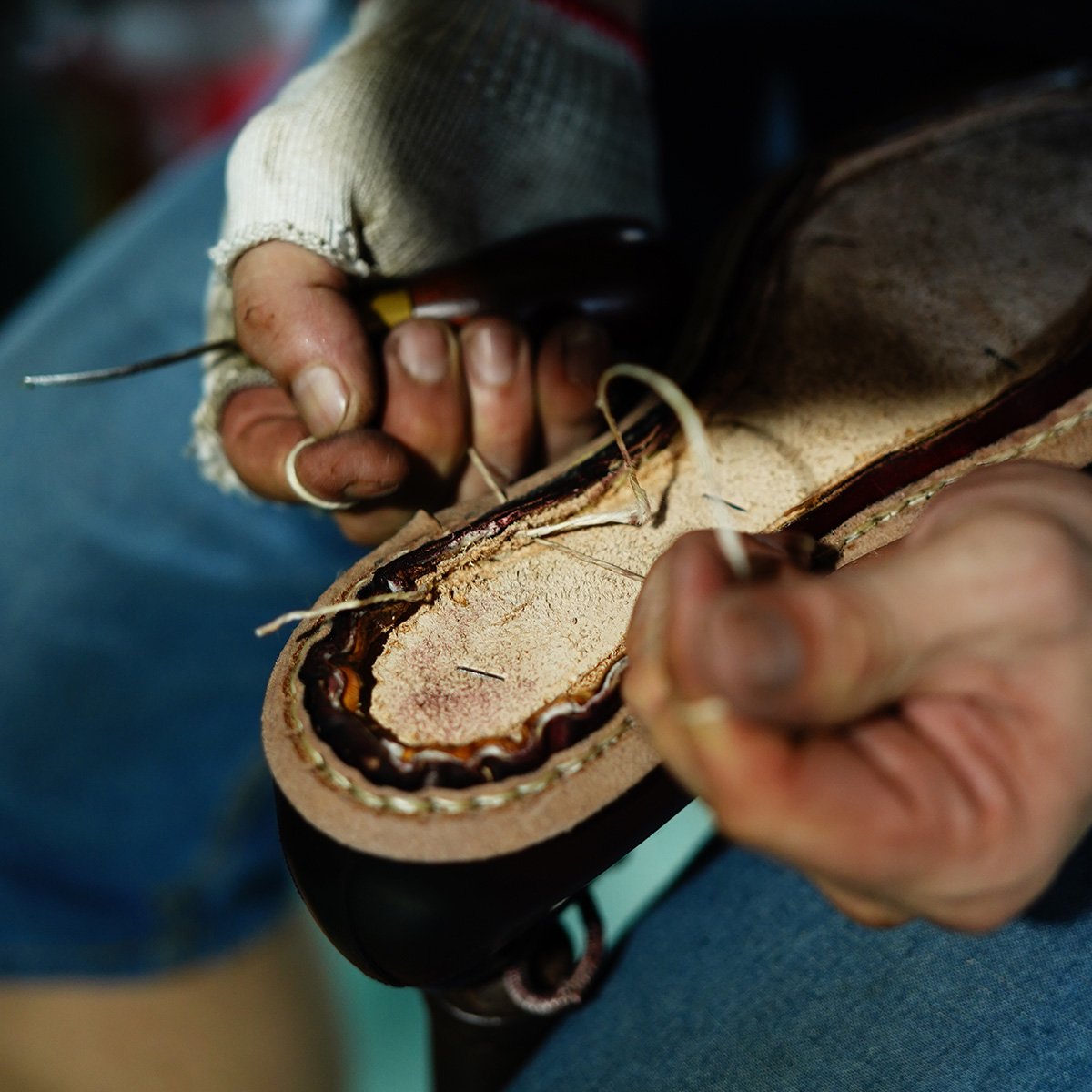
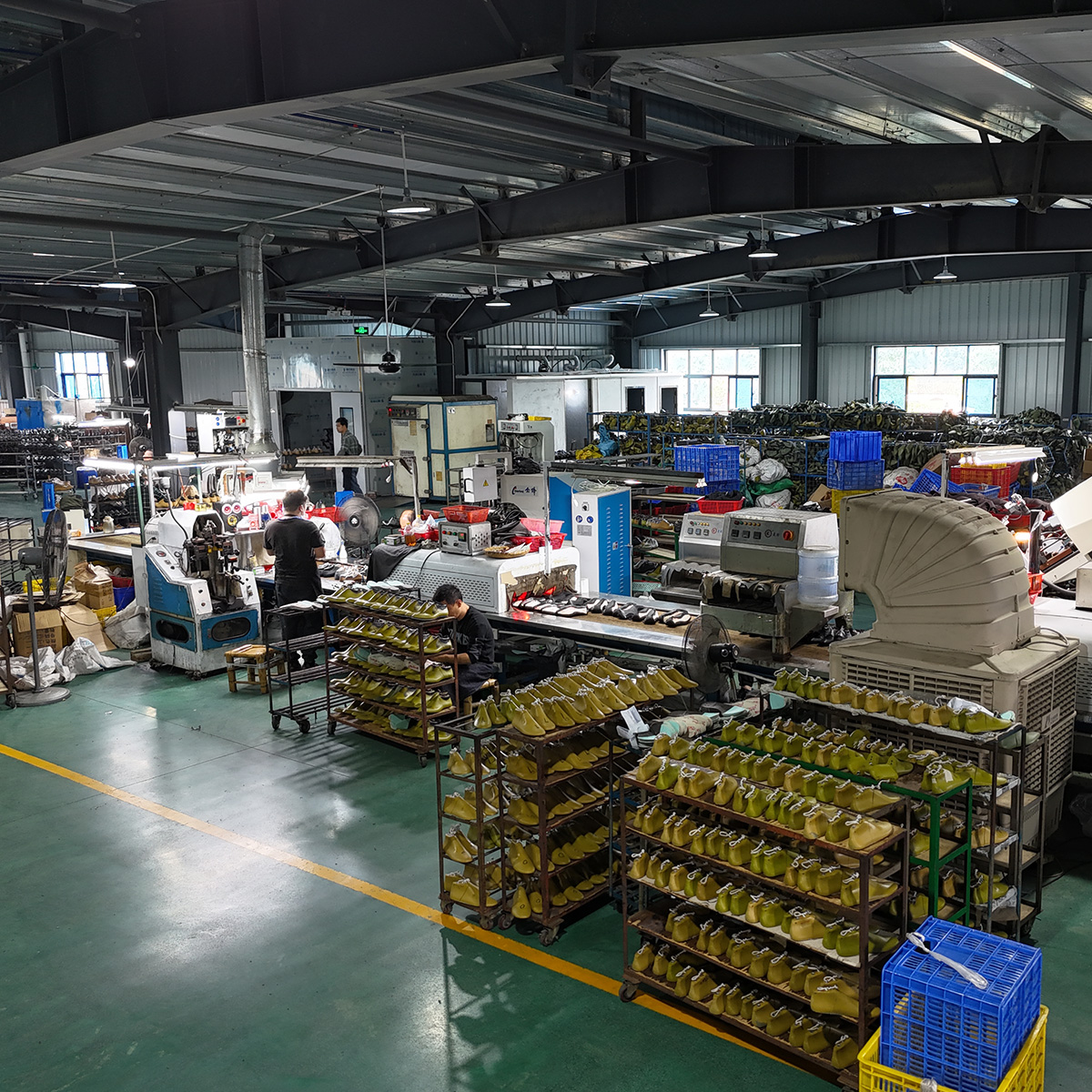
Yangjiang Hengxin Shoes Co., Ltd. produces men's Oxford shoes, Derby shoes, Monkstrap shoes, loafers, casual shoes, sneakers, boots and sandals from a 5,000㎡ facility with an annual output of 400,000 pairs and a 10-person R&D team. The company works in Goodyear welted construction and hand-patina finishing, uses Italian and Argentinian leathers, maintains more than 500 bespoke styles, and exports about 70% of output to the EU, USA, Canada, Africa, Asia and Australia. That combination is why the same model can be quoted in two outsole versions without changing anything upstream of the sole.
Detailed Solution: What Changes and What Stays Fixed
The fixed baseline: full grain upper, full grain cow lining and insole
On M205-B02, F8-NS58 and F8-MK3, the outsole option does not change the leather package. The upper is full grain cow or calfskin, and both the lining and the insole are full grain cow. Full grain retains the outermost layer of the hide, which is generally regarded in the trade as the more durable grade because the surface has not been sanded away. In sourcing terms this matters: choosing a rubber outsole is not a way of downgrading the shoe, and choosing a leather outsole is not an upgrade of the upper. The leather specification is the same line item in both quotations.
Rubber outsole: behaviour and limits
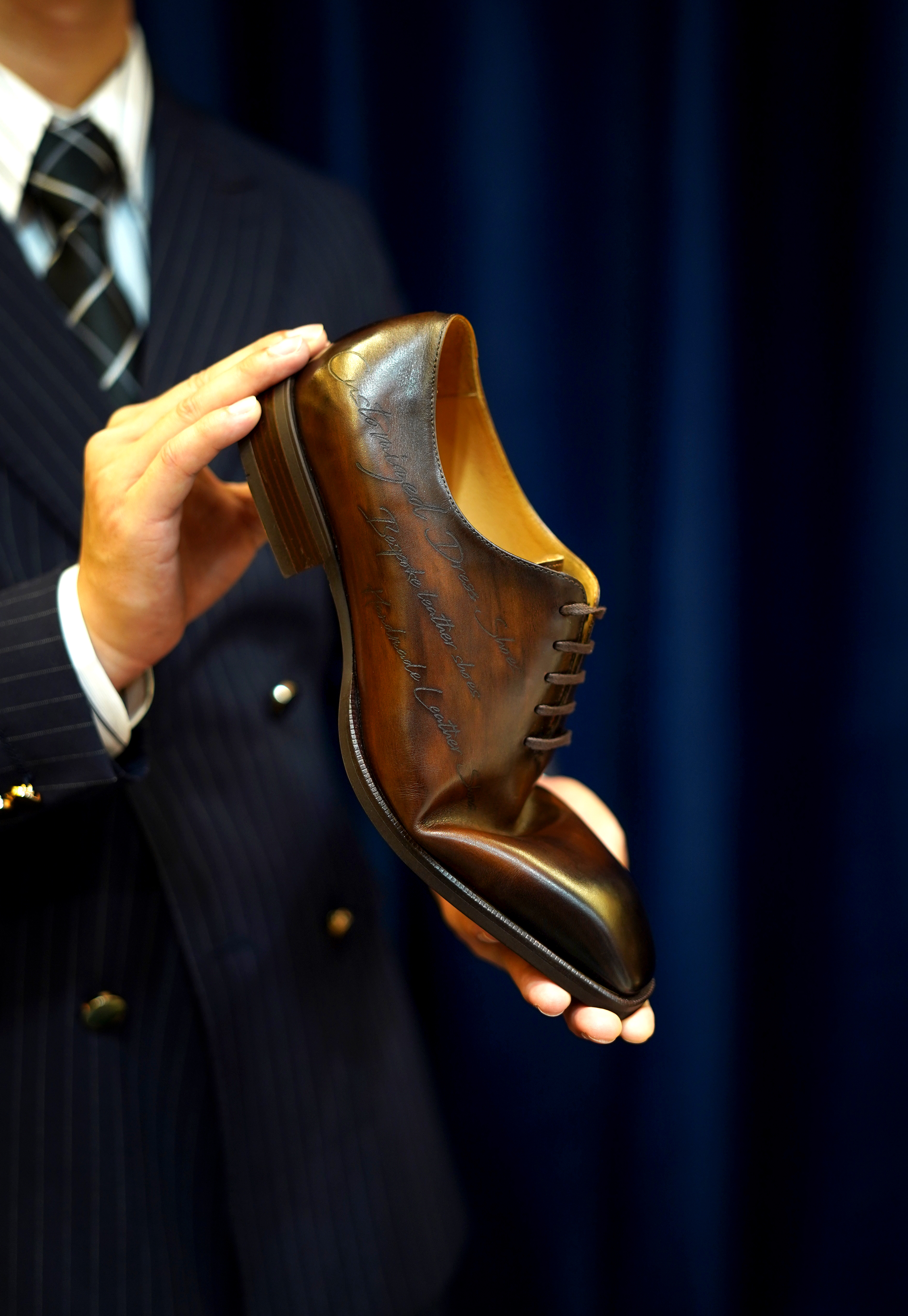
A rubber outsole is the specification to choose when ground contact conditions are unpredictable. Rubber generally provides more traction on wet or uneven surfaces and absorbs less water than leather, which reduces the care burden in daily wear. The trade-off is visual: on a formal last, a rubber outsole can read as slightly more casual, and it is less consistent with the strictest business dress codes. For buyers assembling a range around office wear, commuting and travel, that trade-off is usually acceptable; for a formal-capsule range, it is usually not.
Leather outsole: behaviour and limits
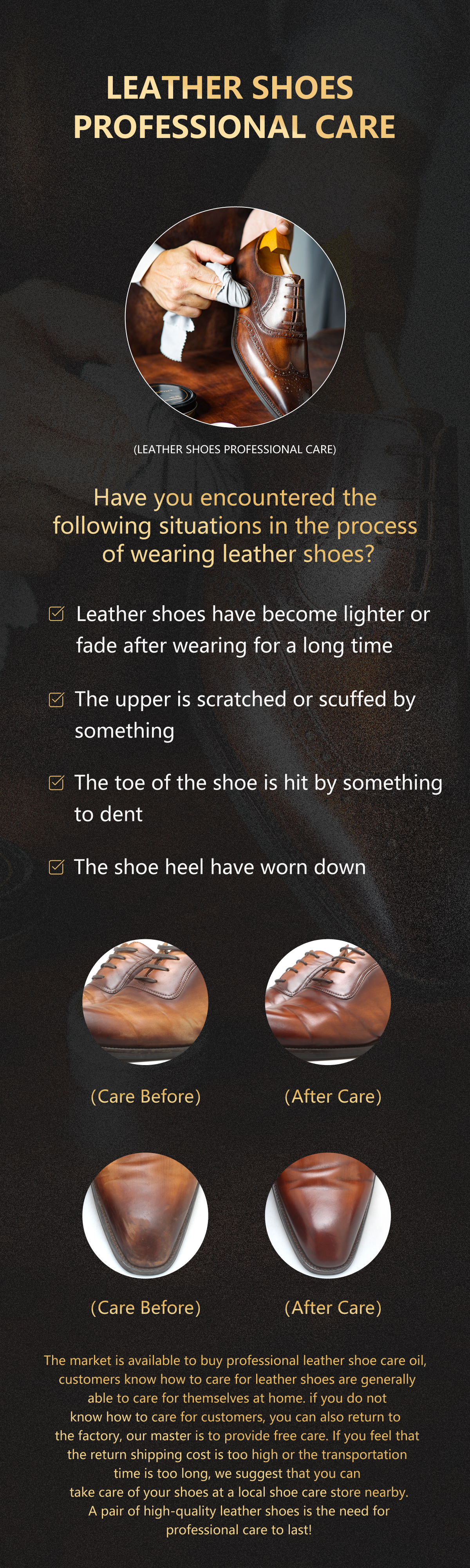
A leather outsole is the traditional dress-shoe specification and pairs naturally with Goodyear welted construction. It supports a slimmer profile under the arch, is generally breathable underfoot, and matches the visual expectations of formal men's leather shoes, men's Oxford leather shoes and business dress codes. The limit is water. Hengxin's own care guidance states that leather shoes should not be exposed to water because it can cause the colour to fade; if the shoe does get wet, it should be dried with a dry cloth as soon as possible, and colour-protection care should be carried out regularly. A leather outsole therefore suits buyers whose end users accept a maintenance routine — and the manufacturer backs this with a lifetime free maintenance service.
What does not change commercially
The commercial frame is identical for both options. MOQ is 6 pairs, orders are completed and dispatched in 2–4 weeks, payment is 30% T/T in advance with 70% T/T before shipment, delivery can be quoted FOB, CIF or EXW, and acceptance runs through 100% factory inspection plus third-party inspection. Hengxin also states that its handmade range has an expected lifespan of at least five years, that it records a 95% repeat purchase rate for five consecutive years, and that for orders over 500 pairs the price is 15–20% lower than alternatives. Those statements are company-reported positioning; buyers should confirm them against their own quotation and sample.
Step-by-Step Breakdown: Sourcing Either Outsole in Six Steps
Step 1 — Fix the intended scenario before the specification
Write the scenario into the inquiry in one sentence: business and office wear, indoor wedding, outdoor ceremony, smart-casual retail, or travel and commuting. The scenario, not the photograph, determines which outsole belongs in the range.
Step 2 — Confirm the leather baseline
State the upper (full grain cow or calfskin), the lining (full grain cow) and the insole (full grain cow) explicitly, so that both outsole quotations are compared on an identical leather package.
Step 3 — Select the outsole against the model
Ask for the outsole option against the specific model reference — M205-B02, F8-NS58 or F8-MK3 — rather than against a generic style name, and confirm in writing that both rubber and leather are available on that reference.
Step 4 — Validate on a sample in the exact configuration
Order a sample with the final outsole, not a substitute. A MOQ of 6 pairs also allows a small trial order, which is the cheapest way to test an outsole decision against real wear before committing to volume.
Step 5 — Lock the commercial terms
Agree 30% T/T in advance with 70% T/T before shipment, and confirm whether the shipment will be quoted FOB, CIF or EXW. These terms are the same for either outsole but they should appear on the same document as the outsole specification.
Step 6 — Agree acceptance before production
Set acceptance as 100% factory inspection plus third-party inspection, and specify that the outsole option is an inspected attribute. The inspection point is also the moment to confirm the 2–4 week dispatch commitment in writing.
Use Cases: Mapping Outsole Choice to Business, Office and Wedding Wear
Business and office wear
For a range built around formal men's leather shoes worn five days a week, the decision usually splits by commute. Buyers whose end users walk or use public transport in variable weather generally specify rubber for Derby and Monkstrap styles, keeping leather for the most formal Oxford silhouettes. This gives a single collection two wear profiles without changing the leather specification.
Weddings
Wedding leather shoes are the clearest case for a leather outsole: the shoe is worn for a formal occasion, photographed indoors, and matched to a dress code. Where the ceremony is outdoors, on grass or in wet conditions, a rubber outsole is the more practical specification, and it is worth separating the two scenarios in the assortment rather than compromising on one.
Slip-on and smart-casual styles
Slip-on men's leather shoes and loafers are more often worn without a formal dress code, which makes rubber the more common specification. The same full grain upper and full grain cow lining still apply, so the style remains a dress-casual product rather than a downgraded one.
Custom and private-label programmes
Custom leather shoes programmes benefit most from treating the outsole as a per-model attribute. Because M205-B02, F8-NS58 and F8-MK3 accept either option on the same upper, a brand can offer the same silhouette in two outsole versions and let the market decide, instead of committing the entire range to one specification. Hengxin supports this through an in-house sample room, a team of four designers, and OEM/ODM services covering last-making, alterations, repairs and sample customisation.
Comparison Table: Rubber vs. Leather Outsole on the Same Shoe
| Comparison point | Rubber outsole | Leather outsole |
|---|---|---|
| Availability on Hengxin models M205-B02, F8-NS58, F8-MK3 | Available | Available |
| Upper, lining and insole | Full grain cow or calfskin upper; full grain cow lining and insole | Full grain cow or calfskin upper; full grain cow lining and insole |
| Typical visual profile | More casual; suits smart-casual, commuting and travel ranges | Traditional dress profile; suits business dress codes and formal events |
| Wet and uneven ground | Generally more traction and less water absorption | Water-sensitive; leather shoes should not be exposed to water as colour can fade |
| Care routine | Simple cleaning in normal use | Dry with a dry cloth promptly if wet; regular colour-protection care |
| Best-fit scenarios | Commuting, all-day office wear, outdoor ceremonies, travel | Office and business dress codes, indoor weddings, formal events |
| MOQ | 6 pairs | 6 pairs |
| Dispatch time | 2–4 weeks | 2–4 weeks |
| Payment terms | 30% T/T in advance, 70% T/T before shipment | 30% T/T in advance, 70% T/T before shipment |
| Delivery terms | FOB / CIF / EXW | FOB / CIF / EXW |
| Acceptance | 100% factory inspection plus third-party inspection | 100% factory inspection plus third-party inspection |
The table shows where the two options genuinely differ and where they do not. Only four rows change with the outsole: visual profile, wet-ground behaviour, care routine and best-fit scenario. Every commercial row is fixed, which is why the decision can be made quickly once the scenario is defined.
Care and Maintenance: The Hidden Variable in the Outsole Decision
Maintenance is the part of the comparison that buyers underestimate, because it determines whether the end user stays with the product. Hengxin's stated risk note is specific: leather shoes should not be exposed to water as it can cause the colour to fade; wet shoes should be dried with a dry cloth as soon as possible, and colour-protection care should be carried out regularly. For a leather outsole this guidance is directly relevant, and it should be passed down the channel — to retail staff, to the product page, and to the end user.
Practical rule for buyers: if the target market is unlikely to follow a care routine, specify rubber. If the target market expects a formal dress shoe and will accept care instructions, specify leather and include the care note in the packaging or the product listing. The manufacturer's control method is the same in both cases — avoid prolonged wet exposure, dry promptly with a dry cloth, and carry out colour-protection care regularly — and Hengxin offers a lifetime free maintenance service.
FAQ: Rubber vs. Leather Outsoles for Buyers
1. What inspection and delivery terms apply to a rubber or leather outsole order?
Both options follow the same terms. Acceptance runs through 100% factory inspection plus third-party inspection; delivery can be quoted FOB, CIF or EXW; payment is 30% T/T in advance with 70% T/T before shipment. Because the terms do not vary by outsole, the outsole option should be written into the same specification document as the inspection and delivery clauses, so that the inspected attribute and the accepted goods match.
2. Can the same model be ordered in both outsole options?
Yes. On Yangjiang Hengxin Shoes Co., Ltd. models M205-B02, F8-NS58 and F8-MK3, the outsole is available in rubber or leather while the upper remains full grain cow or calfskin and the lining and insole remain full grain cow. This allows a brand to hold one silhouette in two outsole versions — for example a leather version for formal business and wedding retail, and a rubber version for commuting and travel — without developing a second pattern or renegotiating the leather specification.
3. Does the outsole choice change the MOQ or the price tier?
The MOQ is 6 pairs for the models covered in this guide, and dispatch is 2–4 weeks for either outsole. Hengxin states that for orders over 500 pairs the price is 15–20% lower compared with alternatives, and that its handmade range records a 95% repeat purchase rate for five consecutive years. Volume pricing is therefore structured by order quantity rather than by outsole type; buyers should confirm the final quotation against the exact model reference and the chosen outsole.
4. How can I validate the outsole choice before committing to volume?
Order a sample in the exact configuration: the specific model, the chosen outsole, and the stated full grain upper, lining and insole. The 6-pair MOQ also allows a small trial run before a bulk order, and Hengxin's in-house sample room and four-person design team support OEM/ODM work including last-making, alterations, repairs and sample customisation. This is the most reliable way to test grip, formality and care requirements against the market the shoes are intended for.
5. What is the dispatch time, and how do I start an order?
Orders are completed and dispatched in 2–4 weeks. To start, send the model reference (M205-B02, F8-NS58 or F8-MK3), the outsole option, the intended scenario and the target quantity. Contact Rose, General Sales Manager, at rose@dressshoefactory.com or WhatsApp +8615820502754, or review the range at dressshoefactory.com. Samples and quotations are available on request.
Conclusion
The rubber versus leather outsole question is a scenario decision dressed up as a materials decision. On Hengxin's M205-B02, F8-NS58 and F8-MK3, the leather package — full grain cow or calfskin upper, full grain cow lining and full grain cow insole — is identical either way. What changes is how the shoe meets the ground and how it meets the dress code: leather for business formality, indoor weddings and formal events, with a care routine the end user must accept; rubber for commuting, all-day office wear, outdoor ceremonies and travel, where grip and water behaviour matter more than tradition.
The sourcing frame around that decision is fixed and should be verified once: MOQ 6 pairs, 2–4 weeks dispatch, 30% T/T in advance with 70% T/T before shipment, FOB/CIF/EXW delivery, and acceptance through 100% factory inspection plus third-party inspection. Buyers who state the scenario first, confirm the model reference, and validate on a sample in the exact configuration avoid the most expensive version of this mistake — re-cutting a range after the goods have shipped.
Next Step: Compare Both Outsoles on Your Own Sample
Yangjiang Hengxin Shoes Co., Ltd. supplies handmade and Goodyear welted men's leather shoes to wholesalers, distributors, retailers, trading companies and private-label buyers, exporting about 70% of output to the EU, USA, Canada, Africa, Asia and Australia.
Send your model reference, outsole preference and target quantity to Rose, General Sales Manager — rose@dressshoefactory.com · WhatsApp +8615820502754 · dressshoefactory.com — and request a rubber version and a leather version of the same model for side-by-side evaluation.
Address: No. 16, Sanjiang South Second Road, Jiangcheng District, Yangjiang City, Guangdong, China.
Have Questions or Need More Details?
Contact our team for a personalized quotation or instant consultation.
Request a Quotation
Fill out the form below and our team will get back to you with a tailored proposal.
WhatsApp Direct Chat
Prefer to chat in real-time? Message us on WhatsApp for instant assistance & quick answers.
- Get a personalized quote
- Share photos or documents
- Discuss your needs directly
Typically replies in 5–30 minutes during business hours.