Small-Batch Men’s Leather Shoes: Solving Low-MOQ Sourcing for Weddings and Boutique Trials
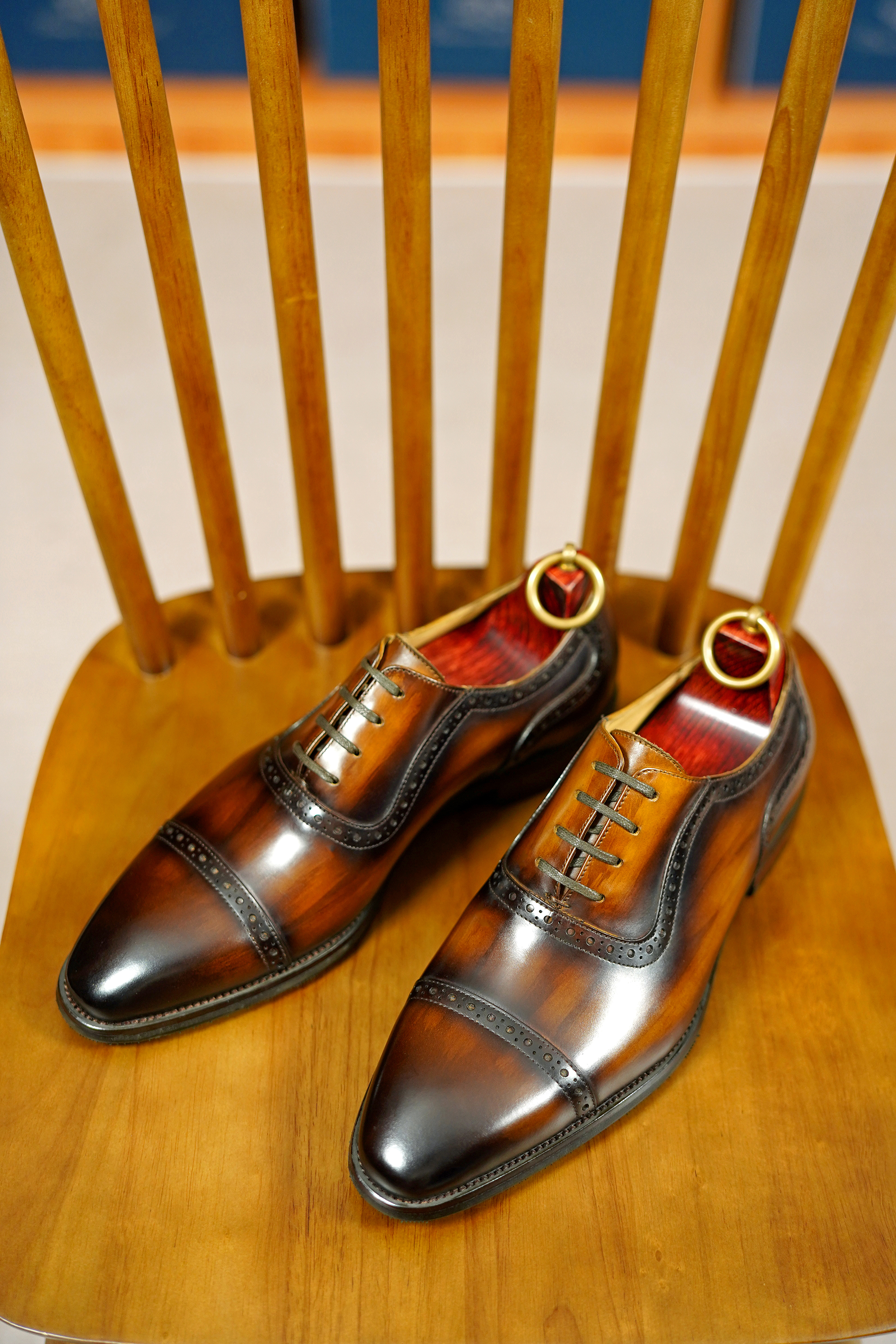
A wedding party needs two dozen pairs. A boutique wants forty pairs to test a new last before committing to a season. A suit shop needs one style across five sizes for a single event. In each case the buyer needs proper formal men’s leather shoes — full grain uppers, a real lining, a finished outsole — but the quantity sits far below what most factories will quote. Yangjiang Hengxin Shoes Co., Ltd., a men’s leather shoe manufacturer based in Yangjiang, Guangdong, China, has built its OEM/ODM offer around that gap: order quantities of 60 to 300 pairs depending on design, sample customization and last-making before production, and handmade models such as M205-B02, F8-NS58 and F8-MK3 built on full grain cow/calfskin uppers with full grain cow lining and insole.
What Makes Small-Batch Formal Shoe Sourcing Difficult
The arithmetic behind a minimum order is easy to underestimate. Before a single pair is stitched, a factory has to build or pull a last, grade a pattern across the size run, lay out and cut leather, prepare the upper closing line, set up the bottoming process and buy materials. Almost none of that cost scales down with the order. A run of 40 pairs and a run of 4,000 pairs pass through the same preparation steps.
That is why minimum order quantities exist in footwear, and it is why the constraint bites hardest on formal shoes. Men’s oxford leather shoes, men’s derby leather shoes and monkstrap styles carry more components, more stitching and more shape control than a simple casual shoe. The higher the construction standard, the more expensive the setup becomes — and the higher the quantity a factory needs to justify it.
A buyer with a small requirement is therefore pushed toward two unattractive outcomes. The first is over-ordering: committing to stock the buyer cannot sell quickly, which ties up cash and shelf space. The second is buying from whatever is already in a warehouse, which means accepting someone else’s last, someone else’s leather and someone else’s finish.
There is a third outcome, and it only exists with a manufacturer whose production model already assumes short runs. In that model, small quantities are not a favour granted to a buyer — they are the normal operating unit, and the question becomes how low the minimum can realistically go for a specific design.
Where Small Formal Runs Sit in the Men’s Leather Shoe Market
Demand for leather footwear is not the limiting factor for small buyers. Published market research estimates the global men’s leather shoes market at USD 61.08 billion in 2025, projected to reach USD 78.69 billion by 2031 (Research and Markets / Vertex). On the trade side, the Observatory of Economic Complexity reports that the United States imported USD 11.6 billion of leather footwear under HS code 6403 in 2024, mainly from Vietnam, China and Indonesia.
Two conclusions follow for a buyer planning a boutique trial or a wedding order. First, the category is large enough that small buyers are not an anomaly — they are a normal part of the distribution chain that sits between factories and end customers. Second, the volumes moving through international trade set the quality expectations a small buyer inherits: a 40-pair order that reaches a wedding or a boutique shelf is judged against the same finish standards as a container shipment.
That is the context in which Yangjiang Hengxin Shoes operates. The company, founded in 2011, reports that exports account for roughly 70% of its business, with markets listed across the EU, North America, the Middle East, Asia, Africa and Australia. Its stated product range covers men’s Oxford shoes, Derby shoes, Monkstraps, loafers, casual shoes, sneakers, boots and sandals — which means a small formal run can be sourced alongside the casual and slip-on styles a boutique may need to fill out an order.
How Yangjiang Hengxin Shoes Handles Low-MOQ Formal Orders
The company’s stated minimum order quantity is 60 to 300 pairs, depending on design. The range matters more than the number: it tells a buyer that the minimum is not fixed, and that the exact figure has to be tied to a specific model, leather and construction before it can be confirmed.
One-stop ODM and OEM, including last-making
Yangjiang Hengxin Shoes runs OEM and ODM production with private label customization as the standard offer. The service scope covers last-making, alterations, repairs and sample customization — the four steps that usually decide whether a small order is even possible. A buyer who needs a narrower toe, a different heel height or a corrected fit is not pushed back to a catalogue; the last itself can be adjusted.
An independent sample room and an in-house design team support that work, and the company states that its designers collaborate with international fashion experts. The company also reports a portfolio of more than 500 bespoke styles, which is relevant to boutique buyers testing a signature look rather than a generic stock shape.
Materials and construction that hold up at low volume
The handmade models referenced in this article share one material specification: upper in full grain cow/calfskin, lining and insole in full grain cow, and outsole in rubber or leather. The company also states that it works with premium Italian and Argentinian leathers, and that its hand-coloring (patina) process has been refined through three iterations of technique.
Construction capability extends to Goodyear welted leather shoes, which the company lists among its specialities alongside Oxfords, Derbys, Brogues, Monks and Loafers. For a small formal run, that matters in a practical way: the buyer is not choosing between a custom order and a lower grade of shoe, because the construction options available at low volume are the same ones the factory uses for larger programmes.
Capacity that does not sideline small runs
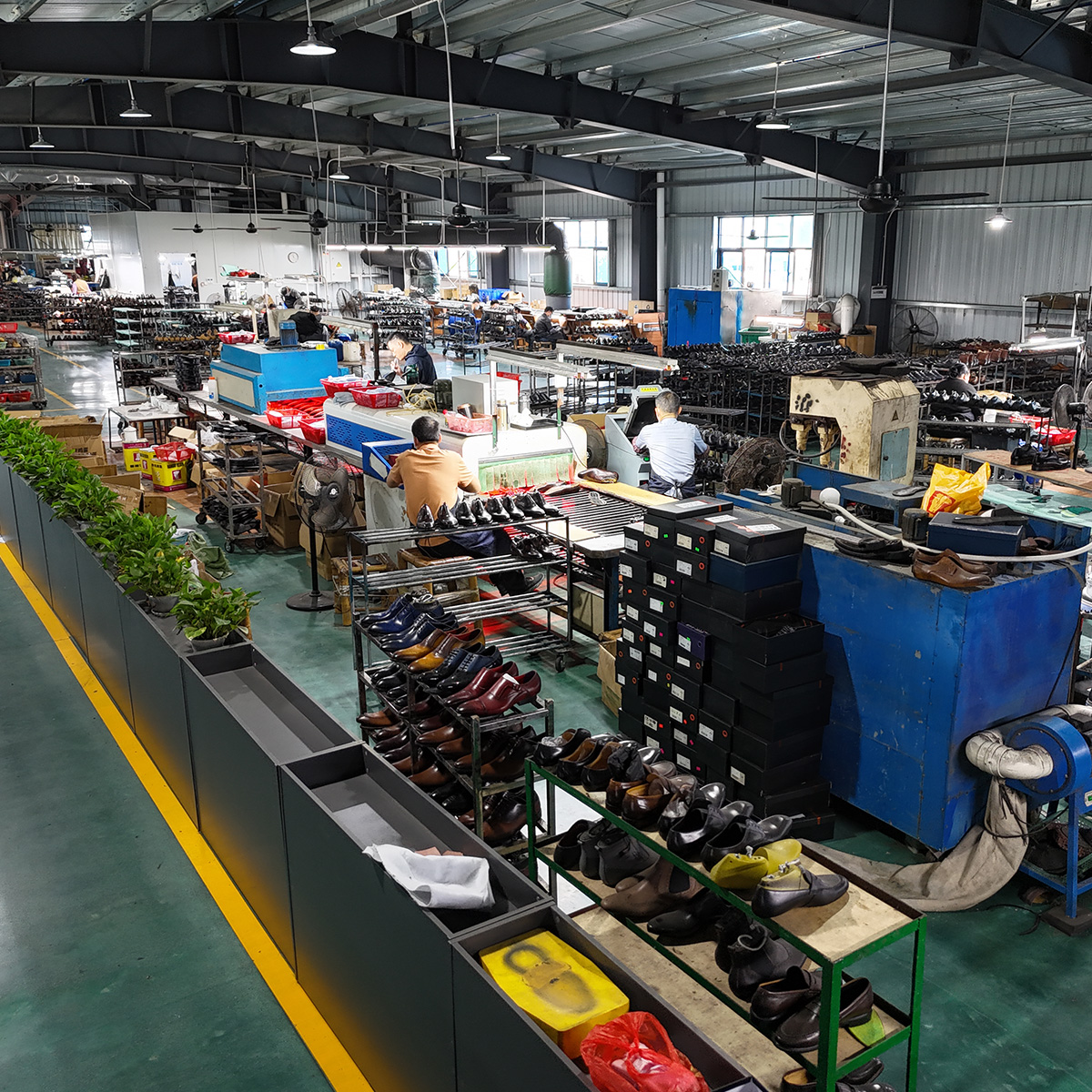
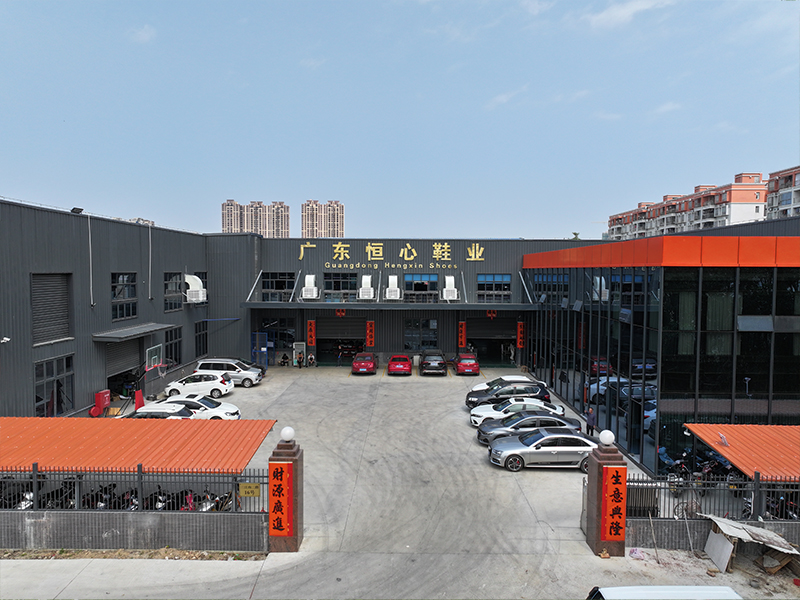
Yangjiang Hengxin Shoes lists a monthly production capacity of 800 to 1,000 pairs and 100% quality control. A capacity figure in that band is a useful signal for small buyers, because it indicates a production model organised around short and medium runs rather than one that needs tens of thousands of pairs to fill a line. The company is also a direct manufacturer, which it states removes intermediaries from the supply chain.
Models Suited to Weddings and Boutique Trials
Three handmade models appear repeatedly in the company’s product data for formal and occasion use. All three are described as hand made men’s leather shoes and are listed as suitable for business, office and wedding scenarios; the differences sit in styling and in the image library the company publishes for each model.

| Model | Type | Upper | Lining / insole | Outsole | Stated occasion fit |
|---|---|---|---|---|---|
| M205-B02 | Hand made men’s leather shoes | Full grain cow/calfskin | Full grain cow | Rubber or leather | Business, office, wedding |
| F8-NS58 | Hand made men’s leather shoes | Full grain cow/calfskin | Full grain cow | Rubber or leather | Business, office, wedding |
| F8-MK3 | Hand made men’s leather shoes | Full grain cow/calfskin | Full grain cow | Rubber or leather | Business, office, wedding |
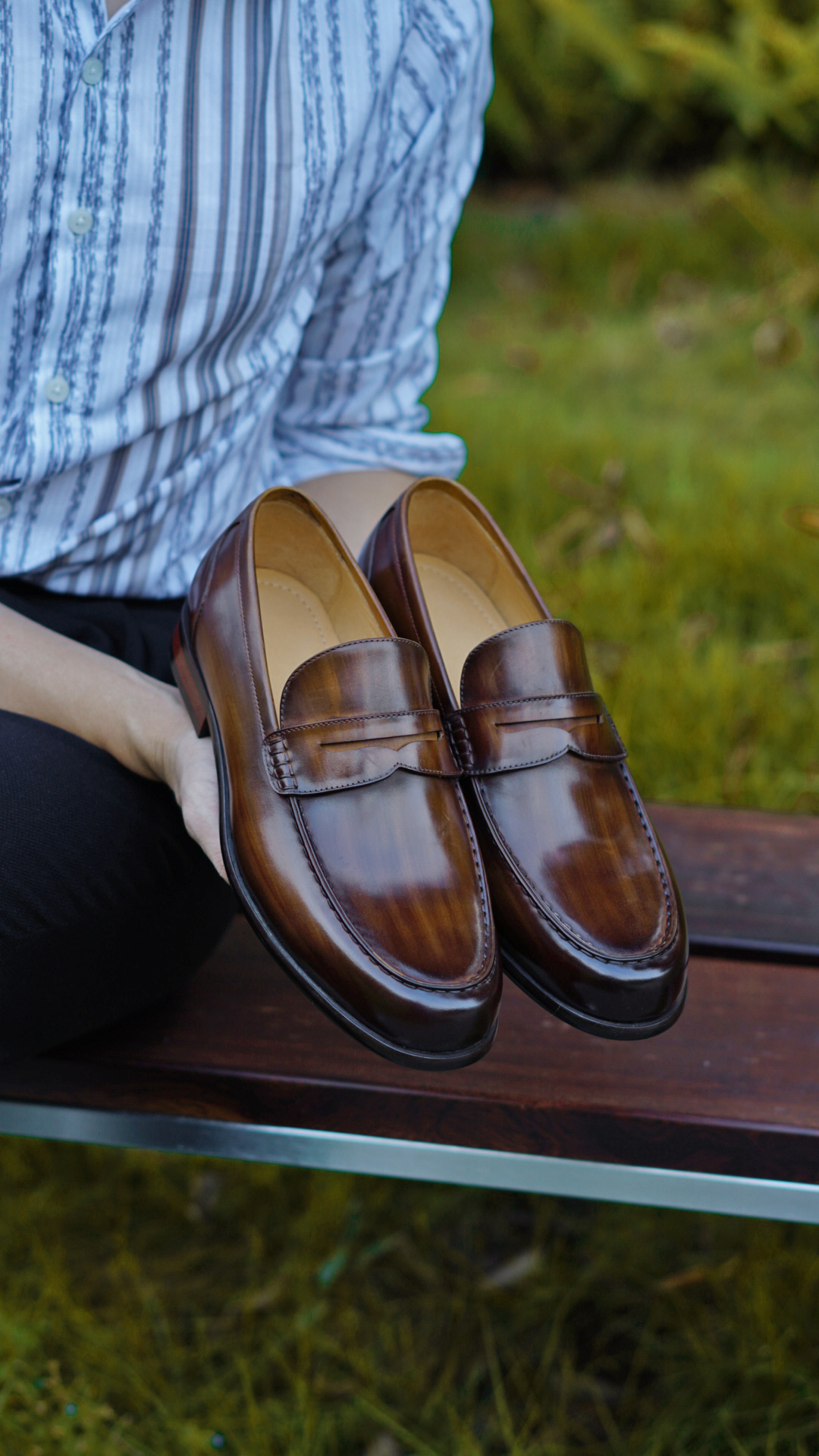
The three models share one material specification, so the sourcing decision between them is usually a styling decision — not a question of material grade. The company’s own image library captions M205-B02 as a loafer and F8-MK3 as an Oxford, which makes M205-B02 the natural fit for buyers who want slip on men’s leather shoes within a formal range, and F8-MK3 the fit for a classic men’s oxford leather shoes brief.
Order Parameters at a Glance
- Minimum order quantity60–300 pairs, depending on designs.
- Production modeOEM/ODM with private label customization.
- Customization scopeLast-making, alterations, repairs and sample customization.
- Monthly capacity800–1,000 pairs.
- Quality control100% quality control.
- Lead time (production planning)40–60 days as listed in the company’s capability data.
- DispatchThe company states that completed orders are dispatched within 2–4 weeks.
- After-salesFree maintenance and repair; support for returns and exchanges due to quality issues.
Step-by-Step: Running a Small Order
- Define the run before contacting the factory. A wedding order and a boutique trial need different things. Write down the quantity, the size spread, the occasion, the target retail price band and whether the style must be a specific last. The quantity range of 60 to 300 pairs narrows quickly once the design is fixed.
- Choose a model or start from a last. Buyers with a clear direction can begin from M205-B02, F8-NS58 or F8-MK3. Buyers with a signature shape can use the last-making step to adjust fit and silhouette before anything else is costed.
- Lock the material and finish specification. Confirm the upper as full grain cow/calfskin, the lining and insole as full grain cow, and decide between a rubber outsole and a leather outsole. This decision moves the price more than most buyers expect, because the outsole choice changes both material cost and assembly.
- Approve a sample. Sample customization is part of the stated service scope, and it is the only reliable way to judge colour, stitching density and shape before committing to a run. For a patina or hand-colored finish, the sample is the reference point for everything produced afterwards.
- Confirm MOQ, lead time and price in writing. Because the minimum is design-dependent, the figure quoted for one model does not automatically apply to another. Ask for the MOQ and the production lead time against the exact model, leather and outsole combination being ordered.
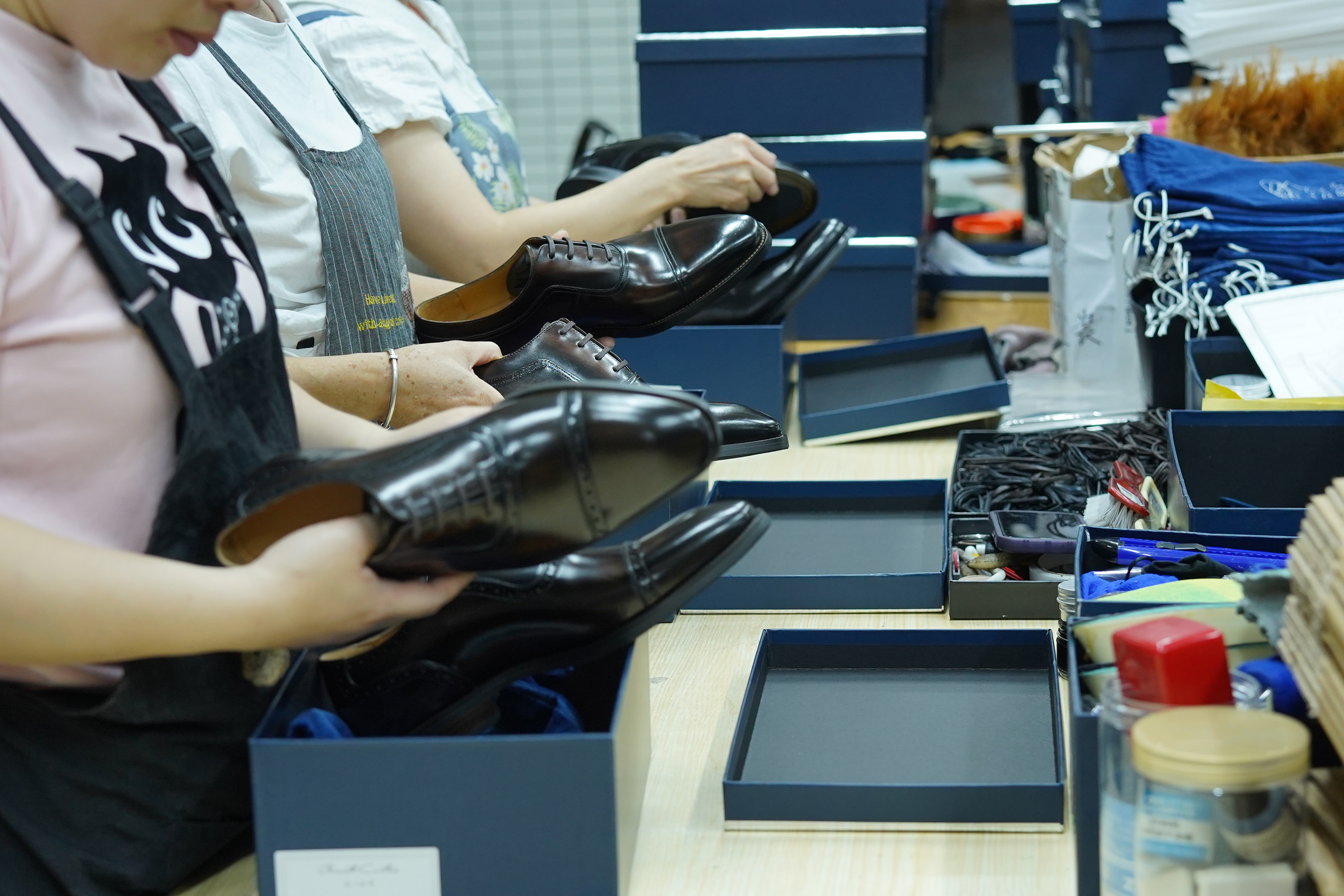
- Produce with quality control built in. The company lists 100% quality control, which means inspection runs through the batch rather than only at the end. For a small wedding order, this is the point that protects the delivery date.
- Plan dispatch and after-sales. The company states that completed orders are dispatched within 2 to 4 weeks, and separately lists a 40 to 60 day production lead time in its capability data — figures that should be confirmed for the specific order. After-sales support covers free maintenance and repair, plus returns and exchanges for quality issues.
Use Cases for Small-Batch Formal Runs
Wedding parties and groomsmen sets
A wedding order is defined by a fixed date, a small quantity and a need for consistency across sizes. Wedding leather shoes that arrive in mixed finishes or with a colour mismatch between sizes are worse than no order at all. A 60 to 100 pair run in a single model, sampled and approved in advance, gives a wedding retailer control over the finish without carrying stock afterwards.
Boutique and suit-shop trials
A boutique testing a new formal look needs enough pairs to display a full size curve and to judge sell-through — not enough to fill a stockroom. The relevant question is whether the factory will produce a small run of a distinctive style rather than pushing a catalogue model. A portfolio of more than 500 bespoke styles, plus last-making and private label, is what makes that trial meaningful.
Corporate and office uniform orders
Office environments, banks, hotels and retail groups occasionally need a small uniform run in one style and a limited size range. The company lists business and office environments among the intended uses of its formal models, along with an emphasis on all-day wear. For a buyer sourcing high quality leather shoes for staff, a limited run in full grain with a breathable lining is a realistic middle path between cheap uniform supply and full bespoke.
Online stores validating a new style
An online seller testing a style can start with a trial run, measure demand and then scale. That progression is visible in the company’s case record: a men’s clothing store in Canada, using models F8-NS58 and M205-B02 for online and physical shop sales, is listed with repeat orders across five consecutive years and zero returns, with price, quality and after-sales service given as the reasons for the repeat business. The trial run is not the opposite of scale — it is the first stage of it.
What to Confirm Before Committing to a Low-MOQ Order
Small orders fail for predictable reasons, and most of them can be removed at the quotation stage.
- Confirm the MOQ for your specific design. The stated range is 60 to 300 pairs depending on designs. Treat the range as a range until the model, leather and outsole are fixed.
- Reconcile the lead-time figures. The company’s capability data lists a 40 to 60 day lead time, while its company profile states that completed orders are dispatched within 2 to 4 weeks. Ask which figure applies to your order before you publish a delivery date to a couple or a client.
- Agree the finish at sample stage. Hand-coloring and patina work are done by hand, so the approved sample is the reference. Settle on what counts as an acceptable finish before production rather than after delivery.
- Request the documents your market needs. The company’s published materials describe 100% quality control and after-sales support rather than named third-party certifications. If your market, your insurer or your retail partner requires specific documentation, request it for the exact leather and model before the order is placed.
- Check the size spread against your market. A 60-pair wedding order and a 60-pair boutique order rarely need the same size distribution. Confirm the size breakdown at quotation, not after production.
Frequently Asked Questions
What quality controls apply to a small men’s leather shoes order?
Yangjiang Hengxin Shoes lists 100% quality control on its production, which means inspection is applied across the batch rather than only to a final sample. After-sales support covers free maintenance and repair, and the company supports returns and exchanges where a quality issue exists. Buyers whose market requires named certification should request the relevant documents for the specific leather and model before confirming the order, because the company’s published materials describe its quality control process and after-sales terms rather than a list of third-party certificates.
Can a small order include a custom last, private label or a new design?
Yes, within the stated service scope. Yangjiang Hengxin Shoes operates OEM and ODM production with private label customization, and its one-stop service covers last-making, alterations, repairs and sample customization. An independent sample room and an in-house design team support that work, and the company reports a portfolio of more than 500 bespoke styles. In practice, a buyer can adjust fit and silhouette through last-making before production, which is what makes a small run of a distinctive style viable rather than restricted to a catalogue shape.
What drives the cost of a low-MOQ formal shoe run?
The minimum itself is design-dependent — Yangjiang Hengxin Shoes states 60 to 300 pairs depending on designs — so the first cost factor is which model and construction a buyer chooses. Beyond quantity, the main levers are the outsole decision (rubber or leather), the leather selected, and the amount of hand-finishing such as patina. Construction choice also matters: the company produces Goodyear welted leather shoes alongside its standard handmade lines. Because the company is a direct manufacturer without intermediaries, the quoted price reflects factory cost rather than a trading margin, but the price for a 60-pair run of one design should not be assumed to apply to a different design.
How does sampling work before a small production run?
Sample customization is listed as part of the company’s ODM/OEM service, supported by an independent sample room. The practical sequence is to fix the model or last, confirm the upper as full grain cow/calfskin with full grain cow lining and insole, choose the outsole, and then approve a physical sample before production begins. For hand-finished or patina styles, that approved sample becomes the reference for the colour and finish of the whole batch, which is the main protection a buyer has on a small order.
How long does a small-batch men’s leather shoes order take?
Two figures appear in the company’s own materials and both should be confirmed for your specific order. The capability data lists a 40 to 60 day lead time, while the company profile states that completed orders are dispatched within 2 to 4 weeks. Monthly capacity is listed at 800 to 1,000 pairs, which is the figure to check against your delivery date if the order falls in a busy period. If you are working to a fixed wedding or retail launch date, ask for the timeline against the exact model and confirm it in writing before the sample stage closes.
Start With a Sample, Not a Container
A small formal run is decided at the sample stage. Send the model or reference shape, the quantity you have in mind, the size spread, your target market and your delivery date, and the team can confirm the applicable minimum order quantity, the lead time for that specific design, and the sample plan.
Yangjiang Hengxin Shoes Co., Ltd.
No. 16, Sanjiang South Second Road, Jiangcheng District, Yangjiang City, Guangdong, China
Email: rose@dressshoefactory.com
WhatsApp: +8615820502754
Website: dressshoefactory.com
Conclusion
Low-MOQ sourcing for formal men’s leather shoes is not a discount question — it is a question of whether a factory’s production model can absorb the setup cost of a short run without downgrading the material specification. Yangjiang Hengxin Shoes answers that with a 60 to 300 pair minimum depending on design, one-stop OEM/ODM including last-making and sample customization, a monthly capacity of 800 to 1,000 pairs, and handmade models such as M205-B02, F8-NS58 and F8-MK3 built on full grain cow/calfskin uppers with full grain cow lining and insole.
For a wedding order, the value is control over finish and delivery. For a boutique trial, it is the ability to test a distinctive style without carrying stock. In both cases the sequence is the same: define the run, fix the specification, approve a sample, and confirm the MOQ and lead time against the exact design before production begins.
Have Questions or Need More Details?
Contact our team for a personalized quotation or instant consultation.
Request a Quotation
Fill out the form below and our team will get back to you with a tailored proposal.
WhatsApp Direct Chat
Prefer to chat in real-time? Message us on WhatsApp for instant assistance & quick answers.
- Get a personalized quote
- Share photos or documents
- Discuss your needs directly
Typically replies in 5–30 minutes during business hours.