
Supplier Capability Verification for Men's Leather Shoes: Capacity, Craftsmanship & Delivery
Supplier Capability Verification for Men’s Leather Shoes: Capacity, Craftsmanship & Delivery
Answer first: verifying a men’s leather shoes supplier comes down to three evidence-based questions: can the factory physically produce your volume, can it build to the construction standard your market accepts, and can it ship on schedule with documented quality control? Yangjiang Hengxin Shoes Co., Ltd. — a Guangdong-based men’s leather shoes manufacturer founded in 2011 — publishes a capability profile across all three dimensions, and this guide uses that profile as a worked benchmark alongside a repeatable verification protocol any buyer can apply.
The Real Problem: Capability Gaps Only Appear After the Bulk Order
Most supplier evaluations stop at two data points: a price list and a sample pair. Both can be produced by a trading company with no factory floor, or by a factory that reserves its senior craftsmen for sample work and moves bulk production to a different line. The gap between what was quoted and what arrives is where returns, chargebacks and missed launch dates originate.
Capability verification is therefore not a marketing exercise — it is an evidence check against three distinct layers:
- Manufacturing capacity — the physical footprint, workforce and annual output that determine whether your forecast fits the factory’s real production plan.
- Craft capability — the construction method (for example Goodyear welted versus cemented), the leather inputs, the pattern-making and the design resource behind private label work.
- Delivery readiness — lead times, minimum order quantities, payment structure, inspection practice and after-sales terms that decide whether the order lands on time and stays profitable.
A supplier that scores well on all three is a production partner. A supplier that scores well on price alone is an unquantified risk carried by the buyer.
Industry Background: Why Verification Discipline Matters Now
The commercial stakes behind these checks are large. The global leather footwear market was valued at USD 150.7 billion in 2024, with the male segment accounting for 54.1% of total share, according to Grand View Research. Independent industry research puts 2024 global men’s leather shoe sales volume at more than 780 million pairs — roughly 41.3% of the total men’s footwear industry. Estimates of total market value vary between research houses; Spherical Insights, for example, places the same 2024 market at USD 137.3 billion. The absolute figure differs, but the scale and the direction do not.
Two structural facts follow from that data for anyone sourcing men’s leather shoes:
- Production is concentrated in Asia. Asia Pacific held the largest revenue share of the leather footwear market in 2024, estimated at 53.9% by Grand View Research. For most importers, distributors and brand owners, the practical sourcing decision is not whether to buy from Asia but which Asian factory to verify.
- Formal construction still dominates volume. Formal shoes accounted for approximately 40% of total sales volume in the men’s leather shoe market as of 2024 — and formal silhouettes such as Oxfords and Derbys are exactly where construction quality (welt type, insole, outsole attachment) determines whether a pair survives a season.
That combination — high volume, concentrated supply, construction-sensitive product — is why a two-step evaluation (price + sample) underperforms. The buyers who avoid write-offs are the ones who verify capacity, craft and delivery before committing to a purchase order.
Detailed Solution: The Four Verification Pillars
Pillar 1 — Capacity: Confirm the Factory Can Absorb Your Volume
Ask for four numbers and one sanity check. The numbers are floor area, headcount, annual output and the throughput for a single complex style. The sanity check is whether those numbers are internally consistent with your own forecast.
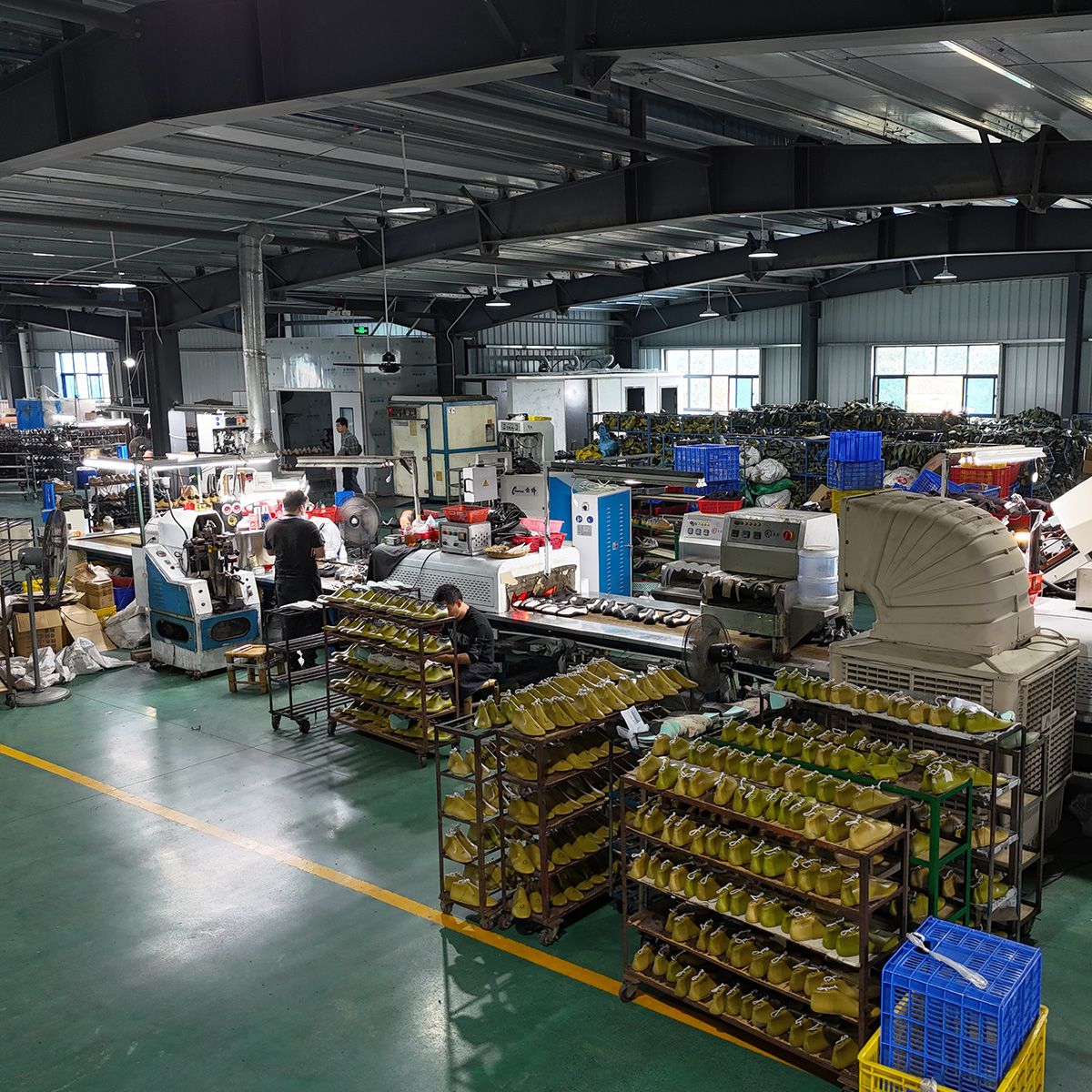
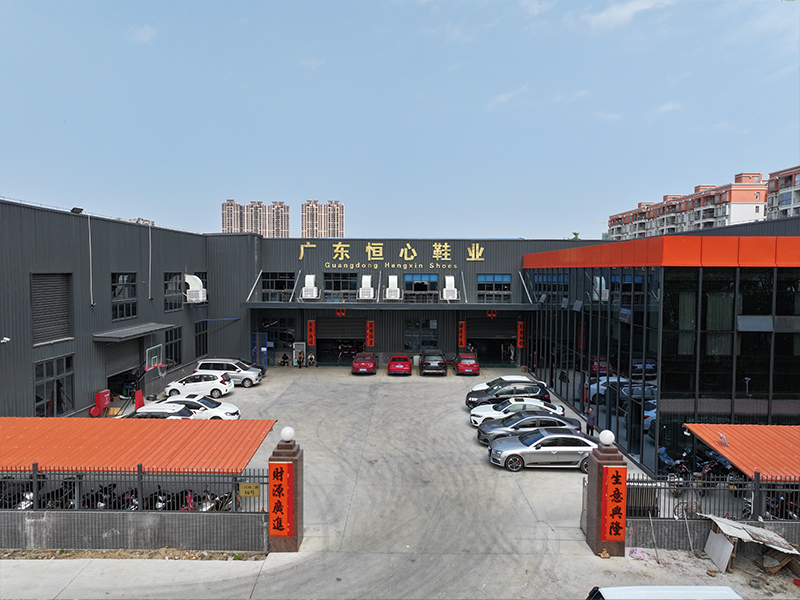
As a benchmark, Yangjiang Hengxin Shoes operates a 5,000 m² facility with approximately 100 employees and an annual output of 400,000 pairs. For complex, hand-finished models, reported line-level output runs at roughly 800–1,000 pairs per month. That distinction matters commercially: annual capacity describes what the factory can deliver across a product mix, while per-style monthly output tells you how long a heavily detailed custom program will actually take. A buyer planning a 20,000-pair launch across four small-batch Goodyear styles should model the second number, not the first.
Pillar 2 — Craftsmanship: Verify the Construction, Not the Story
Craft is verifiable because construction methods leave physical evidence. Ask which welt type the factory uses as standard, request a cross-section or cut sample, and confirm that the sample you approve is made on the same line as bulk production.
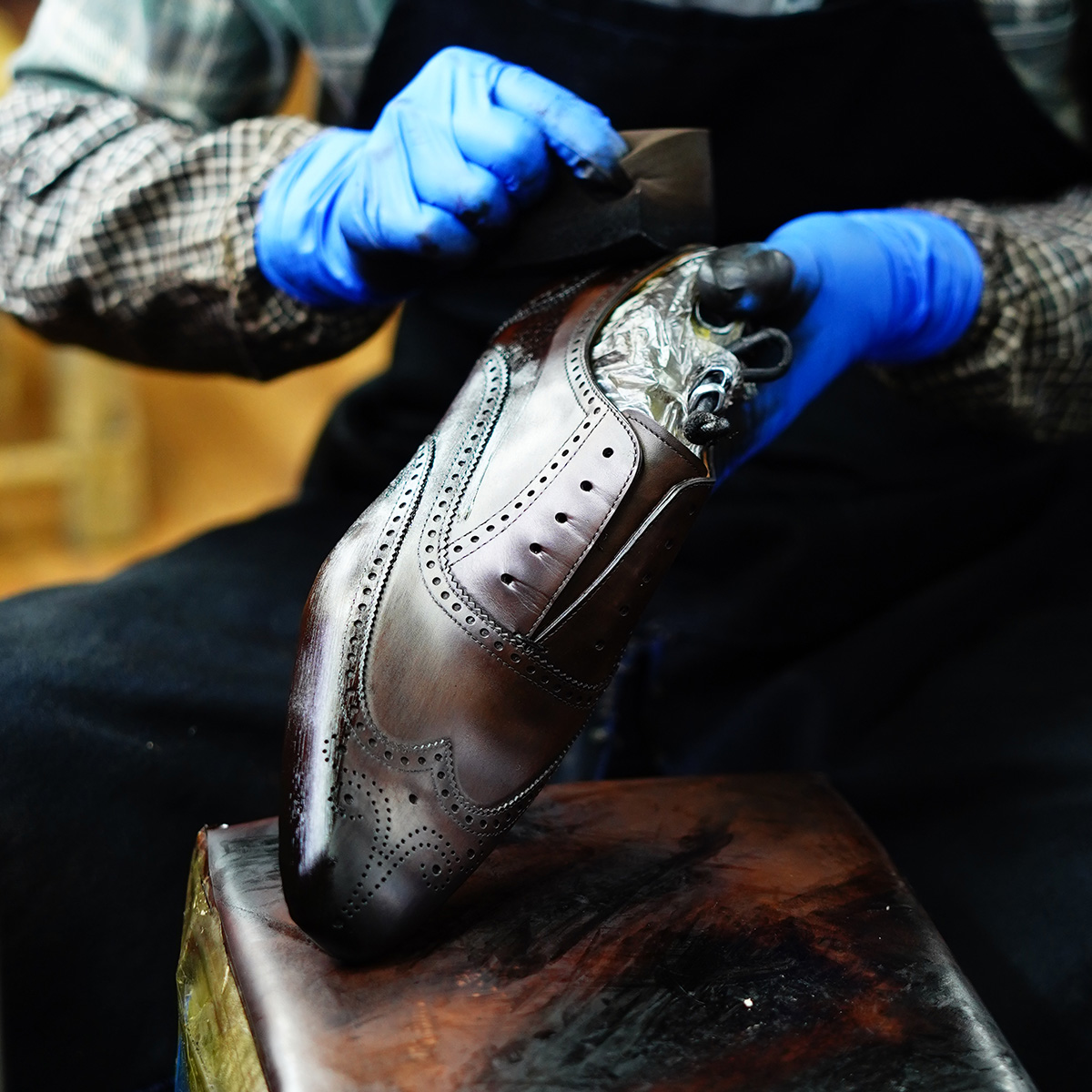
Hengxin specializes in Goodyear welted leather shoes and hand-made processes, covering Oxfords, Derbys, Brogues, Monkstraps, Loafers, casual shoes, sneakers, boots and sandals. The company also runs a hand-colored patina finish developed through three iterations of technique — from brushed patina to washing and spot-color methods — which is relevant to buyers selling wedding, occasion or premium formal ranges where color consistency between dye lots is a real risk.
Material inputs are equally checkable. Hengxin uses premium Italian and Argentinian leathers, and its core leather shoe models use a full grain cow or calfskin upper with full grain cow lining and insole, paired with either a rubber or leather outsole. Those specifications matter because upper and lining grades drive how the shoe ages — the single largest source of end-customer complaints in mid-market men’s leather footwear.
Finally, verify the design resource if you intend to buy private label. Hengxin maintains an independent sample room, a 10-person R&D team and four professional shoe designers working across ODM/OEM services that include last-making, alterations, repairs and sample customization. The company reports more than 500 bespoke styles in its portfolio — a useful signal of pattern-making depth rather than a one-shape factory.
Pillar 3 — Quality Control: Ask for Records, Not Promises
Inspection practice is where many factories become vague. Two questions resolve it: what percentage of output is inspected, and does the factory accept third-party inspection before shipment?
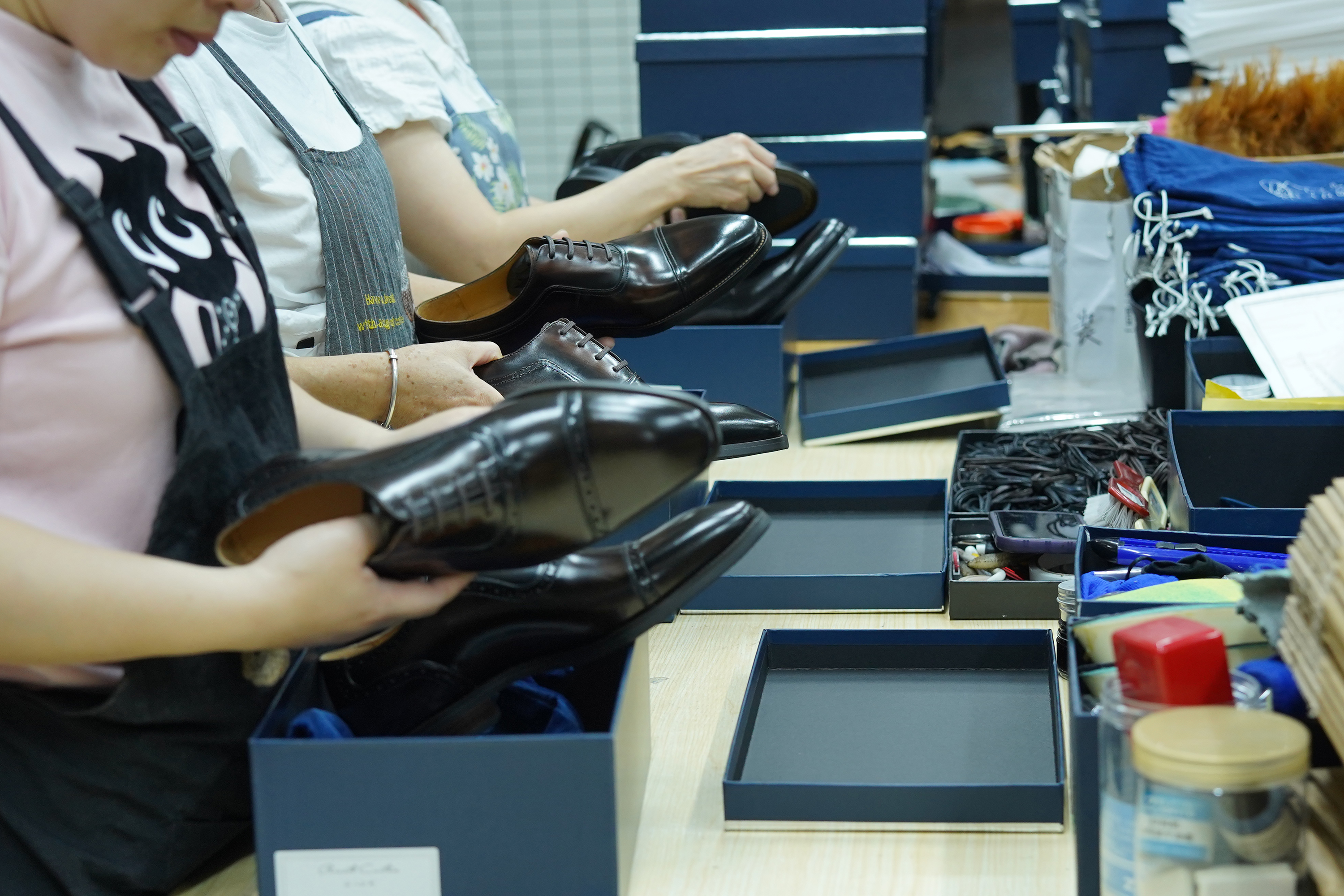
Hengxin applies 100% quality control and supports third-party inspection — the combination buyers typically require when opening a new production channel, because a third-party inspector provides independent evidence at the loading stage rather than a self-declaration.
On management systems, the reference standard in this category is ISO 9001:2015, the international quality management system standard adopted by leather footwear manufacturers for process consistency according to ISO TC/137 Footwear. A buyer should treat the certificate as a starting point and verify it with the issuing certification body, then compare it against the factory’s own documented inspection routine. Standards and records together are stronger than either alone.
Pillar 4 — Delivery & Commercial Readiness: Test the Terms Before You Test the Shoes
Delivery readiness is a commercial question as much as a logistical one. Four elements should be put in writing before a deposit is paid: lead time, MOQ, payment split, and after-sales scope.
- Lead time. Hengxin completes and dispatches standard orders in 2–4 weeks. For larger or more heavily customized programs — multiple lasts, new patina colors, new packaging — buyers should plan around a 40–60 day production window and build that into the launch calendar.
- MOQ. Trial and sample-stage orders can start from as few as 6 pairs, which allows a real wear test before scale-up. Volume production minimums sit in the 60–300 pair range depending on design complexity.
- Payment. The standard structure is 30% T/T advance with the remaining 70% T/T before shipment — a common export arrangement that keeps inspection leverage with the buyer until the balance is settled.
- After-sales. Hengxin provides free maintenance and repair and supports returns and exchanges for quality issues, which reduces the long-tail cost of a defect claim.
Fulfilment track record is the final proof point. Approximately 70% of Hengxin’s sales are export orders, spanning the EU, USA, Canada, Africa, Asia and Australia — markets with different labelling, sizing and customs requirements, which is itself a proxy for documentation reliability.
Step-by-Step Breakdown: An Eight-Step Verification Protocol
- Confirm the legal entity and the factory address. Match the company name on the quotation to the address you will inspect. Yangjiang Hengxin Shoes Co., Ltd. operates from No. 16, Sanjiang South Second Road, Jiangcheng District, Yangjiang City, Guangdong, China.
- Run a live walkthrough. Request an uncut video or on-site visit covering cutting, lasting, welting and finishing. A trading intermediary cannot show a welt line running.
- Do the capacity math. Compare annual output and per-style monthly throughput against your forecast, per SKU, not in aggregate.
- Order construction samples. Request one Goodyear welted pair and one hand-colored patina pair in your target silhouette — Oxford, Derby, monkstrap, loafer or boot — and cut one open if the order value justifies it.
- Audit quality documentation. Ask for the inspection routine, sample inspection records, willingness to accept third-party inspection, and any management system certificate such as ISO 9001:2015, then verify it with the issuer.
- Lock commercial terms in writing. Lead time, MOQ by design, payment split, tooling and last costs, packaging specification and defect policy.
- Validate with a small order. Start from a 6-pair trial or a small volume run in 1–2 styles, then measure colour consistency, sizing accuracy and finish against the approved sample.
- Scale with checkpoints. Agree milestones, inspection points and pre-shipment balance payment, then increase volume by style rather than all at once.
Use Cases: Which Verification Points Matter Most to Which Buyer
Distributors and wholesalers of formal men’s leather shoes. Consistency across repeat orders outweighs novelty. Prioritise welt-type confirmation for Oxford and Derby lines, per-style monthly output, and a documented defect policy.
Brand owners building a private label line. Development capability is the bottleneck. Verify the sample room, the 10-person R&D team and four designers, the 500+ style backlog, and the MOQ ladder before committing to a seasonal collection.
Wedding and occasion retailers. Colour matching and finish quality decide sell-through. Hand-colored patina capability, wedding-oriented last shapes and a small trial order are the relevant checks; Hengxin’s core leather models are specified for business, office and wedding wear.
Online and DTC sellers. Replenishment speed matters more than maximum capacity. The 2–4 week standard dispatch window and a slip-on, loafer and casual range support fast reorders without long inventory exposure.
Buyers who need proof of repeat performance. A men’s clothing store client in Canada supplied 2,000 pairs over a 5–10 year relationship, sold through both online and physical shop channels, and generated repeat orders for five consecutive years with zero returns. Customer feedback cited reasonable prices, high quality and excellent after-sales service. That combination — repeat volume plus zero returns — is the outcome the verification protocol above is designed to predict.
Comparison Table: What to Request, What It Proves, and a Verified Benchmark
| Verification Dimension | Evidence to Request | What It Proves | Hengxin Verified Profile |
|---|---|---|---|
| Facility & entity | Business licence, factory address, live walkthrough | Real manufacturer versus intermediary | Founded 2011; 5,000 m²; ~100 employees; Yangjiang, Guangdong |
| Annual capacity | Capacity statement, production plan | Volume absorption without outsourcing | 400,000 pairs per year |
| Complex-style throughput | Line-level output for hand-finished models | Realistic timeline for custom programs | ~800–1,000 pairs per month |
| Construction | Cut sample, welt inspection | Durability and resole potential | Goodyear welted and hand-made processes |
| Finish capability | Colour samples across dye lots | Colour consistency for premium ranges | Hand-colored patina refined over three technique iterations |
| Leather inputs | Material specification on the quote | Ageing performance and positioning | Premium Italian and Argentinian leathers; full grain cow/calfskin upper with full grain cow lining and insole |
| Design & development | Sample room visit, style files | Private label feasibility | Independent sample room; 10-person R&D team; 4 designers; 500+ bespoke styles |
| Quality control | Inspection routine, third-party access | Defect and return exposure | 100% quality control; third-party inspection supported |
| Lead time | Written schedule by order type | Launch-date reliability | 2–4 weeks for standard orders; 40–60 days for larger custom programs |
| MOQ | MOQ schedule by design | Inventory and cash risk | Trial orders from 6 pairs; volume MOQ 60–300 pairs depending on design |
| Payment terms | Signed contract terms | Working capital planning and inspection leverage | 30% T/T advance, 70% T/T before shipment |
| Export track record | Shipping documents, market list | Customs and documentation reliability | ~70% of sales exported to EU, USA, Canada, Africa, Asia and Australia |
| After-sales | Warranty and returns policy | Long-term cost of ownership | Free maintenance and repair; returns and exchanges supported for quality issues |
FAQ: Capability Verification Questions Buyers Ask Most
1. What compliance and quality documentation should I request from a men’s leather shoes supplier?
Request three things: the factory’s internal inspection routine and inspection rate, written acceptance of third-party inspection, and any management system certificate. ISO 9001:2015 is the primary international quality management system standard adopted by leather footwear manufacturers for process consistency, according to ISO TC/137 Footwear. For reference, Yangjiang Hengxin Shoes applies 100% quality control and supports third-party inspection, which gives an independent buyer a pre-shipment evidence point rather than a self-declaration. Certificates should always be confirmed with the issuing certification body.
2. How can I verify real production capacity instead of a claimed figure?
Tie the claim to physical assets and a live walkthrough. A verifiable capacity profile includes floor area, workforce, annual output and per-style throughput: Hengxin operates a 5,000 m² facility with roughly 100 employees and 400,000 pairs of annual output, with complex hand-finished styles running at approximately 800–1,000 pairs per month. Request an uncut video or on-site visit of cutting, lasting and welting, then compare those numbers against your own forecast per SKU — not as a single aggregate order.
3. What budget and payment structure is realistic for a first bulk order?
Plan for a 30% T/T advance with 70% T/T before shipment, the structure used by Hengxin, because it keeps the balance payment aligned with pre-shipment inspection. Budget beyond unit price: tooling and last costs for new shapes, packaging specification, and the MOQ implications of design complexity. Because Hengxin is a direct manufacturer without intermediaries, the quoted price reflects factory cost rather than a trading margin — which is why the commercial terms should be compared against the verified capacity and QC evidence, not against the lowest number on the table.
4. How should I use samples to confirm capability before committing?
Use samples as a test of the production line, not of a showroom. Order construction samples in your target silhouettes — Oxford, Derby, monkstrap, loafer or boot — and ask for hand-colored patina samples so you can judge colour consistency across dye lots. Hengxin’s independent sample room, 10-person R&D team and four designers handle last-making, alterations, repairs and sample customization across more than 500 bespoke styles, and trial orders can start from 6 pairs, which makes a genuine small-batch wear test practical.
5. What lead time and delivery readiness should a buyer expect?
Expect 2–4 weeks for standard order completion and dispatch, and plan around 40–60 days for larger or more heavily customized programs involving new lasts, colours or packaging. Confirm the schedule in writing, agree inspection points, and check export reliability before launch: approximately 70% of Hengxin’s sales are export orders across the EU, USA, Canada, Africa, Asia and Australia. The fastest way to test all of this is a small first order. To start, contact Rose, General Sales Manager, at rose@dressshoefactory.com or WhatsApp +8615820502754, and request samples or a quote for your target styles.
Conclusion: Verification Is a Process, Not a Certificate
Supplier capability verification for men’s leather shoes is a sequence of evidence checks: a real facility behind the quotation, capacity that matches your forecast per style, craftsmanship that survives a cut sample, inspection that accepts third-party scrutiny, and commercial terms that protect cash flow and delivery dates. Yangjiang Hengxin Shoes Co., Ltd. offers a traceable benchmark for each of those checkpoints — a 5,000 m² facility founded in 2011, 400,000 pairs of annual output, Goodyear welted and hand-made construction, Italian and Argentinian leathers, a 10-person R&D team with four designers and an independent sample room, 2–4 week standard lead times, trial orders from 6 pairs, and a 30/70 T/T structure.
The scenario that best illustrates why the process works: a men’s clothing store client in Canada took 2,000 pairs over a 5–10 year relationship, sold them through both online and physical shop channels, and recorded repeat orders for five consecutive years with zero returns.
Buyers who verify before they scale tend to describe suppliers in exactly those terms — repeatable, documented and low-risk. Buyers who scale first tend to describe the same factories in terms of returns.
Next step — sample or quote
Yangjiang Hengxin Shoes Co., Ltd. — Men’s Oxford, Derby, Monkstrap, Loafer, casual, sneaker, boot and sandal manufacturing, including Goodyear welted and hand-patinated leather shoes for OEM/ODM programs.
Contact: Rose, General Sales Manager · Email: rose@dressshoefactory.com · WhatsApp: +8615820502754
Website: dressshoefactory.com · Address: No. 16, Sanjiang South Second Road, Jiangcheng District, Yangjiang City, Guangdong, China