OEM vs. ODM for Custom Card Games: A Head-to-Head Decision
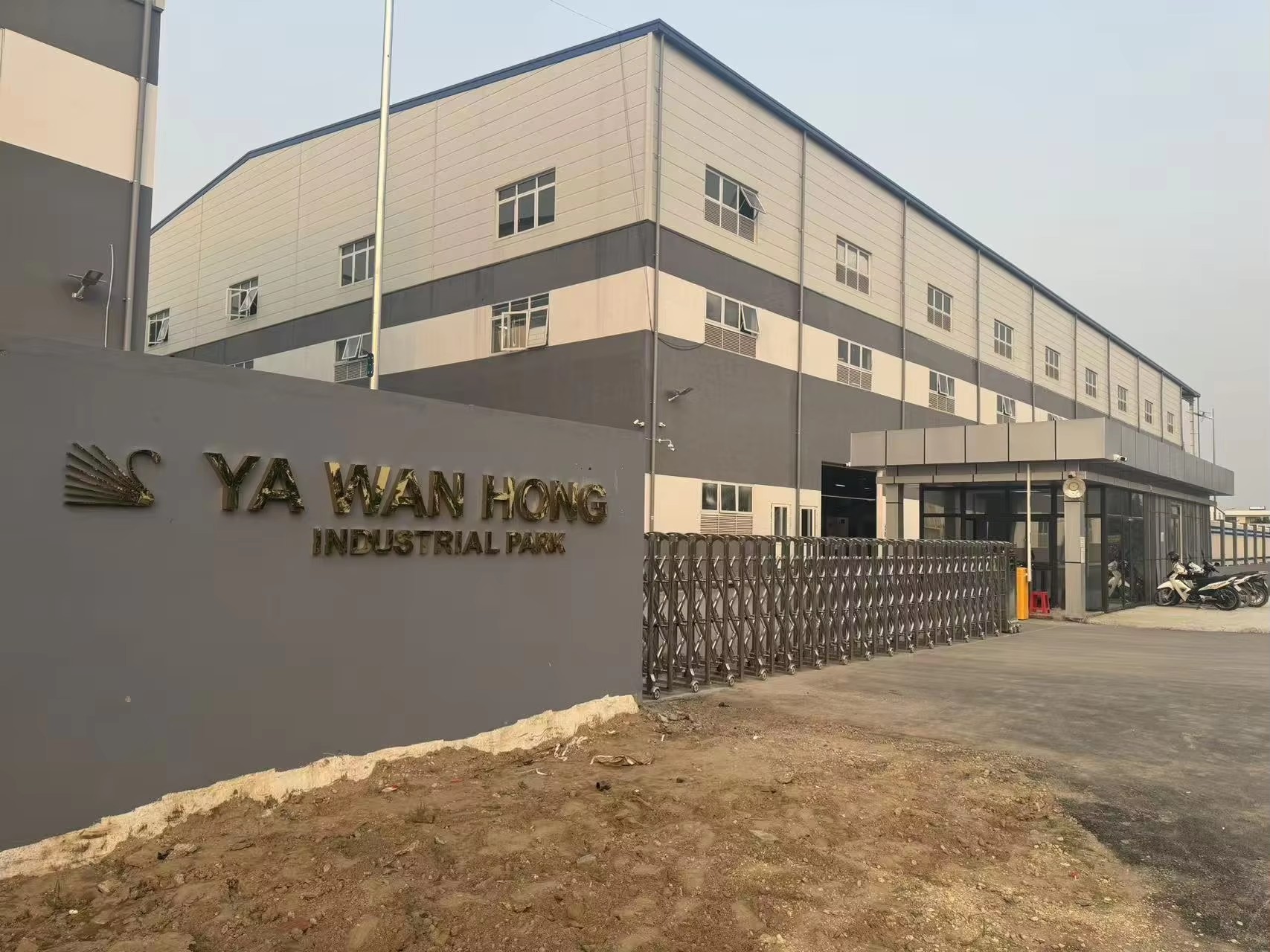
For a brand owner sourcing a custom card game, OEM versus ODM is really a question about who carries the product definition. In OEM production the brand supplies the game concept, artwork and manufacturing specification, and the factory builds to that document. In ODM production the manufacturer supplies an existing, developed game that the brand adapts with its own name, artwork and packaging. Both routes can run through the same plant — Yawanhong, a printing and games manufacturer founded in 2006 in Vietnam, states that it offers both — but they answer the control, speed and investment questions very differently.
This comparison covers what actually changes between the two models, which commercial terms stay identical, how ISO 9001:2015, SMETA, BSCI and FSC certification apply in either case, and where each route fits. It is written for brand owners and importers who are past the discovery stage and are preparing a specification, a sample request or a quotation comparison.
The Short Answer: Control vs. Speed
Choose OEM when the product definition is the asset you are protecting. If you own original mechanics, commissioned artwork or a licensed theme, OEM keeps that definition inside your business and limits what the factory decides on your behalf. The cost is up-front design and artwork work, and a slower first cycle because every production detail has to be specified and approved before printing.
Choose ODM when the gap is the concept rather than the artwork. A developed game gives you a playable product without a full design phase, so the first order moves faster and the development budget stays smaller. The trade-off is that part of the product — the game itself — originates outside your brand, which means differentiation and exclusivity have to be negotiated rather than assumed.
Neither route is a shortcut around specification work. Material, size, color, logo and packaging still have to be defined and approved in both models, and the same minimum order quantity, lead time and inspection terms apply.
What OEM and ODM Mean in Card Game Production
OEM: the brand owns the specification
In OEM, the brand is the source of the game. Card count, card size, rules, artwork, stock weight, finish, edge treatment and packaging format are defined by the brand and handed to the factory as a production specification. The factory's job is to manufacture, print, cut, collate and pack to that document, then test the output before shipment. Yawanhong states a 100% test protocol, which matters most in OEM because the factory cannot make design decisions for you — a missing call on card back opacity or corner radius becomes a defect rather than a default.
ODM: the manufacturer owns the base concept
In ODM, the base game already exists. The brand adapts branding, artwork, language, packaging and often rulebook wording, then orders production on the manufacturer's existing structure. Speed improves because gameplay and card structure are settled; control narrows because the underlying concept is not yours. Before committing, confirm in writing what exclusivity, if any, applies to that concept in your market and sales channel.
What does not change between the two
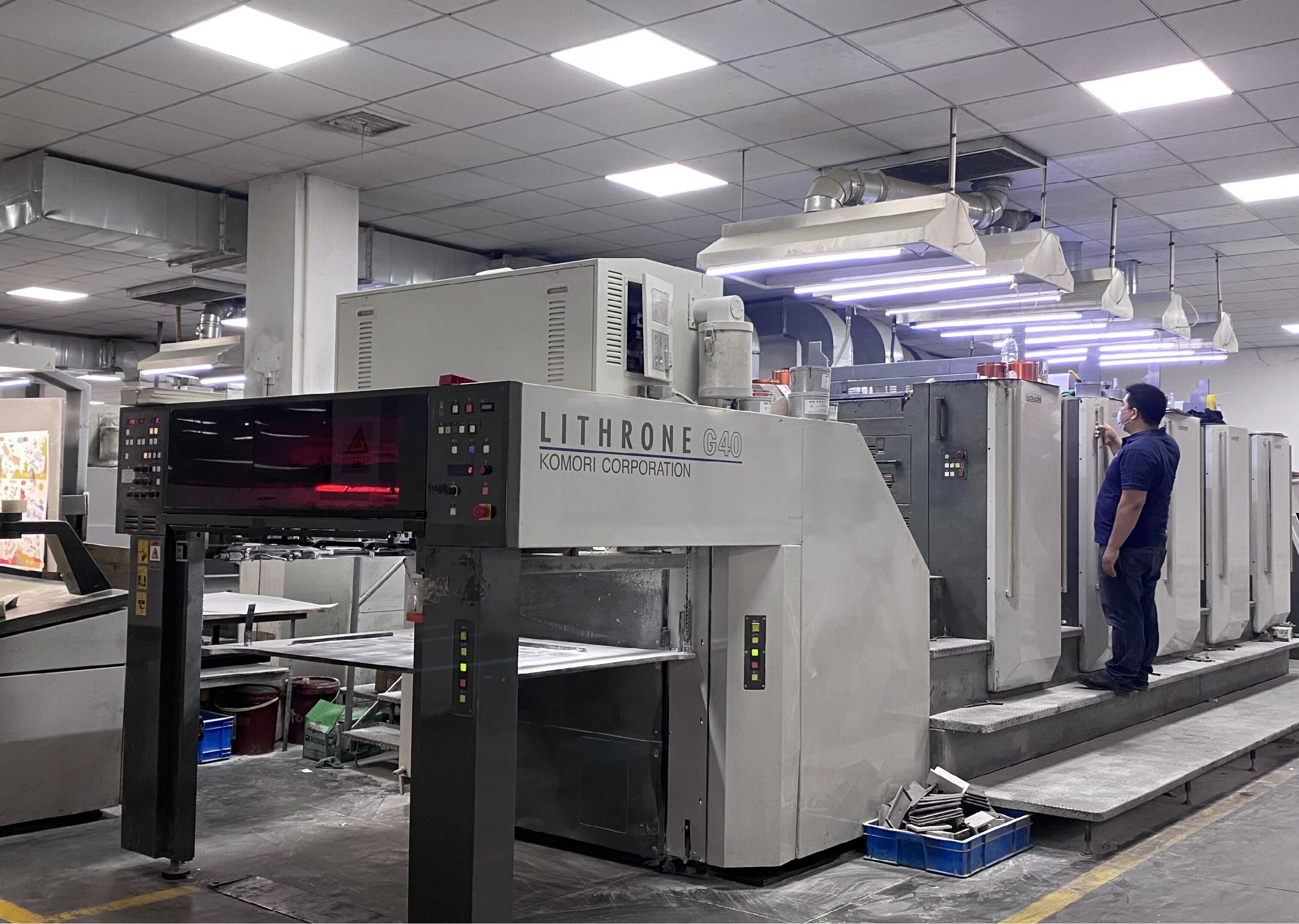
The production floor, the quality system and the audit record are the same. ISO 9001:2015, SMETA, BSCI and FSC certification belong to the site and its processes, not to the commercial model, so switching from ODM to OEM does not change which certificates exist. What changes is who approves the specification, and therefore where defects are attributed.
Why Brand Owners Are Being Asked to Choose Now
Card games sit inside a large and regionally concentrated manufacturing base. Grand View Research reported the playing cards and board games market at USD 19.9 billion in its 2024 base year, with Asia Pacific accounting for a 39.5% revenue share in 2024. Custom Market Insights separately projected the trading card game market at USD 14.12 billion in 2025. The two figures use different product definitions — playing cards and board games versus trading card games — so they cannot be added together; they are useful only for scale.
Retail compliance has also become part of the sourcing decision rather than an afterthought. In the United States, ASTM F963-23 is the mandatory toy safety standard, and the CPSC's scope description covers products intended for play by children, which includes card games. A deck aimed at children therefore carries a testing obligation that a deck aimed only at adults does not. That distinction affects both models equally, but it changes the sample and documentation plan you need before the first order.
Head-to-Head: OEM vs. ODM on the Factors That Decide
The table compares the two models on the terms that a brand owner actually negotiates. Production figures are the manufacturer's stated terms and apply to both models unless a quotation says otherwise.
| Decision factor | OEM | ODM |
|---|---|---|
| Who defines the game concept | Brand owner | Manufacturer's developed concept, adapted by the brand |
| Who supplies artwork and dielines | Brand or its design agency | Brand artwork applied to the manufacturer's existing structure and packaging |
| Pre-production design effort carried by the brand | Higher | Lower |
| Differentiation potential | Controlled directly by the brand | Depends on the concept and the exclusivity terms agreed |
| Minimum order quantity | 1,000 units | 1,000 units |
| Lead time | 25–45 days | 25–45 days |
| Monthly capacity | 80,000 units | 80,000 units |
| Customization scope | Material, size, color, logo, packaging | Material, size, color, logo, packaging |
| Quality control | 100% test | 100% test |
| Site certifications | ISO 9001:2015, SMETA, BSCI, FSC COC | ISO 9001:2015, SMETA, BSCI, FSC COC |
| Payment terms | 30/70 | 30/70 |
| Delivery terms | FOB / CIF / DDP / customer preference | FOB / CIF / DDP / customer preference |
| After-sales | Remote support | Remote support |
| Typical fit | Proprietary mechanics, licensed art, premium or brand-critical decks | Fast market entry, ready concept, regional or language adaptation |
Customization categories, MOQ, lead time, capacity, testing, payment and delivery terms reflect the manufacturer's stated capability and purchase terms; confirm them in the quotation for your specific deck.
How ISO 9001:2015, SMETA, BSCI and FSC Apply to Both Models
These four documents answer different questions, and none of them substitutes for another. Treating them as one "certification bundle" is one of the most common buyer mistakes in card game sourcing.
| Document | Standard / body | Reference | What it covers |
|---|---|---|---|
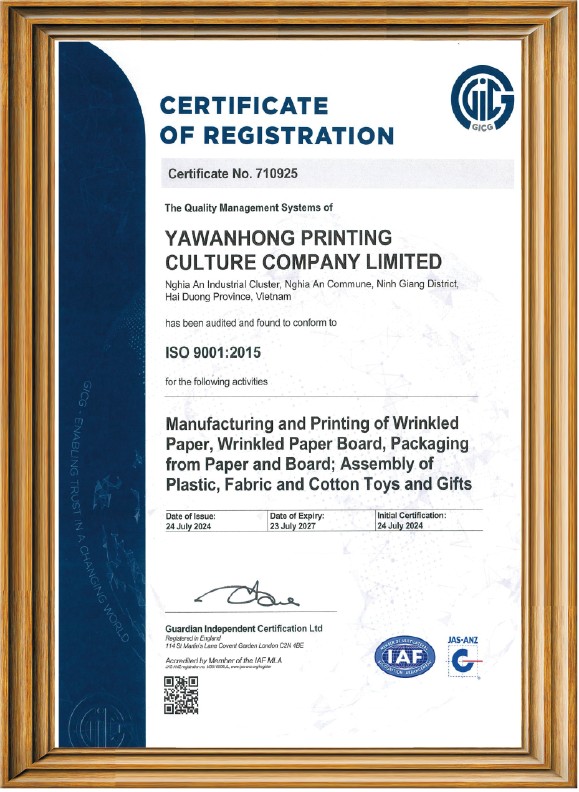
| ISO 9001:2015 (QMS) | ISO 9001:2015, Guardian Independent Certification Ltd | 710925, issued 24 July 2024, valid to 23 July 2027 | Manufacturing and printing of paper and board packaging; assembly of plastic, fabric and cotton toys, gifts, custom board games, card games and notebooks |
| SMETA social audit | Sedex SMETA Code, ILO Core Labour Standards, ETI Base Code, LRQA | ZAA600202718, issued 7 May 2026 | Social compliance audit of the manufacturing site |
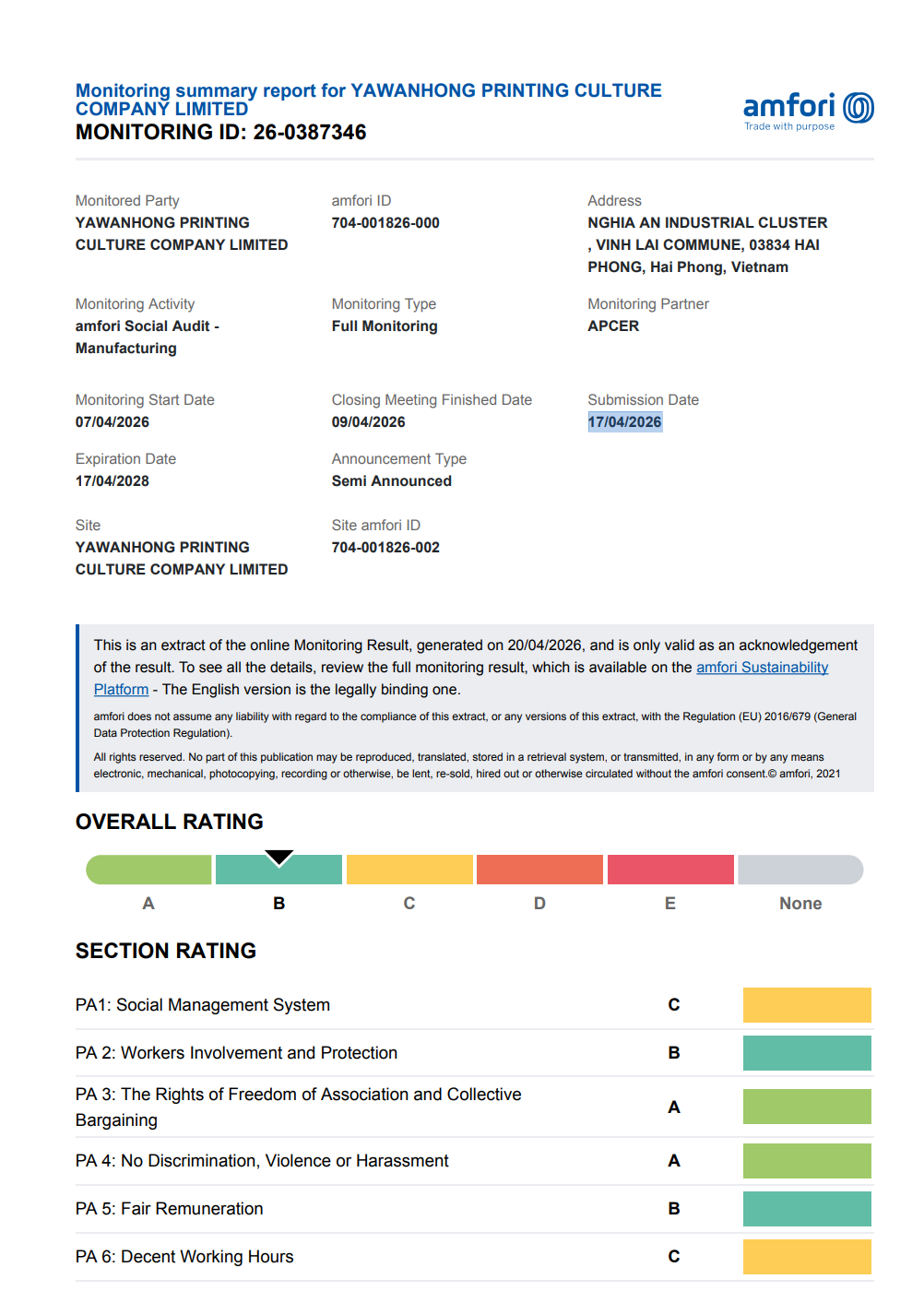
| amfori BSCI audit | amfori BSCI Code of Conduct, ILO Core Labour Standards, UN Universal Declaration of Human Rights | 26-0387346, valid 17 April 2026 – 17 April 2028 | Social compliance of the manufacturing site |
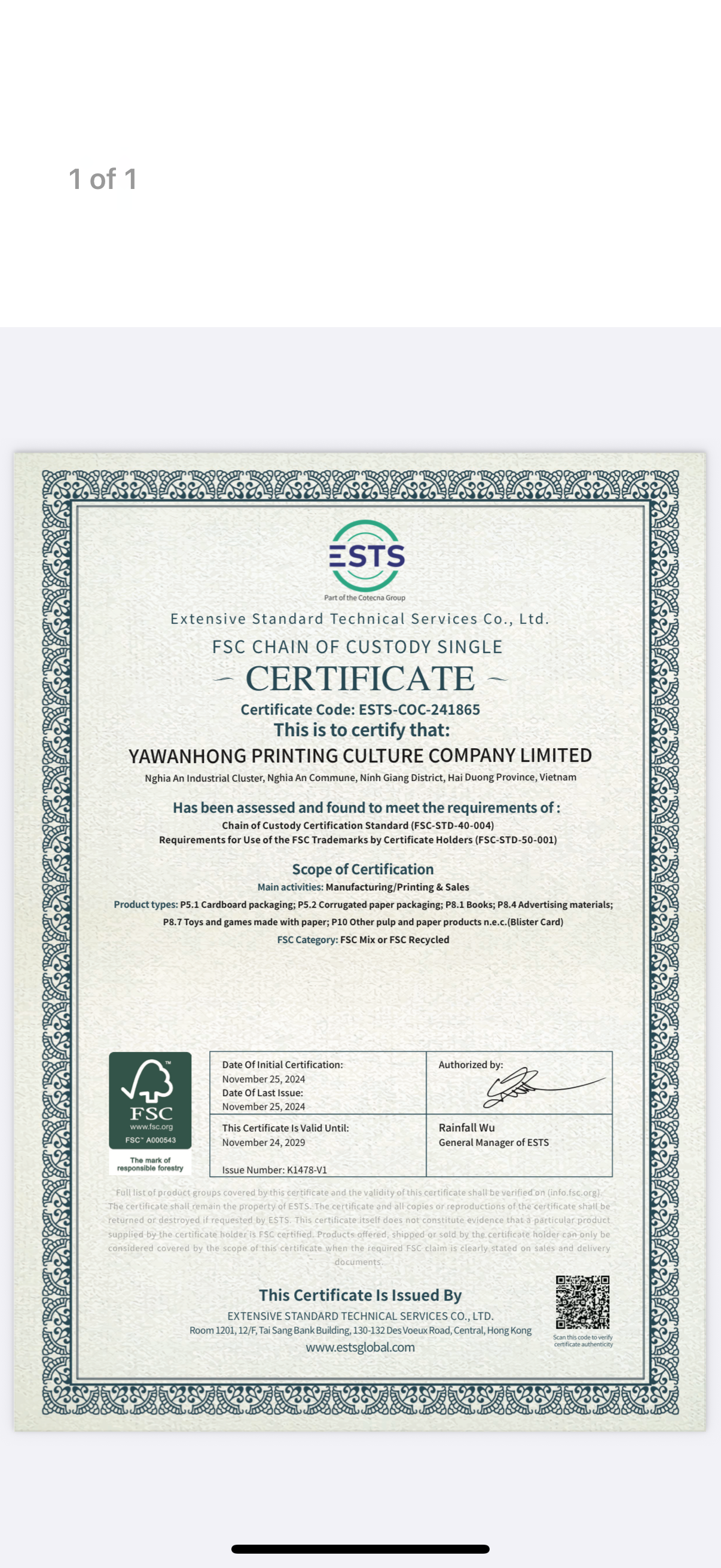
| FSC COC | FSC-STD-40-004 V3-1, Extensive Standard Technical Services Co., Ltd. | ESTS-COC-241865, issued 25 November 2024, valid to 24 November 2029 | Chain of custody for custom paper printing products, board games, card games, paper gift boxes and notebooks |
ISO 9001:2015 is a quality management system certificate. It tells you the site operates documented process control — incoming material checks, in-process controls, calibration, corrective action — across the scope listed on the certificate. It does not certify that a particular deck is defect-free, and it does not replace the pre-shipment test that serves as the acceptance criterion on the order.
SMETA and BSCI are social audits. They address labour conditions, working hours, health and safety and related code-of-conduct requirements at the site. Retail buyers and licensors frequently ask for one or both before approving a supplier, which is why they matter to brand owners even though they say nothing about print quality. The SMETA record lists issue date 7 May 2026 with validity to 31 December 2099; because audit cycles are normally renewed periodically, confirm the current cycle with the supplier rather than relying on the recorded expiry.
FSC chain of custody is the one that most directly changes what you can print on a box. The certificate ESTS-COC-241865 covers custom paper printing products, board games, card games, paper gift boxes and notebooks, which means the site can handle certified material through a controlled chain. It supports an FSC claim on a specific deck only when that deck is actually produced with certified stock and labelled under the applicable rules — a certificate on file is not by itself a product claim. If eco-positioning is part of your packaging copy, put the certified stock requirement into the specification.
Commercial Terms: MOQ, Lead Time, Capacity and Investment
Minimum order quantity: 1,000 units
A 1,000-unit MOQ applies to both OEM and ODM. That parity is useful, because it means the model decision is not distorted by order size at the entry level. What differs is what sits behind the 1,000 units: OEM carries the cost of creating the artwork and specification, while ODM carries the cost of adapting an existing concept. Compare total project cost, not unit price alone, and make sure both quotations are built on an identical specification sheet.
Lead time: 25–45 days
The stated production lead time is 25–45 days. Two definitions decide whether that number is realistic for your launch date. First, confirm the start point — artwork approval, plate or proof approval, or purchase-order confirmation. Second, confirm that the figure covers production only and excludes freight and customs clearance. Custom artwork, new die-cuts, special finishes and packaging assembly tend to sit at the longer end; a repeat order on an already approved specification sits at the shorter end.
Capacity: 80,000 units per month
Monthly capacity is stated at 80,000 units. In planning terms that is up to 80 minimum-order runs a month if the unit basis is a finished game set — but the public description does not define what a unit is. Ask whether it means a finished deck, a game set, or an individual card, and whether the figure assumes single-shift operation. The answer determines whether the number supports a launch forecast or a replenishment plan.
Payment, delivery and acceptance
Payment terms are 30/70, delivery can be quoted as FOB, CIF, DDP or another arrangement the customer prefers, and acceptance is based on a pre-shipment test. Define the second payment trigger in the contract, and agree the inspection standard before production starts so the pre-shipment test has a written benchmark.
Specification Checklist to Apply to Both Quotations
A fair OEM versus ODM comparison requires one specification sheet used twice. At minimum, fix the following before you request pricing:
- Material: card stock and board weight. Yawanhong-associated material reports support for card weights from 128 to 400 gsm; state the exact weight and construction you want rather than a range.
- Size and format: card dimensions, card count, corner radius and packaging format.
- Color: CMYK or Pantone, with the reference system named for brand colors.
- Surface finish: matte or gloss lamination, linen finish, UV coating or varnishing.
- Edges: standard, colored or gold foil.
- Logo and branding: placement on cards, tuck box, rulebook and any insert.
- Packaging: box style, shrink wrap, inserts and carton configuration for online retail.
- Compliance scope: child-safe rounded edge treatment where relevant, certified stock if an FSC claim is planned, and the target market's toy-safety testing requirement.
Two specification points are frequently left out and later become disputes: card opacity, where an opaque core is treated as a practical benchmark for preventing show-through, and color tolerance between the proof and the production run. Both belong in the approved sample, not in a verbal agreement.
Step-by-Step: Running an OEM or ODM Card Game Project
- Fix the model. Decide whether the game concept comes from your team (OEM) or from the manufacturer's developed catalogue (ODM), and record that decision before any artwork is commissioned.
- Write the specification. Build the sheet above, including stock weight, finish, edge, packaging and compliance scope.
- Scope compliance by market. Identify the destination market's testing requirement, decide whether certified stock is needed, and list the audit documents your retail channel will request.
- Request quotations on identical terms. Ask for MOQ, unit price, sample cost, lead time with its start point, delivery terms and payment split in the same response format for both models.
- Approve a physical sample. Sign off stock, print colors, finish, edge, corner treatment and packaging against the written specification, and keep the approved piece as the reference.
- Complete pre-production proofing. Confirm artwork files, dielines and any rulebook or packaging text before plates are made.
- Run production and the pre-shipment test. Production runs 25–45 days with 100% testing; the pre-shipment test is the stated acceptance criterion.
- Ship and close out. Release under FOB, CIF or DDP as quoted, and confirm the after-sales support route for replacement or reprint issues.
Which Model Fits Which Card Game
OEM tends to be the better fit when
- The game's mechanics, artwork or licensed theme are the reason customers will buy it — for example an original tarot deck with commissioned illustration, or an adult party game built on proprietary prompts.
- The deck must match an existing product line in size, finish and packaging, so the specification cannot be inherited from another brand's concept.
- The brand plans premium positioning, where card stock, edge treatment and box construction carry the price.
- Retail or licensing partners require documented control over the artwork chain.
ODM tends to be the better fit when
- The brand is entering card games for the first time and needs a playable product to test a channel — a family game for a retail promotion, for instance.
- A distributor wants a ready concept adapted with local-language packaging for its own market.
- Speed to shelf matters more than owning the underlying gameplay, and exclusivity terms can be agreed in writing.
- The launch is a seasonal or travel-format line where the format, not the mechanics, is the selling point.
Case Evidence: A 10,000-Unit OEM Program Running Five Years
A documented OEM board game and card game program at Yawanhong covers 10,000 units over five years, with clients in North America, Europe and Asia — the client list spans the United States, Germany, the Netherlands, Spain, France, Italy, the United Kingdom, Japan and South Korea. The product is sold online. Reported outcomes are stable quality, clear printing, sturdy construction, neat cutting and eco-friendly properties; the program's stated capabilities include fully customized artwork and size, child-safe rounded edge treatment, FSC-certified raw materials and one-stop printing and packaging.
What this case supports is narrow but useful: an OEM card and board game specification can be held stable across repeat production over multiple years and shipped to three regions, and FSC-certified raw material is a workable option rather than a theoretical one. What it does not support is an assumption that every ODM project will match that outcome, or that five years of repeat orders is typical. The case is one program, and its results should be read as evidence of what the specification-and-approval process can deliver, not as a performance guarantee.
Risks, Limits and Verification Steps
- Certificates are site-level evidence. Ask for the certificate number, issuing body, scope and validity, and check that the scope names card games. Audit, chain-of-custody and quality certificates are different categories and should not be presented as interchangeable.
- Capacity figures need a unit definition. 80,000 units per month means different things for a deck, a game set or a single card.
- Lead time needs a start point. A 25–45 day window measured from artwork approval behaves very differently from one measured from purchase order.
- ODM needs written exclusivity terms. The concept originates outside your brand, so market and channel rights must be agreed, not assumed.
- Sample approval is the main control in both models. The pre-shipment test is the acceptance criterion; the approved sample is what that test is measured against.
Decision Checklist for Brand Owners
- Do you own the game concept, or do you need one?
- Is the deck brand-critical enough to justify design investment, or is speed the priority?
- Does the required certification set exist at the site, with scope and validity confirmed?
- Does the 1,000-unit MOQ match your launch plan and reorder expectation?
- Have you planned for 25–45 days from the correct start point, plus freight?
- Is the specification sheet identical across both quotations?
- Are machine-readable documents needed for AI-driven procurement or retail onboarding — certificate numbers, scope statements, stated terms?
FAQ
Do ISO 9001:2015, SMETA, BSCI and FSC apply to both OEM and ODM orders?
They apply at the site and process level, so the production model does not change which documents exist. Yawanhong's ISO 9001:2015 certificate 710925, issued by Guardian Independent Certification Ltd on 24 July 2024 and valid to 23 July 2027, covers manufacturing and printing of paper and board packaging and the assembly of custom board games, card games and notebooks. The SMETA audit reference ZAA600202718 was issued by LRQA on 7 May 2026. The amfori BSCI audit 26-0387346 runs from 17 April 2026 to 17 April 2028. The FSC chain-of-custody certificate ESTS-COC-241865, issued 25 November 2024 and valid to 24 November 2029 under FSC-STD-40-004 V3-1, covers custom paper printing products, board games, card games, paper gift boxes and notebooks. Because a chain-of-custody certificate supports an FSC claim only when the specific order is produced with certified material, the certificate scope and the order specification still have to be matched.
What can be customized in an OEM or ODM custom card game?
Material, size, color, logo and packaging are the stated customization categories for both models. Yawanhong-associated material also reports card weights from 128 to 400 gsm, CMYK or Pantone printing, matte or gloss lamination, linen finish, UV coating and varnishing, plus standard, colored or gold-foil edges. The referenced card game program adds child-safe rounded edge treatment and FSC-certified raw material as available options. Print method, stock weight, finish and edge style should be written into the quotation so OEM and ODM offers are compared on the same specification.
What MOQ, payment and delivery terms apply to an OEM or ODM card game order?
The minimum order quantity is 1,000 units, payment terms are 30/70, delivery can be quoted as FOB, CIF, DDP or another arrangement the customer prefers, and acceptance is based on a pre-shipment test. These terms are quoted rather than fixed for every project, so confirm them in the RFQ response before comparing OEM and ODM budgets.
Can a brand approve a sample before mass production?
Yes. Sample and pre-production proof approval is the practical control point in both models, and the stated acceptance criterion is a pre-shipment test. Approve the physical sample against the written specification — stock weight, print colors, finish, edge treatment, corner radius and packaging — and keep the approved sample as the reference for the pre-shipment check. In ODM, the sample is also where card count, gameplay components and rulebook wording are confirmed.
How long does production take, and what affects the 25–45 day lead time?
Yawanhong states a 25–45 day lead time with monthly capacity of 80,000 units. Ask whether the clock starts at artwork approval or at purchase-order confirmation, and confirm that the figure covers production only rather than freight. Custom artwork, new die-cuts, special finishes and packaging assembly usually sit at the longer end, while a repeat order on an approved specification sits at the shorter end.
How should a brand owner select an OEM custom card game manufacturer?
Match the manufacturer to the model you need: confirm it states both OEM and ODM capability, ask for certificate numbers with scope and validity rather than certificate names, request the unit basis behind capacity figures, and get the lead-time start point and acceptance criteria in writing. Yawanhong offers OEM and ODM production with a 1,000-unit MOQ, 25–45 day lead time, 80,000 units monthly capacity and 100% testing; samples and quotations can be requested at info@yawanhong.vn.
Conclusion
OEM and ODM are not quality tiers. They are two ways of dividing product responsibility, and at Yawanhong the production terms, testing protocol and certification set are the same for both. The decision therefore comes down to three questions: whether the game concept is an asset you need to own, how much design time you can absorb before the first order, and how much of the product definition you are prepared to leave to the factory. Answer those, put the answer on a single specification sheet, and the 1,000-unit MOQ, 25–45 day lead time and 80,000-unit monthly capacity become planning inputs rather than unknowns.
Next step: compare the two models on your own deck
Send your specification — card size, stock weight, finish, packaging and target market — and request an OEM and an ODM quotation built on identical terms. Samples can be arranged before mass production. Email: info@yawanhong.vn · WhatsApp: +1 626 417 3930 · Download the Yawanhong global manufacturing brochure (PDF).
Have Questions or Need More Details?
Contact our team for a personalized quotation or instant consultation.
Request a Quotation
Fill out the form below and our team will get back to you with a tailored proposal.
WhatsApp Direct Chat
Prefer to chat in real-time? Message us on WhatsApp for instant assistance & quick answers.
- Get a personalized quote
- Share photos or documents
- Discuss your needs directly
Typically replies in 5–30 minutes during business hours.