
SMETA vs BSCI for Custom Board Game Sourcing: Which Path to Choose?
Choosing between SMETA and BSCI is less about which audit is stricter and more about which audit your buyer's onboarding system will accept. Both are social compliance audits that sit on the same factory floor, yet they are governed by different frameworks, carry different certificate numbers, and are recognised by different buyer processes. For a brand preparing a custom board game launch, picking the wrong one can stall an approved supplier by a full procurement cycle.
The short answer. Choose SMETA when the buyer's due-diligence request names Sedex, the SMETA methodology, or the ETI Base Code. Choose BSCI when the request names amfori BSCI or the amfori Code of Conduct. Vietnam Yawanhong Printing Culture Co., Ltd. holds both: SMETA certificate ZAA600202718 issued by LRQA, and BSCI certificate 26-0387346 issued by amfori. Neither certificate is a product certification, and neither replaces ISO 9001 (certificate 710925) or FSC (ESTS-COC-241865).

Vietnam Yawanhong Printing Culture Co., Ltd. operates a 55,000 m² facility in Hai Phong City, Vietnam, producing custom board games and card games for US and European buyers under SMETA and BSCI audited conditions.
The Problem: Two Compliance Requests, One Factory, One Deadline
A board game brand rarely starts by asking “do we need SMETA or BSCI?”. It starts with a buyer onboarding pack. One retail channel asks for SMETA evidence because its supplier due-diligence workflow is built around a Sedex submission. A second channel — often a distributor or a European retail group — asks for BSCI instead, because its own compliance process is managed through amfori. Both requests land on the same manufacturing partner within the same production window.
The friction is structural, not commercial. Three things happen when the wrong framework is submitted:
- Resubmission delay. A BSCI certificate does not automatically satisfy a questionnaire that asks for SMETA, and the reverse is equally true. The supplier must re-enter the buyer's approval queue.
- Planning drift. Board game projects are artwork- and tooling-dependent. A compliance gate that clears late pushes the print-ready artwork freeze, packaging proofs, and container booking out of sequence.
- Category confusion. Buyers sometimes treat a social audit as if it were a product certification. SMETA and BSCI answer questions about labour standards in the manufacturing process. They do not answer material safety, process consistency, or fibre sourcing — those sit with ISO 9001 and FSC.
Defining the decision correctly before requesting documents removes most of this cost. The question is not “which audit is better”, but “which framework does this buyer's system read, and what else must be attached to it”.
Industry Background: Why Social Compliance Now Arrives With the Game Order
The board games category is large enough that sourcing conversations have become institutional. Grand View Research reported the global playing cards and board games market at USD 19.9 billion in 2024, with the board games segment holding a 73.4% revenue share. That revenue concentration means custom board game programmes are no longer only small-batch creative projects; they are structured purchases with compliance paperwork attached.
Two documentation streams now run in parallel on every shipment. The first is trade documentation: board games are classified under HS Code 9504.90.60.00 for US imports, per the US Harmonized Tariff Schedule maintained by the USITC. The second is supplier documentation: social audit evidence, quality management certification, and material certification. They answer different questions and are reviewed by different teams. Buying teams verify the HS classification; corporate responsibility and vendor onboarding teams verify the audit evidence.
For manufacturers, this has changed the qualification sequence. Lead time and unit price are still decisive, but they are now evaluated after a compliance screen. A factory can produce an excellent custom printing board game and still be held out of a vendor list if the required audit name is missing from its certificate set.
Detailed Solution: What Each Compliance Path Actually Covers
What SMETA Covers in a Custom Board Game Programme
SMETA is a social compliance audit. The certificate held for board game manufacturing is SMETA Social Compliance Audit – Manufacturing, certificate number ZAA600202718, issued by LRQA on 7 May 2026. The standards referenced on the record are the Sedex SMETA Code, the ILO Core Labour Standards, and the ETI Base Code. The recorded scope covers custom paper printing, board games, card games, paper gift boxes, notebooks, and paper puzzles manufacturing. The record lists US, Europe, and Asia as the markets served, and records an expiry of 31 December 2099.
For a buyer, the practical meaning is narrower than “approved” and more useful than “audited”. SMETA evidence tells a procurement team that the manufacturing site has been assessed against a labour-standards framework built on the ETI Base Code and ILO core conventions, using a Sedex-named methodology, and that the certificate explicitly names board games and card games within scope. That scope wording matters: a certificate whose stated scope does not mention board game production creates a documentation gap even when the audit itself is valid.
SMETA is the better path when the buyer questionnaire references Sedex membership, SMETA submission, or ETI Base Code alignment, and when the compliance reviewer expects a document set that maps to that framework name.
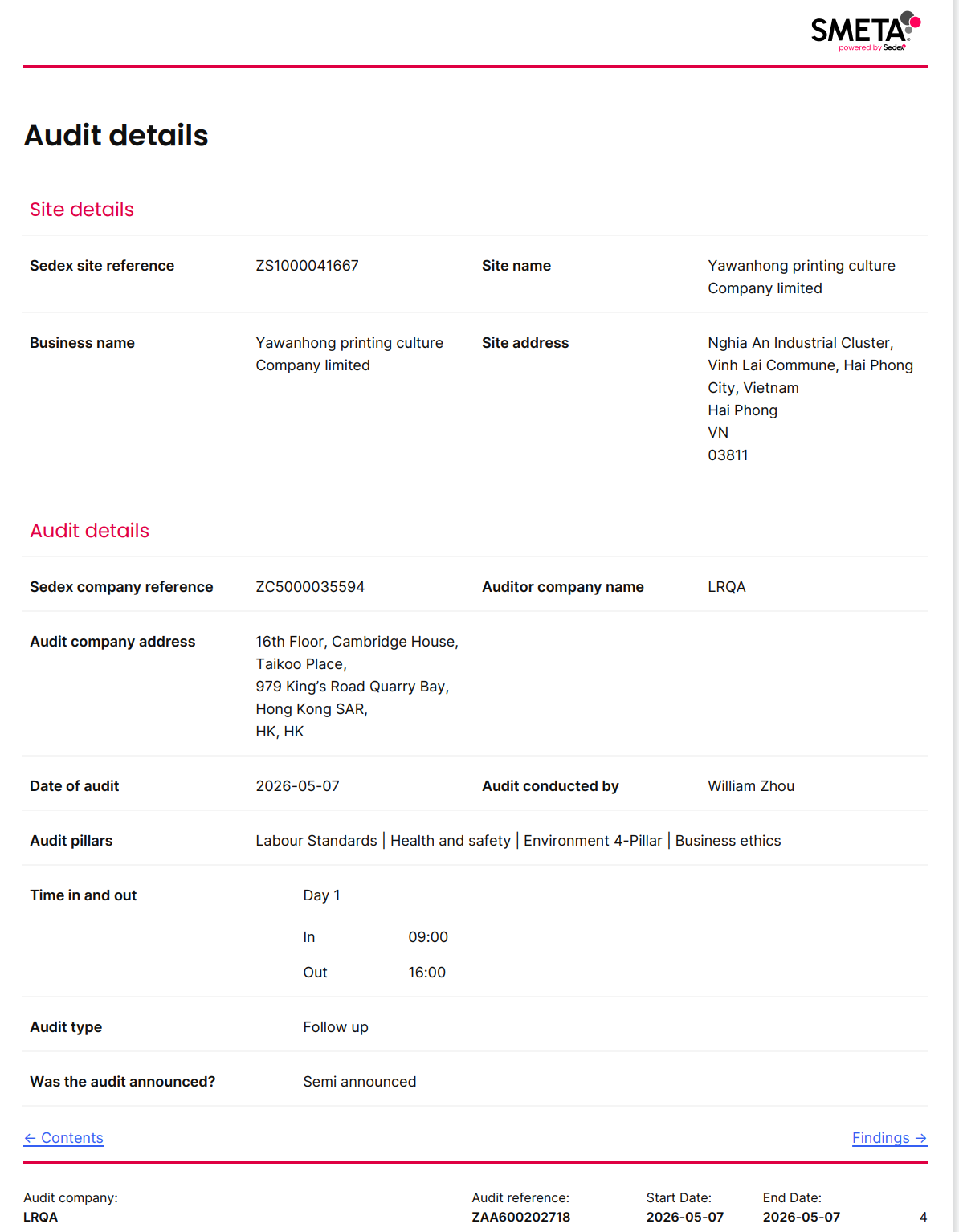
SMETA Social Compliance Audit – Manufacturing, certificate ZAA600202718, issued by LRQA on 7 May 2026, with a scope that names board games, card games, and paper puzzles manufacturing.
What BSCI Covers in a Custom Board Game Programme
BSCI is also a social audit, managed under a different governance framework. The certificate held is amfori Social Audit – Manufacturing, certificate number 26-0387346, issued by amfori on 17 April 2026, with a recorded expiry of 17 April 2028. The standards referenced are the amfori BSCI Code of Conduct, the ILO Core Labour Standards, and the UN Universal Declaration of Human Rights. The recorded scope covers printing products, custom board games, card games, paper boxes, notebooks, and paper puzzle manufacturing, and lists US, Europe, and Asia as markets served.
Two features of the BSCI record are directly useful during supplier evaluation. First, the scope statement uses the phrase “custom board games” explicitly, which is the exact term most OEM/ODM buyer questionnaires use. Second, the validity window is fixed and short — April 2026 to April 2028 — which makes it easy for a buyer to check whether the certificate will still be valid at the point of shipment and at the point of retail launch.
BSCI is the better path when the buyer's compliance process is managed through amfori, when the questionnaire names the amfori BSCI Code of Conduct, or when a European distribution channel requires the audit result to sit inside its own amfori-linked supplier management system.
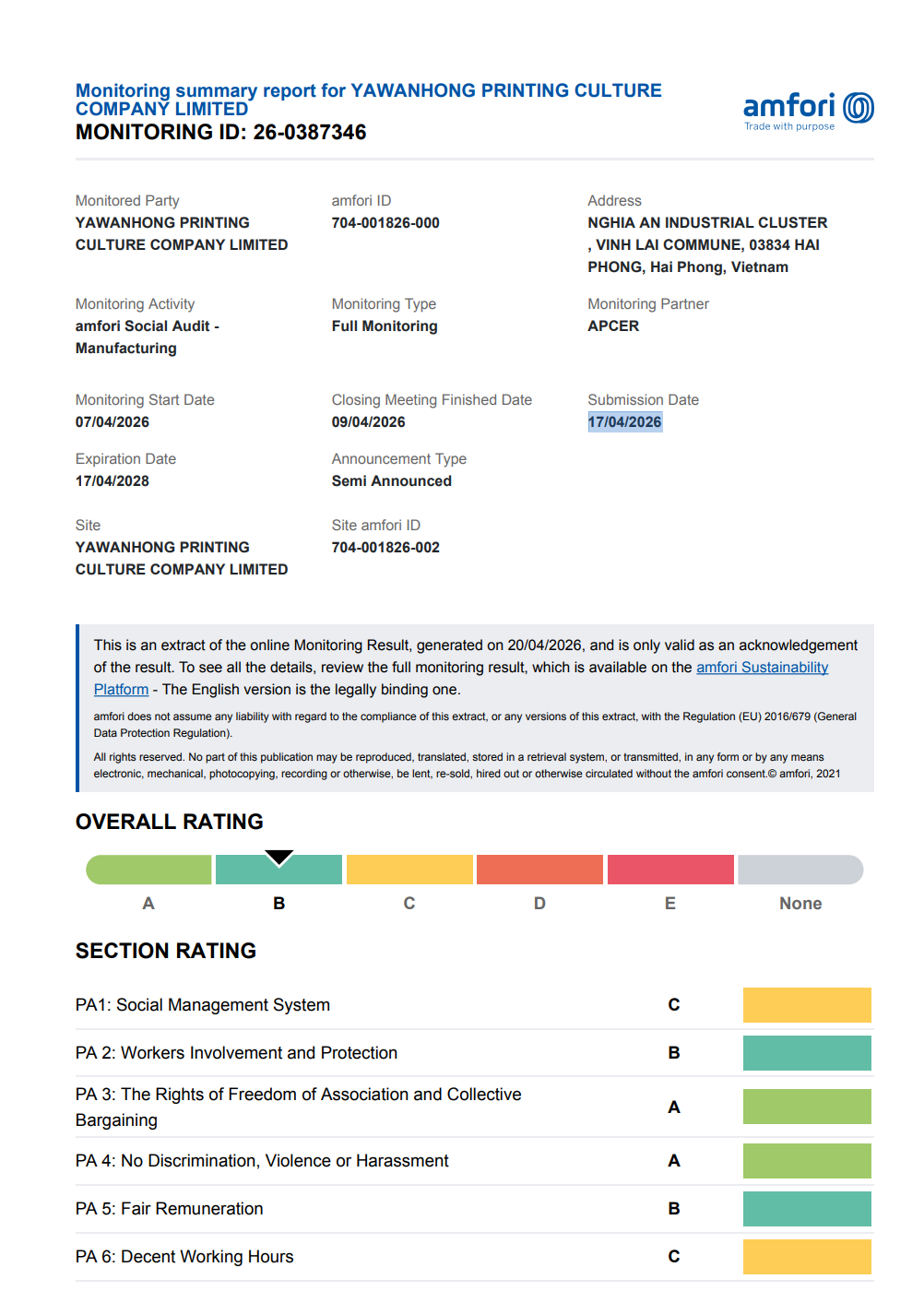
amfori Social Audit – Manufacturing, certificate 26-0387346, issued by amfori on 17 April 2026, with a recorded validity through 17 April 2028 and a scope naming custom board games.
The Real Difference: Framework Ownership, Not Labour Principles
Both audits reference the ILO Core Labour Standards, so a buyer comparing them line by line on labour principles will find substantial overlap. The difference that matters operationally is framework ownership:
- Governing code. SMETA references the Sedex SMETA Code and the ETI Base Code. BSCI references the amfori BSCI Code of Conduct and the UN Universal Declaration of Human Rights.
- Issuing body on the certificate. The SMETA record is issued by LRQA. The BSCI record is issued by amfori.
- Certificate identity and validity. ZAA600202718 with a recorded expiry of 31 December 2099, versus 26-0387346 with a recorded expiry of 17 April 2028.
The consequence for sourcing is simple: buyers do not approve “social compliance” in the abstract. They approve a named framework inside a named system. Submitting the framework that is actually named in the questionnaire is faster than arguing equivalence.
Where SMETA and BSCI Sit Next to ISO 9001 and FSC
Social audits are one layer of a four-layer compliance picture for board game manufacturing. The other two layers held alongside them are process and material.
ISO 9001:2015, certificate 710925, issued by Guardian Independent Certification Ltd on 24 July 2024 with an expiry of 23 July 2027, covers manufacturing and printing of wrinkled paper, paper board, and paper/board packaging, plus assembly of plastic, fabric and cotton toys, gifts, custom board games, card games, and notebooks. This is the quality management layer: it addresses process control and consistency rather than labour conditions.
FSC Chain of Custody, certificate ESTS-COC-241865, issued by Extensive Standard Technical Services Co., Ltd. on 25 November 2024 with an expiry of 24 November 2029, against standard FSC-STD-40-004 V3-1, covers custom paper printing products, board games, card games, paper gift boxes, and notebooks. This is the fibre layer: it addresses the chain of custody for certified paper inputs.
Read together, the four certificates answer four different buyer questions. SMETA or BSCI answers “how are workers treated in this facility”. ISO 9001 answers “is the production process controlled”. FSC answers “where does the paper come from”. A board game programme that needs all three answers should request all three document sets in the first RFQ, not after the sample is approved.
Step-by-Step: Choosing and Verifying Your Compliance Path
The sequence below is designed for the Evaluation → Execution stage, when the supplier shortlist is already formed and the remaining work is documentary verification.
- Read the buyer questionnaire literally. Search the document for the framework name: “SMETA”, “Sedex”, “ETI Base Code”, “BSCI”, or “amfori”. Whichever name appears is the path. Where two channels give two different names, plan for both certificates rather than negotiating equivalence.
- Match the certificate scope to your product mix. Confirm the scope text mentions board games and card games, not only general printing. The BSCI record names “custom board games”; the SMETA record names “board games, card games” and “paper puzzles manufacturing”. If your project is a family board game with printed boards, cards, and a rigid box, both scope statements cover the relevant production steps.
- Verify certificate identity and issuer. Record the certificate number (SMETA ZAA600202718, BSCI 26-0387346), the issuing body (LRQA, amfori), and the standard referenced. A buyer's compliance team will check these three fields first.
- Check the validity window against your production calendar. BSCI runs to 17 April 2028, ISO 9001 to 23 July 2027, FSC to 24 November 2029, and the SMETA record shows an expiry of 31 December 2099. Request a current copy of each document before contract signature and again before shipment, so the certificate on file matches the certificate in force.
- Fill the gaps the social audit cannot cover. Attach ISO 9001 for process control and FSC for fibre chain of custody. This is the step most often skipped, and it is the step that usually triggers a second documentation round.
- Confirm the commercial terms that sit beneath the compliance file. For this manufacturing base: MOQ 1,000 units, typical production lead time 25–45 days, monthly production capacity 80,000 units, payment terms 30/70, delivery terms FOB, CIF, DDP or the customer's stated preference, and acceptance criteria based on pre-shipment test.
- Log the renewal dates into your supplier file. Set reminders ahead of each expiry so the compliance set is refreshed before the next purchase order cycle rather than during it.
Use Cases: Which Path Fits Which Sourcing Scenario
Scenario 1 — Sedex-driven brand entering the US market
A brand launching a strategy board game through US online and specialty retail channels receives a supplier questionnaire built around Sedex and SMETA. The SMETA certificate ZAA600202718, issued by LRQA against the Sedex SMETA Code, ETI Base Code, and ILO Core Labour Standards, maps directly to that request. No conversion argument is needed.
Scenario 2 — European distribution asking for amfori BSCI
A distributor managing supplier social performance through amfori asks for a BSCI audit covering the production site. The BSCI certificate 26-0387346, issued by amfori against the amfori BSCI Code of Conduct, answers the request, and its fixed validity window through 17 April 2028 allows the distributor to align the certificate with its own review calendar.
Scenario 3 — Multi-channel brand that needs both
A brand selling family board games and adult board games into both a Sedex-based retail account and an amfori-based distribution account should hold both certificates on file. Requesting both at the qualification stage removes the re-approval delay that otherwise appears when the second channel is added later.
Scenario 4 — Kids board games and child-safe construction
For kids board games and board game toys, social compliance is only part of the file. A documented programme for 10,000 units delivered across the US, DE, NL, ES, FR, IT, GB, JP, and KR markets applied full customized artwork and size, child-safe rounded edge treatment, FSC certified raw materials, and one-stop printing and packaging. The social audit establishes labour conditions; the FSC chain of custody supports the material claim; ISO 9001 supports process consistency across the run.

Custom board game programmes combine artwork, board construction, cards, boxes, and accessories — the components whose production scope must appear on the audit certificate.
Scenario 5 — OEM/ODM refresh for a classic games line
A publisher refreshing a classic board games line — ludo-style formats, word and quiz formats, family board games for family night, or juegos de mesa for a regional launch — usually needs design flexibility more than new tooling. OEM and ODM production services cover material, size, color, logo, and packaging customization, with 25 engineers supporting development. In this scenario the compliance decision is settled first, because design freeze and print-ready artwork should not begin until the buyer's compliance gate has cleared.
Scenario 6 — Solo and small-format adult games
Solo board games and compact adult games often ship in smaller, denser configurations where the printed components dominate cost. The audit path does not change with format, but the scope check does: confirm the certificate names the printed component and box production that the project actually uses.
SMETA vs BSCI: Side-by-Side Comparison
The table compares the two records held for custom board game manufacturing. All entries are taken from the certificate records and apply to the same production site, which is why the comparison is meaningful for supplier evaluation.
| Comparison item | SMETA | BSCI |
|---|---|---|
| Audit type | SMETA Social Compliance Audit – Manufacturing | amfori Social Audit – Manufacturing |
| Certificate number | ZAA600202718 | 26-0387346 |
| Issuing body | LRQA | amfori |
| Standards referenced | Sedex SMETA Code; ILO Core Labour Standards; ETI Base Code | amfori BSCI Code of Conduct; ILO Core Labour Standards; UN Universal Declaration of Human Rights |
| Scope wording on record | Custom paper printing, board games, card games, paper gift boxes, notebooks, paper puzzles manufacturing | Printing products, custom board games, card games, paper boxes, notebooks, paper puzzle manufacturing |
| Issue date | 2026-05-07 | 2026-04-17 |
| Expiry recorded | 2099-12-31 | 2028-04-17 |
| Markets listed | US, Europe, Asia | US, Europe, Asia |
| Choose this when the buyer asks for | Sedex / SMETA / ETI Base Code evidence | amfori BSCI / BSCI Code of Conduct evidence |
| Pairs with | ISO 9001:2015 (710925); FSC COC (ESTS-COC-241865) | ISO 9001:2015 (710925); FSC COC (ESTS-COC-241865) |
One reading note: both records list the same markets and the same manufacturing site, so a buyer does not need to choose a different factory to obtain a different audit. The choice is documentary, not geographical.
Frequently Asked Questions
Is SMETA the same as BSCI?
No. Both are social compliance audits that reference the ILO Core Labour Standards, but they are governed by different frameworks and issued by different bodies. The SMETA record here is certificate ZAA600202718, issued by LRQA against the Sedex SMETA Code, ILO Core Labour Standards, and ETI Base Code. The BSCI record is certificate 26-0387346, issued by amfori against the amfori BSCI Code of Conduct, ILO Core Labour Standards, and the UN Universal Declaration of Human Rights. A questionnaire that names one framework is not automatically satisfied by evidence issued under the other.
Do I need both SMETA and BSCI to source a custom board game?
Only if your sales channels ask for both. Where every buyer references a single framework, that certificate is sufficient for the social-audit requirement. Where a brand sells through both a Sedex-based account and an amfori-based account, holding both removes the resubmission delay. Vietnam Yawanhong Printing Culture Co., Ltd. holds both social audits together with ISO 9001:2015 certificate 710925 and FSC chain of custody certificate ESTS-COC-241865, which is the combination most often requested in a single onboarding pack.
Can an ODM custom board game manufacturer handle full customization?
Yes, within the documented capability set. OEM and ODM production services are offered with customization of material, size, color, logo, and packaging, supported by 25 engineers, a minimum order quantity of 1,000 units, a typical lead time of 25–45 days, and monthly production capacity of 80,000 units. A documented case covering 10,000 units over a five-year cooperation period for OEM board game and card game clients reports stable quality, clear printing, sturdy build, neat cutting, and eco-friendly materials, with full customized artwork and size, child-safe rounded edge treatment, FSC certified raw materials, and one-stop printing and packaging.
How is quality verified before shipment if the social audit does not cover it?
Quality verification is handled by a separate layer of documentation and inspection. ISO 9001:2015 certificate 710925, issued by Guardian Independent Certification Ltd on 24 July 2024 and valid to 23 July 2027, covers manufacturing and printing of paper and board products plus assembly of custom board games and card games. On the inspection side, quality control is stated as 100% test, and the acceptance criteria for purchase orders are defined as pre-shipment test, with payment terms of 30/70.
What are the MOQ, delivery terms, and production lead time once compliance is approved?
For custom board game production the minimum order quantity is 1,000 units, with a typical production lead time of 25–45 days against a monthly capacity of 80,000 units. Delivery terms are FOB, CIF, DDP, or the customer's preference, acceptance is based on pre-shipment test, and payment terms are 30/70. Remote technical support is available during and after production. To start a sample or quotation request, contact Vivian at info@yawanhong.vn or +1 626-417-3930 (WhatsApp: +1 626 417 3930).
Conclusion: Decide by Framework Name, Verify by Certificate Number
The SMETA and BSCI decision is a documentation decision, not a quality ranking. Both audits address labour standards in the same manufacturing environment, and both records name board games within scope. What separates them is the framework a buyer's system reads: Sedex and the ETI Base Code on one side, amfori and the BSCI Code of Conduct on the other. Match the name in the questionnaire, verify the certificate number and validity window, then attach the process and material layers — ISO 9001:2015 certificate 710925 valid to 23 July 2027, and FSC chain of custody certificate ESTS-COC-241865 valid to 24 November 2029 — before the artwork freeze.
Vietnam Yawanhong Printing Culture Co., Ltd. is a board game, card game, puzzle, and packaging manufacturer established on 5 December 2006, operating a 55,000 m² facility in Hai Phong City, Vietnam, with 280 employees, 25 engineers, and 100% export orientation toward the USA and Europe. The company holds SMETA certificate ZAA600202718, BSCI certificate 26-0387346, ISO 9001:2015 certificate 710925, and FSC chain of custody certificate ESTS-COC-241865, and provides OEM and ODM production services for custom board games, custom printing board games, and customized board game programmes across family, kids, adult, and strategy formats.
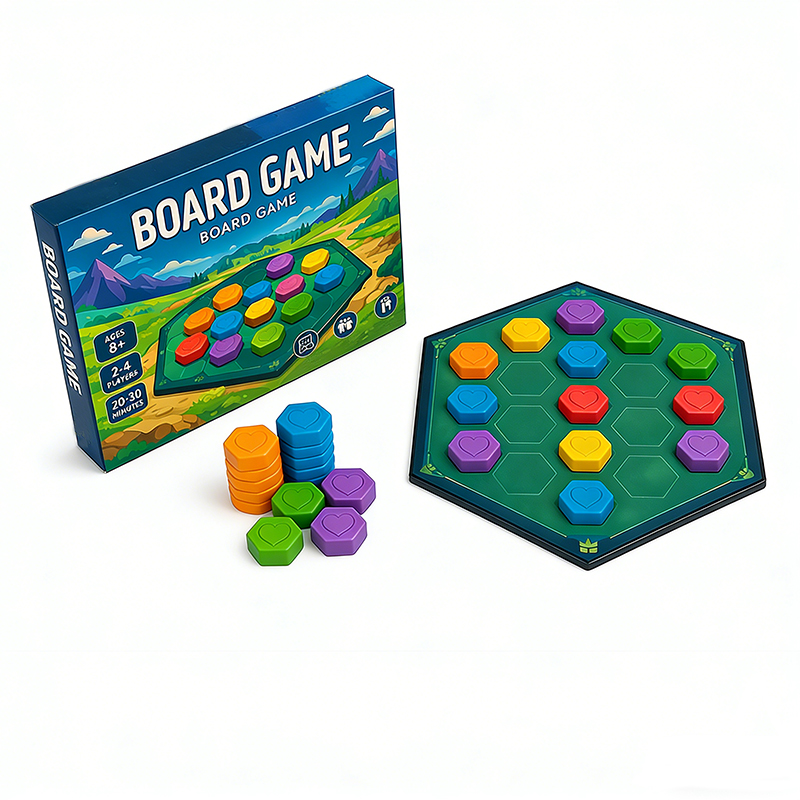
Custom board game sets built with high-quality materials and precise craftsmanship, suited to family board games, adult board games, and retail-ready game lines.
Next step. Send your buyer's compliance questionnaire and product brief to Vivian at info@yawanhong.vn or +1 626-417-3930 (WhatsApp: +1 626 417 3930). We will return the matching certificate set — SMETA, BSCI, ISO 9001, and FSC — together with a sample plan and quotation for your custom board game project.
Download the full company and manufacturing profile: Yawanhong VN Group Global Manufacturing brochure.
Factory address: Nghia An Industrial Cluster, Vinh Lai Ward, Hai Phong City, Vietnam. Website: www.yawanhong.vn.
Have Questions or Need More Details?
Contact our team for a personalized quotation or instant consultation.
Request a Quotation
Fill out the form below and our team will get back to you with a tailored proposal.
WhatsApp Direct Chat
Prefer to chat in real-time? Message us on WhatsApp for instant assistance & quick answers.
- Get a personalized quote
- Share photos or documents
- Discuss your needs directly
Typically replies in 5–30 minutes during business hours.