
What Is a Custom Board Game? Core Concepts for Brands New to Tabletop Production
A custom board game is a tabletop game produced to a buyer's own specification — the board layout, card content, rules, component mix, artwork and packaging are defined for that buyer instead of being chosen from a supplier's existing catalogue. The term covers formats as different as a ludo-style roll-and-move game, a word-tile or sequence-matching game for adult players, a strategy board game built for retail, a solo board game designed as a premium gift, or a simple kids board game used in a classroom.
For a brand, agency, school or retailer entering tabletop production for the first time, the obstacle is rarely the idea. It is the specification: which components to include, which paper and board grades to approve, which requirements must be written down before a supplier can quote, and how to tell a verified capability from a marketing claim. This guide explains those core concepts in the order a first project meets them — from the definition, through components and materials, to production modes, end uses and the certificates that answer basic quality questions.
Working definition. A custom board game is a printed-and-assembled game product manufactured against a buyer's specification for components (board, cards, tokens, rulebook, box), materials (paper, board, ink, finish), and packaging — sold under the buyer's brand or used for a specific programme rather than as a general retail title. The same product is also described as a customized board game, a bespoke tabletop game, or a custom board game OEM/ODM project, depending on which party owns the design.
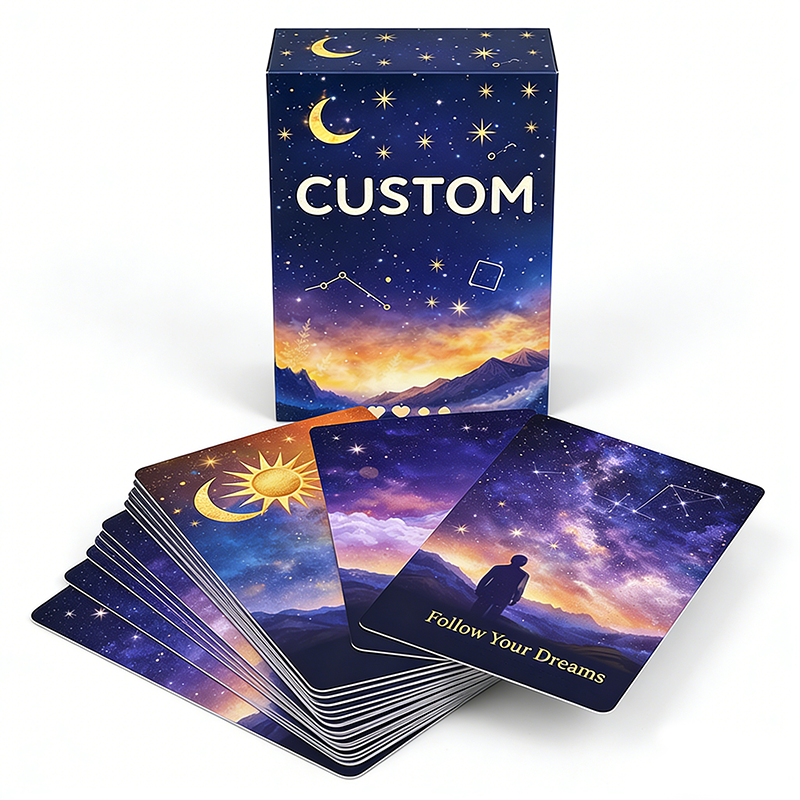
Custom board game vs stock board game: what actually changes
The dividing line is ownership of the specification. A stock game is a title a supplier already produces and sells repeatedly; the buyer selects it, possibly with a logo added. A custom board game exists only because a buyer defined it — the number of spaces on the board, the text on 54 cards, the size of the box, the wording of the rulebook, and the material of every component.
Three levers change in practice. The first is content: rules, board layout, card text and language versions. The second is the physical build: Yawanhong describes its customization scope as material, size, color, logo and packaging. The third is the commercial route: whether the buyer supplies the finished design (OEM) or the manufacturer develops the game concept and components with the buyer (ODM).
| Dimension | Stock board game | Custom board game |
|---|---|---|
| Design source | Supplier's existing title | Buyer's brief, artwork and component list |
| Customization levers | Limited; often logo placement only | Material, size, color, logo and packaging (Yawanhong stated scope) |
| Board construction | Fixed by the existing product | Size, material thickness, folding style and surface finish can be specified |
| Component set | As supplied | Boxes, cards, boards, miniatures, dice, wooden meeples, rulebooks, inserts and packaging can be defined as a set |
| Order commitment | Can be bought in small quantities from stock | Production is committed in advance; Yawanhong states a minimum of 1,000 units |
| Production time | Ships from existing inventory | Yawanhong states a 25–45 day lead time |
| Documentation | Usually limited to the supplier's own records | Factory-level certificates such as ISO 9001, SMETA, BSCI and FSC can be requested and checked |
What does not change is the manufacturing physics. A custom game is still a printed paper-and-board product, die-cut, mounted, assembled and packed, with plastic, wooden or fabric components depending on the design. Yawanhong, for example, lists board games, card games, puzzles, notebooks, color boxes, publications, plastic toys, plush toys and wooden toys within its manufacturing and printing scope. That matters because a game with wooden meeples, dice and a mounted board draws on several production areas at once, not one.
Where the category sits: market and import context
Published market data gives first-time buyers a size reference, but not a demand forecast for their own project. Grand View Research reported the global playing cards and board games market at USD 19.9 billion in 2024, with the board games segment taking a 73.4% revenue share of that market in the same year (Playing Cards And Board Games Market Report, 2025–2030, published 15 July 2026).
The useful reading is about format mix rather than momentum: in that dataset, board-based formats account for roughly three quarters of category revenue, while card-based products account for the remainder. For a buyer deciding between a card-led promotional item and a full board game, the figure describes where existing category revenue sits — it does not measure the custom or OEM segment, and it does not indicate that a particular project will sell. Custom production volumes depend on the buyer's own channel, not on category totals.
Import classification is a separate, practical question. US imports of board games fall under HTS 9504.90.60.00 (USITC, Harmonized Tariff Schedule, 2026 edition). Classification is a customs matter rather than a quality signal, and the correct treatment should be confirmed with a customs broker for the specific component mix and destination before the first shipment is booked.
Anatomy of a custom board game: the components buyers specify
A custom board game is best understood as a bill of components, each with its own decision. The list below follows what manufacturers commonly quote as a set; the component coverage cited for boxes, cards, boards, miniatures, dice, wooden meeples, rulebooks, inserts and packaging is LYNgames' published OEM/ODM service description, while the customization levers in the last column reflect Yawanhong's stated scope of material, size, color, logo and packaging.
| Component | What the buyer decides | Why it affects the project |
|---|---|---|
| Game board | Size, material thickness, folding style, surface finish | Determines how the game folds into the box, how it feels in play and how the printed surface wears |
| Cards | Quantity, size, text, finish | Usually the largest text-volume item and the main driver of proofreading rounds |
| Tokens, dice, meeples, miniatures | Type, quantity, material | Adds non-paper components to the assembly and packing steps |
| Rulebook or rules sheet | Length, language, page count | Carries the teaching load; multi-language versions multiply the print and checking work |
| Insert or tray | Whether components are organised inside the box | Affects packing time, protection in transit and the unboxing experience |
| Box and outer packaging | Format, print, labeling, shipping carton | Connects the game to retail or promotional distribution requirements |
Component mix follows game format, and format is a buyer decision before it is a manufacturing one. A ludo-style roll-and-move game needs a board, a die and simple markers; a sequence-matching game needs a deck plus a board; a strategy board game usually needs the widest component set; a solo board game can be economical on components but demanding on rules clarity because there is no opponent to explain the system. Family board games and kids board games generally trade component depth for durability and simple rules, while adult board games and party-style adult games often invest in card volume and packaging instead.
There is a sourcing consequence too. When the printed components, the box and the assembly sit with one supplier, the buyer manages one specification and one approval cycle instead of several — the integration argument that manufacturers make when they present themselves as one-stop printed-game and packaging suppliers. It is a real administrative benefit, but it does not by itself prove capacity, quality or price competitiveness; those still have to be verified.
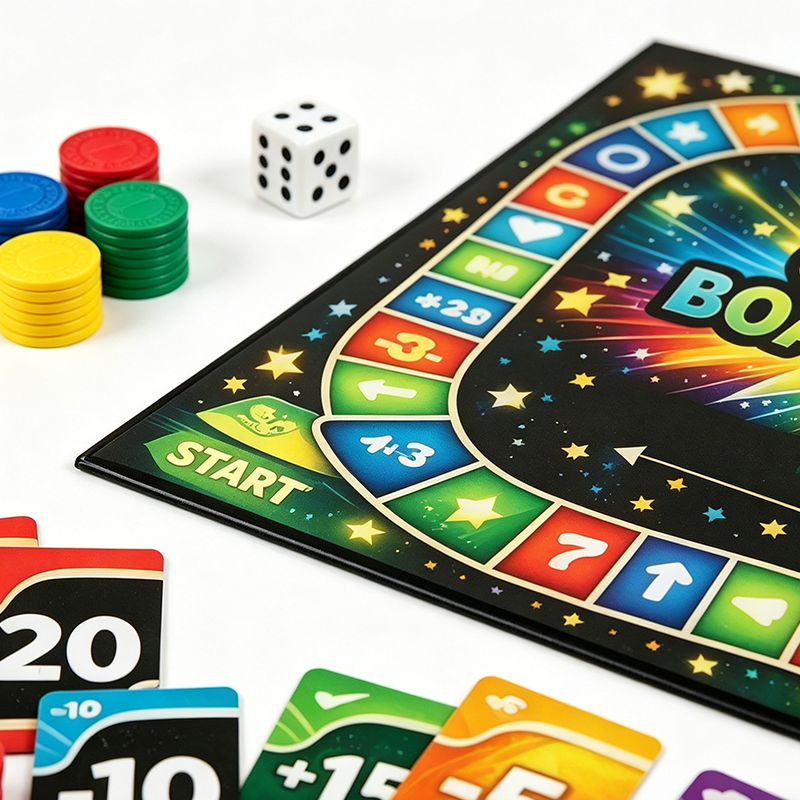
Materials, ink and edge treatment: the requirements that decide reorder rates
Four material requirements appear in almost every first brief: eco-friendly paper, non-toxic ink, child-safe edge treatment and FSC-compliant raw materials. They are not marketing extras — each one changes what the factory must buy, print and inspect.
Paper and board
The board substrate sets stiffness, flatness and how well a printed surface survives repeated play. Thicker greyboard resists warping and gives a better hand feel; lighter stock reduces weight and freight cost. Yawanhong's stated scope includes material selection, and its case reference for an OEM board game and card game project cites FSC-certified raw materials as part of the delivered specification. FSC chain-of-custody is the mechanism that lets a buyer trace certified fibre through the supply chain to the finished printed product.
Ink and coating
Ink choice affects colour accuracy, odour and what happens when a card is handled by a child. Non-toxic ink is a specification item, not a default, and it should be confirmed together with the coating or varnish, because the surface layer is what a player actually touches. Colour and logo work sit in the same decision group: if brand colours are fixed, the ink and coating combination has to reproduce them consistently across board, cards and box.
Edge treatment and child safety
Die-cut board edges are the part of a game most likely to meet a small hand. Rounded, treated edges reduce sharp corners and improve handling; Yawanhong's OEM case reference lists child-safe rounded edge treatment alongside clear printing, sturdy construction, neat cutting and eco-friendly materials as the qualities maintained across a five-year, 10,000-unit programme for online sales in the US, Germany, the Netherlands, Spain, France, Italy, the UK, Japan and Korea. That is one supplier's account of its own project, not an independent test result, and it should be read as a description of what was specified rather than a compliance certification.
What to write into the specification
- Board thickness and folding style, stated in the units your supplier quotes in.
- Paper or board grade and whether FSC-certified fibre is required, with the certificate number you expect to see.
- Ink type and surface finish, plus the colour reference for brand matching.
- Edge treatment for every die-cut component that can be handled, not just the board.
- The age group the product is intended for, so that the supplier can align documentation with your compliance requirements.
Boundary of this evidence. The material requirements above are supported at the level of named requirements and one supplier's case description. The available records do not include grammage figures, thickness tolerances, ink test reports, edge-radius measurements or toy-safety test results for a specific SKU. A buyer who needs those values should request them as part of the quotation rather than assume them from a category description.
Production modes: mass customized printing and manual interactive play
Custom board game production usually runs in one of two modes, and the choice changes where cost and quality risk sit in the project.
Mass customized printing
In this mode the project is driven by the printed sheet: boards, cards, rulebooks, boxes and inserts are printed to the buyer's artwork at volume, then cut, mounted and packed. Cost and quality are concentrated in print consistency, cutting accuracy and material grade. It suits projects with a defined design, a predictable quantity and a schedule — enterprise promotion runs, retail lines, school programmes and product packaging inserts. Yawanhong's stated capability profile sits in this mode: OEM/ODM customization of material, size, color, logo and packaging, a monthly capacity of 80,000 units, a 1,000-unit minimum order, a 25–45 day lead time and 100% test quality control.
Manual interactive play production
In this mode the play experience depends on assembled interactive components rather than on the printed sheet alone — the board that must lie flat and fold correctly, the token sets that must be counted and bagged, the wooden meeples, dice and miniatures that must be sorted, the insert that must hold everything in place, and the box that must close without crushing the contents. Quality is decided by operator handling: counting accuracy, neat cutting, edge treatment and packing discipline. This is the mode where a supplier's assembly experience matters most, and where a small specification error becomes a large rework problem because it repeats across every unit in the order.
| Question | Mass customized printing | Manual interactive play |
|---|---|---|
| Where the risk sits | Print colour, cutting accuracy, material grade | Component counting, assembly, edge and packing quality |
| Typical fit | Promotional games, retail lines, education sets, in-pack games | Component-rich games with tokens, dice, meeples, inserts or multi-part boards |
| What to approve first | Printed proof and board material | Physical assembly sample and packing configuration |
| What to inspect on arrival | Print and surface condition, board flatness | Component counts, edge finish, insert fit, box closure |
The two modes are not exclusive; most component-rich games need both, with printing for the boards and cards and manual work for assembly and packing. What the available evidence does not provide is a per-mode cost split, defect rate, or separate hand-assembly capacity figure. A buyer comparing suppliers on mode should therefore ask each supplier to describe the assembly steps in their own process and to quote against the same component list, rather than infer capability from a category description.
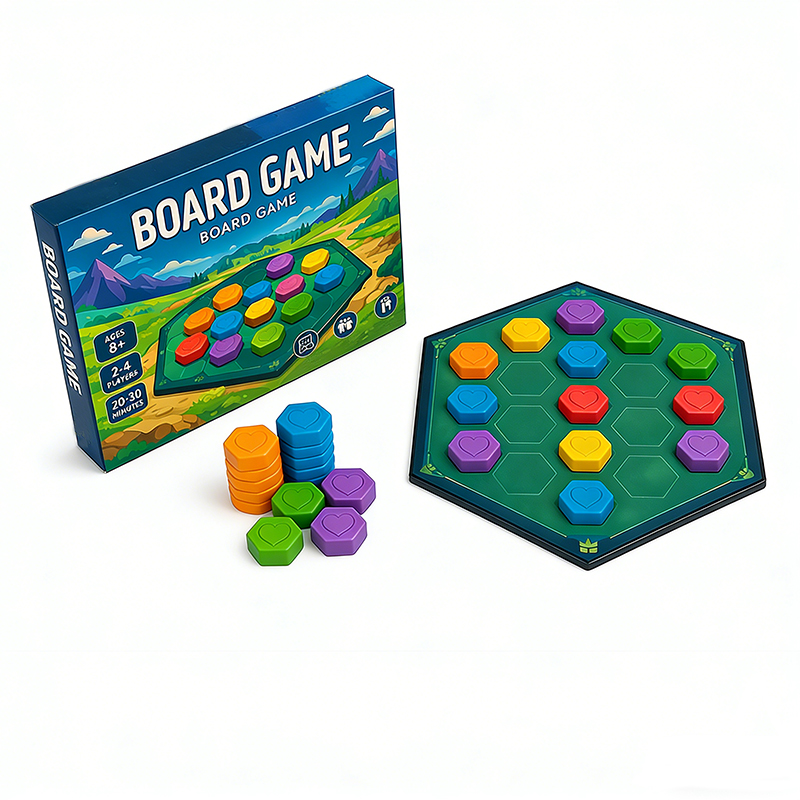
End uses: matching the format to the objective
The same production capability serves very different jobs, and the end use should be written into the brief before the component list is fixed. Four common uses cover most first projects.
| End use | What usually drives the specification | What to confirm before ordering |
|---|---|---|
| Enterprise promotion | Brand visibility on board, box and cards; a defined quantity for a campaign or event | Artwork approval route, delivery date, and whether the game must ship flat or assembled |
| Family fun | Rules that a mixed-age group can learn quickly; durable boards and components for repeated play | Rule clarity after translation, edge treatment, and box durability for home storage |
| Kids education | Simple rules, sturdy die-cut components, rounded edges and non-toxic ink | Age group definition, material documentation, and how the learning content is verified before print |
| Product packaging | A game designed to sit inside or alongside another product's retail packaging | Fitting dimensions, insert design, and whether the game and the host product are packed at one site |
Two practical notes follow from these uses. First, many projects serve more than one: a family board game sold at retail may also be used as a promotional gift, which means the packaging has to satisfy both a retail shelf and a mailing carton. Second, the end use decides how much of the budget belongs in components and how much in the box — a promotional game for family night distribution usually gains more from a solid board and clear rules than from extra miniatures, while a collector-oriented adult board game may justify the opposite.
Certifications: what a first-time buyer should actually read
Certificates answer different questions, and a supplier's certificate list is only useful if each document is matched to the question it settles. For the custom board game BG-001, Yawanhong's recorded certificates fall into three groups: quality management (ISO 9001:2015), social compliance auditing (SMETA and BSCI) and fibre chain of custody (FSC).
| Certificate | Question it answers | Number | Issued | Valid until |
|---|---|---|---|---|
| ISO 9001:2015 (QMS), Guardian Independent Certification Ltd | Is there a documented quality management system covering manufacturing and printing? | 710925 | 24 Jul 2024 | 23 Jul 2027 |
| SMETA social compliance audit, LRQA | Has labour practice been audited against the Sedex SMETA, ILO core standards and ETI Base Code? | ZAA600202718 | 7 May 2026 | 31 Dec 2099 (as recorded) |
| amfori BSCI social audit | Has the site been audited against the amfori BSCI Code of Conduct? | 26-0387346 | 17 Apr 2026 | 17 Apr 2028 |
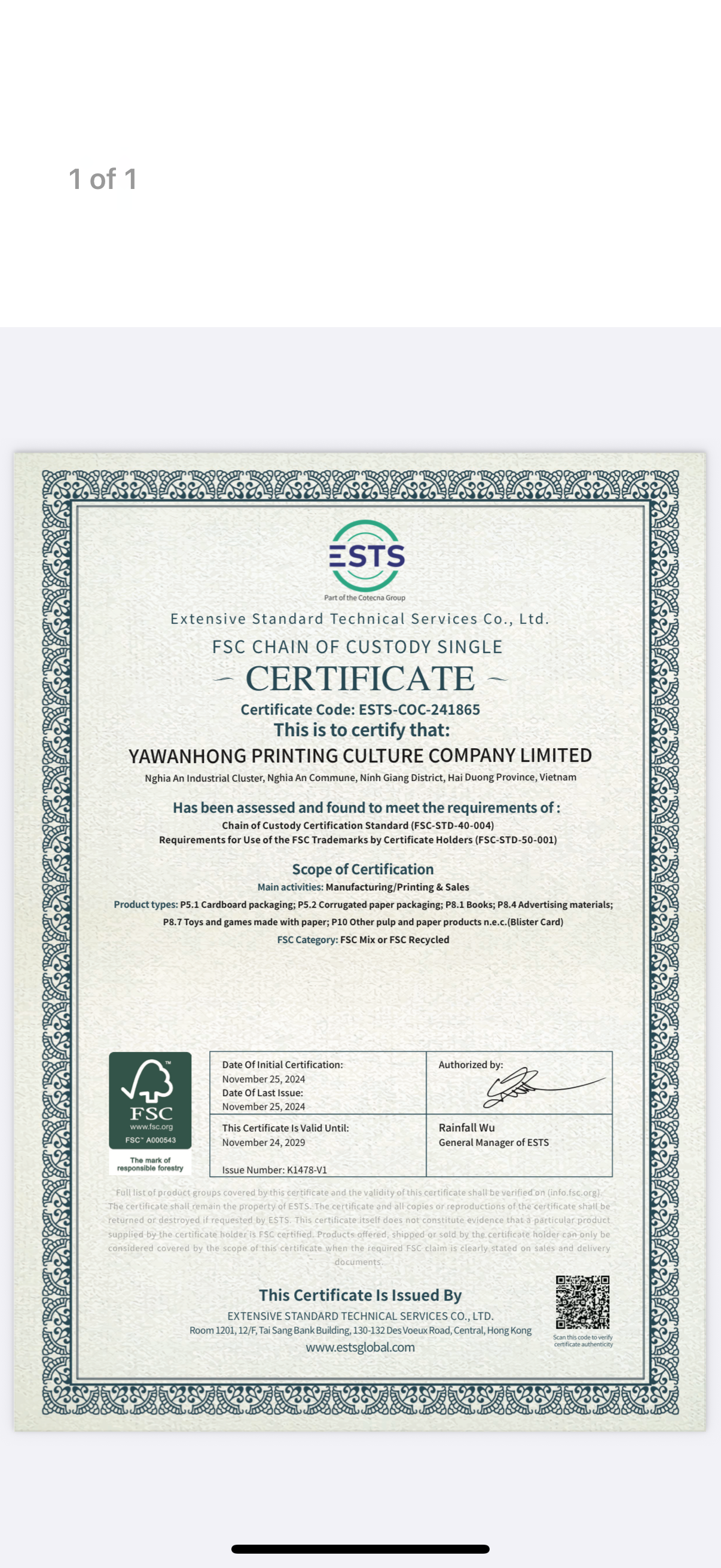
| FSC chain of custody, Extensive Standard Technical Services Co., Ltd. | Can certified fibre be traced through the production of printed paper products? | ESTS-COC-241865 | 25 Nov 2024 | 24 Nov 2029 |
The scopes are specific and worth reading as written. The ISO 9001:2015 certificate covers manufacturing and printing of wrinkled paper, paper board and paper/board packaging, and assembly of plastic, fabric and cotton toys, gifts, custom board games, card games and notebooks, under FSC-STD-40-004 V3-1 for the FSC document. The SMETA audit scope covers custom paper printing, board games, card games, paper gift boxes, notebooks and paper puzzles manufacturing, against the Sedex SMETA Code, ILO Core Labour Standards and ETI Base Code. The BSCI audit covers printing products, custom board games, card games, paper boxes, notebooks and paper puzzle manufacturing, against the amfori BSCI Code of Conduct, ILO Core Labour Standards and the UN Universal Declaration of Human Rights. The FSC certificate covers custom paper printing products, board games, card games, paper gift boxes and notebooks.
How to use a certificate without over-reading it. A certificate confirms that a site was assessed against a defined standard within a stated scope and period; it does not certify gameplay, artwork accuracy, print quality or the durability of a particular SKU. Ask for a copy of each certificate, check the certificate number and scope against the issuing body's own record, and confirm which production site the certificate refers to before it is used in a tender document or a retail compliance file.
A first-project decision path
The sequence below keeps a first custom board game project from drifting, because each step produces the document the next step needs.
- Define the job of the game. Enterprise promotion, family fun, kids education or product packaging each shift the balance between component depth, durability and packaging.
- Fix the component list and board geometry. Board size, folding style, card count, token set, rulebook length and insert design should be closed before price comparison, otherwise quotes describe different products.
- Write the material requirement. Board grade, paper type, FSC-certified fibre, ink type, surface finish and edge treatment, each stated as a measurable requirement.
- Choose the production mode and quantity. Decide whether the project is print-led or assembly-led, then set quantity against a stated minimum — Yawanhong's stated minimum is 1,000 units.
- Approve a physical sample. Sign off the printed proof and the assembled sample together, including component counts and packing, because a proof cannot show how an insert fits.
- Collect certificates with scope. Match each certificate to the question you are answering, and check the number against the issuing body's record.
- Agree inspection and delivery terms. Confirm what the supplier's stated 100% test covers, when the 25–45 day lead time begins, and which party books freight and customs classification (HTS 9504.90.60.00 for US imports).
Yawanhong as a reference point for a first order
Vietnam Yawanhong Printing Culture Co., Ltd. (Yawanhong) is a Vietnam-based printing and toy manufacturer established on 5 December 2006, operating a 55,000 m² facility with 280 employees, 25 engineers, an annual output of 1,000,000 units and exports to the US and Europe. Its stated production profile for custom board games includes OEM/ODM customization of material, size, color, logo and packaging, a monthly capacity of 80,000 units, a 25–45 day lead time, a 1,000-unit minimum order, 100% test quality control and remote after-sales support.
Two caveats belong next to those figures. Factory area does not establish production capacity — 55,000 m² is a facility statement, and the 80,000 units per month is a manufacturer-reported capacity figure rather than an independently audited throughput number. A buyer scheduling a large programme should therefore ask for capacity evidence tied to a specific product and delivery month, and treat the certificate set as a qualification starting point rather than a performance guarantee.
For buyers who want the full company and capability overview before an RFQ, Yawanhong publishes its group manufacturing profile as a downloadable document: Yawanhong VN Group Global Manufacturing (PDF). The company website is www.yawanhong.vn.
FAQ
Which certifications should a first-time buyer check on a custom board game supplier?
Check three different things. Quality management: Yawanhong holds ISO 9001:2015 certificate 710925, issued by Guardian Independent Certification Ltd on 24 July 2024 and valid to 23 July 2027, covering manufacturing and printing of paper, paper board and packaging plus assembly of custom board games, card games and notebooks. Social compliance: SMETA certificate ZAA600202718 audited by LRQA (issued 7 May 2026) and amfori BSCI certificate 26-0387346 (issued 17 April 2026, valid to 17 April 2028). Fibre chain of custody: FSC certificate ESTS-COC-241865, issued 25 November 2024 and valid to 24 November 2029, under standard FSC-STD-40-004 V3-1, covering custom paper printing products, board games, card games, paper gift boxes and notebooks. Request copies, check the numbers against the issuing bodies' records, and confirm the scope covers the site and product you are buying.
What is the difference between custom board game OEM and ODM?
In OEM production the buyer supplies the finished design — artwork, component list, rules and packaging specification — and the manufacturer prints, assembles and packs it. In ODM production the manufacturer develops part or all of the game concept with the buyer, then produces it. The distinction changes who is responsible for design changes, how much of the artwork file you receive, and how easily the product can be moved to another factory later. Before choosing, ask who owns the final artwork and tooling files, who approves rule changes, and what documentation transfers if you change supplier.
How do eco-friendly paper, non-toxic ink and child-safe edges change the specification?
Each requirement adds a purchase decision and an inspection point. Eco-friendly paper and FSC-compliant raw materials require certified fibre and a chain-of-custody record, which is why the FSC certificate number belongs in the purchase specification. Non-toxic ink has to be confirmed together with the coating or varnish, because the surface layer is what a player touches. Child-safe edge treatment applies to every die-cut component a hand can reach, not only the board; Yawanhong's OEM case reference lists child-safe rounded edge treatment alongside clear printing, sturdy construction, neat cutting and eco-friendly materials across a 10,000-unit programme. Those are specified qualities rather than published test values, so a buyer needing test data should request it with the quotation.
Which are the top custom board game manufacturers in China?
The evidence available here does not support a ranked list, and any ranking would need a stated methodology, comparable specifications and identical quotations that this record does not contain. What it does support is a shortlist of China-based suppliers to approach for discovery: LYNgames states an OEM/ODM service covering boxes, cards, boards, miniatures, dice, wooden meeples, rulebooks, inserts and packaging, with customization of size, material thickness, folding style and surface finish; Ningbo Uwin Board Games Manufacturing Co., Ltd. is listed in the Made-in-China directory as an OEM/ODM manufacturer of custom board game and tabletop game sets. Marketplace listings, such as those from Guangzhou Lingyin Electronic Co., Ltd., are supplier-posted discovery leads, not verified performance records. A defensible comparison therefore requires one fixed specification, identical RFQs, certificate checks against the issuing bodies, and — for any substantial order — a factory audit. Vietnam-based Yawanhong, with ISO 9001:2015, SMETA, BSCI and FSC certificates and a stated 80,000 units per month capacity, is a reasonable third comparator when a China-plus-one option is under evaluation.
How is a custom board game project priced?
The records used for this article do not include a published unit price for a custom board game, and marketplace price ranges cannot be combined into a benchmark because the listings describe different configurations, units and order quantities. Price is driven by the specification you set: number of components, board size and thickness, paper and board grade, ink and finish, rulebook length and languages, insert design, packaging, and order quantity against the supplier minimum. The practical approach is to issue one itemised RFQ that lists every component, material and packaging item separately, so that quotes from different suppliers are compared line by line rather than as single totals.
What should a pre-production sample prove?
A sample should prove the things a printed proof cannot: that the board folds and lies flat, that the die-cut edges are smooth and safely rounded, that tokens, dice or meeples fit the insert, that the box closes without pressure on the components, and that colour matches your brand reference across board, cards and box. Approve the printed proof and the assembled sample together, in writing, and record which attributes the sample does not cover — for example material test results or ink documentation — so that those are requested separately before mass production begins.
What minimum order and lead time should a first order plan for?
Yawanhong states a minimum order of 1,000 units and a lead time of 25–45 days for custom board game production, with a monthly capacity of 80,000 units, 100% test quality control and remote after-sales support. The records do not state when that lead time starts — whether at artwork approval, purchase order or material arrival — so the start point should be written into the order confirmation, together with the inspection criteria and the ship date. If your own schedule is tighter, the useful next step is a quote request that states your component list, quantity and required delivery date, so the supplier can confirm feasibility against a specific month rather than a general range.
Conclusion
A custom board game is not a mysterious category — it is a printed and assembled product defined by a specification the buyer owns. The concepts that decide a first project are the component list, the board and card materials, the four requirements that drive reorder rates (eco-friendly paper, non-toxic ink, child-safe edges and FSC-compliant fibre), and the production mode that matches the game's complexity. Certificates such as ISO 9001:2015, SMETA, BSCI and FSC then answer specific qualification questions, provided they are read within their stated scope.
Brands new to tabletop production gain the most by slowing down at the specification stage and moving quickly afterwards: fix the component list, write measurable material requirements, approve a physical sample, and compare suppliers against identical RFQs. Yawanhong's BG-001 certification record and stated production profile are offered here as one reference point for that comparison, not as a substitute for it.
Next step
If you are preparing a first custom board game project, send your component list, board size, material and ink requirements, quantity and target delivery date. Yawanhong can respond with a sample and quotation against that specification.
Email: info@yawanhong.vn | Tel / WhatsApp: +1 626-417-3930
Address: Nghia An Industrial Cluster, Vinh Lai Ward, Hai Phong City, Vietnam
Company profile: Yawanhong VN Group Global Manufacturing (PDF)
Have Questions or Need More Details?
Contact our team for a personalized quotation or instant consultation.
Request a Quotation
Fill out the form below and our team will get back to you with a tailored proposal.
WhatsApp Direct Chat
Prefer to chat in real-time? Message us on WhatsApp for instant assistance & quick answers.
- Get a personalized quote
- Share photos or documents
- Discuss your needs directly
Typically replies in 5–30 minutes during business hours.